
You don't need the product names or old records. No fee unless we recover compensation for your family.
Lewis H. Brown, chairman of Johns-Manville, wrote this report at the request of General Lucius D. Clay, the American military governor of Germany, after touring the country in 1947. It argues that Western Europe could not recover unless German industry was put back on its feet, and it sets out how: more food and coal, working railroads, a sound currency and incentives to work. It is often counted among the groundwork for the Marshall Plan. Farrar, Straus published it in October 1947.
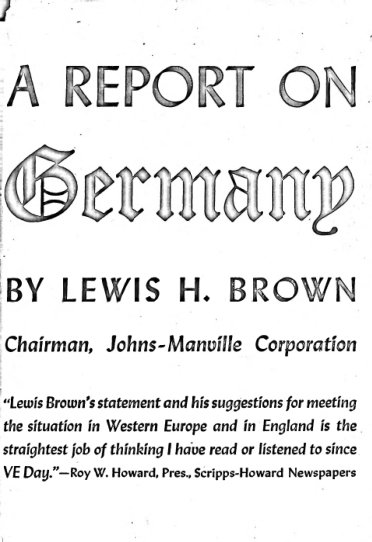
- Author
- Lewis H. Brown
- Published by
- Farrar, Straus and Company, New York
- Date
- 1947
- Rights
- Still in copyright: registered in 1947 (A18826) and renewed by Mary Allen Brown in 1974 (R590510). We describe it here, with its cover, contents and short quotations, but cannot offer the book itself.
How it came about
Brown explains in his introduction that Clay asked him to spend his time on a European business trip in Germany, because he had advised the Army's Chief of Ordnance during the war. Clay wanted, Brown writes, a report "on what should be done to get German industry on its feet and off the backs of the American taxpayers as soon as possible" (p. v).
Johns-Manville's part in it
The report was a Johns-Manville production in more than its author. Brown sent the company's economist, William C. Bober, ahead of him into Germany. Bober, he writes, "has been with the Johns-Manville Corporation as economist for almost twenty years" (p. vi). Bober's memorandum, "The German Situation Today," is the book's second chapter, and the appendix reports on food, coal, transportation and incentives to work are also his work. A retired J-M vice president, J. P. Kottcamp, spent two and a half months investigating in Germany before Brown arrived.
Asbestos itself appears only in passing. Arguing that trade between nations is not a fixed pie, Brown traces a chain from a bridge in Africa built with German steel to a railroad needing British locomotives, "which in turn need German packings which in turn need asbestos and copper from the mines of the British Empire" (p. 162). And in the appendix on transport, the slow repair of Germany's rolling stock is put down partly to shortages of supplies, among them "asbestos packing and lagging" (p. 225).
Asbestos magazine noted the report in November 1947, from the J-M stockholders' newsletter. For Brown's career, see his Lexicon entry.
Contents
- Introduction, p. v
- I. Origin of the Present Situation, p. 1
- Section 1. Historical Development, p. 1
- Section 2. Background of Policy, p. 7
- II. The German Situation Today, p. 27
- III. Summary of Conclusions, p. 55
- IV. Plan for Reconstruction, p. 70
- V. Summary of Recommendations, p. 140
- VI. Obstacles and What May Actually Happen, p. 154
- Appendix: Detail Sections, p. 182
- Section 1. Food, p. 182
- Section 2. Coal, p. 203
- Section 3. Transport, p. 223
- Section 4. The Incentive to Work, p. 232
Rights
The book was registered for copyright in 1947 and the copyright was renewed in 1974 by Brown's widow, Mary Allen Brown, so it remains protected. We show its cover and contents and quote it briefly, for reference and comment, but do not offer the text. Many research libraries hold copies.
Cited on this site
Cite this document
Lewis H. Brown. “A Report on Germany.” 1947. Farrar, Straus and Company, New York. AsbestosClaims.Law Library. https://asbestosclaims.law/library/books/a-report-on-germany-1947.
ACL Doc numbers and their short links never change. See how to cite the Library.
Talk with an asbestos lawyer
Start with what you remember, and we'll take it from there.
This page is provided for general informational purposes and does not constitute legal advice. Every asbestos case turns on its own facts, exposure history, diagnosis, deadlines, available evidence, and applicable law. Reviewing this page does not create an attorney-client relationship. For advice about your specific situation, call 833-4-ASBESTOS for a free case review.