
If you or someone you love has been diagnosed with mesothelioma, one of the most consequential decisions still ahead of you is where the treatment happens.
Mesothelioma is rare, and the surgeons and oncologists who do best with it have seen hundreds of cases, not the handful most community oncologists encounter in a career. The difference shows up in national data. In a study of 2,682 peritoneal mesothelioma patients, those treated at academic centers were about twice as likely to have debulking or radical surgery, and unadjusted five-year survival was 29.7 percent, compared with 18.3 percent at community centers.¹ For pleural mesothelioma surgery, patients at high-volume facilities had a lower 90-day death rate than those at lower-volume ones (10.0 versus 14.6 percent).² Studies like these can't fully separate the effect of the hospital from differences between the patients, but they point the same way: getting to an experienced team is one of the most important medical decisions a family makes in the days after a diagnosis.

For most families, the obstacle isn't access; it's cost. Mesothelioma specialty programs accept patients from anywhere in the country, and most insurers cover at least part of the treatment. But travel, lodging, time off work, out-of-network gaps, treatments insurance denies, and the indirect costs of a serious illness accumulate quickly, and families on fixed incomes often can't absorb them out of pocket. That gap between "best care available" and "best care we can afford" is what asbestos compensation can help close. Where the written agreement and applicable law permit it, our firm can advance the cost of travel, lodging, and out-of-pocket expenses while the case is moving forward, so the choice of a treatment center may not have to wait on a settlement. What can be advanced depends on the rules of the client's state.
You don't need the product names or old records. No fee unless we recover compensation for your family.
Quick answers
| Where should we go for mesothelioma treatment? | At a high-volume specialty center if at all possible. Mesothelioma is rare enough that most community hospitals see only a few cases a year, while the busiest specialty programs see many new patients each year. In national database studies, patients treated at academic or high-volume centers were more likely to have surgery, had fewer early deaths after pleural surgery, and lived longer on average, though those studies can't fully separate the center's effect from differences between patients. A state-by-state list of the NCI-designated centers that treat patients is at the bottom of this page. |
|---|---|
| Are NCI-designated cancer centers worth the travel? | For mesothelioma, a consultation is usually worth it. NCI designation recognizes cancer centers for the strength of their research programs, and these centers tend to concentrate the surgical volume, multidisciplinary teams, and clinical trial access that matter in a rare cancer. In a national study of peritoneal mesothelioma, unadjusted five-year survival was 29.7 percent at academic centers versus 18.3 percent at community centers; that study grouped hospitals as academic or community, not by NCI designation.¹ The travel costs are real, but there are ways to manage them. |
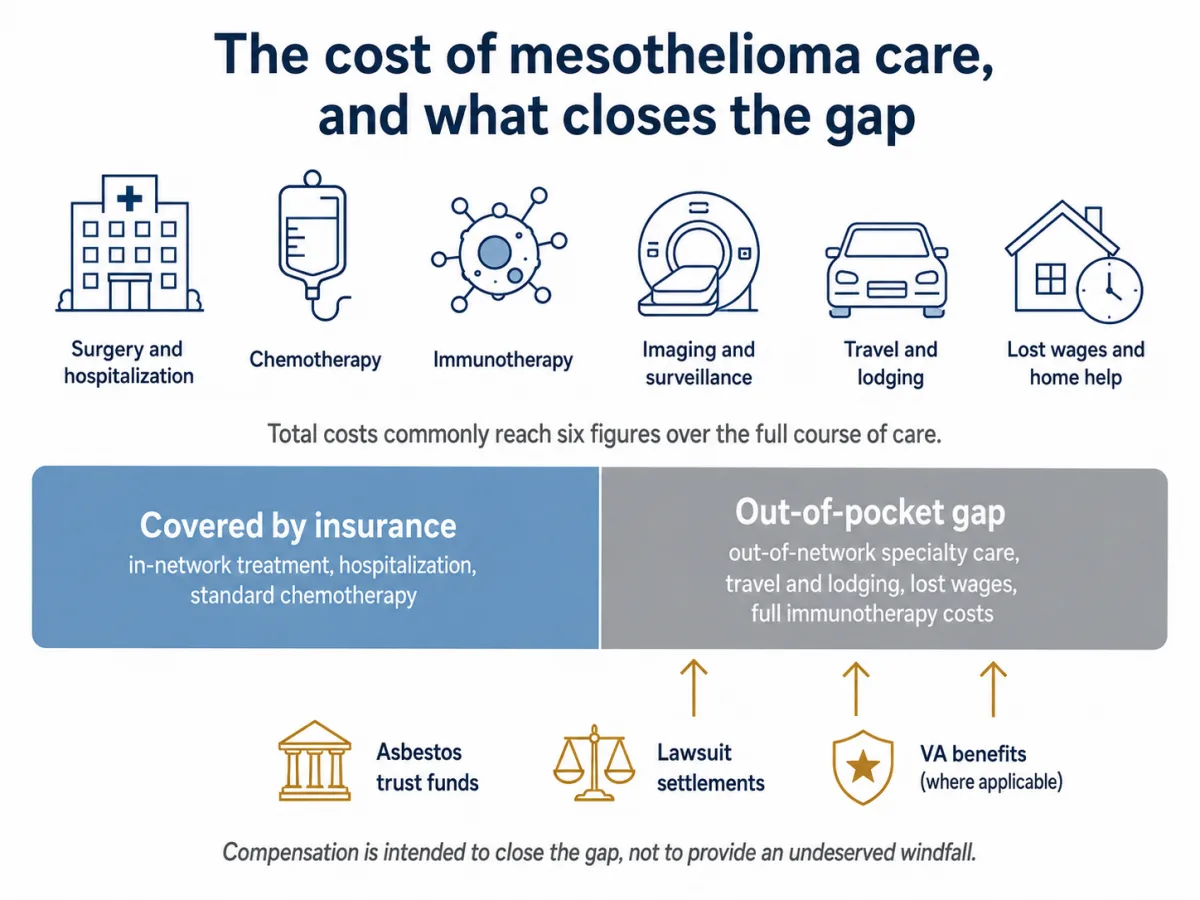
| How much does mesothelioma treatment cost out of pocket? | It varies dramatically by center, treatment plan, and insurance coverage. Major surgery alone is expensive: one U.S. academic center's analysis of 100 CRS-HIPEC operations, mostly for other abdominal cancers, put the hospital's median direct cost at about $45,000 and the median amount the hospital and surgeons collected at about $52,000; billed charges are usually higher, and none of these is what the patient pays.³ Add chemotherapy, immunotherapy, radiation, post-surgical care, surveillance imaging, travel, lodging, and lost wages, and total spending on multimodal treatment, most of it paid by insurers, can reach six figures over the course of care. What a family pays itself depends on its coverage: most commercial plans and Medicare Advantage plans cap a patient's share of covered in-network care with an annual out-of-pocket maximum, but Original Medicare has no such cap unless the patient also has supplemental coverage such as a Medigap policy, and out-of-network care, travel, lodging, and lost income usually fall outside any cap. |
| Will my insurance cover treatment at a specialty center? | Often much of it, but rarely all of it, and it depends on the plan. Some plans will approve an out-of-network specialty center for a rare cancer like mesothelioma, through prior authorization or a network exception, but coverage gaps are common: prior authorization disputes, denied immunotherapy combinations, balance billing, out-of-network deductibles, and travel and lodging that insurance doesn't reimburse at all. The gap between what insurance approves and what gives a patient the best chance is what asbestos compensation can help close. |
| What if we can't afford to travel to a specialty center? | Often there's a way, even when it doesn't look that way from the kitchen-table math. Hospital assistance programs, nonprofit lodging and flight programs, and asbestos compensation can all help, and where the written agreement and applicable law permit it, our firm can advance the cost of travel, lodging, and out-of-pocket medical expenses while the case is moving forward. Settlement money takes time to come through, but the travel usually can't wait. Advances are repaid from any recovery. |
| Can we still switch centers if we've already started treatment locally? | In most cases, yes. Mesothelioma specialty centers regularly accept patients who have already begun treatment elsewhere, and a second opinion or transfer of care is a routine step rather than an unusual one. The earlier you make the switch, the more options stay on the table, but it's almost never too late to ask for a consultation at a high-volume center. |
| How quickly do we need to make these decisions? | Soon, but not in a panic. Mesothelioma is aggressive and time matters, particularly for surgical candidates whose disease can progress past the window where surgery is feasible. But the decision about where to be treated deserves a second opinion, a multidisciplinary review, and a clear understanding of the options. A few days to make a careful choice is generally better than weeks of hesitation followed by a default to the local recommendation. |
“I started this firm after learning that the cancers that killed my father and grandparents were caused by asbestos, something we did not realize until it was too late to hold anyone accountable. That experience is why we built this site: so that no other family misses their chance to ask the questions, hear the options, and decide for themselves what to do.”
Where you're treated can change your options
A national database study of 2,682 peritoneal mesothelioma patients found that those treated at academic centers received surgery more often and lived longer on average, and the association held after the researchers accounted for measured differences in patients and tumors, though a retrospective study cannot prove the hospital caused the difference.¹ A separate national analysis of 1,307 patients who had surgery for pleural mesothelioma found better short-term results at high-volume facilities: shorter hospital stays, fewer readmissions, and fewer deaths in the first 90 days. Long-term survival did not differ once the researchers accounted for differences between patients, and the authors said the postoperative findings had implications for patient counseling and referral.²
The numbers from the two studies:
| Outcome | Academic or high-volume | Community or lower-volume |
|---|---|---|
| Peritoneal: debulking or radical surgery (academic vs community)¹ | 42.9% | 20.2% |
| Peritoneal: chemotherapy on the day of surgery, the database's marker for HIPEC¹ | 28.8% | 10.4% |
| Peritoneal: 5-year survival, unadjusted¹ | 29.7% | 18.3% |
| Pleural surgery: 90-day mortality (high vs lower volume)² | 10.0% | 14.6% |
| Pleural surgery: 30-day readmission² | 4.6% | 6.1% |
Peritoneal patients at academic centers were about twice as likely to have debulking or radical surgery and nearly three times as likely to receive chemotherapy on the day of surgery, the database's marker for CRS-HIPEC, the procedure that has transformed outcomes in peritoneal disease. Pleural patients who had surgery at high-volume facilities were less likely to die in the first 90 days or to be readmitted in the first month after discharge. These are observational findings, not a promise for any one patient, but they are consistent with what mesothelioma specialists see.
The studies don't pin down why the gap exists, but experience is a likely part of it: mesothelioma is rare enough that most general oncologists see only a few cases a year, while the busiest specialty programs see many new patients a year. That volume can mean more refined surgical technique, better treatment selection, sharper judgment about who is a candidate for aggressive treatment, and access to clinical trials that are rarely available elsewhere. Specialists call this the volume-outcomes relationship, and it has been described across many rare cancers and complex operations. In mesothelioma it's pronounced enough that "where you're treated" is one of the most important medical decisions a family makes.
What specialty centers offer that community hospitals don't
Five advantages at experienced academic centers help explain the gap:
- Surgical volume and expertise. The main operations in mesothelioma, cytoreductive surgery with HIPEC (CRS-HIPEC) for peritoneal disease and pleurectomy/decortication (P/D) for carefully selected pleural patients, are technically demanding and require surgeons with substantial mesothelioma experience. Since the MARS2 randomized trial, pleural surgery is offered far more selectively: being able to remove a pleural tumor doesn't by itself mean surgery will help, and part of what a specialty center offers is an experienced judgment about whether it should be done at all. In the national peritoneal study, academic centers performed debulking or radical surgery on 42.9% of patients; community centers performed it on 20.2%.¹
- HIPEC experience. Cytoreductive surgery alone removes visible tumor, and the heated intraperitoneal chemotherapy bathing the abdominal cavity at the end of the procedure is intended to treat microscopic disease the surgery couldn't reach. HIPEC requires specialized equipment, training, and protocols. In the national study, academic centers gave chemotherapy on the day of surgery, the database's marker for HIPEC, to 28.8% of peritoneal patients; community centers did so for 10.4%.¹
- Immunotherapy expertise. The combination of nivolumab and ipilimumab (checkpoint inhibitors that help the immune system recognize and attack cancer cells) became FDA-approved as first-line treatment for unresectable pleural mesothelioma in 2020, and pembrolizumab with chemotherapy followed in 2024. Choosing among these options and managing their distinctive immune-related side effects is something specialty centers do routinely; a community practice may treat only a few mesothelioma patients with them.
- Clinical trial access. The most promising new treatments in mesothelioma are typically available first through clinical trials run by academic centers with active research programs. Many trials require enrollment at the institution conducting them, and reaching a specialty center early keeps open the chance to be evaluated for a suitable trial.
- Multidisciplinary tumor boards. At specialty centers, surgical oncologists, medical oncologists, radiation oncologists, pathologists, and radiologists meet regularly around individual mesothelioma cases. That kind of coordinated peer review helps produce treatment plans tailored to the individual case, rather than what any single doctor would develop alone.
Why financial help is a medical tool
In mesothelioma care, the uncomfortable truth is that people with more financial resources often have more treatment options open to them. And in cancer treatment, options matter.
More financial support means:
- Second opinions at top cancer centers instead of settling for local facilities with limited mesothelioma experience
- Access to immunotherapy or clinical trials that insurance won't always cover
- Travel to specialists who see mesothelioma regularly, not just a handful of times
- Staying near a treatment center during intensive therapy instead of commuting for hours while exhausted
- Hiring home help so a spouse or adult child doesn't have to become a full-time caregiver
- Covering the out-of-pocket accumulation that comes with a serious illness, like medications, transportation, lost income, and the gaps insurance doesn't fill
When we say that money is part of the treatment plan, we're being accurate, not dramatic. Compensation from asbestos claims changes the range of what a patient can say yes to. It can fund the second opinion that changes a treatment plan. It can pay for care insurance denied. It gives a doctor more options to recommend without having to think about what the family can afford.
The following is a composite example, not a real client.
Marcia was 69 when a CT scan for unexplained abdominal pain showed peritoneal thickening, which a biopsy weeks later confirmed as peritoneal mesothelioma. The exposure history wasn't obvious; she had never worked in industry, and neither had her husband. But her daughter, doing her own research, surfaced a different possibility. Marcia had used the same brand of cosmetic talcum powder for sixty years, and some cosmetic talc has been found to contain asbestos. Looking into that history became part of the case.
The local oncologist recommended chemotherapy alone, and was honest he had not treated peritoneal mesothelioma before. The daughter found a specialty center several states away with an active CRS-HIPEC program and a surgeon willing to evaluate the case. The travel, the lodging during the workup, and the out-of-network costs were beyond what the family could absorb. They were on the verge of declining the consultation when they called us.
Within two weeks, under the terms of the written agreement and the applicable law, we'd advanced the travel and lodging costs for Marcia and her daughter. Marcia received CRS-HIPEC three months after her diagnosis. A lawsuit on her behalf, and trust claims where her exposure history qualified, moved in parallel, and the first settlement payment arrived six months later, reimbursing our advances and funding the surveillance care that followed. Real timelines vary widely, and many claims take considerably longer than this.
This example is general. Every case depends on the diagnosis, the exposure history, the family situation, and applicable law.
You are not taking anything you didn't already pay for. You paid for it in your lungs, your health, and your time.
The companies that made and sold asbestos made a calculated business decision to protect their profits while knowing what their product was doing to workers. Now it's your turn to make a calculated decision: do whatever's necessary to give your family access to the best care available.
Common hesitations about asking for help
We hear the same hesitations from families almost every day. Most are about pride, dignity, or feeling overwhelmed, and we take them seriously because they're decent reasons not to pick up the phone. The short version of how we answer them:
"I don't want to sue anyone."
You may not need to. Many of these claims are paid through asbestos bankruptcy trusts, which are administrative claims against money set aside when the companies that made asbestos products reorganized in bankruptcy. In the ordinary case there's no courtroom and no deposition, though each trust reviews the evidence, and disputes can go to the trust's review and arbitration process. Where a lawsuit is filed, it's usually against manufacturers that are still in business, or the companies that owned the sites where the exposure happened. You're not suing your neighbor, and in most cases not even your employer; you're filing claims against companies that, in many cases, knew of the danger decades ago.
"I worked hard for everything I have. I don't want a handout."
This isn't a handout, and it isn't a windfall. The companies that made and sold asbestos profited from work that destroyed the lungs of the people doing it. The money set aside in trust funds and the verdicts won in lawsuits are compensation for harm that's already been done. As we said earlier on this page: you're not taking anything you didn't already pay for. You paid for it in your lungs, your health, and your time.
"I'm too sick to deal with legal matters."
You don't have to. The firm reconstructs the exposure history, identifies the products and worksites involved, files the claims with the trusts, and manages the lawsuit timeline. What we need from you, or your family, is what you remember about where you worked and when, which is usually a thirty-minute conversation. The legal work isn't something the family takes on while coordinating treatment; it's something we do in the background so the family can focus on care.
"My loved one already passed away. I missed the window."
Don't be so sure. Asbestos claims can be filed after a death; trust claims allow estate filings, and many states permit wrongful death lawsuits with their own deadlines. The timelines vary by state and some are short, so the safest step is to call promptly. We handle posthumous claims as a matter of routine, including, in some cases, for families whose loved one died some time ago, depending on the deadlines that apply.
"I should focus on treatment, not lawyers."
For mesothelioma, those aren't separate. The financial help is what makes the best treatment accessible: the specialty center, the travel, the immunotherapy combination that insurance may not fully cover. The firm does the legal work; the family focuses on care.
Sources of financial support
Many mesothelioma patients have more than one possible source of financial support. They can often proceed during the same period, but they don't simply add together without consequence: trust submissions may have to be disclosed in a lawsuit, state law may allow credits or setoffs, and liens, reimbursement rights, and releases can affect how recoveries interact. The largest are tied to the asbestos exposure itself, which is what the firm handles. Other sources are general patient-support programs that can help with specific costs, and we help families navigate those too.
What the firm handles
-
Asbestos bankruptcy trusts. When the companies that made asbestos products went bankrupt, courts required them to set aside money in trusts to pay the people their products harmed. These are administrative claims: no lawsuit, no courtroom, and no deposition, though each trust reviews the evidence and can question or audit a submission, and a disputed claim can go to review, arbitration, and in some cases back to court. Each trust requires a qualifying diagnosis and evidence of exposure to that company's products; examples such as the Armstrong and Quigley procedures require that company exposure before December 31, 1982, and at least ten years between first exposure and diagnosis, but set no minimum exposure duration for mesothelioma. One person's history often supports claims against several trusts, though most trusts pay only a published percentage of the scheduled value, and timing varies by trust. How asbestos trust claims work.
-
Lawsuits against still-solvent manufacturers and the premises that used their products. Many of the companies that made asbestos products are still in business, and so are many of the refineries, plants, shipyards, and other facilities where exposure happened, and both can be sued. Lawsuit recovery is typically larger than trust recovery but takes longer to resolve. How product liability claims work; how premises liability claims work.
-
Veterans benefits. The military used asbestos extensively, especially in the Navy. Veterans with mesothelioma may qualify for VA disability compensation and VA health care for the condition if VA finds it connected to asbestos exposure during service, and a surviving spouse may qualify for survivor benefits under VA's separate rules, all independent of any lawsuit. How VA benefits and other asbestos disability claims work.
-
Federal worker benefit programs and Social Security disability. Maritime workers injured on navigable waters or adjoining areas such as docks and shipyards may claim benefits under the Longshore and Harbor Workers' Compensation Act (LHWCA), civilian federal and postal employees may claim benefits under the Federal Employees' Compensation Act (FECA), Department of Energy contractor workers may qualify under the Energy Employees Occupational Illness Compensation Program Act (EEOICPA), and Social Security Disability Insurance (SSDI) is available to people whose illness keeps them from working and who meet its work-history and other requirements. Pleural, peritoneal, and pericardial mesothelioma are on the Social Security Administration's Compassionate Allowances list, which can speed medical review of a disability application. These are separate systems from trust and lawsuit claims, though offset, reimbursement, and disclosure rules may apply. How asbestos disability and benefit claims work.
Other support worth knowing about
-
Hospital financial-assistance programs. Most cancer centers, including the NCI-designated centers listed below, have financial-assistance and charity-care programs that reduce or waive bills for patients who qualify. These programs are widely underused because patients don't know to ask. The hospital's billing office or social-services office is the starting point.
-
Nonprofit grants and patient-assistance programs. Mesothelioma-focused nonprofits such as the Mesothelioma Applied Research Foundation offer patient support and help finding specialists, and general cancer charities run financial-assistance and copay programs. Drug manufacturers also run patient-assistance programs that can reduce the out-of-pocket cost of specific immunotherapy combinations and other expensive treatments, though eligibility rules differ and people with Medicare usually can't use manufacturer copay cards. Your oncologist's office or the manufacturer's website can connect you.
-
Travel and lodging support. When the best treatment is far from home, programs like Hope Lodge (American Cancer Society) provide free lodging near major cancer centers for eligible patients and a caregiver, subject to availability, and Air Charity Network and similar organizations provide free or low-cost flights to treatment. We help families identify which programs apply, and where the written agreement and applicable law permit it, the firm can advance remaining costs when there's a gap.
NCI-designated cancer centers
The National Cancer Institute (NCI) designates cancer centers that meet rigorous federal standards, chiefly for the strength of their cancer research and the leadership and infrastructure behind it. Only a little over 70 institutions hold the designation, and the list is a good starting point for finding the kind of specialty center described earlier on this page.
Two designations below see patients; the remaining NCI-designated centers are laboratory research centers that don't treat patients:
- Comprehensive Cancer Centers show depth and breadth of research across laboratory, clinical, and population-based science. This is the highest NCI tier.
- Clinical Cancer Centers are recognized for their scientific leadership, resources, and research in basic, clinical, and/or population science. The distinction from Comprehensive reflects the breadth of the research program, not a rating of patient care.
For mesothelioma specifically, what matters more than the designation tier is whether a center has an active mesothelioma program with experienced thoracic or surgical oncologists, CRS-HIPEC capability for peritoneal cases, and lung-sparing surgical expertise for pleural cases. Not every NCI-designated center has a strong mesothelioma program in-house, but those that don't will typically refer to a colleague at another NCI center who does. A phone call to any center on this list is a reasonable starting point.
Centers are grouped by region below, with the designation tagged after each entry. Mayo Clinic Cancer Center holds a single NCI designation across three patient campuses (Phoenix, Jacksonville, and Rochester); each is listed separately for ease of finding the closest one. The list is current as of the page's last review date; the authoritative source is the NCI's Find a Cancer Center directory.
Northeast
Connecticut
- Yale Cancer Center, New Haven (Comprehensive)
Massachusetts
- Dana-Farber/Harvard Cancer Center, Boston (Comprehensive)
New Hampshire
- Dartmouth Cancer Center, Lebanon (Comprehensive)
New Jersey
- Rutgers Cancer Institute of New Jersey, New Brunswick (Comprehensive)
New York
- Memorial Sloan Kettering Cancer Center, New York (Comprehensive)
- Herbert Irving Comprehensive Cancer Center (Columbia), New York (Comprehensive)
- Laura and Isaac Perlmutter Cancer Center at NYU Langone Health, New York (Comprehensive)
- Mount Sinai Tisch Cancer Center, New York (Comprehensive)
- Montefiore Einstein Cancer Center, Bronx (Comprehensive)
- Roswell Park Comprehensive Cancer Center, Buffalo (Comprehensive)
- Wilmot Cancer Institute (University of Rochester), Rochester (Clinical)
Pennsylvania
- Abramson Cancer Center (University of Pennsylvania), Philadelphia (Comprehensive)
- Fox Chase Cancer Center, Philadelphia (Comprehensive)
- Sidney Kimmel Cancer Center at Thomas Jefferson University, Philadelphia (Comprehensive)
- UPMC Hillman Cancer Center, Pittsburgh (Comprehensive)
South
Alabama
- O'Neal Comprehensive Cancer Center (UAB), Birmingham (Comprehensive)
District of Columbia
- Georgetown Lombardi Comprehensive Cancer Center, Washington (Comprehensive)
Florida
- Mayo Clinic Cancer Center, Jacksonville (Comprehensive)
- Moffitt Cancer Center, Tampa (Comprehensive)
- Sylvester Comprehensive Cancer Center (University of Miami), Miami (Clinical)
- University of Florida Health Cancer Institute, Gainesville (Clinical)
Georgia
- Winship Cancer Institute (Emory University), Atlanta (Comprehensive)
Kentucky
- Markey Cancer Center (University of Kentucky), Lexington (Comprehensive)
Maryland
- Sidney Kimmel Comprehensive Cancer Center (Johns Hopkins), Baltimore (Comprehensive)
- University of Maryland Marlene and Stewart Greenebaum Comprehensive Cancer Center, Baltimore (Comprehensive)
North Carolina
- Duke Cancer Institute, Durham (Comprehensive)
- UNC Lineberger Comprehensive Cancer Center, Chapel Hill (Comprehensive)
- Wake Forest Baptist Comprehensive Cancer Center, Winston-Salem (Comprehensive)
Oklahoma
- Stephenson Cancer Center (University of Oklahoma), Oklahoma City (Clinical)
South Carolina
- Hollings Cancer Center (MUSC), Charleston (Clinical)
Tennessee
- St. Jude Children's Research Hospital, Memphis (Comprehensive; treats children)
- Vanderbilt-Ingram Cancer Center, Nashville (Comprehensive)
Texas
- Dan L Duncan Comprehensive Cancer Center (Baylor College of Medicine), Houston (Comprehensive)
- Harold C. Simmons Comprehensive Cancer Center (UT Southwestern), Dallas (Comprehensive)
- Mays Cancer Center (UT Health San Antonio), San Antonio (Clinical)
- The University of Texas MD Anderson Cancer Center, Houston (Comprehensive)
Virginia
- VCU Massey Comprehensive Cancer Center, Richmond (Comprehensive)
- University of Virginia Cancer Center, Charlottesville (Comprehensive)
Midwest
Illinois
- Robert H. Lurie Comprehensive Cancer Center (Northwestern), Chicago (Comprehensive)
- The University of Chicago Comprehensive Cancer Center, Chicago (Comprehensive)
Indiana
- Indiana University Melvin and Bren Simon Comprehensive Cancer Center, Indianapolis (Comprehensive)
Iowa
- Holden Comprehensive Cancer Center (University of Iowa), Iowa City (Comprehensive)
Kansas
- The University of Kansas Cancer Center, Kansas City (Comprehensive)
Michigan
- Barbara Ann Karmanos Cancer Institute (Wayne State), Detroit (Comprehensive)
- University of Michigan Rogel Cancer Center, Ann Arbor (Comprehensive)
Minnesota
- Masonic Cancer Center (University of Minnesota), Minneapolis (Comprehensive)
- Mayo Clinic Cancer Center, Rochester (Comprehensive)
Missouri
- Alvin J. Siteman Cancer Center (Washington University/Barnes-Jewish), St. Louis (Comprehensive)
Nebraska
- Fred and Pamela Buffett Cancer Center (UNMC), Omaha (Clinical)
Ohio
- Case Comprehensive Cancer Center (Case Western Reserve), Cleveland (Comprehensive)
- The Ohio State University Comprehensive Cancer Center (James Cancer Hospital), Columbus (Comprehensive)
Wisconsin
- University of Wisconsin Carbone Cancer Center, Madison (Comprehensive)
West
Arizona
- Mayo Clinic Cancer Center, Phoenix (Comprehensive)
- University of Arizona Cancer Center, Tucson (Comprehensive)
California
- Chao Family Comprehensive Cancer Center (UC Irvine), Orange (Comprehensive)
- City of Hope Comprehensive Cancer Center, Duarte (Comprehensive)
- Jonsson Comprehensive Cancer Center (UCLA), Los Angeles (Comprehensive)
- Moores Comprehensive Cancer Center (UC San Diego), La Jolla (Comprehensive)
- Stanford Cancer Institute, Stanford (Comprehensive)
- UC Davis Comprehensive Cancer Center, Sacramento (Comprehensive)
- UCSF Helen Diller Family Comprehensive Cancer Center, San Francisco (Comprehensive)
- USC Norris Comprehensive Cancer Center, Los Angeles (Comprehensive)
Colorado
- University of Colorado Cancer Center, Aurora (Comprehensive)
Hawai'i
- University of Hawai'i Cancer Center, Honolulu (Clinical)
New Mexico
- University of New Mexico Cancer Research and Treatment Center, Albuquerque (Comprehensive)
Oregon
- Knight Cancer Institute (OHSU), Portland (Comprehensive)
Utah
- Huntsman Cancer Institute (University of Utah), Salt Lake City (Comprehensive)
Washington
- Fred Hutchinson/University of Washington/Seattle Children's Cancer Consortium, Seattle (Comprehensive)
References
-
Welten VM, Fields AC, Malizia RA, et al. Survival outcomes for malignant peritoneal mesothelioma at academic versus community hospitals. J Gastrointest Surg. 2022;26(1):161–170. doi:10.1007/s11605-021-05084-0
-
Verma V, Ahern CA, Berlind CG, et al. Facility volume and postoperative outcomes for malignant pleural mesothelioma: a National Cancer Data Base analysis. Lung Cancer. 2018;120:7–13. doi:10.1016/j.lungcan.2018.03.019
-
Abreu AA, Farah E, Nix R, et al. Cost analysis and financial implications of a peritoneal surface malignancy program in the USA. Ann Surg Oncol. 2024;31:630–644. doi:10.1245/s10434-023-14442-y
Frequently asked questions
How quickly can the firm advance costs for travel, lodging, or treatment expenses?
Where the written agreement and applicable law permit it and the case qualifies, advances for travel and lodging tied to time-sensitive care can sometimes be arranged within a week or two of the first call, though that isn't guaranteed. The exact timing depends on the documentation we need to gather and on the case itself; when treatment can't wait, we work to keep travel and care from being delayed.
What if insurance denies a treatment my doctor recommends?
Denials can happen with out-of-network specialty care, certain immunotherapy combinations, and procedures like HIPEC at centers outside an insurer's preferred network. The first step is usually an appeal, with the treating doctor's support, and some denials are reversed on appeal or external review. Beyond that, the hospital's financial-assistance program may reduce or waive the bill, and the drug manufacturer may have a patient-assistance program that covers part of the cost. If those don't close the gap, the firm may in some cases advance the cost, where the written agreement and applicable law permit it, to be repaid from any recovery.
We're already in treatment locally. Is it too late to get a second opinion at an NCI center?
Almost never. Patients in the middle of treatment seek and get second opinions all the time, and most NCI centers are set up to evaluate cases that started elsewhere. The right second opinion often confirms the local plan, but sometimes it changes it: a different chemotherapy regimen, a surgical option the local team didn't consider, a clinical trial that's a good fit. Even when the local plan turns out to be the right one, having a specialty center's confirmation is worth the trip.
What if the best NCI center is far from home, and someone in the family can't travel?
This is a common situation, and there are several ways to handle it. Many specialty centers offer telemedicine consultations for the initial evaluation, so the family doesn't have to travel just to ask questions. For patients who do need to travel for treatment, lodging programs like Hope Lodge (American Cancer Society) provide free stays near major centers for eligible patients and a caregiver, subject to availability, and where the written agreement and applicable law permit it, the firm can advance the costs those programs don't cover. For an elderly spouse who can't make the trip, we help families set up regular check-ins so the patient doesn't feel alone on the road.
How do we know if a specific NCI center has a strong mesothelioma program?
The straightforward way is to call the center's cancer information line and ask whether they have a mesothelioma program, who leads it, and how many cases they see per year. Centers with active programs answer those questions immediately; centers without one will usually refer you to a colleague at another NCI center who runs one. We can also help families identify the centers with the most established programs for the specific subtype involved, including pleural surgical programs, peritoneal CRS-HIPEC programs, and the rare specialty centers that handle pericardial or testicular cases.
My loved one is in hospice. Is there anything that would help at this stage?
Yes. Even in late-stage care, the financial help an asbestos case provides can ease real burdens for the patient and the family: funding home nursing care, paying for palliative treatments outside hospice coverage, covering household expenses so a spouse doesn't have to keep working through this, and providing financial stability that lasts after the patient is gone. We handle the claim in a way that doesn't intrude on what the family is going through. The conversation usually starts with a thirty-minute call, often with a spouse or adult child rather than the patient, and we take it from there.
Can you work with our existing medical team, or does that have to be separate?
The medical and legal sides stay separate by design. Your oncologist, surgeon, and hospital team make the medical decisions; the firm handles the legal and financial side independently. Where the two meet is in records — we may need pathology reports, imaging, and treatment summaries to support the claim. We request those records directly from the providers, with your authorization, so the family doesn't have to be the go-between.
Talk with us about treatment and financial help {#talk}
Whether you're a patient who just received the diagnosis, or a spouse or adult child trying to find help for someone navigating treatment options, we're ready to talk. You don't need to have made decisions about care before calling. You don't need to know which trust funds or benefit programs might apply. And you don't need to travel to us. Start with what you know, and we'll take it from there.
Related resources
This page is provided for general informational purposes and does not constitute legal advice. Every asbestos case turns on its own facts, exposure history, diagnosis, deadlines, available evidence, and applicable law. Reviewing this page does not create an attorney-client relationship. For advice about your specific situation, call 833-4-ASBESTOS for a free case review.