

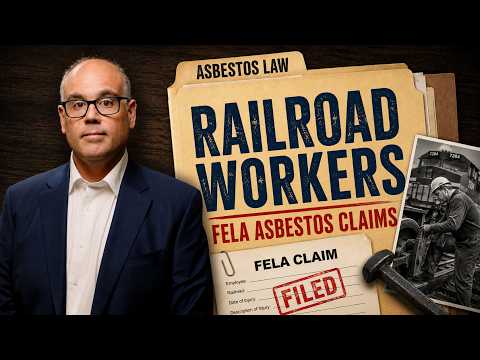
For generations, railroad workers kept the country moving; laying track, hauling freight, repairing engines, and keeping America's trains running on time. But behind the power and speed of the railroad industry was a deadly secret: asbestos was everywhere.
It wrapped around boilers and lined brake pads. It insulated pipes in railcars and coated the walls of roundhouses. Workers breathed asbestos dust during routine maintenance and heavy overhauls, year after year, without ever being warned of the risks.
Decades later, many of those workers are facing the consequences: mesothelioma, lung cancer, and asbestosis, all of which are diseases that trace back to the asbestos they inhaled on the job.
The law gives them a unique way to fight back.
Under the Federal Employers' Liability Act (FELA), railroad workers have the right to sue their employers for asbestos exposure and other workplace hazards. Unlike workers' compensation, which limits what injured workers can recover, FELA allows railroad employees to hold their employers accountable in court, with no caps on damages and a lighter burden of proof on causation than traditional injury claims.

You don't need the product names or old records. No fee unless we recover compensation for your family.
The Hidden Engine: Why Railroads Were Full of Asbestos
Steam locomotives were rolling pressure cookers; they were literally giant boilers on wheels, burning fuel to heat water under intense pressure. That steam drove pistons, pulled freight, and carried passengers across the country. But that kind of heat couldn't be controlled without insulation.
Asbestos made it possible.
No other material combined the heat resistance, durability, and flexibility that railroad operations demanded. Asbestos could withstand the temperatures inside a locomotive firebox, absorb the friction of brake systems, and hold up under decades of punishing use. Without it, the railroad revolution might never have happened, at least not at the speed and scale that transformed America.
So railroads wrapped asbestos around boilers, fireboxes, brake linings, exhaust pipes, and valves. It filled gaskets, coated electrical panels, and lined the walls of passenger cars. It was used in locomotive engines, railcars, repair shops, roundhouses, and even in the protective gloves and welding blankets workers wore.
The danger didn't end with steam. Diesel locomotives, which replaced steam by the end of the 1950s, still used asbestos in brake shoes, gaskets, insulation, and electrical components, and the shops and roundhouses were still full of older asbestos material. Most railroad workers diagnosed today worked in the diesel era.
Every time asbestos was cut, repaired, or disturbed, it released microscopic fibers into the air. Workers breathed them in—day after day, year after year—without knowing the damage being done inside their lungs. In many cases workers were provided with no warnings, no masks, and little to no ventilation. By the time the railroads acknowledged the truth, thousands of workers were already sick or gone.
Learn more about asbestos exposure in the railroad industry.
What Is FELA?
At the turn of the 20th century, railroad work was one of the most dangerous jobs in America. Brakemen lost limbs jumping between moving cars to hand-tighten brakes. Firemen were burned alive in boiler explosions. Crew members were crushed, maimed, and killed in staggering numbers. And when workers were injured, they had almost no legal recourse. Railroad companies could avoid responsibility by blaming the worker or pointing to a coworker's mistake. Thousands of families were left with nothing after devastating injuries and deaths.
That changed in 1908, when Congress passed the Federal Employers' Liability Act. FELA was a law written in blood and an official recognition that railroad work was uniquely dangerous and that workers deserved the right to hold their employers accountable.
FELA changed three things that still matter today.
The right to sue your employer. Most workers are limited to workers' compensation, which bars lawsuits against employers. FELA allows railroad employees to sue them directly for negligence, including failure to warn about asbestos, failure to provide protective equipment, and failure to maintain a safe workplace.
Compensation without caps. Workers' compensation provides limited benefits and doesn't cover pain and suffering. FELA allows railroad workers to recover their damages in court, including pain and suffering, with no statutory limits on the amount.
The featherweight burden of proof. In most injury cases, you have to prove the defendant was a primary or substantial cause of your harm. Under FELA, you only need to show that your employer's negligence played any role in causing your harm, even a small one.
FELA cases can also be filed in either state or federal court, and once a worker files in state court, the railroad can't move the case to federal court. That choice of court is a real advantage.
The Featherweight Burden
The featherweight burden of proof is one of the most powerful protections FELA provides and it's often the difference between winning and losing an asbestos case.
In most personal injury lawsuits, you have to prove that the defendant's negligence was the primary or substantial cause of your illness. That's a high bar, especially in asbestos cases where exposure often came from multiple sources over decades. Defense attorneys will argue that your disease could have come from anywhere else - maybe another job, another product, or another employer.
FELA doesn't work that way.
Under FELA, you don't have to prove the railroad was the main cause of your illness. You only need to show that the railroad's negligence contributed in any way—even slightly—to your harm. Courts call this the featherweight burden because it tips the scales in favor of injured workers. You still have to prove the railroad was negligent, meaning it knew or should have known about the danger and failed to act reasonably, but once negligence is shown, the causation hurdle is low.
This matters enormously for asbestos claims. A railroad mechanic who spent five years repairing locomotives and later worked a decade at a refinery doesn't have to untangle which exposure caused his mesothelioma. If the railroad failed to warn him about asbestos, failed to provide respirators, or failed to ventilate the shop where he worked, that's enough. The railroad's negligence played a role, and under FELA, that's all he needs to prove.
The Supreme Court went further in 2003. In Norfolk & Western Railway v. Ayers, a case brought by railroad workers with asbestosis, the Court held that a railroad can be made to pay the worker's full damages even when other employers or other products also contributed to the disease. The railroad can try to recover a share from those other companies, but that's the railroad's problem, not the worker's.
The featherweight burden exists because Congress recognized that railroad workers face hazards most people never encounter. Proving exactly how an illness developed decades later shouldn't be an impossible bar to justice.
Your Own Fault Can Reduce the Award
FELA uses comparative fault. If the worker's own conduct contributed to the illness, the jury can reduce the damages by that share. In asbestos lung cancer cases, railroads often argue that smoking was a cause and ask for a reduction. Smoking doesn't cause mesothelioma, so that argument carries far less weight in a mesothelioma case.
There's an important exception. If the railroad violated a federal safety law, such as the Locomotive Inspection Act, and that violation contributed to the illness, the worker's own fault can't reduce the damages at all.
Who Can File a FELA Claim?
FELA provides powerful protections, but it doesn't cover everyone. To file a claim, you must meet three requirements.
You must be a railroad employee. FELA covers current or former employees of railroad companies engaged in interstate commerce. That usually means you were directly employed by the railroad; contractors, vendors, or third-party workers generally are not covered. Your work must have been tied to railroad operations, such as maintenance, repair, inspection, or transportation.
A machinist employed by Union Pacific who repairs locomotives in a roundhouse is covered. A janitor hired by an outside cleaning company to work in the same roundhouse usually is not—even if both were exposed to the same asbestos. There's an exception: if the railroad controlled a contractor's day-to-day work, that worker can sometimes be treated as a railroad employee under FELA.
The exposure must have happened on the job. FELA applies only when asbestos exposure occurred while performing your job duties. That includes repairing locomotives and railcars, working in rail yards and roundhouses, and handling asbestos-containing insulation, brakes, or gaskets.
The railroad must have been negligent. FELA requires you to show the railroad failed in its duty to keep you safe. That includes failing to warn workers about known asbestos hazards, failing to provide respirators or protective equipment, failing to ventilate enclosed work areas, and failing to remove or safely manage asbestos-containing materials. Remember: under the featherweight burden, even a small act of negligence is enough.
What if you don't qualify? Workers who weren't employed directly by the railroad may still have options. Contractors and vendors who worked on railroad property may have a premises liability claim against the railroad as the property owner, and they can file trust claims against bankrupt asbestos companies. Family members who developed illness from take-home exposure (washing contaminated work clothes, for example) can't file under FELA, but they may have product liability and trust claims available to them, and in some states, a negligence claim against the railroad itself.
What Compensation Is Available?
FELA allows railroad workers to recover compensation from their employers that most workers never get under state workers' compensation systems. That includes economic damages and noneconomic damages. FELA does not allow punitive damages; its damages are meant to compensate, not to punish.
Economic Damages cover the measurable financial losses caused by your illness. That includes medical expenses for treatment, surgery, chemotherapy, and ongoing care. Lost wages from the time you couldn't work are also available. You may also recover for any reduced earning capacity if the illness prevents you from returning to your job or forces early retirement.
Noneconomic Damages address the losses that don't come with receipts: pain and suffering from the disease itself and the treatment it requires, and emotional distress, including the anxiety, depression, and fear that come with a serious diagnosis. In Ayers, the Supreme Court held that a railroad worker with asbestosis can also recover for a genuine and serious fear of developing cancer. Unlike many state-law claims, FELA doesn't allow a spouse to recover for loss of companionship while the worker is living.
When a Railroad Worker Dies
When a railroad worker dies from an asbestos-related disease, FELA allows two kinds of claims, brought on behalf of the worker's surviving spouse and children (or, if there are none, parents or other dependent relatives):
A survival claim recovers what the worker could have recovered had he lived, including his pain and suffering before death and his medical expenses.
A wrongful death claim recovers the family's financial losses: the income and support the worker would have provided, the value of the services he performed for the household, and, for children, the loss of a parent's care and guidance. FELA's wrongful death damages are limited to these financial losses; unlike many state wrongful death laws, they don't compensate for the family's grief.
Learn more about wrongful death claims.
How FELA Works with Other Claims
FELA is powerful, but it's usually not your only option. Most railroad workers with asbestos-related illness have multiple claims, each targeting a different responsible party.
FELA claims target the railroad company that employed you and failed to provide a safe working environment. You're suing them for the warnings they didn't give, the protective equipment they didn't provide, and the hazards they knew about and ignored.
Trust claims are often the most important claims after FELA itself. More than 60 asbestos companies, including many that made brake, gasket, and insulation products used on the railroads, have gone bankrupt and established trusts to compensate victims. If the company that made the brake linings you handled is bankrupt, you file a trust claim. Learn more about asbestos trust claims.
Product liability claims against manufacturers are more limited for railroad workers than for other workers. In 2012, in Kurns v. Railroad Friction Products, the Supreme Court held that the federal Locomotive Inspection Act blocks state-law claims against the makers of locomotive equipment, including claims that they failed to warn about asbestos. Some courts have applied similar reasoning to railcar parts. That rule doesn't affect trust claims, and it doesn't protect makers of products that weren't part of the locomotive, such as insulation in shop buildings. The product liability framework itself traces back to Borel v. Fibreboard, the first successful failure-to-warn lawsuit against asbestos manufacturers. Learn how product liability claims work.
Take-home exposure claims are available to family members who can't file FELA. A railroad worker's wife who laundered his asbestos-covered clothes for decades and later developed mesothelioma isn't a railroad employee, so she can't sue under FELA. But she can file trust claims against bankrupt companies, may have product liability claims against manufacturers, and in some states may have a negligence claim against the railroad.
Railroad Retirement Board benefits take the place of Social Security disability for railroad workers. The RRB pays disability annuities, and it pays sickness benefits while a worker can't work. If the RRB paid sickness benefits for the same illness, it's entitled to be repaid from a FELA settlement or verdict, so that repayment has to be planned for.
We coordinate every claim to ensure no responsible party escapes accountability and no source of compensation is left on the table.
Learn more about why families choose us.
FELA Asbestos Claim FAQ
I worked at the railroad for a contractor, not the railroad itself. Do I have a FELA claim?
Usually not, because FELA covers people the railroad employed. But there's an exception: if the railroad controlled your day-to-day work, you may be treated as its employee. Even without FELA, you may have a premises liability claim against the railroad as the property owner, plus trust claims against bankrupt asbestos companies.
I also worked other jobs with asbestos. Does that weaken my FELA case?
No, and this is one of FELA's biggest advantages. Under the featherweight burden of proof, you only have to show the railroad's negligence played some role in your illness, even a small one. And under the Supreme Court's Ayers decision, the railroad can be made to pay your full damages even though other jobs or products also contributed.
What if I can't identify the exact asbestos product that made me sick?
You don't have to. FELA doesn't ask you to trace your disease to one product; it asks whether the railroad failed to warn or protect you and whether that failure contributed to your harm. That lighter standard is exactly why FELA matters for railroad workers.
I settled a FELA claim for asbestosis years ago. Can I still file for mesothelioma?
Possibly. FELA limits a railroad's ability to use a release to escape liability, and some courts have held that a release only covers the illnesses and risks the worker actually knew about when signing. Whether an earlier settlement blocks a new mesothelioma claim depends on the release's wording and the court, so have the old paperwork reviewed rather than assuming the door is closed.
Can the railroad blame my smoking?
In a lung cancer case, the railroad can argue that smoking contributed and ask the jury to reduce your damages by that share. It can't reduce them at all if it violated a federal safety law that contributed to your illness. And smoking doesn't cause mesothelioma.
My spouse got sick from washing my work clothes. Can they use FELA?
No, because they weren't a railroad employee, but they aren't without a claim. Take-home exposure like laundering dusty clothes can support trust claims and product liability claims of their own, and in some states a negligence claim against the railroad.
Is there a deadline for FELA claims?
Yes. A FELA claim must generally be filed within three years from when you knew, or should have known, that your illness was tied to your railroad work. It's easy to miss, so call promptly after a diagnosis.
Videos
Take the First Step
FELA claims have strict deadlines. The statute of limitations is generally three years, and it begins running when you knew, or reasonably should have known, that your illness was connected to asbestos exposure at the railroad. Once that window closes, your right to compensation may be gone, no matter how strong your case.
"I know what it means to miss that window. I lost my father and two grandparents to asbestos-related cancers. By the time I became an attorney and understood what legal options should have been available, it was too late. The statute of limitations had run. I never got justice for my own family. I won't let that happen to yours." - Justinian Lane Read my story.
If you or someone you love worked on the railroad and later developed mesothelioma, lung cancer, or asbestosis, the time to act is now. When you call, a member of our litigation team—not a screener—answers the phone. We'll review your work history, determine whether FELA applies to your situation, identify every railroad, manufacturer, and trust that may be liable, and explain how all your claims fit together.
We handle FELA claims alongside product liability lawsuits and trust filings, coordinating everything to maximize your total recovery. You focus on your health and your family. We handle the rest.
The consultation is free. There's no obligation. You pay nothing unless we recover compensation for you.
Call 833-4-ASBESTOS (833-427-2378) or schedule your free consultation online.
Legal Disclaimer
This page is for general informational purposes only and is not legal or medical advice. Reading it does not create an attorney-client relationship, and no such relationship exists until you and the firm sign a written representation agreement. Every case is different, and prior results do not guarantee, promise, or predict the outcome of any future matter. Asbestos claims are subject to strict filing deadlines that vary by state, disease, and defendant; if you believe you may have a claim, speak with a licensed attorney promptly, because waiting can permanently bar your right to recover.
This page is provided for general informational purposes and does not constitute legal advice. Every asbestos case turns on its own facts, exposure history, diagnosis, deadlines, available evidence, and applicable law. Reviewing this page does not create an attorney-client relationship. For advice about your specific situation, call 833-4-ASBESTOS for a free case review.