

If you worked for the railroad — or if someone in your family did — and a mesothelioma, lung cancer, asbestosis, or other asbestos diagnosis has now come in, this page is the place to start. The same dust reached the spouses and children who washed the work clothes, and it didn't matter whether the worker was a machinist, a boilermaker, a car man, or an engineer, because the locomotives and the shops that maintained them were built and lagged with asbestos.
The railroad job with the heaviest asbestos exposure was tearing the insulation off a steam locomotive. A single locomotive boiler was wrapped in roughly three tons of asbestos block and cement, and when it came into the backshop for an overhaul, the crews stripped all of it off by hand and blew the residue down with air hoses, filling the shop with what one witness called a snow storm of dust that settled over everyone working the floor. None of that dust stayed with the crew that made it: asbestos fibers are light enough to hang in the air for hours and drift across a shop, so the machinist at the next bench and the laborer sweeping up breathed it too. That bystander exposure was significant: even twenty feet from active work the air put roughly a month of ordinary city background through the lungs in a quarter hour. The lagging was only the worst of it; the brakes, the packing, the pipe covering, and even the boxcars that hauled raw asbestos across the country all carried the same fiber. The chart below shows fifteen minutes of three backshop jobs against a year of ordinary city air.
Even ordinary city air carries a faint trace of asbestos, from natural mineral erosion and a century of industrial use, and that trace is the yardstick the chart measures against.
What these numbers mean. Asbestos in air is measured in fibers per cubic centimeter (f/cc), a unit that hides how dangerous a task was. Across this site we translate each measurement into fibers breathed, feet of fiber end to end, and years of ordinary city air, using conservative, government-sourced assumptions. See how we measure asbestos in air for the method and its limits.
You don't need to remember which company made the lagging or the brake shoes, and you don't need old job records or a service history in hand. Railroad workers also have a legal path most workers don't: because railroads are interstate commerce, a railroad worker's claim against the railroad runs under a federal law written specifically for railroad workers, not the state workers' compensation system, and it lets you hold the railroad directly accountable. If you can say "I worked the backshop at the rail yard" or "my father was a boilermaker for the railroad for thirty years," we have a starting point.

You don't need the product names or old records. No fee unless we recover compensation for your family.
Quick answers
| Did railroad work really expose me to asbestos? | Almost certainly, for any career that ran through the 1980s. Steam locomotives were insulated with tons of asbestos lagging, diesel locomotives used asbestos in brakes, gaskets, and wiring, and the shops, cabooses, and passenger cars carried it too. Whole crafts spent careers in the dust. |
|---|---|
| I worked diesels, not steam. Was there still asbestos? | Yes. Even after steam ended, diesel locomotives used asbestos brake shoes, gaskets, insulation, arc chutes, and wire coverings, and the shops were still full of legacy material. The railroads' own records show asbestos products in use into the 1980s. |
| How is a railroad claim different from other asbestos claims? | Railroad workers have a federal law of their own. Instead of state workers' compensation, an injured railroad worker sues the railroad directly under the Federal Employers' Liability Act, which lets you hold the railroad accountable and doesn't cap what you can recover. It runs alongside claims against the companies that made the products. |
| How much exposure do I need for a claim? | For mesothelioma, less than you'd expect. The bankruptcy trusts that pay many product claims are built to compensate brief exposure on a worksite that used asbestos, so you don't have to prove years of heavy dust, and a railroad case against the railroad itself is built on the conditions it allowed. We handle both. |
| How long do I have to file? | Some of these deadlines are short, and the railroad claim has its own federal clock that generally starts when the worker knew or should have known the illness was work-related. Other deadlines depend on your state. The safest step is to call promptly after diagnosis. |
| Do I have to file a lawsuit? | Not always. Many railroad families recover through product trust claims and benefits, and the FELA claim against the railroad is its own path. We explain each one and respect your decision. |
| My railroad doesn't exist anymore. Can I still bring a claim? | Usually yes. The big railroads merged and were absorbed many times over, and a successor company often carries the liability. We trace which company answers for your railroad and era. |
“I started this firm after learning that the cancers that killed my father and grandparents were caused by asbestos, something we did not realize until it was too late to hold anyone accountable. That experience is why we built this site: so that no other family misses their chance to ask the questions, hear the options, and decide for themselves what to do.”
Why the locomotives and the shops were full of asbestos
A steam locomotive was a boiler on wheels, running at high pressure and high heat, and the boiler had to be insulated to work at all. For most of the twentieth century that meant asbestos block and cement, and the railroads specified exactly what they wanted: surviving purchase specifications from the 1930s through the 1970s call out asbestos boiler lagging, asbestos cement, asbestos welding paper, and asbestos car cement by fiber content. By 1923 Johns-Manville was already publishing a catalog written specifically for railroads, placing its locomotive lagging, pipe insulation, cements, packing, and brake materials in every part of the railroad. The railroads wrote asbestos into their purchasing specs and bought it by the carload.
The locomotive boiler lagging was most often chrysotile (white asbestos), the most common form, combined with magnesia into the block and cement that wrapped the boiler. Certain packing and gasket materials brought some amphibole (a more hazardous fiber type) into the shops. The lagging jobs with chrysotile were, by volume, the largest asbestos exposure in the whole industry, and they produced some of the earliest railroad mesotheliomas in the medical record. The mesothelioma epidemiology is documented on our mesothelioma research page.
And the work that maintained the locomotives is what put the fiber in the air, in a sequence that pulled in the whole shop. When a steam locomotive came into the backshop for an overhaul, the crews stripped the tons of old lagging off the boiler by hand, and the tear-out threw chunks of dry, degraded asbestos down into the pits and filled the air with what witnesses described as a snow storm of dust. Sheet-metal workers pulled the tin jacketing, insulators ripped out the block and blew the residue off with compressed air, boilermakers made their repairs in the cloud, insulators re-lagged the boiler, the sheet-metal crews closed it back up, and painters blew off the last of the fiber with air hoses. Every craft in the shop breathed the same dusty air. The men often did it bare-faced and went home in dusty clothes to their families, while the companies that made the products, and the railroads that specified them, knew what the dust was doing.
Where the asbestos was, from the backshop to the boxcar
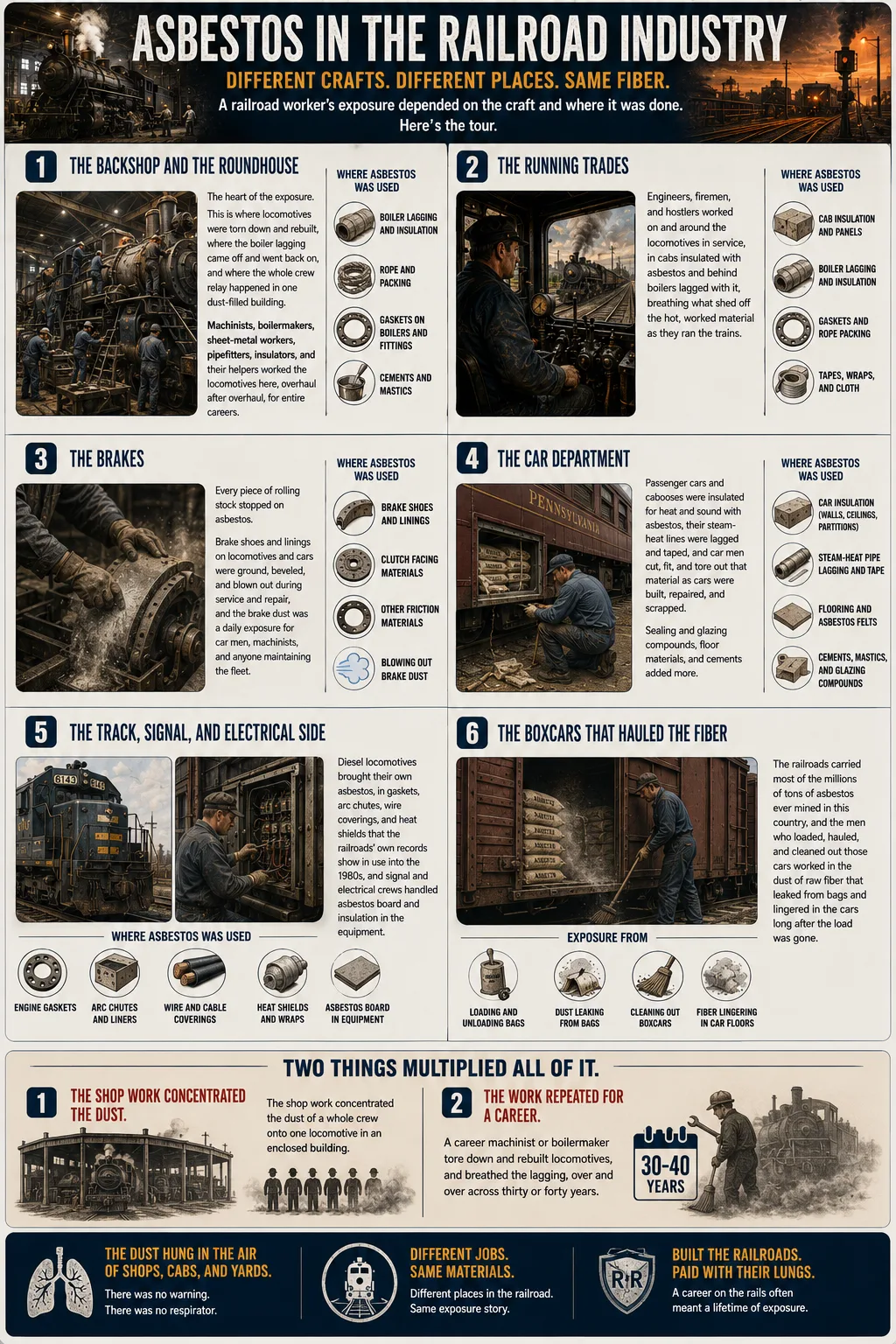
A railroad worker's exposure depended on the craft and where it was done. Here's the tour.
- The backshop and the roundhouse. The heart of the exposure. This is where locomotives were torn down and rebuilt, where the boiler lagging came off and went back on, and where the whole crew relay happened in one dust-filled building. Machinists, boilermakers, sheet-metal workers, pipefitters, insulators, and their helpers worked the locomotives here, overhaul after overhaul, for entire careers.
- The running trades. Engineers, firemen, and hostlers worked on and around the locomotives in service, in cabs insulated with asbestos and behind boilers lagged with it, breathing what shed off the hot, worked material as they ran the trains.
- The brakes. Every piece of rolling stock stopped on asbestos. Brake shoes and linings on locomotives and cars were ground, beveled, and blown out during service and repair, and the brake dust was a daily exposure for car men, machinists, and anyone maintaining the fleet. See how asbestos brake and friction products caused exposure.
- The car department. Passenger cars and cabooses were insulated for heat and sound with asbestos, their steam-heat lines were lagged and taped, and car men cut, fit, and tore out that material as cars were built, repaired, and scrapped. Sealing and glazing compounds, floor materials, and cements added more.
- The track, signal, and electrical side. Diesel locomotives brought their own asbestos, in gaskets, arc chutes, wire coverings, and heat shields that the railroads' own records show in use into the 1980s, and signal and electrical crews handled asbestos board and insulation in the equipment.
- The boxcars that hauled the fiber. The railroads carried most of the millions of tons of asbestos ever mined in this country, and the men who loaded, hauled, and cleaned out those cars worked in the dust of raw fiber that leaked from bags and lingered in the cars long after the load was gone.
Two things multiplied the exposure. The shop work concentrated the dust of a whole crew onto one locomotive in an enclosed building, and the work repeated for a career: a career machinist or boilermaker tore down and rebuilt locomotives, and breathed the lagging, over and over across thirty or forty years.
How a railroad case gets paid
A railroad worker's case is built differently from almost any other asbestos case, because railroad work is governed by its own federal laws. Where most workers are limited to state workers' compensation against their employer, a railroad worker can sue the railroad directly, and that changes everything about how the case comes together.
- The FELA claim against the railroad. The Federal Employers' Liability Act (FELA) is a federal law written specifically for railroad workers. Instead of the limited, no-fault payments of state workers' compensation, FELA lets an injured railroad worker sue the railroad directly for failing to provide a safe workplace, with no cap on what can be recovered for medical costs, lost income, and pain and suffering. And it uses a comparative-fault rule: even if the worker is found partly responsible for his own exposure, that reduces the recovery rather than barring it. For a railroad family, this is usually the center of the case.
- The Boiler Inspection Act. A second federal law strengthens many locomotive cases. Because federal law required locomotives and their parts to be safe to operate, a railroad that ran locomotives insulated and equipped with asbestos can be held liable without the worker having to prove the railroad was careless in the ordinary sense. The railroads' own purchasing specifications, which called out asbestos lagging and cement by name, are part of what shows they knew what they were putting into the shops.
- Product claims against the makers. Alongside the case against the railroad, the companies that made the lagging, brakes, gaskets, packing, and pipe covering can be reached separately. Many are now bankrupt and pay through asbestos trusts, which are paper claims requiring no lawsuit; some are still in business and can be sued directly. The makers behind each product, and which of their trusts pay today, are laid out on the product pages. See the makers behind asbestos pipe and block insulation, and the makers behind asbestos brake and friction products.
- Federal and disability benefits. Railroad workers have their own federal retirement and disability system, and Social Security disability may apply as well, both paid alongside the FELA and product recovery. How asbestos disability and benefit claims work.
The FELA claim has its own federal deadline, which generally runs three years from when the worker knew or should have known that the illness was related to the railroad work, and other deadlines can depend on your state. Some of these clocks are short, which is why it's worth calling promptly rather than waiting. Find your state's asbestos deadlines.
The railroads, and the shops where the work was done
For a railroad worker's case, where the work happened tells us which products were in the shops and on the locomotives during which years, and it identifies the railroad that answers for the conditions. The exposure happened across the whole system:
- The big backshops and locomotive works, where heavy overhauls and rebuilds concentrated the lagging and rebuild work, run by the major railroads and their locomotive builders.
- The roundhouses and running-repair shops at division points and terminals across the country, where locomotives were serviced between runs.
- The car shops and yards, where passenger cars, cabooses, and freight cars were built, repaired, and scrapped.
The railroads employed hundreds of thousands of workers across many large and small companies, and almost all of the old railroad companies have since merged, been absorbed, or been reorganized into today's railroads. A claim doesn't depend on your railroad still existing under its old name; a successor company usually carries the liability, and part of what we do is trace which company answers for a given railroad and era. If your road or shop isn't the kind of famous name people recognize, that means nothing about your claim; our exposure database reaches far beyond the big systems.
What the asbestos trade press said about the railroads
The asbestos industry's own trade journal, Asbestos, wrote about the railroads for sixty years. Its notices were written to sell products, not to warn anyone. Today they help families see what was on the locomotives and in the shops where someone worked.
Locomotive boilers and pipes. In 1919 the magazine said 85% Magnesia "lagged the boilers of the locomotives" that carried American supplies in France (Asbestos, Oct. 1919). Ehret Magnesia Manufacturing Co. sold its 85% Magnesia as "locomotive lagging" in ads through the 1920s (Asbestos, Jan. 1923). In 1929 it reported that more locomotives being built and reconditioned had created "a very large demand for magnesia" (Asbestos, Dec. 1929).
Removable asbestos mattresses were used on locomotive boilers. A 1921 article said they had been applied to locomotives "all over the world," and that this lagging was "frequently removed and replaced" for annual inspections (Asbestos, Dec. 1921).
How the shop men did it. Where pipe covering wouldn't fit, "railroads and locomotive builders" wrapped asbestos listing, a narrow tape, around locomotive steam pipes at the bends (Asbestos, Oct. 1919). Unarco said its INSUTAPE asbestos tape, made from 1922 for "hard-to-get-at" pipes on steam locomotives, won "almost universal acceptance among railroads" (Asbestos, Sept. 1971).
In 1940 the Reading Company described how apprentices in its Reading, Pa., shops insulated a model locomotive. They wrapped the boiler barrel in three layers of asbestos tape and covered part of the firebox with sheet asbestos: about 200 feet of tape in all (Asbestos, Jan. 1940).
Cars, cabs and brakes. Unarco patented a locomotive cab curtain woven with asbestos threads (Asbestos, Apr. 1939) and registered a trade-mark for asbestos gasket tape "for locomotive front end plates" (Asbestos, May 1941). Keasbey & Mattison made "Locomotive and Car Tape" at Ambler, Pa. (Asbestos, June 1951) and said its asbestos textiles went into "railroad locomotives, rolling stock" (Asbestos, Feb. 1954). In 1959 Westinghouse Air Brake patented a brake shoe made with asbestos fiber "to be used on railway vehicles" (Asbestos, Jan. 1960). Johns-Manville's employee magazine listed "railroad cars and locomotives" among the uses of J-M asbestos friction materials (J-M News Pictorial, July–Aug. 1962). As late as 1977, Lake Asbestos advertised fibre for brake linings in "railway and subway cars" (Asbestos, Feb. 1977).
Selling to the railroads. The suppliers built whole departments to sell to the railroads. Unarco began as a railway supply firm (Asbestos, Sept. 1971). Keasbey & Mattison set up a railroad department in 1930 (Asbestos, Jan. 1931). Johns-Manville's Transportation Department was run by a former Pullman Company general mechanical inspector (Asbestos, Feb. 1943).
| Site | Year reported | What the magazine says was used | Source |
|---|---|---|---|
| New Haven Railroad electric locomotives | 1924 | Rockbestos all-asbestos covered cable, after cable fires under the floors | Asbestos, Oct. 1953 |
| Pennsylvania Railroad improvements, Newark, N.J. | 1934 | Asbestos cement electrical conduit | Asbestos, Oct. 1934 |
| Underground railway, London | 1934 | Sprayed asbestos-rubber lining for noise | Asbestos, Nov. 1934 |
| San Francisco Bay Bridge railway switch and signal lines | 1938 | Asbestos-cement conduit | Asbestos, May 1938 |
| Reading Company Shops, Reading, Pa. (model locomotive) | 1940 | Asbestos insulating tape and sheet asbestos on the boiler | Asbestos, Jan. 1940 |
| Canadian National Railways Central Station, Montreal | 1944 | Lead-asbestos anti-vibration pads under the building columns | Asbestos, July 1944 |
| British Rail locomotives and carriages | 1966 | Limpet sprayed asbestos between double floors and under floor sheets | Asbestos, Sept. 1966 |
If your railroad or shop isn't named here, that doesn't mean it was free of asbestos. These are only the places the trade press happened to write about.
The crafts that worked the railroad
The railroad employed dozens of crafts, and several of them have their own pages, because their exposure followed them across industries. If your loved one's work fits one of these better than it fits "railroad worker," start there:
- Insulators and insulation workers
- Boilermakers
- Pipefitters and plumbers
- Electricians
- All asbestos occupations
For everyone else, the machinists and their helpers, the sheet-metal workers, the car men, the engineers, firemen, and hostlers, the brakemen, and the shop and yard laborers, this page is your page, and the work described above is the exposure story we build the claim on.
Mentioned on this site
- American Journal of Industrial Medicine
- Annals of Global Health
- Annals of the New York Academy of Sciences
- Asbestos Brakes, Clutches, and Friction Materials
- Asbestos Exposure by Industry
- Asbestos Railroad Claims Under FELA
- Battery Box
- BMJ Open
- British Journal of Industrial Medicine
- Cancer
- Cancer Investigation
- Catalog page
- Catalog page
- Chest
- Composition brake block (US Patent 2,861,964, 1958)
- Composition material for railway vehicle brake shoes and a method of fabrication of brake shoes (US Patent 3,450,236, 1969)
- Environmental Health
- European Journal of Cancer
- European Journal of Epidemiology
- Fear of Cancer Damages
- Friction elements (US Patent 2,901,456, 1959)
- Friction elements (US Patent 3,492,262, 1970)
- Friction material for railroad disc brakes (US Patent 4,111,891, 1978)
- H.W. Johns Manufacturing Co.
- H.W. Johns Manufacturing Co. bill for paints sold to a Farmers Village, N.Y., customer (1885)
- Industrial Health
- Insulating Tape (US Patent 2,366,291, 1945)
- International Journal of Cancer
- Johns-Manville Service to Railroads (1923)
- Journal of Occupational and Environmental Medicine
- Journal of Occupational Health
- La Medicina del Lavoro
- Letters and Comments on Asbestos
- Locomotive Cab Curtain (US Patent 2,145,235, 1939)
- Merit
- Method of Making Waterproof Heat Insulating Tape (US Patent 1,937,561, 1933)
- Occupational and Environmental Medicine
- Occupational Medicine
- Preemption
- Reading Castleman, Chapter 4
- Reading Castleman, Chapter 5
- Reading Castleman, Chapter 7
- Reading Castleman, Chapter 8
- Reading Castleman, Chapter 9
- Research on Amphibole Asbestos
- Research on Chrysotile
- Research on Railroads
- Risk Analysis
- Scandinavian Journal of Work, Environment & Health
- Sheet Insulation (US Patent 1,807,785, 1931)
- Smoke Jack (US Patent 2,083,933, 1937)
- The American Journal of Forensic Medicine and Pathology
- The American Review of Respiratory Disease
- Toxicology and Industrial Health
- Tumori
- Unarco
- Urology
- Videotaped Deposition of Dr. Paul Kotin in the South Carolina Asbestos Cases (1979)
In the research library
The National Library of Medicine indexes 22 studies in our medical research library under railroads. Among the most cited:
- A retrospective cohort study of lung cancer and diesel exhaust exposure in railroad workersE. Garshick, M.B. Schenker, A. Muñoz, et al, 1988 · The American Review of Respiratory Disease · cited 125 times
- A case-control study of lung cancer and diesel exhaust exposure in railroad workersE. Garshick, M.B. Schenker, A. Muñoz, et al, 1987 · The American Review of Respiratory Disease · cited 119 times
- Asbestos-related disease in railroad workers. A cross-sectional studyL.C. Oliver, E.A. Eisen, R.E. Greene, et al, 1985 · The American Review of Respiratory Disease · cited 39 times
- Relative risk of mesothelioma among railroad machinists exposed to chrysotileT.F. Mancuso, 1988 · American Journal of Industrial Medicine · cited 38 times
- Mesothelioma among machinists in railroad and other industriesT.F. Mancuso, 1983 · American Journal of Industrial Medicine · cited 38 times
In our case-law library
111 court decisions in our case-law library involve railroads. Among them:
- Connor v. Covil CorporationU.S. Court of Appeals, Fourth Circuit, 2021 · Machinist mechanic at Norfolk Southern Railway, 1943-1944, 1946-1963
- Jack v. Dco, LLCU.S. Court of Appeals, Ninth Circuit, 2021 · Father of Patrick Jack, a UP worker at Union Pacific Railroad premises, before 1955
- Little v. the Budd Company, Inc.U.S. Court of Appeals, Tenth Circuit, 2020 · Pipefitter at ATSF Topeka car shops
- Stephens v. Union Pacific R. Co.U.S. Court of Appeals, Ninth Circuit, 2019 · Child of a roundhouse worker; dust on father's work clothes at Union Pacific roundhouse, Weiser, late 1940s and early 1950s
- Illinois Central Railroad Company v. Oakes EX rel. HaganMississippi Supreme Court, 2018 · Railroad employee at 1952-1994
- Cole v. Norfolk Southern Railway CompanyVirginia Supreme Court, 2017 · Machinist at more than 35 years
Videos
The defenses companies raise, and how we answer them
When a railroad case goes to court, the railroad and the product makers raise a familiar set of defenses, and none of them is new to us. The short version is that the arguments describe a cleaner, smaller version of the work than the one your loved one actually did, and the evidence answers them. The detail is below for anyone who wants it.
One thing worth knowing up front: the product trust claims are a paper process, with no opposing lawyer, no deposition, and no court. The defenses below come up on the lawsuit side, including the FELA case against the railroad, which is the part of a railroad claim that can actually go before a judge and jury.
How we answer the defenses raised in railroad cases
"He knew the shops were dusty and took the job anyway." This argument, that a worker accepted the risk of his own job, is one the railroads are not allowed to make. The Federal Employers' Liability Act specifically abolished the assumption-of-risk defense in railroad cases, so a railroad cannot escape responsibility by saying the worker knew the work was dusty. It's one of the ways the law written for railroad workers is stronger than ordinary injury law.
"Railroad brakes were made with a kind of asbestos that's safe." The makers of brake shoes and linings argue that the heat of braking changed the asbestos into a harmless mineral, or that the chrysotile in brakes doesn't cause mesothelioma. The published science does not support treating brake work as safe, mesothelioma has been documented in brake workers, and grinding, beveling, and blowing out brake shoes put respirable asbestos into the air the worker breathed. We put the established science on and answer this directly.
"Steam locomotives were gone by the 1950s, so this is too old to matter." Asbestos disease takes decades to appear, so a lagging exposure in the steam era surfacing as mesothelioma today is exactly the expected timeline, not a reason for doubt. And the asbestos didn't leave with the steam engines: the railroads' own records show asbestos brakes, gaskets, insulation, and wiring in diesel locomotives and shops into the 1980s. The exposure spanned both eras.
"The exposure to any one company's product was too small to have made a difference." These cases are built on documented exposure: the specific high-dust tasks the crafts performed, like stripping tons of lagging off a boiler, and the dose built up across a full career in the shops. The trusts pay on brief exposure, and in court we prove a meaningful contribution with that task and career evidence, reconstructing which makers' products were in a given shop and era.
Frequently asked questions
I don't have my old railroad service records. Can I still file?
Yes, and that's the normal starting point. You don't need your service records, seniority roster, or old pay records in hand to begin. We reconstruct the work from our exposure database, the trust documentation for each product's maker, the railroads' own purchasing and interrogatory records showing what asbestos they used, and the recollections of the worker and his coworkers, and railroad retirement and union records often fill in the dates and assignments. The claim is built on the railroad, the craft, and the years, not on a perfect paper file.
My railroad merged into another company, or doesn't exist anymore. Does that end the claim?
Usually not. The American railroads consolidated over decades, and the company operating today often carries the liabilities of the roads it absorbed. Part of what we do is trace which company answers for your railroad and your era, so a road that vanished from the map long ago can still stand behind a claim.
My loved one has already passed away. Can we still bring a claim?
Yes. Families regularly file after a death, both product trust claims and a lawsuit, including the FELA claim against the railroad, depending on the circumstances. These deadlines can be short, and the family's claim can depend on what was preserved during the worker's life, so it's best to call promptly. We handle wrongful death and estate claims as a matter of routine.
He smoked. Does that ruin the case?
No. Mesothelioma isn't caused by smoking, so a smoking history doesn't touch a mesothelioma claim at all. For lung cancer, asbestos and smoking multiply each other's damage rather than canceling out, and railroad workers who smoked and breathed asbestos may still have strong claims. And under the railroad law, being found partly at fault reduces a recovery rather than ending it. Don't let a smoking history stop you from asking.
Could my family have been exposed through the work clothes?
Yes, and it's common. The dust that settled on a railroader's clothes, hair, and boots came home with him, and spouses who shook out and laundered work clothes and children who hugged a parent after a shift were exposed too. That's why our representation includes free asbestos health screening for family members, and if a family member is later diagnosed, they may have a claim of their own. The screening is a chest X-ray read by a B-reader, with a CT scan if needed; it looks for asbestos-related changes in the lungs and isn't a diagnosis or a reliable way to find mesothelioma early.
What happens when I call?
A member of our litigation team, not a screener, takes the call, and the first conversation usually runs twenty to thirty minutes. We listen to the work history, explain which claims and channels may apply, and lay out the timeline for your situation. No one is pressured to sign anything on that call.
What does it cost to work with you?
Nothing up front, and nothing at all unless we recover for you. We work on a contingency fee, which means our fee comes only out of money we recover, and the case review and consultation are free.
Do we have to travel to your office?
No. We handle these cases by phone, video, and mail, and we come to you when an in-person visit helps. Families work with us from every state without traveling to us.
Talk with an asbestos lawyer about railroad exposure
Whether you're a railroader who was just diagnosed, or a spouse or adult child trying to find help for someone who is sick or who has passed, we're ready to talk. You don't need the product names, you don't need the old records, and you don't need to travel to us. Start with the railroad, the craft, and the years, and we'll take it from there.
Related resources
Sources and references
The exposure measurements on this page come from published industrial hygiene testing, cited in full on the product pages where each figure lives:
- The 51.7 f/cc pipe-and-block insulation measurement is documented on our asbestos pipe and block insulation page.
- The brake-box area measurement (about 70 f/cc) is documented on our asbestos brake and friction products page.
- The 28.4 f/cc gasket-removal measurement is documented on our asbestos gaskets and packing page.
Other authorities relied on:
- Occupational exposure limits. OSHA's asbestos standard sets the current permissible exposure limit at 0.1 f/cc averaged over eight hours, with a short-term excursion limit of 1.0 f/cc over thirty minutes. 29 C.F.R. § 1910.1001.
- Carcinogenicity. The International Agency for Research on Cancer classifies all forms of asbestos as carcinogenic to humans (Group 1) and recognizes no safe threshold of exposure for mesothelioma. IARC Monographs, Vol. 100C.
- Historical product placement. Johns-Manville, Service to Railroads (1923), a product catalog dedicated to the railroad industry, and railroad purchasing specifications for asbestos boiler lagging, cement, and welding paper (1930s–1950s), in our document archive.
This page is provided for general informational purposes and does not constitute legal advice. Every asbestos case turns on its own facts, exposure history, diagnosis, deadlines, available evidence, and applicable law. Reviewing this page does not create an attorney-client relationship. For advice about your specific situation, call 833-4-ASBESTOS for a free case review.