

Asbestos gaskets and packing sealed almost every pipe joint, pump, and valve in American industry for most of the twentieth century, and the danger came not from installing them but from tearing the old ones back out. Grinding a single gasket off a flange has been measured at 28.4 fibers per cubic centimeter, which in fifteen minutes puts roughly eight years' worth of ordinary city background air through a worker's lungs1, and the companies whose products these were recorded much the same figures in their own plants and kept the results to themselves. You don't need to remember which brand you handled or dig up any old records to find out whether you have a claim; if you worked around this material, that's where we start.
Even ordinary city air carries a faint trace of asbestos everywhere, from natural mineral erosion and decades of industrial use, and that trace is the baseline both sides of the panel are measured against.
What these numbers mean. Asbestos in air is measured in fibers per cubic centimeter (f/cc), a unit that hides how dangerous a task was. Across this site we translate each measurement into fibers breathed, feet of fiber end to end, and years of ordinary city air, using conservative, government-sourced assumptions. See how we measure asbestos in air for the method and its limits.

You don't need the product names or old records. No fee unless we recover compensation for your family.
Quick answers
| Did asbestos gaskets and packing really expose me? | Almost certainly, if your work touched industrial piping, pumps, or valves. The heaviest exposure came from removing old, baked-on gaskets and dried packing, which is when the fiber came loose. Installing new ones intact was lighter. |
|---|---|
| I never installed them, I just took the old ones off. Was that exposure? | That was the worst of it. Scraping, wire-brushing, and grinding hardened gaskets off flange faces, and pulling degraded packing out of a stuffing box, is exactly the work that put the highest fiber levels into the air. |
| How much exposure do I need for a claim? | For mesothelioma, less than you'd expect. The bankruptcy trusts that pay many of these claims are built to compensate brief exposure on a worksite that used asbestos. Courts ask for a meaningful contribution, and we handle that distinction for you. |
| Which companies made this material? | Names like Garlock, John Crane, A.W. Chesterton, Johns-Manville, and Flexitallic. Some are bankrupt and now pay through trusts; others are still in business and can be sued directly. |
| Do I need to remember the brand? | No. We reconstruct the products from your work history, our exposure database, and the trust documentation. The brand names are our job, not yours. |
| Do I have to file a lawsuit? | Not necessarily. Many families recover through trust claims, which are paper claims with no courtroom. Cases against the still-solvent makers are lawsuits, and we explain both paths. |
| Can a spouse or adult child call for the worker? | Yes. Most of our first calls come from a wife or an adult child. You don't need a power of attorney to ask questions. |
“I started this firm after learning that the cancers that killed my father and grandparents were caused by asbestos, something we did not realize until it was too late to hold anyone accountable. That experience is why we built this site: so that no other family misses their chance to ask the questions, hear the options, and decide for themselves what to do.”
What asbestos gaskets and packing were
A gasket is a flat seal clamped between two flange faces to hold a joint tight; packing is the rope-like or braided material stuffed into the space around a moving shaft in a pump or valve to keep it from leaking. For most of the twentieth century both were made of asbestos, because asbestos held its shape against the heat, pressure, and chemicals that would destroy an ordinary seal. Wherever a pipe carried steam, hot oil, or aggressive chemicals, the seal at the joint was almost always asbestos.
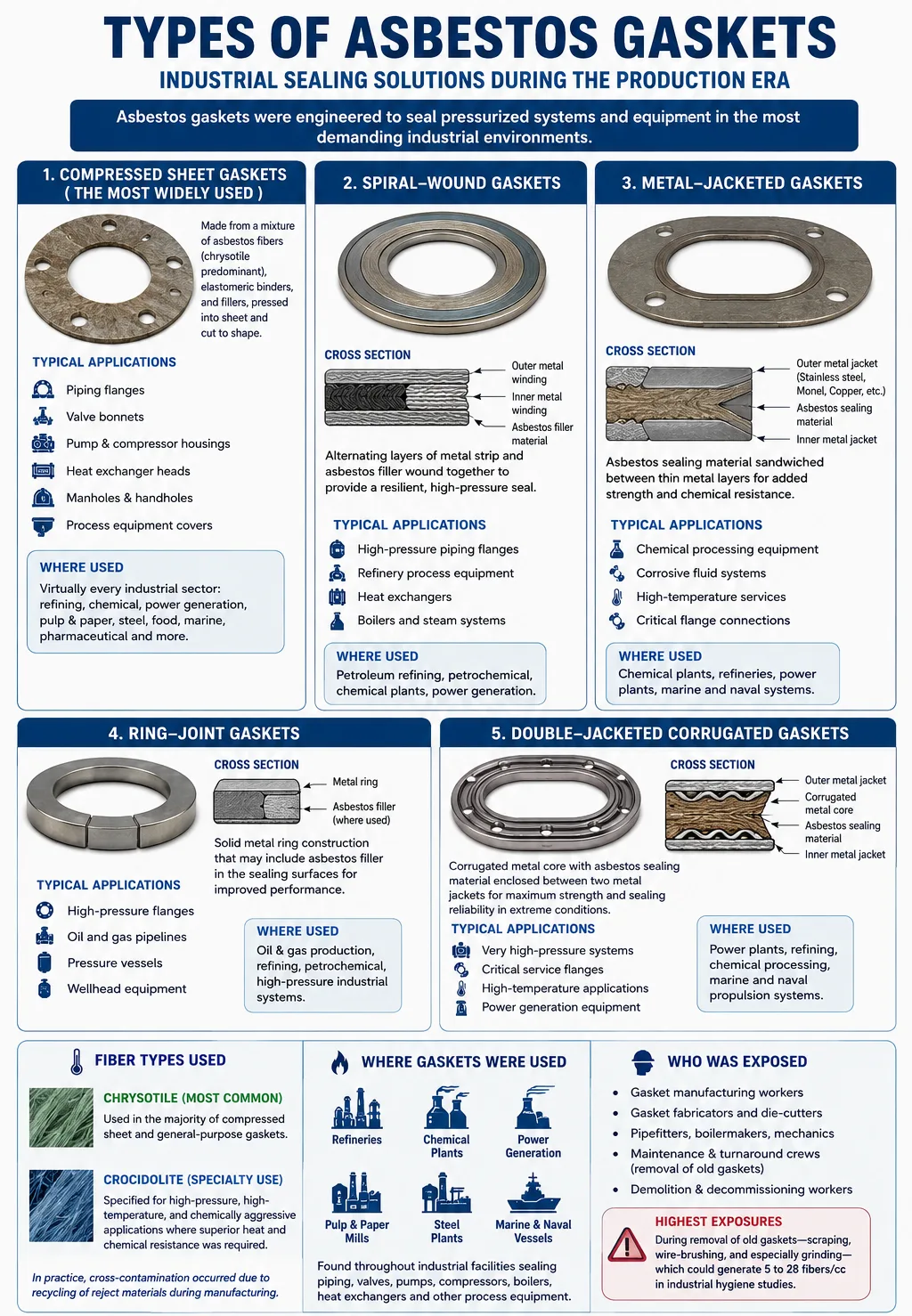
Gaskets came in several forms, and which one a joint used came down mostly to how much pressure and heat it had to survive. The compressed asbestos sheet gasket was the workhorse and the one most workers handled: a sheet of asbestos fiber, binder, and filler that a fitter cut and punched to shape on the job, then clamped between flanges on piping, valve bonnets, pump and compressor housings, heat exchanger heads, and manhole covers across nearly every industry. Higher-pressure and more corrosive joints used metal-bodied designs that still carried an asbestos sealing element: spiral-wound gaskets that alternated asbestos filler with metal windings, metal-jacketed gaskets that wrapped an asbestos core in thin metal, solid ring-joint gaskets with asbestos in the sealing surface, and double-jacketed corrugated gaskets built for the most extreme boiler and refinery lines. The metal hid the asbestos but didn't remove it, and cutting or grinding a spent gasket out released the fiber just the same.
Packing did a different job. Instead of sealing a static joint, it sealed around parts that moved, most often the rotating shaft of a pump, which was the single largest use. Braided or twisted into rope and coiled, it was cut to length, stuffed into the space around the shaft or around a valve stem sliding up and down, and compressed into rings that held back steam, hot oil, or chemicals while the part kept moving. The same rope packing sealed boiler manhole and handhole covers, furnace doors, and the rotating seals on cement, lime, and ceramic kilns. Which packing went where came down to temperature, motion, pressure, and how tight the seal had to be, and the hottest services, like furnace doors and kiln seals, used dry asbestos packing with no lubricant, since anything oily would just burn off.

Representative products and their asbestos content.
These are examples, not a full list:
| Product | Maker | Fiber | Asbestos content | In production |
|---|---|---|---|---|
| Compressed asbestos sheet gasket (No. 900) | Garlock | Chrysotile | ~80% | from 1907 |
| Braided compression packing (No. 234) | Garlock | Chrysotile (presumed) | ~65% | from 1933 |
| "Ajax" packing | Johns-Manville | Chrysotile | 91-93% | from 1913 |
| Houdaille Packing | John Crane | Chrysotile | 20-80% | from 1950 |
| Sheet gasket (No. 7705) | Garlock | Crocidolite (blue) | ~85% | 1950's |
That last row carries legal significance. "It was only chrysotile, the least dangerous type" is a defense you'll hear, but some gaskets were made with crocidolite, or blue asbestos, the most hazardous fiber of all, so the sealing category was never a chrysotile-only story.
How gaskets and packing put asbestos in the air
Sealed inside an installed joint, a gasket doesn't shed much fiber. The exposure came from taking joints apart, which every maintenance worker did constantly. Years of heat bake a gasket onto the flange faces, so removing it means scraping, wire-brushing, and grinding hardened material off the metal, and each of those methods drives dry, friable (crumbly and dusty) fiber straight into the breathing zone. Pulling dried, degraded packing out of a stuffing box with a hook does the same thing.
Here is what that removal work measured. Each figure is a phase-contrast (PCM) measurement, which counts only the longer fibers and so reads as a floor, not a ceiling:
| Removal task | Measured (f/cc) | ≈ years of background per 15 min | Source |
|---|---|---|---|
| Grinding a sheet gasket off a flange | 28.4 | ~8 years | Longo 20101 |
| Power-grinding a bonnet gasket | 68.4 | ~20 years | Longo 20101 |
| Gasket removal, refinery (internal survey) | 28 | ~8 years | Shell Wood River 19852 |
| Rotary-tool gasket removal (internal survey) | 18 | ~5 years | Dow Chemical 19873 |
| Wire-brushing a gasket off | 11 | ~3 years | Millette & Compton 20104 |
By the illustrative math on our how we measure asbestos in air page, 15 minutes of grinding a gasket put roughly 8 years of ordinary city air through the lungs. This estimates fibers in the air breathed, not a retained dose.
The full task-by-task story of who did this work, across the trades and the industries, lives on the occupation and industry pages linked below. What belongs here is the product itself and the fact that its danger was designed into how it had to be removed.
What the makers knew
The strongest part of a gasket and packing case is often that the companies documented the hazard themselves and said nothing. This isn't an inference from general industry knowledge; it's on paper, in their own files.
Shell measured it at its own refinery. An internal Shell Wood River industrial hygiene survey in 1985 recorded gasket-removal air at about 28 f/cc2, roughly the same measurement later confirmed in independent work-practice studies. Dow Chemical did the same testing with similar results: a 1987 internal Dow measurement of air-powered rotary-tool gasket removal recorded roughly 18 f/cc3. These were the companies' own hygienists, sampling their own workers, writing down numbers hundreds of times the exposure limit, at a time when the workers doing the job were given no warning and no respirator.
That record is why these cases can reach beyond ordinary negligence. When a company measures a hazard in its own plant, files the result, and neither warns the workforce nor changes the work, the conduct supports a claim for gross neglect and, where the law allows, punitive damages.
Who was exposed
Gaskets and packing weren't tied to one trade or one place; they were everywhere a joint had to seal. Rather than retell each worker's story here, this page hands that off to the pages that own it:
- pipefitters and plumbers, whose daily work was breaking joints and repacking valves
- boilermakers and millwrights and machinists on pumps, valves, and rotating equipment
- refineries and petrochemical plants, where turnaround maintenance meant thousands of gasket changes
- shipyards and the Navy, where high-pressure steam systems ran on asbestos seals
If you or your family member worked around industrial piping in any of these settings, the exposure history is usually easy to reconstruct.
The manufacturers and the trusts
Gasket and packing recovery is broader than almost any other asbestos product category, because it runs against three kinds of defendant at once. The major bankrupt makers now pay through trusts that require no lawsuit. The major packing makers who never went bankrupt still defend cases in court, and those tort recoveries often exceed what the trusts pay per claim. And because so much of this work happened during refinery and plant turnarounds under the site owner's control, the facility owners can be reached as premises defendants. A single career often supports all three at once, and one pathway doesn't reduce another.
| Manufacturer / brand | Status | How claims are handled |
|---|---|---|
| Johns-Manville (gaskets, packing, broader portfolio) | Johns-Manville Asbestos Trust | Trust claim, no lawsuit |
| Garlock Sealing Technologies (sheet gaskets, packing) | Garlock Asbestos Trust | Trust claim, no lawsuit |
| Flexitallic, Vellumoid, Fel-Pro, Ferodo, Turner & Newall | Federal-Mogul Asbestos Trust | Trust claim, no lawsuit |
| John Crane Inc. (mechanical packing) | Solvent, never filed bankruptcy | Lawsuit |
| A.W. Chesterton Company (mechanical packing) | Solvent, never filed bankruptcy | Lawsuit |
| Crane Co. (valves, gasketed equipment, Navy supply) | Solvent, never filed bankruptcy | Lawsuit |
| Refining and chemical companies (premises owners) | Solvent, premises liability | Lawsuit (state-law dependent) |
A brief note on one name you may hear: whether a claim reaches a company like Anchor Packing depends on a successor-specific analysis, and that legal detail is something we work through for your file rather than something you need to sort out. If the idea of a lawsuit is uncomfortable, you're in good company; Clarence Borel, the refinery insulator whose 1973 case built the modern asbestos-litigation system, didn't want to sue either, and we can pursue trust claims alone if that's your preference.
Sources of compensation
A gasket and packing case usually draws from several sources at once, and they run in parallel:
- Asbestos bankruptcy trusts. The makers who went bankrupt set aside money to pay the people they harmed. These are paper claims, with no lawsuit and no courtroom, and one career often supports filings against several trusts. How asbestos trust claims work.
- Lawsuits against solvent makers. John Crane, Chesterton, and Crane Co. are still in business and can be sued directly. How product liability lawsuits work.
- Premises liability against site owners. The refineries, plants, and utilities that controlled the worksite can be held responsible for the conditions they allowed. How premises liability claims work.
- Federal and disability benefits. Navy service can support VA disability benefits, and civilian shipyard work can support Longshore (Longshore and Harbor Workers' Compensation Act) benefits, both paid in addition to the rest. How asbestos disability and benefit claims work.
In our case-law library
688 court decisions in our case-law library involve gaskets and packing. Among them:
- Jolly v. Fisher Controls International, LLCSouth Carolina Supreme Court, 2024 · Inspector overseeing tradesmen who replaced gaskets and valves at Oconee, McGuire, and Catawba nuclear plants, 1980-1984
- Deem v. William Powell Co.U.S. Court of Appeals, Ninth Circuit, 2022 · Outside marine machinist at Puget Sound Naval Shipyard, 1974-1981
- Smith v. Schlage Lock Company, LLCU.S. Court of Appeals, Fourth Circuit, 2021 · Construction worker at Allied Chemical plant, late 1960s or early 1970s
- Coffman v. Armstrong International, Inc.Tennessee Supreme Court, 2021 · Equipment mechanic at Tennessee Eastman chemical plant, Kingsport, 1968-1997
- Roverano v. John Crane, Inc.Pennsylvania Supreme Court, 2020 · Helper and a carpenter at PECO Energy Company, 1971-1981
- Hegger v. Valley Farm Dairy Co.Missouri Supreme Court, 2020 · Servicing industrial machinery at Valley Farm Dairy Company, 1968-1984
In our products database
The gaskets and packing our document library describes, by the company that made or sold it. Each product's page says when it was made and how much asbestos it held, from the documents.
A. W. Chesterton: 64 Diagonal High Pressure Packing · Chesco · Chesterton · Chesterton 1000 · Chesterton Packing Service · Chesterton Sixty Four · Russo · Tanpac
AMG: Summit
AMG Industries: Akron
Aberdeen Asbestos: Mastite
Aberdeen Industries: Aberdeen 50 · Black Mastite · Red Mastite
Albert C. Fischer: Servicised
Anchor Packing: A The Anchor Packing Company Target Sheet · Amflex · Anchor 1106 · Anchor 1108 · Anchor 118 · Anchor 1317NL · Anchor 809 · Target
Argo Asbestos & Rubber: Powerite
Armor Products: Robot Packing
Armstrong Cork: Accobest An-8012 · Accopac An-892 · Ad-486 · As-48S
Asbestos Textile Co.: Asbestext · Aztec
Aubern: Aubeston
B.F. Goodrich: G
Beldam Asbestos Company: Lascar
Beldam Packing & Rubber Company: Bison · Bulldog · Excelite · Lighthouse · Pivot · Sceptre
British Belting & Asbestos: BB · Mintex
C. W. Hanslip: Standco
Chambers Gasket & Mfg.: Superbestos
Charles Laurence Willis: Krespac · Stella · Supa Sca
Chester M. Roe: Sea-ro · Sea-Ro The Universal Packing
Chicago Wilcox: C.W. · Super X
Cincinnati Gasket Packing & Mfg.: Hot Oil Superheat · No Leak
Crane: Cranite
Crane Packing: Chemlon
Daimier-Benz Aktiengesellschaft: Mercedes Benz
Dana: Corbestos
Deutsche Gold- & Silber-Scheideanstalt: Degussa
Devcon: Form Pack 2
Excelsior: X-l
F.D. Farnam: Kaobestos · Kormetal · Pakmetal
Faul & Timmins: Asbesteel
Fel Pro: Grafel
Felt Products Mfg. Co.: Asbestopak
Flexatalic Gasket Corp.: Flexatallic
Flexitallic Gasket: Flextallic
GAF: Asbestos paper · Connectite
Garlock: Asbestos Sheet · Garlock · Ring packing
General Asbestos & Rubber: Garco
Grant Wilson: Fyrex
Greene Tweed & Co.: Cutno · G.T. Ring · Palmetto · Palmetto Cabcock · Palmetto Cutno · Palmetto Plastic · Palmetto Super Sheet · Plastic · Runwel · Super Cutno
H. W. Johns Manufacturing: Kearsarge Asbestos
H.S. White: Klingerit
Hall & Hall: Hallite
Harco Chemical: Azkem
Henrite Products: Squeegee
Herbert A. Greene: S
Hermetic Materials Ltd.: Everoid · Pitseal (Hermetic Materials)
Hollow Center Packing: Hopaco
Industrial Hermetic Materials (Miami, FL): Geniune Pittseal
Istag Ag: Rk
James Walker & Co.: Lion Trade Mark · Sealion
James Walker Packing Co.: Shallex
Janos Industrial Insulation: Bronco
Johns-Manville: 101 Mobilene Sheet · Bellowseal · C Asbestos Millboard · Centripac · Chempac · Chemstone · Cumpac · Goetze Metallic Gaskets · Jewett · Kearsarge · Locklube Packings · Mobilene Sheet Packing · No. 100 Kearsarge Sheet · No. 118 Kearsarge Gaskets · No. 60 Service Sheet · Railroad Brake Shoes · Sea Ring Packing · Spirotallic · Style 869 · Superheat · Tadpole
Joinine Prpducts Company: Jointine Betabestos
Keasbey & Mattison: Battleship · K & M 801 · K&M Best in Asbestos · Uni Syn Style No. 239
Klinger: Klinger Acidit · Klinger-Oilit · Klingerit
Maker not given: Klingerit 400 Universal (maker not given) · Valvasca SS (maker not given) · Valvasca Type M (maker not given) · Vee-Flex (maker not given)
Marlo Corporation: Graphlon C
McCord: McCORPAC Tork-lock · McKim
Mobil Chemical: Hi Heat Dum Dum
Nicolet: 580 · Asbestos · Hy-tensile · K & M 226 · K & M 466 Sheet Packing · K & M Style 740 Hy-Swell · Kon-x · Nicobestos · Nicolam · Nicosat · Nicoseal · Nicospec · Sal-mo
Pars Manufacturing: Pars
Philip Carey: Carey (generic name)
Phoenix Gasket & Packing: Pamco
Pilot Packing Co.: "V" Pilot · Gladiator
Presspan-Fabrik Chr. Authenrieth: Pucaro
Prince Rubber Company: Panacea
Raybestos-Manhattan: Dixie · Fluorobestos · K68 · Pyroid · R/M E-66 · Ray-Mold · Silverbestos · Vee-Square · Viton-Asbestos
Reinz-Dichtungs-Gesellschaft M. B. H.: Reinz-Repa · Reinz-Super-Spezial · Reinzolit
Rhopac: Cogasa
Rich. Klinger Aktiengesellschaft: Klingerit-1000
Rogers Corp. (Rogers, CT): GP/Duroid 3600 Line · GP/Duroid 3700 Line
Ruberoid: Gasket Quality
Rudolph Orlob: Tuffoid
Sepco Metallic Gasket Co.: Flex Seal
Societa Italiana Pirelli: Supersport
Southern Rubber Co.: Soruco
Standco Industries: Spiroflex · Sterlbestos
Sterling Packing & Gasket Company: Graybestos · Sterling Spiroflex
Stuart Brown: Bestolite
TBA Industrial Products: Permanite
Turner Brothers Asbestos: Firefly
Unarco: Cabcock · Style 110 · Style 1105 · Style 1106 · Style 1122 S.O. · Style 117 · Style 119 · Style 120 · Style 143 · Style 192 · Style 193 · Style 350 · Unarco (generic name) · Unitallic 166
Ungarische Gummiwaarenfabriks Actiengesellschaft: "Tauril"
Union Asbestos & Rubber Co.: Unarco
Uniroyal: F.O.P.
United States Gasket: Ajax
Vellumoid: Velbestos
Victor Manufacturing & Gasket: Asbestopac (Victor) · Asbestoprene (Victor) · Victopac
Victor Products: Asbestoprene
William R. C. Windsor: Superpax
Wm. E. Hooper & Sons: Hooperwood
Videos


The defenses companies raise, and how we answer them
The makers raise the same handful of arguments in most gasket cases, and none is new to us. All of this applies only to the lawsuit side. Trust claims are a paper process: no opposing lawyer raises defenses, no one is deposed, and no one goes to court.
How we answer the defenses raised in gasket and packing cases
"The asbestos was sealed inside the gasket, so it stayed locked in during normal use." The exposure never came from intact, installed gaskets. It came from removing old ones, scraping and grinding material that years of heat had baked hard, which is precisely when the fiber comes loose. The industrial hygiene testing that recorded high fiber levels recorded them during that removal work, and the makers' own internal measurements recorded the same thing.
"The asbestos was chrysotile, which is less dangerous than other types." Chrysotile is a recognized cause of mesothelioma, and the argument fails on the facts here anyway, because some sealing products were made with crocidolite (blue asbestos, a more hazardous amphibole fiber) outright. The composition table on this page shows it.
"The exposure from any one company's gasket was too small to matter." These cases rest on documented exposure: the specific high-dust removal tasks and the dose built up across a full career of maintenance work. The trusts pay on brief exposure, and in court we prove a meaningful contribution with that task and career evidence.
Frequently asked questions
What if I have no paperwork or employment records?
Yes, and most people are in exactly that position. We reconstruct the work history from our exposure database, the trust documentation for each manufacturer, purchase and specification records, and the recollections of coworkers. The conversation starts with what you remember.
My loved one has already passed away. Can we still bring a claim?
Yes. Families regularly file after a death, both trust claims and, depending on the state, a wrongful death lawsuit. Some of these deadlines are short, so it's best to call promptly. We handle wrongful death and estate claims as a matter of routine.
Weren't gaskets treated as a "safe" encapsulated product?
That was the industry's position, and it doesn't survive contact with how the work was actually done. Removal, not installation, was the exposure, and grinding a baked-on gasket off a flange is the opposite of leaving fiber encapsulated.
Could my family have been exposed through the work clothes?
Yes, and it's common. Fiber that settled on a maintenance worker's clothes came home with him, and spouses who laundered the clothes were exposed too. Our representation includes free asbestos health screening for family members, and if one is later diagnosed, they may have a claim of their own. The screening is a chest X-ray read by a B-reader, with a CT scan if needed; it looks for asbestos-related changes in the lungs and isn't a diagnosis or a reliable way to find mesothelioma early.
What does it cost to work with you?
Nothing up front, and nothing at all unless we recover for you. We work on a contingency fee, which means our fee comes only out of money we recover, and the case review is free.
What happens when I call?
A member of our litigation team, not a screener, takes the call, and the first conversation usually runs twenty to thirty minutes. We listen to the work history, explain which claims may apply, and lay out the timeline. No one is pressured to sign anything.
Do we have to travel to your office?
No. We handle these cases by phone, video, and mail, and we come to you when an in-person visit helps. Families work with us from every state without traveling to us.
Talk with an asbestos lawyer about gasket and packing exposure
Whether you're a worker who was just diagnosed or a spouse or adult child trying to find help for someone who is sick, we're ready to talk. You don't need the product names, you don't need the old records, and you don't need to travel to us. Start with what you remember, and we'll take it from there.
Related resources
Sources and references
- Longo WE. Exposure to Airborne Chrysotile and Amphibole Fibers During the Removal of Flange and Bonnet Gaskets: A Work Practice Study. Materials Analytical Services (MAS); September 2010.
- Shell Wood River Refinery, internal industrial hygiene survey of gasket removal, 1985 (breathing-zone air approximately 28 f/cc).
- Dow Chemical, internal industrial hygiene measurement of air-powered rotary-tool gasket removal, 1987 (approximately 18 f/cc).
- Millette JR, Compton S. Gasket removal fiber-release measurements, 2010.
- OSHA asbestos standard, permissible exposure limit 0.1 f/cc over eight hours with a short-term excursion limit of 1.0 f/cc over thirty minutes. 29 C.F.R. § 1910.1001.
- International Agency for Research on Cancer. Arsenic, Metals, Fibres, and Dusts. IARC Monographs, Vol. 100C (all forms of asbestos classified as carcinogenic to humans, Group 1).
- Borel v. Fibreboard Paper Products Corp., 493 F.2d 1076 (5th Cir. 1973).
This page is provided for general informational purposes and does not constitute legal advice. Every asbestos case turns on its own facts, exposure history, diagnosis, deadlines, available evidence, and applicable law. Reviewing this page does not create an attorney-client relationship. For advice about your specific situation, call 833-4-ASBESTOS for a free case review.