

Asbestos is a proven cause of lung cancer. Every major form of asbestos, including the chrysotile used in most consumer products, is a recognized human lung carcinogen. In the most recent global data, asbestos-related lung cancer is the single leading asbestos-caused cancer of any kind, and it kills far more people than mesothelioma does. You don't have to be a non-smoker to have an asbestos case, and you don't have to prove asbestos was the only cause. If you worked around asbestos, or lived with someone who did, and you've been diagnosed with lung cancer, you may have a claim worth pursuing. Call us at 833-4-ASBESTOS for a free health test and a free case review.

You don't need the product names or old records. No fee unless we recover compensation for your family.
Quick answers
| Can asbestos cause lung cancer? | Yes. It's the leading asbestos-related cancer, killing far more people than mesothelioma. |
|---|---|
| Can I file a claim if I smoked? | Yes. In most states asbestos only has to have been a substantial contributing cause of your cancer, not the only one, though the exact standard and the proof required vary by state. Most of our lung cancer clients smoked. |
| Is there a safe level of exposure? | No. There's no proven safe amount; risk rises with how much asbestos you breathed over a lifetime. |
| How long after exposure does it appear? | Usually 15 or more years, often decades; exposures from the 1960s through 1980s are surfacing now. |
| Do I need asbestosis to qualify? | No. But documenting asbestosis or bilateral pleural disease (plaques or thickening on both sides of the chest) can move a trust claim into a higher-paying tier. |
| What does it cost to talk to you? | Nothing. Call 833-4-ASBESTOS for a free health test and a free case review. |
A warning that was buried for a decade
In 1943, Dr. LeRoy Gardner of the Saranac Laboratory reported that of 11 mice that had inhaled long-fiber asbestos for 15 to 24 months, 81.8% developed lung tumors, a rate he called "an excessive incidence" of "pulmonary cancer."1 He had already sent the finding to Johns-Manville, the largest asbestos company in the country and one of the companies funding Gardner's work, in the outline of his planned report, where, as later correspondence recounted, the cancer results were described as "suggestive, rather than conclusive."2 When the finding surfaced again in 1947, Johns-Manville's top lawyer, Vandiver Brown, wrote on a copy of the correspondence that "the finding referred to looks like dynamite."2
So the industry buried them. Because the asbestos companies had paid for the Saranac study, the agreement let them control what it said, and when Gardner's results came back dangerous, they used that control to keep them quiet. The people with the most to lose from the truth were the same people who got to decide whether it was ever published.
And the suppression wasn't subtle, either. In 1948, Brown argued that any reference to "neoplasms" in the draft report was premature, the sponsors agreed to delete the cancer findings, and the final report said nothing about tumors in the mice.3 The draft itself described most of the tumors as benign, a reading a Saranac pathologist who later re-examined the work disputed, concluding the tumors included malignant ones.4 In the draft of the laboratory's report, the passage describing Gardner's lung cancer findings was crossed out by hand, with the word "OUT" written across it.
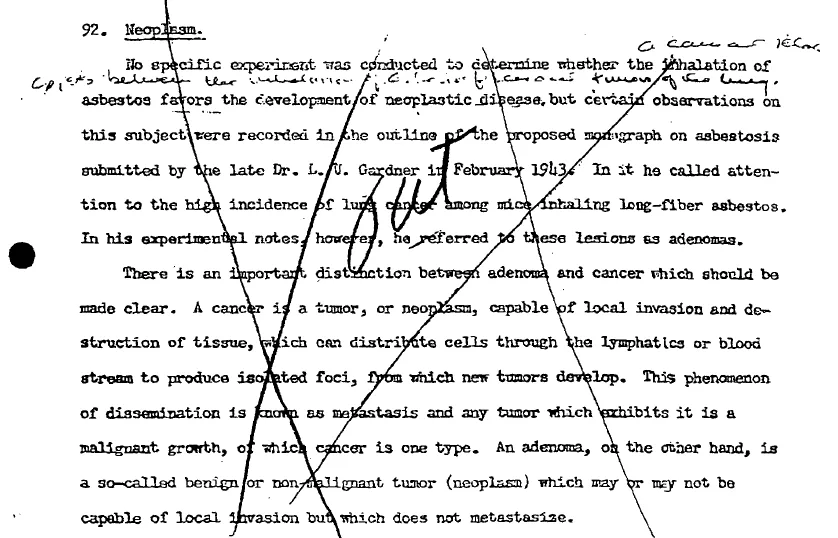
(Typed page headed "92. Neoplasm" from the asbestos-industry-funded Saranac Laboratory monograph draft. The paragraph noting the late Dr. L.U. Gardner's 1943 finding of high lung cancer incidence in mice that inhaled asbestos is struck through by hand and marked "OUT": the industry's deletion of the lung cancer findings from the published report.)
What makes that deletion so damning is that the science was already being acted on in another country. By 1943, wartime Germany had recognized lung cancer in workers with asbestosis as a compensable occupational disease, one of the earliest official recognitions of the link anywhere. The link wasn't unknown or unknowable. It was understood well enough to be written into another country's laws. But the companies that dominated the English-speaking market kept quiet about the risk, and it wasn't until Dr. Richard Doll's landmark 1955 study of British factory workers that the link was firmly established in the English-language medical literature.5 By then, the dust had already been breathed by millions of people.
One of them was a California woman named Terry, who started working at an industrial plant operating ovens that were insulated with asbestos. She never knew that men in a boardroom had decided to stay silent about the risks of asbestos exposure. When she developed lung cancer decades later, neither she nor her family had any idea that asbestos was to blame, or that anyone could be held responsible. She wasn't able to afford the best medical care while she was alive, and her family did their best to provide in-home care for her until she passed away.
Terry was my grandmother, and I was still many years away from becoming a lawyer when she died of lung cancer. Today I know her death wasn't just "one of those things" that happen sometimes. If I had known then what I know now, her last days would have brought less pain and more dignity.
— Justinian C. Lane, Founding Partner
Read our founder's story of how asbestos-related cancers took his family members and why he started this law firm.
How asbestos causes lung cancer
Asbestos is universally recognized as a human lung carcinogen, and all six fiber types cause it, including chrysotile. This is the settled conclusion of the World Health Organization, the U.S. EPA, the International Agency for Research on Cancer, and every other major health authority in the U.S. and in Europe.6
It's also more common than most people realize. Lung cancer is the deadliest cancer in the country: the American Cancer Society estimates about 229,000 new cases and 125,000 deaths in the US in 2026.7 Estimates of the share caused by asbestos vary widely from study to study; a major review found that most estimates for men fell between 10 and 20 percent, with lower figures for women.8 Even well below that range, asbestos would account for thousands of U.S. lung cancers a year, several times the roughly 3,000 mesotheliomas diagnosed annually, the large majority of which are also asbestos-caused.9 Worldwide, a 2025 analysis attributed 9.4 percent of all lung cancer deaths to occupational asbestos.10
Because the public associates asbestos almost entirely with mesothelioma, asbestos-related lung cancer is badly under-recognized, which means many of the people it kills never learn the cause and never pursue the compensation they may be entitled to.
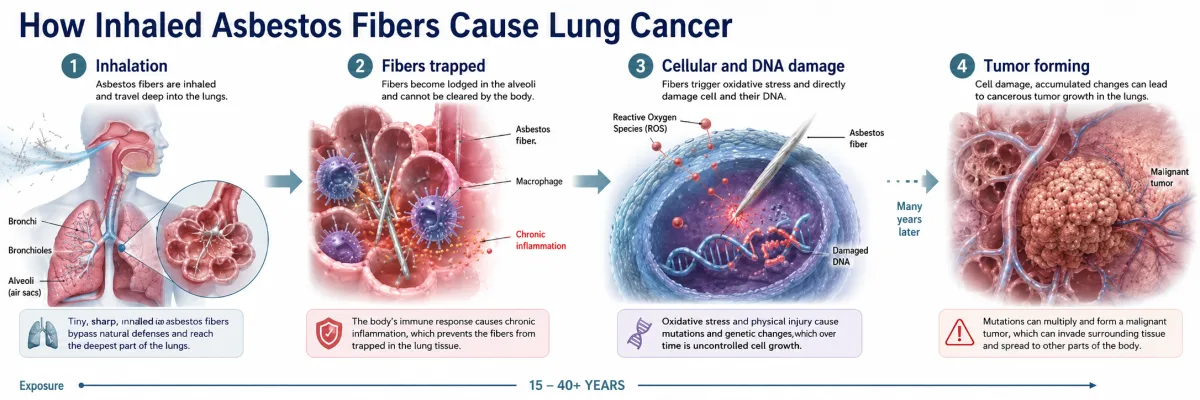
(How inhaled asbestos fibers cause lung cancer, in four stages. Fibers are breathed deep into the lungs and lodge in the air sacs (alveoli), where the body can't clear them. The trapped fibers provoke chronic inflammation, and through oxidative stress and physical injury they damage the DNA of nearby cells. Over 15 to 40 or more years, that accumulated damage can grow into a malignant tumor.)
The biology: how a breathed fiber becomes a tumor
Once asbestos fibers are inhaled, the body can't fully clear them, and the damage builds slowly, often over 15 to 40 years before any cancer appears. Several mechanisms work together. The trapped fibers provoke a state of chronic inflammation as the body tries and fails to wall them off. Asbestos is also directly genotoxic: it generates reactive oxygen species that oxidize and break DNA, it physically interferes with cell division so that genetic errors are passed to daughter cells, and it appears to disrupt the cell's DNA repair machinery. Fiber surfaces may also carry other carcinogens, such as those in tobacco smoke, deeper into the lung, one proposed mechanism that may help explain why asbestos and smoking are so dangerous in combination. Over decades, these accumulated injuries can disable the normal controls on cell growth and produce a malignant tumor.9
What if I smoked - can you still help?
This is the first question most people ask, and the answer is the one they don't expect: smoking doesn't take you out of the compensation picture.
Asbestos causes lung cancer on its own, even in people who never smoked a day in their lives. In one large insulator study, lifelong non-smokers exposed to asbestos still had several times the lung cancer rate of unexposed workers.11 So a non-smoker with asbestos exposure may well have a claim.
For people who did smoke, asbestos and tobacco together raise the risk far more than either alone. The classic insulator data showed asbestos alone raising lung cancer death rates about 5-fold, smoking alone about 11-fold, and the two together about 53-fold.12 Modern studies put the combined effect somewhere between adding the two risks and multiplying them, depending on the study, with the largest effects in people who also have asbestosis.11
What that means legally is simple and important: in most states asbestos only has to have been a substantial contributing cause of your lung cancer, not its sole cause, though the exact standard and the proof required vary by state, so lifelong smokers are still eligible to file asbestos trust claims and lawsuits. Many of our clients smoked.
And there's genuine good news for anyone still smoking. Lung cancer risk falls quickly after quitting, dropping by about half within the first ten years, and asbestos-exposed workers who quit and stayed off cigarettes for around 30 years eventually reached the same lung cancer risk as asbestos-exposed workers who had never smoked, still higher than for people never exposed to asbestos.11
The numbers: how smoking and asbestosis stack
A 2013 study of North American insulators measured all of these factors at once and laid the interaction out clearly.11 Compared with an unexposed control group, the lung cancer mortality rate ratios were:
| Group | No asbestosis | With asbestosis |
|---|---|---|
| Asbestos-exposed, never smoked | 3.6 | 7.4 |
| Asbestos-exposed, smoked | 14.4 | 36.8 |
Two things stand out. First, even with no asbestosis and no smoking, asbestos exposure alone raised the risk 3.6-fold. Second, insulators with asbestosis had roughly twice the risk of those without it, in both smokers and non-smokers, partly because asbestosis is a sign of heavier exposure. In this study, smoking and asbestos combined roughly additively without asbestosis (14.4) and more than additively with it (36.8). That second point matters for your compensation, and we come back to it below.
How much asbestos exposure does it take to cause lung cancer?
There's no proven safe amount of asbestos. What the science shows is a dose-response relationship: lung cancer risk rises with the total amount of asbestos a person breathed over a lifetime, measured in what researchers call fiber/mL-years of cumulative exposure.
What a "fiber/mL" actually measures
A fiber/mL (the same unit as f/cc, fibers per cubic centimeter) is a measure of how dusty the air is; our page how we measure asbestos in air explains the unit and what the numbers mean. A fiber/mL-year adds the dimension of time, combining how concentrated the fibers were with how long you breathed them, so a year spent in air holding 1 fiber/mL equals 1 fiber/mL-year of cumulative exposure. To put the numbers on this page in perspective, the current legal workplace limit in the U.S. is 0.1 fiber/mL averaged over an eight-hour day (the U.K.'s control limit is also 0.1, averaged over four hours13), which adds up to roughly 4.5 fiber/mL-years over a 45-year U.S. career, and regulators are explicit that even this legal limit isn't safe.14
This is the key difference between lung cancer and mesothelioma, and it's worth understanding. Both risks rise with exposure (a dose-response relationship), and neither has an established safe threshold, but they behave differently. Mesothelioma can follow even brief exposures to asbestos. Lung cancer risk, by contrast, tends to climb with how much asbestos you breathed and for how long, which is why it's most strongly tied to sustained occupational exposure or long-term household exposure. That doesn't mean low exposure is safe; it means the risk accumulates.
The table below is a general guide to relative likelihood by exposure scenario. It's not a safety cutoff. Risk accumulates with total lifetime exposure, individual susceptibility varies, and no exposure is entirely without risk.
| Exposure scenario | Lung cancer | Asbestosis | Mesothelioma |
|---|---|---|---|
| One-time exposure (e.g. a DIY home project) | Very low | Negligible | Possible (very low) |
| A few days near disturbed asbestos | Low | Negligible | Possible (low) |
| Repeated short-term exposure (weeks) | Low to moderate | Unlikely | Possible |
| Daily work with asbestos (months to years) | High | Moderate to high, rising with years of exposure | High |
| Long-term secondary household exposure | Moderate | Possible | Moderate to high |
| Usual time before onset (approximate, not a cutoff) | About 15 years or more | About 10 years or more | Usually 20 years or more |
Smoking adds to the lung cancer risk at every level; as described above, the combined effect falls somewhere between adding and multiplying the two risks (see synergistic effect), and is greatest in people who also have asbestosis.
The dose-response evidence in detail
Lung cancer risk rises with cumulative asbestos exposure, and no threshold has been demonstrated below which the risk disappears.9 Hodgson and Darnton's review of the major cohort studies found lung cancer risk rising with cumulative exposure somewhere between a straight line and a steeper curve, varying by fiber type.15
Several studies put numbers to it. Gustavsson and colleagues, in a population-based study of more than 1,000 lung cancer cases in Stockholm that controlled for smoking, found that lung cancer risk rose about 14% for every fiber/mL-year of cumulative exposure,16 and that an exposure of 4 fiber/mL-years carried an odds ratio of 1.90 (95% CI 1.32–2.74).17 Critically, the risk they found at the low end of the exposure range was higher than estimates scaled down from heavily exposed cohorts would predict, meaning the danger of low-level exposure is easy to underestimate.
Most of what we know about asbestos and lung cancer comes from workers who were heavily exposed, so for years scientists estimated the risk at lower exposures by scaling those numbers straight down, on the assumption that a tenth of the exposure simply meant a tenth of the risk. A French cohort of telephone linemen, exposed mainly while working in asbestos-insulated buildings, showed that this assumption understates the danger: at a cumulative exposure of only about 2 fiber/mL-years, their lung cancer death risk was 2.1 (95% CI 1.1–4.0) compared with linemen exposed to less than 0.5 fiber/mL-years,18 well above what that scale-it-straight-down estimate would predict. And in a study of insulators, asbestos exposure alone, with no asbestosis and no smoking, still produced a 3.6-fold lung cancer mortality rate ratio.11 Pooled analyses estimate smaller increases at low exposure: one systematic review put the increase at about 1 to 4 percent per fiber/mL-year,19 and a meta-regression estimated smaller increases still.20 So the size of the low-dose risk is still debated, but neither identified a safe level.
How people were exposed to asbestos
Because lung cancer risk climbs with how much asbestos a person breathed, the people most at risk are the ones who breathed it day after day for years. That means the building trades and heavy industry: insulators, pipefitters, boilermakers, electricians, sheet-metal workers, welders, and laborers in shipyards, construction, refineries, power plants, steel mills, and factories, along with the miners, millers, and textile workers who dug and processed the raw fiber. For most of the twentieth century, these jobs meant working in clouds of asbestos dust with no mask and no warning.
The exposure reached well beyond those trades, though. From the 1950s into the early 1980s, asbestos was woven into so much of industrial and commercial life that many people who worked around insulation, boilers, furnaces, or dusty building materials breathed some of it, often with no idea the material contained asbestos at all. If your work, or your husband's or father's, put you near any of that, it's worth finding out how heavy the exposure really was. Learn more about asbestos exposure on the job.
Asbestos didn't stay at the plant, either. It rode home on work clothes, hair, and tools, and the family members who shook out and laundered those clothes breathed it in too, year after year. This wasn't a harmless trace: in one study of the families of asbestos factory workers, about a third of household members who had never worked with asbestos themselves had asbestos-related changes on their chest X-rays, mostly in the lining of the lungs,21 which suggests the dose at home could be heavy enough to raise lung cancer risk too. A spouse or adult child who carries that history may have a claim of their own. Learn more about take-home asbestos exposure.
And asbestos was never a single product. It was built into pipe and block insulation, spray-on fireproofing, cement pipe and sheeting, gaskets and packing, brake linings, floor tile, roofing, and joint compound, made by dozens of companies across dozens of industries, which is why the exposure could have come from almost any direction, and why one worker's case often reaches several manufacturers at once. See the kinds of products made with asbestos.
Warning signs, and our free health test
Because asbestos-related lung cancer can take decades to appear, and because its early symptoms overlap with asbestosis, COPD (chronic obstructive pulmonary disease), and ordinary aging, it's often caught late. Knowing the warning signs, and getting checked when they appear, helps.
The most common warning signs are a persistent cough that doesn't resolve, shortness of breath during things that used to be easy, chest or shoulder pain, unexplained weight loss, deep fatigue, coughing up blood, persistent hoarseness, and repeated chest infections in the same part of the lung. Any of these, especially with a history of asbestos exposure, is worth getting checked.
We offer a free asbestos health test to people who qualify. We start with a chest X-ray read by a certified B-reader, which can document pleural plaques, fibrosis, and other asbestos-related changes, and if your X-ray or your exposure history warrants it, we cover the cost of a CT scan ourselves, even if you turn out not to be eligible for compensation. A chest X-ray on its own isn't an effective lung cancer screening test. Low-dose CT is the screening test shown to reduce lung cancer deaths, in trials of older heavy smokers; current U.S. guidelines recommend it yearly for people aged 50 to 80 with at least a 20 pack-year smoking history who smoke now or quit within the past 15 years.22 The evidence specific to asbestos-exposed people, especially non-smokers, is more limited, and screening carries real downsides, including false alarms and radiation, so whether a CT should be a screening scan or a diagnostic one is a decision for your own doctor.23 Your results go to you and your doctor, who can decide what follow-up makes sense. There's also a second reason this screening matters, and it has to do with your claim, which we explain in the compensation section below.
If you worked in construction, shipyards, refineries, power plants, or other high risk trades, or lived with someone who may have brought asbestos home on their clothes to you call 833-4-ASBESTOS to schedule your free test.
How asbestos-related lung cancer is treated
Treatment depends on the type of lung cancer, its stage, and your overall health, and the options have improved dramatically over the last decade. Early-stage disease, the kind screening is most likely to catch, is often treatable with surgery and offers the best chance of cure. More advanced disease is treated with combinations of chemotherapy, immunotherapy, targeted drugs, and radiation, and newer treatments are helping people live longer even when the cancer is found late.24,25
An overview of lung cancer treatment options
Lung cancer falls into two broad groups, and they're treated differently. Non-small cell lung cancer (NSCLC) makes up the large majority of cases, and small cell lung cancer (SCLC) is less common but tends to grow and spread faster.
For NSCLC, the stage drives the approach. Early-stage tumors are often removed surgically, and minimally invasive techniques have made that possible for more patients, including older ones with reduced lung function. Surgery is sometimes followed by chemotherapy, immunotherapy, or targeted therapy to lower the chance the cancer comes back. Locally advanced disease is often treated with chemotherapy and radiation together, followed by immunotherapy, and disease that has spread is treated systemically. Where a tumor carries a specific genetic change, targeted drugs aimed at that change can work better than chemotherapy, and immunotherapy, which helps the immune system recognize and attack the cancer, has become a mainstay. These approaches are often combined.24
SCLC is usually treated with chemotherapy and immunotherapy together, often alongside radiation, and whether the disease is limited to one part of the chest or has spread more widely guides how aggressive that treatment is.25
A few things hold across both types. Because most people with asbestos-related lung cancer also smoked, the targetable mutations most common in never-smokers turn up less often, but molecular testing is still worthwhile, because it can reveal a treatable alteration. Underlying asbestosis or COPD can complicate treatment but rarely rules it out, and care is best coordinated by a team of specialists. This is an orientation, not medical advice; your oncologist will tailor a plan to your specific diagnosis.
Compensation, and why it can pay for lung cancer treatment
A lung cancer diagnosis is expensive and exhausting, and compensation exists to take that weight off you and your family. And these claims are far from rare or fading. The litigation-tracking firm KCIC counted 1,877 asbestos lung cancer lawsuits filed in the United States in 2025, up from 1,509 in 2020 and fewer in the years before. It projects about 1,654 for 2026, a 12% dip that still leaves lung cancer filings well above pre-2020 levels.26 For many years, asbestos-related lung cancer was overshadowed by mesothelioma; that has changed, and the people filing now are largely workers exposed in the 1960s, 70s, and 80s whose cancer is only surfacing today.
Asbestos-related lung cancer qualifies for several distinct sources of recovery, and many of our clients are eligible for more than one. There are four main channels. Asbestos trust fund claims are paid from funds that bankrupt asbestos manufacturers were court-ordered to set aside; most of them accept lung cancer claims, and many clients qualify for multiple trusts at once.
Lung cancer lawsuits against the companies and property owners responsible for your exposure can recover more than trusts alone, and may include punitive damages where a company concealed what it knew.
Social Security Disability puts small cell lung cancer, and non-small cell lung cancer that has spread, come back, or can't be removed surgically, on its Compassionate Allowances list, which speeds up review, though the decision itself still follows the usual rules. Disability insurance (SSDI) requires enough work credits, while Supplemental Security Income (SSI) can be available without them for people with limited income and resources. And veterans' benefits are available to those exposed during military service, especially in the Navy. The VA has no presumption based on asbestos exposure, so an asbestos-based VA claim usually needs a doctor's opinion linking the cancer to in-service exposure; separately, under the PACT Act, respiratory cancers are presumed service-connected for veterans with qualifying burn-pit or other toxic-exposure service. We handle all of it, and we can advance the costs in some cases, so you're never out of pocket and we're only paid if you recover.
Two points are important especially for lung cancer.
First, a smoking history doesn't by itself disqualify you from any of these. For trust claims and lawsuits, asbestos generally only has to have contributed to your cancer, so smoking doesn't rule you out. Social Security disability doesn't depend on what caused the cancer at all, and a VA claim based on asbestos needs a connection to exposure during service, not proof that you never smoked; each program has its own eligibility rules. We say this plainly because the fear of being blamed for smoking is the single most common reason people never call, and it can cost them compensation and benefits they might otherwise have received.
Second, asbestosis or bilateral pleural disease can substantially raise what your claim is worth. You don't need asbestosis to have an asbestos-caused lung cancer or to be eligible; the science is clear that asbestos causes lung cancer even when no asbestosis is present. But most asbestos trusts pay lung cancer claims on a tiered schedule, and a claim supported by documented asbestosis or bilateral pleural disease (plaques or thickening on both sides of the chest) usually sits in a higher tier, often worth substantially more, sometimes across many trusts at once; claims without either are typically paid at a lower level, roughly what an asbestosis claim pays or less. The higher tier also requires the trust's exposure and medical criteria, and amounts vary from trust to trust. This is why the free chest X-ray and CT we described above do double duty: a CT can help find cancer early, and the films can document the lung or pleural disease that moves your claim into a higher-paying category. The same medical record that protects your health can materially increase your recovery.
Lawsuit deadlines are set by state law, and some are short; each trust also sets its own filing and timeliness rules. So the most important thing you can do is call promptly after diagnosis, before any window closes. Find your state's asbestos filing deadlines.
Talk to us
You focus on your health. We'll take care of the rest.
If you or someone you love has been diagnosed with lung cancer and worked with or around asbestos, even decades ago, and even if you smoked, you may have a lung cancer claim, and you may qualify for a free health test today. Call 833-4-ASBESTOS or contact us here for a free, no-obligation review. There's no fee unless we win.
References
- Gardner LU. Letter to Ludvig Hektoen, National Cancer Institute, on cancer in asbestos-dusted mice. 1943. AsbestosClaims.Law library. Leroy Gardner to Ludvig Hektoen of the National Cancer Institute on Cancer in Asbestos-Dusted Mice (1943)
- Brown V, Bowditch M. Letters on lung cancer in Gardner's mice, March 1947 (including Brown's note that "the finding referred to looks like dynamite"). AsbestosClaims.Law library. Vandiver Brown and Manfred Bowditch Letters on Lung Cancer in Gardner's Mice (1947)
- Brown V. Letter to the Saranac sponsors enclosing the revised report, Asbestos Pneumoconiosis, with his memorandum on the September 1948 draft. March 3, 1949. AsbestosClaims.Law library. Vandiver Brown to the Saranac Sponsors Enclosing the Revised Report, Asbestos Pneumoconiosis (1949)
- Schepers GWH. Chronology of asbestos cancer discoveries: experimental studies of the Saranac Laboratory. Am J Ind Med. 1995;27(4):593-606.
- Enterline PE. Changing attitudes and opinions regarding asbestos and cancer 1934-1965. Am J Ind Med. 1991;20(5):685-700. (See also Doll R. Mortality from lung cancer in asbestos workers. Br J Ind Med. 1955;12(2):81-86. doi:10.1136/oem.12.2.81.)
- International Agency for Research on Cancer. Asbestos (chrysotile, amosite, crocidolite, tremolite, actinolite, and anthophyllite). In: IARC Monographs on the Evaluation of Carcinogenic Risks to Humans. Vol 100C. Lyon, France: IARC; 2012:219-309.
- American Cancer Society. Key statistics for lung cancer. Accessed June 18, 2026. https://www.cancer.org/cancer/types/lung-cancer/about/key-statistics.html
- Albin M, Magnani C, Krstev S, Rapiti E, Shefer I. Asbestos and cancer: an overview of current trends in Europe. Environ Health Perspect. 1999;107(Suppl 2):289-298. doi:10.1289/ehp.99107s2289
- Markowitz S. Asbestos-related lung cancer and malignant mesothelioma of the pleura: selected current issues. Semin Respir Crit Care Med. 2015;36(3):334-346.
- Huang Q, Cheng Y, Lei R, et al. Global burden of lung cancer attributable to occupational asbestos exposure: 1990 to 2021. Environ Health. 2025;24(1):84. doi:10.1186/s12940-025-01217-z
- Markowitz SB, Levin SM, Miller A, Morabia A. Asbestos, asbestosis, smoking, and lung cancer: new findings from the North American insulator cohort. Am J Respir Crit Care Med. 2013;188(1):90-96. doi:10.1164/rccm.201302-0257OC
- Hammond EC, Selikoff IJ, Seidman H. Asbestos exposure, cigarette smoking and death rates. Ann N Y Acad Sci. 1979;330:473-490. doi:10.1111/j.1749-6632.1979.tb18749.x
- Health and Safety Executive. The Control of Asbestos Regulations 2012 (SI 2012/632), regulation 2 (control limit). https://www.legislation.gov.uk/uksi/2012/632/regulation/2
- Occupational Safety and Health Administration. Asbestos. 29 C.F.R. § 1910.1001.
- Hodgson JT, Darnton A. The quantitative risks of mesothelioma and lung cancer in relation to asbestos exposure. Ann Occup Hyg. 2000;44(8):565-601.
- Gustavsson P, Jakobsson R, Nyberg F, et al. Occupational exposure and lung cancer risk: a population-based case-referent study in Sweden. Am J Epidemiol. 2000;152(1):32-40.
- Gustavsson P, Nyberg F, Pershagen G, Schéele P, Jakobsson R, Plato N. Low-dose exposure to asbestos and lung cancer: dose-response relations and interaction with smoking in a population-based case-referent study in Stockholm, Sweden. Am J Epidemiol. 2002;155(11):1016-1022. doi:10.1093/aje/155.11.1016
- Meguellati-Hakkas D, Cyr D, Stücker I, et al. Lung cancer mortality and occupational exposure to asbestos among telephone linemen: a historical cohort study in France. J Occup Environ Med. 2006;48(11):1166-1172. doi:10.1097/01.jom.0000243357.70143.47
- Nielsen LS, Bælum J, Rasmussen J, et al. Occupational asbestos exposure and lung cancer: a systematic review of the literature. Arch Environ Occup Health. 2014;69(4):191-206. doi:10.1080/19338244.2013.863752
- van der Bij S, Koffijberg H, Lenters V, et al. Lung cancer risk at low cumulative asbestos exposure: meta-regression of the exposure-response relationship. Cancer Causes Control. 2013;24(1):1-12. doi:10.1007/s10552-012-0107-7
- Anderson HA, Lilis R, Daum SM, Selikoff IJ. Asbestosis among household contacts of asbestos factory workers. Ann N Y Acad Sci. 1979;330:387-399. doi:10.1111/j.1749-6632.1979.tb18741.x
- US Preventive Services Task Force; Krist AH, Davidson KW, Mangione CM, et al. Screening for lung cancer: US Preventive Services Task Force recommendation statement. JAMA. 2021;325(10):962-970. doi:10.1001/jama.2021.1117
- Aberle DR, Adams AM, Berg CD, et al; National Lung Screening Trial Research Team. Reduced lung-cancer mortality with low-dose computed tomographic screening. N Engl J Med. 2011;365(5):395-409. doi:10.1056/NEJMoa1102873
- PDQ Adult Treatment Editorial Board. Non-small cell lung cancer treatment (PDQ®): health professional version. National Cancer Institute. Accessed June 18, 2026. https://www.cancer.gov/types/lung/hp/non-small-cell-lung-treatment-pdq
- PDQ Adult Treatment Editorial Board. Small cell lung cancer treatment (PDQ®): health professional version. National Cancer Institute. Accessed June 18, 2026. https://www.cancer.gov/types/lung/hp/small-cell-lung-treatment-pdq
- Burns M, Gelbart J. 2026 Mid-Year Asbestos Filings Update. KCIC; August 7, 2026. Accessed October 27, 2026. https://rb.kcic.com/trending/feed/2026-mid-year-asbestos-filings-update/
In our case-law library
256 court decisions in our case-law library involve lung cancer. Among them:
- Roverano v. John Crane, Inc.Pennsylvania Supreme Court, 2020 · The Pennsylvania Supreme Court reversed the Superior Court's order for percentage apportionment, holding that liability among strictly liable asbestos defendants John Crane and Brand is apportioned per capita (a win for the Roveranos). It also held that bankruptcy trusts may be put on the verdict sheet on appropriate requests and proofs, and remanded for a new trial on apportionment (a win for the defendants on that issue).
- Jones v. Pneumo Abex LLCIllinois Supreme Court, 2019 · The Illinois Supreme Court reversed the appellate court's reinstatement of the civil conspiracy claims against Owens-Illinois and Pneumo Abex and remanded to the appellate court to review the circuit court's summary judgment for those defendants under the correct standard.
- Illinois Central Railroad Company v. Oakes EX rel. HaganMississippi Supreme Court, 2018 · The Mississippi Supreme Court reversed the Court of Appeals and the circuit court, holding Illinois Central Railroad entitled to a pro tanto setoff for asbestos trust payments, and remanded for a hearing on whether the payments covered the same injuries.
- Krik v. Exxon Mobil Corp.U.S. Court of Appeals, Seventh Circuit, 2017 · The Seventh Circuit affirmed the judgment for Exxon Mobil and Owens-Illinois after a jury found cigarettes were the sole cause of Krik's lung cancer, holding that excluding Dr. Frank's causation testimony and the Helsinki document was not an abuse of discretion and that the juror investigation did not prejudice Krik.
- Cole v. Norfolk Southern Railway CompanyVirginia Supreme Court, 2017 · The Supreme Court of Virginia affirmed the circuit court's grant of Norfolk Southern's plea in bar, holding the 2000 release barred the executor's FELA lung cancer claim, so the estate lost.
- Bobo v. Tennessee Valley AuthorityU.S. Court of Appeals, Eleventh Circuit, 2017 · The Eleventh Circuit affirmed the district court's bench-trial finding that the Tennessee Valley Authority was liable to the Bobo estate, vacated the damages award because it included written-off medical expenses, and remanded for recalculation.
Videos


Talk with an asbestos lawyer
Start with what you remember, and we'll take it from there.
This page is provided for general informational purposes and does not constitute legal advice. Every asbestos case turns on its own facts, exposure history, diagnosis, deadlines, available evidence, and applicable law. Reviewing this page does not create an attorney-client relationship. For advice about your specific situation, call 833-4-ASBESTOS for a free case review.