

Asbestos's connection to colon cancer is clearest in people who were exposed heavily enough to develop asbestosis, the scarring of the lungs that comes from years of breathing asbestos. For that group, the risk is recognized, most asbestos trusts include colon cancer among the cancers they compensate, and some courts have let asbestos colon cancer cases go to a jury. If you've been diagnosed with colon cancer and you have asbestosis or pleural plaques on both sides of the chest, or a history of heavy asbestos exposure, you may have a claim worth pursuing. Call us at 833-4-ASBESTOS for a free health test and a free case review.
You don't need the product names or old records. No fee unless we recover compensation for your family.
Quick answers
| Can asbestos cause colon cancer? | It's a recognized risk, and it's strongest in people exposed heavily enough to develop asbestosis. |
|---|---|
| Do I need asbestosis to have a claim? | For most trust claims you need asbestosis or bilateral pleural disease (plaques or thickening on both sides of the chest), plus a qualifying work history. Lawsuits turn on documented heavy exposure and your state's rules. |
| Will the asbestos trusts pay a colon cancer claim? | Most trusts include colon cancer when that lung or pleural disease, the exposure history, and a doctor's opinion are documented. |
| Have these cases gone to court? | Yes. Some courts have allowed asbestos colon cancer cases to go to a jury. |
| How long after exposure does it appear? | Typically 20 years or more; asbestos-related cancers have long latency. Trusts generally look for at least 10 years between first exposure and diagnosis. |
| What does it cost to talk to you? | Nothing. Call 833-4-ASBESTOS for a free health test and a free case review. |
“I started this firm after learning that the cancers that killed my father and grandparents were caused by asbestos, something we did not realize until it was too late to hold anyone accountable. That experience is why we built this site: so that no other family misses their chance to ask the questions, hear the options, and decide for themselves what to do.”
Where the connection between asbestos and colon cancer comes from
The link between asbestos and colon cancer first showed up where you'd expect it to: in the workers who breathed the most asbestos dust. When Dr. Irving Selikoff and his colleagues followed thousands of insulation workers through the 1960s and 70s, the men with the heaviest, longest asbestos exposure turned up with more colorectal cancer than expected.6 These were workers in the trade where asbestosis, the scarring of the lungs, was most common.
That pattern has held up since. The risk of colon cancer rises with the amount of asbestos a person breathed, and it's at its clearest in the most heavily exposed. Asbestosis is the clinical sign of exactly that kind of exposure, which is why it sits at the center of these cases.
How asbestos is linked to colon cancer
Asbestos is a Group 1 human carcinogen, the highest classification there is. For colon cancer specifically, the most comprehensive review of the evidence so far, a 2024 analysis that drew on 144 studies of colorectal cancer, concluded that the evidence supports a causal link between occupational asbestos exposure and colorectal cancer.5
What that review made clear is that the risk climbs with the dose: the more asbestos a person breathed, the higher their colorectal cancer risk.
- Across all exposed workers, colorectal cancer risk was about 16% higher than in people without occupational asbestos exposure (a relative risk of 1.16; 95% confidence interval 1.08 to 1.24).
- The risk tracked the dose: in studies that measured exposure levels, the most heavily exposed workers had about 29% higher risk than the most lightly exposed workers in the same studies (1.29; 1.09 to 1.53).
- Asbestos insulation workers, one of the most heavily exposed trades of all, had about 59% higher risk than expected from general-population rates (1.59; 1.14 to 2.23), the highest of any group, though with the widest margin of uncertainty.
These are relative increases. Colorectal cancer is common, with a lifetime risk of roughly 1 in 25 for Americans in general, so a 16% relative increase is a modest absolute one; it's in the heaviest-exposed trades that the added risk becomes substantial. The pattern is consistent: the heavier the exposure, the higher the colorectal cancer risk, with the insulation trades carrying the most of all. This is why exposure history carries these cases, and why asbestosis, the body's record of heavy asbestos exposure, sits at the center of them.
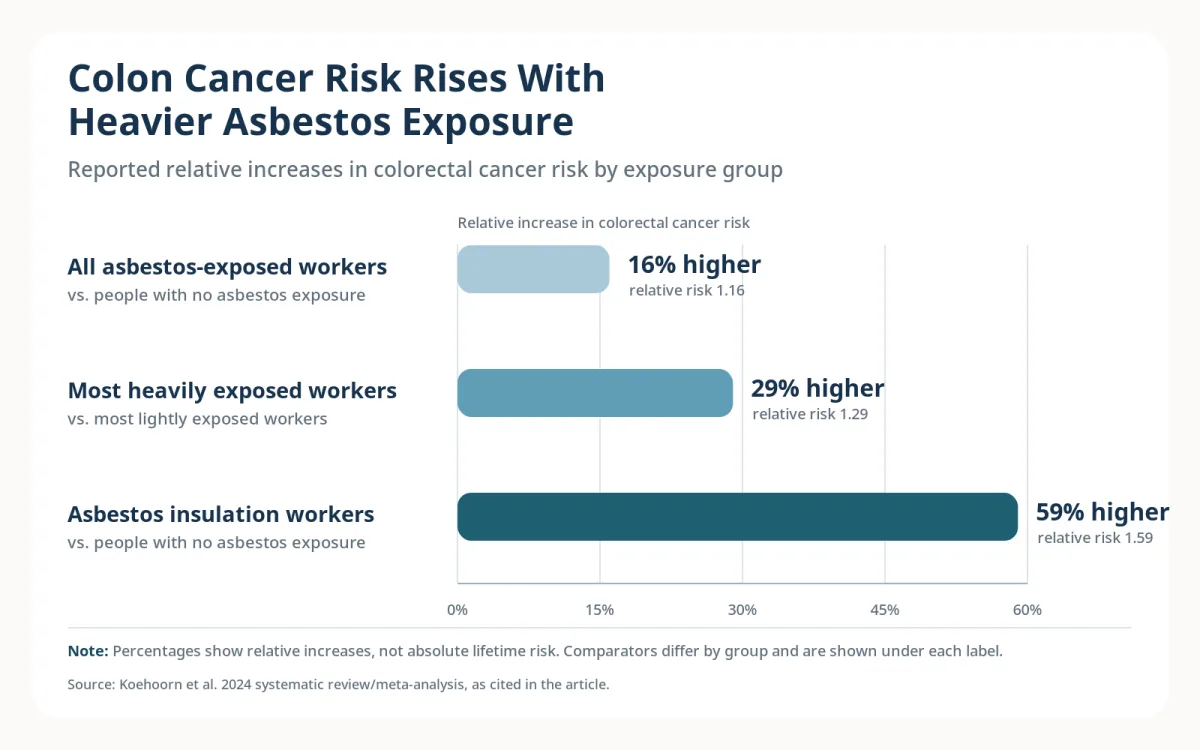
(Horizontal bar chart showing reported relative increases in colorectal cancer risk by asbestos exposure group: 16% higher among all asbestos-exposed workers and 59% higher among asbestos insulation workers, each compared with unexposed workers or general-population rates, and 29% higher among the most heavily exposed workers compared with the most lightly exposed workers in the same studies.)
How the science on asbestos and colorectal cancer developed
The colorectal cancer link has a long and genuinely contested history, and it's worth seeing how the science arrived where it is.
The first signal came in 1964, when Selikoff and his colleagues followed 632 asbestos insulation workers who had entered the trade before 1943 and found 29 deaths from stomach, colon, or rectal cancer where about 9.4 would have been expected, roughly three times the expected rate for those cancers combined.1 It was a striking result, and it came from the most heavily exposed trade of all. But that study didn't settle the question. Over the next several decades the evidence split: some cohort studies of asbestos workers found excess colorectal cancer and others didn't, and many of the early ones leaned on death records rather than diagnoses and couldn't account for diet, smoking, and the other ordinary drivers of colon cancer. A skeptic could read that record and argue the link wasn't real.
What kept the question alive was a pattern inside the disagreement. The studies of lightly exposed workers tended to show little or no excess risk, while the studies of heavily exposed workers kept finding one. The signal tracked the dose, the same way it does in the figures above.
The authoritative reviews moved with that evidence, and their own caution shows how live the debate still was. In 2006 the U.S. Institute of Medicine called the evidence that asbestos causes colorectal cancer suggestive.2 In 2012 the World Health Organization's International Agency for Research on Cancer (IARC) panel split over whether it was strong enough to call asbestos a cause of colon cancer outright.3 In 2014 the Helsinki expert group found the evidence consistent, especially at heavy and long-duration exposure, but stopped short of calling it definitive.4
What changed was the volume and quality of the data. A 2024 review included 144 studies of colorectal cancer, far more than any earlier evaluation, applied a rigorous method for separating the genuinely heavily exposed workers from the rest, and held up under repeated sensitivity testing. With that fuller picture, its authors concluded that the evidence now supports a causal link between occupational asbestos exposure and colorectal cancer, strongest where exposure was heaviest.5 That is a significant update from one research group. The formal evaluations by IARC, the Institute of Medicine, and the Helsinki group haven't been revised since, and the results still varied from study to study, so the question is better described as moving toward a causal link than as settled.
How asbestos fibers reach the colon
Asbestos fibers are microscopic, far thinner than a human hair, and they reach the digestive tract two ways. Some are swallowed. Fibers caught in the airway get swept back up toward the throat by the lung's natural cleaning system, the slow conveyor that clears everyday dust, and they're then swallowed down into the stomach and intestines. Others are ingested directly, off contaminated hands, food, or drink in a dusty workplace.
Once in the gut, some of these fibers can lodge in the wall of the colon. We know they reach it because pathologists have gone looking and found them there. In one study of colon-cancer patients, asbestos fibers or the iron-coated "asbestos bodies" that form around them turned up in the colon tissue of 14 of 44 workers with a history of asbestos exposure, and in none of 20 colon-cancer patients without that exposure. The fibers were often sitting in the tumor tissue itself.7 That study shows the fibers get there; it doesn't show they caused the tumors. The proposed explanation is that, lodged in the colon wall, they set off the same kind of chronic inflammation and cellular damage they do in the lung, and that over decades this contributes to the genetic changes that lead to cancer. That's also why asbestos-related colon cancer, like the other asbestos diseases, usually takes 20 years or more to surface after exposure.
Why documented asbestos lung disease is the key to compensation
For colon cancer, the presence of asbestosis does two jobs at once, one medical and one legal.
Medically, it's the marker of the exposure where the risk is significant. The 2024 evidence is consistent on this point: the colon cancer signal was strongest in exactly the groups whose exposure was heaviest, the insulation trades most of all.5 Asbestosis is the clinical evidence that a person was exposed at that level. It documents the kind of heavy exposure where the colorectal risk is strongest, and it supports, though it doesn't by itself prove, that asbestos contributed to a particular person's cancer; colon cancer has other common causes, and a doctor weighs them all.
It also answers the question a skeptic raises first: whether smoking, itself a cause of colon cancer, is the real culprit behind a smoker's case. The 2024 review weighed that, and the evidence is reassuring, if not conclusive. Studies that recorded their workers' smoking gave much the same results as those that didn't, and a very large Nordic occupational study, covering millions of workers, found only minimal to moderate change in colon and rectal cancer risk after adjusting for smoking and alcohol, though its job groups weren't defined by asbestos exposure. Too few studies recorded smoking to analyze it directly, but the review found little evidence that smoking or other unmeasured factors explain the asbestos signal.5
Legally, documented lung or pleural disease is what qualifies a colon cancer claim at most trusts. Most trusts include colon cancer in their "other cancer" category and look for documented asbestosis, usually a chest X-ray read at 1/0 or higher by a certified B-reader, or bilateral pleural disease (plaques or thickening on both sides of the chest), along with a qualifying work history and a doctor's opinion that asbestos contributed. The same evidence of heavy exposure has helped some asbestos colon cancer cases survive challenge and reach a jury, though courts have also excluded causation testimony in others.
What's a B-read, and what does "1/0" mean?
A B-read is a standardized reading of a chest X-ray by a doctor specially certified to spot the lung scarring that asbestos and other mineral dusts leave behind. It isn't a routine radiology report. B-readers are trained and tested by NIOSH, the federal occupational-health institute, to use the International Labour Organization's (ILO) standard classification, which helps different readers looking at the same film reach consistent results. B-readers must pass the NIOSH exam again every five years.
The "1/0" is a score on the ILO scale, which grades how many small scar-like shadows (opacities) show in the lung itself; changes in the lung lining, like pleural plaques, are recorded separately. It runs from 0, meaning none, up through 1, 2, and 3 as the scarring grows more extensive. Each reading is written as two numbers: the first is the grade that best fits the film, and the second is the nearest grade the reader also seriously considered. So "1/0" means the reader settled on category 1 after weighing category 0. Most trusts treat 1/0 or higher as documented asbestos-related scarring for a claim, and many also accept a CT scan or pathology showing the disease. A B-read is one piece of evidence, though, not a diagnosis by itself: a clinical diagnosis of asbestosis also depends on your exposure history, the time since exposure, and your doctor's assessment, sometimes including a CT scan.
How people with colon cancer were exposed to asbestos
The core group here is the trades with the heaviest, most sustained exposure: insulators, boilermakers, pipefitters, shipyard and construction workers, and others who handled asbestos insulation, cement, and fireproofing day in and day out. Because colon cancer risk climbs with the dose, as the studies above show, it's that heavy, long-running exposure that carries these claims.
But they weren't the only ones exposed. From the 1950s through the early 1980s, asbestos was so common in industrial and commercial work that almost anyone in a blue-collar trade or industry breathed some of it, often without knowing the material contained asbestos at all. If your work, or a family member's, involved insulation, boilers, pipes, furnaces, building materials, or dusty plants and job sites, it's worth learning how heavy that exposure really was. Learn more about asbestos exposure on the job.
Asbestos also reached the home and family members of asbestos workers. The fibers that settled on a worker's clothes, hair, and shoes came home too, and the family members who shook out and laundered those clothes, year after year, breathed them in. This wasn't a trivial dose, either. In one study of the families of asbestos factory workers, about a third of household members who had never worked with asbestos themselves had asbestos-related changes on their chest X-rays, mostly in the lining of the lungs, which tells you the exposure at home could be heavy enough to cause asbestos disease in its own right.8 The colorectal risk figures above come from studies of workers, and household exposure hasn't been measured separately for colorectal cancer, but a spouse or child with that kind of exposure history may share some of the elevated risk. Learn more about take-home asbestos exposure.
Asbestos wasn't a single product. It was built into insulation, cement, gaskets, fireproofing, floor tile, joint compound, and hundreds of other materials across dozens of industries, which is why the exposure could have come from almost any direction. See the kinds of products made with asbestos.
Symptoms of and screening for colon cancer
Colon cancer is often unnoticed until it's advanced, and its early signs (a change in bowel habits, blood in the stool, ongoing abdominal pain or cramping, unexplained weight loss, persistent fatigue) often get mistaken for ordinary digestive trouble. Anyone with a history of asbestos exposure should take those signs seriously and mention the exposure to their doctor.
Screening is straightforward and effective. A colonoscopy is the gold standard, finding and removing precancerous polyps before they ever become cancer and catching tumors early, when they're most treatable. National guidelines recommend routine colorectal screening starting at 45 for most adults, and earlier or more often for people with added risk.
The chest X-ray we provide is a different test with a different job: it isn't colon cancer screening. A chest X-ray read by a certified B-reader documents asbestos-related changes in the lungs and their lining, for your claim and for your own doctor, who can decide what follow-up makes sense. We offer a free asbestos health test to people who qualify, and we cover the cost of follow-up imaging when your history warrants it, whether or not you turn out to be eligible for compensation. The test is a chest X-ray read by a B-reader, with a CT scan if needed; it looks for asbestos-related changes in the lungs, which can help show exposure, and it isn't a test for colon cancer. If you worked around asbestos, or lived with someone who did, call 833-4-ASBESTOS to schedule it.
How colon cancer is treated
Treatment depends on how far the cancer has spread, and for most people it begins with surgery. For early-stage colon cancer, an operation to remove the affected section of colon and the nearby lymph nodes is the main treatment, and on its own it often cures the disease. When the cancer has reached the lymph nodes, surgery is usually followed by chemotherapy to clear any cancer cells left behind; for some larger tumors that haven't spread to the nodes, chemotherapy depends on other risk factors, and sometimes it's given beforehand to shrink the tumor first.9
For cancer that has spread beyond the colon, the options now reach well past chemotherapy alone, and treatment is increasingly matched to the tumor's own biology. Some colon cancers carry genetic changes that make them respond to targeted drugs aimed at those specific mutations, and a subset with certain DNA-repair defects respond to immunotherapy, which turns the immune system against the cancer. Which approach fits depends on testing the tumor itself.10
Care is usually directed by a team rather than one doctor, commonly a surgeon and a medical oncologist (a cancer-drug specialist), with a radiation oncologist involved when radiation is being considered, which for colon cancer (unlike rectal cancer) is uncommon. They plan and adjust treatment together and weigh the choices with the patient.
This is an orientation, not medical advice. Your own care team will tailor a plan to your diagnosis, your overall health, and what the tumor testing shows. For a fuller, plain-language walk through the current options stage by stage, the National Cancer Institute's regularly updated summary, Colon Cancer Treatment (PDQ), is an excellent place to read more.
Compensation, and how it helps pay for treatment
A colon cancer diagnosis is costly and exhausting, and compensation exists to take that weight off you and your family. When the cancer is tied to asbestos exposure, several sources of recovery can be available, and they don't all ask for the same proof.
Asbestos trust funds are the most common path. Most of the trusts set up by bankrupt asbestos companies include colon cancer in the "other cancer" part of their schedule, meaning the cancers beyond mesothelioma and lung cancer. For a colon cancer claim, most of them require, on top of the diagnosis, documented asbestos disease of the lung or its lining: asbestosis (scarring of the lung) or bilateral pleural disease (plaques or thickening on both sides of the chest). They also require a qualifying exposure history, typically five years of cumulative asbestos exposure plus exposure to that trust's own company's products, and a doctor's opinion that asbestos contributed to the cancer. Learn more about asbestos trust claims for colon cancer.
Lawsuits against the companies responsible for the exposure are also possible, and some courts have allowed asbestos colon cancer cases to go to a jury. These cases lean on the same proof: because asbestos is only one of several causes of colon cancer, a case generally depends on documenting heavy exposure, and asbestosis is the strongest evidence of it. What's required and how long you have vary by state, so it's worth checking yours promptly. Learn more about asbestos lawsuits.
So for trust claims, documented asbestos lung disease is the anchor: asbestosis, or for most trusts bilateral pleural disease, is the documented evidence of heavy exposure that qualifies a colon cancer claim. In a lawsuit, it's usually the strongest evidence of heavy exposure, though not the only kind. That's the practical reason the free chest X-ray we offer matters so much, since that film can be what documents it. Recovery via trust claims or lawsuits helps cover treatment costs, eases the strain on your family, and makes sure the companies that exposed you to asbestos bear the costs your family has to pay. See how much asbestos trusts pay and how their payment percentages work.
Two additional channels for compensation work differently, and neither one requires asbestosis. Social Security disability looks at whether the illness keeps you from working, not at how you got it, so colon cancer can qualify whatever its cause; you also need enough work credits, and the illness must be expected to last at least a year or be terminal. Some advanced colon cancers meet Social Security's listing for cancer of the large intestine outright. Veterans' benefits turn on whether the exposure happened during military service and is connected to the illness, not on any lung-scarring diagnosis. Colon cancer isn't on the VA's list of conditions presumed to be service-connected, so a VA claim usually needs a doctor's opinion linking the cancer to in-service asbestos exposure. Learn more about disability claims for colon cancer.
Talk to us
You focus on your health. We'll take care of the rest.
If you've been diagnosed with colon cancer and you worked with or around asbestos, especially if you also have asbestosis, you may have a claim, and you may qualify for a free health test today. Call 833-4-ASBESTOS or contact us here for a free, no-obligation review. There's no fee unless we win.
References
- Selikoff IJ, Churg J, Hammond EC. Asbestos exposure and neoplasia. JAMA. 1964;188:22-26. doi:10.1001/jama.1964.03060270028006
- Institute of Medicine. Asbestos: Selected Cancers. Washington, DC: National Academies Press; 2006.
- International Agency for Research on Cancer. Asbestos (chrysotile, amosite, crocidolite, tremolite, actinolite, and anthophyllite). In: IARC Monographs on the Evaluation of Carcinogenic Risks to Humans. Vol 100C. Lyon, France: IARC; 2012:219-309.
- Wolff H, Vehmas T, Oksa P, Rantanen J, Vainio H. Asbestos, asbestosis, and cancer, the Helsinki criteria for diagnosis and attribution 2014: recommendations. Scand J Work Environ Health. 2015;41(1):5-15. doi:10.5271/sjweh.3462
- Koehoorn M, McLeod CB, Fan J, et al. Occupational asbestos exposure and gastrointestinal cancers: systematic review and meta-analyses. Occup Environ Med. 2024;81(12):639-646. doi:10.1136/oemed-2024-109707
- Selikoff IJ, Hammond EC, Seidman H. Mortality experience of insulation workers in the United States and Canada, 1943-1976. Ann N Y Acad Sci. 1979;330:91-116. doi:10.1111/j.1749-6632.1979.tb18711.x
- Ehrlich A, Gordon RE, Dikman SH. Carcinoma of the colon in asbestos-exposed workers: analysis of asbestos content in colon tissue. Am J Ind Med. 1991;19(5):629-636. doi:10.1002/ajim.4700190507
- Anderson HA, Lilis R, Daum SM, Selikoff IJ. Asbestosis among household contacts of asbestos factory workers. Ann N Y Acad Sci. 1979;330:387-399. doi:10.1111/j.1749-6632.1979.tb18741.x
- PDQ® Adult Treatment Editorial Board. PDQ Colon Cancer Treatment. Bethesda, MD: National Cancer Institute. Updated 05/16/2025. Available at: https://www.cancer.gov/types/colorectal/patient/colon-treatment-pdq. Accessed 10/27/2026.
- Morris VK, Kennedy EB, Baxter NN, et al. Treatment of metastatic colorectal cancer: ASCO guideline. J Clin Oncol. 2023;41(3):678-700. doi:10.1200/JCO.22.01690
Key Sources
- Homa DM, Garabrant DH, Gillespie BW. A meta-analysis of colorectal cancer and asbestos exposure. Am J Epidemiol. 1994;139(12):1210-1222. doi:10.1093/oxfordjournals.aje.a116967. An earlier meta-analysis of 20 cohorts that found elevated colorectal cancer risk in workers exposed to amphibole asbestos but not chrysotile, and cautioned that misclassified causes of death might explain part of it; an example of how contested the question was.
In our case-law library
20 court decisions in our case-law library involve colon cancer. Among them:
- In re Joint Eastern & Southern Dist. Asbestos Lit.U.S. Court of Appeals, Second Circuit, 1995 · The Second Circuit reversed the district court's judgment as a matter of law for United States Mineral Products and reinstated the plaintiff's jury verdict, affirmed rulings against the contractor third-party defendants, and remanded so plaintiff could choose between the remittitur and a new trial.
- Newman v. RichardsonWest Virginia Supreme Court of Appeals, 1991 · The court granted the widows' mandamus petition as molded, ordering the Workers' Compensation Commissioner to reprocess their claims as occupational pneumoconiosis claims and to pay their attorney's fees, but it did not order immediate referral to the Occupational Pneumoconiosis Board.
- Landrigan v. Celotex Corp.New Jersey Supreme Court, 1991 · The New Jersey Supreme Court reversed the Appellate Division, set aside the directed verdict for Owens-Corning and Owens Illinois, and remanded for retrial, so plaintiff Angelina Landrigan won.
- Smith v. Bethlehem Steel Corp.Maryland Court of Appeals, 1985 · The Court of Appeals of Maryland answered two certified questions: workers' compensation § 58 does not toll limitations until an award is made, and a later colon cancer claim can be a separate cause of action accruing on discovery if the cancer is a latent disease distinct from asbestosis. Appellee asbestos suppliers prevailed on the first question and the Smiths on the second.
- Welsh v. Ford Motor Co.Ohio Court of Appeals, 2011 · The court of appeals affirmed the jury verdict and the denial of directed verdict, JNOV and new trial, so the widow Sylvia Welsh won and Ford Motor Company lost.
- Nelson v. Aurora Equipment CompanyIllinois Appellate Court, 2009 · Affirmed the circuit court's summary judgment for Aurora Equipment Company, holding it owed no premises-liability duty to Eva Nelson's estate, which lost.
Talk with an asbestos lawyer
Start with what you remember, and we'll take it from there.
This page is provided for general informational purposes and does not constitute legal advice. Every asbestos case turns on its own facts, exposure history, diagnosis, deadlines, available evidence, and applicable law. Reviewing this page does not create an attorney-client relationship. For advice about your specific situation, call 833-4-ASBESTOS for a free case review.