

If you or someone you love has just been diagnosed with peritoneal mesothelioma, this page is the place to start understanding what that diagnosis means and what comes next.
Peritoneal mesothelioma is the rarer of the two main forms of the disease, accounting for roughly 10 percent of mesothelioma cases, with published estimates ranging from about 7 to 30 percent.1,5,7 It forms in the peritoneum, the thin membrane that lines the abdominal cavity and wraps the organs inside it, and asbestos is its leading known cause. When asbestos is responsible, a slow biological process usually takes decades to surface as cancer, which is why a diagnosis today often traces back to work or exposure that ended long before. The documented link is less consistent than in pleural mesothelioma, especially in women, and many patients, women in particular, don't know whether or how they were ever exposed. A careful exposure investigation can help rule asbestos in or out.
It's also, in a real sense, a different disease than it was twenty years ago. A combined operation called cytoreductive surgery with hyperthermic intraperitoneal chemotherapy (CRS-HIPEC), which removes the visible tumor from the abdomen and then bathes the area in heated chemotherapy, has changed what's possible for the patients who qualify for it. In a 2024 multi-center study, median survival after CRS-HIPEC was about 44 months, and some patients with favorable disease live well beyond that.1 Those outcomes depend heavily on where the treatment happens, because the procedure takes a specialized surgical team and an institution that handles this disease routinely; in a national database study, patients treated at academic facilities were more likely to receive surgery and had longer survival than those treated at community hospitals.6
This page covers what peritoneal mesothelioma is, how the fibers reach the abdomen, how doctors diagnose and stage it, what the cell types mean, what treatment looks like in 2026, and how families pay for the best care. You don't have to read it all at once, and you don't have to have decided anything before calling us. Whether you're a patient who just heard the diagnosis, or a spouse or adult child trying to find the next step, we're ready to listen.

You don't need the product names or old records. No fee unless we recover compensation for your family.
Quick answers
| What exactly is peritoneal mesothelioma? | Peritoneal mesothelioma is a cancer that forms in the peritoneum, the thin membrane that lines the abdominal cavity and covers the organs inside it. Asbestos is its leading known cause: fibers that reached the abdomen decades earlier can lodge in the lining and set off the slow biological process that eventually produces cancer. It's the second most common form of mesothelioma, after the pleural (chest) form. |
|---|---|
| Is peritoneal mesothelioma the same as ovarian or stomach cancer? | No, though it's mistaken for them often. Peritoneal mesothelioma starts in the abdominal lining itself, not in the ovaries, stomach, or bowel, but its early symptoms (bloating, abdominal pain, fluid buildup) look like those of far more common abdominal and gynecological conditions. That resemblance is why it's often misdiagnosed or diagnosed late, and why a history of asbestos exposure is such an important clue for reaching the right diagnosis. |
| Is peritoneal mesothelioma always caused by asbestos? | Not always, but asbestos is the leading known cause, and no safe level of exposure has been identified. The documented link is weaker than in pleural mesothelioma: in published series, the share of patients with a recorded asbestos history varies widely and is lower among women, partly because exposures such as a family member's work clothes or a contaminated product are easy to miss.1,2,7 Fibers are thought to reach the abdomen after being inhaled and carried to the peritoneum, or after being swallowed, and in some women through long-term use of asbestos-contaminated talc. A peritoneal mesothelioma diagnosis is a reason to look carefully for past asbestos exposure, even when the person doesn't recognize any; a structured investigation can help rule asbestos in or out. |
| What's the prognosis? | Prognosis varies more widely in peritoneal mesothelioma than in almost any other cancer, and that range is shaped by factors you can still influence. Outcomes depend on the cell type, on how widely the disease has spread across the abdomen (measured by a score called the PCI), and above all on whether the patient is a candidate for CRS-HIPEC at an experienced center. Patients with favorable disease who undergo that surgery can live years, sometimes well beyond five; patients managed with chemotherapy alone generally have much shorter survival. |
| Can it be treated, and what is CRS-HIPEC? | Yes, and for eligible patients the results can be substantial. The cornerstone treatment is CRS-HIPEC: surgery to remove all the visible tumor from the abdomen, followed immediately by heated chemotherapy delivered directly into the abdominal cavity to reach what surgery can't. It isn't right for everyone, and patients who aren't surgical candidates are treated with chemotherapy and, increasingly, immunotherapy. Treatment is rarely a cure, but it can extend life and quality of life meaningfully, especially at centers that treat this disease often. |
| Does it matter where I'm treated? | More than in almost any other cancer. Peritoneal mesothelioma is rare enough that most oncologists see only a handful of cases in a career, while a small number of high-volume centers handle it routinely and have the surgical teams and infrastructure that CRS-HIPEC requires. In a national database study, patients treated at academic centers were more likely to have surgery and lived longer on average than those treated at community hospitals. A consultation at a specialty center, even if you keep getting most of your care closer to home, is one of the highest-value steps you can take, and if cost or travel is the barrier, the firm can help. |
| Do I need to prove a specific amount of asbestos exposure to make a claim? | Not usually for the trusts. Example trust procedures for mesothelioma require a qualifying diagnosis, a ten-year latency, and credible exposure to that company's products, but set no minimum exposure duration. You also don't need brand names, employment records, or union cards in hand to start; a lawsuit may require more detailed proof. If you can describe where you worked and when, or how you were exposed at home or through talc, that's a starting point. |
“I started this firm after learning that the cancers that killed my father and grandparents were caused by asbestos, something we did not realize until it was too late to hold anyone accountable. That experience is why we built this site: so that no other family misses their chance to ask the questions, hear the options, and decide for themselves what to do.”
What peritoneal mesothelioma is
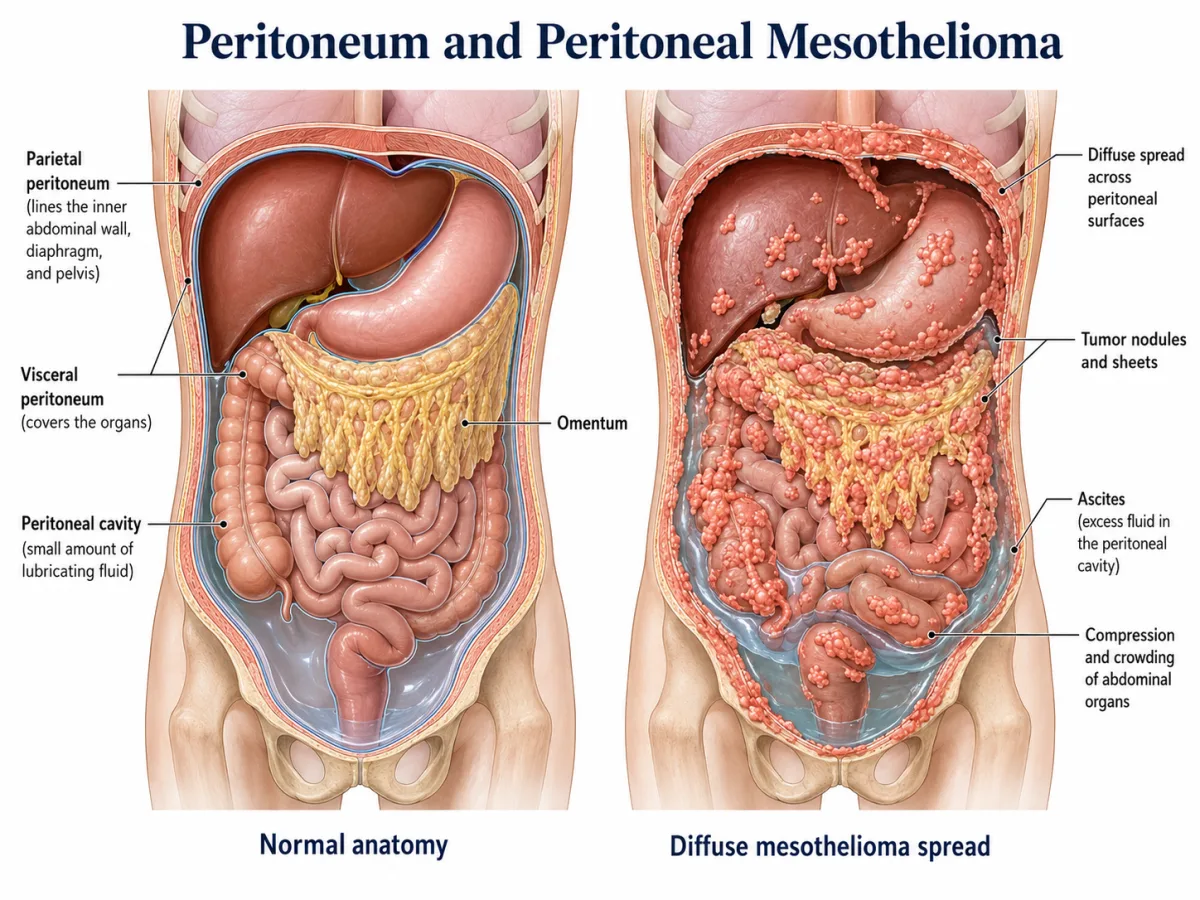
The peritoneum is a thin membrane that lines the abdominal cavity and folds inward to cover the organs inside it. Like the pleura in the chest, it has two layers: the parietal peritoneum, which lines the abdominal wall, the diaphragm, and the pelvis, and the visceral peritoneum, which wraps the stomach, intestines, liver, and other organs. Between the two layers is the peritoneal cavity, normally holding only a small amount of lubricating fluid that lets the organs slide smoothly against one another. A fatty, apron-like fold of the membrane called the omentum hangs over the abdominal organs. Peritoneal mesothelioma forms in this lining and spreads across its surfaces.
That spread pattern is one of the most important things to understand about the disease. Rather than forming a single discrete mass the way many cancers do, peritoneal mesothelioma grows diffusely, seeding the peritoneal surfaces with sheets and nodules of tumor scattered across many regions of the abdomen at once. As it grows, it disrupts the membrane's normal handling of fluid, so fluid builds up in the abdominal cavity (a condition called ascites), and the accumulating tumor adds bulk that presses on the stomach and bowel. This pattern explains the symptoms most patients first notice, and it's also why peritoneal mesothelioma can't be staged with the tumor-size measurements used for most cancers. It's measured instead by how widely it has spread across the abdomen, which is what the PCI score captures and what the staging section below explains.
How asbestos reaches the peritoneum
The route from asbestos exposure to peritoneal cancer is less obvious than the inhale-it-into-the-lungs path of pleural disease. Several routes have been proposed, and no test can show which one applied in a particular person.
Inhaled fibers carried to the abdomen. The most commonly proposed route begins the same way pleural disease does: asbestos fibers are inhaled deep into the lungs. From there, the thinnest fibers can enter the lymphatic system, the network of vessels that drains fluid from the body's tissues. That network connects the chest to the abdomen, and it can carry fibers to the peritoneal lining and the omentum, where they lodge.
Swallowed fibers. Fibers can also be swallowed, in contaminated food or water, off dusty hands, or after being cleared up out of the airways and into the throat (a normal process that moves trapped fibers out of the lungs and into the digestive tract). Once swallowed, fibers can pass through the wall of the gastrointestinal tract into the peritoneal cavity, or reach it through the abdomen's own lymphatic network.
Asbestos-contaminated talc. Talc and asbestos are minerals that often occur together in the ground, and some consumer talcum powder products were found to be contaminated with asbestos. Contaminated powder can be inhaled during use, and in women one proposed route is that particles applied for personal hygiene travel upward through the reproductive tract into the peritoneal cavity; how often that happens is debated. For people with no workplace or household asbestos exposure, long-term use of a contaminated product is a potential source worth investigating. It's covered in full on the women's page below.
What happens once fibers arrive. However they get there, what follows is the same slow process that precedes mesothelioma anywhere in the body. The immune system attacks the embedded fibers but can't break them down or clear them, so the inflammation never resolves. Decades of chronic inflammation and physical irritation damage the surrounding cells, and eventually that damage reaches the genes that control how cells grow and repair themselves. When those controls fail, cells that should stop dividing keep dividing, and a tumor forms. The shared biology of that cascade is covered in more depth on the mesothelioma hub page; the peritoneal-specific point is simply that the abdomen is where these particular fibers ended up.
The whole sequence, from first exposure to diagnosis, typically takes several decades, most often 20 to 50 years, and occasionally longer. Most people diagnosed today were exposed long ago, often without realizing it: on a job that used asbestos insulation, gaskets, cement, brakes, or fireproofing; through a parent's or spouse's dusty work clothes brought home; during Navy or other military service; or, for some women, through years of cosmetic talc use. The history that explains a diagnosis can be decades old and only partly remembered, and reconstructing it is part of what a claim involves.
Even brief or indirect exposure can be enough
A common assumption is that only long, heavy asbestos exposure causes mesothelioma. It isn't so. Heavier and longer exposure raises the statistical risk, but there's no exposure level the medical consensus considers safe, and many people with peritoneal mesothelioma had only brief or indirect contact: a few months on a job site, a parent's work clothes, or years of cosmetic talc use they never tied to asbestos. If you were exposed even briefly or secondhand, that history matters both medically and legally. Whether it supports a claim depends on the facts, but brief and indirect exposures often can.
Symptoms of peritoneal mesothelioma
Peritoneal mesothelioma rarely causes symptoms early, and the ones that finally bring patients in look almost exactly like those of far more common conditions. Abdominal pain gets blamed on irritable bowel syndrome, bloating on diet, fluid buildup on liver or heart trouble, and in women the whole picture is often mistaken for ovarian cancer. That's why it's often misdiagnosed or diagnosed late, and why some patients spend months being evaluated or treated for something else before the real diagnosis is reached. A national review of 155 patients in the UK and Ireland notes that diagnosis is often delayed because the symptoms are nonspecific and many patients present with advanced disease.4 In a study of 164 women, 15 percent were diagnosed incidentally, during surgery or imaging for something else, and among the cases referred for a second opinion, the initial diagnosis differed from the final one in about half, most often because the tumor had first been called a carcinoma.2
The single piece of information that most changes this pattern is asbestos exposure history. The same abdominal complaints that might prompt watchful waiting in someone with no asbestos history take on different weight in someone who spent years in a shipyard or a construction trade, or whose husband did. If you have known or suspected asbestos exposure and any of the symptoms below, that history needs to be part of the conversation with your doctor from the start, especially if the exposure was decades ago and even if it seemed minor at the time.
Abdominal fluid buildup (ascites)
The most common presenting sign of peritoneal mesothelioma is ascites, an abnormal buildup of fluid in the abdominal cavity, and it's often what finally sends a patient to the doctor. As tumor grows along the peritoneal surfaces, it disrupts the membrane's normal fluid balance, and fluid collects in the abdomen. Patients notice visible swelling, a sensation of heaviness or fullness, and as the volume increases, real discomfort. Ascites matters diagnostically in its own right: when it shows up in someone with an asbestos history, peritoneal mesothelioma belongs on the list of possibilities from the first evaluation, not after months of inconclusive workup.
Abdominal pain
Persistent abdominal pain is one of the earliest and most common symptoms. It may spread across the abdomen as a generalized ache or pressure, or sit more localized where tumor is concentrated. Early on it's often dull and comes and goes, which makes it easy to write off as a digestive problem; as tumor burden grows, the pain usually becomes more constant. Pain that persists, worsens, and doesn't respond to the usual measures for a gastrointestinal cause (dietary changes, acid suppression, motility drugs) deserves a closer look, especially with an asbestos history.
Bloating, fullness, and digestive changes
Beyond the swelling caused by ascites, many patients describe a steady sense of abdominal distension that doesn't track with eating or bowel habits, the cumulative bulk of tumor distributed across the peritoneal surfaces and the omentum. As those deposits press on the stomach and bowel, they produce symptoms easily mistaken for ordinary digestive trouble: feeling full after only a few bites, nausea with no clear cause, new constipation or other changes in bowel habits, and intermittent episodes that resemble a partial bowel blockage. Many patients notice that clothing fits differently over a few weeks or months, or that they feel full without having eaten much.
A new or worsening hernia
Some patients develop a new hernia, or notice an existing one getting worse, most often at the navel or groin. Rising pressure inside the abdomen from ascites and tumor bulk can push tissue through weak points in the abdominal wall. A hernia that appears or worsens suddenly alongside other abdominal symptoms is worth evaluating in that context rather than treating as an isolated structural problem.
Weight loss, fatigue, and other whole-body symptoms
Several symptoms come from the cancer's effect on the whole body rather than the abdomen alone. Unintended weight loss with no change in diet, persistent fatigue that doesn't improve with rest, and low-grade fevers or night sweats all reflect a body fighting a cancer it can't resolve. The weight loss has a second driver in peritoneal disease: nausea, early fullness, and reduced appetite cut calorie intake at the same time the tumor is raising the body's calorie demand. Any one of these on its own is nonspecific and easy to dismiss; in combination with the abdominal symptoms above, and with a history of asbestos exposure, they point to something that needs investigating.
What to tell your doctor
If you're having persistent abdominal symptoms and have any history of asbestos exposure, occupational, military, or secondhand through a family member, say so to your doctor directly and early, and ask whether your symptoms could be related to it. Ask whether cross-sectional imaging is appropriate if it hasn't been done; a contrast-enhanced CT scan of the abdomen and pelvis is a common first study when it's clinically indicated. If the initial workup is inconclusive, ask for referral to a gastroenterologist or a surgical oncologist with experience in peritoneal disease rather than continuing to chase each symptom in isolation.
Speed matters here more than in most cancers. Patients whose disease is caught at low tumor burden, before it has spread widely across the peritoneal surfaces, are far more likely to qualify for CRS-HIPEC, the surgery that drives the best outcomes. The difference between being a surgical candidate and not often comes down to how quickly the right diagnosis was reached, so pressing for a clear answer is worth doing.
How peritoneal mesothelioma is diagnosed
Peritoneal mesothelioma is rarely diagnosed in a single test. It usually emerges from a sequence of imaging, fluid sampling, tissue biopsy, and specialized pathology, often across several specialists and several weeks. Because the disease is rare and its symptoms are shared by dozens of more common conditions, it doesn't sit high on most clinicians' lists even when the symptoms are persistent and unexplained. Below is how that sequence typically unfolds, and which steps matter most for peritoneal disease specifically.
Imaging
The workup almost always begins with cross-sectional imaging, usually ordered to investigate unexplained abdominal symptoms or ascites. Imaging characterizes how far the disease has spread, points to the best sites for biopsy, and gives a first read on whether surgery may be possible.
A contrast-enhanced CT of the abdomen and pelvis is the standard first study. It can show ascites, thickening of the peritoneum, involvement of the omentum, and tumor nodules scattered across the peritoneal surfaces, the characteristic findings of the disease. Its main limitation is that CT consistently underestimates the true extent of peritoneal disease, particularly small deposits on the bowel and the tissue that supports it, compared with what surgeons actually find.5
MRI, including diffusion-weighted imaging, may add information about small bowel involvement, one of the most important variables in deciding whether CRS-HIPEC is feasible and one that CT can miss. Evidence for MRI's accuracy comes mainly from other peritoneal cancers, and the PSOGI/EURACAN guideline notes there are no data specific to peritoneal mesothelioma, so centers use it selectively.5
PET-CT adds metabolic information, highlighting tissue with the high glucose uptake typical of active tumor. In this disease it's most useful for catching spread outside the abdomen that would change the surgical plan. It shares CT's blind spot for very small deposits, so it's used selectively rather than in every case.
One limitation runs across all of these: no combination of CT, MRI, and PET-CT can confirm peritoneal mesothelioma on its own. Imaging identifies findings consistent with the diagnosis and guides the biopsy. Only a biopsy can confirm it.
Fluid testing
When ascites is present, draining the fluid through a needle procedure called paracentesis (the abdominal counterpart of thoracentesis in the chest) serves two purposes: it relieves the pressure and discomfort, and it provides a fluid sample a pathologist can examine for cancer cells.
The catch is that fluid analysis seldom settles the diagnosis. The reported sensitivity of fluid cytology for this disease ranges from about 30 to 75 percent, guidelines call for tissue rather than fluid for a definitive diagnosis, and even when mesothelioma cells turn up, the fluid can't reliably establish the cell type that treatment planning depends on.5 The cells are also hard to tell apart from benign reactive cells and from the cells of other abdominal cancers, including ovarian and primary peritoneal carcinoma. Paracentesis is a useful early step, but a tissue biopsy is needed in nearly every case.
Biopsy
A biopsy takes actual tissue from the peritoneal lining or a tumor deposit, and it's the only way to diagnose peritoneal mesothelioma with confidence. Tissue lets pathologists examine the cells directly, run the antibody stains that confirm the diagnosis, and determine the cell type that shapes every later decision.
The PSOGI/EURACAN guideline accepts either a core needle biopsy or a diagnostic laparoscopy as adequate tissue sampling.5 Many experienced centers favor laparoscopy, because in peritoneal disease it does something with no real parallel in the chest: it confirms the diagnosis and measures how far the disease has spread in the same procedure. Through small incisions, a surgeon can look directly at the peritoneal surfaces, see the pattern and distribution of the tumor, take targeted samples from several regions, and estimate the PCI score (the spread measurement the staging section explains) from direct inspection. That single procedure often determines whether a patient proceeds to CRS-HIPEC, and when. Because the surgeon can sample several regions and target the most representative disease, laparoscopy is also more accurate than a needle approach.
When laparoscopy isn't feasible, in a patient too frail for even a minimally invasive procedure, or when imaging shows a clearly reachable mass, a CT- or ultrasound-guided core needle biopsy is the alternative. Its limitation is sample size: a needle yields less tissue, which can make it harder to pin down the cell type and can miss disease in regions the needle didn't reach. In a disease where the difference between cell types can decide surgical candidacy, that matters, so many teams prefer laparoscopy when it's feasible.
Pathology and immunohistochemistry
Once tissue is in hand, diagnosing peritoneal mesothelioma is more involved than for most cancers, because it has to be separated not just from benign conditions but from a specific set of other cancers that can look identical in the abdomen. The most important mimics are primary peritoneal carcinoma, ovarian serous carcinoma (especially in women), colorectal and appendiceal metastases, and a rare tumor called desmoplastic small round cell tumor. Telling these apart isn't always possible on a routine microscope slide, and it takes a targeted panel of immunohistochemical (IHC) stains, which use antibodies that bind to proteins specific to particular cell types, read by a pathologist with experience in peritoneal disease.
The pattern across the whole panel, read together with the tumor's appearance, is what supports the diagnosis; no single marker is perfectly specific. The table below shows how the markers most commonly used typically read in peritoneal mesothelioma versus its principal mimics:8
| Marker | Peritoneal mesothelioma | Primary peritoneal / ovarian carcinoma | Colorectal metastasis |
|---|---|---|---|
| Calretinin | Usually positive | Usually negative, but positive in a minority | Usually negative |
| WT-1 | Usually positive | Usually positive | Usually negative |
| D2-40 (podoplanin) | Usually positive | Usually negative; positive in about 20% of serous carcinomas | Usually negative |
| CK5/6 | Usually positive | Positive in about 30% of serous carcinomas | Usually negative |
| Mesothelin | Usually positive | Variable | Variable |
| BerEP4, MOC-31, claudin-4 | Usually negative | Usually positive | Usually positive |
| PAX8 | Usually negative, but positive in a minority | Usually positive | Usually negative |
| CEA | Usually negative | Variable | Usually positive |
| CA-125 | Variable | Usually positive | Usually negative |
| BAP1 | Often lost; retained staining does not exclude mesothelioma | Almost always retained | Usually retained |
The typical signature is positive calretinin, D2-40, and CK5/6 together with negative BerEP4, MOC-31, claudin-4, and CEA. Loss of the BAP1 protein, seen in more than half of peritoneal mesotheliomas, is especially useful because serous carcinomas almost never lose it; when BAP1 loss is found in a mesothelial proliferation, it strongly supports mesothelioma, but retained BAP1 does not rule mesothelioma out.2,8 BAP1 also carries treatment and clinical-trial implications, which the treatment page covers.
This panel has to be read by a pathologist experienced in peritoneal disease. General pathologists see this cancer rarely and may not be familiar with the full range of mimics or with borderline staining. Mistaking peritoneal mesothelioma for ovarian or primary peritoneal carcinoma is a documented and consequential error: it produces a treatment plan built around the wrong cancer and can delay access to CRS-HIPEC. If your diagnosis was made somewhere without specific peritoneal expertise, having your biopsy slides reviewed again at a major mesothelioma center is worth doing before treatment begins.
If you have a pathology report in hand and aren't sure what it says, call us at 833-4-ASBESTOS. A member of our litigation team, not a screener, will walk through it with you, including the cell type, the immunohistochemistry markers, and whether nuclear grading has been done. If your slides haven't been reviewed at a high-volume center, we can help arrange that.
How peritoneal mesothelioma is staged: PCI and CC
Most cancers are staged with the TNM system (tumor size, lymph nodes, distant spread), but peritoneal mesothelioma isn't, because TNM was built for cancers that form a discrete mass and spread in predictable steps. This disease grows diffusely across the abdominal lining in sheets and nodules scattered over many regions at once, with no single primary mass for TNM to measure. Two scores are used instead, and they measure different things at different moments. The Peritoneal Cancer Index (PCI) measures how widely the tumor has spread, and it's the main factor in deciding whether a patient is a candidate for CRS-HIPEC. The Completeness of Cytoreduction (CC) score measures how much tumor is left after surgery, and it's one of the strongest predictors of how a patient does afterward.
The Peritoneal Cancer Index (PCI)
The PCI divides the abdominal cavity into 13 regions: nine covering the peritoneal surfaces of the abdomen and pelvis, and four covering the small bowel and the tissue that anchors it. Each region is scored from 0 to 3 by the size of the largest tumor nodule in it:
| Lesion score | Largest visible tumor nodule |
|---|---|
| 0 | No tumor seen |
| 1 | Nodule up to 0.5 cm |
| 2 | Nodule 0.5 cm to 5 cm |
| 3 | Nodule larger than 5 cm, or confluent disease |
Adding the 13 region scores gives a total PCI from 0 to 39. A 0 means no visible disease anywhere; a 39 means every region has a nodule larger than 5 cm or confluent disease.
One thing sets peritoneal mesothelioma apart from other abdominal cancers here. The PCI was first developed for cancer that spreads to the abdomen from the colon, where a score around 20 became a rough cutoff for offering surgery. In mesothelioma the relationship is more forgiving: at high-volume centers, patients with PCI scores above 20 can still get meaningful benefit from CRS-HIPEC, especially with epithelioid disease. The number is a guide, not a hard line, and the distribution of the disease and how much the small bowel is involved matter alongside it.1,5
Still, the general relationship between PCI and outcome is consistent, with lower being better. The ranges below are a rough orientation, not validated cutoffs; a high PCI alone doesn't exclude surgery, and candidacy depends on where the disease sits, the cell type, fitness, and the likelihood of complete cytoreduction:5
| PCI range | Surgical implications | Expected outcomes |
|---|---|---|
| 0–10 | Strong candidate; complete cytoreduction highly achievable | Best outcomes; longest survival in favorable cell types |
| 11–20 | Candidate at most experienced centers | Good outcomes when complete cytoreduction is reached |
| 21–30 | Borderline; center experience and cell type are decisive | Surgery possible at high-volume centers; outcomes more variable |
| 31–39 | Generally not a surgical candidate | Systemic therapy is the primary approach |

The completeness of cytoreduction (CC) score
Where PCI is mostly assessed before and during surgery, the CC score is assessed by the surgeon at the end of the cytoreductive phase, just before the heated chemotherapy goes in. It measures the size of the largest tumor deposit still remaining anywhere in the abdomen:
| CC score | Residual disease after surgery |
|---|---|
| CC-0 | No visible tumor remaining |
| CC-1 | Residual nodules smaller than 2.5 mm |
| CC-2 | Residual nodules 2.5 mm to 2.5 cm |
| CC-3 | Residual nodules larger than 2.5 cm |
CC-0 and CC-1 are conventionally grouped together as a complete cytoreduction, because nodules smaller than 2.5 mm are thought to be within reach of the heated chemotherapy that follows surgery, and they're the goal of every CRS-HIPEC operation. CC-2 and CC-3 are a different story: when larger deposits remain, the chemotherapy can't reach the center of them, the leftover disease drives recurrence, and much of the operation's benefit is lost. In the multi-center study cited here, one-year survival was 93 percent after a CC-0 or CC-1 cytoreduction and 17 percent after CC-2 or CC-3.1
What PCI and CC mean together
PCI and CC are related but distinct. PCI predicts the probability of achieving a complete cytoreduction; CC records whether it was actually achieved. A patient with a low PCI and epithelioid disease has a high chance that a skilled team can clear all visible tumor; a patient with a high PCI and heavy small bowel involvement has a much lower chance, and operating without reaching CC-0 or CC-1 exposes them to the risks of major surgery without its benefit. That's why PCI is used to select patients, not just to predict outcomes.
It's also why two things matter as much as the PCI number itself: the distribution of the disease, and the experience of the surgical team. A PCI of 18 concentrated on the omentum and the front of the abdomen is a very different operation from a PCI of 18 spread through the small bowel, even though the number is identical. Experienced surgeons at high-volume centers can achieve complete cytoreduction in cases a less experienced team would call inoperable. And distant spread outside the abdomen, to the lung, liver, or distant lymph nodes, generally moves a patient from surgery to systemic treatment, since CRS-HIPEC can't reach disease beyond the peritoneal cavity. For all of these reasons, the judgment about whether your PCI and disease distribution make you a surgical candidate should be made by a surgeon who does this operation often, not inferred from a CT report.
If you've been told you're not a surgical candidate, or you're not sure a peritoneal mesothelioma specialist has assessed your PCI and disease distribution, call us at 833-4-ASBESTOS. That conclusion deserves a second look at a high-volume center before it's accepted, and we can help connect you with the right programs.
Histology and what it means
Once a biopsy confirms peritoneal mesothelioma, one of the most important things the pathology report tells you is the cell type, or histological subtype. In this disease, cell type is among the strongest predictors of how the cancer will behave, which treatments are likely to work, whether CRS-HIPEC is on the table, and what the outlook is. There are three main subtypes (epithelioid, sarcomatoid, and biphasic), and there are two low-grade lesions, found more often in women, that behave very differently from the rest: well-differentiated papillary mesothelial tumor and peritoneal inclusion cysts, formerly called multicystic mesothelioma. The general biology of each subtype is covered on the histology hub pages; what follows is what's specific to peritoneal disease. Most of the survival figures here come from Chapel et al. 2021, a study of 225 peritoneal cases from 11 institutions across 6 countries, the largest peritoneal-specific pathology dataset published, with added detail from Liu et al. 2014.3,7
Epithelioid mesothelioma
Epithelioid is by far the most common subtype in the peritoneum, a higher share than in the chest: in the Chapel series, 168 of 186 tumors diagnosed after 2000 were epithelioid, 17 were biphasic, and one was sarcomatoid.7 Epithelioid disease carries the most favorable outlook of the three. Its cells form fairly orderly, tissue-like structures and grow more cohesively than the other types, which reflects a less aggressive biology and a better response to both surgery and chemotherapy. In the Chapel series, epithelioid peritoneal mesothelioma had a median overall survival of 39 months, and patients who underwent cytoreduction did far better than those who didn't.7
But epithelioid disease isn't uniform, and two features drive much of the variation within it. The first is architectural pattern, meaning how the cells are arranged. The tubulopapillary pattern (cells lining small tube- and finger-like structures) is the most favorable, with a median survival of 76 months in the Chapel series, more than double the 32 months seen with other patterns. The solid pattern is less favorable. Deciduoid features (large cells with a glassy appearance) were first described in young women but occur in both sexes; current pathology guidance does not treat them as prognostically significant on their own, although a large series of peritoneal mesothelioma in women found worse survival when deciduoid cells predominated.2,8 The page on epithelioid mesothelioma covers the variants in more depth.
Nuclear grade: the strongest pathological predictor of survival
The second feature, and the single most powerful one, is nuclear grade. Chapel validated a grading system for epithelioid peritoneal mesothelioma that combines two features a pathologist assesses under the microscope.
Nuclear pleomorphism is a measure of how abnormal the cells' nuclei look. In healthy tissue, nuclei tend to be uniform in size and regular in shape; as a tumor turns more aggressive, the nuclei grow enlarged, irregular in outline, and variable from one cell to the next, sometimes with darker, denser staining. The pathologist examines the nuclei across the sample and scores that abnormality from 1 (close to normal) to 3 (markedly abnormal).
Mitotic index measures how fast the cells are dividing. A cell caught in the act of dividing has a distinctive appearance under the microscope, called a mitotic figure, and the pathologist counts how many of them appear across a set number of high-magnification fields (the standard is per 10 such fields). The more dividing cells there are, the faster the tumor is growing, and that count is scored from 1 to 3 as well.
The two scores are added, giving a total from 2 to 6, which sorts epithelioid tumors into three grades:
| Nuclear grade | Combined score | Median overall survival |
|---|---|---|
| Grade I (low) | 2–3 | 58 months |
| Grade II (intermediate) | 4–5 | 32 months |
| Grade III (high) | 6 | 7 months |
Among the 21 parameters Chapel assessed, composite nuclear grade was the only one independently associated with both overall and disease-free survival in epithelioid disease; cytoreduction and tubulopapillary architecture were also independently associated with overall survival. PCI and performance status were left out of those models to preserve statistical power.7 One finding deserves particular attention: the survival of grade III epithelioid disease (about 7 months) is close to that of biphasic disease (about 14 months). A tumor that's epithelioid by cell type but grade III by these nuclear features behaves, in survival terms, much like the more aggressive biphasic form, which has direct consequences for whether CRS-HIPEC is likely to help. Nuclear grading isn't always reported by community pathology labs, but it's available, and it's now the strongest prognostic tool in the peritoneal pathology toolkit. If your report doesn't mention it, asking whether it was done is reasonable.
Sarcomatoid mesothelioma
Sarcomatoid is the rarest peritoneal subtype, a small minority of cases (one of 186 recent tumors in the Chapel series), and the most aggressive. Its spindle-shaped, disorganized cells are highly invasive and resist chemotherapy more than epithelioid cells do, and survival is typically under a year. CRS-HIPEC is rarely appropriate, because even when all visible tumor can be removed, the disease tends to return quickly enough to erase the benefit. Systemic therapy is the primary approach. Nivolumab plus ipilimumab, which roughly doubled median survival in non-epithelioid pleural mesothelioma (18.1 versus 8.8 months), is often used by extension, but no randomized trial has tested it in peritoneal disease, and PD-L1 levels did not reliably predict who benefited in the pleural trial.10 The page on sarcomatoid mesothelioma covers current treatment and trials.
Biphasic mesothelioma
Biphasic disease contains both epithelioid and sarcomatoid cells in the same tumor and made up 17 of the 186 recent cases in the Chapel series, with a median survival of about 14 months.7 The ratio of the two cell types largely governs how it behaves and how it's treated: the more sarcomatoid component, the more it acts like sarcomatoid disease. The flip side is encouraging. In the Chapel series, the five biphasic patients who underwent cytoreduction with HIPEC had a median survival of 63 months, versus 12 months for the 12 treated more conservatively, a difference the authors note was not statistically significant given the small numbers. That is why biphasic disease shouldn't be ruled out of surgery categorically but evaluated case by case at an experienced center. Because a small biopsy can catch one cell type and miss the other, this is also a strong argument for laparoscopic sampling from several regions. The page on biphasic mesothelioma covers the cell-ratio question in more depth.
Well-differentiated papillary mesothelial tumor (WDPMT)
This lesion was long called well-differentiated papillary mesothelioma (WDPM). Current pathology guidance renames it well-differentiated papillary mesothelial tumor (WDPMT) to avoid confusion with malignant mesothelioma: it is a noninvasive papillary growth of bland mesothelial cells, genetically distinct from mesothelioma, and usually discovered by chance during surgery for something else. Older series described it mainly in women; in a 54-patient cancer-center series, half the patients were women, there were no deaths from WDPMT, and none transformed to mesothelioma.8,9 Identifying it correctly matters: a patient with true WDPMT doesn't need CRS-HIPEC on the urgent timeline that malignant disease demands, and careful monitoring may be reasonable. It can be misread as malignant mesothelioma by a pathologist without peritoneal experience, which risks over-treatment; the opposite error, missing true invasive mesothelioma or mesothelioma in situ, is why specialist review, often with BAP1 testing, matters. And the link between asbestos and WDPMT is less firmly established than for malignant disease, which affects how the legal side is framed in any individual case.
Peritoneal inclusion cysts (formerly multicystic mesothelioma)
These lesions appear as clusters of thin-walled, translucent cysts on the peritoneal surfaces, usually in the pelvis, and they're found mostly in women, often incidentally. They were long called multicystic mesothelioma, but current pathology guidance discourages that name in favor of (multiloculated) peritoneal inclusion cyst, to avoid confusion with malignant mesothelioma. They aren't classified as cancer, and whether they are reactive or a true growth is still debated. They can recur after removal, and rare malignant transformation has been reported, so surveillance after surgery is reasonable and recurrences are best managed at a center with peritoneal expertise. As with WDPMT, the causal link to asbestos isn't established the way it is for malignant disease.8
A note on BAP1
BAP1 loss, present in more than half of peritoneal cases, is one of the most useful markers for confirming the diagnosis, as the diagnosis section described. Its value as a prognostic marker, though, is different in the peritoneum than in the chest. In pleural mesothelioma, BAP1 loss is generally tied to a better outlook; in peritoneal disease, the Chapel data found no meaningful survival difference between patients with and without it (median 34 versus 36 months, not statistically significant).7 Why the two sites differ isn't fully understood. The practical takeaway: in peritoneal mesothelioma, BAP1 is a diagnostic tool, not a reliable basis for predicting how long someone will live.
Why cell type and grade matter beyond the clinic
Cell type and nuclear grade shape treatment, trial eligibility, and prognosis, and they also bear directly on a legal claim, because projected life expectancy is central to how damages are assessed and it differs enormously across these categories. A grade I tubulopapillary epithelioid case and a grade III epithelioid case carry survival distributions nearly as far apart as epithelioid and biphasic disease. Accurate classification and nuclear grading are therefore both a clinical and a legal priority. If your diagnosis was made somewhere without specific peritoneal pathology experience, or nuclear grading wasn't done, a second review of your slides at a major mesothelioma center is worth pursuing before treatment begins and before any legal claim moves forward.
Peritoneal mesothelioma in women
Women make up a larger share of peritoneal mesothelioma cases than of pleural cases, and their experience of the disease differs from men's in several documented ways. A few are worth flagging here, with the full discussion on the dedicated page.
Misdiagnosis is a particular risk. Because the symptoms overlap so closely with advanced ovarian cancer (which asbestos can also cause), women can be worked up and treated along a gynecological-cancer path for months before peritoneal mesothelioma is considered. A woman with equivocal abdominal pathology who isn't responding as expected to treatment for a gynecological cancer should have peritoneal mesothelioma specifically ruled out, with the IHC staining reviewed by a pathologist experienced in peritoneal disease.
Some related lesions are found more often in women. The well-differentiated papillary mesothelial tumor and peritoneal inclusion cysts described in the histology section are more common in women and carry their own treatment implications.
And one proposed exposure route is specific to women. Those with no workplace or household asbestos history may have been exposed through long-term use of talcum powder contaminated with asbestos, including by a proposed route through the reproductive tract, and that history can support a distinct kind of legal claim against the makers of those products.
For the full discussion, including the talc pathway, the women-predominant variants, fertility considerations for younger patients, prognosis by sex, and legal options for women without occupational exposure, see our peritoneal mesothelioma in women page.
How peritoneal mesothelioma is treated
Peritoneal mesothelioma is treated with a combination of approaches matched to the cell type, how far the disease has spread, and the patient's overall health. For patients who qualify, the cornerstone is CRS-HIPEC, the combined operation introduced above: surgery to remove all the visible tumor from the abdomen, followed immediately by heated chemotherapy delivered into the abdominal cavity to reach the microscopic disease surgery can't. At experienced centers it produces the longest survival seen in this disease, and it's the single treatment most responsible for how much the outlook has improved over the past two decades.
Not everyone is a candidate. Patients with a high PCI, sarcomatoid or unfavorable biphasic disease, poor performance status, or significant other illnesses are generally treated with systemic therapy. The main first-line options are chemotherapy with pemetrexed and cisplatin or carboplatin, and immunotherapy with nivolumab plus ipilimumab; for sarcomatoid or biphasic disease, many specialists favor the immunotherapy combination, by extension from pleural trial results. Either can control the disease and ease symptoms. Chemotherapy is sometimes given to surgical candidates before or after the operation, depending on the disease, though evidence on the best timing is limited. Immunotherapy with checkpoint inhibitors also has a role for recurrence after surgery and for disease that has progressed on chemotherapy. And because this is an active research area, clinical trials at major centers can be a genuine first-line consideration rather than a last resort.
The single most important point about treatment is the one the rest of this page keeps returning to: where it happens matters more than in almost any other cancer, because CRS-HIPEC takes a specialized surgical team and an institution that handles this disease routinely. A consultation at a high-volume center, even if most care continues closer to home, is one of the highest-value steps a newly diagnosed patient can take.
The full treatment discussion, with CRS-HIPEC in detail, the chemotherapy and immunotherapy regimens, emerging therapies and trials, what each costs, and how legal compensation funds access to the best care, is on the peritoneal mesothelioma treatment page.
Prognosis
Prognosis is the question every patient asks, and one no doctor can answer with certainty for any one person. What the data can do is give you a realistic framework to plan around and to base conversations on.
The honest picture is this: peritoneal mesothelioma has one of the widest ranges of outcomes of any cancer, and the distance between the best and worst ends of that range is enormous. A patient with low-PCI, grade I tubulopapillary epithelioid disease who undergoes a complete cytoreduction at a major center has a realistic chance of living five, ten, or more years. A patient with high-PCI sarcomatoid disease managed with chemotherapy alone at a community hospital may have survival measured in months. A single population average hides almost all of that. So what matters is understanding where your specific disease falls, and which decisions can move you toward the better end.
The variables that drive outcomes
Treatment, and where you get it. Treatment is one of the most important variables. In a 2024 multi-center study, the 54 patients who underwent CRS-HIPEC had a median overall survival of 44.6 months, compared with 11.2 months for patients with metastatic disease treated without surgery; these were different groups of patients, so the comparison reflects who could have surgery as well as the surgery itself.1 Where treatment happens also matters: in a national database study of 2,682 patients, academic facilities performed cancer-directed surgery about twice as often as community facilities (42.9 versus 20.2 percent) and gave chemotherapy on the day of surgery, the database's marker for HIPEC, nearly three times as often (28.8 versus 10.4 percent). Unadjusted five-year survival was 29.7 percent versus 18.3 percent, and community treatment remained associated with a higher risk of death after adjustment for measured differences.6 This is why getting assessed at an experienced center is one of the most important steps a newly diagnosed patient can take.
Cell type and nuclear grade. The pathology of the tumor is another major driver, and nuclear grade is the strongest pathological predictor in epithelioid disease. Epithelioid disease carries the most favorable outlook, biphasic a shorter one, and sarcomatoid the shortest, and within epithelioid disease the architectural pattern and nuclear grade shift the picture dramatically. The figures are in the histology section above; the practical point is that an accurate cell type and a nuclear grade are essential to any honest prognosis.
How far it has spread (PCI). Lower is consistently better. A PCI below 10 at surgery carries the best odds of a complete cytoreduction and the longest survival, while a very high PCI shortens survival even with surgery and, past a certain point, shifts the plan to systemic treatment. The relationship is a gradient, not a single cutoff.
Age and overall fitness. Younger and fitter patients do better, partly because they qualify for more aggressive treatment and partly because of underlying biology. In the Chapel series, patients under 60 had a median survival of 58 months versus 25 months for those 60 and older, and patients who were fully active or nearly so at diagnosis (an ECOG performance status of 0 or 1, on a scale where 0 is fully active and higher numbers mean greater limitation) had a median survival of 62 months versus 21 months for those who were more limited.7
Sex. Among epithelioid patients diagnosed after 2000 in the Chapel series, women had a median survival of 44 months versus 34 months for men. The difference was significant on its own, but sex was not an independent predictor once surgery, nuclear grade, and tumor architecture were accounted for, and the analysis excluded the low-grade lesions.7 The sex differences are discussed further on the women's page.
You are not a statistic
Every year, patients with peritoneal mesothelioma live longer than the numbers predicted, usually because they reached the right specialist, qualified for a clinical trial, responded well to immunotherapy, or simply had disease that sat at the favorable end of a very wide distribution. There's no way to know in advance whether you'll be one of them. What you can do is make the choices that give you the best chance: getting to a center with specific peritoneal mesothelioma expertise, making sure your cell type and nuclear grade have been accurately determined, and securing the financial resources that make the best care a real option rather than a theoretical one. The rest of this page is about that last piece.
Living with peritoneal mesothelioma
A diagnosis of peritoneal mesothelioma changes the texture of everyday life in ways that are hard to explain to people who haven't been through it. Time feels different. Ordinary decisions carry new weight. And the people who love you are going through something too, often quietly, because they're trying to protect you from their fear. None of that is fixable, but a lot of it is manageable with the right support in place.
Managing physical symptoms
The physical symptoms of peritoneal mesothelioma (abdominal pain, distension, nausea, fatigue, and the discomfort of ascites) don't have to be accepted as fixed. Most respond well to palliative care delivered alongside whatever primary treatment is underway.
Palliative care is one of the most misunderstood parts of oncology. It isn't hospice, and it doesn't mean giving up on treatment; it's the active management of symptoms, using every available tool to keep you comfortable, functional, and in control of your day. A good palliative team can manage pain precisely, drain ascites with paracentesis to relieve abdominal pressure, adjust medications to settle nausea, and help with the fatigue and disrupted sleep that come with active disease. If your care team hasn't raised palliative symptom management alongside your primary plan, ask for it directly.
For patients who undergo CRS-HIPEC, the recovery deserves honest framing. It's major abdominal surgery, often six hours or more on the table, sometimes followed by an ICU stay, with hospital stays that commonly run one to two weeks and can be longer. Returning to normal activity usually takes four to eight weeks, and feeling fully like yourself again often takes three to six months. Many patients find the first weeks harder than they expected even when the surgery went well. That's normal, not a sign that something went wrong, and knowing it in advance helps.
Two practical things make a real difference through all of this:
- Nutrition carries more weight in peritoneal disease than in most cancers, because the disease and its treatment both act directly on the digestive system. Before treatment, ascites and tumor bulk press on the stomach and bowel and blunt appetite; after CRS-HIPEC, especially when part of the bowel was removed, the digestive tract needs time to adjust. Small, frequent, calorie-dense meals are usually easier than full ones, and a dietitian with oncology experience can tailor a plan to your situation.
- Movement helps more than rest. The instinct to rest completely is understandable, but sustained inactivity tends to make fatigue worse, while walking, gentle activity, and supervised rehabilitation (particularly after CRS-HIPEC) support energy, recovery, and mood. Build up gradually, and ask your team what's appropriate for where you are.
The emotional weight
The emotional experience of this diagnosis doesn't follow a tidy sequence of stages. Fear, grief, anger, and acceptance arrive in no particular order, sometimes all at once, and often in response to things that look small from the outside: a follow-up scan, a bad week of fatigue, a conversation that goes wrong. All of it is normal, and none of it has to be carried alone.
Peritoneal mesothelioma is also diagnosed at younger ages than the pleural form, with a real share of patients in their forties and fifties. For them, the diagnosis lands at a stage of life with particular pressures: careers interrupted, children still at home, decades that were expected to come. Finding support from people who understand mesothelioma at a younger age can offer something general cancer resources don't.
Three kinds of support help with different parts of the experience:
- Peer support groups connect you with people living the same thing, which offers something even the most caring family and physicians can't fully replicate. In-person and online groups exist specifically for mesothelioma.
- Counseling and therapy offer professional help processing the weight of the diagnosis and managing the anxiety and depression that are common and often underdiagnosed in cancer patients. Many cancer centers offer it at no extra cost; if yours doesn't, ask for a referral.
- Spiritual and contemplative practices, in whatever form they take in your life, can provide grounding when things feel out of control. They aren't a substitute for medical care, but the evidence that they help cancer patients is real.
For caregivers
Caregivers carry a heavy and often invisible load. The person who drives to appointments, manages medications, deals with insurance, runs the household, and holds everything together is doing essential work, usually while carrying their own fear and grief about what's happening to someone they love.
If you're a caregiver, your needs matter too. Respite care, meaning short-term relief from caregiving so you can rest, exists precisely because sustainable caregiving requires it; taking time for yourself isn't abandonment, it's how you stay able to show up. The recovery after CRS-HIPEC is especially demanding, with weeks of significant help needed after discharge, so it's worth planning that support before the surgery rather than improvising afterward. The social worker attached to most major peritoneal mesothelioma programs can help coordinate resources and community support. Caregiver-specific groups, online communities, and counseling exist too, and they're worth using.
How a case unfolds
The following is a composite example, not a real client.
Marcus was 52 when the bloating and the feeling of being full after a few bites stopped seeming like stress or middle age. He'd had a dull, spreading ache in his abdomen for months, and when his belt stopped fitting and the discomfort got harder to ignore, his doctor ordered a CT scan. It showed fluid in his abdomen and thickening along the peritoneal lining. A diagnostic laparoscopy a couple of weeks later confirmed peritoneal mesothelioma, epithelioid type, with the disease limited enough that he looked like a candidate for surgery.
His asbestos history turned out to run deeper than anyone in the family had realized. His father had been a pipefitter and came home for years in work clothes full of dust that Marcus, as a kid, was around constantly. His mother had used talcum powder heavily in the house, one possible source of asbestos in the home he grew up in. And Marcus himself had spent much of his thirties and forties doing building maintenance and HVAC work in older commercial buildings, cutting into insulation and working around materials he never thought twice about at the time. None of it had seemed dangerous, and none of it was labeled.
The first oncologist Marcus saw, close to home, laid out a chemotherapy plan and was frank that he'd treated only a couple of cases like this. Marcus's wife, Steph, started making calls, and within two weeks they had an appointment at a high-volume peritoneal mesothelioma program a long drive away. That center's tumor board confirmed what the local oncologist couldn't be sure of on his own: Marcus was a good candidate for CRS-HIPEC, the combined surgery and heated chemotherapy that offers the best odds in this disease, and it should be done by a team that performs it often.
For Marcus's family, the legal side moved alongside the medical one, and its real value was access. The exposure history pulled together more than one possible channel: the asbestos products behind his father's trade and his own work, and a separate kind of claim tied to the contaminated talc, none of which required Marcus to remember a single brand name. The recovery covered the travel and lodging for the trips to the distant center, paid for the parts of his care that insurance fought, and replaced the income that stopped when he couldn't work for several months. It also meant Steph could take time off to be with him through the surgery and the early recovery without the mortgage and the kids' lives coming apart at the same time. Recoveries aren't always that large or that quick; trust payments are often a fraction of a claim's scheduled value, and lawsuits take longer. A little over a year out, Marcus was back at work part-time, in regular surveillance at the center that treated him, and at his daughter's games on the weekends.
This example is general. Every case depends on the diagnosis, the exposure history, the dates, the family situation, the available evidence, and the applicable law.
Sources of compensation
Many peritoneal mesothelioma patients have more than one possible source of compensation. They can often proceed during the same period, but they don't simply add together without consequence: trust submissions may have to be disclosed in a lawsuit, state law or court orders may allow credits or setoffs, and liens, reimbursement rights, and releases can affect how recoveries interact. For this disease in particular, that compensation is often what turns the best treatment from a theoretical option into an affordable one: it's what funds travel to a high-volume center, covers the care insurance fights, and replaces lost income while someone can't work. The main channels are below, with links to fuller explanations of each.
-
Asbestos bankruptcy trust claims. When the companies that made asbestos products went bankrupt, courts required them to set aside money in trusts to pay the people their products harmed. These are administrative claims: no lawsuit, no courtroom, and no deposition, though each trust reviews the evidence and can question or audit a submission. Each trust requires a qualifying diagnosis and evidence of exposure to that company's products; examples such as the Armstrong and Quigley procedures require that company exposure before December 31, 1982, and at least ten years between first exposure and diagnosis, but set no minimum exposure duration for mesothelioma. One person's history often supports claims against several trusts, though most trusts pay only a published percentage of the scheduled value and timing varies. How asbestos trust claims work.
-
Lawsuits against solvent manufacturers and premises owners. Many companies that made asbestos products are still in business, and so are many of the facilities where exposure happened, and both can be sued. Lawsuit recovery is typically larger than a trust claim but takes longer to resolve. How product liability claims work; how premises liability claims work.
-
Talc claims. Asbestos-contaminated talcum powder is a potential source of exposure. Where the evidence shows a product used was contaminated, a claim against the cosmetic manufacturer is a distinct channel from the industrial-asbestos claims above and can be pursued alongside them. The contaminated-talc claims are covered in full on the peritoneal mesothelioma in women page, though talc exposure isn't limited to women.
-
VA benefits for veterans. Veterans with peritoneal mesothelioma may qualify for VA disability compensation and VA health care for the condition if VA finds it connected to asbestos exposure during service, and a surviving spouse may qualify for survivor benefits under VA's separate rules, all independent of any lawsuit. Because the military used asbestos heavily, especially the Navy, veteran cases are common. Learn about VA disability claims.
-
Federal worker programs and Social Security disability. Maritime workers injured on navigable waters or adjoining areas such as docks and shipyards may claim benefits under the Longshore and Harbor Workers' Compensation Act (LHWCA), civilian federal and postal employees may claim benefits under the Federal Employees' Compensation Act (FECA), Department of Energy contractor workers may qualify under the Energy Employees Occupational Illness Compensation Program Act (EEOICPA), and Social Security Disability Insurance (SSDI) is available to people whose illness keeps them from working and who meet its work-history and other requirements. Peritoneal mesothelioma is on the Social Security Administration's Compassionate Allowances list, which can speed medical review of a disability application. These are separate systems from trust and lawsuit claims, though offset, reimbursement, and disclosure rules may apply. How asbestos disability and benefit claims work.
References
- Yaşar S, Yılmaz F, Utkan G, et al. Analysis of treatment strategies and outcomes in malignant peritoneal mesothelioma: insights from a multi-center study. Ann Surg Oncol. 2024;31(9):6228–6236. doi:10.1245/s10434-024-15506-3
- Malpica A, Euscher ED, Marques-Piubelli ML, et al. Malignant mesothelioma of the peritoneum in women: a clinicopathologic study of 164 cases. Am J Surg Pathol. 2021;45(1):45–58. doi:10.1097/PAS.0000000000001545
- Liu S, Staats P, Lee M, Alexander HR, Burke AP. Diffuse mesothelioma of the peritoneum: correlation between histological and clinical parameters and survival in 73 patients. Pathology. 2014;46(7):604–609. doi:10.1097/PAT.0000000000000181
- Brandl A, Westbrook S, Nunn S, et al. Clinical and surgical outcomes of patients with peritoneal mesothelioma discussed at a monthly national multidisciplinary team video-conference meeting. BJS Open. 2020;4(2):260–267. doi:10.1002/bjs5.50256
- Kusamura S, Kepenekian V, Villeneuve L, et al. Peritoneal mesothelioma: PSOGI/EURACAN clinical practice guidelines for diagnosis, treatment and follow-up. Eur J Surg Oncol. 2021;47(1):36–59. doi:10.1016/j.ejso.2020.02.011
- Welten VM, Fields AC, Malizia RA, et al. Survival outcomes for malignant peritoneal mesothelioma at academic versus community hospitals. J Gastrointest Surg. 2022;26(1):161–170. doi:10.1007/s11605-021-05084-0
- Chapel DB, Schulte JJ, Absenger G, et al. Malignant peritoneal mesothelioma: prognostic significance of clinical and pathologic parameters and validation of a nuclear-grading system in a multi-institutional series of 225 cases. Mod Pathol. 2021;34(2):380–395. doi:10.1038/s41379-020-00688-4
- Husain AN, Chapel DB, Attanoos R, et al. Guidelines for pathologic diagnosis of mesothelioma: 2023 update of the consensus statement from the International Mesothelioma Interest Group. Arch Pathol Lab Med. 2024;148(11):1251–1271. doi:10.5858/arpa.2023-0304-RA
- Offin M, Aguirre N, Yang SR, et al. Clinical characteristics and outcomes of patients with well-differentiated papillary peritoneal mesothelial tumors. Ann Surg Oncol. 2024;31(12):7973–7977. doi:10.1245/s10434-024-16004-2
- Baas P, Scherpereel A, Nowak AK, et al. First-line nivolumab plus ipilimumab in unresectable malignant pleural mesothelioma (CheckMate 743): a multicentre, randomised, open-label, phase 3 trial. Lancet. 2021;397(10272):375–386. doi:10.1016/S0140-6736(20)32714-8
In our case-law library
141 court decisions in our case-law library involve peritoneal mesothelioma. Among them:
- Nemeth v. Brenntag N. Am.New York Court of Appeals, 2022 · The Court of Appeals reversed the Appellate Division and dismissed the complaint against Whittaker, Clark & Daniels, Inc., holding that the plaintiff's causation proof was legally insufficient, so the defendant won and the plaintiff lost the jury verdict.
- Coogan v. Borg-Warner Morse Tec Inc.Washington Supreme Court, 2021 · The Washington Supreme Court reversed the Court of Appeals in part and reinstated in full the $81.5 million jury verdict for the Coogan family and estate against Genuine Parts Company and NAPA, affirming denial of a new trial, exclusion of the defense expert, and denial of CR 60 relief.
- Finch v. Covil CorporationU.S. Court of Appeals, Fourth Circuit, 2020 · The Fourth Circuit affirmed the judgment for Ann Finch and her husband's estate against Covil Corporation, holding that the jury instruction on causation was proper and the $32.7 million compensatory award did not have to be reduced.
- Letcher County Board OF Education v. HallKentucky Supreme Court, 2019 · The Kentucky Supreme Court affirmed the Court of Appeals, which had upheld the Workers' Compensation Board's reversal of the ALJ's finding that Hall's claim was untimely, so Hall (claimant) won against the Letcher County Board of Education, and the case was remanded to the ALJ.
- Kesner v. Superior Court and HaverCalifornia Supreme Court, 2016 · The California Supreme Court reversed the Court of Appeal in Haver (BNSF's demurrer had been sustained) in favor of the Havers, and vacated the Court of Appeal judgment in Kesner (Abex's nonsuit had been reversed), remanding both for further proceedings, finding employers and premises owners owe a duty to household members.
- Finerty v. Abex Corp.New York Court of Appeals, 2016 · The Court of Appeals reversed the Appellate Division's order and granted Ford Motor Company's (Ford USA) motion for summary judgment dismissing the complaint against it, ruling against plaintiffs Finerty.
Frequently asked questions
Can peritoneal mesothelioma be cured?
Honestly, rarely, in the strict sense of the word. It's usually treated as a disease to be controlled and pushed back rather than eliminated. That said, this is one of the cancers where "controlled" can mean a long time. A real subset of patients, particularly those with favorable epithelioid disease and low tumor burden who reach a complete cytoreduction with CRS-HIPEC at an experienced center, achieve disease control measured in years, and some live well beyond five. The low-grade lesions described in the histology section, WDPMT and peritoneal inclusion cysts, are not malignant mesothelioma and usually behave far less aggressively. "Cure" is usually the wrong word; meaningful, sometimes lengthy, extension of life and quality of life is the right one.
What if I've been told I'm not a surgical candidate?
That isn't the same as having no options, and it's sometimes worth a second look. CRS-HIPEC is right for a specific group (lower tumor burden, favorable cell type, good overall fitness), and many patients fall outside it. For them, systemic chemotherapy and, increasingly, immunotherapy can control the disease and relieve symptoms, and clinical trials at major centers may offer approaches not available locally. Just as important, surgical candidacy partly depends on who's assessing it: experienced surgeons at high-volume centers sometimes operate successfully on disease that a less experienced team judged inoperable. Being told you're not a candidate is a strong reason to get assessed at a specialty center, not a reason to assume the path has run out.
Could secondhand asbestos exposure cause this, and is my family at risk now?
Yes to the first part. Secondhand exposure, usually from laundering a worker's dust-covered clothes or being near them when they came home with fibers on their skin and hair, is well documented as a cause of mesothelioma, and so is household exposure to asbestos-contaminated talc. If that's how your exposure happened, it counts both medically and legally. As for ongoing risk to your family: mesothelioma isn't contagious, and a person with the disease doesn't give off asbestos fibers, so family members aren't at risk from being around the patient. Whether there is any current asbestos in a home is a separate question about the building and stored belongings. Anyone who shared significant secondhand exposure should mention it to their own doctor and stay alert to symptoms, but they aren't in danger from being around the patient.
Is peritoneal mesothelioma hereditary?
For almost everyone reading this, no. Asbestos is the leading known cause, and documented exposure with the usual decades-long latency is strong evidence pointing to it, though whether it caused one person's disease is an individual question. A small number of people carry an inherited change in a gene called BAP1 that can make them more susceptible to mesothelioma, and defendants sometimes point to it as an alternative explanation. But genetic susceptibility and asbestos exposure can coexist: people with these inherited variants may develop mesothelioma after lower asbestos exposure, and a genetic finding does not by itself establish that asbestos played no contributing role. A trust applies its own medical, latency, and exposure criteria; in a lawsuit, the significance of a genetic finding depends on the medical evidence and the governing law.
I don't remember the products or employers from decades ago. Can I still file?
Yes, and most people are in exactly that position, because the exposure often happened 30, 40, or 50 years ago at jobs and companies that no longer exist. You don't need brand names, pay stubs, or union cards in hand. We reconstruct the exposure history from employment and union records, military service records, our exposure database, manufacturer and product records, and the recollections of coworkers and family. What you remember about where you worked, in what years, and the kind of work it was, or how exposure happened at home, is usually enough to start.
My loved one already passed away. Can we still bring a claim?
Yes. Families regularly file after a death, both trust claims and, depending on the state, a wrongful death claim. These deadlines vary by state and some are short, and what's available can depend on whether a claim was preserved during the person's life, so it's best to ask promptly. We handle wrongful death and estate claims as a matter of routine, and the first conversation can happen entirely by phone.
How long do I have to file a claim?
It depends on your state, and some deadlines are short, sometimes as little as a year or two. The deadlines for a personal-injury claim and for a wrongful-death claim are different, and they turn on where you live, where the exposure happened, and where a claim would be filed. Trust claims run on their own separate timing. The safest step is to call soon after diagnosis so the clock doesn't run out on options you'd otherwise have, and we sort out which deadlines apply to your situation. Find your state's asbestos laws and filing deadlines.
Talk with an asbestos lawyer about peritoneal mesothelioma
Whether you're a patient who just got the diagnosis, or a spouse or adult child trying to find help for someone facing it, we're ready to talk. You don't need to have made any treatment decisions before calling. You don't need to know which trusts or benefit programs might apply, or whether talc is part of the picture. You don't need records or product names. Start with what you know about the work and exposure history and where care is being delivered now, and we'll take it from there. A member of our litigation team, not a screener, takes the call.
Related resources
This page is provided for general informational purposes and does not constitute legal advice. Every asbestos case turns on its own facts, exposure history, diagnosis, deadlines, available evidence, and applicable law. Reviewing this page does not create an attorney-client relationship. For advice about your specific situation, call 833-4-ASBESTOS for a free case review.