

Asbestosis is the scarring of the lungs caused by breathing asbestos. It is permanent and incurable, it can keep progressing even after the exposure ends, and asbestos is the only thing that causes it. The fibers lodge deep in the lung, where the body can't break them down, and the slow buildup of scar tissue stiffens the lung and makes breathing harder over years and decades. Because asbestos is the sole cause, an asbestosis diagnosis is also the single strongest piece of evidence in asbestos law: it proves heavy exposure, it can often qualify for compensation on its own, and it's often the diagnosis that unlocks claims for asbestos-related cancers too. If you've been diagnosed with asbestosis, or worked around asbestos and struggle to breathe, call us at 833-4-ASBESTOS for a free health test and a free case review.
You don't need the product names or old records. No fee unless we recover compensation for your family.
Quick answers
| What causes asbestosis? | Only asbestos. It's the one lung-scarring disease asbestos and nothing else causes. |
|---|---|
| Is it curable? | No. The scarring is permanent. Treatment eases symptoms and protects the lung that's left. |
| How much exposure does it take? | Sustained, heavy exposure, usually years. Brief, low-level contact, like a single home project, carries very little risk. |
| How long until it shows up? | Usually 15 to 40 years after first exposure. |
| Can I get compensation? | Usually, yes. Asbestosis can qualify for trust claims, lawsuits, Social Security Disability, and VA benefits, depending on your exposure history and how severe the disease is. |
| What does it cost to talk to you? | Nothing. Call 833-4-ASBESTOS for a free health test and a free case review. |
“I started this firm after learning that the cancers that killed my father and grandparents were caused by asbestos, something we did not realize until it was too late to hold anyone accountable. That experience is why we built this site: so that no other family misses their chance to ask the questions, hear the options, and decide for themselves what to do.”
The first named victim, and the first warning
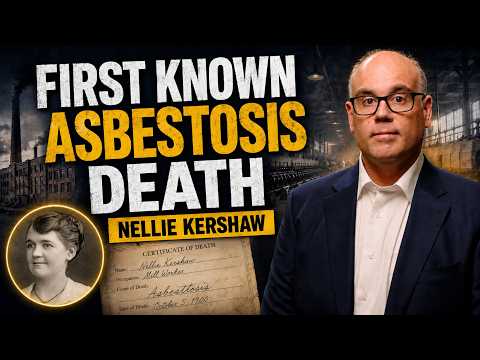
The disease has a name and a face. Asbestos workers were dying of scarred lungs before anyone put a name to them. A London physician described one such death to a government committee in 1906, but the man went unnamed and little was recorded about his work. The first person known by name to have been medically proven to die of asbestos was Nellie Kershaw. In 1924, the 33-year-old English textile worker died after years spinning raw asbestos at Turner Brothers in Rochdale. Her death certificate gave the cause as "fibrosis of the lungs due to the inhalation of mineral particles," and the pathologist William Cooke published her case that year in the British Medical Journal as "Fibrosis of the Lungs Due to the Inhalation of Asbestos Dust,"15 one of the first medical descriptions of the disease he would name asbestosis in 1927.16 Her death helped prompt the British government inquiry that followed: E.R.A. Merewether and C.W. Price examined 363 asbestos textile workers, found the scarring rising with years in the trade, and their 1930 report led to Britain's Asbestos Industry Regulations of 1931.1
Three years later, Merewether2 wrote a description of the disease that has never been improved on:
Asbestosis—the pulmonary fibrosis of asbestos workers—is insidious in its onset, irregular in its course, and variable in its mode of termination. … While new fibrous tissue is being laid down like a spider's web, that deposited earlier gradually contracts. This fibrous tissue is not only useless as a substitute for the air cells, but with continued inhalation of the causative dust, by its invasion of new territory and consolidation of that already occupied, it gradually, and literally, strangles the essential tissues of the lungs.
A spider's web slowly strangling the lung is still, ninety years later, the most accurate picture of what asbestosis does.
 Original 1884 hand-drawn blueprints of the Turner Brothers asbestos works in Rochdale, England, the factory where Nellie Kershaw spun raw asbestos until her death in 1924. This blueprint is owned by our founder and is provided here for anyone to download.
Asbestos is the only cause of this disease
Asbestosis is a pneumoconiosis, which is the medical term for diseases caused by the inhalation of dust. But asbestos is different than other disease-causing dusts in a way that matters enormously, both medically and legally: only asbestos causes asbestosis. Coal dust causes its own disease, silica causes silicosis, but the specific pattern of scarring called asbestosis comes from asbestos and nothing else. The word itself is reserved for it.
That single fact makes asbestosis the cleanest causation case in all of asbestos law. With the asbestos cancers, a defense can always point to smoking, family history, or chance as the cause. With asbestosis, there is no other cause to point to. The fight instead is over whether the scarring really is asbestosis, which is why a careful exposure history and the exclusion of look-alike diseases matter so much. A diagnosis of asbestosis is, by definition, proof of substantial asbestos exposure, which is why it does so much work in a compensation claim and why it so often supports claims for the cancers that are caused by asbestos exposure.
How asbestos causes asbestosis
Asbestos fibers are thin, sharp, and nearly indestructible. When inhaled, they slip past the airway's normal defenses and settle in the deepest part of the lung, the small airways and air sacs where oxygen crosses into the blood. There the body's immune cells try to clear them and fail, and that failure is what starts the scarring.
The cellular cascade, step by step
The pulmonary pathologist Dr. Samuel Hammar,3 summarizing the model laid out by Dr. William Rom and colleagues, described the mechanism this way:
The asbestos fibers that bypass the upper airway defenses are initially deposited in the region of the respiratory bronchioles and alveolar ducts. This is followed by rapid accumulation in this area of pulmonary macrophages, which phagocytose the shorter asbestos fibers and attempt to phagocytose longer asbestos fibers. This causes activation of macrophages that release lysosomal enzymes and cytokines resulting in an intense inflammatory response that eventually leads to fibrosis.
In plain terms, here are each of the steps:
- The fibers reach the deepest lung tissue, too thin and aerodynamic to be filtered out on the way in.
- Immune cells called macrophages swarm them and try to digest them.
- Short fibers can be swallowed up, but the longer ones are too long and durable to be engulfed. A fiber can puncture the macrophage from the inside, killing it and spilling inflammatory chemicals into the surrounding tissue. Researchers call this "frustrated phagocytosis."
- Those chemicals recruit more immune cells, which also fail and rupture. The inflammation becomes chronic, lasting years rather than days.
- The same signals stimulate fibroblasts to lay down collagen, the body's scar tissue, which replaces healthy, elastic lung with stiff fibrous bands.
- Every additional exposure repeats the cycle, and fibers already lodged in the lung keep feeding it, so the scarring can spread and the lung lose more of its capacity to move air.
The same long, durable fibers that won't break down are the ones that drive the disease, which is why fiber type matters.
 How asbestos exposure causes asbestosis, step by step. Thin, durable fibers slip past the airway's defenses and lodge deep in the lung, where macrophages try to engulf them, fail, and rupture, spilling the enzymes and cytokines (inflammatory signaling chemicals) that drive a self-sustaining cycle of inflammation. That cycle stimulates fibroblasts to lay down collagen, the stiff scar tissue that gradually replaces the elastic, air-exchanging lung and becomes asbestosis. The same cycle of injury and repair can also damage DNA over time, and that's part of why this much exposure raises the risk of later cancers, including mesothelioma.
Not all asbestos carries equal risk. The amphibole fibers (amosite, crocidolite, tremolite, and the rest) are straight, stiff, and needle-like; they persist in the lung for decades and are the most strongly tied to asbestosis. Chrysotile, the curly serpentine fiber, clears more readily, though heavy or prolonged exposure still causes the disease. Fiber length matters too: short fibers are more readily engulfed and cleared, while fibers longer than a macrophage is wide (roughly 15 to 20 microns) can't be fully engulfed, and those are the ones that drive the chronic inflammation. (The 5-micron figure you may see elsewhere is the length regulators use to count a "fiber" in air samples, not the size at which the lung stops clearing it.)
 Why fiber length and type matter. A short asbestos fiber, shorter than the cell is wide, can be fully engulfed by a macrophage, the lung's scavenger cell, and carried back out through the airway's normal clearance system (left). A long amphibole fiber (the straight, durable type) is too large to engulf; the macrophage tries, fails, and is injured or destroyed in the attempt, releasing the inflammatory signals that keep the cycle of damage going (right). That failed-clearance reaction, called frustrated phagocytosis, is a central reason long amphibole fibers are the ones most strongly tied to asbestosis.
Even knowing the mechanism, medicine can't predict who will develop asbestosis and who won't. Two workers with similar histories can have very different outcomes, a variability usually chalked up to individual susceptibility and other factors still not understood. What is certain is that asbestosis doesn't happen to people by chance; it happens because asbestos fibers stayed in the lungs long enough to do damage.
How much exposure it takes to develop asbestosis
Asbestosis is a dose-dependent disease. Unlike mesothelioma, which can follow far briefer exposure, asbestosis requires heavy exposure, and the more a person breathed, the worse the scarring. It usually takes years of it. Months have been enough only under extreme industrial conditions, like insulation work in a ship's confined spaces.4 In other words, someone who disturbed asbestos once during a home project faces very little risk of asbestosis, even though they understandably worry. The disease is a hazard of long careers, not occasional moments.
The exposure-response relationship is stark. In 1963 and 1964, Irving Selikoff and his colleagues at Mount Sinai X-rayed 1,117 asbestos insulation workers in New York and New Jersey, and the share showing asbestosis on their films climbed steadily with the years since each man had started the trade:5
| Years since first exposure | Men examined | Share with X-ray signs of asbestosis |
|---|---|---|
| Under 10 years | 346 | 10% |
| 10 to 19 years | 379 | 44% |
| 20 to 29 years | 77 | 73% |
| 30 to 39 years | 194 | 87% |
| 40 or more years | 121 | 94% |
In the first two decades the changes were usually minimal. After 20 years they were typically more extensive, and shortness of breath became common.
The same gradient shows up when you look across trades instead of across years. At the Puget Sound Naval Shipyard in Bremerton, Washington, the Navy's own industrial hygiene program compared two and a half years of chest X-rays, starting in 1965, across the shipyard's whole workforce. The men who handled the insulation directly had the most abnormal films: 21 percent of the 104 pipe coverers and insulators had diagnosed lung abnormalities, compared with 3.5 percent of the boilermakers, who had some exposure to asbestos and silica but didn't work the material as heavily, and under 1 percent of the 420 clerical workers, who had no known dust exposure.6,7 These were X-ray abnormalities, not formal diagnoses of asbestosis (the shipyard recorded only one of those during the study), but the employer measuring its own workers found the damage tracking the dose, trade by trade.
The disease is also slow to appear. Merewether found that even in the dustiest processes of the 1930s, it commonly took about eleven years from the first day of work for serious asbestosis to develop, and about seven at the very least.2 Under today's lower exposures the latency runs longer: asbestosis is rarely detectable until 15 to 20 years after first exposure, and often longer. Even a short stint can matter when the dust is extreme: in a notoriously dusty New Jersey amosite factory, some men who worked there for as little as a month showed scarring on their chest X-rays when they were examined about twenty years later.8 That's a short exposure, not a fast disease. The latency was as long as ever, and the rule holds: this disease is one of cumulative dose over time.
A note for anyone newly worried: if your asbestos contact was brief and light, your asbestosis risk is very low. If you worked around it for years, or lived with someone who did, a free health test, a chest X-ray read by a certified B-reader, can show whether there are signs of scarring. Call 833-4-ASBESTOS.
How people were exposed to asbestos
Asbestosis is overwhelmingly a disease of long-term occupational exposure. The workers at highest risk handled asbestos daily: insulators and laggers, boilermakers, pipefitters, shipyard workers, construction and demolition trades, asbestos miners and millers, textile workers, and brake and clutch mechanics. Anyone who cut, sawed, mixed, or installed asbestos insulation, cement, fireproofing, or tile without protection breathed fibers with every task. Learn more about asbestos exposure on the job.
Exposure also followed workers home. Fibers carried on clothes, boots, and hair exposed spouses and children who laundered work clothes for years, and some of the most severe cases on record came not from workers but from family members exposed this way. Learn more about take-home asbestos exposure.
Asbestos wasn't a single product. It was built into insulation, cement, gaskets, fireproofing, floor tile, joint compound, and hundreds of other materials across dozens of industries, which is why the exposure could have come from almost any direction. See the kinds of products made with asbestos.
Asbestos also causes disease of the lung's lining, pleural plaques and pleural thickening, which are separate conditions from asbestosis and a common marker of past exposure. We cover those on our pleural plaques and disease page.
Symptoms of Asbestosis
Asbestosis comes on gradually, usually many years after exposure. The earliest and most common sign is shortness of breath, at first only on exertion and later with milder and milder activity. A persistent dry cough, chest tightness, and fatigue from low blood oxygen are also common. On examination, doctors often hear fine crackles (called rales) at the lung bases through a stethoscope, and in longstanding disease the fingertips may broaden in a change called clubbing.
As the scarring advances it can strain the heart and lungs together. Severe asbestosis can lead to pulmonary hypertension (high pressure in the lung's arteries), cor pulmonale (enlargement and failure of the right side of the heart), and ultimately respiratory failure. Catching the disease early doesn't reverse it, but it opens the door to care that eases symptoms, heads off complications like infections, and protects quality of life, and it's the signal to avoid any further exposure.
How asbestosis is diagnosed
Asbestosis isn't diagnosed by a single test. As the American Thoracic Society put it, the diagnosis is a judgment based on careful consideration of all the findings,4 and it rests on three pillars: imaging that shows the right kind of scarring, a credible history of asbestos exposure heavy enough and long enough to cause it, and the exclusion of other causes of lung fibrosis.
Imaging and the B-read
The classic sign on imaging is small, irregular opacities, usually in the lower lungs, reflecting the interstitial scarring that defines the disease. For decades the chest X-ray has been the core tool, and to keep readings consistent it's interpreted under the International Labour Organization (ILO) system by a certified B-reader, a physician who has passed a NIOSH (the federal occupational-safety institute) exam in classifying these films. There are fewer than 200 B-readers in the United States.9 The B-read classifies what the film shows; turning that into a diagnosis still takes a doctor weighing it against the exposure history and other findings.
The B-reader grades the profusion of opacities on a 12-point scale built from four categories, 0 (none) through 3 (most extensive), each written as two numbers. The first is the category that best fits the film; the second is the nearest category the reader also seriously considered. So a reading of 1/0 means the reader settled on category 1 after weighing 0, the lowest grade that registers as the scarring of asbestos disease.
It helps to know how that score is actually reached, because it's more concrete than it sounds. The B-reader doesn't grade from memory or general impression. The ILO system supplies a set of official standard reference films, each one already scored for a specific amount of disease, and the reader sets the patient's chest film alongside them to find the standard it most closely resembles.
What they're matching on is profusion: how many of the small, irregular opacities are scattered through the lung and how densely they're packed. Those small irregular shapes, concentrated in the lower lungs, are the radiographic signature of asbestosis, and they're what distinguish it from the small rounded opacities of dust diseases like silicosis. The two-number score simply records which standard the film matched and the neighboring grade the reader also weighed. That side-by-side comparison against fixed standards is what helps different certified readers reach consistent results (readings can still differ, which is why a second B-read is sometimes ordered), and it's what gives the reading its standing in both medicine and law.
Where the line sits at 1/0 has been debated, and the history is worth knowing because it still comes up in some claims:
- The 1986 ATS guidelines urged caution at 1/0 and preferred 1/1 or higher for a confident diagnosis.10
- The 1997 Helsinki Criteria treated 1/0 as evidence of early-stage asbestosis.11
- The 2004 ATS guidelines struck the middle, calling 1/0 presumptively diagnostic, suggestive but not conclusive on its own.4
Today, a reading of 1/0 or higher is the threshold most asbestos trusts use for asbestosis, usually paired with lung-function results, and severe-asbestosis levels typically require 2/1 or higher. That's why this single number carries so much weight in a claim. Medically, high-resolution CT has become a standard imaging method because it is more sensitive and can show scarring the X-ray misses. But the ILO-graded film remains the standard currency of trust and court claims.
Exposure history
A diagnosis requires exposure of sufficient dose, duration, and latency to plausibly cause disease, and those aren't just clinical niceties. They're built into the compensation system. Most asbestos trusts ask for a minimum of about five years of cumulative asbestos exposure and at least ten years of latency between first exposure and diagnosis before they'll pay a claim as asbestosis. The five years can come from any asbestos exposure, not just one company's products, but each trust separately requires exposure to its own company's products, typically at least six months of it. Those are eligibility rules, not medical definitions, but both line up with how the disease usually behaves. The five-year rule reflects a dose-dependent illness that typically takes years of sustained exposure to develop, not a single bad day, though in rare cases months of extremely heavy exposure have been enough. The ten-year rule reflects how slowly it appears. Even in the dustiest jobs of the 1930s, Merewether found serious asbestosis commonly took about eleven years to develop, and about seven at the minimum. Under modern conditions it takes longer still, so scarring that surfaced only a few years after first exposure would point to some other cause.
In a validation study of a structured asbestos-exposure questionnaire, the tool turned up probable or definite occupational exposure in 60% of respiratory patients whose medical records showed no known exposure at all.12 People simply don't connect their illness to a job they held decades ago, and memory is part of the problem: in one validation study, workers correctly recalled the specific occupation of only about two-thirds of the jobs they'd held, with accuracy worse for jobs held longer ago and for people who'd worked more jobs.13 A good asbestos exposure reconstruction works around that by prompting with specific trades and materials, rather than asking an open-ended "were you exposed?"
It's also why we begin our clients' exposure reconstruction from childhood, not just across a person's working years. Asbestos disease is driven by total lifetime dose, and the clock on latency starts at the very first exposure, which is often not a job at all. It might be a father who came home from the shipyard with dust on his work clothes, or a childhood home downwind of a factory. Those early exposures count toward the dose, they're the ones people are least likely to remember or report, and starting the history in childhood is how we surface them.
Excluding other causes
Because asbestosis resembles other interstitial lung diseases, doctors must rule those out before settling on it. One feature helps: asbestosis usually favors the lower lungs, while several look-alikes favor the upper lungs. It's a clue, not a rule.
The look-alikes, and how they differ
The most important distinction is from idiopathic pulmonary fibrosis (IPF), which can look very similar on imaging, and a person with IPF may also have worked around asbestos. The ATS guidance points to what tips the balance: asbestos bodies in lung tissue and pleural plaques on imaging support asbestosis, while fibrosis that worsens rapidly year to year without a history of heavy exposure points toward IPF.4
Other conditions on the differential include the other pneumoconioses and several unrelated diseases:
| Dust or cause | Disease | Typical lung region |
|---|---|---|
| Asbestos | Asbestosis | Lower lobes |
| Crystalline silica | Silicosis | Upper lobes |
| Coal dust | Coal workers' pneumoconiosis | Upper/mid lobes |
| Beryllium | Chronic beryllium disease | Upper/mid lobes |
| Talc | Talcosis | Diffuse |
Sarcoidosis, drug-induced fibrosis, and scarring from old infections like tuberculosis also have to be considered and ruled out.
Pulmonary function testing
Lung-function testing doesn't diagnose asbestosis, but it measures how much damage has been done, which matters for tracking the disease and for compensation. Asbestosis is a restrictive disease: the stiff, scarred lung can't expand fully, so it holds less air and transfers oxygen less efficiently.
What the lung-function numbers mean
- Forced Vital Capacity (FVC): the most air you can forcibly exhale after a full breath in. It's measured with spirometry, where you inhale as deeply as possible and then blow out as hard and as completely as you can into a mouthpiece. Scarring (fibrosis) makes the lung tissue stiff and less elastic, so it can't expand fully on the way in, and FVC drops. The more scarring, the lower the number.
- FEV1/FVC ratio: FEV1 is the amount of air you push out in just the first second of that same hard exhale, and dividing it by FVC gives this ratio (also from spirometry). It distinguishes restrictive disease like asbestosis from obstructive disease like COPD. In obstructive disease the airways are narrowed, so air leaves slowly, FEV1 falls more than FVC, and the ratio is low. In asbestosis the airways are open but the whole lung is smaller, so both numbers fall together and the ratio stays normal or even runs high.
- Diffusing Capacity (DLCO): how well oxygen crosses from the air sacs (alveoli) into the bloodstream. It's measured by breathing in a tiny, harmless amount of carbon monoxide mixed with a tracer gas, holding it for about ten seconds, then breathing out so the machine can read how much was absorbed. Asbestosis thickens the barrier between the air sacs and the blood vessels around them, so less oxygen gets across and DLCO drops. It's often one of the first values to fall, and a falling DLCO tends to track the breathlessness patients feel on exertion.
- Total Lung Capacity (TLC): the total air the lungs can hold when filled all the way up. This one can't be captured by blowing into a tube, because some air always stays behind after you exhale, so it's measured either in a sealed booth (body plethysmography) or with a harmless tracer gas that spreads through the lungs. As the lung stiffens and scars it can't inflate as far, so TLC falls, and a reduced TLC is the measurement that actually confirms a restrictive pattern.
These values are used to grade severity, follow progression over time, and establish eligibility for disability benefits.
Treatments for asbestosis
There is no cure for asbestosis, and the reason traces straight back to Merewether's spider's web analogy. The scar tissue doesn't crowd in alongside the working lung; it takes the place of it. It replaces the delicate lung tissue where oxygen crosses into the blood, and scar tissue can't do that job. Once that functional tissue is gone, nothing can rebuild it, which is why the lung capacity asbestosis takes is gone for good. Treatment can't reverse the damage, so it aims instead at easing symptoms, preventing complications, and protecting the working lung that remains. No treatment has been proven to halt the scarring itself.
Supplemental oxygen helps with breathlessness and low blood oxygen. Pulmonary rehabilitation, a structured program of exercise and education, can improve stamina and quality of life. Medications can't undo the scarring, but they can relieve specific symptoms. When scarring is documented to be getting worse, a lung specialist may consider an antifibrotic drug: nintedanib has been FDA-approved since 2020 for progressive fibrosing lung diseases in general, and it can slow the loss of lung function. No drug is approved for asbestosis specifically, the evidence in asbestosis itself is thin, and none reverses scarring that's already there. In the absolute most severe cases, lung transplantation is occasionally considered, though few patients qualify. (We've represented a number of clients with very severe asbestosis, but none of them qualified.)
 (How asbestosis destroys the lung, in three stages. Healthy alveoli (left) have open air spaces where oxygen crosses into the blood. As scarring sets in, new fibrous tissue spreads through the lung like a spider's web (center), narrowing those spaces. Where the disease advances, the scar contracts and replaces the air cells entirely (right), and because scar tissue can't exchange gas, the lung capacity it takes is gone for good. It's the process Dr. E.R.A. Merewether described in 1933, when he wrote that the fibrosis is laid down like a spider's web and literally strangles the essential tissues of the lungs.)
If you have asbestosis, two steps can protect your health more than any current treatment. Quitting smoking is critical, because tobacco accelerates the decline and multiplies the already-raised risk of lung cancer. And staying current on flu and pneumonia vaccines guards against infections that hit damaged lungs hard.
Why an asbestosis diagnosis is the key to compensation
Here is what sets asbestosis apart from every other condition on this site. Because asbestos is its only cause, a well-documented diagnosis is powerful proof of serious exposure, and that does two things at once.
First, asbestosis is compensable in its own right, and the claim is unusually clean. There's no competing cause for a defendant to blame, and the severity is documented objectively through B-reads and lung-function numbers. Because the trusts pay scheduled values by disease level, trust payouts are more predictable than most.
Second, an asbestosis diagnosis is frequently the key that unlocks compensation for the asbestos cancers. Most asbestos trusts require documented asbestosis or bilateral pleural disease before they'll pay full value on claims for asbestos-related colon, stomach, and throat or esophageal cancer, because that underlying disease is the marker of the heavy exposure those claims depend on, and asbestosis is the strongest such marker. (But asbestosis is not required in mesothelioma claims because that disease can be caused by exposure far too brief to cause asbestosis.) So the chest film that documents asbestosis can be the same document that makes a cancer claim viable. This is why we offer a free health test, a chest X-ray read by a certified B-reader: finding asbestosis protects your health and, if cancer ever follows, can strengthen your claim. Any findings go to you to review with your own doctor.
Asbestosis and the risk of asbestos-related cancer
An asbestosis diagnosis carries a hard truth beyond the breathing trouble itself. The same heavy, prolonged exposure that scarred the lungs also raises the risk of several asbestos-related cancers. Asbestosis isn't a precancer, and it doesn't turn into cancer. But it's the clearest marker a person can have that they breathed enough asbestos to be at real risk of developing an asbestos-related cancer, and that risk shows up in the data.
Lung cancer is the foremost concern. Asbestos is an established cause of lung cancer on its own, and the risk climbs with cumulative exposure, exactly the kind of exposure an asbestosis diagnosis reflects. In a 2026 study that enrolled 254 asbestosis patients and 548 patients with idiopathic pulmonary fibrosis (a similar scarring disease without the asbestos cause), 12.6% of the asbestosis patients already had a cancer diagnosis when they enrolled, compared with 4.9% of the IPF patients, and among the asbestosis patients, lung cancer was one of the conditions linked to a higher risk of death.14 Those percentages are the share of patients in one cohort at the start of the study, not an adjusted risk: the asbestosis patients were older and less likely to have smoked, and the IPF patients actually had more disease progression and deaths over the study period. For anyone who also smoked, the danger compounds: asbestos and tobacco don't simply add together, they multiply, which is why quitting smoking matters so much after an asbestosis diagnosis. More about asbestos and lung cancer.
The risk isn't limited to the lungs. Asbestos is an established cause of cancer of the voice box and of the ovaries, a risk that matters for women exposed on the job or at home, such as wives who washed asbestos-covered work clothes, and the evidence also links it, less conclusively, to cancers of the throat and esophagus, colon, and stomach. Mesothelioma, the cancer of the lung and abdominal lining, is also a lifelong risk for anyone with this much exposure, though unlike asbestosis it can follow far lighter exposure too. More about mesothelioma.
An asbestosis diagnosis is a signal to stay under regular care with your own doctor, who can tell you what follow-up makes sense for you. It's also why the diagnosis does double duty in a legal claim, a point we turn to next.
Compensation for asbestosis
Because the causation is so clear, people with asbestosis usually have several paths open at once.
Asbestos trust funds are often the fastest. The trusts set up by bankrupt asbestos companies recognize asbestosis and grade it by your B-read and lung-function results, and a well-documented claim can pay within months. A single work history often supports claims against several trusts at once. Learn more about asbestos trust claims.
Lawsuits against the companies responsible can recover more than a trust claim, but they're typically only viable when the asbestosis is severe, because a lawsuit's value depends on demonstrable impairment and the cost of litigation rarely makes sense for milder disease. The claims include product-liability claims against the makers of asbestos products, premises-liability claims against employers and site owners who failed to provide a safe workplace , and wrongful-death claims brought by surviving families. Several states have gone a step further and written medical criteria into law, setting minimum thresholds of lung impairment and radiographic severity that an asbestosis claimant must meet before they're even allowed to sue. Whether a lawsuit makes sense in your case turns on how advanced the disease is and on your state's rules, which we'll assess for you.
Learn more about asbestos lawsuits.
Social Security Disability is available when asbestosis keeps you from working for at least a year and you have enough work credits. Approval leans heavily on lung-function evidence: the SSA looks for severe impairment shown through spirometry (FEV1 or FVC), DLCO, low blood-oxygen levels, or repeated hospitalizations, or for limits that leave you unable to do any work you're suited for. See if you're eligible for a Social Security disability claim.
Veterans' benefits are available to those exposed in service, especially Navy veterans who served aboard ships or in shipyards. The VA pays disability compensation graded by severity, rating asbestosis on lung-function tests (FVC and DLCO), with a 100 percent rating for veterans who need outpatient oxygen or whose disease has strained the heart, plus support for surviving dependents. Learn about VA disability claims.
Every state sets its own filing deadline, and some are short, so the safest step is to call promptly after diagnosis, before that window closes. Find your state's asbestos filing deadlines.
Talk to us
You focus on your health. We'll take care of the rest.
If you've been diagnosed with asbestosis, or you worked around asbestos and find yourself short of breath, you may have a claim, and you may qualify for a free health test today. Call 833-4-ASBESTOS or contact us here for a free, no-obligation review. There's no fee unless we win.
References
- Merewether ERA, Price CW. Report on Effects of Asbestos Dust on the Lungs and Dust Suppression in the Asbestos Industry. London: His Majesty's Stationery Office; 1930.
- Merewether ERA. A memorandum on asbestosis. Tubercle. 1933;15(2):69-81 (part 1; quotation at p. 75), doi:10.1016/S0041-3879(33)80023-7; and 1933;15(3):109-118 (part 2; latency at p. 111), doi:10.1016/S0041-3879(33)80043-2. Both issues are in our library: part 1, part 2.
- Hammar SP. Asbestosis. In: Dodson RF, Hammar SP, eds. Asbestos: Risk Assessment, Epidemiology, and Health Effects. 2nd ed. Boca Raton, FL: CRC Press; 2011:447-479 (quotation at p. 448).
- American Thoracic Society. Diagnosis and initial management of nonmalignant diseases related to asbestos. Am J Respir Crit Care Med. 2004;170(6):691-715.
- Selikoff IJ, Churg J, Hammond EC. The occurrence of asbestosis among insulation workers in the United States. Ann N Y Acad Sci. 1965;132(1):139-155 (X-ray results at pp. 146-147). doi:10.1111/j.1749-6632.1965.tb41097.x.
- Mangold CA, Beckett RR, Bessmer DJ. Asbestos exposure and pulmonary x-ray changes to pipe coverers and insulators at Puget Sound Naval Shipyard. Bremerton, WA: Industrial Hygiene Division, Puget Sound Naval Shipyard; August 1968. Presented at the American Industrial Hygiene Association Pacific Northwest Section annual meeting, Richland, WA, October 3-4, 1968.
- Mangold CA, Beckett RR, Bessmer DJ. Asbestos exposure and control at Puget Sound Naval Shipyard. Bremerton, WA: Industrial Hygiene Division, Medical Department, Puget Sound Naval Shipyard; March 1970.
- Ehrlich R, Lilis R, Chan E, Nicholson WJ, Selikoff IJ. Long term radiological effects of short term exposure to amosite asbestos among factory workers. Br J Ind Med. 1992;49(4):268-275. doi:10.1136/oem.49.4.268.
- National Institute for Occupational Safety and Health. NIOSH B Reader Program, B Reader search. Accessed October 27, 2026. https://www.cdc.gov/niosh/chestradiography/php/breader/index.html.
- American Thoracic Society. The diagnosis of nonmalignant diseases related to asbestos. Am Rev Respir Dis. 1986;134(2):363-368.
- Tossavainen A. Asbestos, asbestosis, and cancer: the Helsinki criteria for diagnosis and attribution. Scand J Work Environ Health. 1997;23(4):311-316.
- Ferrer J, Granados G, Hernández S, et al. Validation of an asbestos exposure questionnaire (QEAS-7) for clinical practice. Int J Environ Res Public Health. 2020;17(24):9167. doi:10.3390/ijerph17249167.
- Sonnega A, Al-Hinai M, Chen Q, Helppie-McFall B, Smith J. Can retrospective reports provide accurate job history information? A comparison with concurrent reports in a national prospective study of older adults. Innov Aging. 2024;8(3):igae021. doi:10.1093/geroni/igae021.
- Song Y, Wang Y, Dilixiati N, Wang D, Wang Y, Ye Q. Distinct comorbidity profiles and outcomes in asbestosis versus idiopathic pulmonary fibrosis: a 6-year prospective cohort study. BMC Pulm Med. 2026;26(1):94. doi:10.1186/s12890-025-04070-5.
- Cooke WE. Fibrosis of the lungs due to the inhalation of asbestos dust. Br Med J. 1924;2(3317):147. doi:10.1136/bmj.2.3317.147.
- Cooke WE. Pulmonary asbestosis. Br Med J. 1927;2(3491):1024-1025. doi:10.1136/bmj.2.3491.1024.
In our case-law library
395 court decisions in our case-law library involve asbestosis. Among them:
- Letcher County Board OF Education v. HallKentucky Supreme Court, 2023 · The Kentucky Supreme Court affirmed the Court of Appeals, holding that the Department of Workers' Claims, not the Board of Claims, has jurisdiction over Roger Hall's workers' compensation claim against the Letcher County Board of Education, so Hall prevailed.
- Atchinson v. Howmet Aerospace, Inc.U.S. Court of Appeals, Ninth Circuit, 2021 · The Ninth Circuit affirmed summary judgment for Alcoa (Howmet Aerospace) against the estate of Clinton Casey, upheld the denial of certification to the Washington Supreme Court, and denied the renewed certification motion.
- Illinois Central Railroad Company v. Oakes EX rel. HaganMississippi Supreme Court, 2018 · The Mississippi Supreme Court reversed the Court of Appeals and the circuit court, holding Illinois Central Railroad entitled to a pro tanto setoff for asbestos trust payments, and remanded for a hearing on whether the payments covered the same injuries.
- Cole v. Norfolk Southern Railway CompanyVirginia Supreme Court, 2017 · The Supreme Court of Virginia affirmed the circuit court's grant of Norfolk Southern's plea in bar, holding the 2000 release barred the executor's FELA lung cancer claim, so the estate lost.
- In re Asbestos Products Liability Lit.(no. VI)U.S. Court of Appeals, Third Circuit, 2016 · The Third Circuit vacated the District Court's dismissal of Peggy Hassell's claims against Budd and Resco on Locomotive Inspection Act preemption grounds and remanded, so Hassell prevailed on appeal.
- State EX rel. Boyd v. Scotts Miracle-Gro Co.Ohio Supreme Court, 2016 · The Ohio Supreme Court affirmed the court of appeals' denial of Robert Boyd's mandamus petition, leaving in place the Industrial Commission's denial of permanent-total-disability benefits, so Scotts Miracle-Gro and the Commission prevailed.
Talk with an asbestos lawyer
Start with what you remember, and we'll take it from there.
This page is provided for general informational purposes and does not constitute legal advice. Every asbestos case turns on its own facts, exposure history, diagnosis, deadlines, available evidence, and applicable law. Reviewing this page does not create an attorney-client relationship. For advice about your specific situation, call 833-4-ASBESTOS for a free case review.