

If your pathology report names pericardial mesothelioma, or you are researching for someone in your family, this page is a place to start. The cancer begins in the pericardium, the thin, two-layered sac around the heart, and accounts for about 1–2% of mesotheliomas.2
It often looks like a more common heart condition. Breathlessness, chest pain, fluid around the heart, irregular heart rhythms (arrhythmias), and heart-failure symptoms may lead first to an evaluation for inflammation of the pericardium (pericarditis), heart failure, infection, or autoimmune disease. Many historical cases were confirmed only during surgery or after death.2,19
Evidence supports asbestos as a cause of pericardial mesothelioma. A 2020 Italian study found substantially higher odds of the disease among people with occupational asbestos exposure.10 That study helps establish that asbestos is capable of causing the disease. Whether it contributed to one person's cancer depends on the diagnosis, exposure history, timing, and the rest of the medical and factual record.
Evidence scope. There is no validated pericardial staging system or completed randomized pericardial-specific treatment trial. The largest population-based study found “no consensus on diagnostic and therapeutic management,” while Memorial Sloan Kettering investigators concluded that trimodality treatment (surgery, chemotherapy, and radiation) “may improve outcomes in selected patients.” Most evidence comes from registries, reviews of published cases, small institutional series, and individual case reports. Evidence from pleural mesothelioma can inform treatment, but it is not direct proof of what works for a tumor arising around the heart.2,4
You don't need the product names or old records. No fee unless we recover compensation for your family.
Quick answers
| What is pericardial mesothelioma? | It is an exceptionally rare cancer of the sac around the heart. It represents about 1–2% of mesotheliomas. A 2025 case description summarized older literature as reporting an occurrence below 0.0022% among 500,000 cases and around 200 published cases.2,19 |
|---|---|
| Why is it difficult to diagnose? | The symptoms overlap with pericarditis, heart failure, infection, and autoimmune disease. Older literature summarized in 2025 estimated that only 10–20% of cases were accurately diagnosed before death, but diagnosis after death has become much less common over time. Among 47 Italian registry patients with detailed clinical records, 11% had presurgical fluid-cell examination (cytology), 6% had presurgical tissue examination, and 15% were diagnosed at autopsy.2,19 |
| Can asbestos cause it? | Yes. The 2020 Italian study found substantially higher odds among people with occupational asbestos exposure. That answers whether asbestos can cause the disease in some people. The cause of one person's cancer has to be evaluated from the diagnosis, exposure history, timing, and other evidence.10 |
| What if I never handled asbestos directly? | Direct handling is only one pathway. Exposure can occur near other trades, during military service, through fibers brought home on clothing, from asbestos-containing buildings or products, or from an environmental source. Because the fibers are invisible and the events may be decades old, not remembering a labeled asbestos product does not rule out exposure. |
| How is it treated? | There is no single treatment pathway. Care may include drainage, surgery, chemotherapy, carefully planned radiation, immunotherapy, supportive care, or a clinical trial. The choice depends on the tumor's extent, its effect on the heart, the patient's health, and the goal of treatment. Review by an experienced multidisciplinary team is especially important.1,2,4 |
| How quickly should a legal claim be reviewed? | Deadlines depend on the claim, jurisdiction, and whether the matter involves personal injury or wrongful death. Some are short. Prompt review is the safest way to identify which deadlines may apply. |
| Can a spouse or adult child call? | Yes. A family member can ask questions and begin gathering information. Formal authority may be needed for later decisions or filings, but not ordinarily for an initial inquiry. |
“I started this firm after learning that the cancers that killed my father and grandparents were caused by asbestos, something we did not realize until it was too late to hold anyone accountable. That experience is why we built this site: so that no other family misses their chance to ask the questions, hear the options, and decide for themselves what to do.”
Asbestos and pericardial mesothelioma
For years, reviews called the asbestos relationship uncertain because the disease was too rare for a large population study. The evidence now includes a direct-contact case, occupational reports, structured exposure assessments, and a national population study. Together, those sources support asbestos as a cause of pericardial mesothelioma.7–10
Historical use of asbestos in heart surgery
The asbestos industry's own trade press documented an experimental medical practice that would be unthinkable today. In July 1943, Asbestos magazine described powdered asbestos being placed around the heart to create adhesions and improve blood supply. In March 1950, it reported a related procedure presented at a conference sponsored by the National Institutes of Health: powdered asbestos was mixed with saline and applied to the surface of the heart and an adjacent lung to provoke inflammation and encourage new vascular connections.5,6
The direct-contact case
In 1978, Andrew Churg and colleagues reported a patient who developed malignant pericardial mesothelioma 15 years after fibrous material had been applied directly to the pericardial cavity during surgery. At autopsy, fibers and ferruginous bodies (microscopic structures that can form around certain fibers in tissue) remained in the pericardium. About two thirds of the identified fibers were tremolite and anthophyllite asbestos; the rest were fiberglass, which human studies have not established as a cause of mesothelioma.7,39
A single case cannot estimate population risk. Even so, the likelihood that this exact sequence was merely coincidental appears vanishingly small: asbestos-containing material was applied to the pericardium, mesothelioma arose there 15 years later, and asbestos fibers remained in the tissue. The report is unusually direct human evidence that pericardial mesothelioma has occurred after asbestos-containing material was placed against the pericardium.
Occupational cases and population evidence
Other reports followed. Kahn and colleagues described primary pericardial mesothelioma after asbestos exposure in 1980. Beck and colleagues reported three cases with occupational exposure evidence in 1982.8,9 Those reports could not estimate risk, but they identified a pattern that a later population study could test.
The Italian National Mesothelioma Registry did that in 2020 through a case-control study, which compared people with the disease with people who did not have it. Occupational asbestos exposure was associated with 3.68 times the odds of pericardial mesothelioma overall and 5.52 times the odds in men. The estimate in women was too imprecise to establish a clear association because the numbers were small.10
Technical detail: The 95% confidence interval, meaning the range of values compatible with the study's estimate, was 1.85–7.31 for the overall result and 2.14–14.2 for men.
The registry's 2025 population analysis found occupational exposure in 32 of the 55 patients whose exposure histories were assessed, or 58%. Among the men assessed, 27 of 35, or 77%, had occupational exposure. Those percentages describe the assessed patients, not all 72 people in the registry.2
What the evidence means for one person
The studies establish that asbestos is capable of causing this disease in at least some people. They do not assign the cause of one person's cancer. That judgment depends on the diagnosis, the full exposure history, the timing, and the other medical and factual evidence.
Across populations, mesothelioma risk rises with cumulative asbestos exposure. But that relationship is not a minimum-dose test for one case. No safe exposure threshold has been identified, and a brief or intermittent exposure does not, by its duration alone, exclude a contributing role.20 Pericardial mesothelioma is too rare for a validated site-specific dose-response curve.
How this page weighs sources
Not every source is equally useful for every question. For causation, this page gives greatest weight to population studies designed to test an association, structured exposure assessment, direct-contact evidence, and consistency with the broader asbestos literature. For diagnosis and treatment, it relies on pathology standards, population registries, specialty-center experience, and the ChARM consensus.
Funding, industry or litigation relationships, independent corroboration, and a material governmental or institutional dependence on asbestos mining, manufacture, or continued use can affect how a causation claim is weighed. That concern is limited to the proposition being tested. It does not discredit imaging or treatment research from the same country or institution. The ChARM consensus is cited here for clinical guidance, not as the principal support for the causation conclusion.
How asbestos may reach the pericardium and contribute to cancer
How inhaled fibers reach the pericardium is not fully established. Proposed routes include lymphatic channels, blood vessels, and movement across nearby thoracic tissues. Pleural and pericardial disease can occur together, but coexistence does not show which route a fiber traveled or distinguish tumor spread from disease involving the lining around more than one body cavity.
Asbestos fibers can remain in tissue for years. They can contribute to persistent inflammation, cell-damaging oxidative stress, interference with cell division, and changes in tumor-suppressor pathways, the cellular safeguards that help prevent cancer. Those mechanisms are well studied in mesothelioma generally, but no test can reconstruct the exact sequence in one pericardial tumor. The interval from first exposure to diagnosis is often measured in decades, but pericardial mesothelioma is too rare to support a precise site-specific range.20
A person does not need to remember handling a product labeled “asbestos” for an exposure investigation to be useful. Fibers were invisible, warnings were often absent, and the relevant event may have happened decades earlier. Exposure may have come from the person's own work, nearby trades, military service, fibers brought home by another household member, asbestos-containing buildings or products, or an environmental source.
Genetic susceptibility does not automatically displace asbestos exposure. Genetic susceptibility and asbestos exposure can coexist. Mesothelioma research has found that people with harmful inherited variants in BAP1 or other DNA-repair genes may develop disease after lower cumulative asbestos exposure, which supports an interaction between inherited susceptibility and asbestos.21 The study was not specific to the pericardium. A genetic finding does not by itself establish that asbestos played no contributing role or decide eligibility for a trust, lawsuit, or benefit program.
What pericardial mesothelioma does to the heart
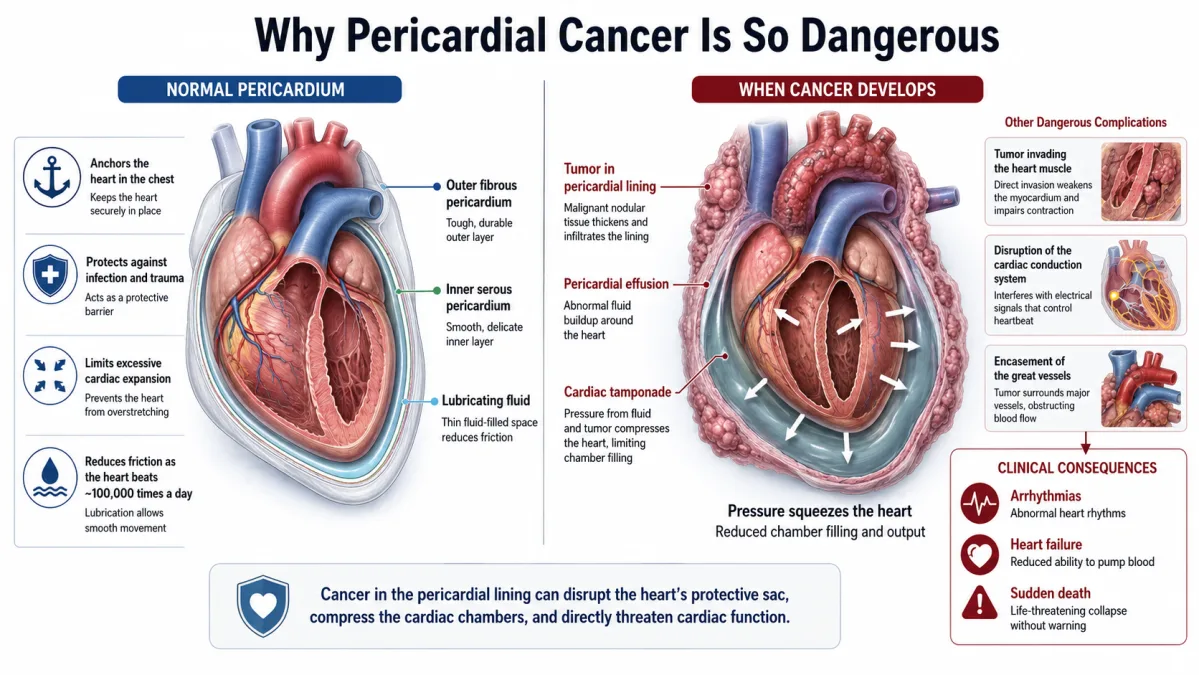
The pericardium has a tough outer layer and a smooth inner membrane, with a small amount of fluid between them. It holds the heart in position, limits sudden overfilling, and allows the heart to beat with little friction.
Pericardial mesothelioma may spread along the sac, form a mass, thicken and stiffen the pericardium, or invade nearby tissue. The immediate danger often comes from what the tumor does around the heart:
- Pericardial effusion: fluid accumulates around the heart.
- Cardiac tamponade: pressure from the fluid prevents the chambers from filling normally and can become life-threatening.
- Constrictive physiology: a thickened or tumor-encased pericardium restricts the heart as it relaxes and fills.
- Local invasion: tumor may involve the heart's surface, heart muscle, coronary region, chambers, diaphragm, pleura, or major blood vessels.
- Electrical or mechanical effects: invasion or compression can contribute to arrhythmias, heart-failure symptoms, impaired blood flow, and other acute cardiovascular problems.
A relatively small amount of tumor or fluid can have an immediate effect on circulation. Representative tissue can also be difficult to obtain, and surgery may require work beside the heart muscle, coronary arteries, and major blood vessels. So disease can be locally advanced even when no distant metastasis is visible.
In the Italian registry, the median age at diagnosis was 66, with a range from 22 to 89. Forty-six of the 72 patients were men and 26 were women.2 Those figures describe the registry population, not a rule about who can develop the disease.
Symptoms of pericardial mesothelioma
The disease often first resembles a common cardiac or inflammatory condition. Symptoms may come from fluid, constriction, impaired filling, local invasion, or the body's response to cancer. None is specific to mesothelioma by itself.
The best population-based symptom data come from 47 Italian registry patients with detailed clinical records. Every percentage below describes those 47 patients, not all 72 people in the registry, and one patient could have several findings.2
| Symptom or finding | Share of the 47-patient group | What it can mean |
|---|---|---|
| Pericardial effusion | 64% | The most common recorded presentation, but an effusion has many possible causes. |
| Shortness of breath | 49% | May reflect impaired filling, heart failure, pleural fluid, or another heart-lung effect. |
| Heart failure or pericardial tamponade | 36% | A combined registry category, not a 36% tamponade-only rate. |
| Malaise or fever | 28% | A nonspecific systemic presentation. |
| Pericarditis | 23% | May initially appear inflammatory or have no identified cause. |
| Chest pain | 23% | Can overlap with pericarditis, heart disease, lung disease, or local tumor involvement. |
| Pleural effusion | 23% | Fluid around a lung can occur with pericardial disease. |
| Cough | 21% | Nonspecific and potentially related to the pleura, lungs, or central chest. |
| Weakness | 19% | A nonspecific systemic symptom. |
| Gastrointestinal symptoms | 19% | May accompany systemic illness or a backup of blood in the veins. |
| Enlarged lymph nodes outside the chest | 17% | Enlarged lymph nodes were recorded in a minority of patients. |
| Cardiac arrhythmia | 15% | May occur when tumor, fluid, pressure, or inflammation affects the heart. |
| Pericardial or mediastinal (central-chest) mass | 11% | Many patients did not have a readily identified discrete mass. |
| Ascites (abdominal fluid) | 11% | Abdominal fluid may accompany right-sided pressure or advanced disease. |
The absence of a visible mass does not rule the disease out. Diffuse thickening, recurrent fluid, constriction, or invasion may matter more than a single measurable lesion. A known or suspected asbestos history should be shared with the medical team because it adds context to an otherwise unexplained pericardial problem.
Recurrent unexplained effusion, bloody fluid, pericarditis that does not behave as expected, constrictive findings, or persistent symptoms despite treatment are reasonable reasons to ask whether cancer has been fully evaluated.1,2
Seek emergency care for possible cardiac tamponade. Severe or rapidly worsening breathlessness, fainting or near-fainting, confusion, marked weakness, low blood pressure, or other signs of circulatory collapse require urgent medical evaluation. A legal or outpatient consultation is not a substitute for emergency care.
Trying to organize a difficult diagnostic history? A member of our litigation team can review records for case-intake purposes, identify where the effusion, imaging, biopsy, pathology, and asbestos history appear, and help you prepare questions for the medical team. We do not diagnose disease, interpret an emergency, or recommend treatment.
Call 833-4-ASBESTOS or request a free case review.
How pericardial mesothelioma is diagnosed
Diagnosis requires several kinds of information to agree. Imaging shows what is happening around the heart. Fluid or tissue sampling provides material for the laboratory. Pathology determines whether malignant mesothelial tumor is present. The imaging and operative record then help decide whether the tumor began in the pericardium rather than spreading there from another site.
A definitive diagnosis usually requires representative tissue. Fluid-cell examination can occasionally establish the diagnosis, but it may not show invasion or provide enough architecture to identify sarcomatoid or biphasic disease. No scan, blood marker, stain, or molecular result should be read alone.
Stabilization comes first. If fluid is causing cardiac tamponade or another urgent circulation problem, immediate cardiac treatment may take priority. Drainage can relieve the pressure and provide fluid for testing, but the cancer workup may need to continue after the emergency is controlled.
Prompt multidisciplinary review
Because the disease is rare and cardiac and cancer decisions often overlap, prompt multidisciplinary review is ideal. The 2025 ChARM consensus recommends starting that review within 48 hours of diagnosis when feasible.1 That's a reasonable aspirational benchmark, but not a universally accepted standard of care.
The team may include cardiology and cardiac imaging, thoracic or cardiothoracic surgery, medical and radiation oncology, interventional radiology, supportive care, and a pathologist with mesothelioma experience. Specialist input before the final diagnosis can also help identify the safest and most informative biopsy target.
Findings that may justify a more active search for cancer include:
- Recurrent or unexplained pericardial effusion
- Bloody or repeatedly reaccumulating fluid
- Cardiac tamponade or simultaneous fluid and constrictive findings
- Pericarditis or constriction that persists despite an appropriate initial treatment
- Nodular pericardial thickening, a pericardial or mediastinal mass, or suspected heart-muscle invasion
- Unexplained pleural disease, enlarged lymph nodes, or distant lesions occurring with a pericardial process
- Any of these findings in a person with known or suspected asbestos exposure
These findings do not diagnose mesothelioma. They are reasons to reconsider a benign working diagnosis and decide whether more complete imaging, tissue sampling, or specialist review is needed.
Imaging
The ChARM consensus recommends echocardiography as the initial imaging test, with CT, MRI, and PET/CT used as their different strengths become relevant. PET/CT uses a radioactive sugar tracer to highlight active tissue.1
| Imaging study | What it helps answer | Main limitation |
|---|---|---|
| Echocardiography | How much fluid is present? Is the heart compressed? Are there tamponade or constrictive features, impaired function, or a visible mass? | A nondiagnostic study does not exclude diffuse tumor or show its full extent. |
| Contrast-enhanced CT | Is there thickening, nodularity, a mass, pleural or lung disease, enlarged nodes, distant disease, or a safe biopsy target? | Thin or early diffuse disease can be hard to distinguish, and CT cannot establish the microscopic diagnosis. |
| Cardiac MRI | Does tumor involve the heart muscle, chambers, vessels, or other structures important to surgery and radiation planning? | Availability, scan time, implanted devices, motion, and patient stability can limit its use. |
| PET/CT | Are lymph nodes or distant sites taking up the tracer, and is there a useful sampling target? | Inflammation can also take up the tracer, so the result is not specific for mesothelioma. |
Among the 47 Italian registry patients with detailed clinical records, 37 underwent contrast-enhanced CT, 12 MRI, and seven PET imaging. Those numbers show how the tests were used in that cohort, not which test is most accurate or the order every patient should follow.2 For major surgery or focused radiation, the imaging should be reviewed by clinicians who understand both pericardial anatomy and mesothelioma.4
No blood test can confirm or exclude primary pericardial mesothelioma. Mesothelin, CA-125, lactate dehydrogenase, inflammatory markers, and routine laboratory findings may add context or help follow a marker that was elevated at baseline, but imaging, symptoms, cardiac function, and pathology remain central.
Pericardial fluid, biopsy, and surgical tissue
Pericardiocentesis drains fluid through a needle or catheter. It may be urgently necessary for tamponade and can provide fluid for cytology, microbiology, and other testing. A positive, properly worked-up result can be meaningful. A negative result does not rule out mesothelioma, especially when the tumor is not shedding diagnostic cells or the sample cannot show tissue architecture and invasion.
The Italian registry should not be read to mean that cytology detected only 11% of cases. Among the 47 patients with detailed records, five had presurgical cytology, three had presurgical tissue examination, and seven were diagnosed at autopsy. Those are the paths by which patients were evaluated or diagnosed, not measurements of how well each test performs.2
The ChARM consensus prioritizes pericardial needle biopsy for clinically suspected disease.1 But the best procedure depends on the target's location and size, the patient's stability, the risk to nearby structures, the likely tissue yield, whether drainage is already required, and local expertise. Useful material may come from:
- An image-guided core biopsy of an accessible pericardial or mediastinal lesion
- A surgical pericardial window with biopsy
- Pericardiectomy or mass-resection tissue
- An accessible lymph node, pleural lesion, or distant site when it is safer to sample
A specimen from another site may establish mesothelioma or metastatic disease. Pathology alone usually cannot prove that the pericardium was the primary site; that conclusion also depends on imaging and operative findings.
What pathology must establish
The pathologist is answering four separate questions:
- Is the sampled process malignant rather than reactive or benign?
- Is it mesothelial, meaning derived from the lining cells, rather than carcinoma, sarcoma, another cardiac tumor, or another mimic?
- Does the microscopic appearance support epithelioid, sarcomatoid, biphasic, or not-otherwise-specified mesothelioma?
- Does the complete record support the pericardium as the primary site?
No single stain or molecular result answers all four.
Immunohistochemistry
Immunohistochemistry uses antibodies to identify proteins in the sampled cells. WHO-aligned guidance from the International Collaboration on Cancer Reporting (ICCR) recommends at least two mesothelial markers and at least two carcinoma markers when the pathologist is distinguishing an epithelioid mesothelioma from carcinoma, with other markers chosen for the actual alternatives.22,23
Common mesothelial markers include calretinin, WT1, D2-40, and cytokeratin 5/6. Claudin-4, MOC31, BerEP4, and organ-specific markers can help exclude carcinoma or identify another primary cancer. The panel is interpreted as a pattern. It is not a mechanical rule that every tumor must show the same two positive and two negative results.
Sarcomatoid mesothelioma requires extra care because many traditional mesothelial markers can be weak or absent. Broad-spectrum cytokeratins, the microscopic pattern, imaging, and a wider exclusion panel may be needed to distinguish it from sarcomatoid carcinoma, angiosarcoma, synovial sarcoma, other sarcomas, and reactive fibrosis.22,23
Immunohistochemistry can support mesothelial lineage. It does not by itself prove that the cells are cancerous, identify the primary site, or determine whether asbestos contributed.
BAP1, MTAP, and CDKN2A
After a mesothelial growth has been identified, three additional findings can strongly support that it is cancerous:
- Loss of BAP1 protein staining in the cell nucleus
- Loss of MTAP protein staining in the cell body, an imperfect stand-in for CDKN2A deletion whose use for that purpose was validated mainly in pleural mesothelioma
- Homozygous CDKN2A deletion (loss of both gene copies), detected by FISH, a laboratory test for missing gene material
These findings answer a limited question. They do not independently prove mesothelial lineage, show that the tumor began in the pericardium, identify the histologic subtype, or determine asbestos causation. CDKN2A deletion is common in sarcomatoid mesothelioma, but it does not confirm the sarcomatoid subtype. Retained BAP1 or MTAP and a negative CDKN2A FISH result do not rule out mesothelioma.22,23
The abnormal result must also be assigned to the correct cells. In a possible biphasic tumor, an abnormality confined to epithelioid cells does not automatically prove that nearby spindle cells are malignant.
Histologic subtype and sampling limits
The three main invasive subtypes are epithelioid, sarcomatoid, and biphasic. The Italian registry recorded the following distribution among 72 patients:2
| Registry category | Share of 72 cases | What it means |
|---|---|---|
| Epithelioid | 36% | Cohesive malignant mesothelial cells growing in epithelioid patterns. |
| Sarcomatoid | 14% | Malignant spindle-cell or fibrous growth; traditional mesothelial markers may be reduced or absent. |
| Biphasic | 13% | Both malignant epithelioid and malignant sarcomatoid components are present. |
| Not otherwise specified | 33% | Mesothelioma was recorded, but the material or report did not support a more specific subtype. |
| Unavailable | 4% | Subtype information was not available to the registry. |
One third of the registry cases were not assigned a specific subtype. That is a useful reminder that published case reports, which tend to feature surgically sampled and unusually well-characterized tumors, can look cleaner than ordinary clinical practice.
The biphasic 10% convention depends on the specimen. In a definitive resection, the lesser component generally must account for at least 10% of the tumor examined. In a biopsy, convincing malignant epithelioid and sarcomatoid components can support a biphasic diagnosis even when one occupies less than 10% of the sample.22,23
A report such as “70% epithelioid and 30% sarcomatoid” estimates the material examined, not every part of the tumor. A later subtype change may reflect better sampling rather than an error in the first report.
Some tumors form a relatively discrete mass; others spread diffusely and encase the heart. That growth pattern can affect surgery, but it is not a validated stage and does not guarantee complete removal.
About Ki-67 and grade. Ki-67 may appear in a report as a measure of cell proliferation, but ICCR guidance says its use alongside a count of dividing cells has not been validated.22 It is not a required pericardial prognostic measure. The current WHO low-grade/high-grade framework was developed for diffuse pleural epithelioid mesothelioma and should not be transferred automatically to every pericardial tumor.
Tumor sequencing
Targeted next-generation sequencing, which reads many genes at once, may help identify a clinical trial, investigate an unusual tumor, or find an uncommon alteration with a recognized treatment implication. A study of three primary pericardial tumors found alterations involving CDKN2A, MTAP, NF2, BAP1, and TP53.24 Three tumors cannot define a universal molecular profile or establish a standard targeted treatment.
Sequencing does not replace microscopy and immunohistochemistry, determine the primary site, or decide asbestos causation. A finding should change treatment only when a relevant drug or trial exists and the patient meets its criteria.
Specialist pathology review
Because this cancer is exceptionally rare and has numerous mimics, a patient should consult with a pathologist who has mesothelioma or thoracic-tumor expertise. That's especially true when the sample is limited, the stains conflict, or the tumor may be sarcomatoid or biphasic. Treatment decisions are usually irreversible once begun, which is another reason they should be guided by a multidisciplinary panel with mesothelioma expertise.
Particular reasons for review include:
- Cytology-only, small, superficial, crushed, necrotic, or otherwise limited material
- Language such as “atypical mesothelial proliferation,” “favor,” or “cannot exclude”
- A spindle-cell process that could be mesothelioma, another cancer, or reactive fibrosis
- A biphasic diagnosis based on a small sample
- A mismatch between imaging and pathology
- Planned major surgery, high-risk radiation, or clinical-trial enrollment
Reviewing existing slides and blocks is often the first step. The consultant may confirm the diagnosis, add a subtype or limitation, recommend more tests, or conclude that another sample is needed. A second opinion does not mean the first pathologist acted unreasonably; rare tumors are especially vulnerable to sampling and classification limits.
Staging and extent of disease
There is no validated pericardial-mesothelioma-specific TNM system (the tumor-node-metastasis system used to describe how far many cancers have spread). Pleural TNM categories should not be copied onto a primary pericardial tumor as though they had been tested for this anatomy. Clinicians instead describe the disease that is actually present and use those findings to discuss surgery, radiation, drug treatment, symptom control, and prognosis.1,2
| Area | Questions the team is trying to answer |
|---|---|
| Growth pattern | Is there a discrete mass, several nodules, diffuse thickening, or encasement of the heart? |
| Cardiac invasion | Is the tumor limited to the sac, or does it involve the heart's surface, muscle, chambers, coronary region, valves, or conduction structures? |
| Nearby structures | Are the major blood vessels, diaphragm, mediastinum, pleura, or lung involved? |
| Lymph nodes | Are regional nodes suspicious, and would sampling change the diagnosis or plan? |
| Distant disease | Is there spread to lung, brain, liver, bone, or another organ? |
| Effect on the heart | Is the disease causing tamponade, constriction, heart failure, arrhythmia, or impaired filling? |
| Resectability and fitness | Can meaningful tumor removal be attempted without unacceptable cardiac or vascular risk, and can the patient tolerate it? |
Distant metastases were documented at diagnosis in five of the 47 Italian registry patients with detailed clinical records, or 11%: two involved lung, one brain, and two other sites.2 That does not mean the other 89% had early disease. A tumor can be locally unresectable because it involves heart muscle or major vessels even when no distant spread is visible.
Terms such as apparently localized, locally invasive, node-positive, metastatic, technically resectable, and unresectable are usually more useful than a borrowed pleural stage. The imaging, operative findings, pathology, cardiac function, and multidisciplinary assessment should be read together.
Treatment options for pericardial mesothelioma
There is no universally accepted treatment protocol. The disease is too rare for large pericardial-specific randomized trials, so the evidence comes from a population registry, a review of published cases, a 12-patient specialty-center series, clinical consensus, individual case reports, and carefully identified use of pleural-mesothelioma research.1–4
That does not mean there is no useful evidence. The record shows recurring treatment principles and prolonged control in some selected patients. It also explains why the plan should be made by a team that understands mesothelioma and complex pericardial disease.
Treatment principle. The team should separate three goals: stabilizing the heart and relieving symptoms, controlling tumor around the heart, and treating tumor cells elsewhere in the body. One treatment may help with more than one goal, but no single procedure or drug should be assumed to accomplish all three.1,4
What the evidence supports
These studies are not competing treatment arms. They describe different patients, eras, disease burdens, and levels of medical fitness.
| Treatment | What the evidence supports | Main limit |
|---|---|---|
| Drainage or a pericardial window | Can relieve pressure from effusion or tamponade and may provide diagnostic material.2 | Does not by itself control all tumor or prevent recurrence of fluid. |
| Major surgery | May be appropriate for selected patients with localized or substantially removable disease and can serve as the local-control part of combined treatment.2–4 | Retrospective comparisons cannot separate surgery's effect from younger age, better fitness, favorable histology, or less extensive disease. |
| Platinum-based chemotherapy, usually with pemetrexed | Is the chemotherapy combination used most often and is associated with longer survival in published reports and registry data.1–4 | No randomized pericardial trial establishes the size of benefit or one required regimen. |
| Modern radiation | Shows that carefully planned pericardial radiation can be feasible at an experienced center.4 | Five MSK patients without documented radiation toxicity do not establish that it is risk-free or right for every tumor. |
| Trimodality treatment | Provides one of the most encouraging modern signals and shows prolonged control in a selected group.4 | The result came from three nonrandomized patients at one center. |
| Immunotherapy or a blood-vessel-growth blocker | Supports specialist discussion for selected patients, especially when disease is unresectable, progressing, or not tolerating chemotherapy.11,14–16,25,26 | Case reports and pleural trials do not establish a standard pericardial regimen. |
| Molecularly selected treatment or a clinical trial | Sequencing may identify an appropriate trial or an uncommon actionable alteration.17,18,24 | A BAP1, CDKN2A, MTAP, or other finding does not automatically show that a particular drug will work. |
Stabilizing the heart and relieving symptoms
Cardiac tamponade, severe constriction, an unstable arrhythmia, or another immediate cardiac problem comes first. Pericardiocentesis drains fluid through a needle or catheter. A pericardial window creates a drainage opening. Partial or complete pericardiectomy may relieve constriction in selected patients. These procedures can be lifesaving and may also provide tissue, but pressure relief is not the same as cancer control.
Among the 47 Italian registry patients with detailed treatment records, 23 underwent a procedure classified as surgery. Fifteen had a major procedure, meaning pericardiectomy or mass resection. Eight had a palliative procedure, defined as therapeutic pericardiocentesis or a pericardial window.2 The distinction matters because drainage, diagnosis, and tumor removal have different purposes even when a database records all three as surgery.
Supportive and palliative care can accompany active treatment. Recurrent-fluid management, relief of pain and breathlessness, treatment of edema or arrhythmia, nutrition, rehabilitation, and practical support are not signs that cancer-directed care has ended.
Surgery
Surgery may be used for diagnosis, urgent relief, removal of a localized mass, removal of as much visible tumor as possible, or a combination of those goals. The decision turns on the tumor's relationship to the heart muscle, coronary structures, major blood vessels, diaphragm, pleura, and other nearby tissue. Complete removal may be impossible when disease spreads diffusely or invades critical structures.
In the Italian registry, 15 of the 47 patients with detailed treatment records underwent a major operation. Seven later received treatment after surgery, and only one of those seven received both chemotherapy and radiation. Survival was longer in that small surgery-plus-treatment group, but the investigators warned that patient selection could explain part of the difference: people healthy enough to receive additional treatment were already a more favorable group.2
The 2019 review of 103 published cases also gives a mixed answer. Surgery was not clearly associated with longer survival across the entire cohort, but patients who had a tumor mass removed, with or without pericardiectomy, had a reported median survival, the midpoint of the group, of 27 months, compared with 3 months for patients who had no surgery.3 That result is encouraging for localized, removable disease, but it should not be transferred to diffuse or unresectable tumors.
What this means. Major surgery may offer meaningful local control for a carefully selected patient, especially when the tumor is localized or can be substantially removed and surgery can be combined with drug treatment or radiation. Before an operation, the patient should understand its goal, the likelihood of visible tumor remaining, the expected effect on heart function and symptoms, and the plan if disease proves more extensive than imaging suggested.
Platinum-based chemotherapy
Cisplatin or carboplatin combined with pemetrexed is the chemotherapy combination used most often. Its use rests on recurring pericardial case experience and the much larger pleural evidence base. Doctors commonly use it, but no randomized pericardial trial has established how much it helps.1–3,25
In the 103-case review, patients who received chemotherapy had a reported median survival of 13 months, compared with 0.5 months among those who did not. Chemotherapy was the only treatment variable associated with longer survival after the authors accounted for the other measured differences between patients.3 That is an important signal, but not a randomized comparison. Patients had to survive long enough and remain well enough to receive treatment, and published reports tend to overrepresent unusual responses.
In the Italian registry, the seven patients treated after major surgery mainly received cisplatin or carboplatin plus pemetrexed.2 The regimen should still be tailored to kidney function, hearing, nerve function, cardiac condition, overall fitness, and the patient's goals. Bevacizumab-containing chemotherapy and pemetrexed maintenance have been described in individual cases, which supports a specialist conversation but not a routine rule.1,11
Modern radiation
Older reviews often treated radiation beside the heart as having little value or unacceptable risk. Modern planning makes that conclusion too broad. Five MSK patients received pericardial radiation, and none had documented radiation-related toxicity during the reported monitoring by echocardiography or cardiac MRI. Four of the five patients in the series who lived longer than 12 months had received radiation.4
That is encouraging evidence that the treatment can be delivered in selected patients, not proof of zero risk. Radiation may be considered after surgery, for residual or unresectable local disease, or for symptom relief. It should be planned by a radiation oncologist experienced with thoracic or cardiac targets, with attention to cardiac structures, prior treatment, baseline heart function, and follow-up monitoring.
Trimodality treatment
The MSK series included 12 patients treated by a multidisciplinary specialty team. Median survival for the full group was 25.9 months. Three patients received surgery, chemotherapy, and sequential pericardial radiation; their reported median was 70.3 months, compared with 8.2 months among the nine who did not receive all three components.4
Those figures matter, but the scale must stay visible. Three patients cannot show that the three-part treatment caused the longer survival. The result may also reflect younger age, epithelioid histology, resectability, fitness for several treatments, and access to an experienced team.
What this means. Trimodality treatment may produce prolonged control in selected patients. The MSK experience is a strong reason for a medically fit patient with potentially treatable disease to obtain prompt review at a center that can integrate surgery, chemotherapy, and modern pericardial radiation. It is not a promise that every patient can receive the approach or obtain the same result.
Immunotherapy and drugs that block tumor blood vessels
Checkpoint inhibitors, drugs that help the immune system recognize cancer, have a much stronger evidence base in pleural mesothelioma. Pleural trials and the 2025 ASCO guideline support first-line options for appropriate unresectable pleural disease that include nivolumab plus ipilimumab, and pembrolizumab combined with platinum-pemetrexed chemotherapy.15,16,25,40 That provides a rationale for discussion, but not a pericardial estimate of benefit.
Direct pericardial evidence consists mostly of individual cases and very small institutional experience. A 2026 report described a patient who developed severe grade 4 bone-marrow suppression, a dangerous reduction in blood-cell production, after one cycle of tislelizumab, an immunotherapy drug, given with platinum-pemetrexed chemotherapy. Treatment then changed to tislelizumab with bevacizumab, which blocks a signal tumors use to grow blood vessels. The report recorded 29.4 months of stable disease during that treatment course, with a short radiation course delivered during the same period, and overall survival of 33.6 months.26 Other case reports have described checkpoint inhibitors or bevacizumab-containing chemotherapy.11,14
These cases show that contemporary drug treatment can sometimes produce extended control. They do not make one combination the pericardial standard. For unresectable, recurrent, or progressing disease, or when platinum-pemetrexed cannot be tolerated, immunotherapy, a drug that blocks tumor blood-vessel growth, or a clinical trial is reasonable to discuss with a mesothelioma specialist.
Molecularly selected treatment and clinical trials
MiST1, which studied rucaparib, and MiST2, which studied abemaciclib, were small mesothelioma trials without comparison groups and were not pericardial-specific.17,18 They support continued study of treatment selected by a tumor marker. They do not show that BAP1 loss automatically predicts benefit from rucaparib or that CDKN2A or p16 loss automatically predicts benefit from abemaciclib.
Sequencing is most useful when it identifies a trial, an uncommon alteration with a recognized treatment implication, or a question for a specialty team. The gene name alone is not a treatment plan.24
Where treatment happens
No study has directly compared academic and community outcomes for primary pericardial mesothelioma. But the disease requires rare pathology, specialized cardiac imaging, high-risk surgery, mesothelioma drug treatment, and radiation beside critical cardiac structures. Because those decisions are connected and often irreversible, a patient should obtain at least one treatment-plan review from a multidisciplinary center with direct mesothelioma and complex pericardial-tumor experience. When medically feasible, that review should occur before major surgery, pericardial radiation, or a definitive drug-treatment plan.
A study of 2,682 patients with malignant peritoneal mesothelioma provides related, not direct, evidence. Academic facilities were more likely to provide cancer-directed surgery and same-day chemotherapy. In the raw results, five-year survival was 29.7% at academic facilities and 18.3% at community facilities. The association remained after researchers accounted for measured patient and tumor factors.12 Those are peritoneal results and must not be presented as pericardial survival figures. They do support the broader practical value of disease-specific experience in a rare mesothelioma.
An expert consultation does not require every scan, infusion, or follow-up visit to occur far from home. The specialty team may review pathology and imaging, decide whether surgery is possible, design the sequence, or deliver the most technical part while coordinating other care locally.
Access matters. Travel, lodging, repeated appointments, caregiver time, insurance limits, and time away from work can make a medically appropriate consultation impractical. Insurance appeals, hospital assistance, nonprofit resources, clinical trials, and compensation from a valid asbestos claim may help. Legal work is separate from medical treatment, recovery and timing cannot be guaranteed, and necessary care should not be delayed while a claim is evaluated.
Questions to ask the treatment team
- What needs attention first? Is the patient stable, or does fluid, tamponade, constriction, arrhythmia, or heart failure require treatment now?
- What is each treatment meant to do? Diagnose the disease, relieve symptoms, control local tumor, treat disease elsewhere, or more than one of those?
- Have experienced specialists reviewed the pathology and imaging together? Is the diagnosis secure, and is the tumor localized, removable, or diffusely invasive?
- What would surgery realistically remove? How much visible tumor is expected to remain, and what treatment would follow?
- Which recommendations come from direct pericardial evidence and which come from pleural research?
- Could radiation, immunotherapy, a drug that blocks tumor blood-vessel growth, molecular testing, or a clinical trial add a reasonable option for this patient?
- Can a specialty center design the plan while some care is delivered locally?
Prognosis for pericardial mesothelioma
Pericardial mesothelioma often progresses quickly, but no single survival number describes every patient. The numbers below come from groups of patients, not from a clock that can predict one person's course. Registries include older and critically ill patients, including some diagnosed after extensive cardiac invasion or at autopsy. Published cases and specialty-center series are more likely to include people who reached expert care and were fit enough for treatment.
Quick answer. The 72-patient Italian registry reported a median survival of 2.8 months. A United States population study reported 2 months, with 22.0% alive at one year and 12.2% at two years. Selected published and specialty-center groups reported longer survival. These studies describe different patients and should not be averaged or treated as a personal countdown.2–4,27
What each survival estimate describes
| Evidence source | Patients | Reported outcome | What it means |
|---|---|---|---|
| Italian national registry, 1993–2021 | 72 patients; median age 66; population-based cases across Italy | Median 2.8 months. In the 47-patient clinical subset, 1.8 months.2 | The strongest broad population estimate. The 47 patients are part of the 72, not a separate cohort. |
| United States Surveillance, Epidemiology, and End Results (SEER) registry, 1973–2015 | 41 patients; median age 57 | Median 2 months; one-year survival 22.0%; two-year survival 12.2%.27 | Independent population evidence, but the long period spans major changes in diagnosis and treatment. |
| Review of published cases, 2000–2016 | 103 reported cases; median age 55 | Median 6 months.3 | Useful for showing treatments and outcomes that have been reported, but likely to overrepresent unusual or more favorable cases. |
| Memorial Sloan Kettering, 2011–2022 | 12 referred patients; median age 51; eight women; nine epithelioid tumors | Median 25.9 months. The three trimodality patients had a reported median of 70.3 months.4 | Shows that prolonged control is possible in selected patients, not what is typical across all settings. |
The numbers do not contradict one another. Population studies describe the disease across ordinary practice. Published cases and a small specialty-center series show what has been attempted and what may be possible in carefully selected patients.
Age, medical fitness, and the heart
Among the patient characteristics studied, older age had the clearest link with shorter survival in the Italian registry. Patients 75 or older generally had shorter survival than patients younger than 45 in both the full registry and the smaller clinical group. Age can also stand in for frailty, other illnesses, cardiac reserve, ability to tolerate treatment, and whether complex treatment is medically feasible. The groups were small, so age should not be used alone to predict one person's outcome.2
A 55-year-old with localized disease, preserved cardiac function, and the ability to receive several forms of treatment is not well described by the same midpoint as an 85-year-old diagnosed during tamponade with extensive heart-muscle invasion. That does not guarantee a favorable result for the younger patient or make age the treatment decision. It explains why prognosis has to be tied to the actual person and tumor.
Technical detail: In the full cohort, the hazard ratio was 2.76 for patients 75 or older compared with those younger than 45, meaning the older group had a higher recorded rate of death during follow-up. The 95% confidence interval was 1.10–6.92. In the clinical subset, the hazard ratio was 4.59 and the interval was 1.38–15.24.
Histology matters, but the numbers are unstable
In the 47-patient Italian clinical group, sarcomatoid tumors were associated with shorter survival than epithelioid tumors. But only seven patients had sarcomatoid disease, and the full 72-patient analysis did not show the difference clearly enough to treat it as settled. The tiny biphasic groups even appeared to have longer medians than the epithelioid groups, the opposite of the usual mesothelioma pattern. That is what unstable numbers look like when only a few patients are available.2
What this means. Epithelioid disease is generally associated with a more favorable prognosis than sarcomatoid disease, while biphasic disease is more variable. The pericardial evidence is too sparse for fixed subtype survival ranges or a personal forecast based on a biopsy percentage.
Technical detail: In the 47-patient clinical subset, the hazard ratio for sarcomatoid versus epithelioid histology was 2.74, with a 95% confidence interval of 1.06–7.06. The full-cohort estimate was less precise and did not show a clear difference.
What else changes the outlook
No validated pericardial prognostic calculator exists. The treatment team should consider:
- The patient's current cardiac stability, including tamponade, constriction, arrhythmia, filling problems, or heart failure
- Whether the tumor is localized, substantially removable, or invading heart muscle, coronary structures, or major vessels
- How secure the subtype diagnosis is and whether the biopsy may have missed another component
- Kidney function, cardiac reserve, nutrition, mobility, other illnesses, and ability to tolerate treatment
- Which treatments can realistically be completed
- How the tumor and heart respond after treatment begins
The registry did not establish sex as an independent prognostic factor. Before accounting for other differences, women had a longer median than men, 6.7 months versus 1.2 months, but the statistical estimate was too imprecise to show a clear independent difference.2 Nor did the registry prove that distant spread had no effect. Only five patients in the clinical group had recorded metastases, and staging may have been incomplete. Absence of known metastases does not make locally invasive disease early or operable.
Longer survival is documented
Short population medians do not mean that longer survival never occurs. Five of the 12 MSK patients lived longer than one year, and the three trimodality patients had prolonged survival.4 Case reports describe a patient alive and asymptomatic for almost three years after surgery, another with survival beyond four and a half years during sequential drug treatment, and a 2026 patient with overall survival of 33.6 months after several treatments.13,14,26
Those reports establish possibility, not probability. They cannot define an expected favorable range or show that one treatment component caused the outcome. They do show why a medically fit patient should not be denied a complete expert review merely because a population median is short.
For one patient, the useful questions are whether the diagnosis is secure, whether the tumor is localized or diffusely invasive, how well the heart is functioning, which treatments are medically realistic, and how the disease responds. No study has isolated the survival effect of an academic-center consultation in pericardial disease. But specialist review can change the process that shapes prognosis by confirming pathology, defining invasion, assessing resectability, coordinating treatment, planning radiation beside the heart, and identifying drug-treatment or trial options.
A median is not a countdown. The population data show an often aggressive, rapidly life-threatening disease. The specialty-center and case-level evidence show that some selected patients live substantially longer. Both are true.
How a pericardial mesothelioma case can come together
The following is a composite, not a real client. It combines circumstances that can arise in different cases and does not promise the same diagnosis, treatment, recovery, timing, or outcome for anyone else.
Ray, 67, spent three decades as a process operator at a chemical plant. Insulated reactors, columns, steam lines, pumps, valves, gaskets, and packing surrounded the units where he worked, especially during maintenance and turnarounds. Years after retirement, he developed breathlessness and fatigue. He was evaluated for heart failure, then treated for pericarditis. When the fluid returned, a pericardiocentesis drained bloody fluid, but the cell examination did not provide a diagnosis.
A surgical pericardial window and biopsy followed. The local pathologist favored mesothelioma, and a specialist confirmed epithelioid disease. A multidisciplinary team reviewed the slides, cardiac MRI, and other imaging together. It concluded that the tumor had begun in the pericardium and that major surgery was medically feasible. Ray chose pericardiectomy, platinum-pemetrexed chemotherapy, and carefully planned pericardial radiation. In this composite, surveillance imaging showed no recurrence 18 months after surgery. That illustrates a possible selected-patient outcome, not a typical or promised one.
The legal investigation did not begin by asking Ray to name product brands. The team rebuilt his history from the earliest potentially relevant period: homes, household members' work, military service if any, employers, worksites, job titles, plant units, tasks, maintenance practices, nearby trades, coworkers, and approximate dates. Targeted questions about turnarounds, insulation removal, flange and gasket work, valve packing, and contractor activity turned his general memory of dusty maintenance into a usable worksite history.
The firm compared that history with employment and Social Security records, plant and product records, trust materials, prior sworn testimony, coworker evidence, corporate records, and its internal exposure database. It also investigated suppliers, distributors, contractors, the premises owner, private-label relationships, and corporate successors. The potentially responsible companies were then separated into bankrupt companies with trusts and nonbankrupt entities that might be addressed through civil claims.
The in-house trust team matched the diagnosis, latency (the time between first exposure and diagnosis), and company-specific exposure evidence to each trust's procedures. Several claims specialists had previously worked inside asbestos trusts, which helps the team anticipate trust-specific documentation questions. In this composite, several claims met the applicable criteria. The filings did not require a separate expert opinion assigning each company a percentage of causation or proving that one company's product was the sole cause. Some claims were paid at the trusts' payment percentages while other matters remained under review.
For the civil side, the firm selected a trial team experienced with chemical-plant and refinery exposures, the relevant defendants, and the likely forum. The trial lawyers received the worksite, product, corporate, witness, medical, and scientific record already developed, and the firm's researchers stayed involved. Separate written agreements governed the trust work and the lawsuit. Under the firm's structure, the trial team had no contractual claim to Ray's trust recoveries, and the firms divided the single civil contingency fee rather than adding a second fee to the same civil recovery. Disclosure, setoff, lien, reimbursement, and other legal rules still had to be addressed.
Available funds helped with travel and lodging near the specialty center, deductibles, caregiver time, and household help. Ray's wife had lived with him during the exposure years and regularly laundered his dusty work clothes, so she had a plausible take-home pathway and qualified for the firm's family health-testing program. She received a chest X-ray. A NIOSH-certified B Reader, a physician certified to classify chest radiographs, reviewed it under the International Labour Organization (ILO) system. The test can record findings consistent with asbestos-related pleural or lung disease; it cannot detect or exclude mesothelioma. If the physician recommended a chest CT because of an abnormal or uncertain finding, the firm paid for that CT even if the formal B-read was negative. She was told to review the results and follow up with her own physician.37,38
Medical care and legal work can proceed at the same time, but they remain separate. The treating team makes the medical decisions. Every claim depends on the diagnosis, exposure evidence, responsible entities, rules, deadlines, written agreements, and other case-specific facts.
Sources of compensation for pericardial mesothelioma patients
Depending on the exposure history, responsible entities, work, military service, jurisdiction, and program rules, more than one claim or benefit route may be available. Several can sometimes proceed during the same period, but they do not simply stack without consequences. Trust disclosures, credits or setoffs, liens, reimbursement rights, releases, rules that may make workers' compensation the only claim against an employer, and other coordination requirements must be reviewed for the particular case.
Asbestos bankruptcy trusts
Asbestos trusts are administrative systems created through bankruptcy plans for claims connected to particular companies. Each trust follows its own published procedures rather than conducting a civil trial.
The rules vary. As of July 2026, Armstrong and Quigley illustrate a common mesothelioma structure for expedited review, the trust's scheduled criteria-based process: a qualifying diagnosis, at least ten years between first asbestos exposure and diagnosis, and meaningful and credible company-specific exposure that occurred before December 31, 1982. A claim that cannot meet those presumptive exposure requirements can still ask for the trust's individual review. Their mesothelioma criteria do not state a separate minimum number of exposure days, months, or years or a minimum cumulative dose. Duration requirements elsewhere in those procedures apply to other disease levels.28,29
That ten-year requirement is a trust eligibility rule, not a medical statement that any exposure followed by ten years automatically caused the disease. A brief exposure is not automatically disqualifying under procedures structured this way, but it still must be credibly connected to products or operations for which the trust has responsibility. Every trust's current criteria must be checked separately.
Trust claims are not miniature civil trials. Under the examples above, the trust decides whether its diagnosis, latency, and company-specific exposure criteria are met. The claimant does not have to submit a separate medical opinion assigning that company a percentage of causation or proving its product was the sole or predominant cause. That administrative decision does not establish that every exposure was medically equal or decide the causation, allocation, or damages issues in a lawsuit.28,29
Trust claims usually proceed through forms and records rather than a courtroom. A work history may support several claims, but each must satisfy its own procedures. Payment percentages also mean an approved claim may pay only part of the value assigned under the trust's rules. Approval and timing cannot be guaranteed.
Learn how asbestos trust claims work.
Civil claims against nonbankrupt entities
Depending on the evidence and law, civil claims may be available against manufacturers, suppliers, contractors, premises owners, or other entities connected to the exposure. Claims against a direct employer may be limited because the law may require the claim against that employer to proceed only through workers' compensation. Claims against third parties may still be possible.
A lawsuit applies the medical, factual, and legal standards of the relevant jurisdiction. Product identification, the frequency and circumstances of exposure, causation, allocation, fault, damages, releases, trust disclosures, and deadlines may all be disputed. Meeting a trust's administrative criteria does not automatically prove every element of a lawsuit. A defendant's preferred litigation standard likewise does not rewrite a trust's published criteria.
Military, occupational-disease, and disability benefits
Separate systems may also apply:
- Department of Veterans Affairs (VA) disability and survivor benefits. VA looks for medical records, service records showing the job or specialty, and a medical connection to in-service asbestos exposure. Eligibility is decided case by case.30
- Longshore and other occupational-disease programs. The Longshore and Harbor Workers' Compensation Act generally covers maritime workers injured on navigable waters or adjoining areas such as docks and shipyards, and it can cover a work-related disease diagnosed long after exposure, including after retirement. State workers' compensation, the Federal Employees' Compensation Act (FECA) for qualifying federal employees, and the Energy Employees Occupational Illness Compensation Program Act (EEOICPA) for certain Department of Energy or atomic-weapons workers and survivors may also warrant review.31,34,35
- Social Security disability. Pericardial mesothelioma is on Social Security's Compassionate Allowances list, which can speed medical review. The applicant must still file and satisfy the program's other requirements.32
Pursuing one route does not automatically eliminate every other one, but disclosure, reimbursement, election, offset, or exclusivity rules may apply. Learn about asbestos-related disability and benefit claims.
How compensation can affect access to care
A rare cancer can create costs far beyond the medical bill:
- Travel and lodging for specialty care
- Deductibles, coinsurance, and uncovered services
- Lost income and caregiver time
- Transportation, household help, and other daily needs
- Future family and estate-planning needs
Seeking compensation for those expenses is not greed. It can keep geography, insurance limits, and household cash flow from deciding whether a patient obtains an expert pathology review or specialty-center consultation. Compensation cannot change the biology of the disease or guarantee an outcome, but it may remove practical barriers. Recovery, amount, and timing are never guaranteed, and necessary care should not be delayed while a claim is evaluated.
References
- Ji Q, Xu C, Wang Q, et al. Expert consensus on the diagnosis and treatment of malignant pericardial mesothelioma. Med Research. 2025;1:122–130. https://doi.org/10.1002/mdr2.70003
- Stella S, Consonni D, Ceresoli GL, et al. Pericardial mesothelioma: Diagnostic and therapeutic management, a population-based study in Italy. Cancers. 2025;17(23):3865. https://doi.org/10.3390/cancers17233865
- McGehee E, Gerber DE, Reisch J, Dowell JE. Treatment and outcomes of primary pericardial mesothelioma: A contemporary review of 103 published cases. Clinical Lung Cancer. 2019;20(2):e152–e157. https://doi.org/10.1016/j.cllc.2018.11.008
- Offin M, De Silva D, Sauter JL, et al. Multimodality therapy in patients with primary pericardial mesothelioma. Journal of Thoracic Oncology. 2022;17(12):1428–1432. https://doi.org/10.1016/j.jtho.2022.08.017
- "The Heart — And Asbestos." Asbestos (trade magazine). July 1943:18. https://asbestosclaims.law/library/magazine/asbestos-magazine-1943
- "Asbestos for Heart Trouble." Asbestos (trade magazine). March 1950:11. https://asbestosclaims.law/library/magazine/asbestos-magazine-1950
- Churg A, Warnock ML, Bensch KG. Malignant mesothelioma arising after direct application of asbestos and fiber glass to the pericardium. American Review of Respiratory Disease. 1978;118(2):419–424. https://doi.org/10.1164/arrd.1978.118.2.419
- Kahn EI, Rohl AN, Barrett EW, Suzuki Y. Primary pericardial mesothelioma following exposure to asbestos. Environmental Research. 1980;23(2):270–281. https://doi.org/10.1016/0013-9351(80)90061-4
- Beck B, Konetzke G, Ludwig V, Röthig W, Sturm W. Malignant pericardial mesotheliomas and asbestos exposure: A case report. American Journal of Industrial Medicine. 1982;3(2):149–159. https://doi.org/10.1002/ajim.4700030205
- Marinaccio A, Consonni D, Mensi C, et al. Association between asbestos exposure and pericardial and tunica vaginalis testis malignant mesothelioma: A case-control study and epidemiological remarks. Scandinavian Journal of Work, Environment & Health. 2020;46(6):609–617. https://doi.org/10.5271/sjweh.3895
- Wang D, Wang YH, Chu SC. Case report: Early diagnosis and bevacizumab-based chemotherapy for primary pericardial mesothelioma: A case with occupational asbestos exposure history. Frontiers in Cardiovascular Medicine. 2023;10:1257373. https://doi.org/10.3389/fcvm.2023.1257373
- Welten VM, Fields AC, Malizia RA, et al. Survival outcomes for malignant peritoneal mesothelioma at academic versus community hospitals. Journal of Gastrointestinal Surgery. 2022;26(1):161–170. https://doi.org/10.1007/s11605-021-05084-0
- Fujita K, Hata M, Sezai A, Minami K. Three-year survival after surgery for primary malignant pericardial mesothelioma: report of a case. Surgery Today. 2014;44(5):948–951. https://doi.org/10.1007/s00595-013-0511-y
- Arponen O, Salo V, Lönnberg A, Vaalavirta L, Koivu H, Nyandoto P. Primary pericardial mesothelioma: A case report of a patient treated with an immune checkpoint inhibitor as the second-line treatment. Acta Oncologica. 2021;60(5):687–691. https://doi.org/10.1080/0284186X.2021.1887515
- Scherpereel A, Antonia S, Bautista Y, et al. First-line nivolumab plus ipilimumab versus chemotherapy for the treatment of unresectable malignant pleural mesothelioma: Patient-reported outcomes in CheckMate 743. Lung Cancer. 2022;167:8–16. https://doi.org/10.1016/j.lungcan.2022.03.012
- Peters S, Scherpereel A, Cornelissen R, et al. First-line nivolumab plus ipilimumab versus chemotherapy in patients with unresectable malignant pleural mesothelioma: 3-year outcomes from CheckMate 743. Annals of Oncology. 2022;33(5):488–499. https://doi.org/10.1016/j.annonc.2022.01.074
- Fennell DA, King A, Mohammed S, et al. Rucaparib in patients with BAP1-deficient or BRCA1-deficient mesothelioma (MiST1): An open-label, single-arm, phase 2a clinical trial. Lancet Respiratory Medicine. 2021;9(6):593–600. https://doi.org/10.1016/s2213-2600(20)30390-8
- Fennell DA, King A, Mohammed S, et al. Abemaciclib in patients with p16ink4A-deficient mesothelioma (MiST2): A single-arm, open-label, phase 2 trial. Lancet Oncology. 2022;23(3):374–381. https://doi.org/10.1016/s1470-2045(22)00062-6
- Meter M, Glavaš D, Radović D, Meter D, Gabrić J. Primary cardiac pericardial mesothelioma—a rare but deadly disease: a case description. Quantitative Imaging in Medicine and Surgery. 2025;15(11):11689–11694. https://doi.org/10.21037/qims-2025-915
- World Health Organization. Chrysotile asbestos. Geneva: World Health Organization; 2014. ISBN 978-92-4-156481-6.
- Betti M, Aspesi A, Ferrante D, et al. Sensitivity to asbestos is increased in patients with mesothelioma and pathogenic germline variants in BAP1 or other DNA repair genes. Genes, Chromosomes & Cancer. 2018;57(11):573–583. https://doi.org/10.1002/gcc.22670
- Klebe S, Judge M, Brcic L, et al. Mesothelioma in the pleura, pericardium and peritoneum: recommendations from the International Collaboration on Cancer Reporting (ICCR). Histopathology. 2024;84(4):633–645. https://doi.org/10.1111/his.15106
- Husain AN, Chapel DB, Attanoos R, et al. Guidelines for pathologic diagnosis of mesothelioma: 2023 update of the consensus statement from the International Mesothelioma Interest Group. Archives of Pathology & Laboratory Medicine. 2024;148(11):1251–1271. https://doi.org/10.5858/arpa.2023-0304-RA
- Schaefer IM, Mariño-Enríquez A, Hammer MM, Padera RF, Sholl LM. Recurrent tumor suppressor alterations in primary pericardial mesothelioma. Modern Pathology. 2023;36(9):100237. https://doi.org/10.1016/j.modpat.2023.100237
- Kindler HL, Ismaila N, Bazhenova L, et al. Treatment of pleural mesothelioma: ASCO guideline update. Journal of Clinical Oncology. 2025;43(8):1006–1038. https://doi.org/10.1200/JCO-24-02425
- Liu Z, Yan Y, Jiang C. Case report: Tislelizumab combined with bevacizumab in the treatment of primary malignant pericardial mesothelioma. Frontiers in Oncology. 2026;16:1848097. https://doi.org/10.3389/fonc.2026.1848097
- Brydges H, Yin K, Balasubramaniyan R, et al. Primary pericardial mesothelioma: A population-based propensity score-matched analysis. Seminars in Thoracic and Cardiovascular Surgery. 2022;34(3):1113–1119. https://doi.org/10.1053/j.semtcvs.2021.07.020
- Armstrong World Industries, Inc. Asbestos Personal Injury Settlement Trust. Second Amended and Restated Trust Distribution Procedures, including the Fifth Amendment effective November 14, 2025. Accessed July 2026. https://www.armstrongworldasbestostrust.com/wp-content/uploads/2025/12/Conformed-AWI-Trust-Fifth-Amendment-to-the-Second-Amended-and-Restated-Trust-Distribution-Procedures-TDP-effective-11-14-2025-1.pdf
- Quigley Company, Inc. Asbestos PI Trust. Asbestos PI Trust Distribution Procedures. Accessed July 2026. https://www.quigleytrust.com/assets/uploadedFiles/f2db79ce-6d5b-48cf-82b4-16481c477a68.pdf
- U.S. Department of Veterans Affairs. Veterans asbestos exposure. Updated July 18, 2023. Accessed July 2026. https://www.va.gov/disability/eligibility/hazardous-materials-exposure/asbestos/
- U.S. Department of Labor, Office of Workers' Compensation Programs. Longshore and Harbor Workers' Compensation Act frequently asked questions. Accessed July 2026. https://www.dol.gov/agencies/owcp/dlhwc/FAQ/lsfaqs
- Social Security Administration. POMS DI 23022.266: Pericardial mesothelioma. Updated December 11, 2025. Accessed July 2026. https://secure.ssa.gov/apps10/poms.nsf/lnx/0423022266
- American Cancer Society. Early detection, diagnosis, and staging of mesothelioma. Revised February 3, 2026. Accessed July 2026. https://www.cancer.org/cancer/types/malignant-mesothelioma/detection-diagnosis-staging.html
- U.S. Department of Labor, Office of Workers' Compensation Programs. Federal Employees' Compensation Program. Accessed July 2026. https://www.dol.gov/agencies/owcp/FECA
- U.S. Department of Labor, Office of Workers' Compensation Programs. Energy Employees Occupational Illness Compensation Program: Program benefits. Accessed July 2026. https://www.dol.gov/agencies/owcp/energy/regs/compliance/progbenefits
- American Cancer Society. Asbestos and cancer risk. Revised October 3, 2023. Accessed July 2026. https://www.cancer.org/cancer/risk-prevention/chemicals/asbestos.html
- National Institute for Occupational Safety and Health. NIOSH B Reader Program. Updated May 20, 2026. Accessed July 2026. https://www.cdc.gov/niosh/chestradiography/php/breader/index.html
- Agency for Toxic Substances and Disease Registry. Asbestos Toxicity: Case Studies in Environmental Medicine (CSEM). Original date August 18, 2010. Accessed July 2026. https://stacks.cdc.gov/view/cdc/5213/cdc_5213_DS1.pdf
- Agency for Toxic Substances and Disease Registry. Toxicological Profile for Synthetic Vitreous Fibers. Atlanta, GA: U.S. Department of Health and Human Services, Public Health Service; September 2004. https://stacks.cdc.gov/view/cdc/7009
- Baas P, Scherpereel A, Nowak AK, et al. First-line nivolumab plus ipilimumab in unresectable malignant pleural mesothelioma (CheckMate 743): a multicentre, randomised, open-label, phase 3 trial. Lancet. 2021;397(10272):375–386. https://doi.org/10.1016/S0140-6736(20)32714-8
Additional references
These sources informed the page's background but aren't cited at a specific point above.
- Arrossi AV. Pericardial mesotheliomas. Advances in Anatomic Pathology. 2023;30(4):253–258. https://doi.org/10.1097/PAP.0000000000000392
- Cao S, Jin S, Cao J, et al. Malignant pericardial mesothelioma: A systematic review of current practice. Herz. 2018;43(1):61–68. https://doi.org/10.1007/s00059-016-4522-5
- Didier AJ, Li M, Gheeya J, et al. Trends in mesothelioma mortality in the United States between 1999 and 2020. JTO Clinical and Research Reports. 2025;6:100804. https://doi.org/10.1016/j.jtocrr.2024.100804
- Guo J, Ronco C, Kellum JA. The pericardium in health and disease. Critical Reviews in Oncology/Hematology. 2005;55(3):231–240.
- Marinaccio A, Binazzi A, Di Marzio D, et al. Incidence of extrapleural malignant mesothelioma and asbestos exposure, from the Italian national register. Occupational and Environmental Medicine. 2010;67(11):760–765. https://doi.org/10.1136/oem.2009.051466
- Mezei G, Chang ET, Mowat FS, Moolgavkar SH. Epidemiology of mesothelioma of the pericardium and tunica vaginalis testis. Annals of Epidemiology. 2017;27(5):348–359. https://doi.org/10.1016/j.annepidem.2017.04.001
- Panou V, Gadiraju M, Wolin A, et al. Frequency of germline mutations in cancer susceptibility genes in malignant mesothelioma. Journal of Clinical Oncology. 2018;36(28):2863–2871. https://doi.org/10.1200/jco.2018.78.5204
- Ravindra K, Vanchiere C, Ferrari VA. A rare cause of constrictive pericarditis: Primary pericardial mesothelioma. JACC Case Reports. 2025;30:103802. https://doi.org/10.1016/j.jaccas.2025.103802
- Sauter JL, Dacic S, Galateau-Salle F, et al. The 2021 WHO classification of tumors of the pleura: Advances since the 2015 classification. Journal of Thoracic Oncology. 2022;17(5):608–622. https://doi.org/10.1016/j.jtho.2021.12.014
- Stacchiotti S, Frezza AM, Blay JY, et al. Ultra-rare sarcomas: A consensus paper from the Connective Tissue Oncology Society community of experts on the incidence threshold and the list of entities. Cancer. 2021;127(16):2934–2942. https://doi.org/10.1002/cncr.33618
- Thomason R, Schlegel W, Lucca M, Cummings S, Lee S. Primary malignant mesothelioma of the pericardium: Case report and literature review. Texas Heart Institute Journal. 1994;21(2):170–174.
In our case-law library
3 court decisions in our case-law library involve pericardial mesothelioma. Among them:
- Ehret v. Congoleum Corp.California Court of Appeal, 1999 · The Court of Appeal reversed the trial court's JNOV and its 75 percent settlement allocation, and remanded for entry of judgment of $817,896 against Congoleum, so Congoleum largely prevailed over Ehret's heirs.
- Vanni v. Honeywell International, Inc.California Court of Appeal, 2021 · The Court of Appeal affirmed the judgment of $1,970,716 that the jury's verdict produced for Barbara Vanni and her sons against Honeywell International, finding substantial evidence of exposure and causation.
- Doolin v. Ford Motor CompanyU.S. District Court, Middle District of Florida, 2018 · The district court excluded the plaintiff's specific-causation expert, Dr. Kradin, and then granted summary judgment to Ford Motor Company and Pneumo Abex LLC, ruling against the estate's representative, Stacey Doolin.
Frequently asked questions
My relative's diagnosis was confirmed only after death. Can the family still investigate a claim?
Possibly. Trust, estate, survival, workers' compensation, benefit, and wrongful-death routes may remain available. The answer depends on the jurisdiction, legally authorized representative, exposure evidence, claims or releases completed during life, probate requirements, and deadlines. Some deadlines begin at death and can be short.
Can a brief asbestos exposure qualify for a trust claim?
It can under a trust whose mesothelioma criteria do not impose a minimum exposure duration, as long as the rest of the trust's requirements are met. Armstrong and Quigley currently require a mesothelioma diagnosis, at least ten years between first asbestos exposure and diagnosis, and meaningful and credible company-specific exposure before December 31, 1982, but do not list a separate minimum number of exposure days, months, or years for mesothelioma.28,29
A short exposure is not automatically disqualifying under procedures structured this way. The evidence still must connect the exposure to products or operations for which that trust has responsibility, and every trust's current procedures must be checked.
Does a trust claim require proof that asbestos was the only cause?
Not under the Armstrong and Quigley expedited-review criteria used as examples here. They evaluate diagnosis, latency, and company-specific exposure. They do not require a separate expert opinion proving that one company's asbestos was the sole or predominant cause or assigning each exposure a percentage of responsibility.28,29
Other trusts may use different language. A trust decision also does not establish every element of a civil lawsuit.
Can trust claims and a lawsuit proceed during the same period?
Often, but the sequence requires planning. Trust filings may have to be disclosed in litigation, payments may affect credits or setoffs, and releases must be reviewed before signing. The trust procedures, court orders, and state law control how the matters interact.
We handle trust claims in-house. When the evidence supports a lawsuit, we select a trial team for the exposure setting, defendants, likely forum, relevant experience, and capacity. The trial lawyers receive the exposure, product, corporate, witness, medical, and scientific record we have built, and our researchers remain involved.
How does your fee structure protect trust recoveries if a lawsuit is filed?
Trust representation and civil litigation are governed by separate written agreements. Under our structure, the outside trial team has no contractual claim to trust recoveries obtained through our trust work. Bringing in that team does not add a second contingency fee to the civil recovery; the firms divide the single litigation fee stated in the civil agreement.
The contracts cannot eliminate rules imposed from outside them. Disclosures, statutory or court-ordered setoffs, liens, reimbursement rights, releases, and other requirements may still affect a case. The written agreements and applicable law control.
Does an inherited BAP1 or other cancer-predisposition finding prevent compensation?
Not automatically. Genetic susceptibility and asbestos exposure can coexist. A trust applies its medical, latency, and exposure criteria; under procedures like the examples above, a genetic finding is not an automatic disqualifier. In a lawsuit, its significance may depend on expert evidence and the law, but the finding does not by itself establish that asbestos played no contributing role.
My family member was treated for pericarditis or heart failure before the cancer was found. Does the delay matter legally?
The history matters because it shows the medical course and the patient's condition when treatment began. A delayed diagnosis does not erase an otherwise valid asbestos claim. Whether it supports a separate medical-negligence claim is a different question that depends on the records, expert review, causation, damages, deadlines, and state law. Delay alone is not enough to answer it.
Should the pathology slides be reviewed at a specialty center?
It is worth discussing because the cancer is rare and has many mimics. Review is especially important when the sample is limited, the stains conflict, the report uses uncertain language, or the tumor may be sarcomatoid or biphasic. Existing slides and blocks can often be reviewed before another invasive procedure is considered. A clear diagnosis matters for treatment and for documenting a claim, although trusts, lawsuits, and benefit systems may require different medical proof.
Could family members have been exposed through work clothes, and who qualifies for the firm's health testing?
Take-home exposure can occur when fibers are carried home on clothing, shoes, hair, tools, or equipment. But family status alone does not establish the pathway. We offer no-cost health testing to immediate family members of clients when the history shows a plausible household connection, such as a spouse or child who lived with the worker during the exposure years, handled dusty work clothes, or regularly contacted contaminated shoes, tools, or equipment. A spouse who moved in after the asbestos work ended, or who did not share the household during an exposed military deployment, would not ordinarily have that pathway.
The testing includes a chest X-ray and review by a NIOSH-certified B Reader to look for X-ray findings that may be consistent with asbestos-related pleural or lung disease. It is not a validated mesothelioma-screening test. A normal film does not prove that no asbestos-related condition exists. If the interpreting physician recommends CT because of an abnormal or uncertain finding, the firm pays for the CT even when the formal B-read is negative. The family member should review the results and follow up with a licensed physician.33,36–38
I do not remember product brands or have my old employment records. Can a review still begin?
Yes. Most families do not arrive with product names or a complete file. We start with what the patient and family remember: homes, household members, military service, employers, worksites, job titles, plant units, tasks, maintenance and turnaround work, nearby trades, coworkers, approximate dates, and places lived. Targeted questions often surface useful facts even when no one knew the material contained asbestos.
The investigation may use Social Security, employment, union, pension, military, purchasing, specification, construction, trust, and corporate records; prior sworn testimony; coworker evidence; and our internal exposure database. We also examine suppliers, distributors, contractors, premises owners, private-label sellers, and corporate successors. Whether that evidence supports a particular claim cannot be known until it is investigated.
My relative served in the Navy. Does that change the options?
It may add a VA-benefit route and help document exposure. VA looks for a current condition, in-service asbestos contact, and a medical connection between them; eligibility is not automatic.30 VA benefits, trust claims, and civil claims are separate systems. One does not automatically prevent the others, but any disclosure, reimbursement, election, or coordination issue should be reviewed.
Can Social Security disability be processed more quickly?
Pericardial mesothelioma is on Social Security's Compassionate Allowances list. That can speed medical review of a Social Security disability application, but the person still must apply and meet the other program requirements.32
What happens when I call, and what does it cost?
A member of our litigation team, not a screener, takes the initial call. We listen to the diagnosis and immediate medical situation, review available records for case-intake purposes, and begin a structured exposure history. You do not need product names or a complete file.
If the matter warrants investigation, we explain which medical, employment, witness, and other records may help. We assess potential trusts, nonbankrupt entities, benefit programs, jurisdictions, and deadlines rather than treating every route as the same claim. No one has to sign an agreement during the first conversation, and the initial review is free.
When a matter is accepted, representation is offered on a contingency-fee basis, so attorney fees come from a recovery rather than being paid in advance. The written agreements govern fees, expenses, responsibilities, and distribution. No recovery is guaranteed.
Talk with an asbestos lawyer about a pericardial mesothelioma diagnosis
You do not need to identify every product, understand every trust, or decide about a lawsuit before calling. A useful starting point is the diagnosis and whatever the family remembers about homes, household contacts, military service, employers, worksites, job duties, nearby trades, maintenance work, and approximate dates.
We can begin reconstructing the exposure history, compare it with worksite and product evidence, identify companies and benefit programs that may warrant investigation, and explain how trust criteria differ from civil litigation. We handle trust claims in-house and, when a lawsuit is appropriate, bring in a trial team matched to the exposure setting, defendants, and forum while remaining involved in the research. We do not diagnose disease or recommend treatment, and legal work should not delay urgent or necessary medical care.
Related resources
This page is provided for general informational purposes and does not constitute legal advice. Every asbestos case turns on its own facts, exposure history, diagnosis, deadlines, available evidence, and applicable law. Reviewing this page does not create an attorney-client relationship. For advice about your specific situation, call 833-4-ASBESTOS for a free case review.