
If you worked as a boilermaker — or if someone in your family did — and a mesothelioma, lung cancer, asbestosis, or other asbestos diagnosis has now come in, this page is the place to start. The same dust reached the spouses and children who washed the work clothes, and the other tradesmen who shared the firing aisles, boiler settings, and tight drums where the work was done.
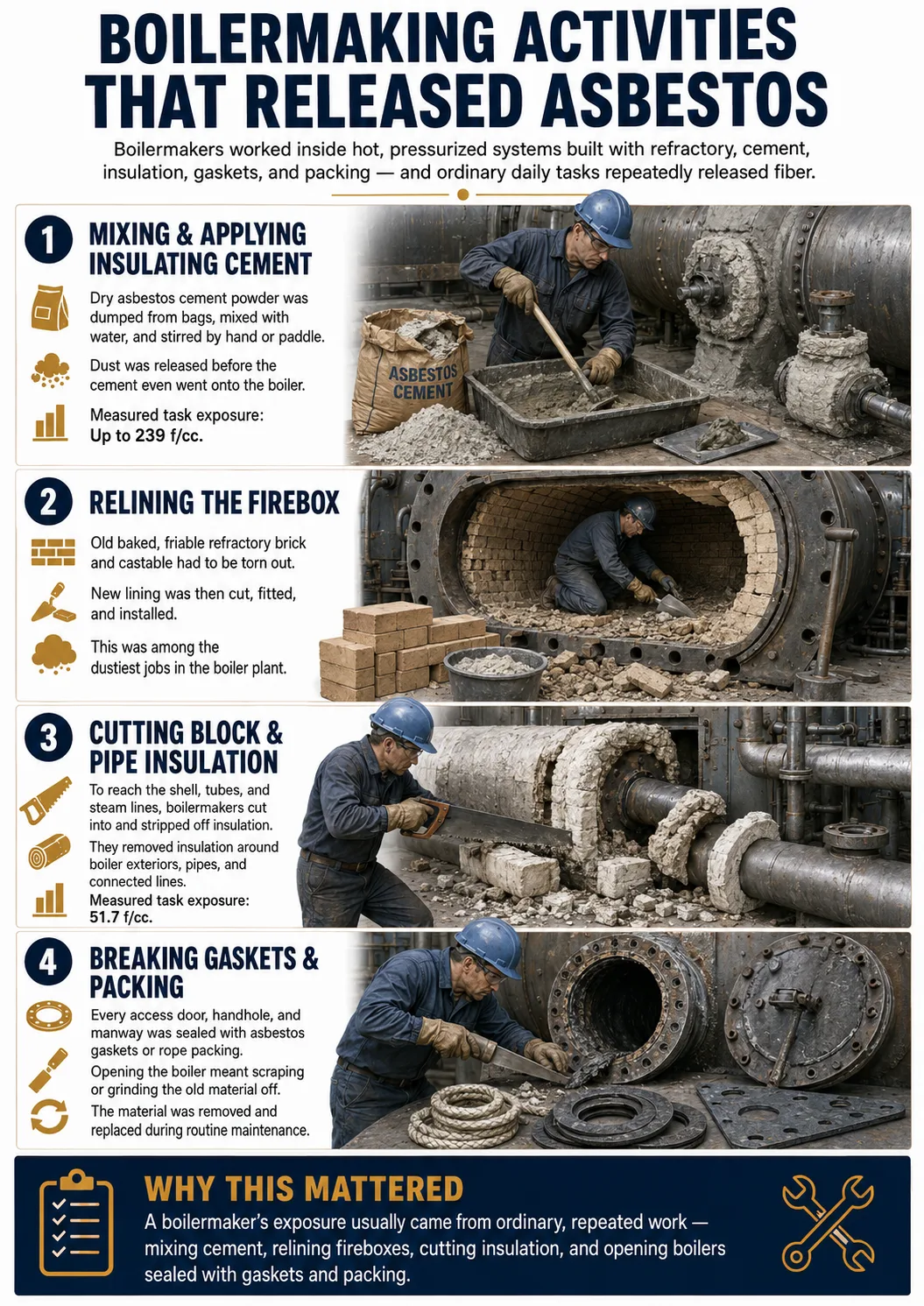
A boilermaker built and tore apart the dustiest equipment in the plant. His own work released asbestos straight into his breathing zone: dumping and mixing dry insulating cement, ripping the old refractory out of a firebox to reline it, cutting the block and pipe insulation away to reach the shell and tubes, and breaking the gaskets and packing on doors and manways. Mixing dry asbestos insulating cement from the bag has been measured at up to 239 fibers per cubic centimeter, thousands of times today's federal limit. And the air around him was already full of it, because the insulators and bricklayers working the same boiler a few feet away filled the same space with dust; cutting one common asbestos block and pipe insulation has been measured at 51.7 f/cc. He didn't have to be the insulator to breathe the insulation.
Fibers per cubic centimeter (f/cc), measured during the task
OSHA’s asbestos standard lists 0.1 f/cc as the 8-hour time-weighted average limit and 1.0 f/cc over 30 minutes as the excursion limit. These task measurements exceed even that short-term ceiling by roughly 52 and 239 times. Sources: published industrial hygiene testing, cited on our insulating cement and pipe insulation pages.
You don't need to remember which company's cement or refractory you used, and you don't need old job records or union cards in hand. The bankruptcy trusts that pay many of these claims are built to compensate exactly this kind of work: for mesothelioma, even brief asbestos exposure on a worksite that used it is typically enough to qualify; you don't have to prove a heavy dose. If you can say "I was Boilermakers Local 1 for thirty years" or "my husband relined boilers at the power plant," we have a starting point.

You don't need the product names or old records. No fee unless we recover compensation for your family.
Quick answers
| Did boilermaking really expose me to asbestos? | Almost certainly. A boilermaker breathed it from his own work, like mixing insulating cement, tearing out and relining refractory, cutting insulation, and breaking gaskets on doors and manways, and also from the insulators and bricklayers working the same boiler a few feet away. You didn't have to handle the insulation to breathe it. |
|---|---|
| I mostly erected new boilers, I didn't do repairs. Was I exposed? | Yes. New erection meant mixing and applying insulating cement, installing refractory and insulation, and seating gaskets, all of which raised dust. Repair and relining work added the heaviest exposure of all, because tearing out old, baked material releases far more fiber than installing it new. Either way, it's worth checking your history. |
| How much exposure do I need for a claim? | For mesothelioma, less than you would expect. The asbestos bankruptcy trusts that pay many of these claims are built to compensate brief exposure on a worksite that used asbestos, so you don't have to prove years of heavy dust. Courts ask for more than the trusts do, and we handle that distinction for you. |
| How long do I have to file? | It depends on your state and on whether this is a personal-injury or a wrongful-death situation, and some of those deadlines are short. The safest step is to call as soon as possible after diagnosis so the clock doesn't run out. |
| Do I have to file a lawsuit? | No. Many boilermakers and their families recover through trust claims and federal benefits without ever filing a lawsuit. Trust claims are paper claims, not courtroom cases. We explain both paths and respect your decision. |
| What can a boilermaker's case recover from? | Usually several sources at once: the bankruptcy trusts of asbestos makers like Manville, Owens-Corning, Eagle-Picher, and Garlock, and of the boiler builders Babcock & Wilcox and Combustion Engineering; lawsuits against still-solvent manufacturers and the plant or yard owners where you worked; and federal benefits like VA or Longshore coverage for Navy and shipyard boilermakers. One does not cancel out another. \ |
| Can a spouse or adult child call for the worker? | Yes. Most of our first calls come from a wife or an adult child researching for someone who is sick or who has passed. You don't need a power of attorney to ask questions. |
“I started this firm after learning that the cancers that killed my father and grandparents were caused by asbestos, something we did not realize until it was too late to hold anyone accountable. That experience is why we built this site: so that no other family misses their chance to ask the questions, hear the options, and decide for themselves what to do.”
Why boilermakers were exposed to asbestos
Boilermaking put workers in daily contact with asbestos for a simple structural reason: the equipment they built and maintained ran hot and under pressure, and for most of the twentieth century asbestos was the material the country used to contain heat and seal pressure. The refractory lining the firebox, the cement troweled on the seams and fittings, the block and pipe insulation around the shell and lines, and the gaskets and packing on every door and manway were all asbestos by design. A boilermaker built the boiler out of these materials, then tore them out to repair it.
The exposure came from the ordinary, repeated motions of the trade, not from anything unusual:
- Mixing and applying insulating cement. Dumping the dry asbestos cement powder out of the bag, adding water, and mixing it by hand or paddle threw fiber into the air before any of it went onto the boiler. Mixing dry asbestos insulating cement has been measured at up to 239 f/cc.
- Relining the firebox. Tearing the old, baked, friable (crumbly and dusty) refractory brick and castable out of a boiler, then cutting and fitting new lining, was the dustiest work in the plant.
- Cutting block and pipe insulation. To reach the shell, tubes, and steam lines, the boilermaker cut into and stripped off the insulation around them. Cutting one common asbestos block and pipe insulation has been measured at 51.7 f/cc.
- Breaking gaskets and packing. Every access door, handhole, and manway was sealed with asbestos gasket or rope, scraped and ground off whenever the boiler was opened up.
Two things multiplied all of this. The work happened in the worst possible places for dust: fireboxes, boiler drums, firing aisles, powerhouse basements, and ship machinery spaces, where there was little ventilation and the fiber hung in the air and was rebreathed rather than carried away. And it happened over and over for an entire working life. A career boilermaker mixed cement, relined fireboxes, and opened up insulation thousands of times across thirty or forty years, and tearing out old, degraded material released far more fiber than installing it new.
Through all of it, the men doing the work were given no warning and no protection. They blew dust off surfaces with compressed air, worked bare-handed, and went home in dusty clothes to their families, while the companies that made the products and ran the plants knew what the dust was doing.
The asbestos products a boilermaker handled, and why they add up to more than one claim
Over a career, a boilermaker handled several different asbestos products, each made by a different set of companies, and that combination is what shapes the claim. Understanding the products is how we identify who's responsible and which claims you can bring.
Boiler refractory brick and castable. The firebox lining that took the flame was asbestos-bearing refractory, set in place new and torn out by hand at every reline. The makers behind it include companies now covered by bankruptcy trusts, such as A.P. Green and Harbison-Walker, alongside still-solvent manufacturers you can sue directly. See how asbestos refractory caused exposure.
Insulating cement. Troweled onto fittings, seams, and vessels and mixed from dry powder on site, this was among the dustiest products a boilermaker touched. It traces back to makers like Eagle-Picher, most of which now pay through trusts. See how asbestos insulating cement caused exposure.
Block and pipe insulation. The covering on the shell, tubes, and steam lines was cut into constantly to reach the boiler. These trace back to the largest names in the industry, including Johns-Manville and Owens-Corning, most of which now pay through trusts. See how asbestos pipe and block insulation caused exposure.
Gaskets and packing on doors and manways. Every access door and manway was sealed with asbestos gasket or rope packing, scraped and ground off each time the boiler was opened. The makers include companies covered by trusts, such as Garlock, alongside still-solvent manufacturers. See how asbestos gaskets and packing caused exposure.
This is why a boilermaker's case is rarely a single claim. Because the work touched refractory, cement, insulation, and gaskets from many different manufacturers, and the boilers themselves were built by makers like Babcock & Wilcox and Combustion Engineering, the typical recovery runs against several bankruptcy trusts at once, plus lawsuits against the manufacturers still in business and the plant or yard owners who controlled the worksite. You don't need to remember which company made the cement you mixed in 1974 or the refractory you tore out in 1981. Give us the work history, and we trace each product back to its maker, and each maker to its trust or its place in a lawsuit.

Where you worked, and why the setting still matters
A boilermaker carried the exposure with him, so the job put him at risk in almost any heavy-industrial setting. Where he worked still matters to the case, though, because it decides which plant or yard owners can be held responsible as premises defendants, and whether federal benefit programs come into play on top of the trust and lawsuit claims.
A few settings account for much of the heaviest boilermaker exposure:
- Power plants and utilities. Boilermakers built, erected, and relined the large utility boilers, working inside heavily insulated fireboxes and drums. Utility and power generation asbestos exposure.
- Shipyards and the Navy. Marine boilers sat in tight, unventilated machinery spaces packed with asbestos insulation, cement, and gaskets. Civilian shipyard work can open Longshore (LHWCA, the Longshore and Harbor Workers' Compensation Act) benefits, and Navy service, including boiler-tender ratings, can open VA disability claims, both alongside the civil case. Shipyard and maritime asbestos exposure.
- Iron and steel mills. Boilers, furnaces, and pressure vessels were relined with refractory and lagged with insulation in mills that ran them hard around the clock. Iron and steel industry asbestos exposure.
- Refineries and petrochemical plants. Process boilers and pressure vessels meant constant refractory, cement, and insulation work, with the major oil companies reachable as premises owners. Petrochemical and refinery asbestos exposure.
If your loved one worked at a federal facility, a shipyard, or in the military, tell us. Those settings often add benefit channels that run in parallel with everything else.
What the asbestos industry's own magazines said about boiler work
The trade journal Asbestos and Johns-Manville's employee magazine, the J-M Circle, almost never named boilermakers. But they wrote often about the boiler itself: its doors, manholes and handholes, its settings, and the walls and drums insulated around it.
Gaskets on every opening
In 1920 the magazine said Babcock and Wilcox used metallic asbestos gaskets "on not only all their new constructions but for their replacement business" (Asbestos, July 1920). In 1943 it called asbestos gaskets "present practice" on new boilers, with jacketed asbestos millboard on the hottest handholes and woven asbestos gaskets on manholes (Asbestos, Mar. 1943).
A 1928 writer said a gasket "has a tendency to stick to the surface of the connection," so that on a repair it was "spoiled, torn and otherwise destroyed" (Asbestos, Oct. 1928).
Settings, rope and refractory
The same writer said you could walk into "almost any boiler room" and find cracks in the setting "large enough to throw a cat thru," with smoke pouring into the room (Asbestos, Oct. 1928). In 1932 the magazine said that where brick settings were built for power plant boilers, "asbestos rope is used as side wall insulation" (Asbestos, Aug. 1932).
In 1930 the J-M Circle told of a Chicago apartment building where firemen and other boiler room workers were collapsing from furnace fumes. J-M's men found "no asbestos rope had been packed between the brick work and the boiler drums," and asbestos rope was ordered at once (J-M Circle, Mar. 1930).
A 1942 article on wartime fuel saving described the repair work in detail:
- Large cracks in a poorly set boiler were caulked "with asbestos rope soaked in asbestos cement" (Asbestos, Aug. 1942).
- On older boilers, the outer brick or casing was to come off and "all the damaged insulation and refractory should be removed" (Asbestos, Aug. 1942).
- The outer wall could be rebuilt with asbestos cement board panels, while asbestos cement "must be renewed each time" (Asbestos, Aug. 1942).
Boiler jobs named in the magazines
| Site | Year reported | What the magazine says was used | Contractor | Source |
|---|---|---|---|---|
| Nekoosa-Edwards Paper Co., Port Edwards, Wis. (new boiler and settings) | 1929 | J-M No. 20 and No. 32 refractory cement; No. 4200 rope | — | J-M Circle, Mar. 1929 |
| Columbia Steel Corp. tin plate factory, Pittsburg (new and old boiler houses) | 1929 | J-M No. 31 and No. 32 high temperature cements; plastic refractory cements | A J-M insulation contractor | J-M Circle, May 1929 |
| Pittsburgh Steel Co., Monessen, Pa. (four new boilers) | 1929 | Superex and Magnesia blocks on fans and breechings | — | J-M Circle, Dec. 1929 |
| "City of New York," Byrd Antarctic Expedition ship | 1930 | J-M Magnesia Blocks and Magnesia Cement on the boilers; Kearsage gaskets on manhole and handhole plates | P. S. Thorsen Co. | J-M Circle, Sept.–Oct. 1930 |
| J. & L. Steel Corp., Eliza Furnaces, Pittsburgh (four new boilers) | 1930 | Not named | Rankin-Dutney Corp. | J-M Circle, Sept.–Oct. 1930 |
| Ford Motor Co., new Edgewater plant | 1930 | J-M Transite Boiler Wall Casing | H. W. Porter Co. | J-M Circle, Nov. 1930 |
| New York Steam Corp. boiler, New York | 1930 | J-M 85% Magnesia and 302 and 352 Cement on the boiler drums | Asbestos Construction Co. | J-M Circle, Dec. 1930 |
| American Sheet & Tin Plate Co., Gary, Ind. (waste heat boilers) | 1936 | J-M Sponge Felt | Asbestos & Magnesia Materials Co. | Asbestos, Sept. 1936 |
| Cahokia power plant, Union Electric, St. Louis (five new boilers) | 1938 | J-M 85% Magnesia and Superex on water walls, tube headers and recirculating tubes | J-M contract department | Asbestos, Dec. 1938 |
| Pacific Reduction Plant, Los Angeles (10 boilers) | 1943 | Carey's fiberated asbestos boiler coating | Warren and Bailey | Asbestos, Oct. 1943 |
How a boilermaker's case can come together
The following is a composite example, not a real client, but it reflects how these cases typically come together in our experience.
Ed spent thirty-four years as a boilermaker, most of it out of his local lodge. He erected, repaired, and relined boilers and pressure vessels in a utility power plant, a steel mill, and on ship-repair jobs at a yard, and the work was the same wherever he went: tear the old refractory out of the firebox, mix and trowel insulating cement, cut the block and pipe insulation away to reach the shell and tubes, and break the gaskets on the doors and manways. He worked inside drums and fireboxes and along firing aisles where the dust never cleared, often a few feet from the insulators and bricklayers on the same boiler. In early 2026, after months of breathlessness and chest tightness he'd put down to age, a biopsy confirmed pleural mesothelioma of the epithelioid type.
For Ed's family, the case moves on several tracks at once, which is typical for the trade. Trust claims go in against the makers of the refractory, cement, insulation, and gaskets he handled across his career, several different companies and several different trusts. Lawsuits go against the manufacturers still in business, the boiler makers, and the power company, mill, and yard that owned the premises where he worked. Because pleural mesothelioma is treated with specialized surgery and chemotherapy at only a limited number of centers, getting Ed to the right one may mean travel, and the firm advances the cost of travel and lodging when the best center isn't close to home. How legal recovery funds mesothelioma treatment access. Ed's wife, who washed his work clothes for three decades, is eligible for free asbestos health screening as part of the representation. The screening is a chest X-ray read by a B-reader, with a CT scan if needed; it looks for asbestos-related changes in the lungs and isn't a diagnosis or a reliable way to find mesothelioma early.
This example is general. Every case depends on the diagnosis, the exposure history, the dates, the defendants, the applicable law, and the available evidence.
Sources of compensation for boilermakers
A boilermaker's recovery usually comes from more than one place, and the different channels run in parallel without canceling one another out. We file across all of them that apply.
- Asbestos bankruptcy trusts. The companies that made the refractory, cement, insulation, and gaskets he handled, and the companies that built the boilers, set aside money in trusts to pay the people they harmed. These are paper claims that don't require a lawsuit or a courtroom, and a single career often supports filings against several trusts at once. How asbestos trust claims work.
- Lawsuits against solvent manufacturers. Many asbestos product makers are still in business and can be sued directly for making and selling materials they knew were dangerous. How product liability lawsuits work.
- Premises liability against the site owners. The utilities, mills, refineries, and yards that controlled the worksites can be held responsible for the conditions they allowed, separate from the companies that made the products. How premises liability claims work.
- Federal and disability benefits. These depend on where and how the work was done, and they're paid in addition to the trust and lawsuit recovery. Military (and especially Navy) service can support VA disability benefits; civilian shipyard work can support Longshore (LHWCA) benefits; civilian work at a federal facility can support FECA (Federal Employees' Compensation Act) benefits; and Social Security disability is available to anyone whose illness stops them from working. How asbestos disability and benefit claims work.
Mentioned on this site
- 85% Magnesia
- A.P. Green Asbestos Trust Claims
- ABB Lummus Asbestos Trust Claims
- American Journal of Industrial Medicine
- Annals of the New York Academy of Sciences
- API, Inc. Asbestos Trust Claims
- Armstrong World Industries Asbestos Trust Claims
- ASARCO Asbestos Trust Claims
- Asbestos Exposure by Occupation
- Asbestos Exposure in Bystander and Proximity Workers
- Asbestos Exposure in Iron and Steel Mills
- Asbestos Exposure in Power Plants and Utilities
- Asbestos Exposure in Railroad Work
- Asbestos Exposure in Refineries and Petrochemical Plants
- Asbestos Exposure in Shipyards and Maritime Work
- Asbestos Gaskets and Mechanical Packing
- Asbestos Insulating Cement, Boiler Coatings, and Spray Cement
- Asbestos insulation
- Asbestos Refractory Products
- Babcock & Wilcox Asbestos Trust Claims
- Boiler Insulation
- Calcium Silicate Insulation
- Caposite
- Combustion Engineering Asbestos Trust Claims
- Durabla Asbestos Trust Claims
- Fibreboard Asbestos Trust Claims
- Gasket
- J.T. Thorpe Company (Texas) Asbestos Trust Claims
- Jefferson County
- Journal of Toxicology and Environmental Health. Part a
- Journal of Toxicology and Environmental Health. Part B, Critical Reviews
- Newport News Shipbuilding
- Occupational Exposure
- Owens-Illinois
- Owens-Illinois Asbestos Trust Claims
- Owens Corning Asbestos Trust Claims
- Pipe Covering
- Pipefitter
- Pittsburgh Corning
- Pittsburgh Corning Asbestos Trust Claims
- Plibrico Asbestos Trust Claims
- Quigley Asbestos Trust Claims
- Respiratory Medicine
- Risk Analysis
- S.S. Morro Castle
- Stress Corrosion Cracking
- The Annals of Occupational Hygiene
- Thermal System Insulation (TSI)
- Tumori
- Turner Brothers Asbestos
- Unibestos
- Videotaped Deposition of Dr. Paul Kotin in the South Carolina Asbestos Cases (1979)
- Welding Rod Coating
- Yarway Asbestos Trust Claims
In our case-law library
120 court decisions in our case-law library involve boilermakers. Among them:
- Ripley v. Foster Wheeler LLCU.S. Court of Appeals, Fourth Circuit, 2016 · Boilermaker at Norfolk Naval Shipyard, Portsmouth, 1969-1972 and 1974-late 1970s
- Anheuser-Busch Companies, Inc. v. CantrellVirginia Supreme Court, 2015 · Boiler tender at 1987-2005
- Nostrom v. AW Chesterton Co.New York Court of Appeals, 2010 · Boilermaker for subcontractors on construction projects at energy facilities / power plants owned by Orange & Rockland Utilities and Central Hudson Gas & Electric, 1970s and 1980s
- Henderson v. Allied Signal, Inc.South Carolina Supreme Court, 2007 · Boilermaker, pipefitter, and sheet metal worker at various industrial sites in South Carolina
- Caruolo v. John Crane, Inc.U.S. Court of Appeals, Second Circuit, 2000 · Navy fireman at Brooklyn Navy Yard, 1944-1950
- Simmons v. Pacor, Inc.Pennsylvania Supreme Court, 1996 · Boilerman at United States Navy, 1964-1968
The defenses companies raise, and how we answer them
When a boilermaker's case goes to court, the manufacturers raise the same handful of defenses they raise in most asbestos cases, and none of them is new to us. The short version is that the arguments describe a cleaner, smaller version of the job than the one your loved one actually did, and the evidence answers them. The detail is below for anyone who wants it.
All of this applies only to the lawsuit side of a case. The trust claims are a paper process: no opposing lawyer raises defenses, no one is deposed, and no one goes to court.
How we answer the defenses raised in boilermaker cases
"The refractory and cement were locked in once they set, so there was no exposure in normal use." The exposure didn't come from the cured, installed lining. It came from mixing the dry powder before it ever went on, and from tearing out the old, baked, broken-down material at every reline, which is when the fiber comes loose. The industrial hygiene testing that recorded high fiber levels recorded them during exactly that mixing and removal work, the work boilermakers did every day.
"Insulation was the insulator's job, not the boilermaker's." Boilermakers cut into and stripped off block and pipe insulation themselves to reach the shell, tubes, and lines, especially on repair and reline jobs where no insulator was standing by. And even when an insulator did the lagging, the boilermaker was working the same boiler in the same tight, unventilated space, breathing the same air. The exposure reached him whether or not he was the one holding the knife.
"The exposure to any one company's product was too small to have made a difference." These cases are built on documented exposure: the specific high-dust tasks the trade performed and the dose built up across a full career, which is what separates a boilermaker's claim from a trivial one. The bankruptcy trusts pay on brief exposure, and in court we prove a meaningful contribution with that task and career evidence.
Frequently asked questions
I don't remember the product brands or have my old records. Can I still file?
Yes, and most people are in exactly that position. You don't need brand names, pay stubs, or union cards in hand to start. We reconstruct the work history and the products from our exposure database, the trust documentation for each manufacturer, purchase and specification records, and the recollections of coworkers, and Boilermakers lodge and pension records often fill in the dates and worksites. The conversation starts with what you remember.
My loved one has already passed away. Can we still bring a claim?
Yes. Families regularly file after a death, both trust claims and, depending on the state, a wrongful death lawsuit. These deadlines vary by state and some are short, and the family's claim can depend on whether a claim was preserved during the worker's life, so it's best to call promptly. We handle wrongful death and estate claims as a matter of routine.
My father worked at several different places over his career. Does that complicate the case?
It usually strengthens it. A boilermaker who moved among power plants, mills, refineries, and shipyards was exposed to more products, made by more companies, at more premises, which means more trusts and more potential defendants. We reconstruct the full career and file across every documented worksite.
Could my family have been exposed through the work clothes?
Yes, and it's common. The dust that settled on a boilermaker's clothes, hair, and tools came home with him, and spouses who shook out and laundered work clothes and children who hugged a parent at the end of a shift were exposed too. That's why our representation includes free asbestos health screening for family members, and if a family member is later diagnosed, they may have a claim of their own.
What happens when I call?
A member of our litigation team, not a screener, takes the call, and the first conversation usually runs twenty to thirty minutes. We listen to the work history, explain which claims and channels may apply, and lay out the timeline for your situation. No one is pressured to sign anything on that call.
What does it cost to work with you?
Nothing up front, and nothing at all unless we recover for you. We work on a contingency fee, which means our fee comes only out of money we recover, and the case review and consultation are free.
Do we have to travel to your office?
No. We handle these cases by phone, video, and mail, and we come to you when an in-person visit helps. Families work with us from every state without traveling to us.
Talk with an asbestos lawyer about boilermaker exposure
Whether you're a worker who was just diagnosed, or a spouse or adult child trying to find help for someone who is sick or who has passed, we're ready to talk. You don't need the product names, you don't need the old records, and you don't need to travel to us. Start with what you remember, and we'll take it from there.
Related resources
Sources and references
The exposure measurements on this page come from published industrial hygiene testing, cited in full on the product pages where each figure lives:
- The 239 f/cc insulating-cement mixing measurement is documented on our asbestos insulating cement page.
- The 51.7 f/cc block and pipe insulation measurement is documented on our asbestos pipe and block insulation page.
Other authorities relied on:
- Occupational exposure limits. OSHA's asbestos standard sets the current permissible exposure limit at 0.1 f/cc averaged over eight hours, with a short-term excursion limit of 1.0 f/cc over thirty minutes. 29 C.F.R. § 1910.1001.
- Carcinogenicity. The International Agency for Research on Cancer classifies all forms of asbestos, including chrysotile, as carcinogenic to humans (Group 1) and recognizes no safe threshold of exposure for mesothelioma. IARC Monographs, Vol. 100C.
This page is provided for general informational purposes and does not constitute legal advice. Every asbestos case turns on its own facts, exposure history, diagnosis, deadlines, available evidence, and applicable law. Reviewing this page does not create an attorney-client relationship. For advice about your specific situation, call 833-4-ASBESTOS for a free case review.