
If you worked as an insulator, lagger, or asbestos worker, or if someone in your family did, and a mesothelioma, lung cancer, asbestosis, or other asbestos diagnosis has now come in, this page is the place to start. The same dust reached the spouses and children who shook out and washed the work clothes, and the other tradesmen who shared the boiler rooms, ship engine rooms, and powerhouses where the work was done.
No trade was exposed to more asbestos than the insulators. The insulator's work was the asbestos itself: cutting and sawing pipe covering and block to fit the lines, and mixing dry asbestos cement by hand to trowel over the fittings and valves. Hand-sawing one common asbestos pipe insulation has been measured at 51.7 fibers per cubic centimeter, hundreds of times today's federal limit, and dry-mixing asbestos insulating cement has been measured higher still, at 239 f/cc. Because that work happened in tight, unventilated spaces, the dust an insulator raised hung in the air and was rebreathed for the rest of the shift, and it was the same dust the pipefitters and other trades around him breathed secondhand.
You do not need to remember which company's covering or cement you used, and you do not need old job records or union cards in hand. The bankruptcy trusts that pay many of these claims are built to compensate exactly this kind of work: for mesothelioma, even brief asbestos exposure on a worksite that used it is typically enough to qualify, and you do not have to prove a heavy dose. If you can say "I was Heat and Frost Insulators Local for thirty years" or "my dad was an asbestos worker at the shipyard," we have a starting point.
Fibers per cubic centimeter (f/cc), measured during the task
OSHA’s asbestos standard lists 0.1 f/cc as the 8-hour time-weighted average limit and 1.0 f/cc over 30 minutes as the excursion limit. These task measurements exceed even that short-term ceiling by roughly 52 and 239 times. Sources: published industrial hygiene testing, cited on our pipe insulation and insulating cement pages.

You don't need the product names or old records. No fee unless we recover compensation for your family.
Quick answers
| Did insulation work really expose me to asbestos? | More than almost any other trade. The insulator's job was to handle asbestos directly all day, cutting and sawing pipe covering and block, mixing dry insulating cement by hand, spraying fireproofing, and tearing out old lagging on repairs. It was the most heavily exposed trade on most worksites. |
|---|---|
| I also worked with the newer fiberglass insulation. Was I still exposed? | Almost certainly, if any part of your career ran before the 1980s. The trade switched to fiberglass and other materials over time, but for decades the covering, block, and cement were asbestos, and men who did both were exposed during the asbestos years and again whenever they tore out old asbestos insulation later. It's worth checking your dates. |
| How much exposure do I need for a claim? | For mesothelioma, less than you'd expect. The asbestos bankruptcy trusts that pay many of these claims are built to compensate brief exposure on a worksite that used asbestos, so you don't have to prove years of heavy dust. Courts ask for more than the trusts do, and we handle that distinction for you. |
| How long do I have to file? | It depends on your state and on whether this is a personal-injury or a wrongful-death situation, and some of those deadlines are short. The safest step is to call as soon as possible after diagnosis so the clock doesn't run out. |
| Do I have to file a lawsuit? | No. Many insulators and their families recover through trust claims and federal benefits without ever filing a lawsuit. Trust claims are paper claims, not courtroom cases. We explain both paths and respect your decision. |
| What can an insulator's case recover from? | Usually several sources at once: the bankruptcy trusts of asbestos makers like Johns-Manville, Owens-Corning, Pittsburgh Corning, and Eagle-Picher; lawsuits against any manufacturers still in business and the plant or yard owners where you worked; and federal benefits like VA or Longshore coverage for Navy and shipyard insulators. One doesn't cancel out another. |
| Can a spouse or adult child call for the worker? | Yes. Most of our first calls come from a wife or an adult child researching for someone who is sick or who has passed. You do not need a power of attorney to ask questions. |
“I started this firm after learning that the cancers that killed my father and grandparents were caused by asbestos, something we did not realize until it was too late to hold anyone accountable. That experience is why we built this site: so that no other family misses their chance to ask the questions, hear the options, and decide for themselves what to do.”
Why insulators and insulation workers were exposed to asbestos
Insulation work put men in direct contact with asbestos every working day, for a simple reason: their whole job was to apply the material that contained heat and protected against fire, and for most of the twentieth century that material was asbestos. The pipe covering, the block on the boilers and vessels, the cement troweled over fittings, and the spray on the steel were asbestos by design. No other trade handled it as constantly, which is why insulators were called "asbestos workers" and why theirs is recognized as the most heavily exposed trade of all.
The exposure came from the ordinary, repeated motions of the trade:
- Cutting and fitting pipe covering and block. Preformed asbestos covering and block was scored, sawed, and snapped to fit each line and vessel, and the cutting released fiber straight into the breathing zone. Hand-sawing one common asbestos pipe covering has been measured at 51.7 f/cc.
- Mixing and applying insulating cement. Dry asbestos cement powder was dumped into a barrel or trough and mixed by hand before being troweled onto fittings and valves, and the dry mixing raised the heaviest dust of all. Dry-mixing insulating cement has been measured at 239 f/cc.
- Spraying fireproofing and insulation. Spray-applied asbestos fireproofing and insulation was blown onto steel and surfaces, putting a fog of fiber into the air around the man holding the gun.
- Tearing out old insulation. On repairs, shutdowns, and demolition, stripping degraded, friable (crumbly and dusty) covering and cement off the lines by hand released far more fiber than installing it new.
Two things multiplied all of this. The work happened in the worst possible places for dust: boiler rooms, ship engine rooms, powerhouse basements, and refinery process units, where there was little ventilation and the fiber hung in the air and was rebreathed rather than carried away. And it happened over and over for an entire working life, thousands of cuts, batches, and rip-outs across thirty or forty years.
Through all of it, the men doing the work were given no warning and no protection. They mixed dry cement bare-handed, blew dust off surfaces with compressed air, and went home in dusty clothes to their families, while the companies that made the products and ran the plants knew what the dust was doing.

Johns-Manville's late-1970s training film Working with Asbestos: "When a product must be cut, shaped, or fitted, take care to avoid generating dust and inhaling it," and wear a respirator that fits. The film was made in the late 1970s, after most of the insulation work described on this page had been done without that advice. The passage runs about a minute.
Watch the whole film, with its transcript: Working with Asbestos
The asbestos products an insulator handled, and why they add up to more than one claim
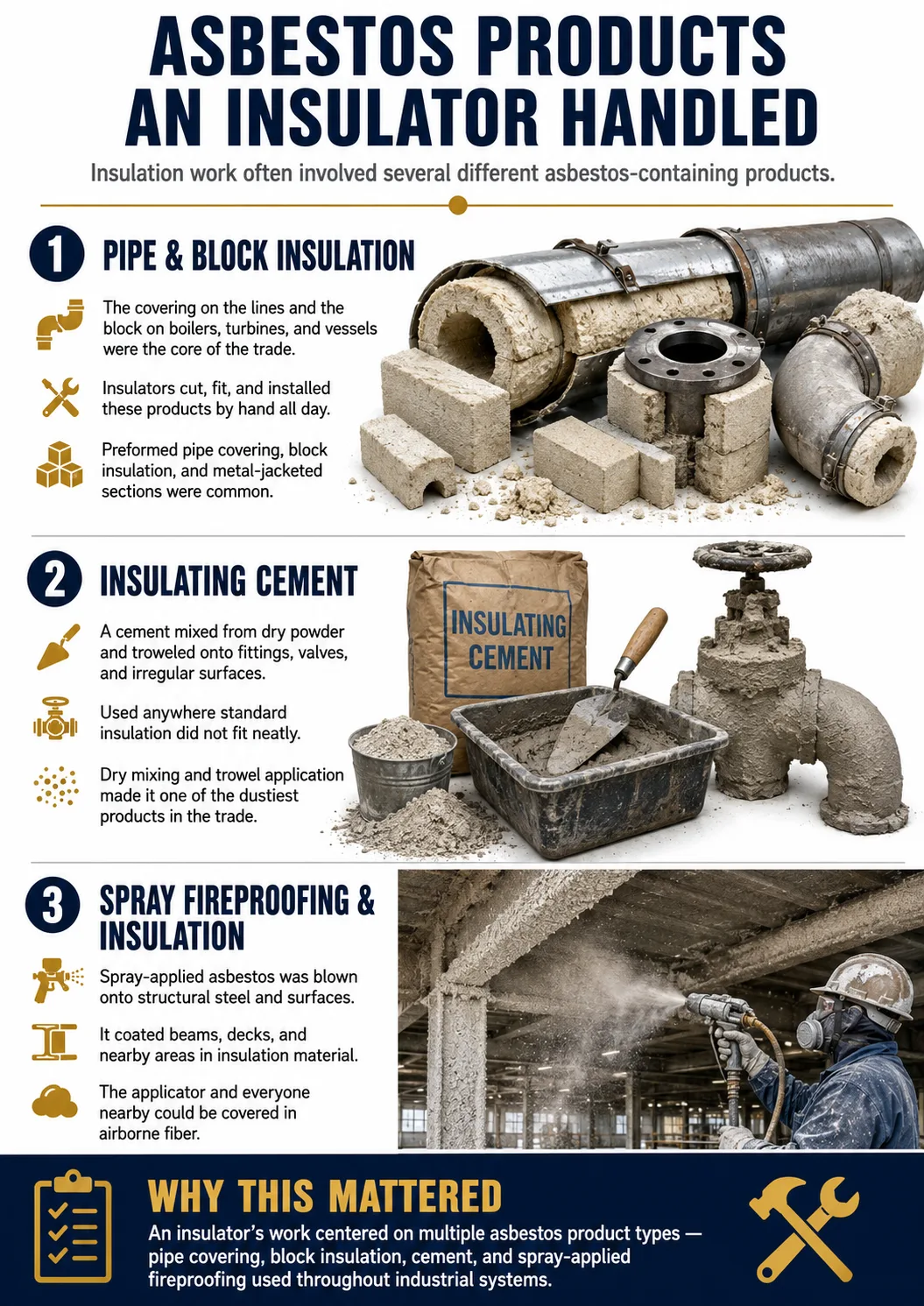
Over a career, an insulator handled several different asbestos products, each made by a different set of companies, and that combination is what shapes the claim. Understanding the products is how we identify who's responsible and which claims you can bring.
Pipe and block insulation. The covering on the lines and the block on the boilers, turbines, and vessels were the core of the trade, cut and fitted by hand all day. These trace back to the largest names in the industry, including Johns-Manville and Owens-Corning, whose Kaylo covering was a mainstay, most of which now pay through bankruptcy trusts. See how asbestos pipe and block insulation caused exposure.
Insulating cement. The cement mixed and troweled onto fittings, valves, and irregular surfaces was among the dustiest products an insulator touched, especially during dry mixing. It traces back to makers such as Fibreboard (Pabco) and Eagle-Picher, both now paying through trusts. See how asbestos insulating cement caused exposure.
Spray fireproofing and insulation. Spray-applied asbestos was blown onto structural steel and surfaces, coating the applicator and everyone nearby in fiber. Armstrong Contracting and Supply, the U.S. applicator of sprayed Limpet asbestos, told its own crews in writing to "wear a dust respirator at all times during the application process" (Armstrong operating instructions, p. 2). See how asbestos spray fireproofing caused exposure.
This is why an insulator's case is rarely a single claim. Because the work touched covering, block, cement, and spray from many different manufacturers, the typical recovery runs against several bankruptcy trusts at once, plus lawsuits against any manufacturers still in business and the plant or yard owners who controlled the worksite. You don't need to remember which company made the covering you cut in 1972 or the cement you mixed in 1979. Give us the work history, and we trace each product back to its maker, and each maker to its trust or its place in a lawsuit.
Where you worked, and why the setting still matters
An insulator carried the exposure with him, so the trade put him at risk in almost any industrial setting. Where he worked still matters to the case, though, because it decides which plant or yard owners can be held responsible as premises defendants, and whether federal benefit programs come into play on top of the trust and lawsuit claims.
A few settings account for much of the heaviest insulator exposure:
- Shipyards and the Navy. Engine rooms and machinery spaces were lined floor to overhead with asbestos covering, block, and cement in tight, unventilated quarters. Civilian shipyard work can open Longshore and Harbor Workers' Compensation Act (LHWCA) benefits, and Navy service can open VA disability claims, both alongside the civil case. Shipyard and maritime asbestos exposure.
- Refineries and petrochemical plants. Miles of high-temperature process piping and vessels meant constant covering, block, and cement work, with the major oil companies reachable as premises owners. Petrochemical and refinery asbestos exposure.
- Power plants and utilities. Powerhouse boilers, turbines, and steam lines were among the most heavily insulated equipment ever built. Utility and power generation asbestos exposure.
- Commercial and institutional construction. Insulators wrapped the mechanical systems and sprayed the structural steel in office towers, hospitals, and schools, working in the same spaces as the other trades. Construction industry asbestos exposure.
- Iron and steel mills. Furnaces, lines, and equipment in the mills ran hot and were heavily insulated and refractory-lined, with insulators working alongside the bricklayers. Iron and steel asbestos exposure.
If your loved one worked at a federal facility, a shipyard, or in the military, tell us. Those settings often add benefit channels that run in parallel with everything else.
How an insulator's case can come together
The following is a composite example, not a real client, but it reflects how these cases typically come together in our experience.
Sal spent thirty-five years as an insulator out of his Heat and Frost local. He covered and repaired high-temperature lines and equipment in two shipyards, a utility powerhouse, and a refinery, and the work was the same wherever he went: saw and fit pipe covering and block to the lines, mix dry insulating cement by the barrel and trowel it over the fittings, spray fireproofing onto the steel, and on shutdowns tear the old, crumbling lagging back off by hand. He worked in engine rooms and boiler basements where the dust never cleared and the fiber he raised hung in the air all shift. In early 2026, after months of abdominal pain and bloating he'd put down to getting older, a biopsy confirmed peritoneal mesothelioma of the epithelioid type.
For Sal's family, the case moves on several tracks at once, which is typical for the trade. Trust claims go in against the makers of the covering, block, cement, and spray he worked with across his career, several different companies and several different trusts. Lawsuits go against the shipyards, refinery, and utility that owned the premises where he worked, and against any product maker still in business. Because peritoneal mesothelioma is treated with surgery and heated chemotherapy (HIPEC) at only a handful of specialized centers, getting Sal to the right one may mean travel, and the firm advances the cost of travel and lodging when the best center isn't close to home. How legal recovery funds mesothelioma treatment access. Sal's wife, who shook out and laundered his work clothes for decades, is eligible for free asbestos health screening as part of the representation. The screening is a chest X-ray read by a B-reader, with a CT scan if needed; it looks for asbestos-related changes in the lungs and isn't a diagnosis or a reliable way to find mesothelioma early.
This example is general. Every case depends on the diagnosis, the exposure history, the dates, the defendants, the applicable law, and the available evidence.
Sources of compensation for insulators and insulation workers
An insulator's recovery usually comes from more than one place, and the different channels run in parallel without canceling one another out. Because the trade handled so much asbestos from so many makers, the trusts are often the center of the recovery. We file across every channel that applies.
- Asbestos bankruptcy trusts. The companies that made the covering, block, cement, and spray he handled and later went bankrupt set aside money in trusts to pay the people they harmed, including names like Johns-Manville, Owens-Corning, Pittsburgh Corning, and Eagle-Picher. These are paper claims that don't require a lawsuit or a courtroom, and a single insulator's career often supports filings against many trusts at once. How asbestos trust claims work.
- Lawsuits against solvent manufacturers. Where a maker of a product he handled is still in business, it can be sued directly for making and selling something it knew was dangerous. How product liability lawsuits work.
- Premises liability against the site owners. The shipyards, refineries, powerhouses, mills, and plants that controlled the worksites can be held responsible for the conditions they allowed, separate from the companies that made the products. How premises liability claims work.
- Federal and disability benefits. These depend on where and how the work was done, and they're paid in addition to the trust and lawsuit recovery. Military (and especially Navy) service can support VA disability benefits; civilian shipyard work can support Longshore (LHWCA) benefits; civilian work at a federal facility can support Federal Employees' Compensation Act (FECA) benefits; and Social Security disability is available to anyone whose illness stops them from working. How asbestos disability and benefit claims work.
Mentioned on this site
- 85% Magnesia
- A. Mayer-Pareyn to R. B. Von Wald and J. A. Brown on the Health and Safety History of J-M do Brazil (1980)
- ABB Lummus Asbestos Trust Claims
- ACandS Asbestos Trust Claims
- Albert E. Hutchinson, From the General President, The Asbestos Worker (August 1968)
- American Journal of Industrial Medicine
- American Journal of Respiratory and Critical Care Medicine
- Annals of the New York Academy of Sciences
- Archives of Environmental Health
- Armstrong Cork and Travelers Insurance File on E. O. McCarrell's Asbestosis Compensation Claim (1957)
- Armstrong World Industries Asbestos PI Settlement Trust
- Armstrong World Industries Asbestos Trust Claims
- ASARCO Asbestos Trust Claims
- Asbestos Corns
- Asbestos Exposure by Occupation
- Asbestos Exposure in Aerospace and Aviation
- Asbestos Exposure in Bystander and Proximity Workers
- Asbestos Exposure in Iron and Steel Mills
- Asbestos Exposure in Power Plants and Utilities
- Asbestos Exposure in Railroad Work
- Asbestos Exposure in Refineries and Petrochemical Plants
- Asbestos Exposure in Shipyards and Maritime Work
- Asbestos Exposure in the Construction Industry
- Asbestos History
- Asbestos Industry Magazines
- Asbestos Information Association Board of Directors Minutes on the State of the Art Defense (1977)
- Asbestos in Schools
- Asbestos Insulating Cement, Boiler Coatings, and Spray Cement
- Asbestos insulation
- Asbestosis (1962)
- Asbestos Textile Institute Air Hygiene and Manufacturing Committee Minutes on Selikoff's Study and British Fiber Counting (1963)
- Asbestos Textile Institute Air Hygiene Committee on Asbestos Exposure and Neoplasia (1963)
- Asbestos Textile Institute Air Hygiene Committee on Dr. Cralley's Progress Report (1964)
- Asbestos Timeline
- Asbestos Timeline
- Asbestos Timeline
- Asbestos Timeline
- Asbestos Timeline
- Asbestos Workers Union
- Babcock & Wilcox Asbestos Trust Claims
- Bergit A. Swartout v. Mundet Cork Corp. and Others, California Asbestosis Death Claim (1956–1958)
- BMJ Case Reports
- Boiler Insulation
- Brauer Supply Asbestos Trust Claims
- British Journal of Cancer
- British Journal of Industrial Medicine
- British Medical Journal
- British Medical Journal
- Bystander Exposure
- C. L. Sheckler to D. B. Wingerter on Wording Warning Labels for Industrial Insulations Products (1969)
- CA
- Calcium Silicate Insulation
- Cancer
- Cancer Causes & Control
- Caposite
- Carl Thompson of Hill and Knowlton to Bert C. Goss on the Johns-Manville Project on the Selikoff Program (1968)
- Case Reports on Asbestos
- Celotex's Answers to Plaintiff's Master Interrogatories in Laird v. Celotex (1984)
- Chest
- Clarence Borel v. Fibreboard Paper Products Corporation, Plaintiff's Original Complaint (1969)
- Colorectal Cancer
- Combustion Engineering Asbestos Trust Claims
- D. W. Ladd, Jr., to H. T. Williams on the October Asbestos Worker (1956)
- Daniel C. Braun to Hugh M. Jackson on Lung Cancer Literature for the Asbestos Textile Institute (1956)
- Deposition of Dr. Alfred A. Angrist in the South Carolina Insulator Cases (1978)
- Detroit District Memo to R. A. Stapleton on the Bradshaw Summons, with "the Wave Is Breaking" Note (1967)
- Dr. Daniel C. Braun to H. M. Jackson Sending Lung Cancer Literature for the Asbestos Textile Industry (1956)
- Dr. Enrico C. Vigliani's Proposal for a Study at the Balangero Mine and Among Italian Shipyard Insulation Workers (1968)
- Dr. George W. Wright, Minutes of the Scientific Relations Subcommittee on X-Ray Findings at Billerica and Manville (1969)
- Dr. George W. Wright, Testimony at the Labor Department Hearing on the Asbestos Standard (1972)
- Dr. George W. Wright to Alex Cross of Cape Asbestos on When Britain Extended Asbestos Rules to Insulation Workers (1975)
- Dr. George W. Wright to Herbert M. Ball on the Asbestosis Defense Task Force (1968)
- Dr. Kenneth W. Smith to N. W. Hendry, "Asbestos versus Cancer" (1965)
- Dr. Kenneth W. Smith to O. A. Battista of Food Machinery Corporation on Asbestos Health Hazards (1966)
- Dr. Paul Kotin to H. D. S. Hardie of Turner & Newall on Crocidolite and Mesothelioma (1977)
- Draft Manville Letter to Health and Human Services Secretary Richard Schweiker Attacking Dr. Selikoff's Work and Credentials (1982)
- E. E. Keal, Asbestosis and Abdominal Neoplasms (1960)
- Eagle-Picher Asbestos Trust Claims
- Edmund M. Fenner, Industrial Pneumoconiosis Prevention and Control (1969)
- Ehret Magnesia Manufacturing Company
- Elliott DeForest of the Northwest Magnesia Association to Washington State on Deleting Its Asbestosis Rule (1943)
- Environmental Health Perspectives
- Environmental Research
- F. H. Edwards to J. M. Briley on Asbestosis and Lung Cancer in Insulation Workers (1966)
- F. H. Edwards to J. M. Briley on Chest X-Rays for Insulation Workers (1966)
- F. Homburger, "The Co-Incidence of Primary Carcinoma of the Lungs and Pulmonary Asbestosis" (1943)
- Faciane v. Travelers Insurance Company, Petitions and Eagle-Picher's Exception (1961-1962)
- Fibreboard Asbestos Trust Claims
- Fleischer, Viles, Gade and Drinker, "A Health Survey of Pipe Covering Operations in Constructing Naval Vessels" (1946)
- Fleischer-Drinker Study
- Flintkote Asbestos Trust Claims
- Frontiers in Public Health
- Fuller-Austin Asbestos Settlement Trust Claims
- G. W. H. Schepers, "Occupational Chest Diseases," Chapter in Modern Occupational Medicine (1962)
- G. W. Wright to F. J. Solon, Jr., on Dr. Selikoff's Asbestos Standard Statements (1973)
- George W. Hatch of Travelers Insurance to Jack C. Else of Marsh and McLennan on Asbestos Cancer Claims and the Sullivan Case (1966)
- Glovebag
- H-60 mask
- H. B. Rhodes of Union Carbide on Asbestos Papers at the International Congress on Occupational Health (1975)
- H. M. Jackson to William T. Marr of the Long Beach Naval Shipyard on Asbestos Dust Standards (1959)
- Henry C. Puetz v. C. F. Braun and Others, California Asbestosis Findings and Award (1966–1969)
- Herbert B. Holleb and Alfred Angrist, "Bronchogenic Carcinoma in Association with Pulmonary Asbestosis" (1942)
- Hilton C. Lewinsohn, "Medical Aspects of Occupational Exposure to Asbestos" (1977)
- Hilton C. Lewinsohn, The Surveillance of High-Risk Groups Exposed to Asbestos in the United States (1978)
- Holleb and Angrist, "Bronchiogenic Carcinoma in Association with Pulmonary Asbestosis" (1942)
- I. P. Tilton to A. M. Schmidt on Gustave J. Carlson's Asbestosis Claim (1935)
- Index Cards Abstracting Italian Studies of Asbestosis Among Miners and Shipyard Workers (1972)
- Indian Journal of Occupational and Environmental Medicine
- Industrial Health
- Industrial Health Survey of the Bath Iron Works Corporation for the Maritime Commission (1942)
- Industrial Hygiene Digest, June 1957, with an Abstract on Asbestosis among Danish Insulation Workers (1957)
- Insulation Industry Testimony of Sheckler, Royer and Zumwalt at the Labor Department Asbestos Hearing (1972)
- Insulator
- International Journal of Environmental Research and Public Health
- International Journal of Gynecological Cancer
- International Journal of Occupational and Environmental Health
- Ira I. Brought to Harold Boeschenstein of Owens-Corning on the Asbestos Workers Union and Asbestosis (1957)
- Irving J. Selikoff, E. Cuyler Hammond and Jacob Churg, Asbestos Exposure, Smoking, and Neoplasia (1968)
- Irving J. Selikoff, Jacob Churg and E. Cuyler Hammond, "Asbestos Exposure and Neoplasia" (1964)
- Isselbacher, Klaus and Hardy, Asbestosis and Bronchogenic Carcinoma (1953)
- J.T. Thorpe Company (Texas) Asbestos Trust Claims
- JAMA
- James K. Green to Thomas C. DeLorenzo on NICA Records and Dr. Kenneth Smith's 1964 Talk to Insulation Contractors (1978)
- Jefferson County
- John H. Marsh to A. A. Cross of Cape Asbestos on Comments About Fiber Types, with Cape's Crocidolite and Amosite Paper (1974)
- Johns-Manville "Position Paper on the Health Aspects of Asbestos" (1966)
- Johns-Manville Environmental Health Task Force Policy Committee Minutes, May 1971 (1971)
- Johns-Manville File on Michael David Mulligan's Ohio Workmen's Compensation Claim (1962)
- Johns-Manville File on William S. McKinney's Ohio Workmen's Compensation Claim (1962)
- Joseph L. Goodman on the Asbestos Threshold Limit Value (1972)
- Journal of Occupational and Environmental Medicine
- Journal of Occupational Health
- Journal of Occupational Medicine.
- Journal of Toxicology and Environmental Health. Part a
- Journal of Toxicology and Environmental Health. Part B, Critical Reviews
- K. S. Johnson to M. D. Burch on the Western States Conference Asbestosis Motion (1957)
- Kaj Ahlman and Eero Siltanen, Exposure of Insulation Workers to Asbestos Dust (1971)
- Keasbey & Mattison Company
- Kenneth W. Smith, "Asbestosis," Chapter 2 of The Pneumoconioses (1955)
- Kenneth W. Smith to E. W. Redd of Leed Insulator Corporation on Asbestosis (1964)
- Klaus Robock, Can We Project an Acceptable Standard for Industrial Use of Asbestos? "Absolutely" (1978)
- La Medicina del Lavoro
- Lancet
- LeGrande v. Johns-Manville Products, Complaint and Summons (1957)
- LeGrande v. Johns-Manville Products, Settlement Hearing Transcript (1959)
- Letters and Comments on Asbestos
- Liberty Ship
- Lois Gaul's Manville Memo on Asbestos Items in Abstracts of World Medicine (1985)
- Manville
- Manville Asbestos Trust Claims (Johns-Manville)
- Manville Fund's Answers to Interrogatories in Gunn v. Celotex (1989)
- Manville Fund's Responses to Plaintiffs' Interrogatories in Moore v. H.K. Porter (1990)
- Marine Sheathing
- Maryland Casualty Company to Johns-Manville on Home Insulation Silicosis Claims (1933)
- Monokote
- N. B. Sherrill Jr. to Vandiver Brown on the M.S.A. Comfo Respirator (1934)
- Nancy Sussman and Gary M. Marsh, Occupations Associated with Asbestosis (1900-1964)
- Naval Ship Engineering Center to Ingalls Shipbuilding on Shipyard Asbestos Hazards, with Ingalls' Reply (1969)
- Newport News Shipbuilding
- New York Academy of Sciences, Preprinted Abstracts for the Conference on Biological Effects of Asbestos (1964)
- Occupational and Environmental Medicine
- Occupational Exposure
- Occupational Safety and Health
- Owens-Illinois
- Owens-Illinois Asbestos Trust Claims
- Owens Corning Asbestos Trust Claims
- Paterson Plant
- Paul-A. Filteau of the Quebec Asbestos Mining Association on Dr. Selikoff's Toronto Lectures (1973)
- Pipe Covering
- Pipefitter
- Pittsburgh Corning
- Pittsburgh Corning Asbestos Settlement Trust
- Pittsburgh Corning Asbestos Trust Claims
- Quigley Asbestos Trust Claims
- R. Belleau and E. A. Gaensler, Mesothelioma and Asbestosis (1968)
- R. R. Standel, Jr. to Herbert M. Ball on Common Law Asbestosis Claims and the Tomplait Case (1968)
- R. R. Standel Jr. to Leroy G. Vandeveer on the Bradshaw Case and J-M's 1954 Dust Warning (1967)
- R. S. Coleman to H. A. Berg Enclosing Johns-Manville's Position Paper, Asbestos and Human Health (1968)
- Raybestos-Manhattan Photograph of Insulation Work, Exhibit 321
- Raybestos-Manhattan Photograph of Insulation Work, Exhibit 322
- Raybestos-Manhattan Photograph of Insulation Work, Exhibit 323
- Reading Castleman, Appendix 2
- Reading Castleman, Chapter 2
- Reading Castleman, Chapter 3
- Reading Castleman, Chapter 4
- Reading Castleman, Chapter 5
- Reading Castleman, Chapter 10
- Regulatory Toxicology and Pharmacology
- Report to Congress on Workers' Home Contamination Study Conducted Under the Workers' Family Protection Act (1995)
- Research on Amphibole Asbestos
- Reviews on Asbestos
- Riley v. Johns-Manville, California Industrial Accident Commission Award for an Insulator's Death (1961)
- Rogers, Field, Gentry, Benjamin & Robertson to George A. Weller on Delaying Publication of the Borel Opinion (1973)
- Scandinavian Journal of Work, Environment & Health
- Scottish Medical Journal
- Seidman 1979 Study
- Selikoff, Pundsack and Hammond, "Fibrous Dust Respirator Protection
- Selikoff Studies
- Seminars in Roentgenology
- Shipyard Exposure
- Sprayed Insulation, Inc.
- Stress Corrosion Cracking
- Synergistic Effect
- Tebbens, Balzer, Cooper and Tabershaw, Dust-Producing Potential of Construction Materials (1970)
- The American Journal of Medicine
- The American Review of Respiratory Disease
- The Annals of Occupational Hygiene
- The Asbestos Worker, 1912
- The Asbestos Worker, 1913
- The Asbestos Worker, 1914
- The Asbestos Worker, 1915
- The Asbestos Worker, 1916
- The Asbestos Worker, 1917
- The Asbestos Worker, 1918
- The Asbestos Worker, 1919
- The Asbestos Worker, 1920
- The Asbestos Worker, 1921
- The Asbestos Worker, 1922
- The Asbestos Worker, 1923
- The Asbestos Worker, 1924
- The Asbestos Worker, 1925
- The Asbestos Worker, 1926
- The Asbestos Worker, 1927
- The Asbestos Worker, 1928
- The Asbestos Worker, 1929
- The Asbestos Worker, 1930
- The Asbestos Worker, 1931
- The Asbestos Worker, 1933
- The Asbestos Worker, 1934
- The Asbestos Worker, 1935
- The Asbestos Worker, 1936
- The Asbestos Worker, 1937
- The Asbestos Worker, 1938
- The Asbestos Worker, 1939
- The Asbestos Worker, 1940
- The Asbestos Worker, 1941
- The Asbestos Worker, 1942
- The Asbestos Worker, 1943
- The Asbestos Worker, 1944
- The Asbestos Worker, 1945
- The Asbestos Worker, 1946
- The Asbestos Worker, 1947
- The Asbestos Worker, 1948
- The Asbestos Worker, 1949
- The Asbestos Worker, 1950
- The Asbestos Worker, 1951
- The Asbestos Worker, 1952
- The Asbestos Worker, 1953
- The Asbestos Worker, 1954
- The Asbestos Worker, 1961
- The Asbestos Worker
- The Borel v. Fibreboard case file (1969-1972)
- The European Respiratory Journal
- The Johns-Manville Knowledge Chronology
- The Motley 1000
- The New England Journal of Medicine
- The Potter v. Fibreboard case file (1969-1972)
- Thermal Insulation Contractors Association and Health and Safety Executive Letters on the 1945 Ships Circular (1945, 1973)
- Thermal System Insulation (TSI)
- The Tomplait v. Combustion Engineering case file (1962-1969)
- The Western Journal of Medicine
- Thorax
- Time & Life Building
- Tomplait v. Combustion Engineering, Complaints and Dr. Stanton Fischer's Letter (1966-1968)
- Toxicology and Industrial Health
- Transcript of the Massachusetts Medical Society Symposium on Occupational Diseases of the Lungs (1953)
- Ultrastructural Pathology
- Unibestos
- Unsigned Draft Letter to Edward C. Ames of Owens-Corning Fiberglas on Albert Baumgardner (1944)
- Videotaped Deposition of Clifford L. Sheckler (1982)
- Videotaped Deposition of Dr. Paul Kotin in the South Carolina Asbestos Cases (1979)
- W. B. Reitze to D. Markusson on Exposures from Mixing Insulating Cements (1976)
- W. C. Dreessen and W. E. Fleischer, Asbestosis from Amosite Pipe Covering at Bath Iron Works (1944)
- W. G. Hazard of Owens-Illinois to Ira I. Brought on Kaylo and the Saranac Experiments (1956)
- W. L. Bowes to John D. Black on the Asbestos Workers Union's Lung Study (1956)
- W. S. Nott Company
- Walter Hesse of Johns-Manville, Statement on Asbestos in Insulation Materials at the Labor Department Hearing (1972)
- Wenham v. Johns-Manville Products, Complaint, Answer and Dismissal (1961)
- William T. Marr, "Asbestos Exposure During Naval Vessel Overhaul" (1964)
- Work-Related Lung Disease Surveillance Report 1999
In our case-law library
186 court decisions in our case-law library involve insulators. Among them:
- Abutahoun v. Dow Chemical CompanyTexas Supreme Court, 2015 · Pipeline insulation worker at Dow Chemical Freeport facility, 1967-1968
- Union Carbide Corporation v. SynatzskeTexas Supreme Court, 2014 · Insulator at Union Carbide Texas City facility, nearly forty years until 1979
- Dunkel v. BoetlerKentucky Supreme Court, 2009 · Insulator (husband Ralph Dunkel) at Big Rivers' Sebree Powerhouse, 1978-1979
- Deschenes v. Transco, Inc.Connecticut Supreme Court, 2008 · Insulator at commercial construction sites, 1967-1985
- Deschenes v. Transco, Inc.Connecticut Supreme Court, 2007 · Insulator at numerous commercial construction sites, 1967-1985
- Herring v. Texaco, Inc.Washington Supreme Court, 2007 · Member of the Asbestos Workers Union Local 7 at Todd Shipyards work sites, 1960s and early 1970s
Videos


The defenses companies raise, and how we answer them
When an insulator's case goes to court, the manufacturers raise the same handful of defenses they raise in most asbestos cases, and none of them is new to us. The short version is that the arguments describe a cleaner, smaller version of the job than the one your loved one actually did, and the evidence answers them. The detail is below for anyone who wants it.
All of this applies only to the lawsuit side of a case. The trust claims are a paper process: no opposing lawyer raises defenses, no one is deposed, and no one goes to court.
How we answer the defenses raised in insulator and insulation worker cases
"The insulation was chrysotile, which is less dangerous than other types." Chrysotile is a recognized cause of mesothelioma on its own, but the argument also gets the facts wrong: much of the pipe and block insulation an insulator handled, including the widely used Unibestos covering, was made with amosite, an amphibole fiber (a more hazardous type). The established science answers this argument, and we put it on.
"The dangers weren't known back when he was working." The corporate-knowledge record shows the opposite. The companies that made and sold these products tracked the disease in their own workers and their own files for decades while the men handling the material were told nothing, a history laid bare in the Clarence Borel case that opened modern asbestos litigation. We put that documentary record in front of the jury.
"You can't prove our specific product was there." We don't ask a sick man or a grieving family to have kept brand names from forty years ago. We reconstruct which products were on each worksite from our exposure database, the trust documentation for each manufacturer, specification and purchase records, and the recollections of coworkers who did the same job in the same places.
Frequently asked questions
I don't remember the product brands or have my old records. Can I still file?
Yes, and most people are in exactly that position. You don't need brand names, pay stubs, or union cards in hand to start. We reconstruct the work history and the products from our exposure database, the trust documentation for each manufacturer, purchase and specification records, and the recollections of coworkers, and Heat and Frost Insulators local and pension records often fill in the dates and worksites. The conversation starts with what you remember.
My loved one has already passed away. Can we still bring a claim?
Yes. Families regularly file after a death, both trust claims and, depending on the state, a wrongful death lawsuit. These deadlines vary by state and some are short, and the family's claim can depend on whether a claim was preserved during the worker's life, so it's best to call promptly. We handle wrongful death and estate claims as a matter of routine.
My father worked at several different sites over his career. Does that complicate the case?
It usually strengthens it. An insulator who moved among shipyards, refineries, powerhouses, and construction sites was exposed to more products, made by more companies, at more premises, which means more trusts and more potential defendants. We reconstruct the full career and file across every documented worksite.
Could my family have been exposed through the work clothes?
Yes, and with insulators it's especially common, because they came home covered in the dust. The fiber that settled on the clothes, hair, and tools came home too, and spouses who shook out and laundered work clothes and children who hugged a parent after a shift were exposed. That's why our representation includes free asbestos health screening for family members, and if a family member is later diagnosed, they may have a claim of their own.
What happens when I call?
A member of our litigation team, not a screener, takes the call, and the first conversation usually runs twenty to thirty minutes. We listen to the work history, explain which claims and channels may apply, and lay out the timeline for your situation. No one is pressured to sign anything on that call.
What does it cost to work with you?
Nothing up front, and nothing at all unless we recover for you. We work on a contingency fee, which means our fee comes only out of money we recover, and the case review and consultation are free.
Do we have to travel to your office?
No. We handle these cases by phone, video, and mail, and we come to you when an in-person visit helps. Families work with us from every state without traveling to us.
Talk with an asbestos lawyer about insulator and insulation worker exposure
Whether you're a worker who was just diagnosed, or a spouse or adult child trying to find help for someone who is sick or who has passed, we're ready to talk. You don't need the product names, you don't need the old records, and you don't need to travel to us. Start with what you remember, and we'll take it from there.
Related resources
Sources and references
The exposure measurements on this page come from published industrial hygiene testing, cited in full on the product pages where each figure lives:
- The 51.7 f/cc pipe-covering hand-sawing measurement is documented on our asbestos pipe and block insulation page.
- The 239 f/cc insulating-cement dry-mixing measurement is documented on our asbestos insulating cement page.
Other authorities relied on:
- Occupational exposure limits. OSHA's asbestos standard sets the current permissible exposure limit at 0.1 f/cc averaged over eight hours, with a short-term excursion limit of 1.0 f/cc over thirty minutes. 29 C.F.R. § 1910.1001.
- Carcinogenicity. The International Agency for Research on Cancer classifies all forms of asbestos, including chrysotile, as carcinogenic to humans (Group 1) and recognizes no safe threshold of exposure for mesothelioma. IARC Monographs, Vol. 100C.
This page is provided for general informational purposes and does not constitute legal advice. Every asbestos case turns on its own facts, exposure history, diagnosis, deadlines, available evidence, and applicable law. Reviewing this page does not create an attorney-client relationship. For advice about your specific situation, call 833-4-ASBESTOS for a free case review.