
Sprayed "Limpet" Asbestos was a wet-sprayed insulation and fireproofing product applied by directing a stream of dry asbestos fiber and inorganic binder onto a surface and intercepting it mid-flight with jets of atomized water. The wetted fibers struck the surface, felted together, and dried into a continuous, joint-free coating. Marketed simultaneously as thermal insulation, fire protection, sound control, and corrosion prevention "all in one coating — SIMULTANEOUSLY," Limpet was applied for roughly four decades on steel framing, ductwork, tanks, vessels, turbines, ship structures, and the underside of floor decks across the United States and forty-odd other countries.
The product is best known today for two reasons. First, its earlier U.S. formulation was built around crocidolite — the most carcinogenic of the regulated asbestos minerals. Second, it was sprayed: the application process generated overspray and fallout that contaminated entire building floors during installation, exposing not only the spray crew but every other trade working in the same structure.
You don't need the product names or old records. No fee unless we recover compensation for your family.
Origins and U.S. distribution
The Limpet spray machine was developed by J.W. Roberts Limited in England in 1932. Roberts, a Turner & Newall subsidiary, patented several features of the machine and licensed the system internationally.
Keasbey & Mattison Company of Ambler, Pennsylvania was licensed as the exclusive U.S. distributor in 1935 and operated a Limpet Spray Training School continuously from that date forward. By 1961, K&M's promotional literature reported Limpet was sold and applied in more than forty countries — among them the United States, Canada, Mexico, Brazil, Argentina, the United Kingdom, France, Germany, Italy, Spain, Sweden, Japan, Australia, South Africa, India, and Israel.
In the United States, the field application of Limpet was performed by Armstrong Contracting & Supply Corporation (later ACandS, Inc.) of Lancaster, Pennsylvania, identified on the K&M sales literature as the "exclusive applicator of SPRAYED 'LIMPET' ASBESTOS as High-Temperature Thermal Insulation." Armstrong/ACandS maintained offices in roughly fifty U.S. cities by the early 1960s, including Akron, Atlanta, Baltimore, Boston, Buffalo, Chicago, Cleveland, Dallas, Denver, Detroit, Houston, Los Angeles, New Orleans, New York, Philadelphia, Pittsburgh, San Francisco, Seattle, St. Louis, and Washington, D.C.
The Roberts → Keasbey & Mattison → Armstrong/ACandS chain matters in litigation because it concentrated the U.S. application of Limpet into a single contractor's workforce while distributing the exposure footprint across thousands of buildings nationwide.
The "four properties in one coating" marketing
K&M's industrial brochure advanced Limpet as a single material that delivered four functions in one application. The technical claims made by K&M, and the way they were presented to architects, engineers, and plant operators, deserve a closer look — both because the marketing drove the product into so many buildings, and because the same claims explain why competing materials were displaced from specifications.
Thermal insulation
The basic measure of an insulation material's performance is its K factor — its thermal conductivity. The K factor expresses how readily heat passes through a unit thickness of the material. Lower K means a better insulator. Engineers use it to calculate how thick the insulation has to be to hold a hot surface to a target temperature or to keep heat loss within an acceptable budget.
For rough orientation: still air has a K factor of about 0.17 (in the units used by K&M — BTU per square foot per hour per degree Fahrenheit per inch of thickness). Common building materials run far higher: brick is around 5, glass is around 6, structural steel is around 310. Insulation materials are designed to trap small pockets of still air inside a fibrous or porous matrix, pushing the assembly's K factor down toward the air baseline.
K&M reported Limpet's K factor as approximately 0.28 at low temperatures, rising to about 0.60 at 800°F as the temperature gradient increased — values comparable to other premium asbestos insulations of the era. The marketing emphasis, however, was not on a lower absolute K factor than competing products. It was on continuity: block insulations were sold with a published K factor for the block itself, but in service the blocks were butted together with insulating cement at the joints, and those cement joints transmitted more heat than the blocks they connected. K&M's pitch was that Limpet, sprayed as a continuous blanket "without seams or joints," delivered the rated K factor across the whole assembly rather than only across the field of the block. The brochure also claimed that the spray process entrapped additional air, "enhancing" the insulation value of the asbestos itself.
In service terms, this meant Limpet was specified for tanks, vessels, irregularly shaped equipment, and large flat duct surfaces where the labor cost of cutting and fitting blocks would have been prohibitive — and where the cumulative cement-joint area on a block installation would have undermined the calculated heat loss.
Fire protection
Fire-resistance ratings in the United States and the United Kingdom are established by exposing an assembly to a standard fire — a curve of rising temperature versus elapsed time codified in ASTM E-119. The standard curve reaches 1,000°F at 5 minutes, 1,700°F at 1 hour, 1,925°F at 3 hours, and 2,300°F at 8 hours or more. A "2-hour rating" means the assembly survived two hours of that escalating fire exposure before failing the test's pass-fail criteria (which vary by assembly type — for a structural steel column, the criterion is essentially that the steel doesn't reach a temperature at which it loses load-bearing capacity).
The reason fire protection matters for structural steel is straightforward: unprotected steel weakens dramatically above roughly 1,000°F, and a fire in a commercial building can reach that temperature within minutes. If the steel frame loses strength while occupants are still evacuating, the building can collapse. Building codes therefore require that structural steel in commercial and industrial buildings be wrapped in a material that holds the steel below its failure temperature long enough for occupants to escape and firefighters to suppress the fire. Sprayed asbestos fireproofing was, from the 1950s through the early 1970s, the dominant code-compliant material for this purpose in high-rise construction.
K&M's 1961 brochure published fire-resistive ratings issued by Underwriters' Laboratories Inc. (Chicago), Underwriters' Laboratories of Canada, and the Fire Offices Committee of Great Britain for a range of assemblies. Among them: 1- and 2-hour ratings for asbestos corrugated roofing and siding at ½" Limpet; 1-hour for ships' bulkhead steel walls at ¼"; 4-hour for 3½" concrete floors at 1"; 2-, 3-, and 4-hour beam ratings direct to steel at thicknesses of 1", 1-5/16", and 1-¾" respectively; and column ratings as long as 5 hours at 3-3/8" thickness. The thicker the Limpet, the longer the rating — every inch of additional thickness bought more time before the protected steel reached failure temperature.
These ratings were the lever that placed Limpet into thousands of buildings. An architect writing "3-hour rated sprayed fireproofing on all structural steel" into a specification was, in effect, writing a specification that only a handful of products could meet — and Limpet was on the short list.
Sound control
The performance measure for an acoustical material is its sound absorption coefficient, expressed on a scale from 0.0 to 1.0. A coefficient of 0.0 means the material reflects all sound energy striking it (a polished concrete wall, for example). A coefficient of 1.0 means it absorbs all of it (the theoretical equivalent of an open window — sound enters and never returns). The National Bureau of Standards' formal definition, quoted in K&M's brochure, is that the coefficient "is defined as the absorbed fraction of the sound energy incident on a material."
Absorption varies with frequency, so manufacturers publish coefficients at standard pitches — 128, 256, 512, 1,024, 2,048, and 4,096 cycles per second (today written as Hz). The average across the speech-range frequencies is called the Noise Reduction Coefficient (NRC), a single number used in specifications.
For orientation: painted gypsum wall board has an NRC of roughly 0.05 (essentially reflective). Heavy carpet runs 0.30 to 0.50. A good acoustical ceiling tile is 0.60 to 0.80. An NRC of 0.90 — Limpet's published figure on metal lath at thicknesses of ¾" to 1½" — is at the top of what any material short of a purpose-built sound chamber will deliver. K&M's tables showed individual-frequency absorption coefficients reaching 0.97 and 0.98 at 512 and 1,024 cycles on 1½" applied to solid backing.
The practical consequence: Limpet sprayed on the underside of a floor deck, on the walls of a fan room, or inside a duct chase made the space dramatically quieter. It was specified into gas compressor stations, blower rooms, mechanical equipment rooms, school cafeterias, and office building plenums precisely for that reason.
Corrosion prevention
K&M's corrosion-prevention claim was the most distinctive — and the most aggressive — of the four. The brochure argued that Limpet's capillary or "wick" action drew any moisture entering the coating out to the outside face, where it re-evaporated into the atmosphere, leaving the underlying steel dry. The mechanism, as K&M described it: the asbestos coating "breathes in" water vapor that would otherwise condense in droplets, and "breathes out" the water when humidity drops back.
The technical foundation offered for this claim was the extreme fineness of asbestos fibers. K&M reproduced a comparison table (sourced to the Canadian Mining and Metallurgical Bulletin, April 1951) showing fiber diameters:
| Fiber | Diameter (inches) | Fibrils per linear inch |
|---|---|---|
| Human hair | 0.00158 | 630 |
| Wool | 0.0008 – 0.0011 | 910 – 1,250 |
| Cotton | 0.0004 | 2,500 |
| Rayon / Nylon | 0.0003 | 3,300 |
| Glass fiber | 0.00026 | 3,840 |
| Rockwool | 0.00014 – 0.00028 | 3,520 – 7,040 |
| Asbestos (chrysotile) | 0.0000007 – 0.0000018 | 850,000 – 1,400,000 |
Asbestos fibers were, on K&M's numbers, roughly a thousand times finer than the next-finest commercial fiber. The argument was that fibers this small generated enormous capillary forces, drawing moisture through the coating as plant roots draw water through soil. K&M backed the claim with a case study: steel columns insulated with Limpet at Imperial Chemical Industries in England in 1934 were reportedly partially stripped in 1960 (26 years later) and found "in their original mill condition," while uninsulated steel nearby — repainted every two years — was "pitted and corroded to an astonishing degree."
The same fiber fineness that K&M marketed as the source of capillary action is, of course, the property that makes asbestos lethal to inhale: fibers small enough to penetrate deep into the lung, durable enough to remain there for decades, and shaped to drive the cellular injury that produces asbestosis, lung cancer, and mesothelioma. The 1951 trade-press numbers K&M used to sell corrosion prevention are, read against modern industrial hygiene literature, also the numbers that define respirable fiber dimensions.
Laboratory backing
The brochure listed testing by an extensive roster of laboratories on both sides of the Atlantic, presented as evidence that the four-property claims rested on independent science. The U.S. and U.K. testing bodies were: the Department of Scientific & Industrial Research at Elstree, the National Physical Laboratory at Teddington, the British Iron & Steel Research Association, Underwriters' Laboratories of Chicago, the Mellon Institute of Industrial Research at the University of Pittsburgh, the National Bureau of Standards at the U.S. Department of Commerce, and R.H. Harry Stanger of Elstree. Continental European laboratories included the Laboratoire National d'Essais in Paris, the Centre Scientifique et Technique du Bâtiment in Paris, the Associazione Nazionale Controllo Combustione in Rome, the Istituto Elettrotecnico Nazionale Galileo Ferraris in Turin, the Forschungsheim für Wärmeschutz in Munich, the Bundesanstalt für Mechanische und Chemische Material Prüfung in Hamburg, Statsprøveanstalten in Copenhagen, and Vienna's Technologisches Gewerbemuseum.
The breadth of the testing roster served K&M's marketing purpose well. It is worth noting in litigation context that none of these laboratories tested the inhalation hazard of the spray application process itself — the brochure's "tested for" list covers thermal insulation, sound absorption, fire protection, moisture re-evaporation, resistance to frost, and mechanical damage. Worker exposure was not on the list.
The two U.S. standardized blends
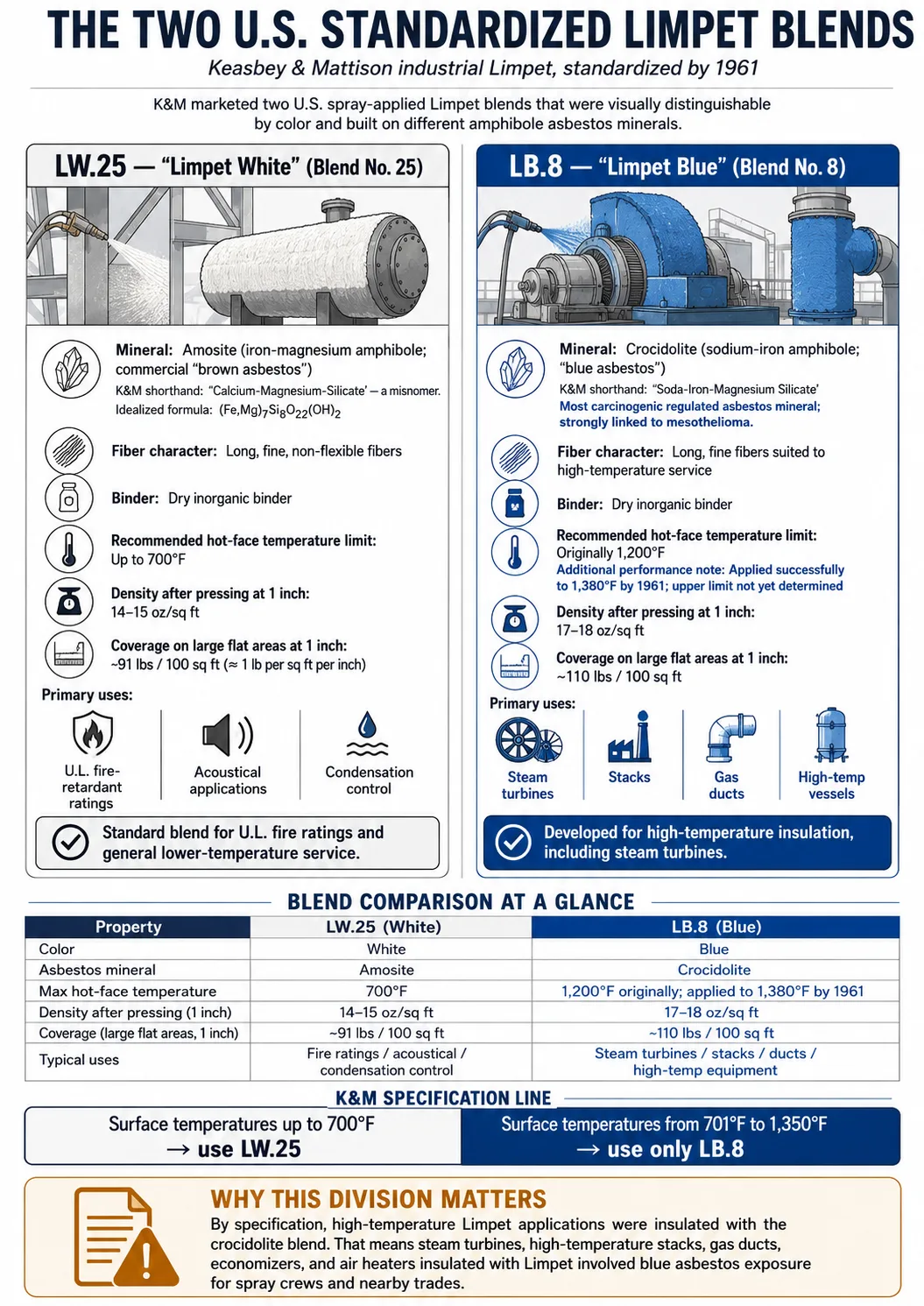
By 1961, K&M had standardized U.S. industrial Limpet on two fiber blends. They were marketed as immediately distinguishable on sight by their colors, and they were built on chemically and mineralogically different amphibole asbestos minerals.
LW.25 — "Limpet White," blend No. 25
- Mineral: Amosite (the commercial name for the grunerite-cummingtonite series — the iron-magnesium amphibole). K&M's brochure described amosite using the simplified shorthand "Calcium-Magnesium-Silicate," which is a misnomer; amosite is properly an iron-magnesium silicate with the idealized formula (Fe,Mg)₇Si₈O₂₂(OH)₂. Amosite is the asbestos mineral characterized commercially by long, fine, but non-flexible fibers — properties K&M cited as the reason it was selected for insulation compositions. The Limpet licensor's own laboratory used the plain name: J. W. Roberts' 1960 dust report heads its LW.25 tables "Amosite (LW 25)" (1960 report, p. 9).
- Color: white.
- Binder: dry inorganic binder incorporated with the asbestos fiber.
- Recommended temperature limit: 700°F (hot face).
- Primary uses: the standard blend for all Underwriters' Laboratories Inc. fire-retardant ratings, plus acoustical applications and condensation control.
- Density specification: 14–15 oz. per sq. ft. at 1" thick after pressing with hand trowel.
- Coverage (large flat areas): approximately 91 lbs. per 100 sq. ft. at 1" finished thickness — roughly 1 lb. per square foot per inch of thickness as a first-pass estimate.
LB.8 — "Limpet Blue," blend No. 8
- Mineral: Crocidolite (the sodium-iron amphibole, the asbestos mineral commonly known as "blue asbestos"). K&M described it as "Soda-Iron-Magnesium Silicate." Crocidolite is the most carcinogenic of the regulated asbestos minerals, particularly for mesothelioma, owing in part to its fine fiber diameter, biopersistence, and high iron content driving redox cycling in lung tissue.
- Color: blue.
- Binder: dry inorganic binder.
- Recommended temperature limit: originally 1,200°F; by the time of the 1961 brochure K&M reported successful application at hot-face temperatures of 1,380°F with the upper limit "not yet determined." K&M identified LB.8 specifically as the blend developed for high-temperature insulation, including steam turbines, where surface temperatures of approximately 1,100°F (about 100°F above the steam-turbine working range) had originally driven the formulation.
- Density specification: 17–18 oz. per sq. ft. at 1" thick after pressing — denser, and "less compressible," than LW.25.
- Coverage (large flat areas): approximately 110 lbs. per 100 sq. ft. at 1" finished thickness.
- In Britain: the blue grade J. W. Roberts tested in 1960 was LB.3, sprayed beside LW.25 in its Horwich booth and on board ship (1960 report, p. 2).
Blend comparison at a glance
| Property | LW.25 ("Limpet White") | LB.8 ("Limpet Blue") |
|---|---|---|
| Color | White | Blue |
| Asbestos mineral | Amosite (iron-magnesium amphibole, brown asbestos) | Crocidolite (sodium-iron amphibole, blue asbestos) |
| K&M's chemical description | "Calcium-Magnesium-Silicate" (a misnomer; amosite contains iron, not calcium) | "Soda-Iron-Magnesium Silicate" |
| Fiber character | Long, fine, non-flexible | Long, fine; suited to high-temperature service |
| Max. hot-face temperature | 700°F | 1,200°F (originally); applied to 1,380°F by 1961 |
| Density after pressing (1" thick) | 14–15 oz/sq ft | 17–18 oz/sq ft |
| Coverage (1" on large flat areas) | ~91 lbs / 100 sq ft (≈ 14.6 oz/sq ft) | ~110 lbs / 100 sq ft (≈ 17.6 oz/sq ft) |
| Primary uses | U.L. fire-retardant ratings; acoustical work; condensation control | High-temperature work: steam turbines, stacks, ducts, high-temp vessels |
| K&M specification line | "Surface temperatures up to 700°F use LW.25" | "Surface temperatures from 701°F to 1,350°F use only Grade LB.8" |
The application specifications make the division explicit: per K&M, "On surface temperatures up to 700°F Keasbey & Mattison Company SPRAYED 'LIMPET' ASBESTOS Grade LW.25 shall be used. Surface temperatures from 701°F to 1,350°F use only Grade LB.8."
The litigation significance of this division cannot be overstated. Every steam turbine, every high-temperature stack, every gas duct, every economizer, and every air heater insulated with Limpet was insulated with the crocidolite blend. Spray crews working those applications, and every other trade present during application or subsequent disturbance, were exposed to blue asbestos by specification.
The application process
The K&M industrial brochure and the Armstrong Contracting construction manual describe the process in detail.
The machine. A spray machine fed dry asbestos fiber from a hopper onto an endless spiked belt called the "creeper sheet." A "control brush" metered the fiber, regulating flow by adjusting clearance from the belt. Fiber was stripped from the belt by a "stripping brush," dropped into a fan unit, and propelled by air pressure through a 2-inch rubber hose (standard length 50 feet, with booster units used for greater distances). Two machine types appear in the manual: the HA Type Spray Machine and the later "K" Machine, which offered three pulley-selectable output speeds, a directly-driven variable-speed fan, a Variac voltage control to compensate for line-voltage variation, and a redesigned hopper sized to hold roughly half a bag of LW-25 at one filling.
The gun. Fiber left the gun dry. Atomized water was sprayed by a series of apertures on the gun itself, focused to intercept the fiber stream approximately nine inches from the gun end. The surface being sprayed was 18 to 20 inches from the gun. The construction manual instructed operators to hold the gun at approximately a 45-degree angle and to overlap each pass.
Build-up and pressing. The applicator built thickness to slight excess and then pressed the surface with hand tools (flat surfacing tool, hand floater, plasterer's steel finishing trowel, corner pressing tool, and pointing trowel) to felt the fibers together and bring the coating to specified thickness. On steam turbines, the construction manual called for a two-layer build with no more than 30 minutes between layers.
Finishes. Where a hard surface was wanted, K&M's BD.2 — "Bull Dog Finish No. 2" was troweled over the Limpet. BD.2 was an asbestos-and-Portland-cement mixture, applied roughly 1/8" to 3/8" thick over the pressed Limpet, often reinforced with 1" hexagonal 20-gauge galvanized or Monel chicken wire. For outdoor or weather-exposed work, the specifications called for Foster's H.I. Mastic 90-07 (or Foster's Safetee Mastic 60-80 in fire-hazard zones), or alternatively a corrugated aluminum jacket with factory-applied moisture barrier secured by stainless steel straps and breather springs.
Crew exposure. Armstrong's operating instructions for the HA Type machine contain an explicit acknowledgment of inhalation hazard: "It is strongly recommended that each member of the spray crew wear a dust respirator at all times during the application process. Respirator must have U. S. Bureau of Mines approval" (Machine Operating Instructions, p. 2). The safety rules add: "Always wear a respirator; see that the man feeding the machine also wears one" (p. 12). Crews were told that at the end of each day's spraying "all excess damp fibers should be cleaned from surrounding surfaces" (p. 7) — recognition that fallout extended well beyond the immediate work zone. Even switching the gun off released dust: moving the trigger straight to off "causes dry fiber remaining in the hose to be blown into the air," so operators were to pause at the water-only setting first (Exhibit 11, p. 25). Loose fiber was cleaned out of the machine by hand every day (p. 12).
What the machine's licensor measured in 1960
In 1960 J. W. Roberts Ltd., the Turner & Newall company that made and licensed the Limpet spray machine, had the dust from the process measured, because "in view of the attention focused on this problem more recently, up-to-date information is required to assist in assessing the health risk" (1960 report, p. 1). W. G. Wright and M. Edmondson sampled the air with a Casella thermal precipitator in three places between February and August 1960 (the report names a United Kingdom booth, ship and building; the counts are particles of all sizes from ½ micron up, per cubic centimeter of air):
| Where | Grade | Particles per c.c. |
|---|---|---|
| Spray booth, J. W. Roberts, Horwich, while spraying | LW.25 (white) | 1,898–2,577 |
| Same booth, while spraying | LB.3 (blue) | 5,091–6,736 |
| On board the liner Empress of Canada, before launch, Vickers-Armstrong yard, Newcastle | White fibre | 5,423–14,002 |
| Same ship | Blue fibre | 8,274–13,921 |
| New Pilkington Bros. research laboratories, "Latham Park" | LW.25 | 144–523 (one more sample, 1,438, the report thought contaminated) |
Figures are each sample's total from the report's tables (pp. 6–10); the scan cuts off the total column of the Horwich tables, so those are the sums of the printed size bands.
What the report found:
- The water damping didn't do much. The machine's damping mechanism lowered the shipboard counts, but "the apparent improvement was not statistically significant," and "the reduction in dust level as measured was in any case disappointing." At Horwich, pre-damped fibre showed no improvement at all (p. 2).
- Blue was dustier than white. On the ship, blue fibre averaged about 11,600 particles per c.c. and white about 9,100, a difference the authors found statistically significant (p. 4).
- "A safe level," undefined. Five minutes after spraying stopped, the booth still held 1,314–1,395 particles per c.c. with LW.25 and 1,007–1,733 with LB.3. The report nonetheless judged that the air "soon reaches a safe level," in about ten minutes for blue fibre and twenty for white, without saying what level it meant (p. 2).
- Its own doubts. The authors could not tell asbestos from cement particles under the microscope, questioned whether their sampler suited air "where the dust concentration is changing rapidly," and thought the counts might be "over-estimates of the true values" (pp. 2, 5).
How these counts compare with the limit of the time
The report names no dust limit. In the United States the recognized limit for asbestos dust in 1960 was 5 million particles per cubic foot of air (mppcf), about 177 particles per c.c. That figure was meant for counts made a different way, with a midget impinger and an ordinary light microscope, which miss most particles smaller than about 1 micron. The thermal precipitator caught and counted particles down to ½ micron, and on the ship between half and nine-tenths of all the particles counted were in that smallest band. Setting the report's totals straight against 5 mppcf would overstate the dust. Counting only the particles of 1 micron and over, which the report's size bands allow, is a fairer comparison, though still a rough one:
- blue fibre on the ship: 3,648–6,549 particles per c.c., about 103–185 mppcf;
- white fibre on the ship: 258–1,344, about 7–38 mppcf;
- LB.3 in the Horwich booth while spraying: 3,757–4,914, about 106–139 mppcf;
- LW.25 in the booth while spraying: 497–1,111, about 14–31 mppcf;
- LW.25 on the Pilkington building site: 69–253, about 2–7 mppcf.
These are particle counts, not fiber counts. They include cement and any other dust in the air, and the two counting methods were never calibrated against each other, so the figures can't be turned into today's fibers per c.c. On this rough basis, spraying the blue grade on board ship ran about twenty to nearly forty times the American figure, the white grade on the ship up to about eight times, and the building site from under it to somewhat over it.
Typical industrial applications
The K&M specifications and Armstrong drawing details cover a substantial range of industrial work, all of which placed Limpet inside operating plants where it would later be disturbed by maintenance, repair, and demolition crews.
- Outside storage tanks, vessels, and heat exchangers — flashing details at the eave, manholes, and grade; finish over hexagonal mesh with Foster's mastic or BD.2 cement and aluminum jacket.
- Indoor vessels, breachings, ducts, fans, boilers, flash tanks, heat exchangers, deaerators, feed water heaters, stage heaters, and steam drum heads — supports of cables, rods, and welded studs; 1" hexagonal 20-gauge wire mesh; BD.2 finish scored in 4' × 4' panels to control cracking.
- Economizers, air heaters, furnace housings, roof housings, induced draft ducts and fans, hot air ducts, gas ducts, recirculating ducts, and precipitators — KSM # 10-gauge welded studs at 12"–24" on center; chicken mesh; BD.2 finish.
- Steam turbines — applied in two layers on the lower casing, with K&M's stated preference for LB.8 at hot-face temperatures up to 1,380°F. The construction manual described tapering the Limpet into the casing at flanges so that asbestos paper or cloth could be wrapped around bolts and the space between bolts and casing "hand-packed with dry LB.8 'LIMPET'" to facilitate removal during repair work. Spraying sequence: underside of casing first, then steam transfer lines above the casing, then top half of casing, then horizontal flange, then steam main, then valve chests and auxiliaries.
- Klip River Power Station, Johannesburg, South Africa — K&M's brochure showcased a 1952 installation on four steel stacks (8'6" diameter, 190' tall) sprayed with Limpet to keep flue gases above the 250°F dew point and prevent acidic condensation on the inner surfaces. The case study is one of K&M's marketing illustrations of the corrosion-prevention claim.
- Ships' hulls and superstructure, railway passenger coach anti-drumming, building steel fireproofing — referenced in the brochure's discussion of specialized fiber blends developed before LW.25 and LB.8 were adopted as the U.S. industrial standards.
Fire-resistive ratings cited by K&M
K&M's 1961 brochure listed approved fire-resistive ratings under three authorities: Underwriters' Laboratories Inc. (Chicago), Underwriters' Laboratories of Canada (Toronto), and the Fire Offices Committee of Great Britain. Among the ratings:
- Roofing & siding, corrugated asbestos: 1-hour and 2-hour ratings at ½" Limpet (FOC).
- Steel walls, ships' bulkhead: 1-hour rating at ¼" (FOC).
- Floor, 3½" concrete: 4-hour rating at 1" Limpet (FOC).
- Beam direct to steel: 2-, 3-, and 4-hour ratings at 1", 1-5/16", and 1-¾" respectively (U.L.I.; U.L.C.).
- Beam over metal lath: 4-hour rating at 1-½" (U.L.I.).
- Column direct to steel: 3-, 3-, and 5-hour ratings at 1-¾", 2-¼", and 3-3/8" respectively (U.L.I.; FOC).
- Column with webs filled: 2-hour rating at 1" (FOC).
These ratings drove specification of Limpet across commercial and industrial construction. Architects and engineers writing a specification calling for "X-hour fire-resistive sprayed asbestos fireproofing" were, in many cases, writing a specification that only Limpet (and competing sprayed-asbestos products like W.R. Grace's Monokote or U.S. Mineral Products' Cafco) could meet.
Listed for chemical plants: Union Carbide's 1962 manual
Limpet was bought for industrial plants as well as buildings. In October 1962 the Design and Construction department of Union Carbide Chemicals Company, at its Technical Center in South Charleston, West Virginia, compiled a manual "as a guide for the selection and procurement of thermal insulations and accessories" (Union Carbide manual, p. 4). Under sprayed insulation it listed Sprayed "Limpet" Asbestos LW-25, from −60 to 700°F, and LB-8, from −60 to 1,350°F, each under both Armstrong and Keasbey & Mattison, next to Columbia Acoustics' Cafco-Asbestos. All three were described as "Asbestos fibers applied by spraying to form a continuous, seamless blanket on any surface contour" (p. 91). The manual's introduction says its listings came from the manufacturers' own data and did not mean Union Carbide had approved a product.
Why this matters in asbestos litigation
A few features of Limpet are particularly significant in asbestos-disease cases.
The crocidolite content of LB.8. Crocidolite is the most carcinogenic asbestos mineral for mesothelioma. Plaintiffs whose exposure occurred at high-temperature installations — steam turbines, stacks, gas ducts, high-temperature vessels — were exposed by specification to blue asbestos. Documenting the LW.25/LB.8 specification line (700°F as the dividing temperature) frequently allows mineral attribution from project documents alone, without product sampling.
The spray application process generates fallout. Unlike pipe covering or block insulation, which expose the installer and the immediate vicinity, sprayed Limpet contaminated entire floors during application. Every trade present on the floor — ironworkers, electricians, plumbers, sheet-metal workers, carpenters, laborers — was exposed during initial application, before any disturbance.
Subsequent disturbance is the continuing exposure pathway. Limpet installed in the 1950s, 1960s, and early 1970s remains in service today in many older industrial facilities, office buildings, and power plants. Renovation, demolition, and removal work on those installations generates new exposure half a century after the spray gun was last triggered.
The chain of responsibility is identifiable. In the United States, the chain is Roberts (license) → Keasbey & Mattison (manufacturer/distributor) → Armstrong Contracting & Supply / ACandS (applicator). K&M ceased operations in the early 1960s; ACandS filed for Chapter 11 in 2002, and the ACandS asbestos trust pays Limpet exposure claims among others.
Source documents
The factual material on this page is drawn from these primary sources.
In the Library:
- Armstrong Contracting and Supply Corporation: Sprayed "Limpet" Asbestos Machine Operating Instructions (undated; the HA Type machine).
- W. G. Wright to J. D. Pennington of J. W. Roberts on the Health Hazard of the Limpet Asbestos Spray Process (1960).
- Union Carbide Chemicals Company: Thermal Insulation and Accessories Manual (1962).
- Armstrong Contracting and Supply Corporation: Sprayed "Limpet" Asbestos (c. 1963), a specification folder.
Coming soon to the Library:
- Keasbey & Mattison Company, Industrial Specifications and Data for Sprayed "Limpet" Asbestos (sold by Armstrong Contracting & Supply Corporation, Lancaster, Pa.), dated 2/27/61.
- Armstrong Contracting Construction Manual, Section D-180, "Sprayed 'Limpet' Asbestos — Operating Procedure," dated 11/1/62 with updates through 8/7/64 covering the "K" Machine.
- J. S. Evans, "'Limpet' Asbestos Spray Machines," J. W. Roberts Ltd., March 17, 1960, an earlier dust report the 1960 study cites.
In our case-law library
55 court decisions in our case-law library involve sprayed asbestos. Among them:
- Adams v. Ethyl CorporationU.S. Court of Appeals, Fifth Circuit, 2020 · Chemical engineer at Ethyl Sodium Plant, Baton Rouge, 1955-1959
- Bostic v. Georgia-Pacific Corp.Texas Supreme Court, 2014 · Relief hot end worker at Knox Glass plant, summers of 1980, 1981 and 1982
- Martin v. Cincinnati Gas and Electric CompanyU.S. Court of Appeals, Sixth Circuit, 2009 · Child of a CG&E worker; father worked on underground power lines at Cincinnati Gas & Electric Company, 1952-1963
- Olivotto v. DeMarco Bros. Co.Nebraska Supreme Court, 2007 · Terrazzo installer at post office, 1970s
- Hoskins v. Business Men's Assur.Missouri Supreme Court, 2002 · Operating engineer at BMA building (Business Men's Assurance), c. 1975-1999
- Tallman v. WR Grace & Co.-Conn.Iowa Supreme Court, 1997 · Electrician at 1968-1969
In our products database
The sprayed insulation our document library describes, by the company that made or sold it. Each product's page says when it was made and how much asbestos it held, from the documents.
48 Insulations: Forty-Eight Spray Insulation
AC&S: Armaspray #16 · Limpet
Acoustic: Fibrespray Asbestos
Armstrong Cork: Armaspray · Armor Spray · Armospray 16
Asbestos Fibers: Spray Craft
Baldwin-Ehret-Hill: Monospray · Pyrospray · Pyrospray Type I · Pyrospray Type S · Pyrospray Type T
Cafco (U.S. Mineral Products): Cafco-Asbestos (Cafco)
Cape Asbestos: Greycoat
Keasbey & Mattison: Limpet · Sprayed Limpet Asbestos
Keene: Mono-spray · Pyrospray I,T & S
Nicolet: Limpet
Philip Carey: SprayCraft
Ranco Industrial Products: Randustrial
Smith & Kanzler: Spray Craft · SprayCraft
Sprayed Asbestos Insulations: Silbestos
Sprayed Insulation: Spray-Cote
W. R. Grace (Zonolite): Zonolite Mono-Kote Mk-1 (W. R. Grace)
Talk with an asbestos lawyer
Start with what you remember, and we'll take it from there.
This page is provided for general informational purposes and does not constitute legal advice. Every asbestos case turns on its own facts, exposure history, diagnosis, deadlines, available evidence, and applicable law. Reviewing this page does not create an attorney-client relationship. For advice about your specific situation, call 833-4-ASBESTOS for a free case review.