
Sprayed "Limpet" Asbestos was a sprayed-on coating sold in the United States by Keasbey & Mattison Company (K&M) of Ambler, Pennsylvania.1 In September 1936, Asbestos, the industry's trade journal, called sprayed insulation "the newest development in the insulation field" and said the material, "known as K & M Limpet Sprayed Asbestos," was "manufactured by Keasbey & Mattison Company, Ambler, Pa."1 The magazine's 1954 history of K&M said that "In 1936, K&M introduced Sprayed 'Limpet' Asbestos acoustical material . . . the first asbestos acoustical product in this country."2
The 1936 article said, "Because of its asbestos content, fire-resisting qualities are high."1 It could be sprayed on metal, wood, cement, brick or plaster, in pebbled or smooth finishes, natural or colored, and in hard, waterproof or sound-absorbing surfaces.1 On steel it was said to prevent corrosion by salt water.1 The same article reported it on the underdecks and bulkheads of the Gulf Refining Company tankers Gulf Belle and Gulf Dawn, and on the stack uptake and stack house of the Virginia Ferry Company's ferry boat Princess Anne.1 The 1954 history described it as an acoustical material "sprayed from a gun like paint," which could go on irregular surfaces and even be painted.2
In December 1958 the company announced Underwriters' Laboratories fire ratings for Sprayed "Limpet" Asbestos on cellular steel floors, beams and columns: four hours for floors and beams, and two, three and five hours for columns.3 In 1959 a new K&M folder, SL-8, said it "now offers protection from flames up to five hours depending upon the thickness of the blanket."4 A January 1961 folder gave sample specifications for ordering it "for fire protection, thermal insulation, noise reduction, or condensation control."5
K&M's ads from 1948 listed Sprayed "Limpet" Asbestos among the products it made.6 In 1956 the company had a sprayed "Limpet" asbestos department in its building materials division, and in January 1960 it appointed a merchandising manager for the product in its Building Products Division.7,8
In Britain: J. W. Roberts' Limpet.
You don't need the product names or old records. No fee unless we recover compensation for your family.
Pictures
How Limpet (Keasbey & Mattison) looked: labels, photographs and catalog pages from our library. Each picture has its own page and library number, so it can be cited on its own.
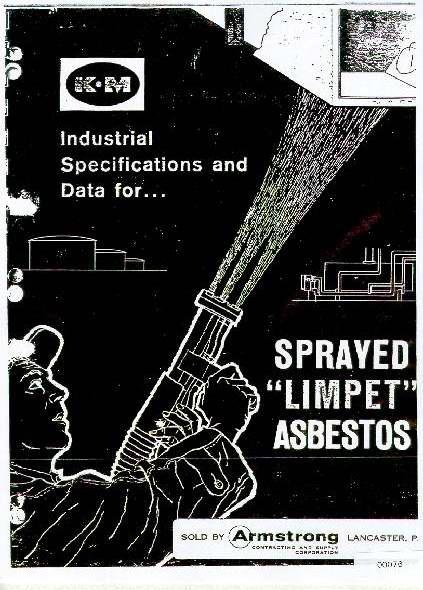 Data sheet: Sprayed "Limpet" Asbestos (K&M)Data sheet or specification · ACL Doc 15247
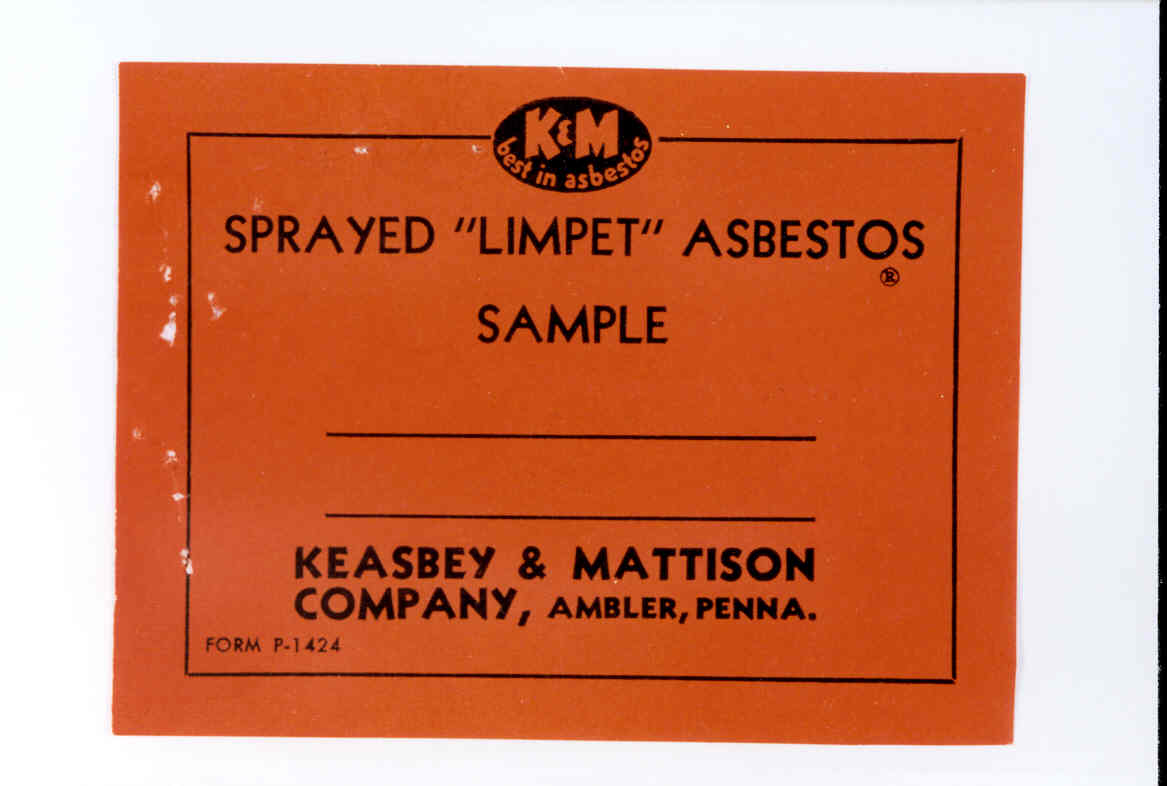 Label: Sprayed "Limpet" Asbestos sample (Keasbey & Mattison Company)Label or package · ACL Doc 20579
What each document says
Every statement about Limpet (Keasbey & Mattison) in the documents, in each document's own words.
Asbestos Magazine, 1936, September 1936
- Sold from: “Sprayed insulation - the newest development in the insulation field ... K & M Limpet Sprayed Asbestos”, p. 141
- Use: “shipbuilding - underdecks and bulkheads of Gulf Refining Company tankers Gulf Belle and Gulf Dawn” (sales to Gulf Refining Company), p. 151
- Description: “pebbled or smooth finishes, natural or colored; surfaces for sound absorption or acoustical treatment; hard or waterproof surfaces”, p. 151
- Made at: “manufactured by Keasbey & Mattison Company, Ambler, Pa.” (the plant: Ambler, Pennsylvania), p. 141
- Use: “protective coating for steel against salt-water corrosion”, p. 151
- Asbestos content: “Because of its asbestos content, fire-resisting qualities are high.”, p. 151
- Use: “stack uptake and stack house of the Virginia Ferry Company's ferry boat Princess Anne” (sales to Virginia Ferry Company), p. 151
Asbestos Magazine, 1954, February 1954
Asbestos Magazine, 1958, December 1958
- Use: “fireproofing cellular steel floors, beams and columns; UL-approved ratings of four hours (floors, beams) and two, three and five hours (columns)”, said by Keasbey & Mattison Company, as recorded by Asbestos (magazine), p. 283
Asbestos Magazine, 1959, February 1959
- Description: “protection from flames up to five hours depending upon the thickness of the blanket (Folder SL-8)”, said by Keasbey & Mattison Company, as recorded by Asbestos (magazine), p. 244
Asbestos Magazine, 1961, January 1961
- Use: “spray-shaped coatings for fire protection, thermal insulation, noise reduction, or condensation control”, said by Keasbey & Mattison Company, as recorded by Asbestos (magazine), p. 245
Asbestos Magazine, 1948, March 1948
- Description: “Sprayed "Limpet" Asbestos, one of K&M's complete line of products”, p. 116
Asbestos Magazine, 1956, June 1956
- Description: “sprayed "Limpet" asbestos department in K&M's building materials division” (as of 1956), said by Keasbey & Mattison Company, as recorded by Asbestos (magazine), p. 567
Asbestos Magazine, 1960, January 1960
- Description: “Sprayed "Limpet" Asbestos, in K&M's Building Products Division (merchandising manager appointed)” (as of 1960), said by Keasbey & Mattison Company, as recorded by Asbestos (magazine), p. 548
Label: Sprayed "Limpet" Asbestos sample (Keasbey & Mattison Company), Image
Union Carbide Chemicals Company: Thermal Insulation and Accessories Manual (1962)
Kind of product
We list Limpet (Keasbey & Mattison) with paper, felt and millboard and sprayed insulation, from how the documents describe it. Those pages explain how such products exposed workers.
Trades that worked with products like it: Insulators and Insulation Workers, Drywall Finishers, Plasterers, and Painters.
Other paper, felt and millboard by Keasbey & Mattison (8)
Paper, felt and millboard by other makers (291)
Min-k (Johns-Manville) · Pyrotex (Raybestos-Manhattan) · Insubestos (Unarco) · Novabestos (Raybestos-Manhattan) · Sal-mo (Nicolet) · K-board (Nicolet) · K-Mat (Hammermill Paper Co. (Strathmore Paper Co. Div.)) · Kalfelt (Atlas Asbestos) · Kreuznacher Asbest-Werke Germany Theo & Geo Seitz (Seitz-Asbest Werke, Theo & Geo Seitz) · Kreuznacher Filter-Undasbestwerke Germany.Theo & Geoseitz (Seitz-Asbest Werke, Theo & Geo Seitz) · Lasco (Lynch Asbestos) · Lily (Jujo Paper) · Long Fiber Asbestos Paper (Johns-Manville) · Micabestos (Raybestos-Manhattan) · Micarta 8564 (Westinghouse) · Microbestos (Johns-Manville) · Millboard (GAF) · Min-klad (Johns-Manville) · Muffler (Celotex) · Mule-Hide (Lehon) · and 271 more: all paper, felt and millboard
Other sprayed insulation by Keasbey & Mattison (1)
Sprayed insulation by other makers (25)
Armaspray (Armstrong Cork) · SprayCraft (Smith & Kanzler) · Limpet (AC&S) · Pyrospray I,T & S (Keene) · Greycoat (Cape Asbestos) · Zonolite Mono-Kote Mk-1 (W. R. Grace) · Armaspray #16 (AC&S) · Armor Spray (Armstrong Cork) · Armospray 16 (Armstrong Cork) · Cafco-Asbestos (Cafco) · Fibrespray Asbestos (Acoustic) · Forty-Eight Spray Insulation (48 Insulations) · Limpet (Nicolet) · Mono-spray (Keene) · Monospray (Baldwin-Ehret-Hill) · Pyrospray (Baldwin-Ehret-Hill) · Pyrospray Type I (Baldwin-Ehret-Hill) · Pyrospray Type S (Baldwin-Ehret-Hill) · Pyrospray Type T (Baldwin-Ehret-Hill) · Randustrial (Ranco Industrial Products) · and 5 more: all sprayed insulation
See also
- Keasbey & Mattison: the company's history, documents, people, products and plants
- Keasbey & Mattison on our products page: what the documents say about the company's asbestos products, with sources
References
- Asbestos Magazine, 1936, September 1936 (September 1, 1936), pp. 14–15.
- Asbestos Magazine, 1954, February 1954 (February 1, 1954), p. 8.
- Asbestos Magazine, 1958, December 1958 (December 1, 1958), p. 28.
- Asbestos Magazine, 1959, February 1959 (February 1, 1959), p. 24.
- Asbestos Magazine, 1961, January 1961 (January 1, 1961), p. 24.
- Asbestos Magazine, 1948, March 1948 (March 1, 1948), p. 11.
- Asbestos Magazine, 1956, June 1956 (June 1, 1956), p. 56.
- Asbestos Magazine, 1960, January 1960 (January 1, 1960), p. 54.
- Label: Sprayed "Limpet" Asbestos sample (Keasbey & Mattison Company), Image.
- Union Carbide Chemicals Company: Thermal Insulation and Accessories Manual (October 1, 1962), p. 91.
Mentioned on this site
Cite this page
“Limpet (Keasbey & Mattison).” AsbestosClaims.Law Library. https://asbestosclaims.law/library/products/keasbey-and-mattison-limpet.
ACL Doc numbers and their short links never change. See how to cite the Library.
Talk with an asbestos lawyer
Start with what you remember, and we'll take it from there.
This page is provided for general informational purposes and does not constitute legal advice. Every asbestos case turns on its own facts, exposure history, diagnosis, deadlines, available evidence, and applicable law. Reviewing this page does not create an attorney-client relationship. For advice about your specific situation, call 833-4-ASBESTOS for a free case review.