

Asbestos paper was everywhere ordinary paper couldn't survive: under vinyl floors, on rooftops, wrapped around pipelines, lining furnaces and appliances, and cut into gaskets on the shop bench. It looked like the most harmless material in the building, and it was among the purest asbestos products ever sold, with some papers running as high as 97% fiber. Cutting asbestos tape and specialty paper has been measured at 49 fibers per cubic centimeter, which in fifteen minutes puts roughly fourteen years' worth of ordinary city background air through a worker's lungs1, and the government's own contractor documented that kind of fiber release across the industry. You don't need to remember which brand you handled or dig up any old records to find out whether you have a claim; if you worked around this material, that's where we start.
Even ordinary city air carries a faint trace of asbestos everywhere, from natural mineral erosion and decades of industrial use, and that trace is the baseline both sides of the panel are measured against.
What these numbers mean. Asbestos in air is measured in fibers per cubic centimeter (f/cc), a unit that hides how dangerous a task was. Across this site we translate each measurement into fibers breathed, feet of fiber end to end, and years of ordinary city air, using conservative, government-sourced assumptions. See how we measure asbestos in air for the method and its limits.
You don't need the product names or old records. No fee unless we recover compensation for your family.
Quick answers
| Did asbestos paper products really expose me? | If your work involved cutting, tearing, scoring, sanding, or ripping out felts, papers, or millboard, yes. The material shed fiber whenever it was worked or removed, and much of that work was done dry, by hand, at bench height, right in the breathing zone. |
|---|---|
| It just looked like paper or tar paper. Was it really asbestos? | Very often, yes. Flooring felts, roofing felts, gasket paper, and millboard were standard asbestos products for decades, and many ran 85 to 97% asbestos, a higher fiber content than most insulation. |
| How much exposure do I need for a claim? | For mesothelioma, less than you'd expect. The bankruptcy trusts that pay many of these claims are built to compensate brief exposure on a worksite that used asbestos. Courts ask for a meaningful contribution, and we handle that distinction for you. |
| Which companies made this material? | Names like Johns-Manville, GAF, Celotex, Armstrong, and Congoleum. Every one of the major paper and felt makers has been through bankruptcy, and each now pays claims through a trust. |
| Do I need to remember the brand or have old records? | No. We reconstruct the products from your work history, our exposure database, and the trust documentation. The brand names and the paperwork are our job, not yours. |
| Do I have to file a lawsuit? | For most paper-product claims, no. The major makers pay through trusts, which are paper claims with no courtroom, and other routes such as premises lawsuits remain available where the facts support them. |
| Can a spouse or adult child call for the worker? | Yes. Most of our first calls come from a wife or an adult child. You don't need a power of attorney to ask questions. |
“I started this firm after learning that the cancers that killed my father and grandparents were caused by asbestos, something we did not realize until it was too late to hold anyone accountable. That experience is why we built this site: so that no other family misses their chance to ask the questions, hear the options, and decide for themselves what to do.”
What asbestos paper products were
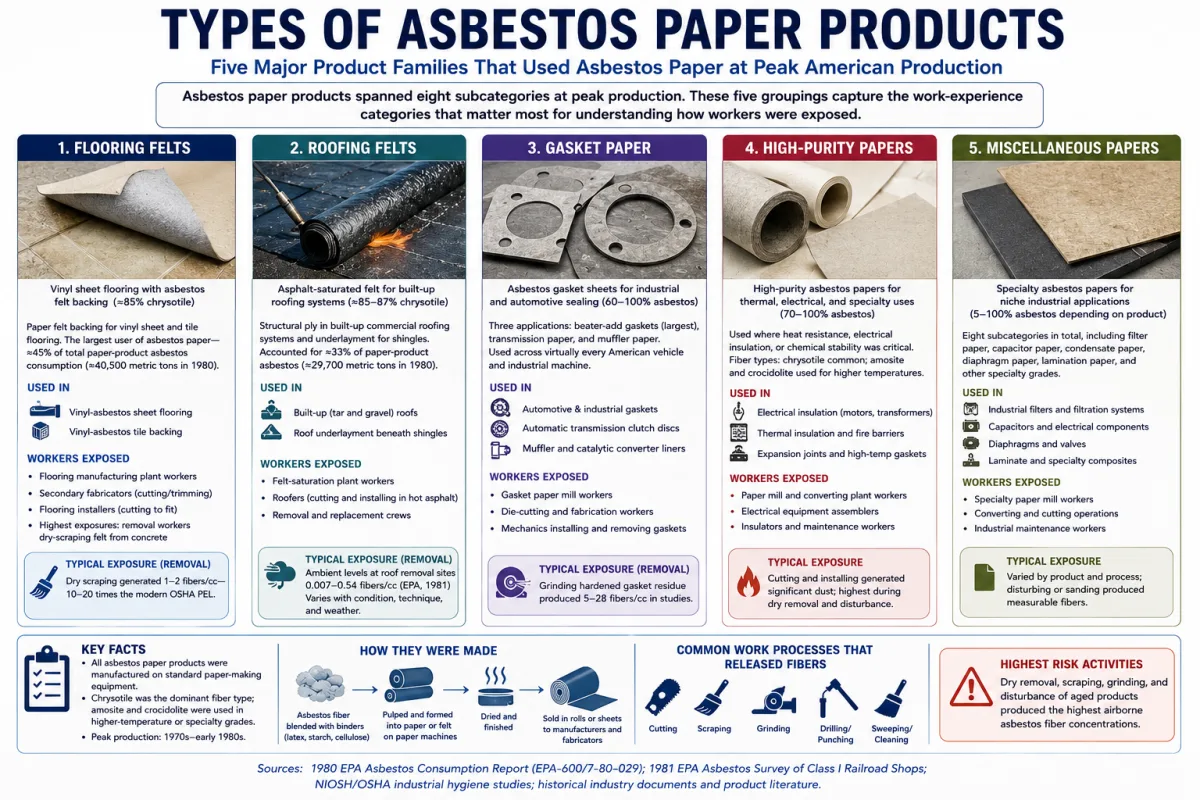
Asbestos paper is exactly what it sounds like: paper made from asbestos fiber instead of wood pulp, run through the same kind of papermaking machinery. Wood-pulp paper burns, rots, and soaks through; asbestos paper does none of those things, so it became the industry's answer wherever a thin, cheap, formable sheet had to stand up to heat, moisture, or electricity. Between the early 1900s and the 1980s it was one of the most widely distributed asbestos product families in the country, and one of the least recognized, because nothing about a roll of felt or a sheet of gray board looks dangerous.
The family came in a few standard forms. Flooring felt was a saturated asbestos paper laid as the backing and underlayment beneath sheet vinyl and linoleum floors. Roofing felt was the heavier, asphalt-saturated version rolled out across rooftops and mopped into built-up roofs. Gasket paper was sheet stock sold in rolls so that mechanics and pipefitters could cut their own flat gaskets on the bench. Millboard was the thick, rigid board of the family, up to a quarter inch or more, used for heat shields, furnace and stove linings, safe and door cores, and protective panels around anything hot. And a long tail of specialty papers did everything else: electrical insulating paper wound into motors and appliances, pipeline wrap, asbestos tape, and acoustical and insulating felts inside walls and equipment.
Much of it was sold under names a supply house would recognize, and the fiber content ran remarkably high.
Representative products and their asbestos content. These are examples, not a full list:
| Product | Maker | Fiber | Asbestos content | In production |
|---|---|---|---|---|
| No. 12 asbestos paper | Johns-Manville | Chrysotile | 95% | from 1936 |
| Armaturo asbestos paper | Johns-Manville | Chrysotile | 97% | from 1920 |
| Asbestos millboard | GAF | Chrysotile | 95% | from 1928 |
| Asbestos papers & roll board | Celotex | Chrysotile | 85% | from 1906 |
A product that's 95 or 97% asbestos is, for practical purposes, a sheet of nearly pure fiber held together with a little binder. The fiber in all of these was chrysotile (white asbestos, the most common commercial type), and chrysotile is classified by the International Agency for Research on Cancer as carcinogenic to humans and is a recognized cause of mesothelioma3. When a defense lawyer says "it was only chrysotile," the answer is that chrysotile is exactly what causes the disease in these cases, delivered here in some of the purest concentrations the industry ever sold.
How paper products put asbestos in the air
A roll of felt sitting on a shelf doesn't shed much fiber. The exposure came from working the material, and asbestos paper, unlike a boiler's insulation or a ship's bulkhead, was made to be worked. Flooring felt was cut to fit the room and torn out again decades later when the floor was replaced. Roofing felt was cut, ripped, and stripped off in tear-offs. Gasket paper existed so someone could cut gaskets out of it, one at a time, at a bench. Millboard was sawed, scored, snapped, and drilled to shape. Every one of those operations breaks the sheet open and drives dry, friable (crumbly and dusty) fiber into the breathing zone, and almost all of it was done by hand, with no ventilation, inches from the worker's face.
Here is what that fabrication work measured. Each figure is a phase-contrast (PCM) measurement, which counts only the longer fibers and so it represents the minimum level of exposure, not the maximum.
| Task | Measured (f/cc) | ≈ years of background per 15 min | Source |
|---|---|---|---|
| Cutting asbestos tape / specialty paper | 49 | ~14 years | GCA / Anderson 19821 |
| Handling pipeline wrap / roofing felt | 14.5 | ~4 years | GCA / Anderson 19821 |
| Cutting and scoring millboard | 8.4 | ~2 years | GCA / Anderson 19821 |
By the illustrative math on our how we measure asbestos in air page, 15 minutes of cutting asbestos tape put roughly 14 years of ordinary city air through the lungs. This estimates fibers in the air breathed, not a retained dose.
What the makers knew
Two threads of the record matter for paper products, and both are on paper themselves.
The first is that the fiber release from this work wasn't hidden or hard to find; the federal government's own contractor documented it. The GCA/Technology Division studies of the American asbestos-paper-products industry, performed under EPA contract, measured secondary-fabrication fiber release across exactly the tasks described above: millboard cutting, felt and wrap handling, and specialty-paper work1. They were measurements of the ordinary, everyday operations the products were sold to be used for, and they recorded fiber levels that turn a quarter hour of bench work into years of background exposure.
The second thread is what the manufacturers knew, and when. Johns-Manville and the other paper makers manufactured 85-to-97% chrysotile papers and felts for decades, and they did so through the same period the Sumner Simpson papers document. That correspondence, running from 1935 forward between Raybestos-Manhattan's president and the industry's executives and lawyers, shows the asbestos industry's leadership discussing the disease hazard of its products and its preference for keeping the subject quiet, years before the workers cutting felt and millboard were told anything at all. The companies selling near-pure asbestos sheet for hand fabrication were part of an industry whose own files show it knew what its fiber did.
That combination, near-pure asbestos products sold for hand cutting, government-documented fiber release from the intended use, and an industry paper trail on the hazard, is why these cases don't depend on reconstructing what any one worker was told. The record speaks for itself.
Who was exposed
Paper products weren't tied to one trade; they followed the floors, roofs, pipes, and wiring into every kind of building. Rather than retell each worker's story here, this page hands that off to the pages that own it:
- flooring installers, who cut and tore out asbestos flooring felt under sheet vinyl and linoleum
- roofers, who cut, laid, and stripped asbestos roofing felt
- pipefitters and plumbers, who cut their own gaskets from gasket paper and worked millboard around hot equipment
- electricians, who handled electrical insulating paper in motors, panels, and appliance work
If you or your family member did any of that work, the exposure history is usually easy to reconstruct.
The manufacturers and the trusts
The paper-products category has an unusual shape: every one of its major makers has been through asbestos bankruptcy, and every one of them now pays claims through a trust. That's good news for families, because trust claims are a paper process, resolved by documentation rather than by litigation, and a single career that touched felts, papers, and millboard often supports filings against several trusts at once. Premises lawsuits against the plants and sites that controlled the work remain available alongside the trusts where the facts support them, and one pathway doesn't reduce another.
| Manufacturer / brand | Status | How claims are handled |
|---|---|---|
| Johns-Manville (insulating paper, millboard, roofing felts, broader paper portfolio) | Johns-Manville Asbestos Trust | Trust claim, no lawsuit |
| GAF (millboard, specialty papers) | GAF Asbestos Trust | Trust claim, no lawsuit |
| Armstrong World Industries (vinyl-asbestos sheet flooring felts) | AWI Asbestos Trust | Trust claim, no lawsuit |
| Congoleum (vinyl-asbestos sheet flooring, backing felt) | Congoleum Asbestos Trust | Trust claim, no lawsuit |
| Celotex (asbestos papers, roll board) | Celotex Asbestos Trust | Trust claim, no lawsuit |
| Industrial and construction site owners (premises) | Solvent, premises liability | Lawsuit (state-law dependent) |
Which trusts apply to a given work history, and whether a premises or other defendant can also be reached, is an analysis we run for every client file; you don't need to sort out the corporate history yourself.
Sources of compensation
A paper-products case usually draws from several sources at once, and they run in parallel:
- Asbestos bankruptcy trusts. The makers who went bankrupt set aside money to pay the people they harmed. These are paper claims, with no lawsuit and no courtroom, and one career often supports filings against several trusts. How asbestos trust claims work.
- Product-liability lawsuits. Where a solvent maker or supplier can be identified for a particular product, it can be sued directly, under the duty to warn established in the foundational asbestos case, Borel v. Fibreboard4. How product liability lawsuits work.
- Premises liability against site owners. The plants, mills, and construction sites that controlled the worksite can be held responsible for the conditions they allowed. How premises liability claims work.
- Federal and disability benefits. Military service can support VA disability benefits, and civilian shipyard work can support Longshore (Longshore and Harbor Workers' Compensation Act) benefits, both paid in addition to the rest. How asbestos disability and benefit claims work.
In our case-law library
57 court decisions in our case-law library involve asbestos paper, felt and millboard. Among them:
- Edwards v. Scapa Waycross, Inc.South Carolina Supreme Court, 2024 · Employee at Bowater at Bowater
- Estate of Barabin v. AstenJohnson, Inc.U.S. Court of Appeals, Ninth Circuit, 2014 · Paper sorter, pulp tester, paper tester, paper machine worker cleaning dryers at Crown-Zellerbach paper mill, 1968-2001
- Barabin v. AstenJohnson, Inc.U.S. Court of Appeals, Ninth Circuit, 2012 · Worked in various jobs at the paper mill at Crown-Zellerbach paper mill, 1968-2001
- Scapa Dryer Fabrics, Inc. v. SavilleMaryland Court of Appeals, 2011 · Broke hustler at Westvaco Mill, Eight and Nine Machine Room Building, 1968-1978
- Director, Office OF Workers'comp. v. Newport News Shipbuilding and Dry Dock Co.U.S. Court of Appeals, Fourth Circuit, 1982 · Sheet metal worker and foreman at Newport News Shipbuilding and Dry Dock Company shipyard, almost thirty-nine years, ending December 1978
- Utter et al. v. Asten-Hill Mfg. Co.Pennsylvania Supreme Court, 1973 · Weaver at Asten-Hill Manufacturing Company, 1946-1966
See all 57 decisions involving asbestos paper, felt and millboard
In our products database
The paper, felt and millboard our document library describes, by the company that made or sold it. Each product's page says when it was made and how much asbestos it held, from the documents.
Albert C. Fischer: Servicised
American Lumber Company: Alumco
American Tar: Atco
Armstrong Cork: Best Felt · Corlon, Aprina · Corlon, Mantina · Corlon, Norager · Corlon, Pirelle · Corlon, Serenada · Corlon, Tessera · Hydrocord
Asahi Asbestos: Aspaal M · Aspaal W
Asahi Kasei Kogyo Kabushiki Kaisha: Sofilia
Atlantic Asphalt & Asbestos: Triple Aaa Hip & Ridge Shingles
Atlas Asbestos Company, Montreal: Kalfelt (Atlas Asbestos)
B.F. Goodrich: Prenite
Baldwin-Ehret-Hill: Sound Barrier
Beacon Sales Company: Yankee
Bird & Son: Bird Metal Gravel Stops Type Gs-2 · Buca Adhesive
Cafco (U.S. Mineral Products): Cafco-Asbestos (Cafco)
Cape Asbestos: Noramite
Carbola Chemical Co.: Asbestol
Celotex: Asbestos (generic name) · Asbestoseal · Barrett Series 400 · Carey Foil · Fireclad · Muffler (generic name) · Resin Saturating (generic name) · Roofing Felt · Spec Ira-440-C · Spec Ira-440-SW · Spec Ira-440-W · Spec Ira-441-SW · Spec Ira-441-W
Chase-Foster: Permatherm
Connecticut Hard Rubber: Cohrlastic
E. I. Du Pont De Nemours And: Quilon
Excelsior: X-l
Fibreboard: Asbestos Felt (Asphalt Saturated) · Asbestos Felt Jacket, Asphalt Saturated (Pabco)
Fibreboard Corporation: Aircell (Fibreboard)
Flintkote: Asphalt Saturated Asbestos Felt
G.E.: Terratex
GAF: Air Vent · Air Vent Asphalt Felt · Anti-Sweat Pipe Covering · Aristo Insulation · Asbestos Base Felt · Connectite · Corrugated asbestos paper · Frost-Proof Pipe Covering · Gaftemp Roof Insulation · Millboard · Range Boiler Jacket · Rollboard · Woolfelt
Gaf/Ruberoid: Asbestos (generic name)
General Electric: Terratex
George W. Bromley: Bromley's Honor Pledge
Grant Wilson: Fyrex · Gum-Bestos Asbestos Paper Tape
H. K. Porter: Cleangard · Covergard · Flamegard · Porterlag · Portersite · Thermafelt · Thermoid Portersite G
H.H. Robertson: Galbestos
Hammermill Paper Co. (Strathmore Paper Co. Div.): K-Mat
Harco Chemical: Azkem
Industrial Gloves Company: Old Hickory
International Pulp: Abestine
J. P. Stevens: Asbestos
John Herman: Herco
Johns-Manville: #50 Asbestos Weatherproofing Felt · 12# Asbestos Tape · 15A Asbestos Jacket · 45A Asbestos Jacket · 50 Weatherproofing · 770 Coated Asbestos Jacket · 7700 Coated Jacket · Akoustikos Felt · Amber Loklube Style 1009A · Aqua Covering · Armaturo Asb Paper · Arp-40 · Asbestocel Paper · Asbestogard · Asbestogard Felt · Asbestos and Hair Woven Felt · Asbestos Blanket · Asbestos Corded Sheathing · Asbestos Felt · Asbestos Finishing Felt · Asbestos Fire Felt · Asbestos Firetard Jacket · Asbestos Jelly Rolls · Asbestos Lining and Deadening Felt · Asbestos Lining Felt · Asbestos Locomotive Lagging · Asbestos Paper Tape · Asbestos Pipe Blanket · Asbestos Roll Fire Felt · Asbestos Sponge Felt · Asbestos Sponge Hair Felt · Asbestos Turbine Blanket · Asbestos Welding Paper · Blue Chip Asbestos Finishing Felt · Ceilinite · Cellamite · Centurian Base Felt · Coated Asbestos Base Felt · Cold Application Felt · Commercial Grade Asbestos Paper · Copperclad · D C Flexstone · Doublex · Engineers Insulating Tape · Fibroid · Fire Felt · Firetard · Flexstone Mineral Surface Cap Sheet · Gold-Line · High Strength Fibroid Asbestos Paper · High Temperature Flexible Min-k Blankets · J-m Built-up Roof · Johns-Manville Jm · Long Fiber Asbestos Paper · Microbestos · Min-k · Min-klad · Niagarite · Niagrite · No. 50 · Non Burn Asbestos Paper · Non-burn Asb Paper · Nycinsul · Pan-o-cel · Paperbestos · Quinorgo · Quinorogo 6000 · Quinorogoboard · Quinterra · Quintex (I, II, ST) · Roofinsul · Salamander · Special Coated Asbestos Base Felt · Spintex · Standard Flex M-k · Standard Flexible Min-k blankets · Super Fire Felt · Telgard · Thermo Felt · Thermoflex · Thermomat · Thermotape · Thermowrap · Toasterbord · Transhield · Type GT · Ventsulation · Vitribestos · Vitro Fire Felt · White Surface Asbestos Jacket
Jujo Paper: Lily
Jujo Paper Mfg. Co. of Tokyo, Japan: Aspaal M
Keasbey & Mattison: Amberlite · Asbestos Paper Tape · K & M 101 · K & M 104 · K & M 201 · K&M Best in Asbestos · Limpet · Resistal · Uni Syn
Keene/Beh: Fyrbestos
Keene/Ehret: Alumino
Koninklijke Papierfabrieken Van Gelder Zonen N.V.: Vangelder Papier
Lehon: "Not A Kick In A Million Feet" · Mule-Hide · So Good That Only The Dealers Sell It
Lone Star Roofing: Don'T Monkey With Cheap Roofs
Lynch Asbestos: Lasco
Maker not given: Durestos (maker not given)
Monroe: Vulca-Dek
Morey Paper & Mill Supply: Scapa-Hall
Munters: Tufedg
Nicolet: 411 · 580 · Cel-lux · Cellotone · Commercial Paper · Foil Laminates · Insul-attic · K-board · Neon · Nicel · No. 411 Asbestos Underlayment · Norriscell · Nu-wrap Non-sweat · Pipe Line Felt 15 · Roll Felt · Sal-mo · Tufbestos · V-dent
Nicolet/Keasbey & Mattison: Duplex
Nordesk A Moskinfilt Aktiebologet: Nordeskafilt
North American Asbestos: Noramite
North American Refractories: Stazon
O'Neill Lumber Co.: Houservice
Philip Carey: Aircel · Asbestos (generic name) · Asbestos Felt (Asphalt Saturated) · Asbestos Felt · Asbestos Felt Jacket, Asphalt Saturated · Asbestos Grapevine Finish Felt · Asbestos Paper (generic name) · Asbestos Paper Tape · Asbestoseal · Base Sheet · Black Top Asbestos · Carey (generic name) · Carey Duct · Carocel · Defendex · Double Sanded Asbestos · Excel · Fiberock · Fiberock Asbestos Felt · Fiberock Cap Sheet · Fireclad · Fireguard · Fireguard Jacketing · Grosscell · No. 15 Fiberock · No. 15 Tar Fiberock · No. 30 Fiberock · No. 35 Fiberock · No. 45 Fiberock · No. 55 Fiberock · Shake Shield · White Top Asbestos Jacket
Plibrico Jointless Firebrick: Plisulate
Presspan-Fabrik Chr. Authenrieth: Pucaro
Raybestos-Manhattan: Florobestos · Fluorobestos · Micabestos · No. 41-Rpd · Novabestos · Pyrotex · Pyrotex Felt · R/M Style 23 Rpd Pyrotex · R/M Style 41-Rpd Pyrotex Felts · R/M Style 48-Rpd Pyrotex prepreg
Reflectal Corporation: Alfol No. 101 (Corrugated) · Alfol No. 102 (Flat) · Alfol No. 103 (Flat)
Ruberoid: Air Vent · Asbestos Paper Tape · Asbestos Sponge Felt · Commercial Grade · Commercial Paper · E-511 · E-515 · Ru-ber-oid Watson · T/NA 200
Sall Mountain: Sal-Mo
Schecter Brothers: Pyramid
Sears: Homart
Seitz-Asbest Werke, Theo & Geo Seitz: Kreuznacher Asbest-Werke Germany Theo & Geo Seitz · Kreuznacher Filter-Undasbestwerke Germany.Theo & Geoseitz
Spaulding Fibre: Filawound · Spauldite
Sun Chemical: Glas-Bes · Polybes
TBA Industrial Products Ltd. (Turner & Newall): Firefly 800 (TBA Industrial Products, Turner & Newall)
Turners Asbestos Cement: Siluminite
U.S. Asbestos: Pyrotex
U.S. Gypsum: Thermafiber
U.S. Plywood-Champion Papers: Weldwood
Unarco: Ambestos Felt · Amoside Felt · Insubestos · Stonefelt · Unarco (generic name) · Unarco Asbestos Blanket · Wovenstone
Uni-Tubes Ltd. (England): Uniroof
Union Asbestos & Rubber Co.: Insubestos · Super Insubestos · Unarco
Westinghouse: Fosterite Asbestos · Micarta 8564
Wheeler Protective Apparel: Wheeler
The defenses companies raise, and how we answer them
The defense arguments in paper-product cases follow a familiar pattern, and none is new to us. All of this applies only to the lawsuit side. Trust claims are a paper process: no opposing lawyer raises defenses, no one is deposed, and no one goes to court.
How we answer the defenses raised in asbestos paper cases
"The asbestos was bonded into the paper, so it didn't release fiber." The products were sold to be cut, scored, torn, and sanded, and every one of those operations breaks the bond and releases fiber. That's not a theory; it's a measurement. Cutting asbestos tape was recorded at 49 f/cc, and cutting millboard in the 4 to 8.4 f/cc range, in the government-contracted fiber-release studies of this very industry1. A binder that survives on the shelf doesn't survive a utility knife.
"It was only chrysotile." These were 85-to-97% chrysotile papers, and chrysotile is classified by IARC as carcinogenic to humans (Group 1) and is a recognized cause of mesothelioma3. The purity of these products cuts against the defense, not for it: the "only chrysotile" argument asks a jury to treat near-pure asbestos as though it weren't asbestos at all.
Frequently asked questions
My loved one has already passed away. Can we still bring a claim?
Yes. Families regularly file after a death, both trust claims and, depending on the state, a wrongful death lawsuit. Some of these deadlines are short, so it's best to call promptly. We handle wrongful death and estate claims as a matter of routine.
I worked with these products decades ago. Is it too late?
Usually not, and here's why: mesothelioma takes decades to develop, so the legal clock in most of these claims starts at diagnosis, not at exposure. Work from the 1960s or 1970s supports claims filed today. There are real deadlines after a diagnosis or a death, though, which is the reason to call sooner rather than later.
Could my family have been exposed through the work clothes?
Yes, and it's common. Felt and millboard work was dusty, the dust settled on clothes, and it came home. Spouses who laundered the clothes were exposed too. Our representation includes free asbestos health screening for family members, and if one is later diagnosed, they may have a claim of their own. The screening is a chest X-ray read by a B-reader, with a CT scan if needed; it looks for asbestos-related changes in the lungs and isn't a diagnosis or a reliable way to find mesothelioma early.
I smoked. Does that hurt the claim?
For mesothelioma, no. Smoking does not cause mesothelioma; asbestos does, and the trusts and the courts treat it that way. For asbestos-related lung cancer the analysis is more involved, but a smoking history does not close the door, and we evaluate those cases every week.
What does it cost to work with you?
Nothing up front, and nothing at all unless we recover for you. We work on a contingency fee, which means our fee comes only out of money we recover, and the case review is free.
What happens when I call?
A member of our litigation team, not a screener, takes the call, and the first conversation usually runs twenty to thirty minutes. We listen to the work history, explain which claims may apply, and lay out the timeline. No one is pressured to sign anything.
Do we have to travel to your office?
No. We handle these cases by phone, video, and mail, and we come to you when an in-person visit helps. Families work with us from every state without traveling to us.
Talk with an asbestos lawyer about paper-product exposure
Whether you're a worker who was just diagnosed or a spouse or adult child trying to find help for someone who is sick, we're ready to talk. You don't need the product names, you don't need the old records, and you don't need to travel to us. Start with what you remember, and we'll take it from there.
Related resources
Sources and references
- Anderson PH, Grant MA, McInnes RG, Farino WJ. Analysis of Fiber Release from Certain Asbestos Products. GCA/Technology Division (EPA); 1982.
- OSHA asbestos standard. 29 C.F.R. § 1910.1001.
- International Agency for Research on Cancer. Arsenic, Metals, Fibres, and Dusts. IARC Monographs, Vol. 100C (chrysotile carcinogenic to humans, Group 1).
- Borel v. Fibreboard Paper Products Corp., 493 F.2d 1076 (5th Cir. 1973).
This page is provided for general informational purposes and does not constitute legal advice. Every asbestos case turns on its own facts, exposure history, diagnosis, deadlines, available evidence, and applicable law. Reviewing this page does not create an attorney-client relationship. For advice about your specific situation, call 833-4-ASBESTOS for a free case review.