
If you worked as a roofer — or if someone in your family did — and a mesothelioma, lung cancer, asbestosis, or other asbestos diagnosis has now come in, this page is the place to start. The same dust came home on the work clothes that spouses and children shook out and laundered, and it reached the laborers and helpers who tended the tar kettle and cut felt alongside him.
A roofer breathed asbestos from the roof itself, going on and coming off. The built-up roofing felt he cut and fit, and the cement and mastic he troweled and patched with, were made with asbestos for most of the twentieth century. Cutting and tearing off that asbestos roofing felt has been measured at 0.54 fibers per cubic centimeter, more than five times today's federal limit, and the dustiest work of all was the tear-off: stripping old, weathered, crumbling roofs down to the deck before the new one went on.
Fibers per cubic centimeter (f/cc), measured during the task
OSHA’s asbestos standard lists 0.1 f/cc as the 8-hour time-weighted average limit and 1.0 f/cc over 30 minutes as the excursion limit. These roofing tasks ran several times the 8-hour limit, repeated over a full career, and there is no safe level of asbestos exposure for mesothelioma. Sources: published industrial hygiene testing, cited on our roofing felt and roofing cement and mastic pages.
You don't need to remember which company's felt or roofing cement you used, and you don't need old job records or union cards in hand. The bankruptcy trusts that pay many of these claims are built to compensate exactly this kind of work: for mesothelioma, even brief asbestos exposure on a job that used it is typically enough to qualify, so you don't have to prove a heavy dose. If you can say "I was in the Roofers local for thirty years" or "my dad ran a built-up roofing crew," we have a starting point.

You don't need the product names or old records. No fee unless we recover compensation for your family.
Quick answers
| Did roofing really expose me to asbestos? | Almost certainly, if your career touched built-up roofs or older roofs of any kind. A roofer breathed it cutting and fitting asbestos roofing felt, mixing and troweling roofing cement and mastic, and above all tearing off old, weathered roofs down to the deck. The asphalt held a lot of it in, but cutting and tear-off broke it loose. |
|---|---|
| I mostly did residential shingle work, not commercial built-up. Was I still exposed? | Residential work was generally lighter than commercial built-up roofing, but it wasn't zero. Many older asphalt shingles, felt underlayments, and flashing cements contained asbestos, and tearing off an old roof stirred up whatever was there. Because even lower-intensity exposure can support a mesothelioma claim, it's worth checking your history. |
| How much exposure do I need for a claim? | For mesothelioma, less than you'd expect. The asbestos bankruptcy trusts that pay many of these claims are built to compensate brief exposure on a job that used asbestos, so you don't have to prove years of heavy dust. Courts ask for more than the trusts do, and we handle that distinction for you. |
| How long do I have to file? | It depends on your state and on whether this is a personal-injury or a wrongful-death situation, and some of those deadlines are short. The safest step is to call as soon as possible after diagnosis so the clock doesn't run out. |
| Do I have to file a lawsuit? | No. Many roofers and their families recover through trust claims without ever filing a lawsuit. Trust claims are paper claims, not courtroom cases. We explain both paths and respect your decision. |
| What can a roofer's case recover from? | Usually more than one source at once: the bankruptcy trusts of asbestos makers like GAF, Celotex, and Flintkote; lawsuits against still-solvent manufacturers like CertainTeed; and premises claims against the building or site owners where you worked. One doesn't cancel out another. |
| Can a spouse or adult child call for the worker? | Yes. Most of our first calls come from a wife or an adult child researching for someone who's sick or who has passed. You don't need a power of attorney to ask questions. |
“I started this firm after learning that the cancers that killed my father and grandparents were caused by asbestos, something we did not realize until it was too late to hold anyone accountable. That experience is why we built this site: so that no other family misses their chance to ask the questions, hear the options, and decide for themselves what to do.”
Why roofers were exposed to asbestos
Roofing put workers in daily contact with asbestos for a simple reason: a roof has to shed water and resist fire, and for most of the twentieth century asbestos was what manufacturers added to roofing products to do both. The felt that built up the membrane, the cement and mastic that sealed every edge and penetration, the coatings, and the cement shingles were all made with asbestos by design. A roofer encountered it constantly because the roof itself was built out of it.
The exposure came from the ordinary, repeated motions of the trade, not from anything unusual:
- Cutting and fitting roofing felt. Built-up roofs were layered from asbestos-saturated felt, cut to size and laid course over course into hot asphalt. Cutting and tearing off that felt has been measured at 0.54 f/cc.
- Mixing and troweling roofing cement and mastic. Flashing compound, plastic roofing cement, and mastic were stirred up and troweled around chimneys, vents, edges, and seams, and the asbestos in them went into the air as the material was mixed and worked. Handling that cement has been measured at 0.4 f/cc.
- Tearing off old roofs. The dustiest work was demolition. Stripping a weathered, brittle old roof down to the deck broke up felt and cement that years of sun and weather had dried into friable (crumbly and dusty) debris, which came up in clouds as it was pried and shoveled.
- Working asbestos shingles. Cutting, snapping, drilling, and nailing asbestos-cement roof shingles released fiber, and pulling old shingles off broke them apart.
Two things multiplied all of this. The first was the tear-off. Roofing that had baked in the sun for twenty or thirty years had gone brittle and friable, and ripping it up released far more fiber than laying new felt ever did. The second was repetition: a career roofer cut felt, troweled cement, and stripped old roofs across thousands of jobs over thirty or forty years, and the dust built up shift after shift. Roofing was outdoor work, which helped, but a man bent over a cut, a mixing bucket, or a tear-off was breathing straight from the dust at his hands, and open air didn't clear the cloud coming off a roof being stripped.
Through all of it, the men doing the work were given no warning and no protection. They cut and tore bare-handed, swept debris with no mask, and went home in dusty clothes to their families, while the companies that made the products knew what the dust was doing.

The asbestos products a roofer handled, and why they add up to more than one claim
Over a career, a roofer handled several different asbestos products, each made by a different set of companies, and that combination is what shapes the claim. Understanding the products is how we identify who's responsible and which claims you can bring.
Roofing felt. Built-up and saturated felt was the core of a commercial roof, laid into hot asphalt course after course, and cutting it and tearing it off released fiber. The makers behind it include companies now covered by bankruptcy trusts, such as GAF and Celotex. See how asbestos roofing felt and paper products caused exposure.
Roofing cement, mastic, and flashing compound. Troweled around every edge, vent, and penetration to seal the roof, these compounds were loaded with asbestos and went airborne when they were mixed and applied. They trace back to makers including Flintkote and the major adhesive and coating lines, some covered by trusts and some still in business. See how asbestos adhesives, mastics, and roofing cements caused exposure.
Asbestos roof shingles. Asbestos-cement shingles were cut, snapped, drilled, and nailed in place, and removing old ones broke fiber loose. These trace to makers including Johns-Manville and Owens-Corning, most of which now pay through trusts. See how asbestos cement shingles caused exposure.
This is why a roofer's case is rarely a single claim. Because the work touched felt, cement, mastic, and shingles from many different manufacturers, the typical recovery runs against several bankruptcy trusts at once, plus lawsuits against the manufacturers still in business and the building or site owners who controlled the job. You don't need to remember which company made the felt you laid in 1974 or the cement you troweled in 1981. Give us the work history, and we trace each product back to its maker, and each maker to its trust or its place in a lawsuit.

Where you worked, and why the setting still matters
A roofer carried the exposure with him from job to job, so the trade put him at risk across almost every kind of building. Where he worked still matters to the case, though, because it decides which general contractors and building owners can be named as premises defendants alongside the product makers, and whether a federal benefit channel comes into play.
Most roofing exposure happened in construction, across the full range of the industry:
- Commercial and industrial built-up roofing. Flat and low-slope roofs on factories, warehouses, schools, hospitals, and office buildings were built up from asbestos felt and hot asphalt, which is the heaviest and most repeated roofing exposure. Construction industry asbestos exposure.
- Residential and re-roofing work. Older homes carried asbestos shingles, felt underlayment, and flashing cements, and tear-off and re-roofing disturbed all of it.
If your loved one roofed at a federal facility or a military base, tell us. Civilian roofing work at a federal site can open FECA (Federal Employees' Compensation Act) benefits that run alongside the trust and lawsuit claims.
What the asbestos industry's own magazines said about roofers
The asbestos industry's trade journal, Asbestos, and Johns-Manville's employee magazine, the J-M Circle, wrote about roofing for decades. They wrote to sell more of it. Read today, they show what roofers handled, how the work was done, and which buildings got asbestos roofs.
The roofs and how they went on
In 1921 the magazine described two kinds of asbestos roof. One was "ready roofing" in rolls. The other was the built-up roof, made of "numerous plies of Asbestos Paper saturated with Asphalt" (Asbestos, Jan. 1921). The felt was "shipped to the job in rolls." It was put down the same way as tar-and-gravel roofing, but bonded with hot asphalt, and usually by the same roofing contractor (Asbestos, Apr. 1921).
Asbestos shingles were a roofer's job too. In 1924 the magazine said they "are generally placed by the roofer or building contractor" (Asbestos, Mar. 1924). In 1927 it listed "the contractor or roofer, who handles asbestos shingles and corrugated sheathing" (Asbestos, Oct. 1927).
Shingles had to be cut to fit at ridges, valleys and edges, and the trade press sold tools for it:
- In 1929 an ad offered a machine for cutting asbestos shingles with carborundum wheels, with a "water connection for wet cutting or exhaust system for dry cutting" (Asbestos, Oct. 1929).
- In 1932 a portable cutter was built for cutting asbestos shingles "right on the job" (Asbestos, May 1932).
- In 1938 hand cutters were offered to "all roofers, contractors, carpenters, mechanics" to cut asbestos roofing to any notch or angle (Asbestos, Nov. 1938).
Old roofs came off as well. In a 1941 time test near Washington, asphalt shingles were "ripped off" and asbestos-cement shingles put on by "two roofers and a helper" (Asbestos, June 1941). That same year, Johns-Manville took 31-year-old asbestos shingles off a building at the Greenport Ship Yard on Long Island (Asbestos, Jan. 1944). Big built-up jobs took big crews. On one Iowa plant in 1929, the roofing contractor "operated with four kettles and thirty men" (J-M Circle, Feb. 1930).
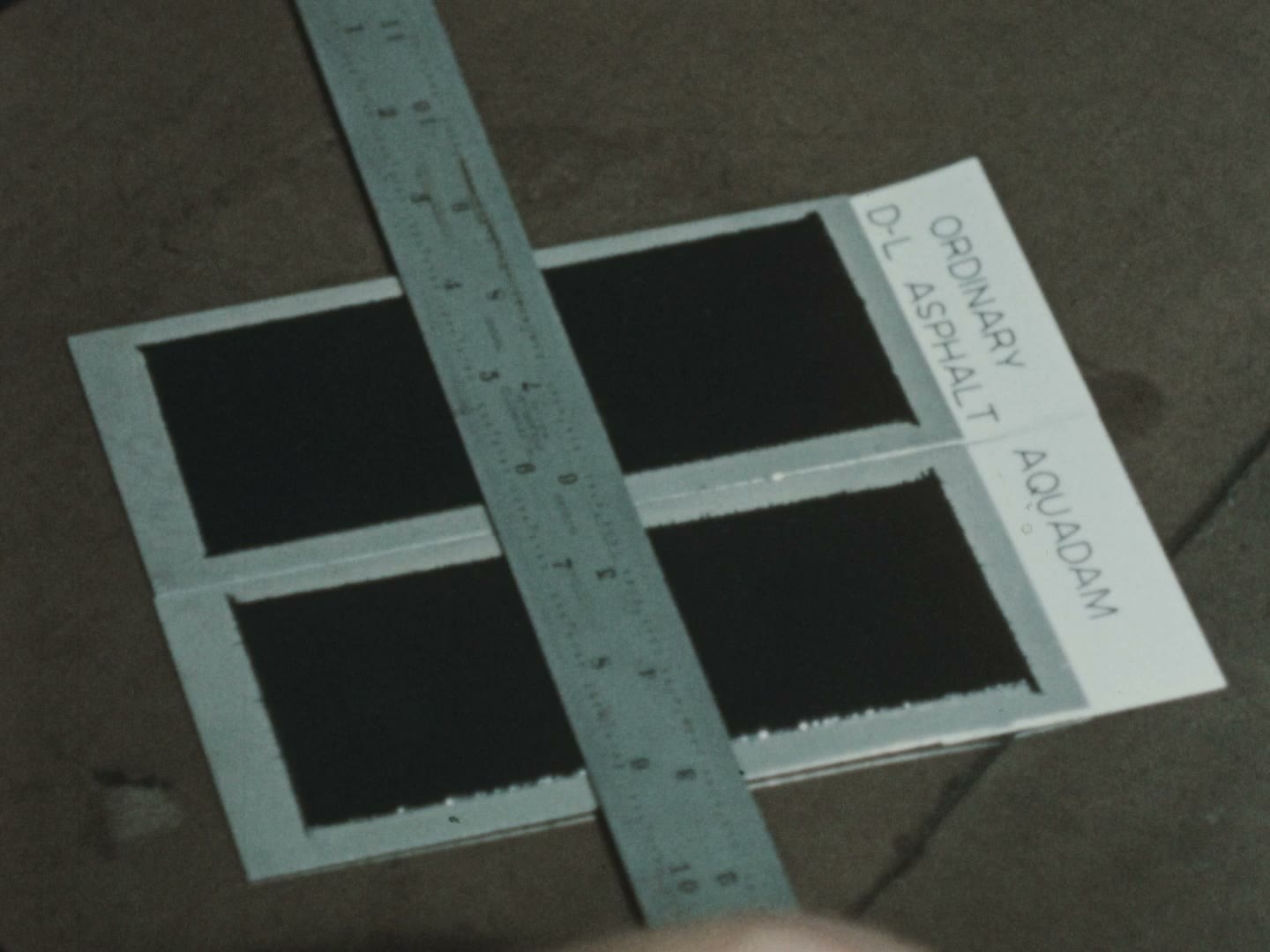
Johns-Manville's 1958 film A Hundred Years of Roofing Experience, made for its centennial to sell its asbestos built-up roofs. Here a crew mops hot bitumen and rolls out felt, course after course, and the narrator says J-M roofs were applied "only by approved roofers." The film calls asbestos "as permanent as stone" and says nothing about dust or about what the roofers were breathing. The passage runs under a minute.
Watch the whole film, with its transcript: A Hundred Years of Roofing Experience (1958)
Buildings the magazines named
| Building | Year reported | What the magazine says was used | Roofer | Source |
|---|---|---|---|---|
| Water tower building, Mattison estate, Ambler, Pa. | applied 1904 | Asbestos shingles, called the first U.S. building covered with them | — | Asbestos, Dec. 1970 |
| Building at the Greenport Ship Yard, Long Island | applied 1910 | J-M Asbestos Shingles, removed 1941 | — | Asbestos, Jan. 1944 |
| New Yankee stadium (printed as Brooklyn, N.Y.) | 1923 | Asbestos built-up roof, 110,000 sq. ft. | — | Asbestos, May 1923 |
| Asbestos Shingle, Slate & Sheathing Co. plant, St. Louis | 1927 | Asbestos sheathing; roofers did half the roof, iron workers the other half | Union roofers and iron workers | Asbestos, May 1977 |
| Great Northern Paper Co., East Millinocket, Maine | 1928 | J-M built-up asbestos roofing; 600 squares of asbestos roofing felt | — | J-M Circle, Dec. 1928 |
| Troy Methodist Church | 1928 | 140 squares of asbestos shingles, replacing slate | — | J-M Circle, Dec. 1928 |
| Bethlehem Steel mines | 1928 | Asbestos shingles made standard; over 600 squares | — | J-M Circle, Dec. 1928 |
| Department School, Kendallville, Ind. | 1929 | 68 squares of asbestos shingles, replacing slate | — | J-M Circle, Jan. 1929 |
| Weaver Wells Building, Oakland, Calif. | 1929 | 600 squares of built-up asbestos roofing | General Roofing Co. | J-M Circle, Feb. 1929 |
| East Oakland High School, Oakland, Calif. | 1929 | 900 squares of asbestos built-up roofing | General Roofing Co. | J-M Circle, Feb. 1929 |
| Babcock & Wilcox Tube Co., Beaver Falls, Pa. | 1930 | 1,500 squares of asbestos roofing felt | — | J-M Circle, Jan. 1930 |
| Oliver Farm Equipment Co., Charles City, Iowa | 1930 | 1,800 squares of Class "A" Asbestos Built-up roofing | Waterloo Roofing & Supply Co. | J-M Circle, Feb. 1930 |
| Ford plant, Edgewater, N.J., and seven other Ford plants | 1930 | J-M asbestos roofs | New York Roofing Co. (Edgewater) | J-M Circle, July 1930 |
| Tidewater Oil Co. refineries | 1937 | Corrugated asbestos-cement roofing | — | Asbestos, Aug. 1937 |
| New England Mutual Life Insurance Building, Boston | 1942 | Asbestos and asphalt built-up roof | A sub-contractor | Asbestos, Nov. 1942 |
What the magazines didn't say
None of the pages we read about roofing says anything about dust or breathing it. The 1929 cutting-machine ad offered an "exhaust system for dry cutting" without saying why. By 1957 the magazine was boasting that roofers "have never seen one wear out" and that asbestos roofing from torn-down buildings was being reused (Asbestos, Mar. 1957). In 1978 a Quebec mill that shipped most of its output to the United States said its roofing felt had "an 85% asbestos content" (Asbestos, Jan. 1978).
How a roofer's case can come together
The following is a composite example, not a real client, but it reflects how these cases typically come together in our experience.
Hank spent thirty years as a commercial roofer, most of it running built-up roofs on schools, warehouses, and office buildings. The work was the same wherever the crew went: tear off the old roof down to the deck, cut the asbestos felt to fit, mop down hot asphalt and lay the felt in course by course, and trowel roofing cement and flashing compound around the vents and edges. The tear-offs were the dustiest days of all, prying up brittle, weathered felt and cement that came up in clouds. In early 2026, after a cough and chest pain he'd chalked up to a long career outdoors, a biopsy confirmed pleural mesothelioma of the epithelioid type.
For Hank's family, the case moves on several tracks at once, which is typical for the trade. Trust claims go in against the makers of the felt, cement, and mastic he handled across his career, several different companies and several different trusts. Lawsuits go against the roofing-product manufacturers still in business and against the general contractors and building owners who controlled the jobsites. Because mesothelioma is treated at only a handful of specialized centers, getting Hank to the right one may mean travel, and the firm advances the cost of travel and lodging when the best center isn't close to home. How legal recovery funds mesothelioma treatment access. Hank's wife, who shook out and laundered his dust-heavy work clothes for three decades, is eligible for free asbestos health screening as part of the representation. The screening is a chest X-ray read by a B-reader, with a CT scan if needed; it looks for asbestos-related changes in the lungs and isn't a diagnosis or a reliable way to find mesothelioma early.
This example is general. Every case depends on the diagnosis, the exposure history, the dates, the defendants, the applicable law, and the available evidence.
Sources of compensation for roofers
A roofer's recovery usually comes from more than one place, and the different channels run in parallel without canceling one another out. We file across all of them that apply.
- Asbestos bankruptcy trusts. The companies that made the felt, cement, and shingles he handled and later went bankrupt set aside money in trusts to pay the people they harmed, names like GAF, Celotex, Flintkote, Manville, and Owens-Corning. These are paper claims that don't require a lawsuit or a courtroom, and a single career often supports filings against several trusts at once. How asbestos trust claims work.
- Lawsuits against solvent manufacturers. Some roofing-product makers, such as CertainTeed, are still in business and can be sued directly for making and selling a product they knew was dangerous. How product liability lawsuits work.
- Premises liability against the site owners. The building owners and general contractors who controlled the jobsites can be held responsible for the conditions they allowed, separate from the companies that made the products. How premises liability claims work.
- Federal and disability benefits. For most roofers this means Social Security disability if the illness stops them from working, and it's paid on top of any trust and lawsuit recovery. Civilian roofing work at a federal facility can also support FECA benefits. How asbestos disability and benefit claims work.
Mentioned on this site
- A Hundred Years of Roofing Experience (1958)
- American Journal of Industrial Medicine
- Asbestos Exposure by Occupation
- Asbestos Exposure in the Construction Industry
- Asbestos in Maui’s Wildfire Ash
- Asbestos Paper Products
- Asphalt Roof Coating
- Bell's United Asbestos Company
- Bird & Son
- CDC
- Curēus
- Do homes built in 1910 have asbestos?
- Eternit
- Flintkote Asbestos Trust Claims
- GAF Asbestos Trust Claims
- Gardner Asphalt Corporation
- Gilsonite
- Johns-Manville
- Johns-Manville
- Journal of Occupational Medicine.
- Reading Castleman, Chapter 5
- Roofing Felt
- Texaco
- The Annals of Occupational Hygiene
- Turner Brothers Asbestos
- Turner Brothers Asbestos
- Turner Brothers Asbestos
- Turner Brothers Asbestos
- What Does Asbestos Glue Look Like?
In our case-law library
8 court decisions in our case-law library involve roofers. Among them:
- In re New York City Asbestos LitigationNew York Supreme Court, 2020 · Roofing mechanic at New York, 1970-1997
- In re New York City Asbestos LitigationNew York Supreme Court, 2019 · Roofer at College Point condos, 1983-1984
- Smith v. Georgia-Pacific, LLCU.S. District Court, Eastern District of Louisiana, 2017 · Roofer at S.W. Campbell & Son Roofing, 1969 through the 1970s
- National Fire Insurance Company OF Hartford v. Burns & Scalo Roofing CompanyU.S. District Court, Eastern District of Pennsylvania, 2017 · Roofer (summer employment) at 1973-1976
- In re New York City Asbestos LitigationNew York Supreme Court, 2015 · Roofer at commercial and residential locations in and around Utica, 1959-1996
- Baiocco v. AC & S., Inc.New York Supreme Court, 2013 · Roofer and waterproofer at commercial and industrial/powerhouse sites, 1960s-1980s
Videos

The defenses companies raise, and how we answer them
When a roofer's case goes to court, the manufacturers raise the same handful of defenses they raise in most asbestos cases, and none of them is new to us. The short version is that the arguments describe a cleaner, smaller version of the job than the one your loved one actually did, and the evidence answers them. The detail is below for anyone who wants it.
All of this applies only to the lawsuit side of a case. The trust claims are a paper process: no opposing lawyer raises defenses, no one is deposed, and no one goes to court.
How we answer the defenses raised in roofer cases
"The asbestos was locked inside the asphalt, so the felt and cement stayed sealed during normal use." The exposure didn't come from an intact, finished roof. It came from cutting felt to fit, mixing and troweling cement, and above all tearing off old roofs, where felt and cement that had baked and weathered for decades had gone brittle and broke up into dust. The industrial hygiene testing that recorded elevated fiber levels recorded them during exactly that cutting and tear-off work, the work roofers did every day.
"Roofing was outdoor work, so the open air carried the dust away." Open air helped, but it didn't empty the breathing zone of a man bent directly over a cut, a mixing bucket, or a tear-off. Cutting and mixing released fiber inches from his face, and stripping a weathered roof raised clouds of friable debris that didn't clear before he breathed it. The measured levels reflect that outdoor reality and still ran several times the federal limit.
"The asbestos in roofing products was chrysotile, which is less dangerous than other types." Chrysotile is a recognized cause of mesothelioma, and the commercial chrysotile of that era was contaminated with amphibole fibers (a more hazardous fiber type). The established science answers this argument, and we put it on. Product identification is rarely a barrier either, because we reconstruct which makers' felt and cement were on the jobs from the work history and the records.
Frequently asked questions
I don't remember the product brands or have my old records. Can I still file?
Yes, and most people are in exactly that position. You don't need brand names, pay stubs, or union cards in hand to start. We reconstruct the work history and the products from our exposure database, the trust documentation for each manufacturer, purchase and specification records, and the recollections of coworkers, and union and contractor records often fill in the dates and worksites. The conversation starts with what you remember.
My loved one has already passed away. Can we still bring a claim?
Yes. Families regularly file after a death, both trust claims and, depending on the state, a wrongful death lawsuit. These deadlines vary by state and some are short, and the family's claim can depend on whether a claim was preserved during the worker's life, so it's best to call promptly. We handle wrongful death and estate claims as a matter of routine.
My father roofed for a lot of different contractors over the years. Does that complicate the case?
It usually strengthens it. A roofer who moved among contractors, building sites, and re-roofing jobs was exposed to more products, made by more companies, at more premises, which means more trusts and more potential defendants. We reconstruct the full career and file across every documented worksite.
Could my family have been exposed through the work clothes?
Yes, and it's common. The dust that settled on a roofer's clothes, hair, and tools came home with him, and spouses who shook out and laundered work clothes and children who hugged a parent at the end of a shift were exposed too. That's why our representation includes free asbestos health screening for family members, and if a family member is later diagnosed, they may have a claim of their own.
What happens when I call?
A member of our litigation team, not a screener, takes the call, and the first conversation usually runs twenty to thirty minutes. We listen to the work history, explain which claims and channels may apply, and lay out the timeline for your situation. No one is pressured to sign anything on that call.
What does it cost to work with you?
Nothing up front, and nothing at all unless we recover for you. We work on a contingency fee, which means our fee comes only out of money we recover, and the case review and consultation are free.
Do we have to travel to your office?
No. We handle these cases by phone, video, and mail, and we come to you when an in-person visit helps. Families work with us from every state without traveling to us.
Talk with an asbestos lawyer about roofer exposure
Whether you're a worker who was just diagnosed, or a spouse or adult child trying to find help for someone who's sick or who has passed, we're ready to talk. You don't need the product names, you don't need the old records, and you don't need to travel to us. Start with what you remember, and we'll take it from there.
Related resources
Sources and references
The exposure measurements on this page come from published industrial hygiene testing, cited in full on the product pages where each figure lives:
- The 0.54 f/cc roofing-felt measurement is documented on our asbestos roofing felt and paper products page.
- The 0.4 f/cc roofing-cement and mastic measurement is documented on our asbestos adhesives, mastics, and roofing cements page.
Other authorities relied on:
- Occupational exposure limits. OSHA's asbestos standard sets the current permissible exposure limit at 0.1 f/cc averaged over eight hours, with a short-term excursion limit of 1.0 f/cc over thirty minutes. 29 C.F.R. § 1910.1001.
- Carcinogenicity. The International Agency for Research on Cancer classifies all forms of asbestos, including chrysotile, as carcinogenic to humans (Group 1) and recognizes no safe threshold of exposure for mesothelioma. IARC Monographs, Vol. 100C.
This page is provided for general informational purposes and does not constitute legal advice. Every asbestos case turns on its own facts, exposure history, diagnosis, deadlines, available evidence, and applicable law. Reviewing this page does not create an attorney-client relationship. For advice about your specific situation, call 833-4-ASBESTOS for a free case review.