

Asbestos cement carried America's water, sided its houses, vented its furnaces, and lined its ships for most of the twentieth century, sold under names like Transite and Marinite as a material so hard and durable it looked like it could never hurt anyone. The hardness was the trap. The fiber sat quietly in the cement until a saw, a grinder, or a drill touched it, and then it came out all at once: cutting dry asbestos-cement pipe with a high-speed disc cutter has been measured at 60 fibers per cubic centimeter in the worker's breathing zone, which in fifteen minutes puts roughly seventeen years' worth of ordinary city background air through a person's lungs1. The companies that made and used these products ran the same measurements inside their own plants, wrote the numbers down, and told the workers on the saws nothing. You don't need to remember which brand you handled or dig up any old records to find out whether you have a claim; if you cut, drilled, or worked around this material, that's where we start.
Even ordinary city air carries a faint trace of asbestos everywhere, from natural mineral erosion and decades of industrial use, and that trace is the baseline both sides of the panel are measured against.
What these numbers mean. Asbestos in air is measured in fibers per cubic centimeter (f/cc), a unit that hides how dangerous a task was. Across this site we translate each measurement into fibers breathed, feet of fiber end to end, and years of ordinary city air, using conservative, government-sourced assumptions. See how we measure asbestos in air for the method and its limits.

You don't need the product names or old records. No fee unless we recover compensation for your family.
Quick answers
| Did asbestos cement products really expose me? | If you cut, drilled, ground, or beveled them, almost certainly. Intact cement pipe or board sheds little; a saw or grinder shatters the cement and drives the fiber into the air, and that machining was routine field work for decades. |
|---|---|
| I heard the fiber was "locked in the cement." Is that true? | Only while nobody touched it. Cutting dry pipe measured 60 f/cc and grinding pipe ends measured around 240, some of the highest task readings in the asbestos literature. The "locked in" story ends the moment the blade starts. |
| We wetted the pipe down. Doesn't that mean I'm fine? | No. Cutting with a water hose running still measured 63 f/cc, essentially the same as dry cutting, and even a fully wet immersed diamond saw stayed far above the exposure limit. Wetting is not a defense here, and it doesn't undo an exposure. |
| Which companies made this material? | Johns-Manville (Transite, Marinite, cement pipe, shingles), Keasbey & Mattison, National Gypsum, GAF/Ruberoid, Eagle-Picher, and CertainTeed, among others. Most now pay through bankruptcy trusts. |
| How much exposure do I need for a claim? | For mesothelioma, less than you'd expect. The bankruptcy trusts that pay many of these claims are built to compensate brief exposure on a worksite that used asbestos. Courts ask for a meaningful contribution, and we handle that distinction for you. |
| Do I need to remember the brand? | No. We reconstruct the products from your work history, our exposure database, and the trust documentation. The brand names are our job, not yours. |
| Can a spouse or adult child call for the worker? | Yes. Most of our first calls come from a wife or an adult child. You don't need a power of attorney to ask questions. |
“I started this firm after learning that the cancers that killed my father and grandparents were caused by asbestos, something we did not realize until it was too late to hold anyone accountable. That experience is why we built this site: so that no other family misses their chance to ask the questions, hear the options, and decide for themselves what to do.”
What asbestos cement products were
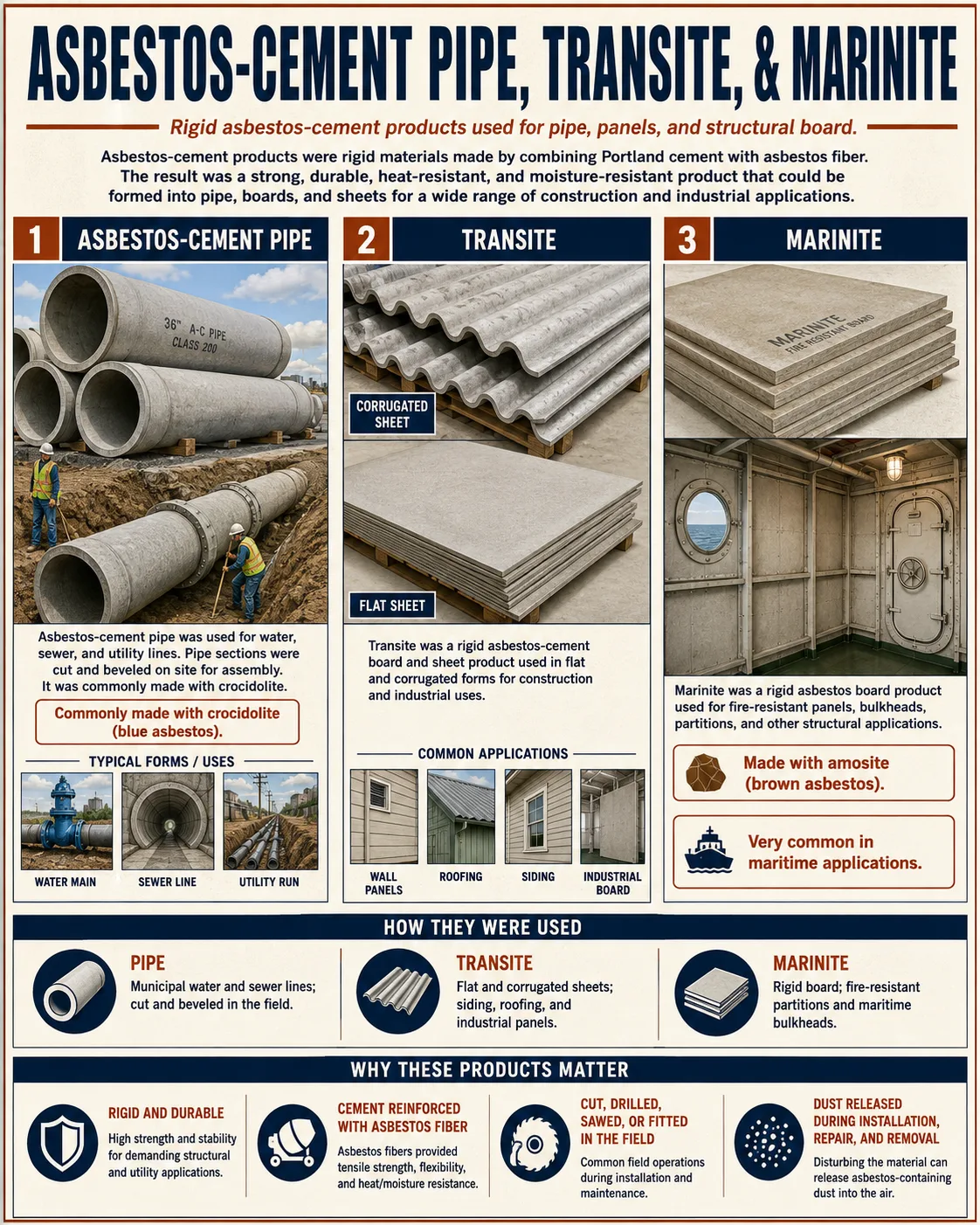
Asbestos cement is exactly what the name says: portland cement reinforced with asbestos fiber, molded under pressure into pipe, flat sheet, corrugated sheet, and shingles. The fiber gave the cement tensile strength the way rebar strengthens concrete, and the result was a material that was cheap, rigid, fireproof, and nearly immune to rot and corrosion. Cities laid it as water and sewer main. Builders nailed it up as siding and roofing. HVAC installers ran it as duct and furnace flue.
Transite was Johns-Manville's brand name for its asbestos-cement line, and like Kleenex or Xerox, the name escaped the brand: workers came to call almost any asbestos-cement sheet or pipe "transite," whoever actually made it. Marinite was a different Johns-Manville product, a calcium-silicate structural board developed for shipboard use, where its light weight and fire resistance made it the standard material for bulkheads (the walls dividing a ship's interior) and joiner work. Marinite matters for a second reason covered below: it ran on amosite, not chrysotile.
Representative products and their asbestos content. These are examples, not a full list:
| Product | Maker | Fiber | Asbestos content | In production |
|---|---|---|---|---|
| Flat Transite | Johns-Manville | Chrysotile + amosite | 22-69% | from 1907 |
| Corrugated Transite | Johns-Manville | Chrysotile | 31-50% | from 1918 |
| Marinite 30 board | Johns-Manville | Amosite | ~50% | from 1949 |
| Asbestone panels | National Gypsum | Chrysotile + amosite | ~30% | from 1957 |
| Carey Stone corrugated sheet | Celotex | Chrysotile | ~22% | from 1925 |
That Marinite row has an important detail: "Asbestos cement was only chrysotile, the least dangerous type of asbestos" is a defense you'll hear, but Marinite 30 was roughly half amosite, or brown asbestos, a more hazardous amphibole fiber, and much flat Transite carried amosite as well. The cement category was never a chrysotile-only story. And chrysotile is recognized by every major US and European health agency as a human carcinogen capable of causing the same cancers amosite and crocidolite can.
How cement products put asbestos in the air
Sitting intact in a trench or on a wall, asbestos cement doesn't shed much fiber; that's the grain of truth the industry built its "safe product" story on. The problem is that the material almost never went into service without being machined. Pipe came in standard lengths that had to be cut to fit, and every cut end had to be beveled or ground smooth so the coupling would seat. Sheet and shingle had to be sawed to size and drilled for fasteners. All of that was done in the field, usually with a high-speed abrasive disc, right at the worker's waist or chest, and each pass of the blade shattered the cement matrix and threw the fiber it had been holding into the breathing zone as dry, friable (crumbly and easily airborne) dust.
Here is what that machining work measured. Each figure is a phase-contrast (PCM) measurement, which counts only the longer fibers and so it represents the minimum level of exposure, not the maximum.
| Task | Measured (f/cc) | ≈ years of background per 15 min | Source |
|---|---|---|---|
| Cutting dry AC pipe, high-speed disc | 60 | ~17 years | Kumagai 19931 |
| Cutting moist AC pipe | 48 | ~14 years | Kumagai 19931 |
| Cutting with a water hose running | 63 | ~18 years | Kumagai 19931 |
| Dry circular-saw cutting Transite (internal study) | 36 | ~10 years | Dow Chemical 19734 |
| Cutting AC pipe with a power saw | ~89 | ~25 years | Longo & Hatfield 20012 |
| Grinding imperfections from pipe ends | ~240 | ~69 years | Hatfield & Longo 19983 |
By the illustrative math on our how we measure asbestos in air page, 15 minutes of cutting dry cement pipe put roughly 17 years of ordinary city air through the lungs. This estimates fibers in the air breathed, not a retained dose.
Look at the wet rows, because they carry this page. Kumagai's team measured moist pipe at 48 f/cc and, remarkably, cutting with a water hose running at 63 f/cc, slightly above the dry figure1. The water controlled the visible dust, which is exactly what made it dangerous: the cut looked clean while the invisible respirable fiber kept pouring off the blade. "We wetted it down" was the industry's own recommended practice, but in some cases that made it worse.
Johns-Manville's late-1970s training film Working with Asbestos tells workers that "when a product must be cut, shaped, or fitted, take care to avoid generating dust," then says finished products such as asbestos-cement pipe "pose little or no threat to health because the fibers have been locked in." The cutting measurements above show what the saw did to that claim. The passage runs about a minute.
Watch the whole film, with its transcript: Working with Asbestos
What the makers and industrial users knew
The strongest part of a cement-products case is often that the hazard was documented inside the companies themselves, decades before the workers on the saws heard a word of it. This isn't an inference from general industry knowledge; it's on paper, in their own files.
Dow Chemical measured it at its own Freeport, Texas plant. A 1973 internal industrial hygiene study of Transite cutting recorded dry circular-saw cutting at 36 f/cc in the worker's breathing zone, with water-saw cutting lower but still elevated4. Westinghouse went further down the same road: 1976 internal documentation of wet, fully immersed diamond-saw Transite cutting recorded about 11 f/cc5, which is to say that even the most controlled cutting method a major corporation could engineer stayed far above the exposure limit. Alcoa ran its own internal Marinite measurement as well with similar results.
The government record runs alongside the corporate one. The Pennsylvania Department of Health investigated conditions at the General Electric plant in Erie as early as 1951. The U.S. Bureau of Mines' Information Circular 7880 laid out the industrial picture in 19596. And in 1977 the U.S. Navy documented Transite and Marinite cutting exposures at its own shipyard facilities, the same yards where Marinite bulkhead work had been standard for a generation. All of them recorded dangerously high dust levels associated with the fabrication of asbestos cement.

At about the same time, Johns-Manville's sales film Perception of Risk, made for the A/C Pipe Producers Association, told water utilities that with the recommended work practices, fiber levels when cutting or machining AC pipe met even OSHA's proposed half-fiber limit, and that "the risk of working with AC pipe is virtually non-existent." It gives no measurements; the ones above run from 11 to 89 f/cc. The passage runs about 45 seconds.
Watch the whole film, with its transcript: Perception of Risk
Who was exposed
Asbestos cement wasn't tied to one trade or one place; it was wherever water flowed, buildings went up, and ships were fitted out. Rather than retell each worker's story here, we link to the relevant pages for your convenience.
- plumbers and pipefitters, who cut and fit asbestos-cement water and sewer mains
- construction workers, who sawed and nailed cement siding, shingles, and Transite panels
- utility and water district crews, who installed and repaired cement main for decades
- HVAC workers, who ran Transite duct and furnace flue
- shipyard workers, who cut and hung Marinite bulkheads and joiner board
If you or your family member worked around cement pipe, board, or shingle in any of these settings, the exposure history is usually easy to reconstruct.
The manufacturers and the trusts
Most of the companies that dominated asbestos cement have been through bankruptcy, which means most of this category now pays through asbestos trusts: those are paper claims, with no lawsuit and no courtroom. The major exception is CertainTeed, the largest late-era cement pipe maker, whose asbestos liabilities were moved into an entity called DBMP LLC that filed Chapter 11 in January 2020; its trust is not yet finalized, and claims against it are queued for the trust once one is confirmed. And because so much cement pipe work happened on premises controlled by water districts, utilities, and plant owners, those site owners can often be reached as premises defendants in ordinary lawsuits. A single career often supports several pathways at once, and one doesn't reduce another.
| Manufacturer / brand | Status | How claims are handled |
|---|---|---|
| Johns-Manville (Transite, Marinite, AC pipe, shingles) | Johns-Manville Asbestos Trust | Trust claim, no lawsuit |
| Keasbey & Mattison (sheet, board, shingles) | Federal-Mogul Asbestos Trust | Trust claim, no lawsuit |
| National Gypsum (Gold Bond cement board) | National Gypsum Asbestos Trust | Trust claim, no lawsuit |
| GAF / Ruberoid (cement shingles) | GAF-Ruberoid Asbestos Trust | Trust claim, no lawsuit |
| CertainTeed / DBMP LLC (AC pipe post-1962, shingles) | Chapter 11 since Jan 2020 (W.D.N.C.); tort litigation stayed; trust not yet finalized | Trust claim once confirmed |
| Water/utility districts and plant owners (premises) | Solvent | Lawsuit (state-law dependent) |
| One practical note on the DBMP row: "trust not yet finalized" does not mean "wait and do nothing." Exposure evidence gets harder to assemble as time passes, other trusts in the same career remain open now, and preserving the CertainTeed claim properly is part of building the file. That timing is our job to manage, not yours. |
Sources of compensation
A cement-products case usually draws from several sources at once, and they run in parallel:
- Asbestos bankruptcy trusts. Manville, Federal-Mogul, NGC, G-I Holdings, and Eagle-Picher all maintain active trusts, and one career of cement work often supports filings against several. These are paper claims, with no lawsuit and no courtroom. How asbestos trust claims work.
- Lawsuits against solvent defendants. Where a responsible company never went bankrupt, or where a site owner controlled the work, the claim proceeds in court. How product liability lawsuits work.
- Premises liability against site owners. The water districts, utilities, and plants where cement pipe was cut and laid can be held responsible for the conditions they allowed. How premises liability claims work.
- Federal and disability benefits. Navy service around Marinite bulkheads can support VA disability benefits, and civilian shipyard work can support Longshore (Longshore and Harbor Workers' Compensation Act) benefits, both paid in addition to the rest. How asbestos disability and benefit claims work.
In our case-law library
107 court decisions in our case-law library involve asbestos-cement pipe and sheet. Among them:
- Smith v. Schlage Lock Company, LLCU.S. Court of Appeals, Fourth Circuit, 2021 · Construction worker at automotive service station, 1957
- Hart v. Keenan Properties, Inc.California Supreme Court, 2020 · Installed pipes at McKinleyville project, September 1976 to March 1977
- Noll v. American Biltrite Inc.Washington Supreme Court, 2017 · Construction worker cutting asbestos-cement pipe at Port Orchard, 1977-1979
- Certainteed Corporation v. FletcherGeorgia Supreme Court, 2016 · Daughter laundering her father's work clothing
- Webb v. Special Electric Company, Inc.California Supreme Court, 2016 · Warehouseman and truck driver at Pyramid Pipe & Supply Co., 1969-1979
- Certainteed Corporation v. DexterKentucky Supreme Court, 2010 · Pipefitter at 1963-1964
See all 107 decisions involving asbestos-cement pipe and sheet
In our products database
The asbestos-cement pipe, board and sheet our document library describes, by the company that made or sold it. Each product's page says when it was made and how much asbestos it held, from the documents.
Albert C. Fischer: Servicised
Allegheny Ludlum Steel: Ludlite Paneling
Ambler Asbestos: Ebonized Asbestos
Ambler Asbestos Shingle & Sheathing Company: Tip Top
American Insulation Co.: Eternit Asbestos Shingles
American Lumber Company: Alumco
American Tar: Atco
Armco Steel: Asbestos-Bonded
Armstrong Cork: Accobest · Accopac · Accopac Ad-8024
Asbestile S.A. (Brussels): Asbestile (Asbestile S.A.)
Asbestone: Asbestone 400 · Chroma-Tex · Gold Bond
Asbestos Corp. of America: Duralite · Linabestos
Atlantic Asphalt & Asbestos: Triple A · Triple Aaa Hip & Ridge Shingles
Atlas Asbestos Company, Montreal: Agedroc (Atlas Asbestos) · Agedroc AO (Atlas Asbestos) · Agedroc MS (Atlas Asbestos) · Pare-Soleil (Atlas Asbestos) · Turnall "Colourgaze" (Atlas Asbestos)
B.F. Goodrich: Prenite Packing
Baldwin-Ehret-Hill: Hansonite
Beacon Sales Company: Yankee
British Uralite Co.: Asbestone (British Uralite)
Cape Asbestos: Asbestobiex
Cape Asbestos Group: Asbestolux "60"
Cape Universal Bldg. Products of Cape Asbestos Group: Facade
Celotex: Acousteel · Acousti-celotex · Asbestos Millboard (generic name) · Asbestos Rollboard · Cemesto · Cemesto Board · Cemesto Structural Insulating Panels
Cement Asbestos Products Co. (Capco): Granostruct · Granowall
Certain-Teed Products: Ct (Plus Other Notations)
CertainTeed: Arta-Seal · Asbestos-Cement Pipe · Certa-Seal · Fluid-Tite
Champion International: Qasal
DeWitt Products: Best-Side
Eternit, Inc.: Eternit Stonewall Siding · Gothic · Italit
Flintkote: Asbestos Cement Siding and Roofing Shingles · Du Shield · Flintite · Stri-Color
Follansbee Steel: Follansbee Terne
GAF: Air Cell · American Thatch · Clipfast · Color-tex · Dura Shake · Dura-Color · Duracolor · Duroc · Dutch Lap · Eternit · Eternit Stonewall · Imperial · Panelbestos · Panelstone · Sponge Felt · Stoneglow · Stonewall Board · Stratalite · Vanguard · Watcocell
Gaf/Ruberoid: Asbestos Millboard (generic name)
George W. Bromley: Bromley's Honor Pledge
Gold Bond Bldg. Products (National Gypsum): Permaboard · Plasti-Clad · Plasticrylic · Plia-F-Lex · Ripple Tone · Woodrock
Gold Bond Building Products (National Gypsum): Asbestone · Classic
H.H. Robertson: Galbestos
Irvington: Novabestos Electricl
J. W. Roberts Ltd (Turner & Newall): Ferobestos
J/Hns-Manville: Micro-Flexboard
James Hardie & Co.: Hardiflex
Johns-Manville: 101 · 101 Asbestos Millboard · 101 Mobilene Sheet · 102 Asbestos Millboard · 102 Millboard · 103 Asbestos Millboard · 103 Millboard · 104 Asbestos Millboard · 105 · 106 Asbestos Millboard · 106 Millboard · 106B Asbestos Millboard · 106B Millboard · 106H · 106H Asbestos Millboard · 219 Asbestos Millboard · 219 Millboard · 85 Magnesia (generic name) · Ace Corspan · Air-Cell · American Colonial · Anti-sweat · Asbesto-sponge · Asbestoboard · Asbestobord · Asbestocel · Asbestocite · Asbestos "Navy Brand" Fire Felt · Asbestos Ebony · Asbestos Fire Felt · Asbestos Fire Felt Locomotive Lagging · Asbestos Millboard · Asbestos Paper and Rollboard · Asbestos Sheathing · Asbestos Sponge (Felted, Sectional, Molded) · Asbestoside · C Asbestos Millboard · C Millboard · Carinsul · Cedargrain · Chemstone · Colorbestos · Colorceran · Colorchip · Colorlith · Colorlith Chalkboard · Colorsil · Corspan · Dekeran · Equality · Face Span · Facespan · Fine Corrugated Asbestocel · Fire Felt · Flat Transite · Flexboard · Flexite · Heat Treated Molted Metal Marinite · Homestead · Imperial Marinite · Korduct · Magno · Marimet 45 · Marine Acoustical Unit · Marine Veneer · Marinite 23 · Marinite 30 · Marinite 36 · Marinite 45 · Marinite 65 · Marrakech · Metal Veneered Marinite · Metal-on · Min-k · Min-k 1301 · Min-k 500 · Molten Metal Marinite · No. 100 Kearsarge Sheet · No. 60 Service Sheet · Pallite · Permatone · Permatone S · Permatone “S” Flexboard · Quinterra 71 · Reeferite · Rentone · Ridge Roll · Ring-Tite · Rock Shake · Rockspan Clapboard · Salem · Submarine Bulkhead · Super Fire Felt · Super Temp-Tite · Superex 2000 · Superex-1900 · Superex-m · Superex-sg · Temp-Tite · Therm-o-bestos · Thermo Fire Felt · Thermobestos · Thermomat · Thermowrap · Transite · Transite Acoustical Panel · Transite Core Plate · Transite Insulated Roof · Transite Panel · Transite Sewer Pipe · Transite-Korduct · Transitop · Tuff-Link · Type A Asbestos Millboard · Type A Millboard · Veneered Marinite · Vitribestos · Vitro Fire Felt · Xxx Asbestos Millboard · Xxx Millboard
Kaiser Refractories: Miraweld
Keasbey & Mattison: 'Century' Apac · Air-Duct · Aircell · Amberlite Packing · Apac · Apac Board · Asbestoroc · Century · Chrom-Tex · Dualay · Ebonized Asbestos · Fluid-Tite · Industal · Industrial · K & M 103 · K & M 601 · K & M 801 · K & M Aircell · K&M Best in Asbestos · K&M Trafford Tile Asbestos Cement · Kamflex · KolorMate · Linabestos · Linalbestos · Monobestos · No. 701 · Nu-Grain · Promenade Tile · Resistal · Sheetflextos · Strytex · T-deck · Trafford Tile · Uni-syn Packing
Keene/Beh: Fyrbestos · Hansonite
Keene/Ehret: Pyroboard
Klinger: Klingerpac
Lehon: "Not A Kick In A Million Feet" · Mule-Hide · Top Notch
Lone Star Roofing: Don'T Monkey With Cheap Roofs
M. H. Detrick: Detroc Board
Maker not given: Gothic (maker not given) · Grain-Tex (maker not given) · Ruco (maker not given) · Shake-Tex (maker not given) · Usg (maker not given) · Vitramic (maker not given)
Marinite: Scotstone
Mirawal (Kaiser Aluminum & Chemical Corporation division): Birdsboard (Mirawal, Kaiser Aluminum & Chemical)
Mundet Cork: Air Cell
National Gypsum: Asbestone · Asbestone 400 · Asbestos Permaboard · Chroma-Tone · Classic-Shake · Economy 250 · Humigard · Pliaboard · Pps · Ranch Style · Sussex 32 · Therm-O-Tec · Woodrock
Nicolet: Aircell (generic name) · Asbestos Millboard Mb-1 · Honeycomb · Hy-swell · K-board · Kolormate · Kon-x · Monobestos · Norbestos · Norriscell · Nortex · Resistal · Sal-mo · Sbr
Nordesk A Moskinfilt Aktiebologet: Nordeskafilt
North American Asbestos: Asbestolux
Nu Side: Nu Side
O'Neill Lumber Co.: Houservice
Orangeburg: Flintite
Owens-Corning: 702 · 703 · 703G · 705 · Frycor · I-s · Unarcoboard
Philip Carey: 4.2 Careystone · AC Board · Aircel · Asbestos millboard (generic name) · Asbestos Rollboard (generic name) · Carey (generic name) · Careybesto-Board · Careycel · Careyflex · Careysote · Careystone · Careystone Colonial Clapboard Siding · Careytemp · Coverall Board · Fire-chex 325 · Firefoil · Formboard · Industrial A-c Board · Marine Panel · No. 1 Hard · Roll Board · Rustic Shakes · Shake Shield · Shasta Snow · Thermo-board · Tri-Tone · Vitricel
Pittsburg Corning: Unibestos
R. J. Dorn Company: Asbestone (R. J. Dorn)
Ruberoid: American Thatch · Asbestos Millboard · Asbestos Sponge Felt · Color Ground · Color-Tex · Colorator · Deluxe Stonewall · Eternit · Gasket Quality · Mill Board · Roll Board · Rubestos · Stonewall · Supertab · Timbertex · Vitramic
Supercrete Pipes S.A.: Asbestex
Supradur: Country Club · Fiber-Shake · Fiber-Shake Sidewall Shingle · If It'S Supradur It'S Supra-Durable! · Magna-Tones · Narro-Side · Shado-Shake · Stride · Supra Slates · Supra-Crylic · Supra-Tones · Supradur · Suprawall · Suramic
The Ruberoid Co.: Gothic (Ruberoid)
Tilo Roofing: Roctone
Turner Brothers Asbestos: Duraform
Turners Asbestos: Turnall · Turnall Granitone
Turners Asbestos Cement Co. Ltd.: Turnall Weatherall (Turners Asbestos Cement)
Turners Asbestos Cement Co. Ltd. (Turner & Newall): Turnall Weatherall
U.S. Gypsum: Concord · Glatex · Pyro-bestos · Sheetrock · Sheetrock RH Fillers · Siding Shingles · Thermalux · Usg
UBE Ceycon: Aslac
Unarco: Unarcoboard
Union Asbestos & Rubber Co.: Unibestos
United States Gypsum: China-Glaze
United States Plywood: Facad
Videos


The defenses companies raise, and how we answer them
The defendants in cement-product cases lean on the material itself: hard, gray, and solid-looking, it photographs well for a jury. None of their arguments is new to us. All of this applies only to the lawsuit side. Trust claims are a paper process: no opposing lawyer raises defenses, no one is deposed, and no one goes to court.
How we answer the defenses raised in cement pipe, Transite, and Marinite cases
"Asbestos cement is non-friable; the fiber is bound in the cement, so it doesn't release." The claim describes the product sitting on a shelf, not the product being installed. Sawing, grinding, and drilling shatter the cement matrix and drive heavy fiber into the air, and the measurements say so: cutting pipe recorded 60 f/cc and grinding pipe ends recorded around 2401,3. A material that had to be cut to be used cannot borrow safety from the moments when nobody was cutting it.
"Wetting the pipe controlled the dust." Kumagai measured cutting with a water hose running at 63 f/cc, effectively the same as dry cutting1, and Westinghouse's own fully immersed wet diamond-saw method still measured about 115, far above the exposure limit. Wet methods suppressed the dust a foreman could see, not the respirable fiber that causes disease.
"It was only chrysotile." Chrysotile is a recognized cause of mesothelioma, and the argument fails on the facts here anyway: Marinite 30 was roughly half amosite (brown asbestos, an amphibole fiber), and much flat Transite carried amosite too. The composition table on this page shows it.
Frequently asked questions
I don't remember the brands or have my old records. Can I still file?
Yes, and most people are in exactly that position. We reconstruct the products and the work history from our exposure database, the trust documentation for each manufacturer, and the recollections of coworkers. With cement products it's often even simpler, because "transite" became the generic field name for the whole category. The conversation starts with what you remember.
My loved one has already passed away. Can we still bring a claim?
Yes. Families regularly file after a death, both trust claims and, depending on the state, a wrongful death lawsuit. Some of these deadlines are short, so it's best to call promptly. We handle wrongful death and estate claims as a matter of routine.
I worked for a city water department, not a manufacturer. Do I still have a claim?
Very likely, yes. The trusts pay based on your exposure to a bankrupt company's product, not on who signed your paycheck, so a municipal crew that cut Manville or CertainTeed pipe has claims against those manufacturers' trusts. Depending on the state, the entities that controlled the worksite may also be reachable in court.
Wasn't asbestos cement considered one of the "safe" asbestos products?
That was the industry's position, and it rested on the product nobody was touching. The measurements above were taken during ordinary installation work, cutting and beveling pipe the way every crew did it, and they're among the higher task readings in the asbestos literature. A safety story that excludes the installation of the product isn't a safety story.
Could my family have been exposed through the work clothes?
Yes, and it's common. Cement-cutting dust settled on clothes, hair, and boots and came home with the worker, and spouses who laundered the clothes were exposed too. Our representation includes free asbestos health screening for family members, and if one is later diagnosed, they may have a claim of their own. The screening is a chest X-ray read by a B-reader, with a CT scan if needed; it looks for asbestos-related changes in the lungs and isn't a diagnosis or a reliable way to find mesothelioma early.
What does it cost to work with you?
Nothing up front, and nothing at all unless we recover for you. We work on a contingency fee, which means our fee comes only out of money we recover, and the case review is free.
What happens when I call?
A member of our litigation team, not a screener, takes the call, and the first conversation usually runs twenty to thirty minutes. We listen to the work history, explain which claims may apply, and lay out the timeline. No one is pressured to sign anything.
Talk with an asbestos lawyer about cement pipe, Transite, or Marinite exposure
Whether you're a worker who was just diagnosed or a spouse or adult child trying to find help for someone who is sick, we're ready to talk. You don't need the product names, you don't need the old records, and you don't need to travel to us. Start with what you remember, and we'll take it from there.
Related resources
Sources and references
- Kumagai S, Nakachi S, Kurumatani N, Nakagiri S, Kataoka A. Estimation of asbestos exposure among workers repairing asbestos cement pipes used for conduits. Jpn J Ind Health. 1993;35:178-187.
- Longo WE, Hatfield RL. Asbestos-cement pipe cutting work-practice study. Materials Analytical Services; 2001.
- Hatfield RL, Longo WE. Fiber release during cutting and grinding of asbestos-cement pipe. 1998.
- Dow Chemical Company. Internal industrial hygiene study of Transite cutting, Freeport, Texas, 1973.
- Westinghouse Electric. Internal measurement of wet diamond-saw Transite cutting, 1976. <
- U.S. Bureau of Mines. Information Circular 7880. 1959.
- OSHA asbestos standard, permissible exposure limit 0.1 f/cc over eight hours with a short-term excursion limit of 1.0 f/cc over thirty minutes. 29 C.F.R. § 1910.1001.
- International Agency for Research on Cancer. Arsenic, Metals, Fibres, and Dusts. IARC Monographs, Vol. 100C (all forms of asbestos classified as carcinogenic to humans, Group 1).
This page is provided for general informational purposes and does not constitute legal advice. Every asbestos case turns on its own facts, exposure history, diagnosis, deadlines, available evidence, and applicable law. Reviewing this page does not create an attorney-client relationship. For advice about your specific situation, call 833-4-ASBESTOS for a free case review.