
If you worked at a power plant or for a water or electric utility — or if someone in your family did — and a mesothelioma, lung cancer, asbestosis, or other asbestos diagnosis has now come in, this page is the place to start. The same dust reached the spouses and children who washed the work clothes, and it didn't matter whether the worker ran the boilers, wired the substations, or laid the water mains, because asbestos ran through all of it.
The utility industry used asbestos in two different worlds, and in both the dust reached well past the man doing the work. In the powerhouse, the boilers, turbines, and steam lines were wrapped in asbestos insulation, much of it amosite (brown asbestos, an amphibole, a more hazardous fiber type), and every flanged joint and valve was sealed with asbestos gaskets and packing, so an insulator cutting covering a few feet from a pipefitter breaking joints filled the shared air with fiber. Beneath the streets, the water and sewer mains were asbestos-cement pipe, much of it containing crocidolite (blue asbestos, the amphibole most strongly linked to mesothelioma), cut and beveled by water crews in open trenches where the dust caught the helper downwind as often as the cutter.
None of it stayed with the man who made it: asbestos fibers hang in the air for hours and drift, so a bystander breathed it too, and even twenty feet from active work the air put roughly a month of ordinary city background through the lungs in a quarter hour. Hundreds of thousands of miles of that pipe are still buried and still carrying water today, and the crews who repair it are still being exposed. The chart below shows fifteen minutes of three utility jobs against a year of that background air.
What these numbers mean. Asbestos in air is measured in fibers per cubic centimeter (f/cc), a unit that hides how dangerous a task was. Across this site we translate each measurement into fibers breathed, feet of fiber end to end, and years of ordinary city air, using conservative, government-sourced assumptions. See how we measure asbestos in air for the method and its limits.
You don't need to remember which company's insulation or pipe you worked with, and you don't need old job records or a service history in hand. The bankruptcy trusts that pay many of these claims are built to compensate exactly this kind of work: for mesothelioma, even brief asbestos exposure on a worksite that used it is typically enough to qualify, so you don't have to prove a heavy dose. If you can say "I ran the powerhouse at the generating station" or "my husband cut water pipe for the city for thirty years," we have a starting point.

You don't need the product names or old records. No fee unless we recover compensation for your family.
Quick answers
| Did utility work really expose me to asbestos? | Almost certainly, for any career that ran through the 1980s. In the power plants, asbestos insulation wrapped the boilers, turbines, and steam lines, and gaskets sealed every joint. In the water and sewer systems, the mains themselves were asbestos-cement pipe. Electrical work brought its own asbestos in the switchgear, panels, and fireproofing. |
|---|---|
| I worked power generation, not water. Are they different cases? | The products differ, but both are strong claims. Power plant workers breathed asbestos from boiler and turbine insulation and gaskets; water utility crews cut asbestos-cement pipe in the trenches. We build each on the products that fit the work, and many utility careers touched both. |
| I laid or cut water pipe. Was that really asbestos? | Much of it was. For decades the water and sewer mains were asbestos-cement pipe, and cutting and beveling it in the trench released heavy dust, often onto the helper downwind as much as the cutter. Hundreds of thousands of miles remain in the ground today. |
| I'm a utility worker still cutting into old pipe or insulation now. Am I being exposed? | You may be. Aged asbestos-cement pipe and old insulation release fiber when they're cut or torn into, sometimes as heavily as when they were new. Document your work history now, even before any diagnosis, and if you're ever diagnosed, the filing clock runs from the diagnosis, not the exposure. |
| How long do I have to file? | It depends on your state and on whether this is a personal-injury or a wrongful-death situation, and some of those deadlines are short. The safest step is to call as soon as possible after diagnosis so the clock doesn't run out. |
| Do I have to file a lawsuit? | No. Many utility workers and their families recover through trust claims and benefits without ever filing a lawsuit. Trust claims are paper claims, not courtroom cases. We explain both paths and respect your decision. |
| I worked for a city or public utility. Does that change anything? | It can affect which claims and benefits apply, but it doesn't take away the core case. The claims against the companies that made the asbestos insulation, gaskets, and pipe run the same way whether your paycheck came from a city, a public utility, or a private company. |
“I started this firm after learning that the cancers that killed my father and grandparents were caused by asbestos, something we did not realize until it was too late to hold anyone accountable. That experience is why we built this site: so that no other family misses their chance to ask the questions, hear the options, and decide for themselves what to do.”
Why both worlds ran on asbestos
The utility industry is really two industries that share a name, and asbestos ran through both for different reasons. Understanding that split is how a utility worker's case gets built, because the powerhouse and the water main were different products, different trades, and different exposures.
In the power plants, the reason was heat. A generating station turns water into high-pressure steam to spin turbines, and the boilers, turbines, and the miles of steam line between them ran at temperatures that demanded the best insulation money could buy. For most of the twentieth century that meant asbestos, and much of the powerhouse insulation was amosite (brown asbestos, an amphibole, a more hazardous fiber type), packed around the boilers and lagged onto every line, with asbestos gaskets and packing sealing every joint, valve, and pump. This was not incidental: by 1920 Johns-Manville was publishing a catalog written specifically for power users, placing its boiler insulation, pipe covering, cements, gaskets, and packing in every corner of the powerhouse and naming the electric companies that were already its customers. The powerhouse was built to run on asbestos, and it was sold that way, generating station by generating station.
Beneath the streets, the reason was speed. The water and sewer mains that spread across postwar America were made of asbestos-cement pipe, and a large share of it contained crocidolite (blue asbestos, the amphibole fiber most strongly linked to mesothelioma), not because crocidolite made better pipe but because it let the wet cement drain faster on the production line and doubled plant output. The men who cut that pipe in the trenches were breathing the most dangerous asbestos fiber known to medicine, and almost none of them knew it was there. See how asbestos cement pipe caused exposure.
And the work that kept both systems running is what put the fiber in the air. In the plants, insulation was cut and torn off for every repair, gaskets were scraped and ground off flanges, and packing was pulled from valves and pumps. In the trenches, pipe was cut to length and beveled with abrasive saws. All of it was old, degraded, friable (crumbly and dusty) material by the time it was disturbed, and tearing out or cutting degraded material releases far more fiber than installing it new. The men did that work bare-faced, cleaned up with brooms and air, and went home in dusty clothes to their families, while the companies that made the products knew what the dust was doing.
Where the asbestos was, in the plant and in the ground
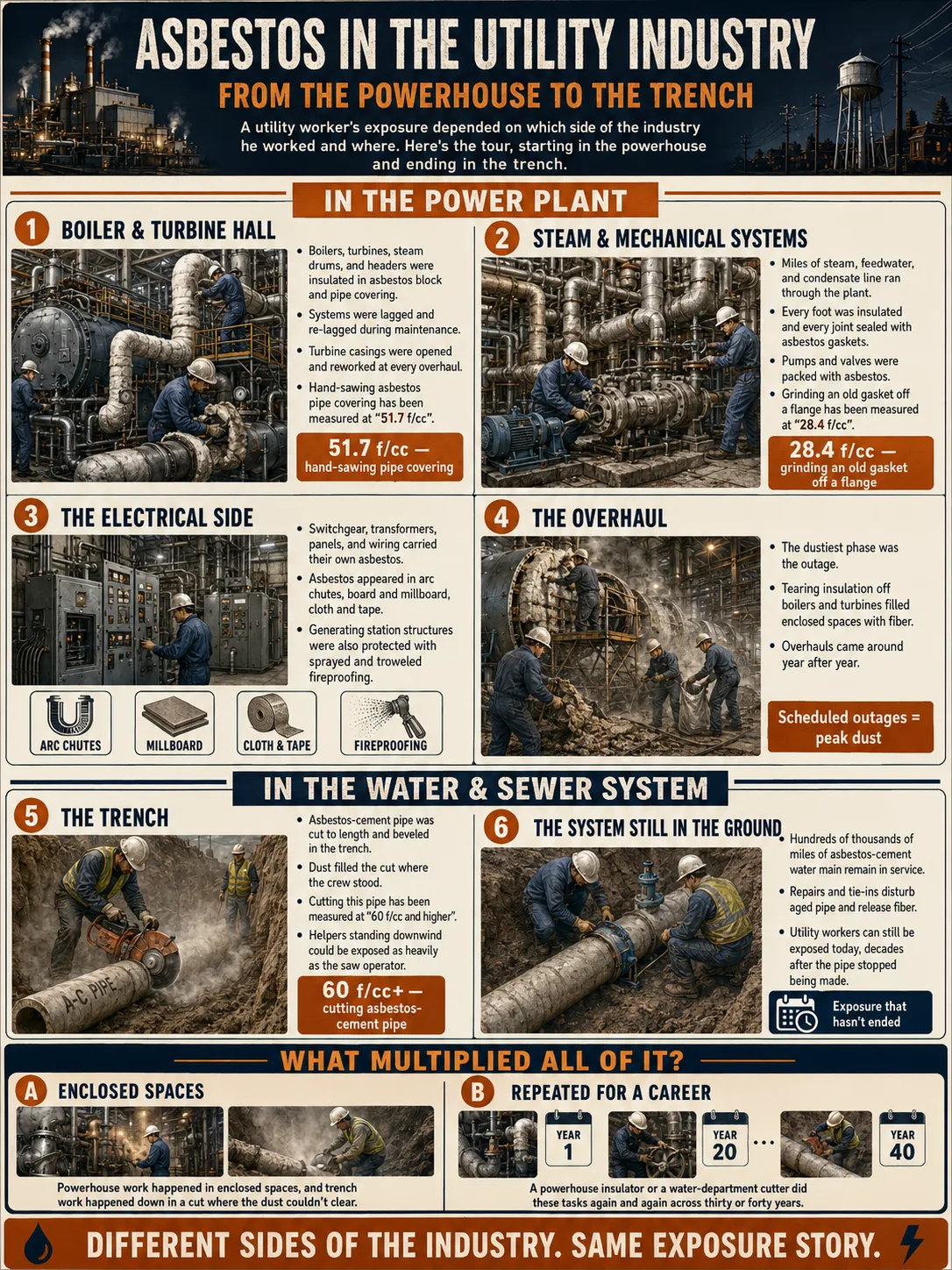
A utility worker's exposure depended on which side of the industry he worked and where. Here's the tour, starting in the powerhouse and ending in the trench.
In the power plant:
- The boiler and turbine hall. The heart of the powerhouse exposure. Boilers, turbines, and the steam drums and headers were insulated in asbestos block and pipe covering, lagged and re-lagged as the plant was maintained, and the turbines themselves sat under insulated casings that were opened and reworked at every overhaul. Hand-sawing that pipe covering has been measured at 51.7 f/cc. See how asbestos pipe and block insulation caused exposure.
- The steam and mechanical systems. Miles of steam, feedwater, and condensate line ran through the plant, every foot insulated and every joint sealed with asbestos gaskets, and the pumps and valves were packed with asbestos. Grinding an old gasket off a flange has been measured at 28.4 f/cc. See how asbestos gaskets and packing caused exposure.
- The electrical side. Switchgear, transformers, panels, and wiring carried their own asbestos, in arc chutes, board and millboard, cloth and tape, and in the sprayed and troweled fireproofing that protected the generating station's structure.
- The overhaul. As in every steam plant, the dustiest phase was the outage. Tearing insulation off boilers and turbines during a scheduled overhaul, in the enclosed spaces of the plant, filled the air with fiber for the duration of the work, and overhauls came around year after year.
In the water and sewer system:
- The trench. The water main and sewer work was a different job entirely. Asbestos-cement pipe was cut to length and beveled at the ends with abrasive disc saws, down in the trench, and the dust filled the cut where the crew stood. Cutting that pipe has been measured at 60 f/cc and higher, and the helper standing downwind in the trench was often exposed as heavily as the man running the saw. See how asbestos cement pipe caused exposure.
- The system that's still in the ground. This is the exposure that hasn't ended. Hundreds of thousands of miles of asbestos-cement water main remain in service across the country, and every time a modern crew cuts into it for a repair or a tie-in, the aged pipe releases fiber much as it did when it was new. Utility workers are still being exposed today, decades after the pipe stopped being made.
Two things multiplied all of it. The powerhouse work happened in enclosed spaces where the fiber concentrated, and the trench work happened down in a cut where the dust couldn't clear, and both repeated for a career: a powerhouse insulator or a water-department cutter did these tasks over and over across thirty or forty years.
The utilities, and the companies behind them
For a utility worker's case, where the work happened tells us two things. It tells us which asbestos products were in the plant or the pipe during which years, and it identifies who controlled the conditions the work was done in. The power side and the water side lead to somewhat different places.
The electric utilities and their generating stations. The power companies ran fleets of generating stations, coal, oil, gas, and later nuclear, and each plant was a powerhouse full of insulated boilers, turbines, and steam lines. The electric companies that operated them, including long-standing utilities that appeared on the asbestos makers' own customer lists as far back as the 1920s, controlled those plants and can be premises defendants for the conditions inside them. Whether a given company can be reached, and how, is something we check case by case, because utilities have merged, been acquired, and been reorganized many times over the decades.
The water and sewer utilities. The water side was often public. Municipal water departments, public utility districts, and sanitation districts employed many of the crews who cut and laid asbestos-cement pipe, and that public-employer status can shape the case. A worker generally can't sue his own employer over workplace conditions, and when that employer was a city or public district, the case runs primarily against the companies that made the pipe. How a public employer figures into a claim varies, and it's one of the things we sort out early.
The utilities didn't make the asbestos; they bought and installed it from the companies that did. The insulation makers supplied the boiler and pipe covering, the gasket and packing makers built lines for powerhouse service, and the pipe makers, led by Johns-Manville, supplied the asbestos-cement water main by the mile. The manufacturers behind each product, and which of their trusts pay today, are laid out on the product pages. See the makers behind asbestos pipe and block insulation, and the makers behind asbestos cement pipe.
Power plants named in the trade press
For sixty years, the asbestos industry's own trade journal, Asbestos, reported which power plants had been insulated, with what, and by whom. Johns-Manville's employee magazines did the same for J-M's sales. These notices were written to sell insulation. Today they help families confirm what was on the pipes and boilers at a plant where someone worked.
In 1932, Asbestos wrote that asbestos "has long been associated with construction and operation of power plants": rope tamped into cracks in boiler walls, felt for expansion joints, and asbestos ebony for switchboards (Asbestos, Sept. 1932). By 1937 it reported that numerous "immense power plants" had gone up across the country and that insulation had "found a huge outlet" in them (Asbestos, Mar. 1937).
| Plant | Year reported | What the magazine says was used | Insulation contractor | Source |
|---|---|---|---|---|
| Buffalo General Electric Co. plant, Buffalo, N.Y. | 1921 | 85% Magnesia on steam lines, in service four years | — | Magnesia Association ad, Asbestos, Feb. 1921 |
| South Meadows station, Hartford Electric Light Co., Hartford, Conn. | 1921 | Pipe covering ("one of the largest individual covering contracts ever awarded in the East") | Collins-Lotz Co. | Asbestos, Aug. 1921 |
| Connecticut Light & Power Co., Devon, Conn. | 1924 | Asbestos fibre packed in the expansion joints of the boiler furnace walls | — | Asbestos, Aug. 1924 |
| Long Beach Steam Plant No. 3, Southern California Edison | 1928 | Johns-Manville insulation (about $60,000) | — | J-M Circle, May 1928 |
| Conowingo power house, Philadelphia Electric Co., Conowingo, Md. | 1928 | 1,546 Transite Wood doors and nine miles of Transite Wood strips | — | Asbestos, July 1928 |
| Dallas Power & Light Co. extension, Dallas, Tex. | 1930 | Johns-Manville insulation (about $20,000) | — | J-M Circle, July 1930 |
| Deepwater Power Station, Deepwater, N.J. | 1931 | Keasbey & Mattison insulation (described in a K&M booklet) | — | Asbestos, June 1931 |
| Northern States Power Co., Minneapolis, Minn. | 1934 | Asbestos-cement electrical conduit laid underground | — | Asbestos, Oct. 1934 |
| Port Washington plant, Milwaukee Electric Railway & Light Co., Wis. | 1937 | Ehret's Enduro High Temperature and 85% Magnesia; Fibrekote asbestos asphalt finish | Sprinkmann Sons Corp. | Asbestos, Mar. 1937 |
| LaClede Power & Light Co., St. Louis, Mo. | 1938 | About two miles of Carey High Temp and Carey 85% Magnesia | — | Asbestos, July 1938 |
| Cahokia plant, Union Electric Co., St. Louis | 1938 | J-M 85% Magnesia and Superex High Temperature, about 70,000 sq. ft. | Johns-Manville contract department | Asbestos, Dec. 1938 |
| Boulder Dam generating plant | 1939 | Arizona asbestos used by General Electric in the generators | — | Asbestos, Feb. 1939 |
| Schuylkill Power Station, Philadelphia Electric Co. | 1939 | K&M Hy-Temp and 85% Magnesia; asbestos cloth, asbestos cement and asbestos paper finishes | John R. Livezey | Asbestos, May 1939 |
| Taunton Municipal Light Plant, Taunton, Mass. | 1943 | K&M asbestos sponge felt on the underground steam mains | Underground Steam Construction Co. | Asbestos, Nov. 1943 |
| Chesterfield Power Station, Virginia Electric & Power Co. | 1945 | Insulation furnished and installed during the war | Reid-Hayden, Inc. (J-M contractors) | Asbestos, Mar. 1945 |
| Hawthorn station, Kansas City Power & Light Co. | 1951 | 85% Magnesia and a second product on all steam piping, about 5,000 lineal feet | Kelley Asbestos Products Co. | Asbestos, May 1951 |
| Scattergood steam plant, Los Angeles Dept. of Water and Power | 1960 | Thermobestos: more than six miles of pipe insulation and 200,000 sq. ft. of block | Thorpe Insulation Co. | J-M News Pictorial, June 1960 |
| Allen S. King plant, Northern States Power Co., Lake St. Croix, Minn. | 1968 | Unibestos amosite asbestos pipe insulation, on pipe up to 36 inches | Asbestos Products, Inc. | Asbestos, Oct. 1968 |
| Fort Martin plant, Allegheny Power System, W. Va. | 1969 | Unibestos amosite asbestos insulation on the 20-inch main steam lines | George V. Hamilton, Inc. | Asbestos, Feb. 1969 |
| Moss Landing Power Plant, Pacific Gas & Electric, Calif. | 1969 | "Nearly all the insulation" for boilers, pipes, turbines and stacks, from Johns-Manville | Western MacArthur Co. | Asbestos, Oct. 1969 |
Utilities bought asbestos products well beyond pipe insulation. Johns-Manville sold 240 carloads of products to Virginia Electric & Power over two years (J-M News Pictorial, Nov.–Dec. 1963). In 1971 Indianapolis Power & Light line crews chose 'Gator Tape, an 80–85% asbestos cable-wrapping tape (Asbestos, Nov. 1971). GAF reported "notable success" for its corrugated asbestos-cement sheets in new power plant construction (Asbestos, June 1971).
The asbestos stayed in the plants. In 1981, construction workers shut down a $20-million overhaul of a Pacific Gas & Electric plant in Pittsburg, California, when state inspectors found asbestos in six of 14 pipe-insulation samples; they had been told there was none (Asbestos, June 1981). The same issue reported that Central Maine Power had been allowed to bury bagged asbestos waste in the foundation of its South Portland plant (Asbestos, June 1981).
If your plant isn't listed here, that doesn't mean it was free of asbestos: these are only the plants the trade press happened to write about.
The trades that worked the utilities
Utilities employed dozens of trades, and several of them have their own pages, because their exposure followed them across industries. If your loved one's work fits one of these better than it fits "utility worker," start there:
- Insulators and insulation workers
- Pipefitters and plumbers
- Boilermakers
- Electricians
- All asbestos occupations
For everyone else, the powerhouse operators and boiler crews, the turbine and maintenance mechanics, the substation and line workers, and the water and sewer crews who cut and laid the pipe, this page is your page, and the work described above is the exposure story we build the claim on.
Sources of compensation for power plant and utility workers
A utility worker's recovery usually comes from more than one place, and the different channels run in parallel without canceling one another out. We file across all of them that apply.
- Asbestos bankruptcy trusts. The companies that made the insulation, gaskets, and asbestos-cement pipe used in the plants and the pipe systems and later went bankrupt set aside money in trusts to pay the people they harmed. These are paper claims that don't require a lawsuit or a courtroom, and a utility career often supports filings against several trusts at once. For a worker whose employer was a city or public district, this is usually the backbone of the case. How asbestos trust claims work.
- Lawsuits against solvent manufacturers. Some makers of utility products, especially in the gasket and packing world, are still in business and can be sued directly for making and selling products they knew were dangerous. How product liability lawsuits work.
- Premises liability against the plant owners. On the power side especially, many of the electric utilities that ran the generating stations are still in business, and the company that controlled a plant can be answerable for the conditions it allowed, separate from the companies that made the products. How premises liability claims work.
- Federal and disability benefits. These depend on where and how the work was done, and they're paid in addition to the trust and lawsuit recovery. Civilian work at a federal power facility can support FECA (the Federal Employees' Compensation Act, the federal workers' compensation system) benefits, military service before or after the utility years can support VA disability benefits, and Social Security disability is available to anyone whose illness stops them from working. How asbestos disability and benefit claims work.
Mentioned on this site
- 85% Magnesia
- A.P. Green Asbestos Trust Claims
- ACandS Asbestos Trust Claims
- Annals of Global Health
- Annals of Occupational and Environmental Medicine
- Annals of the New York Academy of Sciences
- API, Inc. Asbestos Trust Claims
- Armstrong World Industries Asbestos Trust Claims
- Asbestos
- Asbestos Cement Pipe, Transite, and Marinite
- Asbestos Exposure by Industry
- Asbestos Exposure in Boilermakers
- Asbestos Exposure in Bystander and Proximity Workers
- Asbestos Exposure in Carpenters and Construction Workers
- Asbestos Exposure in Electricians and Electrical Workers
- Asbestos Exposure in Glass, Aluminum, and Cement Plant Workers
- Asbestos Exposure in Insulators and Insulation Workers
- Asbestos Exposure in Millwrights, Machinists, and Industrial Mechanics
- Asbestos Exposure in Pipefitters and Plumbers
- Asbestos Exposure in Refractory Bricklayers
- Asbestos Exposure in Welders
- Asbestos Insulating Cement, Boiler Coatings, and Spray Cement
- Asbestos insulation
- Asbestos Packing
- Babcock & Wilcox Asbestos Trust Claims
- BMJ Case Reports
- Boiler Insulation
- Boiler Technician
- British Journal of Industrial Medicine
- British Journal of Urology
- Calcium Silicate Insulation
- Caposite
- Combustion Engineering Asbestos Trust Claims
- Eagle-Picher Asbestos Trust Claims
- Edgewood
- Garlock Sealing Technologies Trust
- Heat
- Histopathology
- International Journal of Occupational and Environmental Health
- International Journal of Radiation Biology
- John Crane Inc.
- Johns-Manville Service to Power Users
- Journal of Occupational and Environmental Hygiene
- Journal of Occupational Health
- Journal of Occupational Medicine and Toxicology
- Kaylo
- Lancet
- Letters and Comments on Asbestos
- Marinite
- New Solutions
- Nuclear Grade
- Occupational and Environmental Medicine
- Occupational Medicine
- Owens-Corning Fiberglas
- Owens-Illinois Asbestos Personal Injury Trust
- Pittsburgh Corning
- Pittsburgh Corning Asbestos Settlement Trust
- Psycho-oncology
- Research on Power Plants
- Scandinavian Journal of Work, Environment & Health
- The Annals of Occupational Hygiene
- The Asbestos Worker
- The Medical Journal of Australia
- Unarco
- Unibestos
- Videotaped Deposition of Dr. Paul Kotin in the South Carolina Asbestos Cases (1979)
In the research library
The National Library of Medicine indexes 28 studies in our medical research library under power plants. Among the most cited:
- Risk of cancer among Danish utility workers--a nationwide cohort studyC. Johansen, J.H. Olsen, 1998 · American Journal of Epidemiology · cited 55 times
- Occupational respiratory cancer and exposure to asbestos: a case-control study in a cohort of workers in the electricity and gas industryE. Imbernon, M. Goldberg, S. Bonenfant, et al, 1995 · American Journal of Industrial Medicine · cited 34 times
- Cancer mortality among workers in a thermoelectric power plantG. Cammarano, P. Crosignani, F. Berrino, et al, 1984 · Scandinavian Journal of Work, Environment & Health · cited 26 times
- Lung cancer in relation to employment in the electrical utility industry and exposure to magnetic fieldsD.A. Savitz, V. Dufort, B. Armstrong, et al, 1997 · Occupational and Environmental Medicine · cited 17 times
- Mortality of UK electricity generation and transmission workers, 1973-2002L. Nichols, T. Sorahan, 2005 · Occupational Medicine · cited 14 times
In our case-law library
242 court decisions in our case-law library involve power plants and utilities. Among them:
- Jolly v. Fisher Controls International, LLCSouth Carolina Supreme Court, 2024 · Inspector overseeing tradesmen who replaced gaskets and valves at Oconee, McGuire, and Catawba nuclear plants, 1980-1984
- Carpin v. Vermont Yankee Nuclear Power CorporationVermont Supreme Court, 2024 · Pipefitter (her husband) at Vermont Yankee Nuclear Power Corp., 1971-1972
- Boynton v. Kennecott Utah Copper, LLCUtah Supreme Court, 2021 · Wife of a construction electrician who laundered his work clothes at Huntington Canyon Power Plant, 1973
- Roverano v. John Crane, Inc.Pennsylvania Supreme Court, 2020 · Helper and a carpenter at PECO Energy Company, 1971-1981
- Stearns v. Metropolitan Life Insurance CompanyMassachusetts Supreme Judicial Court, 2018 · Pipe inspector at two nuclear power plants (turbine halls), 1971-1978
- Matter of New York City Asbestos LitigationNew York Court of Appeals, 2018 · Auto mechanic servicing Ford vehicles at Orange and Rockland Utilities, 25 years
Videos

The defenses companies raise, and how we answer them
When a utility worker's case goes to court, the companies raise the same handful of defenses they raise in most asbestos cases, plus a few tuned to the plants and the pipe, and none of them is new to us. The short version is that the arguments describe a cleaner, smaller version of the work than the one your loved one actually did, and the evidence answers them. The detail is below for anyone who wants it.
All of this applies only to the lawsuit side of a case. The trust claims are a paper process: no opposing lawyer raises defenses, no one is deposed, and no one goes to court.
How we answer the defenses raised in power plant and utility cases
"The asbestos was locked in the cement pipe, so cutting it was safe." The cement bound the fiber when the pipe was sitting in the ground, and defense witnesses have argued for years that bonded asbestos cement is safe to handle. That argument has never matched the work. Cutting and beveling the pipe in the trench broke the fiber free of the matrix, and the published testing of that exact work recorded some of the highest exposures documented for any finished asbestos product. The full cement-pipe measurements are documented on our asbestos cement pipe page.
"We wet the pipe down, so there was no real dust." Wetting reduced the dust; it didn't eliminate it, and in some of the published trench-cutting tests the water-sprayed cutting actually measured higher than dry cutting, because the mist held the fiber in the air instead of letting it settle. Wet methods were a partial control, not a safe one, and the measurements show it.
"The asbestos in these products was the less-dangerous kind." Not in this industry. The powerhouse insulation was often amosite (brown asbestos, an amphibole, a more hazardous fiber type), and the water pipe often contained crocidolite (blue asbestos, the amphibole fiber most strongly linked to mesothelioma). These were among the most dangerous fibers ever put into industrial products.
"The exposure to any one company's product was too small to have made a difference." These cases are built on documented exposure: the specific high-dust tasks the work involved and the dose built up across a full career of overhauls and pipe jobs. The bankruptcy trusts pay on brief exposure, and in court we prove a meaningful contribution with that task and career evidence, reconstructing which makers' products were in a specific plant or pipe system during specific years.
Frequently asked questions
I don't have my old utility or service records. Can I still file?
Yes, and that's the normal starting point. You don't need pay records, plant logs, or a service history in hand to begin. We reconstruct the work from our exposure database, the trust documentation for each product's maker, the known histories of specific plants and water systems, and the recollections of the worker and his coworkers, and union and public-employer records often fill in the dates and job assignments. The claim is built on the plant or system, the job, and the years, not on a perfect paper file.
I still work for the utility and may still be around old pipe or insulation. What should I do?
Start documenting now, even if you haven't been diagnosed with anything. Write down the plants, the systems, the jobs, and the years while your memory is fresh, because aged asbestos-cement pipe and old insulation can still release fiber when they're cut or torn into, and a clear record helps whether or not you ever need it. If you are ever diagnosed, the filing clock runs from the diagnosis, not from the exposure, so a diagnosis decades from now would still open the door to a claim.
My loved one has already passed away. Can we still bring a claim?
Yes. Families regularly file after a death, both trust claims and, depending on the state, a wrongful death lawsuit. These deadlines vary by state and some are short, and the family's claim can depend on whether a claim was preserved during the worker's life, so it's best to call promptly. We handle wrongful death and estate claims as a matter of routine.
He smoked. Does that ruin the case?
No. Mesothelioma isn't caused by smoking, so a smoking history doesn't touch a mesothelioma claim at all. For lung cancer, asbestos and smoking multiply each other's damage rather than canceling out, and utility workers who smoked and breathed asbestos may still have strong claims. Don't let a smoking history stop you from asking.
Could my family have been exposed through the work clothes?
Yes, and it's common. The dust that settled on a utility worker's clothes, hair, and boots came home with him, and spouses who shook out and laundered work clothes and children who hugged a parent after a shift were exposed too. That's why our representation includes free asbestos health screening for family members, and if a family member is later diagnosed, they may have a claim of their own. The screening is a chest X-ray read by a B-reader, with a CT scan if needed; it looks for asbestos-related changes in the lungs and isn't a diagnosis or a reliable way to find mesothelioma early.
What happens when I call?
A member of our litigation team, not a screener, takes the call, and the first conversation usually runs twenty to thirty minutes. We listen to the work history, explain which claims and channels may apply, and lay out the timeline for your situation. No one is pressured to sign anything on that call.
What does it cost to work with you?
Nothing up front, and nothing at all unless we recover for you. We work on a contingency fee, which means our fee comes only out of money we recover, and the case review and consultation are free.
Do we have to travel to your office?
No. We handle these cases by phone, video, and mail, and we come to you when an in-person visit helps. Families work with us from every state without traveling to us.
Talk with an asbestos lawyer about power plant and utility exposure
Whether you're a utility worker who was just diagnosed, or a spouse or adult child trying to find help for someone who is sick or who has passed, we're ready to talk. You don't need the product names, you don't need the old records, and you don't need to travel to us. Start with the plant or the system, the job, and the years, and we'll take it from there.
Related resources
Sources and references
The exposure measurements on this page come from published industrial hygiene testing, cited in full on the product pages where each figure lives:
- The 51.7 f/cc pipe-insulation measurement is documented on our asbestos pipe and block insulation page.
- The 60 f/cc asbestos-cement pipe cutting measurement, and the fuller range for that work, are documented on our asbestos cement pipe page.
Other authorities relied on:
- Occupational exposure limits. OSHA's asbestos standard sets the current permissible exposure limit at 0.1 f/cc averaged over eight hours, with a short-term excursion limit of 1.0 f/cc over thirty minutes. 29 C.F.R. § 1910.1001.
- Carcinogenicity. The International Agency for Research on Cancer classifies all forms of asbestos as carcinogenic to humans (Group 1) and recognizes no safe threshold of exposure for mesothelioma. IARC Monographs, Vol. 100C.
- Historical product placement. Johns-Manville, Service to Power Users (2nd ed., 1920), a product catalog dedicated to the electric power industry, in our document archive.
This page is provided for general informational purposes and does not constitute legal advice. Every asbestos case turns on its own facts, exposure history, diagnosis, deadlines, available evidence, and applicable law. Reviewing this page does not create an attorney-client relationship. For advice about your specific situation, call 833-4-ASBESTOS for a free case review.