
If you worked as a welder, pipe welder, or shipfitter-welder — or if someone in your family did — and a mesothelioma, lung cancer, asbestosis, or other asbestos diagnosis has now come in, this page is the place to start. The same dust reached the spouses and children who washed the work clothes, and the other tradesmen who shared the tanks, compartments, and boiler rooms where the welding was done.
A welder breathed asbestos from two directions at once. The blankets, curtains, and cloth that caught his sparks and slag, and the gloves that protected his hands, were woven from asbestos, and shaking the dust and burned debris out of a used asbestos welding blanket has been measured at 26 to 30 fibers per cubic centimeter, hundreds of times today's federal limit. And before he ever struck an arc, he often had to cut and strip the asbestos insulation and gaskets off the pipe, valves, and equipment to reach clean metal, while the insulators working the same lines a few feet away filled the air around him. He didn't have to be an insulator to breathe it.
Fibers per cubic centimeter (f/cc), measured during the task
OSHA’s asbestos standard lists 0.1 f/cc as the 8-hour time-weighted average limit and 1.0 f/cc over 30 minutes as the excursion limit. These task measurements exceed even that short-term ceiling by roughly 8 and 26 to 30 times. Sources: published industrial hygiene testing, cited on our asbestos textiles page.
You don't need to remember which company made the welding blanket or the gloves you used, and you don't need old job records or union cards in hand. The bankruptcy trusts that pay many of these claims are built to compensate exactly this kind of work: for mesothelioma, even brief asbestos exposure on a worksite that used it is typically enough to qualify, so you don't have to prove a heavy dose. If you can say "I welded at the yard for thirty years" or "my husband was a welder at the steel mill," we have a starting point.

You don't need the product names or old records. No fee unless we recover compensation for your family.
Quick answers
| Did welding really expose me to asbestos? | Almost certainly, if your career touched industrial, shipyard, or commercial work. The welding blankets, curtains, and cloth that caught your sparks and the gloves that protected your hands were asbestos, and you cut and stripped asbestos insulation and gaskets to reach clean metal. You also breathed the dust of the trades working around you. |
|---|---|
| I did mostly field or structural welding, not shipyard work. Was I still exposed? | Yes. The exposure traveled with the trade, not the building. Asbestos welding textiles, and the insulation and gaskets you cut through to weld, were on the job wherever hot, pressurized, or fire-risk work was done. It's worth checking your specific history. |
| How much exposure do I need for a claim? | For mesothelioma, less than you'd expect. The asbestos bankruptcy trusts that pay many of these claims are built to compensate brief exposure on a worksite that used asbestos, so you don't have to prove years of heavy dust. Courts ask for more than the trusts do, and we handle that distinction for you. |
| How long do I have to file? | It depends on your state and on whether this is a personal-injury or a wrongful-death situation, and some of those deadlines are short. The safest step is to call as soon as possible after diagnosis so the clock doesn't run out. |
| Do I have to file a lawsuit? | No. Many welders and their families recover through trust claims and federal benefits without ever filing a lawsuit. Trust claims are paper claims, not courtroom cases. We explain both paths and respect your decision. |
| What can a welder's case recover from? | Usually several sources at once: the bankruptcy trusts of asbestos makers like Raybestos-Manhattan/Raymark, Manville, Owens-Corning/Fibreboard, and Garlock; lawsuits against still-solvent manufacturers and the yard or plant owners where you worked; and federal benefits like VA or Longshore coverage for Navy and shipyard welders. One doesn't cancel out another. |
| Can a spouse or adult child call for the worker? | Yes. Most of our first calls come from a wife or an adult child researching for someone who is sick or who has passed. You don't need a power of attorney to ask questions. |
“I started this firm after learning that the cancers that killed my father and grandparents were caused by asbestos, something we did not realize until it was too late to hold anyone accountable. That experience is why we built this site: so that no other family misses their chance to ask the questions, hear the options, and decide for themselves what to do.”
Why welders were exposed to asbestos
Welding put workers in daily contact with asbestos for two reasons at once: the gear that protected them from their own fire was made of it, and the equipment they welded on was wrapped in it. For most of the twentieth century, asbestos was the material the country used to stop heat and flame, so the blankets, curtains, gloves, and aprons around a welding job, and the insulation and gaskets on the lines he welded, were all asbestos by design. A welder encountered it constantly because the trade lived inside the fire-protection and high-temperature world that asbestos was built for.
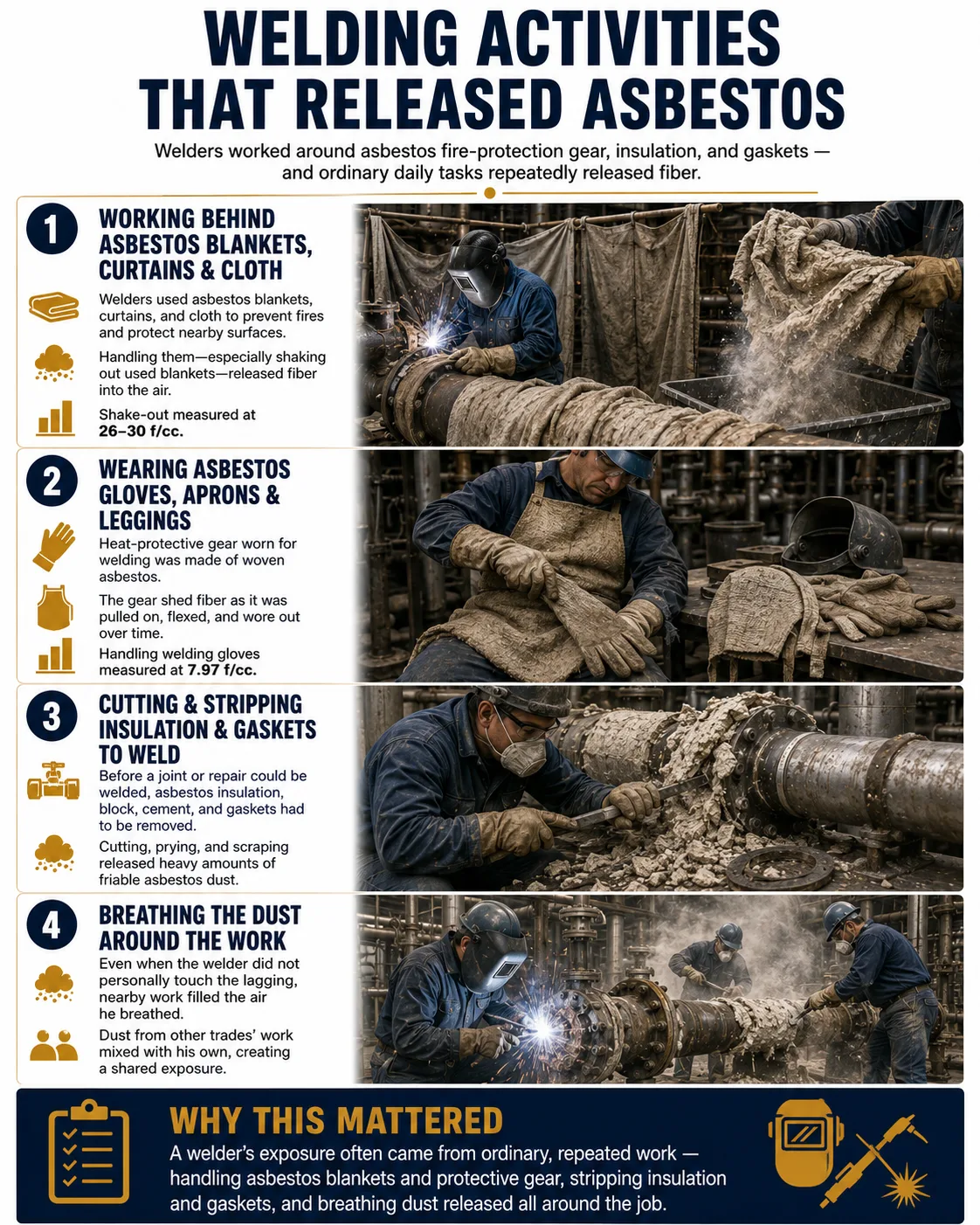
The exposure came from the ordinary, repeated motions of the trade, not from anything unusual:
- Working behind asbestos blankets, curtains, and cloth. To keep sparks and molten slag from starting fires, welders draped asbestos welding blankets over equipment, hung asbestos curtains around the work, and laid asbestos cloth across openings. Handling this material, and especially shaking the dust and burned debris out of a used blanket, put fiber straight into the breathing zone; that shake-out has been measured at 26 to 30 f/cc.
- Wearing asbestos gloves, aprons, and leggings. The gear that protected a welder from burns was itself woven from asbestos, and it shed fiber as it was pulled on, flexed, and worn out. Putting on and handling asbestos welding gloves has been measured at 7.97 f/cc.
- Cutting and stripping insulation and gaskets to weld. Before a joint or a repair could be welded, the asbestos pipe covering, block, cement, and gaskets had to come off to expose clean metal, and welders did that stripping themselves on countless jobs. Tearing out that old, friable (crumbly and dusty) material released heavy dust right where they worked.
- Breathing the dust around the work. Even when a welder touched none of the lagging, the insulators and pipefitters working the same lines a few feet away filled the air he breathed. The exposure reached him from two directions at once.
Two things multiplied all of this. The work happened in the worst possible places for dust: the insides of tanks, boilers, and ship compartments, pits, vessels, and the space behind hung asbestos curtains, where there was little ventilation and the fiber hung in the air and was rebreathed rather than carried away. And it happened over and over for an entire working life. A career welder hung blankets, pulled on gloves, and stripped insulation and gaskets thousands of times across thirty or forty years, and tearing out old, degraded material released far more fiber than new work did.
Through all of it, the men doing the work were given no warning and no protection. They blew slag and dust off with compressed air, worked in dusty leathers and asbestos gear, and went home in dusty clothes to their families, while the companies that made the products and ran the plants knew what the dust was doing.
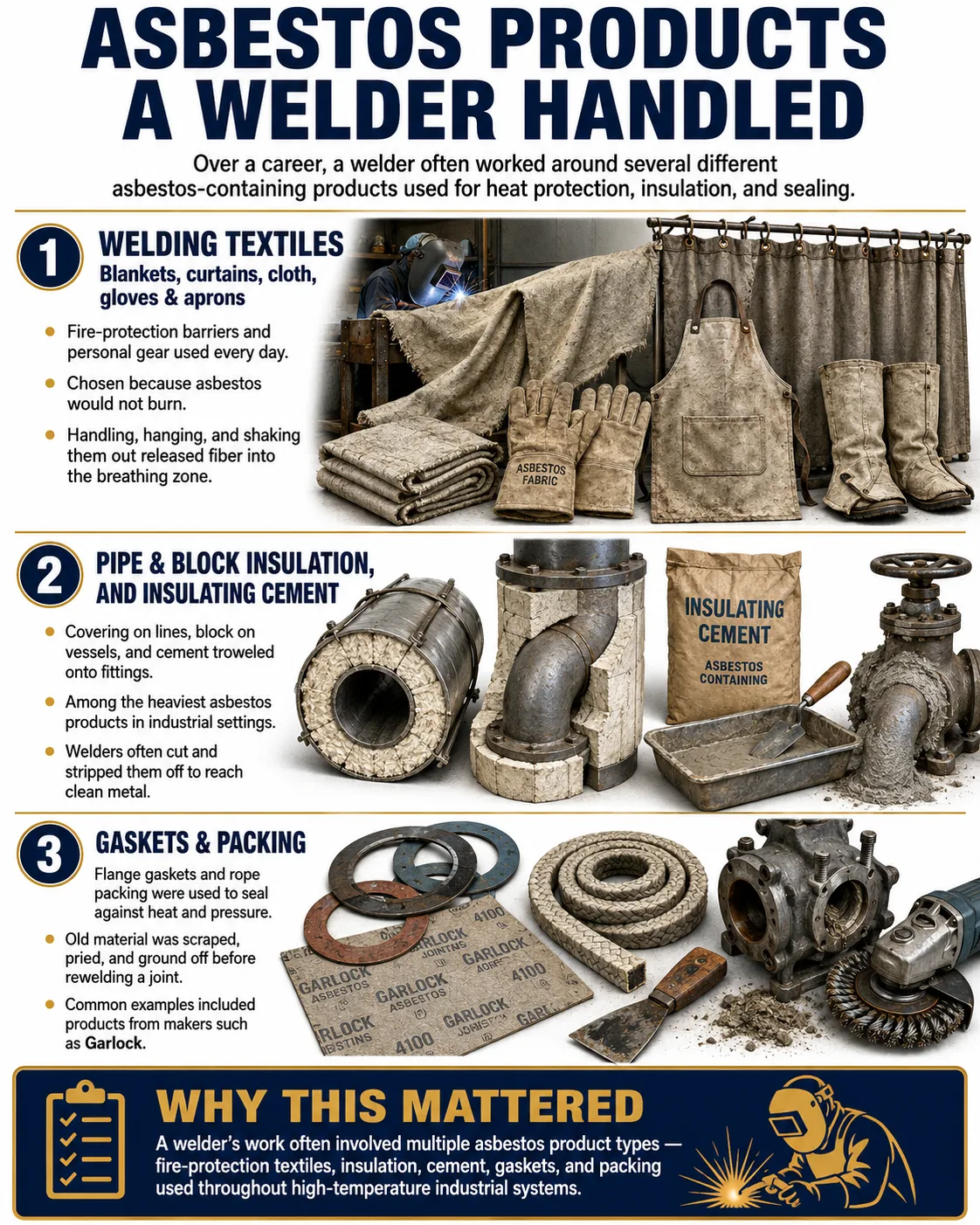
The asbestos products a welder handled, and why they add up to more than one claim
Over a career, a welder handled several different asbestos products, each made by a different set of companies, and that combination is what shapes the claim. Understanding the products is how we identify who's responsible and which claims you can bring.
Welding textiles: blankets, curtains, cloth, gloves, and aprons. The fire-protection barriers and the personal gear the trade used every day were asbestos, chosen because the fiber would not burn. Handling, hanging, and shaking them out released fiber directly into the breathing zone. The makers behind these products include companies now covered by bankruptcy trusts, such as Raybestos-Manhattan (Raymark), alongside still-solvent manufacturers you can sue directly. See how asbestos textiles caused exposure.
Pipe and block insulation, and insulating cement. The covering on the lines, the block on the vessels, and the cement troweled onto fittings were the heaviest asbestos products in the building, and the welder cut and stripped them off to reach clean metal. These trace back to the largest names in the industry, including Johns-Manville and Owens-Corning/Fibreboard, most of which now pay through trusts. See how asbestos pipe and block insulation caused exposure.
Gaskets and packing. The gaskets a welder scraped and ground off a flange before rewelding a joint were asbestos, built to hold against heat and pressure. The makers include companies now covered by trusts, such as Garlock, alongside solvent manufacturers. See how asbestos gaskets and packing caused exposure.
This is why a welder's case is rarely a single claim. Because the work touched welding textiles, insulation, cement, and gaskets from many different manufacturers, the typical recovery runs against several bankruptcy trusts at once, plus lawsuits against the manufacturers still in business and the yard or plant owners who controlled the worksite. You don't need to remember which company made the blanket you shook out in 1974 or the covering you stripped in 1981. Give us the work history, and we trace each product back to its maker, and each maker to its trust or its place in a lawsuit.
Where you worked, and why the setting still matters
A welder carried the exposure with him, so the job put him at risk in almost any setting. Where he worked still matters to the case, though, because it decides which plant or yard owners can be held responsible as premises defendants, and whether federal benefit programs come into play on top of the trust and lawsuit claims.
A few settings account for much of the heaviest welder exposure:
- Shipyards and the Navy. Welders and shipfitter-welders built and repaired ships in compartments packed with asbestos insulation, gaskets, and welding textiles, in tight, unventilated spaces. Civilian shipyard work can open Longshore benefits under the LHWCA (the Longshore and Harbor Workers' Compensation Act), and Navy service can open VA disability claims, both alongside the civil case. Shipyard and maritime asbestos exposure.
- Iron and steel mills. Structural and maintenance welders worked among furnaces, boilers, and process lines wrapped in asbestos, with the mill owners reachable as premises defendants. Iron and steel industry asbestos exposure.
- Refineries and petrochemical plants. Pipe and structural welding on high-temperature process systems meant constant work alongside asbestos insulation and gaskets, with the major oil companies reachable as premises owners. Petrochemical and refinery asbestos exposure.
- Power plants and utilities. Welding repairs on boilers, turbines, and steam lines put welders among the most heavily insulated equipment anywhere. Utility and power generation asbestos exposure.
- Commercial and industrial construction. Structural and mechanical welding built the steel and the systems in plants, towers, hospitals, and schools, in the same spaces as insulators and other trades. Construction industry asbestos exposure.
If your loved one worked at a federal facility, a shipyard, or in the military, tell us. Those settings often add benefit channels that run in parallel with everything else.
What the asbestos industry's own magazine said about welders
The trade journal Asbestos wrote for the companies that mined asbestos and made it into products. Welding was one of its markets. For sixty years its pages described the asbestos a welder worked with: the paper, blankets, curtains and gloves around him, and the coating on the rod in his hand.
Asbestos paper, blankets and curtains
In 1920 a writer from the Davis-Bournonville Company, a welding equipment maker, explained that asbestos paper was "furnished to the oxy-acetylene trade in rolled sheets," and that "the welder can pull off as much of the asbestos as is required." (Asbestos, May 1920). He also wrote that heated asbestos paper "crumbles into small fragments," and told welders to keep the debris in a box for annealing, not throw it away (Asbestos, May 1920). The welder "who knows his business," he said, wrapped an armature in "several thicknesses of sheet asbestos" before repairing its shaft. Torch cutters used asbestos sheets to shield their legs and feet from sparks (Asbestos, May 1920).
In 1926 an electrical engineer described plant repairs in which "Asbestos brick was broken up and the fibre packed around the openings" before welding. He called such uses "typical of the welding operations necessary in all industrial plants" (Asbestos, Jan. 1926, continued).
Asbestos also closed in the welder's work space. In 1929 one plant replaced the burning canvas around its electric welder with an asbestos curtain "about seven feet high" (Asbestos, Dec. 1929). Aircraft builders used "an asbestos blanket" to protect a plane's fabric during welding (Asbestos, July 1930). In 1940 the editors noted that asbestos paper was also laid over finished welds so they would "cool slowly" (Asbestos, Dec. 1940).
The makers advertised these uses for decades. Raybestos-Manhattan listed "curtains in welding operations" in 1945 (Asbestos, Feb. 1945) and "welders' booths" in 1947 (Asbestos, July 1947). The Census Bureau counted "Welders' blankets" among asbestos exports in 1946 (Asbestos, June 1946). In 1975 Southern Asbestos Company still sold "fiery orange Weldgard for asbestos welding curtains and welder safety garments" (Asbestos, Sept. 1975).
Gloves, aprons and clothing
The 1920 article called "the asbestos glove" the safest protection for the hands in heavy welding (Asbestos, May 1920). In 1921 the magazine reported that "aprons, masks, leggins and gloves" were made "for welders and moulders" (Asbestos, Sept. 1921). In 1938 it said "asbestos gloves are worn by the men doing some arc welding operations" (Asbestos, May 1938).
Asbestos on the welding rod
Asbestos was also part of the welding rod itself. A 1922 article described an electrode bound in "an envelope of blue Asbestos" (Asbestos, Mar. 1922). The covering melted into a slag over the weld, and "the Asbestos slag is brittle," to be knocked off "by a hammer blow" (Asbestos, Mar. 1922). Cape Asbestos advertised blue asbestos for "Electrode Wrappings for Arc Welding" (Asbestos, Feb. 1933) and as "the ideal flux for electric arc Welding" (Asbestos, Jan. 1935). The Quasi-Arc Company's chief product was a steel rod "covered with blue asbestos yarn" (Asbestos, Jan. 1937).
Later accounts named anthophyllite, another type of asbestos. In 1943 a North Carolina mine had shipped "large quantities" of it "for use in welding rod coatings" (Asbestos, Sept. 1943). A 1950 article gave a typical coating as "10 parts asbestos," though it called the tonnage small (Asbestos, Sept. 1950). A 1959 article said that in welding rod coatings anthophyllite "takes precedence over all other fibres" (Asbestos, Oct. 1959).
Welding on insulated pipe
The magazine also tied welding to insulated steam lines. In 1935 it said a prefabricated underground steam main, which could be insulated with "Asbestos Dry-paC," could be installed "mainly with unskilled labor and welder" (Asbestos, Nov. 1935). In 1941 the same maker's welded conduit joints were "wrapped tightly with an asbestos felt jacket" (Asbestos, Feb. 1941).
Dust, and the masks that came later
The 1920 writer said asbestos paper "gives off no obnoxious or injurious fumes and is cleanly" (Asbestos, May 1920). Among the welding pages we read, the first to mention dust from asbestos cloth is from 1970. That year Turner Brothers advertised new asbestos cloths, including cloth for "welding screens," that it said showed "at least a five-fold reduction in dust emission when compared with other cloths made of asbestos" (Asbestos, Feb. 1970). By 1979 and 1980 the magazine was listing respirators made for welders and approved against dusts "(including asbestos)" (Asbestos, May 1979; Asbestos, Oct. 1980).
How a welder's case can come together
The following is a composite example, not a real client, but it reflects how these cases typically come together in our experience.
Gary spent thirty-two years as a welder. He started in a shipyard, moved into structural and field work, and spent his last stretch as a pipe welder in refineries and a power plant. The work followed him wherever he went: he hung asbestos welding blankets and curtains to contain his sparks, pulled on asbestos gloves shift after shift, and cut and stripped the old insulation and gaskets off the lines and vessels before he could lay a bead on clean metal. Much of it was inside tanks, ship compartments, and boiler rooms where the dust had nowhere to go. In early 2026, after months of breathlessness and chest pain he'd blamed on age and old injuries, a biopsy confirmed pleural mesothelioma of the epithelioid type.
For Gary's family, the case moves on several tracks at once, which is typical for the trade. Trust claims go in against the makers of the welding textiles, insulation, and gaskets he handled across his career, several different companies and several different trusts. Lawsuits go against the manufacturers still in business and against the shipyard, refinery, and utility that owned the premises where he worked. Because pleural mesothelioma is treated with surgery, chemotherapy, immunotherapy, and radiation at only a limited number of specialized centers, getting Gary to the right one may mean travel, and the firm advances the cost of travel and lodging when the best center isn't close to home. How legal recovery funds mesothelioma treatment access. Gary's wife, who shook out and laundered his work clothes for three decades, is eligible for free asbestos health screening as part of the representation. The screening is a chest X-ray read by a B-reader, with a CT scan if needed; it looks for asbestos-related changes in the lungs and isn't a diagnosis or a reliable way to find mesothelioma early.
This example is general. Every case depends on the diagnosis, the exposure history, the dates, the defendants, the applicable law, and the available evidence.
Sources of compensation for welders
A welder's recovery usually comes from more than one place, and the different channels run in parallel without canceling one another out. We file across all of them that apply.
- Asbestos bankruptcy trusts. The companies that made the welding textiles, insulation, and gaskets he handled and later went bankrupt set aside money in trusts to pay the people they harmed. These are paper claims that don't require a lawsuit or a courtroom, and a single career often supports filings against several trusts at once. How asbestos trust claims work.
- Lawsuits against solvent manufacturers. Many asbestos product makers are still in business and can be sued directly for making and selling a product they knew was dangerous. How product liability lawsuits work.
- Premises liability against the site owners. The shipyards, mills, refineries, and plants that controlled the worksites can be held responsible for the conditions they allowed, separate from the companies that made the products. How premises liability claims work.
- Federal and disability benefits. These depend on where and how the work was done, and they're paid in addition to the trust and lawsuit recovery. Military (and especially Navy) service can support VA disability benefits; civilian shipyard work can support Longshore (LHWCA) benefits; civilian work at a federal facility can support FECA benefits under the Federal Employees' Compensation Act; and Social Security disability is available to anyone whose illness stops them from working. How asbestos disability and benefit claims work.
Mentioned on this site
- A-Best Asbestos Trust Claims
- Acetylene Cylinder Reinforcement
- American Journal of Epidemiology
- American Journal of Industrial Medicine
- American Journal of Respiratory and Critical Care Medicine
- Archives of Environmental Health
- Asbestos Exposure by Occupation
- Asbestos Exposure in Aerospace and Aviation
- Asbestos Millboard
- Asbestos Textiles
- Asbestos Textiles
- British Journal of Industrial Medicine
- Canadian Journal of Public Health = Revue Canadienne de Santé Publique
- Comparative Studies on Asbestos
- Environmental Research
- Industrial Health
- International Journal of Occupational and Environmental Health
- Journal of Occupational and Environmental Medicine
- Journal of Occupational Medicine.
- Journal of Toxicology and Environmental Health. Part a
- Journal of Toxicology and Environmental Health. Part B, Critical Reviews
- Liberty Ship
- Lois Gaul's Johns-Manville Memo on the Rhode Island Medical Journal (1983)
- Multicenter Studies on Asbestos
- Newport News Shipbuilding
- Occupational and Environmental Medicine
- Puerto Rico Safety Equipment Corp.
- Reading Castleman, Chapter 5
- Research on Ships and Shipyards
- Research on Welding
- Respiratory Medicine Case Reports
- Respirology Case Reports
- Safety and Health at Work
- Scandinavian Journal of Work, Environment & Health
- Shipyard Exposure
- Spinnability
- Stress Corrosion Cracking
- Systematic Reviews and Meta-Analyses on Asbestos
- The American Journal of Medicine
- The American Journal of Surgical Pathology
- The American Review of Respiratory Disease
- The Annals of Occupational Hygiene
- The Science of the Total Environment
- Ultrastructural Pathology
- Videotaped Deposition of Clifford L. Sheckler (1982)
- Welding Rod Coating
- Woven Heat-Protective Mittens
In the research library
The National Library of Medicine indexes 38 studies in our medical research library under welding. Among the most cited:
- A historical prospective study of European stainless steel, mild steel, and shipyard weldersL. Simonato, A.C. Fletcher, A. Andersen, et al, 1991 · British Journal of Industrial Medicine · cited 93 times
- A meta-analysis of epidemiologic studies of lung cancer in weldersJ.J. Moulin, 1997 · Scandinavian Journal of Work, Environment & Health · cited 69 times
- A mortality study among mild steel and stainless steel weldersJ.J. Moulin, P. Wild, J.M. Haguenoer, et al, 1993 · British Journal of Industrial Medicine · cited 66 times
- Exposure to stainless steel welding fumes and lung cancer: a meta-analysisB. Sjögren, K.S. Hansen, H. Kjuus, et al, 1994 · Occupational and Environmental Medicine · cited 61 times
- Risk of lung cancer according to mild steel and stainless steel weldingA.R. Sørensen, A.M. Thulstrup, J. Hansen, et al, 2007 · Scandinavian Journal of Work, Environment & Health · cited 58 times
In our case-law library
84 court decisions in our case-law library involve welders. Among them:
- Chevron Oronite Company, LLC v. Jacobs Field Services North America, IncorporatedU.S. Court of Appeals, Fifth Circuit, 2020 · Welder at Chevron refinery, Belle Chasse, 1989-1994
- Bostic v. Georgia-Pacific Corp.Texas Supreme Court, 2014 · Welder's helper at Palestine Contractors, 1977-1978
- Pounders v. Enserch E & C, Inc.Arizona Supreme Court, 2013 · Welder at Four Corners Power Plant, 1969-1974 and 1979-1983
- Gallagher v. National Grid Usa/narragansett Electric.Rhode Island Supreme Court, 2012 · Welder at Electric Boat, Groton, 1965-1971
- Martin v. Cincinnati Gas and Electric CompanyU.S. Court of Appeals, Sixth Circuit, 2009 · Welder and mechanic on ship engines at Valley Line Company, 1979-1984
- Owens-Illinois, Inc. v. ArmstrongMaryland Court of Appeals, 1992 · Laborer and later welder on engines and in boiler rooms of ships at Bethlehem Steel Corporation shipyards, 1942-1963
The defenses companies raise, and how we answer them
When a welder's case goes to court, the manufacturers raise the same handful of defenses they raise in most asbestos cases, and none of them is new to us. The short version is that the arguments describe a cleaner, smaller version of the job than the one your loved one actually did, and the evidence answers them. The detail is below for anyone who wants it.
All of this applies only to the lawsuit side of a case. The trust claims are a paper process: no opposing lawyer raises defenses, no one is deposed, and no one goes to court.
How we answer the defenses raised in welder cases
"Welders weren't exposed to asbestos." This is the argument we hear most, and it's wrong on the facts. The blankets, curtains, cloth, gloves, and aprons that protected welders from their own sparks and heat were woven from asbestos, and they shed fiber when they were handled, hung, shaken out, and worn down. On top of that, welders routinely cut and stripped asbestos insulation and gaskets off equipment to reach clean metal, and worked in the dust of the insulators and fitters around them. The industrial hygiene testing that recorded high fiber levels recorded them during exactly this work.
"The exposure to any one company's product was too small to matter, and it was only chrysotile anyway." These cases are built on documented exposure: the specific high-dust tasks the trade performed and the dose built up across a full career, which is what separates a welder's claim from a trivial one. The bankruptcy trusts pay on brief exposure, and in court we prove a meaningful contribution with that task and career evidence. As for fiber type, Chrysotile - White Asbestos the Most Common Type is a recognized cause of mesothelioma, the commercial chrysotile of that era was contaminated with amphibole fibers (a more hazardous fiber type), and much of the insulation a welder disturbed contained amphibole outright.
"You can't prove whose product caused the disease." You don't have to carry that burden alone. We reconstruct the products and the work history from our exposure database, the trust documentation for each manufacturer, purchase and specification records, and the recollections of coworkers. The trusts don't require pinpointing a single brand, and in a lawsuit we trace each product back to its maker and each maker to its place in the case.
Frequently asked questions
I don't remember the product brands or have my old records. Can I still file?
Yes, and most people are in exactly that position. You don't need brand names, pay stubs, or union cards in hand to start. We reconstruct the work history and the products from our exposure database, the trust documentation for each manufacturer, purchase and specification records, and the recollections of coworkers, and union and pension records often fill in the dates and worksites. The conversation starts with what you remember.
My loved one has already passed away. Can we still bring a claim?
Yes. Families regularly file after a death, both trust claims and, depending on the state, a wrongful death lawsuit. These deadlines vary by state and some are short, and the family's claim can depend on whether a claim was preserved during the worker's life, so it's best to call promptly. We handle wrongful death and estate claims as a matter of routine.
My father welded at several different places over his career. Does that complicate the case?
It usually strengthens it. A welder who moved among shipyards, mills, refineries, powerhouses, and construction sites was exposed to more products, made by more companies, at more premises, which means more trusts and more potential defendants. We reconstruct the full career and file across every documented worksite.
Could my family have been exposed through the work clothes?
Yes, and it's common. The dust that settled on a welder's clothes, hair, and gear came home with him, and spouses who shook out and laundered work clothes and children who hugged a parent at the end of a shift were exposed too. That's why our representation includes free asbestos health screening for family members, and if a family member is later diagnosed, they may have a claim of their own.
What happens when I call?
A member of our litigation team, not a screener, takes the call, and the first conversation usually runs twenty to thirty minutes. We listen to the work history, explain which claims and channels may apply, and lay out the timeline for your situation. No one is pressured to sign anything on that call.
What does it cost to work with you?
Nothing up front, and nothing at all unless we recover for you. We work on a contingency fee, which means our fee comes only out of what we recover, and the case review and consultation are free.
Do we have to travel to your office?
No. We handle these cases by phone, video, and mail, and we come to you when an in-person visit helps. Families work with us from every state without traveling to us.
Talk with an asbestos lawyer about welder exposure
Whether you're a worker who was just diagnosed, or a spouse or adult child trying to find help for someone who is sick or who has passed, we're ready to talk. You don't need the product names, you don't need the old records, and you don't need to travel to us. Start with what you remember, and we'll take it from there.
Related resources
Sources and references
The exposure measurements on this page come from published industrial hygiene testing, cited in full on the product page where each figure lives:
- The 26–30 f/cc welding-blanket shake-out measurement is documented on our asbestos textiles page.
- The 7.97 f/cc welding-gloves measurement is documented on our asbestos textiles page.
Other authorities relied on:
- Occupational exposure limits. OSHA's asbestos standard sets the current permissible exposure limit at 0.1 f/cc averaged over eight hours, with a short-term excursion limit of 1.0 f/cc over thirty minutes. 29 C.F.R. § 1910.1001.
- Carcinogenicity. The International Agency for Research on Cancer classifies all forms of asbestos, including chrysotile, as carcinogenic to humans (Group 1) and recognizes no safe threshold of exposure for mesothelioma. IARC Monographs, Vol. 100C.
This page is provided for general informational purposes and does not constitute legal advice. Every asbestos case turns on its own facts, exposure history, diagnosis, deadlines, available evidence, and applicable law. Reviewing this page does not create an attorney-client relationship. For advice about your specific situation, call 833-4-ASBESTOS for a free case review.