

If you built, maintained, or overhauled aircraft — or if someone in your family did — and a mesothelioma, lung cancer, asbestosis, or other asbestos diagnosis has now come in, this page is the place to start. The same dust reached the spouses and children who washed the work clothes, and it didn't matter whether the worker was on a factory floor, a flight line, or an engine bench, because for most of the twentieth century flight ran on asbestos. Asbestos was in aircraft engines and brakes by the 1930s, in the German rockets that opened the space age, in the airliners of the jet age, and in the spacecraft that carried astronauts to the moon.
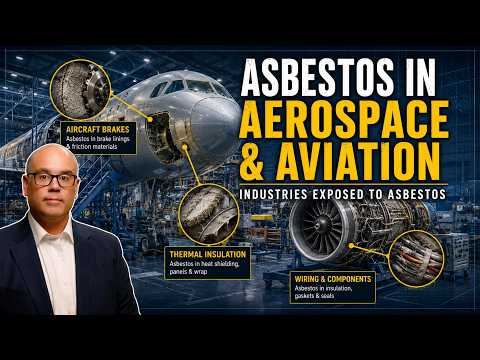
The parts that had to survive heat and fire were made of asbestos, and the aircraft companies specified it that way. When engine makers and airframe builders have been made to account for it in court, their own sworn records show the picture: engine gaskets and packing specified at 25 to 90 percent asbestos by weight, one military gasket specification that required at least 70 percent asbestos, chrysotile (white asbestos) in the clamps, cloth, brakes, and seals, and amosite (brown asbestos, a more hazardous fiber type) in the hot sections of the engines.
Working that material released fiber into the shared air of the hangar and the engine bench, an engine mechanic grinding an old gasket off a case a few feet from a mechanic cutting engine insulation, and none of it stayed with the man who made it. Asbestos fibers hang in the air for hours and drift, so the worker at the next bench breathed it too, and even twenty feet from active work the air put roughly a month of ordinary city background through the lungs in a quarter hour. The chart below shows fifteen minutes of two of those jobs against a year of ordinary city air.
What these numbers mean. Asbestos in air is measured in fibers per cubic centimeter (f/cc), a unit that hides how dangerous a task was. Across this site we translate each measurement into fibers breathed, feet of fiber end to end, and years of ordinary city air, using conservative, government-sourced assumptions. See how we measure asbestos in air for the method and its limits.
You don't need to remember which company made the gasket or the brake, and you don't need old job records in hand. If you can say "I was an aircraft mechanic for the airline" or "my husband built engines at the plant," we have a starting point.

You don't need the product names or old records. No fee unless we recover compensation for your family.
Quick answers
| Did aircraft work really expose me to asbestos? | Almost certainly, for any career between the 1930's and the 1980s. The engine gaskets and packing, the brakes, the firewall and duct insulation, the heat shields, and the electrical wiring were all made with asbestos, and building, maintaining, and overhauling aircraft meant cutting, grinding, and handling all of it. |
|---|---|
| I worked manufacturing, not maintenance. Was I still exposed? | Yes. Assembly and fabrication workers cut and fit asbestos gaskets, laminates, insulation, and wiring on the line, and the machining and cutting released fiber right at the bench. The exposure wasn't limited to the mechanics who serviced the aircraft later. |
| I was in the military, not a civilian job. Am I in the right place? | You may want our military and veterans page, which covers service exposure and VA benefits. But start here if you also did civilian aircraft work, at an airline, a manufacturer, or a contractor overhaul base, because the products and the claims against their makers are the same. |
| I worked on planes that are still flying. Is that still a concern? | It can be. Older aircraft and engines still contain legacy asbestos parts, and cutting into aged gaskets, brakes, and insulation can still release fiber. If you're doing this work now, document your history, and know that if you're ever diagnosed, the filing clock runs from the diagnosis. |
| How long do I have to file? | It depends on your state and on whether this is a personal-injury or a wrongful-death situation, and some of those deadlines are short. The safest step is to call as soon as possible after diagnosis so the clock doesn't run out. |
| Do I have to file a lawsuit? | No. Many aerospace workers and their families recover through trust claims and benefits without ever filing a lawsuit. Trust claims are paper claims, not courtroom cases. We explain both paths and respect your decision. |
| Can a spouse or adult child call for the worker? | Yes. Most of our first calls come from a wife or an adult child researching for someone who is sick or who has passed. You don't need a power of attorney to ask questions. |
“I started this firm after learning that the cancers that killed my father and grandparents were caused by asbestos, something we did not realize until it was too late to hold anyone accountable. That experience is why we built this site: so that no other family misses their chance to ask the questions, hear the options, and decide for themselves what to do.”
Why flight ran on asbestos
Aircraft work put workers in contact with asbestos for a reason the industry had to design around: an aircraft engine is a controlled fire, and the parts nearest that fire had to hold heat, seal pressure, and resist flame without failing at altitude. For most of the twentieth century, asbestos was the material that did all three at once, so it went into the parts that mattered most, and the companies specified it deliberately, by name and by percentage.
We know this in unusual detail, because when aircraft and engine makers have had to account for their materials in litigation, they've produced their own parts lists under oath. Those sworn records show engine gaskets specified at 85 to 90 percent asbestos, packing and preformed seals from 25 to 80 percent, wire-reinforced asbestos loop clamps holding the wiring harnesses, asbestos thermocouple cable, and asbestos in the adhesives and heat-shield blankets, the blankets rated to withstand temperatures up to 2,000 degrees. Military aircraft ran on the same materials under government specifications; one specification for engine gaskets required the material to be at least 70 percent asbestos by weight. Most of it was chrysotile (white asbestos), used in the clamps, cloth, seals, brakes, and gaskets, with amosite (brown asbestos, a more hazardous fiber type) concentrated in the hottest sections of the engines, the exhaust and turbine areas where the heat was worst.
Because these were parts built to detailed specifications, often the government's, the choice to use asbestos wasn't the worker's and usually wasn't even the local plant's; it was written into the drawings. That matters later, when the companies argue they were only building what they were told to build. And the work of building and maintaining those parts is what put the fiber in the air: gaskets and packing were cut and fit on assembly and scraped and ground off at overhaul, brakes were ground and blown out, insulation blankets and duct lagging were cut to fit, and asbestos-insulated wiring was stripped and handled throughout the airframe. The men and women did that work bare-faced, cleaned up with compressed air, and went home in dusty clothes to their families, while the companies that made and specified the products knew what the dust was doing.
Where the asbestos was, from the factory floor to the overhaul base
An aerospace worker's exposure depended on where in the industry the work was done, from original manufacturing through a lifetime of maintenance. Here's the tour.
- Airframe fabrication and assembly. On the factory floor, workers cut and fit asbestos gaskets, seals, and insulation into the airframe, laid up and machined asbestos-reinforced laminates and phenolic composites for structural parts, and installed asbestos-insulated wiring throughout. Cutting and machining these materials at the bench released fiber right into the breathing zone.
- The engine and powerplant. The densest exposure in the industry. Aircraft engines were sealed with asbestos gaskets and packing at 85 to 90 percent asbestos, insulated with asbestos blankets and shields in their hot sections, and wrapped in asbestos-insulated wiring and thermocouple cable. Engine builders and mechanics cut and fit this material new, and scraped, ground, and tore it out at every overhaul. Grinding an old gasket off an engine case has been measured at 28.4 f/cc, and cutting the insulation at 51.7 f/cc. See how asbestos gaskets and packing caused exposure, and how asbestos pipe and block insulation caused exposure.
- Brakes and landing gear. Aircraft brakes used asbestos linings, patented and sold to essentially every airframe builder, and servicing them meant grinding, machining, and blowing out brake dust, the same friction-product exposure found in any brake work. See how asbestos brake and friction products caused exposure.
- Electrical and avionics systems. Aircraft wiring was insulated with asbestos to resist heat and fire, and the panels, boards, and heat shields around the electrical systems carried more. Electricians and avionics workers cut, stripped, and fit this material throughout the aircraft.
- Maintenance and overhaul. The dustiest phase, and the one that never ended. Line maintenance, heavy checks, and depot overhauls meant tearing worn asbestos parts out of aircraft that had been flying for years, gaskets baked hard onto engine cases, glazed brake linings, degraded insulation, and replacing them, over and over, across a fleet's service life. This is where a career mechanic's dose was built.
Two things multiplied all of it. Much of the work happened in enclosed spaces, engine test cells, hangars, and the tight interiors of the aircraft themselves, where the fiber concentrated, and it repeated for a career: a mechanic or engine builder cut, ground, and tore out these same parts over and over across thirty or forty years.

Who can be held responsible in an aviation or aerospace case
A worker's exposure usually traces back to more than one company, and the case is built from several of them at once. Aircraft and engines passed through many hands, the makers who built and specified the parts, the companies that operated and overhauled the fleets, and the makers of the individual asbestos products, so the responsibility is rarely one company's alone.
- The aircraft and engine manufacturers. The airframe builders and engine makers designed asbestos into their products and, in many cases, built the aircraft where the exposure happened. They can be reachable both as the makers of asbestos-containing equipment and, for their own factory workforces, as the operators of the plants where the work was done. Many of these companies have merged and been absorbed over the decades, and a successor company often carries the older liabilities; part of what we do is trace which company answers for a given aircraft, engine, and era.
- The airlines and overhaul bases. The airlines and the independent maintenance and overhaul companies that serviced the fleets controlled the hangars, shops, and flight lines where mechanics worked, and can be answerable as premises for the conditions they allowed.
- The makers of the asbestos products. Separate from the aircraft companies, the companies that made the gaskets, packing, brakes, insulation, and wiring can be reached on their own. Many are now bankrupt and pay through asbestos trusts, which are paper claims requiring no lawsuit; some are still in business and can be sued directly. The makers behind each product, and which of their trusts pay today, are laid out on the product pages. See how asbestos gaskets and packing caused exposure, and how asbestos brake and friction products caused exposure.
- Federal and disability benefits. These depend on where and how the work was done, and they're paid in addition to any lawsuit or trust recovery. Civilian work at a federal aviation facility can support FECA (the Federal Employees' Compensation Act, the federal workers' compensation system) benefits, and Social Security disability is available to anyone whose illness stops them from working. How asbestos disability and benefit claims work.
One argument comes up often enough in aerospace cases to name here: because so many aircraft parts were built to detailed customer or government specifications, the manufacturers sometimes argue they were only building what they were told to build. It's a real defense in some cases and not in others, and it's one we know how to meet; there's more on it below.
If the work was military service
A large share of aviation asbestos exposure happened in uniform, on the flight lines, in the engine shops, and aboard the carriers of the armed forces. That service exposure runs through a different set of channels, including VA disability benefits, and we cover it separately. Military and veterans asbestos exposure.
What the asbestos trade press said about aircraft and rockets
For sixty years the asbestos industry's own trade journal, Asbestos, and Johns-Manville's employee magazine reported where asbestos went in airplanes, jets, missiles and spacecraft. They wrote it to sell product. Today those pages help families see what was in the engines, firewalls and heat shields their loved ones built and serviced.
The early airplanes. In 1921 the magazine listed metallic asbestos gaskets on gasoline motors "for auto, truck, tractor, airplane, or marine service" (Asbestos, Nov. 1921). By 1930 it reported that the Boeing Mail plane type 95 had its cockpit "heated and lined with asbestos," and that spark plug gaskets on the airplane motor were "of course, composed of asbestos" (Asbestos, July 1930; Asbestos, July 1930). In 1929 it noted that larger planes now used brake lining and predicted all new planes would (Asbestos, Aug. 1929). In 1931 it described aviation mechanics warming motors in winter with stove pipes wrapped in asbestos paper (Asbestos, June 1931).
The war years. General Electric's 1940 "deltabeston" aircraft wire was insulated with "a layer of felted asbestos" (Asbestos, Dec. 1940). The Langley plastic-plywood plane's engine cowling was "lined with asbestos cloth" (Asbestos, Jan. 1942). A Fiberglas-and-asbestos fabric boot guarded the tail wheel well of the P-47 Thunderbolt, two feet from the supercharger exhaust, and was installed on almost all of the more than 15,000 P-47s Republic built (Asbestos, Dec. 1945).
Jets. In 1947 Johns-Manville introduced Thermoflex, an "asbestos filled insulating blanket" for jet engine cones, turbine casings and tail pipes, that could be "laced around the engine cone in a few minutes" (Asbestos, Oct. 1947). A 1949 version was made by processing "amosite asbestos fibres into felts," for jet aircraft and guided missiles; its outer side took "most of the wear during inspection and servicing" (Asbestos, Mar. 1949; Asbestos, Mar. 1949). In 1959 J-M's "flexible asbestos firewall cloth" passed FAA fire tests; it sealed openings in aircraft firewalls, around control rods, conduit holes and powerplant controls (Asbestos, June 1959; Asbestos, June 1959).
Missiles and spacecraft. Asbestos was in rockets from the start: a 1932 Austrian mail rocket had a nozzle of "hardened" asbestos (Asbestos, July 1932), and a wrecked V-2's mixture line was "wrapped with asbestos insulation" (Asbestos, Jan. 1945). J-M described its Min-K missile insulation as made of "silica, asbestos" and other materials (Asbestos, Apr. 1958). Its Thermomat, an "asbestos felt saturated with a thermo-setting phenolic resin," came in slabs for "one-man lay-ups" (Asbestos, May 1960). A 1964 article said fabricators used asbestos-phenolic tape in rocket motor exit cones for Polaris and Minuteman, and that most re-entry heat shields were glass- or asbestos-phenolic (Asbestos, July 1964). The Titan II skirt that launched Gemini 4 was Raybestos-Manhattan's 41-RPD, "an asbestos felt impregnated with a specially developed phenolic resin," fabricated by Aerojet General in Azusa, California (Asbestos, Aug. 1965). For Apollo 11, Raybestos-Manhattan asbestos-metallic cloth shielded the Saturn booster engines (Asbestos, Sept. 1969).
The people who made it. At J-M's plant in Manville, N.J., the employee magazine photographed Anna Stryker, Lena Terzino and Pauline Fotta enclosing Min-K, "reinforced with asbestos fibre," in welded foil casings for space vehicle parts. It said the plant's workers had supplied "most of the major missile projects" and "commercial and military aircraft" (J-M News Pictorial, Apr. 1962).
| Site | Year reported | What the magazine says | Who did the work | Source |
|---|---|---|---|---|
| Curtiss-Wright Aeroplane Division plant, Kenmore, Buffalo, N.Y. | 1940 | 16 miles of K&M pipe and boiler insulation, including Featherweight 85% Magnesia | E. J. Eddy, Inc. | Asbestos, Nov. 1940 |
| General Electric rocket motor static test station, near Schenectady, N.Y. | 1947 | Asbestos gaskets on the camera box; 3/4-inch asbestos board shielding fuel valves | — | Asbestos, June 1947 |
| J-M Manville plant, Manville, N.J. | 1962 | Min-K enclosed in foil casings for Mercury and missile parts | Named J-M production workers | J-M News Pictorial, Apr. 1962 |
If your plant or aircraft isn't named here, that doesn't mean it was free of asbestos. These are only the ones the trade press happened to write about.
The trades that worked in aerospace
Aerospace employed many trades, and several of them have their own pages, because their exposure followed them across industries. If your loved one's work fits one of these better than it fits "aircraft worker," start there:
And for everyone else, the assembly and fabrication workers, the engine builders and testers, the sheet-metal and composite workers, the brake and landing-gear specialists, and the overhaul and depot crews, the work described above is the exposure story we build the claim on.
Mentioned on this site
- American Journal of Industrial Medicine
- Asbestos Brakes, Clutches, and Friction Materials
- Asbestos Exposure by Industry
- Asbestos Exposure in the Military
- Heat
- Johns-Manville
- Letters and Comments on Asbestos
- Men Demonstrating Hooded Fire-Proximity Suits
- Preliminary coating for combustion chamber wall (US Patent 2,811,467, 1957)
- Regulatory Toxicology and Pharmacology
- Royal Air Force
- Sound and Vibration Insulation for Aircraft Cabins (US Patent 2,263,919, 1941)
- Workmen Assembling Fire-Proximity Suit Hoods
In our case-law library
78 court decisions in our case-law library involve aerospace and aviation. Among them:
- Williams v. Boeing CompanyU.S. Court of Appeals, Fifth Circuit, 2022 · Mechanical engineer, primarily at a desk, drafting and computing at Michoud Assembly Facility, New Orleans, 1974-2008
- Dietrich v. Boeing CompanyU.S. Court of Appeals, Ninth Circuit, 2021 · Aircraft mechanic at Douglas Aircraft Company facility, Long Beach
- Williams v. Lockheed Martin CorporationU.S. Court of Appeals, Fifth Circuit, 2021 · Employee of Lockheed Martin at NASA-owned facility at Michoud Assembly Facility, 1974-1993
- Williams v. SeidenbachU.S. Court of Appeals, Fifth Circuit, 2021 · Mechanical engineer at NASA Michoud Assembly Facility, Building 350, New Orleans, 1974-1993
- Williams v. Taylor Seidenbach, IncorporatedU.S. Court of Appeals, Fifth Circuit, 2019 · Worker at a NASA facility at NASA facility
- Betzner v. Boeing Co.U.S. Court of Appeals, Seventh Circuit, 2018 · Involved in the assembly of Boeing B-1 and B-1B Lancer heavy bomber aircraft at Ling Temco Vought, Dallas, 1967 to 2015
Videos
The defenses companies raise, and how we answer them
When an aerospace case goes to court, the aircraft makers, the engine builders, and the product companies raise a familiar set of defenses, plus one or two specific to this industry, and none of them is new to us. The short version is that the arguments describe a cleaner, smaller version of the work than the one your loved one actually did, and the evidence answers them. The detail is below for anyone who wants it.
All of this applies only to the lawsuit side of a case. The trust claims are a paper process: no opposing lawyer raises defenses, no one is deposed, and no one goes to court.
How we answer the defenses raised in aerospace and aviation cases
"The government's specifications required the asbestos, so the manufacturer isn't responsible." This is the defense aerospace makers reach for most, because so many parts were built to detailed customer and military specifications. It's a real defense in some cases, but it's one the manufacturer has to earn, not just assert: it generally requires showing the government set the precise specifications, that the company met them, and that the company warned the government of the hazards it knew about. Where a maker knew its product's dangers and stayed silent, the defense weakens. And it does nothing to the claims against the other product makers or to the trust claims, which are a separate paper process.
"Aircraft brakes were made with a kind of asbestos that's safe." The brake makers argue that the heat of braking changed the asbestos into a harmless mineral, or that the chrysotile in brakes doesn't cause disease. The published science does not support treating brake work as safe, and grinding, machining, and blowing out asbestos brake linings put respirable fiber into the air the worker breathed. We put the established science on and answer this directly.
"The asbestos was sealed inside finished parts, so it stayed put." Not through the work that was actually done. Gaskets were scraped and ground off engine cases, packing was pulled from seals, brakes were machined and blown out, and insulation and laminates were cut and torn out at every overhaul. The fiber came loose during exactly that cutting, grinding, and removal work, which is what building and maintaining aircraft required.
"The exposure to any one company's product was too small to have made a difference." These cases are built on documented exposure: the specific high-dust tasks the work involved and the dose built up across a full career of assembly, maintenance, and overhaul. The bankruptcy trusts pay on brief exposure, and in court we prove a meaningful contribution with that task and career evidence, reconstructing which makers' parts were in a given aircraft and engine during specific years.
Frequently asked questions
The parts were built to government or company specifications. Does that mean no one can be held responsible?
No. The fact that a part was built to a specification doesn't erase the claim. Some manufacturers raise a government-contractor defense, but it has to be proven and it doesn't apply in every case, and it doesn't touch the claims against the many other companies whose products your loved one handled, or the trust claims, which are a separate paper process. The right way to find out what applies to your situation is to have someone look at the actual work history.
I worked building aircraft, not flying or fixing them. Can I still have a claim?
Yes. Assembly, fabrication, and engine-building workers cut and fit asbestos gaskets, insulation, laminates, and wiring on the line, and the machining and cutting released fiber right at the workbench. Manufacturing was among the heaviest aerospace exposures, not a lighter version of it.
I don't have my old employment or service records. Can I still file?
Yes, and most people are in that position. You don't need pay records, badge numbers, or a service file in hand to start. We reconstruct the work from our exposure database, the trust documentation for each product's maker, the manufacturers' own records of the asbestos parts they used, and the recollections of the worker and coworkers. The claim is built on the aircraft, the job, and the years, not on a perfect paper file.
My loved one has already passed away. Can we still bring a claim?
Yes. Families regularly file after a death, both trust claims and, depending on the state, a wrongful death lawsuit. These deadlines vary by state and some are short, and the family's claim can depend on whether a claim was preserved during the worker's life, so it's best to call promptly. We handle wrongful death and estate claims as a matter of routine.
He smoked. Does that ruin the case?
No. Mesothelioma isn't caused by smoking, so a smoking history doesn't touch a mesothelioma claim at all. For lung cancer, asbestos and smoking multiply each other's damage rather than canceling out, and aerospace workers who smoked and breathed asbestos may still have strong claims. Don't let a smoking history stop you from asking.
Could my family have been exposed through the work clothes?
Yes, and it's common. The dust that settled on an aircraft worker's clothes, hair, and boots came home, and spouses who shook out and laundered work clothes and children who hugged a parent after a shift were exposed too. That's why our representation includes free asbestos health screening for family members, and if a family member is later diagnosed, they may have a claim of their own. The screening is a chest X-ray read by a B-reader, with a CT scan if needed; it looks for asbestos-related changes in the lungs and isn't a diagnosis or a reliable way to find mesothelioma early.
What happens when I call?
A member of our litigation team, not a screener, takes the call, and the first conversation usually runs twenty to thirty minutes. We listen to the work history, explain which claims and channels may apply, and lay out the timeline for your situation. No one is pressured to sign anything on that call.
What does it cost to work with you?
Nothing up front, and nothing at all unless we recover for you. We work on a contingency fee, which means our fee comes only out of money we recover, and the case review and consultation are free.
Talk with an asbestos lawyer about aerospace and aviation exposure
Whether you're an aircraft worker who was just diagnosed, or a spouse or adult child trying to find help for someone who is sick or who has passed, we're ready to talk. You don't need the part names, you don't need the old records, and you don't need to travel to us. Start with the aircraft or engines you worked on, the job, and the years, and we'll take it from there.
Related resources
Sources and references
The exposure measurements on this page come from published industrial hygiene testing, cited in full on the product pages where each figure lives:
- The 28.4 f/cc gasket-removal measurement is documented on our asbestos gaskets and packing page.
- The 51.7 f/cc insulation measurement is documented on our asbestos pipe and block insulation page.
Other authorities relied on:
- Occupational exposure limits. OSHA's asbestos standard sets the current permissible exposure limit at 0.1 f/cc averaged over eight hours, with a short-term excursion limit of 1.0 f/cc over thirty minutes. 29 C.F.R. § 1910.1001.
- Carcinogenicity. The International Agency for Research on Cancer classifies all forms of asbestos as carcinogenic to humans (Group 1) and recognizes no safe threshold of exposure for mesothelioma. IARC Monographs, Vol. 100C.
- Manufacturer and specification records. The asbestos content of specific aircraft engine and airframe parts described on this page is drawn from aircraft and engine manufacturers' own interrogatory admissions and from military and aerospace material specifications, in our document archive.
This page is provided for general informational purposes and does not constitute legal advice. Every asbestos case turns on its own facts, exposure history, diagnosis, deadlines, available evidence, and applicable law. Reviewing this page does not create an attorney-client relationship. For advice about your specific situation, call 833-4-ASBESTOS for a free case review.