

For most of the twentieth century, the friction surfaces that stopped America's cars, trucks, buses, and trains were made of asbestos, and the mechanics who serviced them worked in the dust those materials shed. Blowing out a brake drum with compressed air, the most routine gesture in the trade, was measured at 43.8 fibers per cubic centimeter in EPA-commissioned testing, which in fifteen minutes puts roughly twelve years' worth of ordinary city background air through a mechanic's lungs1, and the friction industry was recording meaningful fiber releases in its own facilities while its trade literature told mechanics the dust was harmless. You don't need to remember which brand of lining you installed or dig up decades-old repair orders to find out whether you have a claim; if you did brake or clutch work, that's where we start.
Even ordinary city air carries a faint trace of asbestos everywhere, from natural mineral erosion and decades of industrial use, and that trace is the baseline both sides of the panel are measured against. The panel shows one well-documented measurement of the air-blow task; other studies measured the same task lower, and the honest study spread is laid out in the exposure table below.
What these numbers mean. Asbestos in air is measured in fibers per cubic centimeter (f/cc), a unit that hides how dangerous a task was. Across this site we translate each measurement into fibers breathed, feet of fiber end to end, and years of ordinary city air, using conservative, government-sourced assumptions. See how we measure asbestos in air for the method and its limits.
You don't need the product names or old records. No fee unless we recover compensation for your family.
Quick answers
| Did brake and clutch work really expose me? | If you did brake or clutch jobs before the industry moved away from asbestos, almost certainly. The linings, blocks, pads, and clutch facings were asbestos, and the dust from grinding, sanding, filing, and blowing out drums was asbestos dust. |
|---|---|
| I only did brake jobs part of the time. Does that count? | Yes. Brake work was a recurring part of general auto repair, gas station work, and fleet maintenance, and the claims process is built around real work histories, not full-time specialization. |
| I was a weekend or driveway mechanic. Do I have a claim? | Possibly. Home brake jobs used the same asbestos linings and raised the same dust, and hobbyist exposure has supported claims. It depends on the history, which is exactly what a free review sorts out. |
| How much exposure do I need for a claim? | For mesothelioma, less than you'd expect. The bankruptcy trusts that pay many of these claims are built to compensate documented exposure without demanding a lifetime in one trade, and in court we prove a meaningful contribution from the work you actually did. |
| Which companies made these products? | Bendix, Abex (American Brake Shoe), Wagner, Raybestos, Johns-Manville, and others. Some now pay through bankruptcy trusts; others, including Bendix's successor Honeywell, are still in business and can be sued directly. |
| Do I need to remember the brand of lining? | No. We reconstruct the products from your work history, the vehicles and shops you worked on, our exposure database, and the trust documentation. The brand names are our job, not yours. |
| Can a spouse or adult child call for the worker? | Yes. Most of our first calls come from a wife or an adult child. You don't need a power of attorney to ask questions. |
“I started this firm after learning that the cancers that killed my father and grandparents were caused by asbestos, something we did not realize until it was too late to hold anyone accountable. That experience is why we built this site: so that no other family misses their chance to ask the questions, hear the options, and decide for themselves what to do.”
What asbestos friction materials were
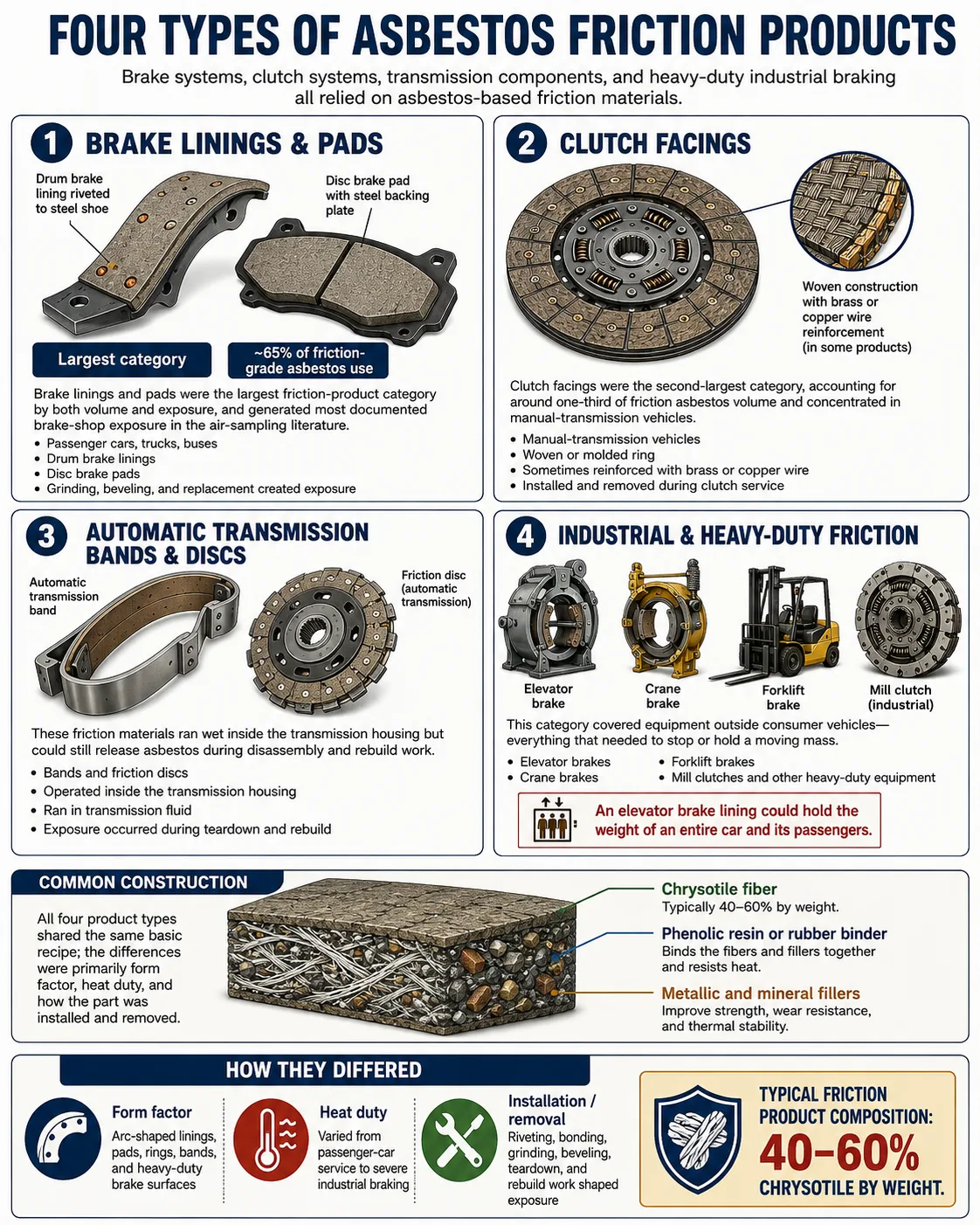
A brake lining is the friction surface that presses against a drum or rotor to stop a vehicle; a clutch facing is the matching surface that lets an engine engage a transmission. Both jobs demand a material that grips hard, holds together under repeated heating, and doesn't wear away in a week, and for most of the twentieth century that material was asbestos, specifically chrysotile (white asbestos, the serpentine mineral that made up nearly all friction material). The fiber was bound into the part with a phenolic resin or rubber binder and packed with metallic and mineral fillers for strength and heat resistance, and across the whole category the finished product ran roughly 40 to 60 percent chrysotile by weight.
Friction products came in four families. They shared that same basic recipe, but differed in shape, in how much heat and load they had to take, and in how the part was installed and later pulled back out, which is what shaped the exposure.
Brake linings and pads were the largest family by far, both in how much asbestos they used and in how much exposure they generated, and they're the ones most workers picture: the molded or woven lining riveted or bonded to the curved steel shoe of a drum brake, and the disc pad with its steel backing plate. They stopped passenger cars, trucks, and buses, and the work of fitting and replacing them, especially grinding and beveling a new lining so it seats flush, is behind most of the documented brake-shop exposure.
Clutch facings were the next largest family, rings of woven or molded friction material (sometimes reinforced with brass or copper wire) on the clutch disc of a manual-transmission vehicle, opened to the air every time a clutch was serviced.
Automatic transmissions used their own asbestos bands and friction discs, which ran wet in transmission fluid inside the housing but still released fiber when the unit was torn down and rebuilt.
And a whole industrial family sat outside consumer vehicles entirely: the oversized brakes and clutches on elevators, cranes, forklifts, and mill equipment, built to hold or stop far heavier loads, where a single elevator brake lining might hold the weight of a full car and everyone riding in it.
Representative products and their asbestos content. These are examples, not a full list:
| Product | Maker | Fiber | Asbestos content | In production |
|---|---|---|---|---|
| Brakeblok | Abex | Chrysotile | 65% | from 1936 |
| Abex brake shoe | Abex | Chrysotile | 65% | from 1943 |
| Bendix brake lining | Bendix | Chrysotile | 50% | from 1939 |
| Bendix clutch facings | Bendix / Allied-Signal | Chrysotile | 44% | from 1975 |
| 121 Super Brakes | Abex | Chrysotile | 65% | from 1975 |
Friction material was almost always a chrysotile product. Outside of a few rare niche products, there's no hidden amphibole (the other asbestos family, generally considered more hazardous) story here. But although chrysotile itself is less likely to cause mesothelioma than other forms of asbestos, it has been classified by the International Agency for Research on Cancer as carcinogenic to humans and recognized as a cause of mesothelioma8. The defenses built around the chrysotile point are taken up, carefully, in the defenses section below.
Johns-Manville's film Asbestos: Where It Came From and Where It Is Used (about 1970) shows a brake job and says that "more than 80 million cars in the U.S. stop on asbestos brake liners." The passage is about half a minute long. The film says nothing about the dust that brake work put in the air, or about disease.
Watch the whole film, with its transcript: Asbestos: Where It Came From and Where It Is Used
How friction materials put asbestos in the air
An asbestos brake lining bolted to a shoe and sitting inside a drum isn't shedding much fiber into anyone's breathing zone. The exposure came from servicing it. Brake and clutch work was abrasive by design: new linings were ground, filed, and beveled to fit the drum; clutch facings were sanded true; and every drum-brake job began by getting the accumulated dust out of the drum, which for decades meant an air hose. Grinding, filing, and sanding release raw, friable (crumbly and easily airborne) chrysotile from the new lining, and blowing out a drum throws the accumulated wear dust into a cloud around the mechanic's face.
Here is what that work measured. Each figure is a phase-contrast (PCM) measurement, which counts only the longer fibers and so reads as a floor, not a ceiling:
| Task | Measured (f/cc) | ≈ years of background per 15 min | Source |
|---|---|---|---|
| Blowing out brake drums (compressed air) | 43.8 | ~12 years | GCA / Anderson 19821 |
| Dry-brushing brake dust | 15 | ~4 years | GCA / Anderson 19821 |
| Filing / beveling brake linings to fit | ~8 | ~2 years | Hatfield & Longo 19982 |
| Sanding a clutch plate on an arbor | 385–466 | very high | MAS 1998 (Borg-Warner)3 |
By the illustrative math on our how we measure asbestos in air page, 15 minutes of blowing out brake drums at the GCA figure put roughly 12 years of ordinary city air through the lungs. This estimates fibers in the air breathed, not a retained dose.
Two honest caveats: First, in routine brake changes the parts of the job that weren't grinding, sanding, or air-blowing, measured lower than the abrasive tasks in the table. Second, the same air-blow task was measured very differently across studies: the EPA-commissioned GCA work recorded 43.8 f/cc, while a Finnish study of routine compressed-air cleaning recorded about 1.5 f/cc6. Study conditions, drum contents, and technique varied, and we present the spread rather than pretend all exposures were always high. What no study disputes is that the abrasive work released chrysotile fiber into the mechanic's breathing zone, and the arbor-sanding measurements show how extreme the upper end could be.
What the makers knew
The friction industry was not guessing about its dust. Through the 1970s, the makers' own hygienists and independent researchers were measuring fiber release from friction materials and friction work, while the trade press and service literature told mechanics the dust was nothing to worry about.
Abex measured its own plant. The Abex Corporation's industrial hygienists sampled the air in its Salisbury, North Carolina friction-manufacturing plant in 1976, documenting the company's direct, dated knowledge of airborne fiber from its own product line5. The next year, researchers from Mount Sinai led by Arthur Rohl took independent breathing-zone (the air right at a worker's nose and mouth) measurements in working American brake shops, putting the hazard on the public scientific record in 19774.
The work-practice studies that followed confirmed what the mechanics had been breathing all along. A 1998 Materials Analytical Services study of Bendix brake-lining filing on Chrysler vehicles recorded breathing-zone air at about 8 f/cc2, and a companion MAS simulation of sanding a Borg-Warner clutch plate on an arbor recorded an astounding 385 to 466 f/cc3, some of the highest task measurements in the friction literature.
Who was exposed
Friction materials weren't confined to one trade, but the exposure ran through a recognizable set of workplaces and occupations:
- auto and brake mechanics, the primary trade, from dealership service bays to corner garages and gas stations
- railroad shops, where locomotive and car brake shoes meant heavy asbestos brake blocks
- aircraft maintenance, where wheel and brake work carried the same friction-material dust
If you or your family member did brake or clutch work in any of these settings, the exposure history is usually straightforward to reconstruct.
The manufacturers and the trusts
Brake and clutch recovery runs down two tracks at once, and this category is unusual in how strong the second track is. The bankrupt makers now pay through trusts that require no lawsuit. But one of the biggest names in friction, Bendix, never went bankrupt: its successor Honeywell is a solvent company that defends these cases in court, and Ford and other still-solvent automakers and friction sellers can likewise be sued directly. A single mechanic's career often supports trust claims and lawsuits at the same time, and one pathway doesn't reduce another.
| Manufacturer / brand | Status | How claims are handled |
|---|---|---|
| Wagner, Ferodo, Pneumo-Abex (American Brake Shoe), Vellumoid, Turner & Newall | Federal-Mogul Asbestos Trust | Trust claim, no lawsuit |
| Johns-Manville brake linings | Johns-Manville Asbestos Trust | Trust claim, no lawsuit |
| General Motors friction products | GM Asbestos Trust | Trust claim, no lawsuit |
| Bendix (Honeywell successor) | Solvent | Lawsuit |
| Ford and other still-solvent automakers / friction sellers | Solvent | Lawsuit |
| Raymark / Raytech (Raybestos successor) | Chapter 7 liquidation, 2001 (not a reorganization) | Recovery limited |
A note on the Raybestos name, because it was on half the parts shelves in America: the corporate successor, Raymark, went through a Chapter 7 liquidation which means they went out of business entirely. That's different than the typical reorganizations that create a trust, so recovery on that name runs differently and is more limited. How a particular defendant is reached, and whether a successor company answers for an older one, is analysis we do for your file, not something you need to sort out. And if the idea of a lawsuit is uncomfortable, you're in good company; Clarence Borel, whose 1973 case built the modern asbestos-litigation system, didn't want to sue either, and we can pursue trust claims alone if that's your preference.
Sources of compensation
A brake and clutch case usually draws from several sources at once, and they run in parallel:
- Asbestos bankruptcy trusts. The friction makers who went bankrupt set aside money to pay the people they harmed. These are paper claims, with no lawsuit and no courtroom, and one career often supports filings against several trusts. How asbestos trust claims work.
- Lawsuits against solvent defendants. Honeywell (for Bendix), Ford, and other still-solvent automakers and friction sellers defend these cases in court, and those tort recoveries often exceed what trusts pay per claim. How product liability lawsuits work.
- Premises liability against site owners. Where the brake work happened on someone else's site, a fleet garage, a plant, a facility that controlled the conditions, the owner can sometimes be reached as a premises defendant. How premises liability claims work.
- Federal and disability benefits. Military vehicle and aircraft brake work can support VA disability benefits, and Social Security disability may be available alongside any claim, both paid in addition to the rest. How asbestos disability and benefit claims work.
In our case-law library
421 court decisions in our case-law library involve brakes, clutches and friction materials. Among them:
- In re Asbestos LitigationDelaware Supreme Court, 2023 · Automotive mechanic at Goodyear Tire Service Center, Maple Heights, 1972 to 1999
- Droz v. Hennessy Industries, LLCDelaware Supreme Court, 2022 · Auto shop worker servicing car brakes, used arc grinder to resurface brake shoes at Larry's Auto Repair, 1971-73
- Coogan v. Borg-Warner Morse Tec Inc.Washington Supreme Court, 2021 · Automotive repair work and repairing industrial equipment in his excavation business at decades
- Palmer v. Walker Jamar CompanyMinnesota Supreme Court, 2020 · Janitor at car dealership, 1974
- In re Asbestos LitigationDelaware Supreme Court, 2020 · Employment and shade tree mechanic
- Jones v. Pneumo Abex LLCIllinois Supreme Court, 2019 · Repaired brakes on motor vehicles he owned at 1962 through the 1970's
See all 421 decisions involving brakes, clutches and friction materials
In our products database
The brakes and friction materials our document library describes, by the company that made or sold it. Each product's page says when it was made and how much asbestos it held, from the documents.
Abex: Abex · Tiger Brake Shoes
Allbestos Corporation (Philadelphia): Allbestos woven brake lining (Allbestos Corporation)
American Brake Shoe: American Brakeblok
Anchor Packing: Silent Grip
Asbestos Corp. of America: Amco
Asbestos Textile Co.: Aztec
Bendix: Bendix
Bondall: Flexiformed · Safetybestos
British Belting & Asbestos: Mintex
C. W. Hanslip: Standco
Cape Asbestos: Top-Dog
Carlisle: Carlisle “Premium” Class GC
Champion Friction: Gralam
Charles Laurence Willis: Stella
Chrysler: MoPar Cyclebond
Cresswell's Asbestos: Chekko
Delco Moraine: Factory Lined Brake Shoes
Emsco Asbestos: Ideal
Fiber Manufacturing: F-m-c
Floyd R. Biggs: Pioneer Asbestos
Garlock: Ring packing
Gatke Corporation: Asbestographite
General Motors: Delco · GM 5470 · GM 5490 · GM 8010 · GM 8011 · Gmc Parts · Inlite
Griffin Wheeler: Anchor Brake Shoes
H. K. Porter: HK Porter
ITT Aimco: Itt Aimco
Istag Ag: Rk
James Walker Packing Co.: Shallex
Johns-Manville: Asbesto-metallic · Cobra · FS Custom Four Star · Railroad Brake Shoes
Keasbey & Mattison: Autobestos
Kirchbach'Sche Werke Kirchbach & Co.: Jurid
Knerr & Bortz: Starbestos
Maremont: Grizzly
Multibestos: Lx
National Gypsum: National Gypsum
Nuturn: Grizzly
Pars Manufacturing: Pars
Railroad Friction Products Corporation (Westinghouse Air Brake Company and Johns-Manville): Cobra Brake Shoe (Railroad Friction Products Corporation)
Raybestos-Manhattan: Grey-Rock · Hydro · R-m · R/M R-2854-B · R/M R-3672-3 · R/M US 98 · Ray-Mold · Rayman · Red Demon
S. G. Tilden: Permafuse
S. K. Wellman: Velvetouch
Scandinavia Belting: Halo
Small & Parkes: Don-Flex · Railko
Standco Industries: 100 Alc · Standco Brake Blocks
The Manhattan Rubber Manufacturing Company: Hycoe brake lining (Manhattan Rubber)
Thermoid Rubber: Servbestos
U.S. Asbestos: Grey Rock · Grey Rock Eagle · Hyco · VeeLock
Unarco: Non-Scor
Union Asbestos & Rubber Co.: Unarco
Wagner: Lined brake shoe sets · Wagner Lockheed
Wheeling Brake Block Manufacturing: Low N Bestos
Wm. E. Hooper & Sons: Hooperwood
Videos
- Asbestos in Brakes: How Mechanics and Auto Workers Were Exposed
- Why Old Cars Used Asbestos Brake Pads | Johns-Manville History
- Railroad Workers and Asbestos Exposure from Brakes and Engines
- Mechanics and Asbestos Exposure from Brakes, Clutches, and Gaskets
- Heavy Equipment Operators and Asbestos Brake Dust Exposure


The defenses companies raise, and how we answer them
Friction cases draw a more scientific set of defenses than most asbestos products, because the defense bar has spent decades building arguments around chrysotile. None of them is new to us, and each deserves a precise answer rather than a slogan. All of this applies only to the lawsuit side. Trust claims are a paper process: no opposing lawyer raises defenses, no one is deposed, and no one goes to court.
How we answer the defenses raised in brake and clutch cases
"Brake asbestos was chrysotile, which is less potent than other types." Chrysotile is classified by the International Agency for Research on Cancer as carcinogenic to humans (Group 1) and is a recognized cause of mesothelioma8. Brake and clutch work was chrysotile exposure, and the claim rests on that recognized causal link, not on a comparison between fiber types. We don't argue that chrysotile and amphibole fibers carry identical potency; we argue what the science supports, which is that chrysotile causes the disease our clients have.
"Friction heat converts the chrysotile to forsterite, so used brake dust isn't asbestos." Forsterite is the non-fibrous mineral chrysotile can transform into at high temperature. The defense overstates what actually happens in a brake. Thermal conversion is incomplete, so unconverted chrysotile remains in used brake debris. And the argument says nothing at all about the other half of the exposure: grinding, filing, beveling, and sanding new linings and clutch facings releases raw, unheated chrysotile before the part ever sees a mile of service.
"The epidemiology shows mechanics have no elevated mesothelioma risk." The record is not that clean. Case reports and several studies document mesothelioma in brake and vehicle mechanics, and the studies that report no elevated risk carry recognized limitations, including exposure misclassification (lumping mechanics who did heavy friction work together with those who did little) and limited statistical power for a rare disease. We present the epidemiology as it is, without overstating it in either direction, alongside the exposure measurements and the individual work history, which is how causation is actually proven in these cases.
"Routine brake jobs were low-dust." The measured record shows a wide spread, and we say so plainly on this page. But the abrasive tasks that were part of ordinary brake and clutch service, grinding and beveling linings, sanding clutch facings, blowing out drums, measured high in multiple studies, including EPA-commissioned testing. A career of brake work included those tasks over and over.
Frequently asked questions
My loved one has already passed away. Can we still bring a claim?
Yes. Families regularly file after a death, both trust claims and, depending on the state, a wrongful death lawsuit. Some of these deadlines are short, so it's best to call promptly. We handle wrongful death and estate claims as a matter of routine.
Could my family have been exposed through the work clothes?
Yes, and it's common in this trade. Brake dust settled on coveralls and came home with the mechanic, and spouses who shook out and laundered the clothes were exposed too. Our representation includes free asbestos health screening for family members, and if one is later diagnosed, they may have a claim of their own. The screening is a chest X-ray read by a B-reader, with a CT scan if needed; it looks for asbestos-related changes in the lungs and isn't a diagnosis or a reliable way to find mesothelioma early.
When did brakes stop being made with asbestos?
Later than most people assume. Asbestos friction materials remained on the market, especially in the aftermarket and in heavy-vehicle applications, long after asbestos left most other product categories, so brake work well into the 1990s could still involve asbestos parts.
I worked at a gas station, not a brake shop. Does that count?
Usually, yes. Gas stations and general-repair garages did brake jobs constantly, and the exposure came from the task, not the sign over the door. Fleet garages, dealerships, and municipal shops all count the same way.
What does it cost to work with you?
Nothing up front, and nothing at all unless we recover for you. We work on a contingency fee, which means our fee comes only out of money we recover, and the case review is free.
What happens when I call?
A member of our litigation team, not a screener, takes the call, and the first conversation usually runs twenty to thirty minutes. We listen to the work history, explain which claims may apply, and lay out the timeline. No one is pressured to sign anything.
Do we have to travel to your office?
No. We handle these cases by phone, video, and mail, and we come to you when an in-person visit helps. Families work with us from every state without traveling to us.
Talk with an asbestos lawyer about brake and clutch exposure
Whether you're a mechanic who was just diagnosed or a spouse or adult child trying to find help for someone who is sick, we're ready to talk. You don't need the brand names, you don't need the old repair orders, and you don't need to travel to us. Start with what you remember, and we'll take it from there.
Related resources
Sources and references
- Anderson PH, Grant MA, McInnes RG, Farino WJ. Analysis of Fiber Release from Certain Asbestos Products. GCA/Technology Division (EPA); 1982.
- Hatfield RL, Longo WE. Bendix brake filing work-practice study. Materials Analytical Services; 1998.
- Materials Analytical Services. Borg-Warner clutch-plate sanding simulation; 1998.
- Lorimer WV, Rohl AN, Miller A, Nicholson WJ, Selikoff IJ. Asbestos exposure of brake repair workers in the United States. Mt Sinai J Med. 1976;43(3):207-218.
- Abex Corporation, internal industrial hygiene survey, Salisbury, NC plant, 1976.
- Kauppinen T, Korhonen K. Exposure to asbestos during brake maintenance of automotive vehicles by different methods. Am Ind Hyg Assoc J. 1987;48(5):499-504. doi:10.1080/15298668791385101
- OSHA asbestos standard, permissible exposure limit 0.1 f/cc over eight hours with a short-term excursion limit of 1.0 f/cc over thirty minutes. 29 C.F.R. § 1910.1001.
- International Agency for Research on Cancer. Arsenic, Metals, Fibres, and Dusts. IARC Monographs, Vol. 100C (chrysotile classified as carcinogenic to humans, Group 1).
This page is provided for general informational purposes and does not constitute legal advice. Every asbestos case turns on its own facts, exposure history, diagnosis, deadlines, available evidence, and applicable law. Reviewing this page does not create an attorney-client relationship. For advice about your specific situation, call 833-4-ASBESTOS for a free case review.