
If you spent your working life at a plant, mill, refinery, shipyard, or powerhouse but never handled asbestos yourself — or if someone in your family did that kind of job — and a mesothelioma, lung cancer, asbestosis, or other asbestos diagnosis has now come in, this page is the place to start. The office staff, clerks, cooks, custodians, and guards who worked those sites breathed the same dust as the tradesmen, and so did the engineers, foremen, operators, and material handlers who were near the work without ever doing it.
You didn't have to touch asbestos to breathe it. The tradesmen who installed and tore out insulation, gaskets, packing, and cement filled the air with fiber, and that fiber drifted across the site and settled on the surfaces around everyone else. Industrial hygiene testing measured it well away from the work: about 0.3 fibers per cubic centimeter roughly six meters from active insulation and gasket work, three times today's federal limit, and about 4.8 f/cc roughly three meters away, forty-eight times the limit. The honest point is simple. The air near the work was many times the legal limit even for people standing back from it, and there is no exposure level known to be safe. See how asbestos pipe and block insulation caused exposure.
You don't need to remember which company's products were being used around you, and you don't need old job records, pay stubs, or badges in hand. The bankruptcy trusts that pay many of these claims are built to compensate exposure on a worksite that used asbestos, and for mesothelioma that on-premises exposure is typically enough even for someone who never handled the material. If you can say "I kept the books at the refinery for twenty-five years" or "my mother cooked in the plant cafeteria," we have a starting point.
Fibers per cubic centimeter (f/cc), measured several meters from active insulation and gasket work
OSHA’s asbestos standard lists 0.1 f/cc as the 8-hour time-weighted average limit and 1.0 f/cc over 30 minutes as the excursion limit. Six meters from the work, the air still ran about three times the 8-hour limit; three meters away, it ran roughly forty-eight times the limit and nearly five times the short-term ceiling. There is no exposure level known to be safe. Source: published industrial hygiene testing, cited on our pipe and block insulation page.

You don't need the product names or old records. No fee unless we recover compensation for your family.
Quick answers
| I never worked with asbestos. Could I still have been exposed? | Very likely, if you spent your days on premises where insulation, gasket, or packing work was going on. The fiber drifted through the air you breathed and settled on the surfaces around you. You didn't have to handle a single asbestos product to take it into your lungs. |
|---|---|
| I was a secretary, clerk, cook, janitor, or guard. Does that count? | It can. Office, food-service, custodial, and security work put people in and around the same buildings as the trades doing dusty asbestos work, often for decades. What matters is where you spent your working days, not your job title. |
| How much exposure do I need for a claim? | For mesothelioma, far less than people expect. The asbestos bankruptcy trusts that pay many of these claims are built to compensate exposure on a worksite that used asbestos, even for someone who never handled it. Courts ask for more than the trusts do, and we handle that difference for you. |
| How long do I have to file? | It depends on your state and on whether this is a personal-injury or a wrongful-death situation, and some of those deadlines are short. The safest step is to call as soon as possible after diagnosis so the clock doesn't run out. |
| Do I have to file a lawsuit? | No. Many families recover through trust claims and federal benefits without ever filing a lawsuit. Trust claims are paper claims, not courtroom cases, and they don't require proving everything a lawsuit does. We explain both paths and respect your decision. |
| Who is responsible if I never used a product? | Usually two kinds of defendant: the bankruptcy trusts of the companies whose asbestos drifted through your worksite, and the plant, mill, or yard owner who controlled the conditions you worked in. |
| Can a spouse or adult child call for the worker? | Yes. Most of our first calls come from a wife, a husband, or an adult child researching for someone who is sick or who has passed. You don't need a power of attorney to ask questions. |
“I started this firm after learning that the cancers that killed my father and grandparents were caused by asbestos, something we did not realize until it was too late to hold anyone accountable. That experience is why we built this site: so that no other family misses their chance to ask the questions, hear the options, and decide for themselves what to do.”
Why bystanders and proximity workers were exposed to asbestos
People who never handled asbestos were still exposed for a simple reason: the fiber doesn't stay where the work happens. For most of the twentieth century, the plants, mills, refineries, and yards where these workers spent their days were built out of asbestos and maintained with it, and the trades cutting, scraping, and tearing out that material released fiber into shared air. Once it was airborne, it drifted, hung, and settled, and everyone in the building breathed it, whether they were running a turbine, typing invoices, plating lunch, mopping a floor, or walking a clipboard from one office to the next.
The exposure reached bystanders and proximity workers through the ordinary conditions of the worksite, not through anything they did with their own hands:
- Shared air, poorly ventilated. Boiler rooms, mechanical rooms, ship engine rooms, powerhouse basements, and process buildings had little ventilation, so fiber released by the trades hung in the air and was rebreathed rather than carried away. Office and break areas were often tucked right against those spaces.
- Drift across the site. Asbestos work several meters away still loaded the air a bystander breathed. Testing measured about 0.3 f/cc roughly six meters from active insulation and gasket work and about 4.8 f/cc roughly three meters away, both above the federal limit, with the closer reading many times over it.
- Settled dust, stirred up again. Fiber that landed on floors, ledges, equipment, and paperwork didn't disappear. Sweeping, cleaning, foot traffic, and compressed air put it back into the air long after the trades had gone.
- Years in the same building. A clerk, cook, custodian, guard, engineer, or foreman who spent a full career on one site breathed that ambient fiber day after day, and tearing out old, friable (crumbly and dusty), degraded material released far more of it than installing it new.
Through all of it, no one warned the people who weren't doing the dusty work, and no one protected them, while the companies that made the products and ran the plants already knew what the dust was doing.

Where the exposure came from
A bystander didn't handle asbestos, so the fiber they breathed came from the trades working around them. Insulators, pipefitters, and boilermakers were installing and tearing out the asbestos that filled the building, and the dust from that work is what reached everyone else. Knowing which products were in the air is how we identify who is responsible and which claims a bystander can bring.
A few products account for most of the fiber that drifted across these sites:
- Pipe and block insulation, and insulating cement. The covering on the lines, the block on the vessels, and the cement troweled onto fittings were the heaviest asbestos products in the building, and cutting and stripping them threw off the most dust. These trace back to the largest names in the industry, including Johns-Manville and Owens-Corning, most of which now pay through trusts. See how asbestos pipe and block insulation caused exposure, and how asbestos insulating cement caused exposure.
- Gaskets and packing. Every flanged joint had a gasket and every valve and pump had packing, and scraping and grinding the old ones out released fiber into shared air. Many of the makers, such as Garlock, are now covered by bankruptcy trusts. See how asbestos gaskets and packing caused exposure.
- Refractory materials. The brick and castable linings in furnaces, boilers, and kilns were torn out and rebuilt with asbestos-bearing refractory, a dusty job that filled the air around it. Makers such as Eagle-Picher are reachable through trusts. See how asbestos refractory materials caused exposure.
This is why a bystander's case is rarely a single claim. The dust came from products made by many different companies, so the typical recovery runs against several bankruptcy trusts at once, with the plant, mill, or yard owner as the central defendant for the conditions it allowed on its premises. You don't need to remember who made the insulation a crew tore out near your office in 1979. Give us the work history, and we trace each product back to its maker, and each maker to its trust or its place in a lawsuit. The trades whose work created the drift have their own pages too: Insulator Asbestos Exposure & Mesothelioma Claims, pipefitters and plumbers, and Boilermaker Asbestos Exposure & Mesothelioma Claims.
Where you worked, and why the setting still matters
For a bystander, the worksite isn't background detail. It is the whole case. A tradesman carried his exposure with him from job to job, so his claim rests on the work he did. A clerk, cook, custodian, guard, or operator was exposed because of the building they were in, so their claim rests on proving that the specific plant, mill, refinery, or yard used asbestos throughout the years they were there. That is what ties the illness to a place, identifies the premises owner who can be held responsible, and decides whether federal benefit programs come into play on top of the trust and lawsuit claims.
This is why we spend real time on where your loved one worked, and for how long. We reconstruct what the site was, what was built and maintained there, which trades were active in the buildings they occupied, and what the conditions were during their years on the premises. A few settings account for much of the heaviest bystander exposure:
- Shipyards and the Navy. Engine rooms, machinery spaces, and the surrounding shops packed asbestos into tight, unventilated quarters, and everyone aboard or nearby breathed it. Civilian shipyard work can open Longshore benefits under the Longshore and Harbor Workers' Compensation Act (LHWCA), and Navy service can open VA disability claims, both alongside the civil case. Shipyard and maritime asbestos exposure.
- Refineries and petrochemical plants. Miles of high-temperature process piping meant constant insulation, gasket, and packing work, with the major oil companies reachable as premises owners. Office, lab, and support staff worked right against the units. Petrochemical and refinery asbestos exposure.
- Power plants and utilities. Powerhouses ran heavily insulated boilers, turbines, and steam lines, and the fiber filled the building around operators, clerks, and maintenance staff alike. Utility and power generation asbestos exposure.
- Iron and steel mills. Furnaces, rolling lines, and their refractory linings generated heavy dust across large, shared buildings where many non-trade workers spent their careers. Iron and steel industry asbestos exposure.
- Industrial and commercial construction. On active sites, insulators and other trades worked the mechanical systems while engineers, foremen, operators, and material handlers moved through the same unfinished spaces. Construction industry asbestos exposure.
- Chemical plants. Process units and their insulated piping put support and operating staff in steady contact with ambient fiber. Chemical industry asbestos exposure.
If your loved one worked at a federal facility, a shipyard, or in the military, tell us. Civilian work at a federal facility can support benefits under the Federal Employees' Compensation Act (FECA), and those settings often add benefit channels that run in parallel with everything else.
What the period magazines show about the people working nearby
The asbestos industry's trade journal, Asbestos, and Johns-Manville's employee magazines were not written about bystanders. But in passing they show the sweepers, clerks, janitors and maintenance men who worked inside asbestos-products plants, and the plant maintenance work that went on around insulation every day.
Inside the plants
Johns-Manville's magazine printed lists of employee suggestions, with each person's job and department. They show that the factories were full of people besides machine operators:
- In 1929 a sweeper in the Roofing Department at the Pittsburg Factory suggested "That incinerator tender be furnished with asbestos hood for protection of face and eyes" (J-M Circle, July 1929).
- The same list names a clerk in the Magnesia Department, a clerk in the Carding Room and a watchman in the Erection and Repair Department at Manville (J-M Circle, July 1929).
- In 1930 the Pittsburg Factory list included a laborer in the shipping department, whose idea was clamps for the "pipe covering trucks", a "clerk, brake lining department", and an office messenger who suggested a machine "for marking moulded brake lining and cartons." The Asbestos Factory list named a stenographer, a timekeeper and a costs clerk from the main office, and a maintenance man in the mining department (J-M Circle, May–June 1930).
- A 1929 item from the "Pittsburg (Calif.) Factory" tells of a birthday luncheon for the janitor of No. 3 Building (J-M Circle, Apr. 1929).
Maintenance men and other trades
Asbestos wrote in 1943 that Careystone flat sheathing, under the headline "Lockers of Asbestos Board," could "be easily worked by plant carpenters or maintenance men" (Asbestos, July 1943).
A 1944 article on plant piping maintenance told plants that "in many cases old insulation should be removed entirely." It said areas behind insulation where leaks were suspected "should be exposed," and that new gaskets should use "the thinnest possible sheet asbestos." For temporary repairs, "broken pieces of 85% magnesia may be ground up and mixed with water and applied," then surfaced "with insulating asbestos cement" (Asbestos, June 1944, p. 8; continued).
Insulation was not always left to insulators. In 1926 the magazine reported that in Florida "the covering is applied by plumbers" (Asbestos, June 1926). In 1942, wartime schools in San Francisco and Oakland trained men "in the art of asbestos insulation," choosing plasterers, cement finishers and tile setters first, "and then the rank and file of carpenters, roofers and other trades" (Asbestos, May 1942).
Sprayed asbestos on the jobsite
Company papers show that sprayed asbestos settled on everything near the sprayer. Armstrong Contracting and Supply's operating instructions for Limpet spray crews said that at the end of each day's spraying "all excess damp fibers should be cleaned from surrounding surfaces," and warned that switching the gun off too quickly "causes dry fiber remaining in the hose to be blown into the air" (Armstrong operating instructions, pp. 7, 25). When J. W. Roberts tested Limpet spraying in 1960, the air in its spray booth still held more than 1,000 dust particles per cubic centimeter five minutes after the spraying had stopped (J. W. Roberts report, 1960, pp. 6, 10).
How a bystander's case can come together
The following is a composite example, not a real client, but it reflects how these cases typically come together in our experience.
Gloria spent about twenty-six years as a timekeeper and clerk, first at a steel mill and then for most of her career at a refinery. Her office sat just off the process units, and her days had her walking the plant to deliver and collect paperwork, in and out of buildings where insulation and gasket work was a constant. She never handled asbestos, never wore the gloves or held the tools, and her exposure was modest compared with a tradesman's. But she breathed the fiber that drifted from that work, day after day, for a quarter century in buildings where the dust didn't clear. In early 2026, after months of breathlessness and chest discomfort she'd put down to age, a biopsy confirmed pleural mesothelioma of the epithelioid type.
Gloria's case doesn't rest on a heavy dose, because it doesn't need to. There is no safe level of asbestos, and on-premises exposure to the products around her is typically enough for the trusts. So trust claims go in against the makers of the insulation, gaskets, and refractory that filled the air she breathed, several different companies and several different trusts, while the refinery and the steel mill that owned and ran those premises are the central defendants for the conditions they allowed. Because pleural mesothelioma is often treated at specialized centers, getting Gloria to the right one may mean travel, and the firm advances the cost of travel and lodging when the best center isn't close to home. How legal recovery funds mesothelioma treatment access. And because dust that settles on a worker also reaches the people at home, free asbestos health screening for her family is part of the representation. The screening is a chest X-ray read by a B-reader, with a CT scan if needed; it looks for asbestos-related changes in the lungs and isn't a diagnosis or a reliable way to find mesothelioma early.
This example is general. Every case depends on the diagnosis, the exposure history, the dates, the defendants, the applicable law, and the available evidence.
Sources of compensation for bystanders and proximity workers
A bystander's recovery usually comes from more than one place, and the channels run in parallel without canceling one another out. For someone who never handled asbestos, the order matters, because the trust channel is the most reliable.
- Asbestos bankruptcy trusts. The companies that made the insulation, gaskets, packing, and refractory in your worksite and later went bankrupt set aside money in trusts to pay the people they harmed. On-premises exposure to a product is typically enough to qualify, even for someone who never touched it. These are paper claims that don't require a lawsuit or a courtroom, and a single career often supports filings against several trusts at once. How asbestos trust claims work.
- Premises liability against the site owners. The refineries, mills, plants, and yards that controlled the worksites can be held responsible for the conditions they allowed, separate from the companies that made the products. For a bystander, the premises owner is the central defendant. How premises liability claims work.
- Lawsuits against solvent manufacturers. Some makers of the products that drifted through the building, especially in the gasket and packing world, are still in business and can be sued directly. How product liability lawsuits work.
- Federal and disability benefits. These depend on where and how the work was done, and they're paid in addition to the trust and lawsuit recovery. Military service can support VA disability benefits; civilian shipyard work can support Longshore (LHWCA) benefits; civilian work at a federal facility can support FECA benefits; and Social Security disability is available to anyone whose illness stops them from working. How asbestos disability and benefit claims work.
One thing to be straight about: proving a bystander's exposure in court is harder than proving a tradesman's, because there's no record of dusty tasks performed by hand. That is exactly why the trust channel matters most here. The trusts pay on documented on-premises exposure, and the lawsuit side is built on proving the conditions of the specific worksite, which we do with the site's history and records rather than a single fiber.
Mentioned on this site
- Asbestos Exposure by Industry
- Asbestos Exposure by Occupation
- Asbestos Exposure in Aerospace and Aviation
- Asbestos Exposure in Iron and Steel Mills
- Asbestos Exposure in Power Plants and Utilities
- Asbestos Exposure in Railroad Work
- Asbestos Exposure in Refineries and Petrochemical Plants
- Asbestos Exposure in Shipyards and Maritime Work
- Asbestos Exposure in the Construction Industry
- Asbestos Exposure in the Navy
- Asbestos in Schools
In our case-law library
16 court decisions in our case-law library involve bystander exposure. Among them:
- Whatley v. Armstrong World Industries, Inc.U.S. Court of Appeals, Fifth Circuit, 1988 · Chipper at Alabama shipyard, over thirty years, until 1982
- Jackson v. Johns-Manville Sales Corp.U.S. Court of Appeals, Fifth Circuit, 1985 · Work leaderman or supervisor at Ingalls Shipbuilding Corporation yard, Pascagoula (naval ships), 1953-1971
- Petitpas v. Ford Motor CompanyCalifornia Court of Appeal, 2017 · Visitor to her boyfriend (later husband) at work in the service bay at Enco service station, Pomona, 1966-1967
- Johnson v. ArvinMeritor, Inc.California Court of Appeal, 2017 · Visitor to his father's workplace who sometimes helped with brake and clutch work at Bekins main warehouse, Stockton, 1972-1982
- Morin v. AutoZone Northeast, Inc.Massachusetts Appeals Court, 2010 · Co-owner and operator of a fresh produce supplier, with an office near the mechanics' pit at Bedford Fruit Company, Hyannis
- Barone v. Gatx Corp.Ohio Court of Appeals, 2006 · Stenciler in the paint shop at GATX temporary paint shop attached to the repair shop, 1961-1962
Videos
- How Factory Workers Were Exposed to Asbestos Without Making Asbestos Products
- Workers Who Handled Raw Asbestos: Exposure Risks Explained
- How Asbestos Product Manufacturing Exposed Workers to Dangerous Dust
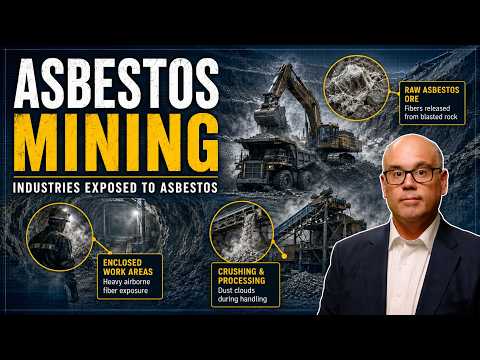
- Why Asbestos Mining Created Some of the Highest Exposure Risks for Workers
- How Foremen and Supervisors Were Exposed to Asbestos
- Engineers and Technical Workers: Asbestos Exposure Risks




The defenses companies raise, and how we answer them
When a bystander's case goes to court, the defense leads with the same argument every time: that someone who never handled asbestos couldn't have been exposed enough to matter. The short version is that the argument describes a cleaner, emptier building than the one your loved one actually worked in, and the evidence answers it. The detail is below for anyone who wants it.
All of this applies only to the lawsuit side of a case. The trust claims are a paper process: no opposing lawyer raises defenses, no one is deposed, and no one goes to court.
How we answer the defenses raised in bystander and proximity worker cases
"She never worked with asbestos, so her exposure was too trivial to matter." Bystander exposure is recognized exposure. The testing that recorded high fiber levels recorded a lot of it well away from the work, in the shared air people breathed without ever touching a product. The illness is what proves the exposure mattered; the bystander doctrine and the ambient evidence are what connect it to the worksite, and there is no exposure level known to be safe.
"You can't tie her illness to our specific premises or product." This is the part of the case we build with the site's own history. We document what the plant, mill, or yard was, what asbestos products were used and maintained there, which trades were active in the buildings she occupied, and over what years, so the exposure is tied to a place and to the owner who controlled the conditions.
"The exposure was too low to have caused anything." These cases don't rest on a single fiber, and we don't argue one. The bankruptcy trusts pay on documented on-premises exposure, and in court we prove a meaningful contribution with the conditions of the worksite, the years spent there, and the established science that recognizes no safe threshold for mesothelioma.
Frequently asked questions
My job had nothing to do with asbestos. Do I really have a claim?
Possibly, yes. The question isn't whether your job involved asbestos, it's whether the building you worked in did. If insulation, gasket, packing, or refractory work was going on around you, the fiber reached the air you breathed regardless of what your own job was. We look at the worksite, not the job description, to tell you whether a claim is realistic.
I don't remember any product brands, and I don't have my old records. Can I still file?
Yes, and most people are in exactly that position. You don't need brand names, pay stubs, or badges in hand to start. We reconstruct the worksite and the products from our exposure database, the trust documentation for each manufacturer, the site's history, and the recollections of coworkers. The conversation starts with what you remember.
My loved one has already passed away. Can we still bring a claim?
Yes. Families regularly file after a death, both trust claims and, depending on the state, a wrongful-death lawsuit. These deadlines vary by state and some are short, and the family's claim can depend on whether a claim was preserved during the worker's life, so it's best to call promptly. We handle wrongful-death and estate claims as a matter of routine.
Is bystander exposure harder to prove than a tradesman's?
In court, yes, because there's no record of dusty tasks done by hand. That's why the bankruptcy trusts matter most for these cases: they pay on documented on-premises exposure without a courtroom. On the lawsuit side, we carry the heavier burden by proving the conditions of the specific worksite, which is work we do routinely.
I only worked there a few years. Is that enough?
It can be. For mesothelioma, even a limited period of on-premises exposure is typically enough for the trusts, because there's no safe threshold and the disease can follow a modest dose. A shorter history may narrow which channels apply, but it's worth checking rather than assuming the answer is no.
What happens when I call?
A member of our litigation team, not a screener, takes the call, and the first conversation usually runs twenty to thirty minutes. We listen to the work history, explain which claims and channels may apply, and lay out the timeline for your situation. No one is pressured to sign anything on that call.
What does it cost to work with you?
Nothing up front, and nothing at all unless we recover for you. We work on a contingency fee, which means our fee comes only out of money we recover, and the case review and consultation are free.
Talk with an asbestos lawyer about bystander and on-site exposure
Whether you're a worker who was just diagnosed, or a spouse or adult child trying to find help for someone who is sick or who has passed, we're ready to talk. You don't need the product names, you don't need the old records, and you don't need to travel to us. We handle these cases by phone, video, and mail, and we come to you when an in-person visit helps. Start with what you remember, and we'll take it from there.
Related resources
Sources and references
The exposure measurements on this page come from published industrial hygiene testing, cited in full on the product page where the figures live:
- The ambient bystander measurements, about 0.3 f/cc roughly six meters from active work and about 4.8 f/cc roughly three meters away, are documented on our asbestos pipe and block insulation page.
Other authorities relied on:
- Occupational exposure limits. OSHA's asbestos standard sets the current permissible exposure limit at 0.1 f/cc averaged over eight hours, with a short-term excursion limit of 1.0 f/cc over thirty minutes. 29 C.F.R. § 1910.1001.
- Carcinogenicity. The International Agency for Research on Cancer classifies all forms of asbestos as carcinogenic to humans (Group 1) and recognizes no safe threshold of exposure for mesothelioma. IARC Monographs, Vol. 100C.
This page is provided for general informational purposes and does not constitute legal advice. Every asbestos case turns on its own facts, exposure history, diagnosis, deadlines, available evidence, and applicable law. Reviewing this page does not create an attorney-client relationship. For advice about your specific situation, call 833-4-ASBESTOS for a free case review.