
If you served aboard ship in the Navy or the Coast Guard (or if someone in your family did) and a mesothelioma, lung cancer, asbestosis, or other asbestos diagnosis has now come in, this page is the place to start. The same dust settled into the berthing and mess where the whole crew lived, and it rode home on uniforms and sea bags to the spouses who laundered them, so the people it reached were never only the ones turning the wrenches.
A warship was a sealed steel box, and the asbestos was wrapped around everything that ran hot. Boilers, turbines, steam lines, and the bulkheads themselves were insulated with it, packed into engine rooms, firerooms, and berthing compartments where the ventilation was poor and the fiber, once disturbed, had nowhere to go but back into the air the crew breathed. Hand-sawing one common asbestos pipe lagging (the insulation wrapped around the ship's steam and water lines) has been measured at 51.7 fibers per cubic centimeter, which in fifteen minutes puts roughly fifteen years' worth of ordinary city background air through the lungs. And a sailor didn't have to be the one cutting it: asbestos fibers hang in the air for hours and drift, so the man racked out a few feet away breathed the same air, the bystander exposure that reached everyone in the sealed compartment.
Even ordinary city air carries a faint trace of asbestos, from natural mineral erosion and a century of industrial use, and that trace is the yardstick the chart measures against.
What these numbers mean. Asbestos in air is measured in fibers per cubic centimeter (f/cc), a unit that hides how dangerous a task was. Across this site we translate each measurement into fibers breathed, feet of fiber end to end, and years of ordinary city air, using conservative, government-sourced assumptions. See how we measure asbestos in air for the method and its limits.
You don't need to remember the brand of insulation on your ship or which company made the gaskets in the engine room, and you don't need your service records in hand to start. For mesothelioma, even brief exposure aboard a ship that used asbestos is typically enough to qualify for the trusts, so a heavy, provable dose isn't the threshold. If you can tell us your rating or job, your ship or ships, and roughly when you served, we have a starting point.

You don't need the product names or old records. No fee unless we recover compensation for your family.
Quick answers
| Did serving in the Navy really expose me to asbestos? | Almost certainly, if you served belowdecks or aboard an older ship between World War II and the 1980s. Asbestos wrapped the boilers, turbines, steam lines, and bulkheads, and in sealed compartments with little ventilation, the fiber stayed in the air the whole crew breathed. Engine-room and fireroom sailors took the heaviest dose, but it reached well beyond them. |
|---|---|
| I worked the deck or a desk, not the engine room. Was I still exposed? | Probably still yes. A ship is a closed space, and fiber disturbed during maintenance or an overhaul drifted through berthing, mess, and passageways. Cooks, yeomen, radiomen, and officers breathed it alongside the engine-room crew. You didn't have to handle insulation to be exposed to it. |
| I'm a veteran. Do I have more options than other asbestos victims? | Yes. Most people have two routes, trust claims and lawsuits; a veteran may have a third, VA disability benefits, paid on top of the rest and without proof of which company made the product. We explain how all three fit together for your situation. |
| How much exposure do I need for a claim? | For mesothelioma, less than you'd expect. The bankruptcy trusts that pay many of these claims are built for brief exposure aboard a ship that used asbestos, so you don't have to prove years of heavy dust. Courts ask for more than the trusts do, and we handle that distinction for you. |
| Can I sue the Navy or the government? | No. A legal rule (the Feres doctrine) bars suing the federal government for a service injury. But you can sue the private companies that made the asbestos insulation, gaskets, and other products, and that's where the lawsuit recovery comes from. The VA path and the trust claims are separate from that. |
| How long do I have to file? | It depends on your state and on whether this is a personal-injury or a wrongful-death claim, and some deadlines are short. The safest step is to call as soon as you can after diagnosis, so the clock doesn't run out before we can act. |
| Can a spouse or adult child call for the sailor? | Yes. Most of our first calls come from a wife or an adult child looking into this for someone who's sick or who has passed. You don't need a power of attorney to ask questions and learn the options. |
“I started this firm after learning that the cancers that killed my father and grandparents were caused by asbestos, something we did not realize until it was too late to hold anyone accountable. That experience is why we built this site: so that no other family misses their chance to ask the questions, hear the options, and decide for themselves what to do.”
Why shipboard service exposed everyone aboard
A warship ran on heat. Boilers made steam, the steam drove the turbines, and steam and hot water ran the length of the ship through miles of piping, all of it under pressure and all of it needing to be insulated. For most of the twentieth century the material the Navy used to contain that heat was asbestos, wrapped around the boilers and turbines, molded over the pipe and valves, troweled onto the fittings as cement, and built into the bulkheads as fireproofing. A ship was insulated with it from the keel up, because it was the cheapest, lightest material that could do the job.
The "lightest" part wasn't incidental. On a warship every ton of insulation was a ton not spent on armor, guns, or fuel, so the Navy and its suppliers reached for the lightest high-temperature insulation they could get, which often meant amosite (an amphibole, a more hazardous fiber type than the chrysotile used in many other products). The choice was deliberate, and it was made at enormous scale.
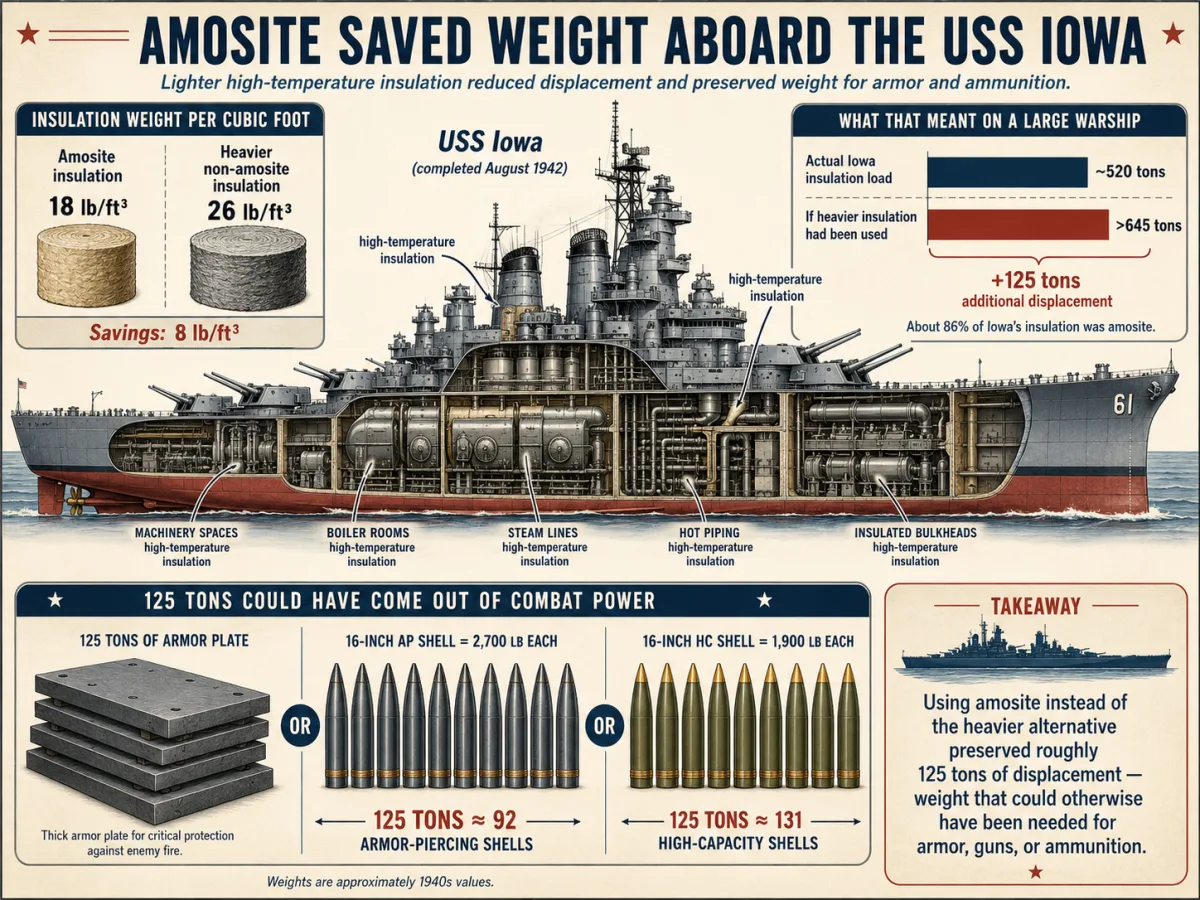
That's a single battleship carrying on the order of 520 tons of insulation, most of it amosite, put there on purpose to save weight. The engineering logic was real. So was the consequence: hundreds of tons of a known carcinogen packed into a sealed steel hull that several thousand men then lived inside. The same property that made asbestos attractive on paper, that it was light, cheap, and everywhere, is what put fiber in the air of nearly every compartment once that insulation aged, got disturbed, or was torn out and replaced. How asbestos pipe and block insulation exposed workers.
What made a ship different from a factory was that there was nowhere for the dust to go. A boiler room or an engine room was a closed steel space with limited ventilation, and fiber knocked loose during maintenance hung in the air and was breathed and rebreathed rather than carried away. It drifted through the passageways into berthing and mess, so the men who slept and ate near the machinery spaces breathed it too. During an overhaul, when lagging was ripped off and replaced wholesale, the whole ship could fill with it while the crew was still living aboard. The exposure reached the rated engine-room sailor first and hardest, but it did not stop with him.
None of this ended when the ships were new. Many of the hulls built in the World War II surge stayed in the fleet for decades, through Korea, Vietnam, and beyond, carrying their original asbestos the whole time and shedding more of it as they aged. The men who served those ships in the 1960s and 1970s often breathed fiber from insulation that had been deteriorating since the 1940s, and the diseases that exposure caused are being diagnosed now, half a century later.
How sailors were exposed: jobs aboard ship
How much asbestos a sailor breathed depended on his rating and where he worked, but the ship's design meant the exposure reached well past the men who handled the material. A few rating families took the heaviest dose.
Engine-room and fireroom ratings. Boiler technicians, machinist's mates, enginemen, water tenders, and firemen spent their watches surrounded by insulated boilers, turbines, and steam lines, and the upkeep was constant: scraping and renewing the gaskets on every flanged joint, pulling and repacking the valves and pumps, and cutting into pipe lagging to reach the line underneath. This was the most asbestos-saturated work on the ship, performed in the most enclosed spaces. The fiber released by that gasket and insulation work is documented on our asbestos gaskets and packing and asbestos pipe and block insulation pages.
Hull, repair, and damage-control ratings. Hull maintenance technicians, pipefitters, and shipfitters cut, fit, and removed asbestos materials throughout the ship, the same work a civilian pipefitter did, in tighter quarters. Damage controlmen trained and worked with asbestos firefighting blankets and protective gear. Repair-gang work during a yard period, tearing out old lagging to get at the structure underneath, was some of the dustiest work aboard.
Electrician's mates. Shipboard wiring, panels, and electrical insulation used asbestos too, so the men who maintained the electrical plant handled it as a matter of routine, often in the same hot, tight spaces as the engineers.
Everyone else aboard. This is the part that surprises people: a sailor did not have to hold a rating that worked asbestos to be exposed to it. Cooks, yeomen, radiomen, sonar techs, and officers lived and worked in the same sealed ship, breathing the same recirculated air, sleeping in berthing a bulkhead away from insulated steam lines. When a ship was in overhaul, no one aboard was clear of it. Bystander exposure on a ship was not a lesser version of the same problem; it was the same fiber in the same air.
You don't need to know how much you breathed or exactly where it came from. Tell us your rating and your ship, and we reconstruct the rest from the ship's configuration, the materials it was built and maintained with, and the work that went on around you.
VA exposure risk by Navy rating
The VA sorts military jobs by how likely they were to involve asbestos, and it uses that judgment when it weighs a veteran's disability claim. For Navy ratings the categories run highly probable, probable, and minimal. Knowing where your rating falls is a useful starting point, but two things about it matter more than the label.
First, this scale measures exposure likelihood, not the strength of your claim. A rating in the highly-probable group is an easier starting point for connecting a diagnosis to service, but a minimal rating doesn't close the door, and many veterans in lower-rated jobs were heavily exposed because of where their ship took them and what was going on around them. We regularly document exposure for sailors whose rating wasn't on anyone's high-risk list, using duty stations, overlapping work areas, and time aboard ships under overhaul. Second, this VA scale is only one of the three paths. It bears on the VA disability claim; it has nothing to do with your trust claims or your lawsuit, which stand on their own. How the three paths fit together for veterans.
Highly probable. The ratings the VA treats as the most likely to have involved asbestos are concentrated in the engine room, the fireroom, and the hull and repair shops: boiler technician (BT), water tender (WT), machinist's mate (MM, via the engine-room work), hull maintenance technician (HT), pipefitter (FP), and the fire-control and sonar ratings that worked in insulated spaces belowdecks, among others.
Probable. A second group carried significant risk through maintenance work, shared spaces, and support roles alongside the high-exposure trades: enginemen (EN), electrician's mates (EM), the aviation machinist's and structural mechanic ratings, construction ratings (the Seabees), and similar jobs that put a sailor near disturbed asbestos even when it wasn't the core of the work.
Minimal. Most remaining ratings are rated minimal, the deck, administrative, supply, medical, and operations jobs, but minimal isn't none. A cook or a yeoman aboard an asbestos-insulated ship still breathed the air in the passageways and berthing, and that exposure is real even when the rating wasn't flagged for it. This is the group where careful documentation of the ship and the duty stations does the most work.
If you can give us your rating, we can tell you where it falls and, more to the point, build the exposure picture that actually fits your service. How to file a VA disability claim for asbestos exposure.
Ship types and where exposure concentrated
Asbestos was in every class of ship, but it concentrated where the heat was, so the platform a sailor served on shaped his exposure.
Steam-powered surface combatants, the battleships, cruisers, and destroyers, were built around large boiler and engine plants threaded with insulated steam piping, which made their machinery spaces among the most asbestos-heavy environments in the fleet. Aircraft carriers were floating cities with the same propulsion plants scaled up, plus hangar and catapult machinery, and a crew of thousands sharing the ventilation. Submarines were the most concentrated exposure of all: the same insulated machinery packed into the smallest, most tightly sealed hull in the Navy, with the least ventilation and the longest stretches submerged, so the crew breathed and rebreathed the same air for weeks at a time.
The age of the ship mattered as much as the type. Many vessels built in the World War II surge served into the 1970s, and by then their original lagging was decades old, friable (crumbly and dusty), and shedding fiber, while the overhauls meant to keep the ships running tore that material out and replaced it with the crew aboard. A sailor on an older ship was often exposed to more fiber than the men who had commissioned her new.
Because the ship classes and the named vessels are their own search-and-records subject, the detailed rosters live with the work we do reconstructing a specific ship's configuration; tell us your hull and we take it from there.
Naval shipyards and overhaul periods
A sailor's heaviest asbestos exposure often didn't happen at sea. It happened in the yard. When a ship came in for overhaul, repair, or modernization, the work meant tearing insulation off boilers, turbines, and miles of piping and lagging it all back, and that rip-out filled the ship with fiber while the crew was still living aboard. A sailor who stood his watches in a clean-enough engine room at sea could spend a yard period breathing the dust of insulation being stripped out three compartments away.
The major naval shipyards (Norfolk, Pearl Harbor, Puget Sound at Bremerton, Portsmouth, Mare Island, Charleston, Long Beach, and others) ran this work around the clock for decades, and the ships passing through them carried thousands of crewmen who were exposed during those periods. If your service included a yard availability or an overhaul, that stretch often accounts for more of your exposure than the rest of your enlistment combined, and the yard's records help us document it.
The yards exposed two different groups in two different ways, and they have two different homes on this site. The sailor aboard during an overhaul is the Navy story, and it's covered here. The civilian shipyard worker who did this work for a living, the premises defendants who ran the yards, and the Longshore benefits available to civilian maritime workers are their own subject. Shipyard and maritime asbestos exposure.
Sources of compensation for Navy veterans
A Navy veteran's recovery usually comes from more than one place at once, and the channels run in parallel without canceling each other out. We file across all of them that apply.
- VA disability benefits. Monthly tax-free payments and VA healthcare for a service-connected asbestos disease, paid on top of everything else and without proof of which company made the product. This is the third path most asbestos victims don't have, and for Navy veterans it's often the most straightforward to establish. VA disability benefits for asbestos exposure.
- Asbestos bankruptcy trusts. The companies that made the insulation, gaskets, and packing aboard ship and later went bankrupt set aside money in trusts to pay the people they harmed. These are paper claims, no lawsuit or courtroom required, and a single enlistment often supports filings against several trusts at once. How asbestos trust claims work.
- Lawsuits against the contractors. The product makers still in business can be sued directly for selling a product they knew was dangerous. Because the Feres doctrine bars suing the government itself, the lawsuit side of a Navy veteran's case is aimed at these private companies, not the service. How asbestos product liability lawsuits work.
- Other benefit programs. These depend on the work history and are paid alongside the rest. Civilian shipyard work, before or after service, can support benefits under the Longshore and Harbor Workers' Compensation Act (LHWCA); civilian work at a federal facility can support benefits under the Federal Employees' Compensation Act (FECA); and Social Security disability is available to anyone whose illness stops them from working. How asbestos disability and benefit claims work.
The three main paths reinforce each other, and the same service history feeds all of them. We line them up so each one supports the others and nothing gets left on the table. How the three paths work together for veterans.
Navy families and take-home exposure
Sailors weren't the only ones exposed. The fiber that settled into a uniform, a sea bag, and a pair of dungarees came home at the end of a deployment or a duty day, to base housing or an off-base place, the same way it came home from any civilian job. Spouses who laundered uniforms handled it week after week, sometimes across a twenty-year career and a dozen duty stations. Children breathed it in the house and the car and hugged a parent still in working clothes.
Family members have developed mesothelioma, lung cancer, and asbestosis from that secondhand exposure, and they have their own claims. A family member's case runs against the same contractors, through the same trusts and lawsuits, as the sailor's, and it stands on its own even when the veteran never got sick. If you're a Navy spouse or child diagnosed with an asbestos disease, that's worth a call. As part of representing a Navy family, we also provide free asbestos health screening for the family members who shared that exposure. The screening is a chest X-ray read by a B-reader, with a CT scan if needed; it looks for asbestos-related changes in the lungs and isn't a diagnosis or a reliable way to find mesothelioma early. Take-home and secondary asbestos exposure.
How a Navy veteran's case can come together
The following is a composite example, not a real client, but it reflects how these cases typically come together in our experience.
Walt enlisted in 1969, straight out of high school, and served four years as a boiler technician aboard a destroyer that had been built in 1944 and was still steaming hard through the end of the Vietnam era. He spent his watches in the fireroom, and the upkeep never stopped: scraping baked-on gaskets off the flanges, pulling dried packing out of the valves and pumps and cutting new rings to seat, and cutting into the pipe lagging to reach a line that needed work. The insulation on that ship was as old as the hull, decades past new, crumbling and shedding fiber every time it was touched, and the worst of it came during a yard overhaul when the repair gang stripped and relagged whole compartments while the crew lived aboard. Walt mustered out in 1973, went home, and didn't think about any of it again for fifty years. In early 2026, after months of breathlessness and a chest X-ray that led to a biopsy, he was diagnosed with pleural mesothelioma of the biphasic type.
For Walt's family, the case moves on three tracks at once, which is typical for a Navy veteran. A VA disability claim goes in: a boiler technician is among the ratings the VA treats as highly likely to have involved asbestos, and his service records place him in the firerooms where the exposure happened. Trust claims go against the makers of the gaskets, packing, and insulation he handled, several different companies and several different trusts (among them the Manville, Owens-Corning/Fibreboard, Garlock, and Federal-Mogul trusts). And lawsuits go against the product makers still in business, the companies that sold the Navy materials they knew were dangerous and said nothing. Because pleural mesothelioma is treated at only a handful of specialized centers, getting Walt to the right one may mean travel, and the firm advances the cost of travel and lodging when the best center isn't close to home. Walt's wife, who laundered his uniforms when he was nineteen and again through every reserve drill after, is eligible for free asbestos health screening as part of the representation.
This example is general. Every case depends on the diagnosis, the exposure history, the dates, the defendants, the applicable law, and the available evidence.
In the research library
The National Library of Medicine indexes 36 studies in our medical research library under the Navy. Among the most cited:
- Radiological survey of men exposed to asbestos in naval dockyardsP.G. Harries, F.A. Mackenzie, G. Sheers, et al, 1972 · British Journal of Industrial Medicine · cited 46 times
- Correlation between fibre content of the lungs and disease in naval dockyard workersJ.C. Wagner, C.B. Moncrieff, R. Coles, et al, 1986 · British Journal of Industrial Medicine · cited 45 times
- The rise and fall in incidence of malignant mesothelioma from a British Naval Dockyard, 1979-1999A.K. Hilliard, J.K. Lovett, C.R. McGavin, 2003 · Occupational Medicine · cited 33 times
- Asbestos dust concentrations in ship repairing: a practical approach to improving asbestos hygiene in naval dockyardsP.G. Harries, 1971 · The Annals of Occupational Hygiene · cited 29 times
- Asbestos-related cancers among 28,300 military servicemen in the Royal Norwegian NavyL.A. Strand, J.I. Martinsen, V.F. Koefoed, et al, 2010 · American Journal of Industrial Medicine · cited 22 times
In our case-law library
496 court decisions in our case-law library involve the Navy. Among them:
- Elorreaga v. Viacomcbs Inc.U.S. Court of Appeals, Ninth Circuit, 2024 · Machinist mate apprentice at USS Rupertus, 1950s and 1960s
- Gay v. AO Smith CorporationU.S. Court of Appeals, Third Circuit, 2024 · Navy trainee in nuclear-powered submarine course at Knolls Atomic Power Laboratory (KAPL), 1954-1955
- Corley v. Long-Lewis, Inc.U.S. Court of Appeals, Eleventh Circuit, 2020 · Served in the United States Navy at United States Navy
- Air and Liquid Systems Corp. v. DeVriesU.S. Supreme Court, 2019 · Navy service member at U.S.S. Wanamassa, 1977-1980
- Latiolais v. Huntington Ingalls, IncorporatedU.S. Court of Appeals, Fifth Circuit, 2019 · Machinist aboard the USS TAPPAHANNOCK at Avondale shipyard (USS TAPPAHANNOCK refurbishing), 1960s and 1970s
- Coulbourn v. Crane Co.U.S. Court of Appeals, Ninth Circuit, 2018 · Machinist for the Navy at Navy ships, 1959-1966
Videos


The defenses companies raise, and how we answer them
When a Navy veteran's case goes to court, the contractors raise the same defenses they raise in most asbestos cases, plus a few that are specific to shipboard service. None of them is new to us, and the evidence answers them.
All of this applies only to the lawsuit side. The trust claims are a paper process: no opposing lawyer raises a defense, no one is deposed, and no one goes to court. VA benefits run through their own system, separate again.
How we answer the defenses raised in Navy asbestos cases
"He wasn't an engine-room rating, so his exposure was incidental and not ours." This is the argument the contractors lean on hardest against deck, supply, and administrative sailors, and the ship itself answers it. A warship was a sealed steel box with limited ventilation, and fiber disturbed in the machinery spaces or during an overhaul drifted through the passageways into berthing and mess, where it was breathed and rebreathed. Bystander exposure aboard ship wasn't a fainter version of the same hazard; it was the same fiber in the same air. We document the ship's configuration, the work that went on aboard, and where the sailor lived and worked to show the exposure was real.
"The exposure to any one company's product was too small to matter." These cases are built on documented exposure: the specific dusty tasks aboard ship and the dose that built up across an enlistment or a career, which is what separates a real claim from a trivial one. The bankruptcy trusts pay on brief exposure, and in court we prove a meaningful contribution with that service evidence. We don't argue that a single fiber decides a case.
The contractors also raise the government-contractor defense (the argument that they only built to Navy specifications) and the claim that shipboard chrysotile was the safer fiber type. Both come up in military cases generally, and we answer them in full on the military and veterans asbestos exposure page.
Frequently asked questions
I don't have my service records, my DD-214, or my ship's history. Can I still start?
Yes. You don't need any paperwork in hand to call. We can often help reconstruct where and when you served, and the records can be requested as the case develops. The conversation starts with what you remember: your rating or job, your ship or ships, and roughly when you were aboard. The hull number alone tells us a great deal about what the ship was built and maintained with.
My loved one already passed away. Can we still file?
Yes. Families regularly file after a death, both trust claims and, depending on the state, a wrongful-death lawsuit, and the VA has its own survivor benefits for some families. These deadlines vary by state and some are short, and what's available can depend on whether a claim was preserved during the veteran's life, so it's best to call promptly. We handle wrongful-death and estate claims as a matter of routine.
I only served a few years and then went on with my life. Is it too late, and was my exposure even enough?
Neither, usually. Mesothelioma can take forty or fifty years to appear, so a man who served in the early 1970s and is diagnosed today is right on the curve we expect, not an outlier. And for mesothelioma the trusts pay on brief exposure aboard a ship that used asbestos, so a short enlistment can still support a claim. A few years in an engine room or aboard an aging ship was plenty of exposure.
My ship wasn't a steam-powered combatant. Does that change things?
It might change the picture, but it rarely closes the door. Asbestos was in auxiliary ships, amphibious ships, submarines, and Coast Guard cutters, not only the battleships and destroyers, and the same sealed-compartment problem applied. Tell us the ship and we'll tell you what it was likely built and maintained with.
Does filing trust claims or a lawsuit reduce my VA benefits?
No. The three paths are separate systems, and a recovery from the trusts or a lawsuit doesn't reduce your VA disability payments or your retirement pay. That's the point of running them together: each adds to the others rather than trading off. We coordinate the timing so nothing interferes.
What happens when I call?
A member of our litigation team, not a screener, takes the call, and the first conversation usually runs twenty to thirty minutes. We listen to the service history, explain which of the three paths may apply, and lay out the timeline for your situation. No one is pressured to sign anything on that call, and you don't have to travel to us; we work with families in every state by phone, video, and mail.
What does it cost to work with you?
Nothing up front, and nothing at all unless we recover for you. We work on a contingency fee, which means our fee comes only out of money we recover, and the case review and consultation are free. Your VA disability benefits are paid directly to you.
Talk with an asbestos lawyer about Navy exposure
Whether you're a veteran who was just diagnosed, or a spouse or adult child trying to find help for someone who's sick or who has passed, we're ready to talk. You don't need the product names, you don't need your service records, and you don't need to travel to us. Start with what you remember (your rating, your ship, the rough years), and we'll take it from there.
Related resources
Sources and references
The exposure measurements on this page come from published industrial hygiene testing, cited in full on the product pages where each figure lives:
- The 28.4 f/cc gasket-removal measurement is documented on our asbestos gaskets and packing page.
- The 51.7 f/cc pipe-insulation measurement is documented on our asbestos pipe and block insulation page.
Other authorities relied on:
- Occupational exposure limits. OSHA's asbestos standard sets the current permissible exposure limit at 0.1 f/cc averaged over eight hours, with a short-term excursion limit of 1.0 f/cc over thirty minutes. 29 C.F.R. § 1910.1001.
- Carcinogenicity. The International Agency for Research on Cancer classifies all forms of asbestos, including chrysotile, as carcinogenic to humans (Group 1) and recognizes no safe threshold of exposure for mesothelioma. IARC Monographs, Vol. 100C.
This page is provided for general informational purposes and does not constitute legal advice. Every asbestos case turns on its own facts, exposure history, diagnosis, deadlines, available evidence, and applicable law. Reviewing this page does not create an attorney-client relationship. For advice about your specific situation, call 833-4-ASBESTOS for a free case review.
This page is provided for general informational purposes and does not constitute legal advice. Every asbestos case turns on its own facts, exposure history, diagnosis, deadlines, available evidence, and applicable law. Reviewing this page does not create an attorney-client relationship. For advice about your specific situation, call 833-4-ASBESTOS for a free case review.