

If you worked in a shipyard or aboard ship — or if someone in your family did — and a mesothelioma, lung cancer, asbestosis, or other asbestos diagnosis has now come in, this page is the place to start. The same dust reached the spouses and children who washed the work clothes, and it didn't matter whether the worker was an insulator, a pipefitter, a machinist, or a sailor, because the ship itself was packed with the material from the keel up.
A ship was the most enclosed workplace in heavy industry, and that put every trade's dust into the same air. In one small steel compartment an insulator might be cutting and ripping out pipe covering while a pipefitter ground gaskets off the flanges a few feet away, with a machinist, a welder, and a boiler tender all working the same space, and each trade's work threw off asbestos dust into a box that couldn't clear it. None of it stayed with the man who made it: asbestos fibers are light enough to hang in the air for hours and drift through a compartment, so a man breathed not just his own dust but everyone's. That bystander exposure was significant: even twenty feet from active insulation and gasket work the air still put about a month's worth of ordinary city background through the lungs in a quarter hour. Making matters worse, a ship's compartment was far tighter than twenty feet. The dustiest work of all was overhaul, tearing the old, degraded lagging back out for weeks at a time, which the Navy's own hygienists singled out as where the heaviest exposures happened. The chart below shows fifteen minutes of insulation and gasket work against a year of ordinary city air.
Even ordinary city air carries a faint trace of asbestos, from natural mineral erosion and a century of industrial use, and that trace is the yardstick the chart measures against.
What these numbers mean. Asbestos in air is measured in fibers per cubic centimeter (f/cc), a unit that hides how dangerous a task was. Across this site we translate each measurement into fibers breathed, feet of fiber end to end, and years of ordinary city air, using conservative, government-sourced assumptions. See how we measure asbestos in air for the method and its limits.
You don't need to remember which company's insulation or gaskets were aboard, and you don't need old service records or yard badges in hand. The bankruptcy trusts that pay many of these claims are built to compensate exactly this kind of work: for mesothelioma, even brief asbestos exposure on a worksite that used it is typically enough to qualify, so you don't have to prove a heavy dose. If you can say "I lagged pipe at the Navy yard" or "my husband was a machinist mate in the engine room," we have a starting point.

You don't need the product names or old records. No fee unless we recover compensation for your family.
Quick answers
| Did shipyard work really expose me to asbestos? | Almost certainly, for any career that ran through the 1980s. Ships were insulated and sealed with asbestos from the engine room to the berthing spaces, and the confined compartments trapped the dust. Building a ship was dusty; repairing and overhauling one, ripping the old lagging back out, was dustier still. |
|---|---|
| I worked a Navy yard. Is that different from a private shipyard? | It can change which benefits apply, not whether you have a claim. Civilian workers at a Navy yard were federal employees, which can open one set of benefits, while workers at private yards may have another. Either way, the claims against the companies that made the asbestos products run in parallel. |
| I served in the Navy aboard ship, I didn't work the yard. Am I in the right place? | You may want our military and veterans page, which covers service exposure and VA benefits, but start here if you also did yard work. Sailors and yard workers breathed the same shipboard asbestos, and the product claims are built the same way. |
| How much exposure do I need for a claim? | For mesothelioma, less than you'd expect. The bankruptcy trusts that pay many of these claims are built to compensate brief exposure on a worksite that used asbestos, so you don't have to prove years of heavy dust. Courts ask for more than the trusts do, and we handle that distinction for you. |
| How long do I have to file? | It depends on your state and on whether this is a personal-injury or a wrongful-death situation, and some of those deadlines are short. The safest step is to call as soon as possible after diagnosis so the clock doesn't run out. |
| Do I have to file a lawsuit? | No. Many shipyard workers and their families recover through trust claims and benefits without ever filing a lawsuit. Trust claims are paper claims, not courtroom cases. We explain both paths and respect your decision. |
| Can a spouse or adult child call for the worker? | Yes. Most of our first calls come from a wife or an adult child researching for someone who is sick or who has passed. You don't need a power of attorney to ask questions. |
“I started this firm after learning that the cancers that killed my father and grandparents were caused by asbestos, something we did not realize until it was too late to hold anyone accountable. That experience is why we built this site: so that no other family misses their chance to ask the questions, hear the options, and decide for themselves what to do.”
Why ships were built out of asbestos
Shipbuilding put workers in daily contact with asbestos for a structural reason and made it worse with a spatial one. The structural reason is the same as every other heavy industry: a ship ran on steam and heat, its engine and boiler rooms passed 1,000 degrees, so workers needed to be protected. Fire at sea meant death with nowhere to go, so the Navy and the shipping lines insulated and fireproofed everything with the one material that could take the heat - asbestos. Ships put one more demand on top of the heat. The material had to survive a salt environment, and amosite (brown asbestos, an amphibole, a more hazardous fiber type) resisted seawater and corrosion better than the alternatives, which is much of why so much marine insulation and board ran on amosite rather than chrysotile alone.
In September 1934 the passenger liner SS Morro Castle caught fire off the New Jersey coast and burned with a heavy loss of life, a disaster that pushed maritime fire-safety rules toward exactly the kind of asbestos fireproofing, including rigid asbestos board like Marinite, that would fill ships for decades after. Read how the Morro Castle fire drove Marinite into shipbuilding.
The spatial reason is what set ships apart. A ship is the most enclosed workplace in heavy industry. It's basically a steel box divided into small steel compartments, so when insulation was cut, fitted, or torn out in one of those spaces, the fiber had nowhere to go but into the air the crew breathed and back into their lungs.
The people who studied this most closely were the Navy's own doctors and hygienists. As early as the 1940s, Navy medicine had flagged that pipe coverers and insulators in the yards were showing lung scarring, and by the late 1960s the Navy's industrial hygiene program was measuring the dust task by task and screening the workforce with chest X-rays. What they found was that the pipe coverers and insulators who handled the material had by far the highest rate of lung abnormalities, the boilermakers with intermittent exposure had less, and the office workers with none had fewer still. The Navy's shipyard findings are documented on our asbestosis page.
Their other central finding was critical: installation studies understated the hazard, because the worst exposures came during overhaul. Ripping degraded, heat-baked insulation off the lines and boilers during a repair put far more fiber in the air than laying new lagging ever did. The men did that work for weeks, often cleaneingup with brooms and air hoses that made the dust worse. And they went home in dusty dungarees to their families, while the companies that made the products knew what the dust was capable of doing.
Where the asbestos was, from the engine room to the yard
A shipyard worker's exposure depended on where he worked the ship and where he worked the yard, and both matter to reconstructing the case. Here's the tour.
- The engine and boiler rooms. The heart of the exposure. Boilers, turbines, and the steam lines running off them were lagged in asbestos pipe covering and block, the joints were sealed with asbestos gaskets, and the valves and pumps were packed with asbestos. Much of the pipe covering was amosite (brown asbestos, an amphibole, a more hazardous fiber type), sold under names like Unibestos, and the confined heat of the space meant the lagging was worked and reworked constantly.
- The machinery and pipe spaces. Beyond the main spaces, miles of piping ran throughout the ship, every foot of it insulated and every joint gasketed, cut and fitted by pipefitters and coverers working shoulder to shoulder in passages and voids.
- Below decks and the living spaces. Fireproofing didn't stop at the machinery. Bulkheads, overheads, and berthing compartments were insulated and faced with asbestos board, much of it Marinite, a rigid structural board that was often made with amosite, the same more hazardous amphibole fiber used in the pipe lagging. Between the board and the troweled or sprayed materials over the framing, even the crew's quarters were built of it.
- The ways and the drydocks. New construction on the building ways and repair work in drydock put dozens of trades onto and into the same hull at once, so a man breathed not only his own dust but the dust of every other trade working the compartment.
- The shops. The pipe shop, the insulation shop, and the machine shops cut, sawed, and fabricated asbestos materials to fit. Mixing asbestos cement and cutting block at the bench was among the dustiest work in the yard, and sawing rigid asbestos board like Marinite to fit a bulkhead or panel threw the same amosite-bearing dust in an enclosed shop.
- Overhaul and repair. The dustiest phase, and the one the Navy's hygienists singled out. Tearing old, friable (crumbly and dusty) insulation out of a ship during a repair availability filled closed compartments with fiber for the duration of the job, and repair and overhaul work went on in the yards continuously, ship after ship.
- Life at sea. The exposure didn't end at the pier. Aboard ship, engine room crews, boiler tenders, machinist mates, and the sailors berthed near the machinery lived in the insulated spaces around the clock, and crews did their own underway repairs on lagging and gaskets. Merchant mariners on commercial vessels faced the same shipboard asbestos as Navy crews.
Two things multiplied the exposures. The compartments were small and poorly ventilated, so the fiber concentrated instead of dispersing, and the work repeated for a career: a yard insulator or a career machinist mate did these tasks on ship after ship, availability after availability, for thirty or forty years.

The yards, and how the work gets paid
For a shipyard worker's case, the yard matters twice. It tells us which asbestos products were aboard the ships and in the shops during which years, and it sorts out how the claim gets paid, because shipyards fall into two groups that lead to different benefit channels.
The Navy yards. The government-run yards built, repaired, and overhauled the fleet, and their civilian workforce did the insulation, pipe, and machinery work at the heart of the exposure. A few of the major ones:
- Puget Sound Naval Shipyard at Bremerton, Washington, where the yard's own industrial hygiene program documented the shipyard asbestos exposures this page describes.
- Norfolk Naval Shipyard in Virginia, and Newport News nearby on the private side, together the center of East Coast naval work.
- Portsmouth Naval Shipyard in Kittery, Maine, and Boston (Charlestown) Navy Yard, longtime submarine and surface-ship yards.
- Brooklyn Navy Yard in New York and Philadelphia Naval Shipyard on the Delaware.
- Mare Island, Hunters Point, and Long Beach on the California coast, the Pacific Fleet's building and repair yards.
- Pearl Harbor Naval Shipyard in Hawaii, the fleet's forward repair base.
The private and commercial yards. The private yards built and repaired both Navy and merchant ships, often under the same roof. Among them: the Kaiser yards at Richmond, California, and elsewhere, which turned out Liberty ships by the hundred; Bethlehem Steel's shipbuilding yards at Sparrows Point, Quincy, and other locations; Ingalls in Pascagoula, Mississippi; Avondale in Louisiana; Todd Shipyards on both coasts; and the Great Lakes builders in Michigan, Ohio, and Wisconsin.
If your yard isn't named here, that means nothing about your claim. Naval and private yards, repair facilities, and dry docks all ran on the same asbestos products, and our exposure database reaches far beyond the famous yards. The yard, the shop or trade, and the years are the starting point.
Which group you worked in shapes the benefits, and this is where a shipyard case is different from most:
- Civilian workers at a Navy yard were federal employees, which can open FECA (the Federal Employees' Compensation Act, the federal workers' compensation system) benefits. As with any employer, a worker generally can't sue his own employer over workplace conditions, and for a federal yard that employer was the government. The case runs against the companies that made the asbestos products.
- Workers at private yards may be covered by the LHWCA (the Longshore and Harbor Workers' Compensation Act, the federal compensation system for maritime workers), and depending on how they were employed, the yard itself may be reachable in the case.
- Navy service aboard ship can support VA disability benefits, which run in parallel with everything else. Sailors and veterans should see our military and veterans page.
In all of these, the claims against the product makers and their trusts run the same way, alongside whichever benefit channel fits.
The shipyards didn't make the asbestos; they installed it, by the ton, from the companies that did. The insulation makers supplied the pipe covering and block, the gasket and packing makers built lines for marine service, and the manufacturers behind each product, and which of their trusts pay today, are laid out on the product pages. See the makers behind asbestos pipe and block insulation, and the makers behind asbestos gaskets and packing.
Ships and shipyards named in the trade press
The asbestos industry's own trade journal, Asbestos, and Johns-Manville's employee magazines wrote about ship insulation for sixty years. They named the ships, the yards, the products and the insulation contractors. These notices were written to sell insulation. Today they help families confirm what went into the ships where someone worked.
In 1921 the magazine wrote that "a large percentage of 85% Magnesia Pipe and Boiler Covering is used in naval construction," along with asbestos packings, millboard and paper (Asbestos, Dec. 1921). By 1937 a writer in the same journal called asbestos "practically mandatory in ship construction" (Asbestos, Sept. 1937).
| Ship or yard | Year reported | What the magazine says was used | Insulation contractor | Source |
|---|---|---|---|---|
| Battleships Indiana and Massachusetts, cruisers Columbia and Minneapolis | 1942 (recalling the 1890s) | "Insulation work", early 85% Magnesia sectional covering era | Magnesia Covering Co. (Keasbey & Mattison), foreman John Liner | Asbestos, Mar. 1942 |
| Hog Island, New York Shipyard, Chester Shipbuilding, Cramp's (World War I) | 1942 | Pipe covering by "some 200" pipe coverers | Keasbey & Mattison Philadelphia Branch | Asbestos, Mar. 1942 |
| USS Tennessee (Brooklyn Navy Yard) and USS California (Mare Island Navy Yard) | 1920 | National "85% Magnesia" on steam lines and boilers | — | National Magnesia ad, Asbestos, Dec. 1920 |
| Cruisers Salt Lake City and Chester, New York Shipbuilding Co., Camden, N.J. | 1929 | All insulation materials, from Johns-Manville | — | J-M Circle, Jan. 1929 |
| Tankers Gulf Belle and Gulf Dawn, Sun Shipbuilding & Dry Dock Co., Chester, Pa. | 1936 | K&M Limpet Sprayed Asbestos on underdecks and bulkheads | — | Asbestos, Sept. 1936 |
| Ferry Princess Anne, Virginia Ferry Co. | 1936 | K&M Limpet Sprayed Asbestos on the stack uptake and stack house | — | Asbestos, Sept. 1936 |
| S.S. America, United States Lines | 1940 | K&M Featherweight 85% Magnesia; K&M Ebonized Asbestos panels; K&M Gray Sheet-flextos doors; J-M Marinite staterooms and corridors | Door contractor not named | Asbestos, Mar. 1940 |
| 88 Liberty Ships and 15 tank carriers, Bethlehem-Fairfield yard, Baltimore | 1943 | Insulation | Reid Hayden, Inc. (J-M approved contractor) | Asbestos, Sept. 1943 |
| New York Shipbuilding (Camden) and Sun Shipbuilding (Chester), World War II | 1971 | Shipboard insulation, with asbestos cloth lagging | Philadelphia Asbestos Co. | Asbestos, July 1971 |
| Queen Elizabeth II, John Brown & Co., Clydebank, Scotland | 1967 | Marinite "fire resistant asbestos and diatomite sheets" | — | J-M News Pictorial, Nov. 1967 |
The wartime yards
The scale of World War II shipbuilding shows up in the insulation trade. Asbestos reprinted a 1943 report that the country had gone "from 21 shipyards and 100 ways to 70 yards and more than 300 ways" in two years (Asbestos, Oct. 1943). Reid Hayden said it had insulated over 500 ships in eight southern states since Pearl Harbor (Asbestos, Sept. 1943). Together with H. W. Porter & Co., it had insulated "over 2,000 ships for the Navy and U. S. Maritime Commission" (Asbestos, May 1946). The government rationed asbestos textiles in 1943 because the Navy and Maritime Commission ship program needed more "insulation cloth, gloves and safety clothing" (Asbestos, Mar. 1943).
How the work was done
Pipe covering was cut, fitted and wrapped by hand. Asbestos cloth went "as lagging over thermal insulation" (Asbestos, July 1971). Pipe hangers were wrapped in "cut-to-measure asbestos cloth" (Asbestos, Sept. 1937). In 1944, Bay Area women trained as asbestos pipe coverers put in 200 classroom hours. They were taught sewing because "there is considerable sewing connected with asbestos work" (Asbestos, Aug. 1944).
Asbestos was also sprayed aboard ships. In April 1960, while the liner Empress of Canada was on the stocks at the Vickers-Armstrong yard at Newcastle-on-Tyne in England, J. W. Roberts, the Turner & Newall company behind the Limpet spray machine, measured the air as its blue and white asbestos grades were sprayed on board. Its report gives counts from roughly 6,000 to 14,000 dust particles per cubic centimeter, and found that the machine's water damping made no statistically significant difference (J. W. Roberts report, 1960, pp. 1–2).
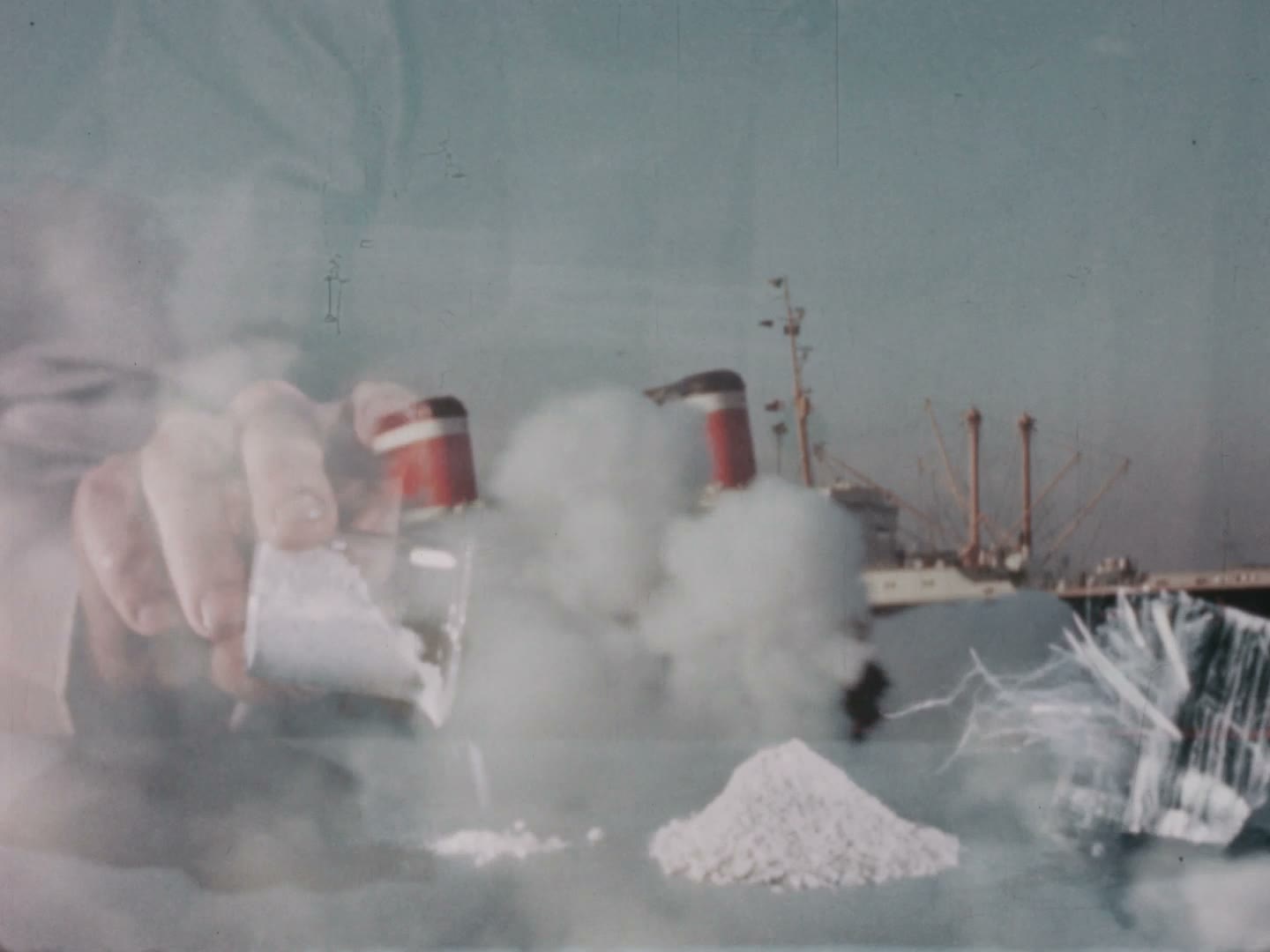
Johns-Manville's own Marinite film (probably 1950s), at Bethlehem Steel's Quincy yard while the liners Independence and Constitution were being built. The panels are cut with a saw "fitted with a silicon carbide cutting wheel," and beveled with a high-speed router. The narrator says a dust disposal system "is desirable when volume cutting is to be done," and says nothing about the asbestos in that dust. The passage runs about two minutes.
Watch the whole film, with its transcript: Safer Ships for Our Merchant Marine
What came later
In 1970 the insulation industry's hygiene program took air samples from ship compartments in Gulf Coast yards (Asbestos, July 1970). In 1975 the union at Electric Boat in Groton said 22 pipecoverers who worked with asbestos had died of respiratory failure in 17 years (Asbestos, July 1975). In 1976, in an item supplied by the asbestos industry's trade association, two Navy medical officers said predicted excess disease among wartime yard workers had "not materialized" (Asbestos, Sept. 1976). In 1980 the same magazine reported abnormal chest X-rays in up to 85% of 300 General Dynamics workers examined at Quincy. It also reported lung damage in more than 86% of long-time workers studied at Bethlehem Steel's Key Highway yard in Baltimore (Asbestos, Mar. 1980).
If your loved one's ship or yard isn't listed here, that doesn't mean it was free of asbestos. These are only the ones the trade press happened to name.
The trades that worked the ships and yards
A shipyard employed dozens of trades, and several of them have their own pages, because their exposure followed them across industries. If your loved one's work fits one of these better than it fits "shipyard worker," start there:
For everyone else, the shipfitters, the pipe coverers and laggers, the machinist mates and boiler tenders, the welders and chippers, the riggers, and the yard laborers, this page is your page, and the work described above is the exposure story we build the claim on.
Sources of compensation for shipyard and maritime workers
A shipyard worker's recovery usually comes from more than one place, and the different channels run in parallel without canceling one another out. We file across all of them that apply.
- Asbestos bankruptcy trusts. The companies that made the insulation, gaskets, and packing installed in the ships and later went bankrupt set aside money in trusts to pay the people they harmed. These are paper claims that don't require a lawsuit or a courtroom, and a shipyard career often supports filings against several trusts at once. For a worker whose employer can't be sued, this is usually the backbone of the case. How asbestos trust claims work.
- Lawsuits against solvent manufacturers. Many asbestos product makers, especially in the gasket and packing world, are still in business and can be sued directly for making and selling products they knew were dangerous. How product liability lawsuits work.
- Claims against reachable premises and yards. Depending on how the work was done and who controlled it, a private yard or a shipowner may be answerable for the conditions aboard, separate from the companies that made the products. How premises liability claims work.
- Federal and veterans' benefits, which carry real weight in these cases. Civilian work at a Navy yard can support FECA (the Federal Employees' Compensation Act) benefits; work at a private yard can support LHWCA (the Longshore and Harbor Workers' Compensation Act) benefits; Navy service aboard ship can support VA disability benefits; and Social Security disability is available to anyone whose illness stops them from working. These are paid in addition to the trust and lawsuit recovery, and sorting out which ones fit a given career is a core part of a shipyard case. How asbestos disability and benefit claims work.
Mentioned on this site
- "Asbestos
- 85% Magnesia
- A. Mayer-Pareyn to R. B. Von Wald and J. A. Brown on the Health and Safety History of J-M do Brazil (1980)
- A. W. Garrett, British Chief Inspector of Factories, on Asbestos Insulation Aboard Ships (1945)
- Acetylene Cylinder Reinforcement
- Acid-resistant packing
- Admiralty Jurisdiction
- American Journal of Clinical Pathology
- American Journal of Epidemiology
- American Journal of Industrial Medicine
- American Journal of Public Health
- American Journal of Respiratory and Critical Care Medicine
- Annali dell'Istituto Superiore di Sanità
- Annals of Occupational and Environmental Medicine
- Annals of the New York Academy of Sciences
- Annual Report of the Surgeon General, U.S. Navy, Chief of the Bureau of Medicine and Surgery, to the Secretary of the Navy Concerning Statistics of Diseases and Injuries in the United States Navy for the Calendar Year 1939
- Archives of Environmental & Occupational Health
- Archives of Internal Medicine
- Armstrong World Industries Asbestos Trust Claims
- Arne Westlin, Asbestos
- Asbestos Cement Pipe, Transite, and Marinite
- Asbestos Claims for Seamen
- Asbestos Exposure by Industry
- Asbestos Exposure in Boilermakers
- Asbestos Exposure in Bystander and Proximity Workers
- Asbestos Exposure in Carpenters and Construction Workers
- Asbestos Exposure in Electricians and Electrical Workers
- Asbestos Exposure in Insulators and Insulation Workers
- Asbestos Exposure in Oil and Gas Drilling Crews
- Asbestos Exposure in Pipefitters and Plumbers
- Asbestos Exposure in the Navy
- Asbestos Exposure in Welders
- Asbestos Gaskets and Mechanical Packing
- Asbestos Insulating Cement, Boiler Coatings, and Spray Cement
- Asbestos insulation
- Asbestosis (1962)
- Asbestos Timeline
- Asbestos Timeline
- Asbestos Timeline
- Asbestos Timeline
- Asbestos Timeline
- Asbestos Timeline
- Asian Pacific Journal of Cancer Prevention
- Atlas of Respiratory Disease Mortality, United States
- Babcock & Wilcox Asbestos Trust Claims
- Bare Metal Defense
- Bergit A. Swartout v. Mundet Cork Corp. and Others, California Asbestosis Death Claim (1956–1958)
- BMC Cancer
- BMJ
- BMJ Case Reports
- BMJ Open
- British Journal of Cancer
- British Journal of Industrial Medicine
- Bureau of Ships to the Supervisor of Shipbuilding at Camden on Water-Repellent Amosite Felt (1943)
- Bystander Exposure
- C. S. Stephenson to Admiral McIntire on Health Hazards in the Navy Yards (1941)
- Canadian Journal of Public Health = Revue Canadienne de Santé Publique
- Canadian Medical Association Journal
- Cancer
- Cancer Causes & Control
- Cancer Epidemiology
- Cancer Investigation
- Caposite
- Captain Ernest W. Brown, "Industrial Hygiene and the Navy in National Defense" (1941)
- Chest
- Clinical Radiology
- Clyde A. Szuch to Dr. David Ozonoff Seeking a Medical Historian for Raybestos-Manhattan (1980)
- Combustion Engineering Asbestos Trust Claims
- Comparative Studies on Asbestos
- Critical Reviews in Toxicology
- Curēus
- Dr. Enrico C. Vigliani's Proposal for a Study at the Balangero Mine and Among Italian Shipyard Insulation Workers (1968)
- Dr. Kenneth W. Smith to H. O. Blackburn of Pine Bluff Arsenal on 85% Magnesia (1959)
- Dr. Morris to Mr. Bowditch on the Asbestosis Problem at Bethlehem Steel's Quincy Shipyard (1943)
- Dr. Paul Kotin on Asbestos
- Eagle-Picher Asbestos Trust Claims
- Editorials and News on Asbestos
- Elliott DeForest of the Northwest Magnesia Association to Washington State on Deleting Its Asbestosis Rule (1943)
- Environmental Health
- Environmental Health Perspectives
- Environmental Research
- Epidemiology
- European Journal of Cancer
- European Journal of Cancer Prevention
- Expanded Transite
- Federal Officer Removal
- Feres Doctrine
- Fibreboard Asbestos Trust Claims
- Fleischer, Viles, Gade and Drinker, "A Health Survey of Pipe Covering Operations in Constructing Naval Vessels" (1946)
- Fleischer-Drinker Study
- Frontiers in Public Health
- Furfuryl Alcohol Resin
- Gabriel Ferrucci to All RMIPCO Employees on the HEW Asbestos Warning (1978)
- GAF's Answers to Plaintiffs' Interrogatories in the Key Highway, Fairfield and Sparrows Point Shipyards Asbestos Cases (1981)
- Garlock Sealing Technologies Trust
- General Maritime Law
- George F. Evans to Steven L. Hoch on Blocking Dr. Merrill's Deposition (1982)
- Government Contractor Defense
- H-60 mask
- H-64 mask
- H. B. Rhodes of Union Carbide on Asbestos Papers at the International Congress on Occupational Health (1975)
- H. M. Jackson to William T. Marr of the Long Beach Naval Shipyard on Asbestos Dust Standards (1959)
- Harvey B. Elkins to Dr. Allen D. Brandt of Bethlehem Steel on Asbestos at the Quincy Shipyard (1954)
- Hercules Packing Corporation
- Hilton C. Lewinsohn, "Medical Aspects of Occupational Exposure to Asbestos" (1977)
- Historical Articles on Asbestos
- Human Pathology
- Index Cards Abstracting Italian Studies of Asbestosis Among Miners and Shipyard Workers (1972)
- Indian Journal of Occupational and Environmental Medicine
- Industrial Health
- Industrial Health Survey of the Bath Iron Works Corporation for the Maritime Commission (1942)
- Industrial Health Survey of the South Portland Shipbuilding Corporation and the Todd-Bath Iron Works (1942)
- Inhalation Toxicology
- Internal Medicine
- International Agency for Research on Cancer Press Release, Asbestos and Cancer
- International Archives of Occupational and Environmental Health
- International Journal of Cancer
- International Journal of Environmental Research and Public Health
- International Journal of Epidemiology
- International Journal of Hygiene and Environmental Health
- International Journal of Occupational and Environmental Health
- International Journal of Occupational Medicine and Environmental Health
- International Journal of Radiation Biology
- Irving J. Selikoff, Jacob Churg and E. Cuyler Hammond, "Asbestos Exposure and Neoplasia" (1964)
- Jackson v. Armstrong Cork, Summary Exhibits of Exposure Documents (1982)
- JAMA
- Japanese Journal of Cancer Research
- Jefferson County
- John Crane Inc.
- Johns-Manville Memos on a Caution Label for Marinite (1958)
- Jones Act
- Journal of Occupational and Environmental Hygiene
- Journal of Occupational and Environmental Medicine
- Journal of Occupational Medicine.
- Journal of Thoracic Disease
- Journal of Thoracic Oncology
- Journal of Toxicology and Environmental Health. Part B, Critical Reviews
- JTO Clinical and Research Reports
- Kaj Ahlman and Eero Siltanen, Exposure of Insulation Workers to Asbestos Dust (1971)
- Kaylo
- Kenneth W. Nelson and James P. Morgan, Industrial Hygiene Survey of Gulf Shipbuilding Corporation, Chickasaw, Alabama (1944)
- La Medicina del Lavoro
- Liberty Mutual and Vandiver Brown on J-M's Help in Silva v. Hopeman Brothers (1941)
- Liberty Ship
- List of Ships Built, Repaired or Overhauled at Ingalls Shipbuilding (1940s-1970s)
- Lois Gaul's Johns-Manville Memo on the Rhode Island Medical Journal (1983)
- Lois Gaul's Manville Memo on 1021 Answers to Industrial Health and Safety Problems (1984)
- Lois Gaul's Manville Memo on E. R. Hayhurst's Survey of Industrial Health-Hazards in Ohio (1985)
- Lois Gaul's Manville Memo on the Bulletin of Hygiene (1985)
- Longshore and Harbor Workers' Compensation Act (LHWCA)
- Lung
- Lung Cancer
- Machinist's Mate
- Manville
- Manville Fund's Answers to Interrogatories in Gunn v. Celotex (1989)
- Marine Sheathing
- Marinite
- Merchant Marine
- Military Specifications (MIL-SPEC)
- Minimum Requirements for Safety and Industrial Health in Contract Shipyards (1943)
- MMWR. Morbidity and Mortality Weekly Report
- Molecular and Clinical Oncology
- Naval Ship Engineering Center to Ingalls Shipbuilding on Shipyard Asbestos Hazards, with Ingalls' Reply (1969)
- Navy Veterans
- Newport News Shipbuilding
- Novelties in Ship Fittings (1899)
- Occupational and Environmental Medicine
- Occupational Exposure
- Occupational Medicine
- Owens-Corning Fiberglas
- Owens-Illinois
- Owens-Illinois Asbestos Personal Injury Trust
- Owens-Illinois Asbestos Trust Claims
- Owens Corning Asbestos Trust Claims
- Part 2 of EPA’s 2024 Asbestos Evaluation (And Why It Matters)
- Pathobiology
- Phoenix area (Mesa)
- Pipe Covering
- Pittsburgh Corning
- Pittsburgh Corning Asbestos Settlement Trust
- Pittsburgh Corning Asbestos Trust Claims
- Proceedings of the Royal Society of Medicine
- Public Law 733
- R. H. Mereness to Asbestos Information Association Members on HEW's Asbestos Awareness Campaign (1978)
- Radiology
- Raybestos-Manhattan Statement on Preventing Asbestos-Related Disease After the HEW Warning (1978)
- Re-Inspection Report on Safety and Industrial Health at Defoe Shipbuilding Company, Bay City, Michigan (1944)
- Reading Castleman, Appendix 2
- Reading Castleman, Chapter 3
- Reading Castleman, Chapter 4
- Reading Castleman, Chapter 5
- Reading Castleman, Chapter 10
- Reading Castleman, Chapter 11
- Removal to Federal Court
- Report to Congress on Workers' Home Contamination Study Conducted Under the Workers' Family Protection Act (1995)
- Research on Amphibole Asbestos
- Research on Chrysotile
- Research on Construction
- Research on Naval Medicine
- Research on Ships and Shipyards
- Research on Welding
- Respiration; International Review of Thoracic Diseases
- Respiratory Medicine
- Respiratory Medicine Case Reports
- Respirology
- Reviews on Asbestos
- Royal Renovation Woes
- S.S. Iowa
- S.S. Morro Castle
- Safer Ships for Our Merchant Marine
- Scandinavian Journal of Work, Environment & Health
- Scottish Medical Journal
- Shipyard Exposure
- Spinnability
- Statement of Richard A. Lemen Before the Subcommittee on Coast Guard and Navigation, House Committee on Merchant Marine and Fisheries (1980)
- Strong Link Found Between Asbestos & Esophageal Cancer
- Study Summary
- The American Journal of Medicine
- The American Review of Respiratory Disease
- The Annals of Occupational Hygiene
- The Employers' Group Engineering Manual on Occupational Disease Hazards (1937)
- The European Respiratory Journal
- The Johns-Manville Knowledge Chronology
- The Medical Journal of Australia
- The New England Journal of Medicine
- Thermal System Insulation (TSI)
- The Travelers Insurance Company's Product Information Booklet for Its Asbestos Seminar (1980–1981)
- The Western Journal of Medicine
- Thorax
- Toxicology and Industrial Health
- Translational Lung Cancer Research
- Tumori
- Turner Brothers Asbestos
- U.S. Maritime Commission Conference on Health and Safety in Shipyards, with Philip Drinker's Address (1942)
- Ultrastructural Pathology
- Videotaped Deposition of Clifford L. Sheckler (1982)
- Videotaped Deposition of Dr. Paul Kotin in the South Carolina Asbestos Cases (1979)
- W. B. Reitze to H. B. Moreno, Trip Report on Asberit and Magnebras in Brazil (1977)
- W. C. Dreessen and W. E. Fleischer, Asbestosis from Amosite Pipe Covering at Bath Iron Works (1944)
- Wards of the admiralty
- War Production Board
- Washington Naval Treaty
- Wedgeworth and Hart v. Armstrong Cork, Plaintiffs' Interrogatories to the Defendants (1981)
- Welding Rod Coating
- William T. Marr, "Asbestos Exposure During Naval Vessel Overhaul" (1964)
In the research library
The National Library of Medicine indexes 65 studies in our medical research library under ships and shipyards. Among the most cited:
- Lung cancer after employment in shipyards during World War IIW.J. Blot, J.M. Harrington, A. Toledo, et al, 1978 · The New England Journal of Medicine · cited 171 times
- Asbestos-associated disease in United States shipyardsI.J. Selikoff, E.C. Hammond, 1978 · CA: A Cancer Journal for Clinicians · cited 71 times
- Asbestos disease in United States shipyardsI.J. Selikoff, R. Lilis, W.J. Nicholson, 1979 · Annals of the New York Academy of Sciences · cited 67 times
- Mortality among shipyard workers in Genoa, ItalyR. Puntoni, M. Vercelli, F. Merlo, et al, 1979 · Annals of the New York Academy of Sciences · cited 62 times
- Incidence of cancer among welders of mild steel and other shipyard workersT.E. Danielsen, S. Langård, A. Andersen, et al, 1993 · British Journal of Industrial Medicine · cited 45 times
In our case-law library
751 court decisions in our case-law library involve shipyards and maritime work. Among them:
- Long v. Foster Wheeler Energy CorporationU.S. Court of Appeals, Ninth Circuit, 2025 · Civilian ships
- Marsh v. Chas Kurz & CompanyU.S. Court of Appeals, Fifth Circuit, 2024 · Merchant mariner at vessels owned by Chas Kurz & Co., Chiquita Brands (United Fruit), Farrell Lines (American Export Lines) and National Bulk Carriers, 1940s-1950s
- Deem v. William Powell Co.U.S. Court of Appeals, Ninth Circuit, 2022 · Outside marine machinist at Puget Sound Naval Shipyard, 1974-1981
- Latiolais v. Huntington Ingalls, IncorporatedU.S. Court of Appeals, Fifth Circuit, 2020 · Machinist aboard the USS Tappahannock at Avondale shipyard (USS Tappahannock refurbishment), 1960s and 1970s
- Schindler v. Dravo Basic Materials Company, IncorporatedU.S. Court of Appeals, Fifth Circuit, 2019 · Worked in the engine room of the dredge Avocet (merchant marine) at Avocet (dredge), Lake Pontchartrain, 1973
- New York City Asbestos LitigNew York Court of Appeals, 2019 · Merchant marine seaman at Texaco-owned ships, 1953-1955
Videos


The defenses companies raise, and how we answer them
When a shipyard worker's case goes to court, the companies raise the same handful of defenses they raise in most asbestos cases, plus a few tuned to the yards, and none of them is new to us. The short version is that the arguments describe a cleaner, smaller version of the work than the one your loved one actually did, and the evidence answers them. The detail is below for anyone who wants it.
All of this applies only to the lawsuit side of a case. The trust claims are a paper process: no opposing lawyer raises defenses, no one is deposed, and no one goes to court.
How we answer the defenses raised in shipyard and maritime cases
"The exposures were within the safety limits of the day." The people best placed to judge that were the Navy's own hygienists, and by the late 1960s they had concluded the opposite: that the exposure limit of the era was too permissive, and that the intermittent peak exposures of cutting and ripping out insulation did the damage even when the time-weighted average looked acceptable. The measured task levels, and the lung disease the Navy found in its own workforce, are how we answer this.
"The asbestos in these products was the less-dangerous kind." Not aboard ship. Much of the marine pipe covering and block was amosite (brown asbestos, an amphibole, one of the more hazardous fiber types), sold under names like Unibestos, and amosite is one of the fibers most strongly linked to mesothelioma. The insulation a shipyard worker cut and tore out was not the mild case the argument imagines.
"The exposure was during removal, not manufacture, so the maker isn't responsible." The makers sold insulation knowing it would be cut and fitted to install and torn out to repair, in exactly the confined shipboard spaces where the fiber couldn't clear. Removal wasn't a misuse of the product; it was the predictable, necessary end of the product's life, and the testing that recorded the highest levels recorded them during that removal work.
"The exposure to any one company's product was too small to have made a difference." These cases are built on documented exposure: the specific high-dust tasks the trades performed and the dose built up across a full career of ships and availabilities. The bankruptcy trusts pay on brief exposure, and in court we prove a meaningful contribution with that task and career evidence, reconstructing which makers' products were aboard specific ships and in specific yards during specific years.
Frequently asked questions
I don't have my Navy yard records or service paperwork. Can I still file?
Yes, and that's a common starting point. You don't need your service records, yard badges, or old pay records in hand to begin. We reconstruct the history from our exposure database, the trust documentation for each product's maker, the known fit-outs and repair histories of specific ships and yards, and the recollections of the worker and his shipmates and coworkers, and where service records help, they can often be requested from the National Personnel Records Center. The claim is built on the ships, yards, trades, and years, not on a perfect paper file.
My loved one was a sailor aboard ship, not a yard worker. Is this the right page?
It's a good place to start, and there may be more. Sailors, especially engine room and boiler crews, machinist mates, and boiler tenders, breathed the same shipboard asbestos as the yard workers who installed it, so the product claims are built the same way. Navy service can also support VA disability benefits, which our military and veterans page covers in full. Tell us about both the service and any yard work, and we'll sort out every channel that applies.
My loved one has already passed away. Can we still bring a claim?
Yes. Families regularly file after a death, both trust claims and, depending on the state, a wrongful death lawsuit. These deadlines vary by state and some are short, and the family's claim can depend on whether a claim was preserved during the worker's life, so it's best to call promptly. We handle wrongful death and estate claims as a matter of routine.
He smoked. Does that ruin the case?
No. Mesothelioma isn't caused by smoking, so a smoking history doesn't touch a mesothelioma claim at all. For lung cancer, asbestos and smoking multiply each other's damage rather than canceling out, and shipyard workers and sailors who smoked and breathed asbestos may still have strong claims. Don't let a smoking history stop you from asking.
Could my family have been exposed through the work clothes?
Yes, and it's common. The dust that settled on a shipyard worker's dungarees, hair, and boots came home with him, and spouses who shook out and laundered work clothes and children who hugged a parent after a shift were exposed too. That's why our representation includes free asbestos health screening for family members, and if a family member is later diagnosed, they may have a claim of their own. The screening is a chest X-ray read by a B-reader, with a CT scan if needed; it looks for asbestos-related changes in the lungs and isn't a diagnosis or a reliable way to find mesothelioma early.
What happens when I call?
A member of our litigation team, not a screener, takes the call, and the first conversation usually runs twenty to thirty minutes. We listen to the work history, explain which claims and channels may apply, and lay out the timeline for your situation. No one is pressured to sign anything on that call.
What does it cost to work with you?
Nothing up front, and nothing at all unless we recover for you. We work on a contingency fee, which means our fee comes only out of money we recover, and the case review and consultation are free.
Do we have to travel to your office?
No. We handle these cases by phone, video, and mail, and we come to you when an in-person visit helps. Families work with us from every state without traveling to us, and shipyard and Navy families are among the people we hear from most.
Talk with an asbestos lawyer about shipyard and maritime exposure
Whether you're a shipyard worker or sailor who was just diagnosed, or a spouse or adult child trying to find help for someone who is sick or who has passed, we're ready to talk. You don't need the product names, you don't need the old records, and you don't need to travel to us. Start with the yard, the ship, or the trade, and the years, and we'll take it from there.
Related resources
Sources and references
The exposure measurements on this page come from published industrial hygiene testing, cited in full on the product pages where each figure lives:
- The 51.7 f/cc pipe-insulation measurement is documented on our asbestos pipe and block insulation page.
- The 28.4 f/cc gasket-removal measurement is documented on our asbestos gaskets and packing page.
- The drift measurements behind the "twenty feet from the work" comparison live on our bystander and proximity exposure page.
Other authorities relied on:
- Occupational exposure limits. OSHA's asbestos standard sets the current permissible exposure limit at 0.1 f/cc averaged over eight hours, with a short-term excursion limit of 1.0 f/cc over thirty minutes. 29 C.F.R. § 1910.1001.
- Carcinogenicity. The International Agency for Research on Cancer classifies all forms of asbestos as carcinogenic to humans (Group 1) and recognizes no safe threshold of exposure for mesothelioma. IARC Monographs, Vol. 100C.
- The Navy's shipyard exposure studies. The U.S. Navy's own industrial hygiene surveys of asbestos exposure at Puget Sound Naval Shipyard, published in the late 1960s, documented the task-by-task dust levels and the elevated rate of lung disease among pipe coverers and insulators described on this page. The lung-disease prevalence finding is documented on our asbestosis page.
This page is provided for general informational purposes and does not constitute legal advice. Every asbestos case turns on its own facts, exposure history, diagnosis, deadlines, available evidence, and applicable law. Reviewing this page does not create an attorney-client relationship. For advice about your specific situation, call 833-4-ASBESTOS for a free case review.