
Marinite was a rigid asbestos insulating board manufactured by Johns-Manville from 1936 until approximately 1978 — a structural sheet material composed of asbestos fiber, diatomaceous silica, and an inorganic binder, pressed into panels and sold as a material that was simultaneously fireproof, insulating, and strong enough to build with. Where sprayed products like Limpet were applied once by a specialist contractor, Marinite was marketed as something any carpenter could cut, drill, and screw together "like lumber." It was installed as bulkhead paneling on, by J-M's own account, every American-flag passenger vessel built from the early 1940s onward and the majority of American cargo ships of the same period, and it built the ovens, driers, and equipment housings of postwar American industry. By 1952, the asbestos trade press put the cumulative marine installation alone at well over thirty million square feet.
The product is significant in asbestos litigation for two reasons. First, its principal grades were built on amosite — an amphibole asbestos with high mesothelioma potency — at 25 to 40 percent by weight. Second, and unlike most rigid asbestos products, the exposure pathway was designed into the marketing: J-M instructed customers to fabricate Marinite themselves, dry-cut, with ordinary woodworking tools, at production rates of hundreds of linear feet per hour. The company's own industrial hygiene testing, decades later, measured what that instruction produced.
You don't need the product names or old records. No fee unless we recover compensation for your family.
The Origins of Marinite: the Morro Castle fire
On September 8, 1934, the American liner Morro Castle caught fire on its run from Havana to New York and was beached at Asbury Park, New Jersey. J-M's commissioned corporate history, Men — and a Magic Mineral, records that 318 passengers and 134 crew were "burned to death, drowned or seriously injured"; the death toll generally accepted in the historical record is approximately 137. The disaster produced immediate political and regulatory reaction: four days after the fire, newspapers nationwide carried a statement from President Roosevelt advocating fireproof ships and a ban on wooden construction in passenger and crew quarters.
The corporate history is candid — strikingly so, read today — about what the disaster meant inside the company. The Morro Castle fire, "terrible disaster that it was, presented an epochal opportunity to J-M to show what it could do toward developing and furnishing fireproof construction in passenger and cargo vessels." Executive Vice-President T.K. Mial convened Evan Rinehart (a lieutenant commander in the Naval Reserve) and L.A. Baldwin of the Industrial Department within days; Rinehart gathered samples of Expanded Transite, Asbestos Flexboard, and Asbestos Cloth and went downtown to canvass marine architects and shipping executives.
The manuscript also preserves a telling early transaction. One prominent shipping line asked to buy J-M's entire stock of Expanded Transite to fireproof under the wood decks of its existing passenger vessels. "Even though J-M knew that this was not the ideal material for this purpose," the history records, the sale went through — the shipping company decided it was good enough as a preliminary installation.
The technical direction came from George C. Sharp, a prominent marine architect and chairman of the Marine Committee of the National Fire Protection Association, whose committee — later formalized under presidential appointment, with Commander (later Rear Admiral) H.L. Vickery as vice-chairman — concluded that the basic problem was confining fires to the areas where they started: fireproof staterooms and cabins, and sectionalized ships with fireproof bulkheads, rather than asbestos draperies and upholstery. A small steamship, the S.S. Nantasket, was assigned for live fire tests under simulated operating conditions, and manufacturers were invited to submit materials for sample staterooms.
Development: three tries and an amosite solution
J-M's path to Marinite ran through two failures, both documented in the corporate history.
First attempt (1935): panels of asbestos paper in cellular form. Some were sold, but the cellular panels were not vermin- and rat-proof and would not hold screws.
Second attempt: at the insistence of marine engineers who wanted a solid, lightweight panel, G.B. Brown of the Research Department developed Marine Sheathing — a cement-and-asbestos-fiber board at 70 pounds per cubic foot. It worked, but the marine engineers and shipyards judged it too heavy.
The constraint that produced Marinite: design requirements capped fireproof panels at 40 pounds per cubic foot. Brown tried numerous substitutes for Canadian (chrysotile) fiber in the marine sheathing formulation until, in early 1936, the problem was solved by using amosite fiber from South Africa to bring the weight down — "and Marinite was invented." The first laboratory samples weighed approximately 40 pounds per cubic foot, and every authority consulted was enthusiastic. Trial production runs were made at the Nashua, New Hampshire factory for sample staterooms in the Nantasket fire test program, and both Marinite and Marine Sheathing were approved in fire tests run through 1936 and 1937.
The mineral selection deserves emphasis: amosite was not incidental to Marinite — it was the invention. The product existed because an iron-magnesium amphibole from South Africa's Transvaal solved a density problem that chrysotile could not.
Regulation builds the market
The regulatory scaffolding erected after the Morro Castle fire created Marinite's market almost as fast as J-M could build capacity:
- The U.S. Maritime Commission was established in 1936, and legislation required either automatic sprinklers or fireproof construction on every U.S. passenger vessel in service after July 1, 1937.
- The Maritime Commission simultaneously launched a program to build fifty modern, fast, fireproof vessels per year for ten years.
- Senator Copeland's bill required "real fireproof construction" on every U.S. vessel put in service after January 1, 1940.
Through Rinehart's efforts, J-M secured the panel contract for the new liner S.S. America — the largest passenger vessel yet built in the United States — with a 400,000-board-foot Newport News Shipbuilding order secured by June 1938. Orders followed for fireproofing structural supports in an oil refinery and for industrial oven business "of some magnitude."
Capacity scaled with demand. In late 1938, 60,000 square feet of ten-foot Marinite was pressed at the Manville, New Jersey plant and shipped to Nashua for finishing; a roughly 100,000-square-foot fireproofing order was filled at Manville in early 1939. On February 20, 1939, the J-M Officers Board approved leasing a plant at Billerica, Massachusetts, which was shipping Marinite and Marine Sheathing by August 1, 1939, reached full operation in spring 1940, and hit full capacity by mid-1941.
The war made Marinite ubiquitous. After Pearl Harbor, by government direction, J-M dropped all products other than marine panels at Billerica until after the war. The plant ran on an overtime basis "long after V-days arrived because officers' and crews' quarters on nearly all the fireproof cargo boats built in the Government-expanded marine program used J-M materials." J-M did not return to other industrial fields until 1944. Every worker who built, sailed, refitted, or scrapped those vessels worked around amosite board.
The flagship: half a million square feet on the S.S. United States
The postwar apex of Marinite's marine career was the S.S. United States, delivered in 1952 — the fastest ocean liner ever built, and by design intent the most fire-safe. William Francis Gibbs's campaign to eliminate combustible material from the ship is maritime legend; the July 1952 issue of Asbestos magazine records what replaced the wood. More than half a million square feet of Marinite went aboard, used exclusively for all accommodations — crew quarters as well as passenger areas — making it the largest single marine installation of the product ever made. No wood or other combustible veneers were permitted anywhere on the ship; most panels were faced with thin-gauge sheet metal laminated to the Marinite at the J-M factory, then coated with fire-retardant paint after erection.
The article closes the circle on the origin story. The naval architects of the S.S. United States, Gibbs & Cox, were the same firm whose 1936 plans governed the reconditioned small steamer — described as probably the world's first completely fireproof passenger craft — on whose stripped main deck experimental Marinite staterooms were fire-tested with cordwood burns while the product was still in development. Sixteen years separate the floating test laboratory from the flagship. By 1952, the magazine reported, well over thirty million square feet of Marinite had gone into vessels of all types, from small inland-waterway craft to ocean liners.
Two details in the coverage matter for exposure work. First, the standard bulkhead panels weighed 36 pounds per cubic foot — the Marinite-36 grade, independently confirming from the trade press which product shipyard joiners handled — and J-M developed a special lighter-weight Marinite specifically for this ship's weight budget, without (the article assures) any reduction in fire protection. Second, although most sheets were delivered factory-cut to size, the article concedes that "some on-the-job cutting was inevitable": the panels could be cut and shaped as readily as wood, sawed and drilled with conventional hand or power tools. Even on the most heavily prefabricated installation in the product's history, field cutting of amosite board by shipyard joiners was built into the job.
The ship's afterlife extends the exposure chronology. Her interior furnishings were auctioned off in 1984, and the remaining asbestos — the Marinite paneling among it — was stripped during abatement work in Turkey and Ukraine in the early 1990s, a removal project on the scale the original installation implies. As of mid-2026, the fully remediated hull sits in Mobile, Alabama, awaiting final federal permits for deployment as the world's largest artificial reef roughly twenty miles off Destin–Fort Walton Beach, Florida. The vessel built as the answer to the Morro Castle will end her career as a dive site — her half million square feet of fireproofing long since removed as hazardous material.
The product line
By the 1954 industrial brochure, Marinite was standardized in three densities, each supplied in Type A (plain sanded finish) and Type B (impregnated with inorganic primer, ready for painting):
| Grade | Density (lb/cu ft) | Positioning | Max service temp | Asbestos content (per J-M MSDS) |
|---|---|---|---|---|
| Marinite-23 | 21–25 | Best thermal insulating value | 900°F | Amosite, ~25% by weight (MSDS 2/23/78) |
| Marinite-36 | 34–38 | "Recommended for most applications" — balanced insulating + structural | 900°F | Amosite, 30% by weight (MSDS 4/21/78) |
| Marinite-65 | 60–70 | Greatest structural strength | 800°F | Chrysotile, ~55% by weight (MSDS 2/23/78) |
Two related products carried Material Safety Data Sheets into the 1980s:
| Product | MSDS date | Asbestos content |
|---|---|---|
| Molten Metal Marinite | 11/2/81 | Amosite, 40% by weight |
| Marimet 45 (asbestos/calcium silicate sheet) | 2/15/82 | Amosite, 40% by weight |
All five MSDSs were issued by Johns-Manville Corp., Ken-Caryl Ranch, Denver, on Form OSHA-20, each referencing 29 CFR 1910.1001. The three core Marinite grades are stamped "DISCONTINUED PRODUCT" on their 1978 sheets. The Marimet 45 sheet — 40 percent amosite — is dated February 15, 1982, roughly six months before Johns-Manville filed for Chapter 11.
The mineral attribution consequence: grade determines mineral. A plaintiff who cut Marinite-36 oven panels was cutting a 30-percent-amosite board; one who worked the high-strength Marinite-65 was in a majority-chrysotile product. Where project documents specify the grade — and J-M's own literature pushed specifiers toward -36 for "most applications" — the mineral follows from the paper.
Standard sheets ran 36", 42", and 48" wide by 96" (48" × 120" available), in thicknesses from 3/8" to 2" depending on grade. The brochure's headline performance claim was that Marinite could "build and insulate (up to 900°F) in one operation" — the panel was the oven wall, with no separate metal sheathing and no through-metal heat paths.
"It can be cut or machined to any desired shape" — exposure by design
This is the section of the 1954 brochure that matters most in litigation, and it repays close reading. The Limpet exposure story is about a specialist spray contractor contaminating a building; the Marinite exposure story is about J-M handing the fabrication — and the dust — to the customer.
The brochure's own language:
- Marinite "can be handled and applied by your own construction staff without special training."
- It has "a surface hardness comparable to yellow pine" and "can be cut with an ordinary carpenter's hand saw, or power saws... of the circular, radial, band or jig type."
- Because the material dulled steel blades, J-M recommended carbide-tipped saws or abrasive wheels — and quantified throughput: a floor or bench circular saw "will generally permit cutting at the rate of 300 to 500 linear feet of 1" thick Marinite-36 per hour."
- "Marinite should always be dry-cut."
- Electric power drills "render drilling of Marinite effortless"; bevelling could be done with wood-joiner tools; templets were recommended for repetitive drilling.
- "All freshly cut edges" of Type B material were to be field-painted — an instruction that presumes routine field cutting.
The dust was acknowledged in the same pages, in terms that read very differently now. The circular saw was "recommended because it more readily permits the collection of dust from cutting by means of an exhaust located beneath the table." For portable power saws, "it is suggested that with this type of equipment, a respirator be worn by the operator, and that an air hose be attached to the frame to blow dust away from the operator."
Three observations. First, J-M's 1954 fabrication guidance acknowledges that cutting Marinite generated dust worth collecting and worth a respirator — knowledge in the company's own customer-facing literature. Second, the respirator suggestion is confined to a single tool configuration; the hand-saw carpenter, the driller, the bench-saw operator cutting 500 linear feet an hour, and every helper in the room receive no such suggestion. Third, the recommended engineering control for the portable saw — an air hose blowing the dust away from the operator — is a fiber-dispersal mechanism. It moves respirable amosite from the operator's breathing zone into everyone else's.
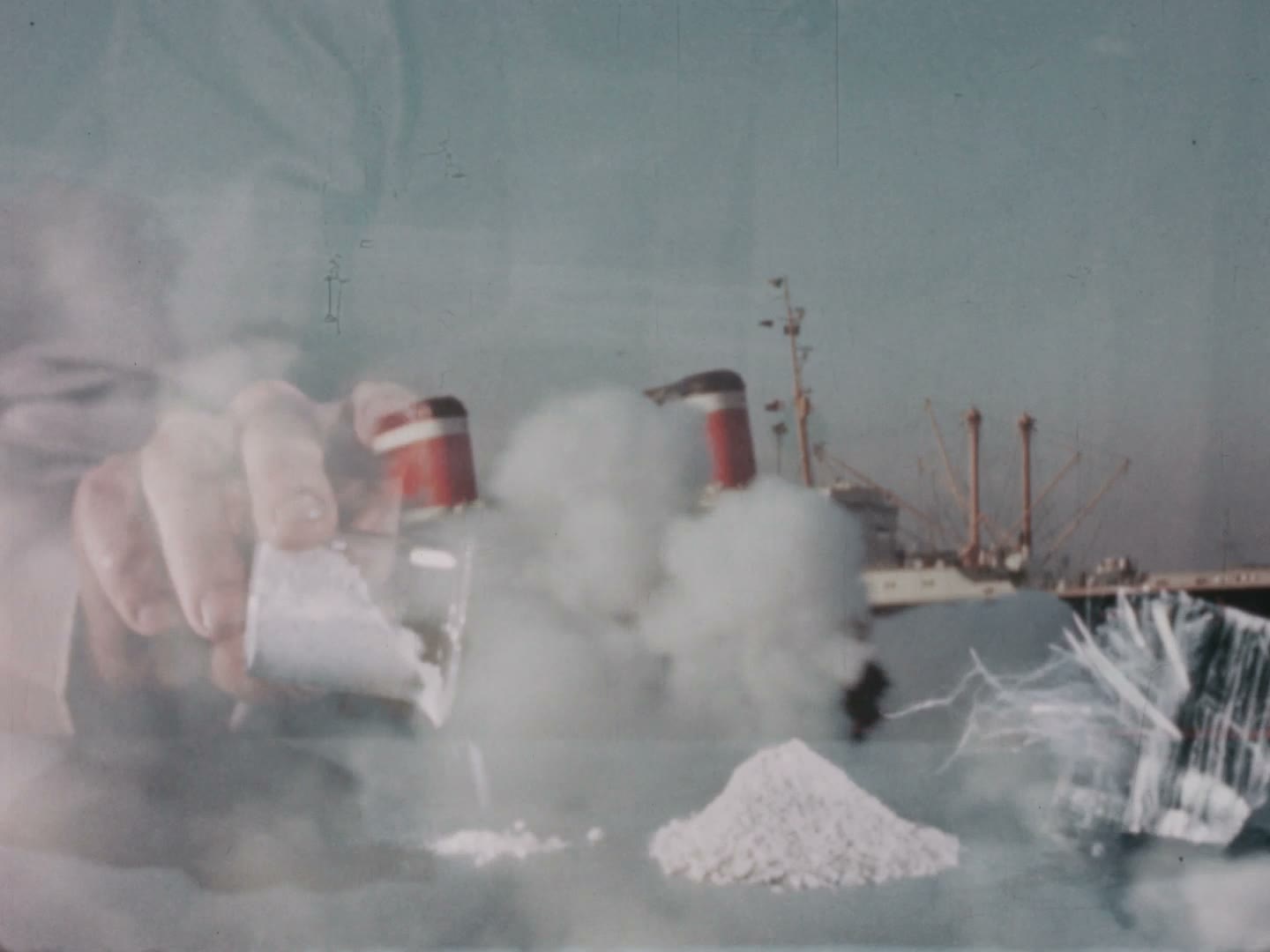
Johns-Manville's own Marinite film (probably 1950s), at Bethlehem Steel's Quincy yard while the liners Independence and Constitution were being built. The panels are cut with a saw "fitted with a silicon carbide cutting wheel," and beveled with a high-speed router. The narrator says a dust disposal system "is desirable when volume cutting is to be done," and says nothing about the asbestos in that dust. The passage runs about two minutes.
Watch the whole film, with its transcript: Safer Ships for Our Merchant Marine
What the testing showed: J-M's numbers, and Alcoa's
J-M's R&D Center, May 1974
An internal J-M memorandum dated May 28, 1974 (P.L. Earle to D.R. Christensen, R&D Center) reports air sampling during the sawing of one-inch Marinite-23 with a Rockwell Model 648 portable jigsaw — precisely the kind of small-job portable-tool work the 1954 brochure contemplated. The TLV at the time was 2.0 fibers/cc. The results:
| Ventilation configuration | Sample type | Result (f/cc) | vs. TLV (2.0) |
|---|---|---|---|
| Spencer portable baghouse, two hoses (saw + vacuum table) | Personal | 0.8 | Under |
| Spencer portable baghouse, two hoses | Personal | 0.5 | Under |
| Baghouse ventilating saw only | Personal | 4.9 | ~2.5× over |
| Baghouse ventilating saw only | Area | 2.3 | Over |
Even with local exhaust ventilation attached to the saw, jigsawing Marinite-23 produced personal exposures nearly two and a half times the TLV; only the addition of a second exhaust hose and a ventilated vacuum table brought the operation under the limit. The field conditions the brochure marketed — a carpenter, a portable saw, no baghouse at all, dust blown away by an air hose — sit well outside anything in this table. The memo is dated four years before the "DISCONTINUED PRODUCT" stamp appears on the Marinite MSDSs.
The customer's numbers: Alcoa, Rockdale Works, October 1974
Five months after the J-M memo, the customer side of the transaction produced matching data. Aluminum Company of America's Rockdale Works laboratory (Report No. 3872-E, October 21, 1974, to E.B. Parker) reported personal air sampling — lapel-mounted filter holders — taken in Building 44 on October 17, 1974, while workers band-sawed 4' × 8' sheets of 2-inch Marinite into 6" × 8' strips. This is the 1954 brochure's promise operating exactly as sold: an industrial customer's own staff, fabricating Marinite in-house on stationary power equipment.
Nine samples on three workers ranged from 1.0 to 7.6 fibers/cc, with six of the nine at or above the 2.0 f/cc TLV — and the highest readings did not belong to the man at the saw:
| Task (per the report's sample notes) | Result (f/cc) |
|---|---|
| Pushing sheets into the band saw (bulk of period) | 1.0 |
| Catching pieces off the saw, stacking on a pallet | 2.4 |
| Guiding the Marinite from the side | 1.9 |
| Catching and stacking pieces on a table behind the saw | 4.9 |
| ~15 min. catching and stacking + ~5 min. pushing into saw | 7.6 |
| Remaining samples across the same operation | 1.3 – 4.4 |
Four findings deserve emphasis:
Handling exceeded sawing. The workers catching and stacking the freshly cut strips recorded the highest exposures — 4.9 and 7.6 f/cc against the pusher's 1.0. Fiber release did not stop at the blade; it traveled with the material into every downstream pair of hands. This is the bystander problem in miniature, measured.
The release was invisible. The report's notes state that the exhaust system and an air jet on the saw blade were both operating, that "no dust was visible coming from saw," and that the only visible dust came from handling the Marinite — while the air carried up to 7.6 f/cc. Visible dust was no proxy whatsoever for respirable amosite fiber, a point that answers decades of defense reliance on "I didn't see any dust" framing.
Non-compliance was anticipated in writing. A handwritten annotation on the report reads, in substance, that in 1976 the operation would be out of compliance — anticipating the OSHA permissible exposure limit's scheduled drop from 5 to 2 fibers/cc effective July 1, 1976. The exposure was measured, the incoming standard was known, and the gap between them was noted by hand in the margin.
The thickness identifies the grade. J-M's own 1954 size table lists 2-inch stock only for Marinite-23 — the amosite grade — permitting mineral attribution at Rockdale from the sheet dimension alone, before any product sampling.
The Rockdale report — which bears a plaintiff's exhibit stamp (AL-73) from its use in litigation — and the J-M R&D memo are independent measurements, taken months apart in 1974 by the manufacturer and a customer, of the same operation the 1954 brochure sold: sawing Marinite with power tools. Both landed in the same place. Neither could be reconciled with the standard taking effect in 1976, and the product was discontinued within four years.
Typical applications and exposed trades
The brochure's own application photography and captions map the exposure population:
- Marine joiner work — bulkheads, staterooms, passageways, and ceilings on every American-flag passenger vessel from the S.S. America through the S.S. United States, plus the majority of WWII-era and postwar American cargo ships and small craft on inland waterways — over thirty million square feet by 1952. Exposed: shipyard joiners, carpenters, ship fitters, and every trade aboard during construction, refit, and scrapping.
- Industrial ovens and driers — bakery ovens, restaurant deck ovens, plastics drying ovens, electronics ovens (a 170-foot Marinite TV-tube baking oven appears in the brochure), textile tenterframe housings and dye-setting equipment. Marinite was the wall, door, and ceiling material, bolted to angle-iron framing in staggered-joint multi-layer panels. Exposed: the customer's own construction and maintenance staff — by explicit design ("No specialized skills or tools were needed," a plastics manufacturer testifies in the brochure).
- Petroleum refineries — the brochure states flatly that "Marinite is ideal for fireproofing structural steel in refineries."
- Electrical power plants — protection of buss bars, switching equipment, and instruments, an application line the corporate history dates to the Billerica capacity expansion of 1940–41.
- Breechings and housings — flue and duct enclosures in industrial plants.
Fabrication exposure recurred across every one of these settings, and — as with all rigid asbestos board — maintenance, renovation, and demolition of Marinite installations remains a continuing exposure pathway in older vessels, plants, and commercial kitchens today.
Why this matters in asbestos litigation
Amosite by design, documented by J-M. The corporate history establishes that amosite was selected deliberately in 1936 to meet the 40-lb/cu-ft marine specification; the MSDSs quantify it at 25–40 percent by weight in the -23, -36, Marimet 45, and Molten Metal grades. Amosite's mesothelioma potency substantially exceeds chrysotile's, and grade-level product identification frequently permits mineral attribution from specification documents alone.
End-user fabrication was the marketing proposition. Unlike products installed by specialist insulators, Marinite's value pitch was that untrained customer staff would cut, drill, bevel, and erect it with woodworking tools, dry, at industrial throughput. The population of exposed workers is therefore not a contractor's spray crews but a diffuse national cohort: shipyard joiners, plant maintenance carpenters, oven builders, millwrights, and the bystander trades around them.
Knowledge is documented on both ends of the product's life — and on both sides of the sale. The 1954 brochure acknowledges cutting dust and recommends a respirator (in one narrow context) while simultaneously advising dry cutting and dust-blowing air hoses; the 1974 J-M internal memo quantifies over-TLV exposures from a single portable jigsaw even with local exhaust; and Alcoa's Rockdale Works data from the same year replicates the finding on the customer's premises, with a handwritten anticipation of 1976 non-compliance in the margin. The Rockdale notes also establish that over-TLV fiber release occurred with no visible dust at the saw — direct documentary rebuttal to "no visible dust" defense narratives.
The chain of responsibility is short. Marinite was developed, manufactured, and sold by Johns-Manville — no licensor/distributor/applicator chain to reconstruct. J-M filed for Chapter 11 in August 1982, and the Manville Personal Injury Settlement Trust pays Marinite exposure claims. The Marimet 45 MSDS of February 1982 documents a 40-percent-amosite sheet product on offer within months of the filing.
The regulatory-capture irony bears telling. Marinite exists because federal law responded to a mass-casualty fire by mandating incombustible ship construction — and the material chosen to satisfy that mandate seeded a slower mass-casualty event through the very shipyards the law sent it to. The corporate history's description of the Morro Castle disaster as an "epochal opportunity" is J-M's own characterization, in J-M's own commissioned manuscript.
Source documents
The factual material on this page is drawn from six primary sources:
- Johns-Manville, Men — and a Magic Mineral, Chapter 26, "J-M And The Merchant Marine" — commissioned corporate history manuscript, 220 Madison Avenue, New York (Bates S683-66 through S683-72).
- Johns-Manville, You Can Build and Insulate with Marinite — industrial brochure IN-153A, dated 12-54 (Bates MT-006463 through MT-006478).
- Johns-Manville Material Safety Data Sheets, Form OSHA-20 — Marinite 23 (2/23/78, discontinued), Marinite #36 (4/21/78, discontinued), Marinite #65 (2/23/78, discontinued), Molten Metal Marinite (11/2/81), Marimet 45 (2/15/82); all Johns-Manville Corp., Ken-Caryl Ranch, Denver, Colorado.
- Internal memorandum, P.L. Earle to D.R. Christensen, R&D Center, May 28, 1974 — "Sawing of Marinite 23, One Inch Thick Using a Rockwell Portable Jigsaw Model 648" (Bates S420-436; produced JM-83).
- "Half Million Square Feet of Marinite for the S.S. United States," Asbestos magazine, July 1952 — trade press coverage of the largest single marine installation of the product.
- Aluminum Company of America, Rockdale Works Laboratory, Report No. 3872-E to E.B. Parker, October 21, 1974 — personal air sampling in Building 44 during band-sawing of 2-inch Marinite, sampled October 17, 1974 (Plaintiff's Exhibit AL-73).
In our case-law library
16 court decisions in our case-law library involve Marinite board. Among them:
- Louisville Trust Co. v. Johns-Manville ProductsKentucky Supreme Court, 1979 · Asbestos worker at Queen Products Company, 1957-1967
- Abadie v. Metropolitan Life Ins. Co.Louisiana Court of Appeals, 2001 · Tacker at Avondale Shipyards (main yard), 1957-58, 1961-76, 1977-79, 1980-81
- Falgout v. Anco Insulations, Inc.U.S. District Court, Eastern District of Louisiana, 2022 · Wife laundering husband's work clothes at Avondale Bridge City shipyard, 1965-1979
- Cortez v. Lamorak Insurance CompanyU.S. District Court, Eastern District of Louisiana, 2022 · Welder and tacker helper at Avondale Shipyards, Westwego Yard, 1969-1974
- Cortez v. Lamorak Insurance CompanyU.S. District Court, Eastern District of Louisiana, 2022 · Welder and tacker helper at Avondale Shipyards (Westwego Yard), 1969-1974
- Cortez v. Lamorak Insurance CompanyU.S. District Court, Eastern District of Louisiana, 2022 · Welder and tacker helper at Avondale Shipyards (Westwego Yard), 1969-1974
In our products database
What documents in our library say about these products: when they were made, how much asbestos they held, and who made them.
Johns-Manville: Marinite · Marinite 23 · Marinite 30 · Marinite 36 · Marinite 45 · Marinite 65
Talk with an asbestos lawyer
Start with what you remember, and we'll take it from there.
This page is provided for general informational purposes and does not constitute legal advice. Every asbestos case turns on its own facts, exposure history, diagnosis, deadlines, available evidence, and applicable law. Reviewing this page does not create an attorney-client relationship. For advice about your specific situation, call 833-4-ASBESTOS for a free case review.