
If you worked construction — or if someone in your family did — and a mesothelioma, lung cancer, asbestosis, or other asbestos diagnosis has now come in, this page is the place to start. The same dust reached the spouses and children who washed the work clothes, and it didn't matter which trade the worker ran with, because for most of the twentieth century the buildings themselves were made of the material.
On a construction site, the asbestos came from every trade's work at once. It was in the products a worker cut, mixed, sanded, and nailed with his own hands, and it was in the air everyone shared, because a jobsite put a dozen trades in the same rooms: the carpenter cutting board, the finisher sanding the walls, the insulator wrapping the pipes, and the laborer sweeping it all up breathed each other's dust from the felts under the slab to the shingles on the roof. None of it stayed with the man who made it. Industrial hygiene testing measured the air across the room from a drywall sander at enough to equal about two and a half years of ordinary background in fifteen minutes, and the room during cleanup at about seven years, breathed by the plumber and electrician who never sanded a thing. The chart below shows fifteen minutes of three of those trades' own work against a year of ordinary city air.
Even ordinary city air carries a faint trace of asbestos, from natural mineral erosion and a century of industrial use, and that trace is the yardstick the chart measures against.
What these numbers mean. Asbestos in air is measured in fibers per cubic centimeter (f/cc), a unit that hides how dangerous a task was. Across this site we translate each measurement into fibers breathed, feet of fiber end to end, and years of ordinary city air, using conservative, government-sourced assumptions. See how we measure asbestos in air for the method and its limits.
You don't need to remember which brands were on your jobs, and you don't need old pay stubs or a list of every contractor you ever worked for. The bankruptcy trusts that pay many of these claims are built to compensate exactly this kind of work: for mesothelioma, even brief asbestos exposure on a worksite that used it is typically enough to qualify, so you don't have to prove a heavy dose. If you can say "I hung and finished rock through the seventies" or "my husband framed houses and did remodels his whole life," we have a starting point.

You don't need the product names or old records. No fee unless we recover compensation for your family.
Quick answers
| Did construction work really expose me to asbestos? | Almost certainly, for any career that ran through the 1980s. Asbestos was in the joint compound, the cement board and siding, the flooring and mastic, the roofing felt and cement, the insulation, and the fireproofing, and every trade on the site cut, mixed, sanded, or swept some of it. You breathed your own dust and everyone else's. |
|---|---|
| I did residential work, not commercial or industrial. Was I still exposed? | Yes. Houses were built out of the same materials: joint compound on every seam, cement siding and shingles, vinyl-asbestos flooring, asbestos roofing felt and cement, and insulation on the heating systems. Residential work was not the light version of the trade. |
| I mostly did remodels and renovation, not new construction. Does that count? | Often it's worse. Renovation meant cutting, sanding, scraping, and tearing out the asbestos that earlier crews had installed, and old, dried-out material releases more fiber coming out than it did going in. Demolition and remodel work is a well-recognized exposure story. |
| How much exposure do I need for a claim? | For mesothelioma, less than you'd expect. The bankruptcy trusts that pay many of these claims are built to compensate brief exposure on a worksite that used asbestos, so you don't have to prove years of heavy dust. Courts ask for more than the trusts do, and we handle that distinction for you. |
| How long do I have to file? | It depends on your state and on whether this is a personal-injury or a wrongful-death situation, and some of those deadlines are short. The safest step is to call as soon as possible after diagnosis so the clock doesn't run out. |
| Do I have to file a lawsuit? | No. Many construction workers and their families recover through trust claims and benefits without ever filing a lawsuit. Trust claims are paper claims, not courtroom cases. We explain both paths and respect your decision. |
| Can a spouse or adult child call for the worker? | Yes. Most of our first calls come from a wife or an adult child researching for someone who is sick or who has passed. You don't need a power of attorney to ask questions. |
“I started this firm after learning that the cancers that killed my father and grandparents were caused by asbestos, something we did not realize until it was too late to hold anyone accountable. That experience is why we built this site: so that no other family misses their chance to ask the questions, hear the options, and decide for themselves what to do.”
Why the buildings themselves were made of asbestos
Construction put workers in daily contact with asbestos for a different reason than the mills and refineries did. In heavy industry, the asbestos mostly wrapped the equipment. On a construction site, it was the building materials themselves: the compound on every drywall seam, the cement board and siding on the walls, the tile on the floor and the mastic under it, the felt and cement on the roof, the millboard behind the furnace, and the fireproofing on the steel. Asbestos was cheap, it was strong, and it didn't burn, so the manufacturers put it in nearly everything a building was made of. The dust never announced itself; it looked like ordinary construction dust, and cutting, sanding, and sweeping it was just the job.
None of this was incidental, and the industry said so itself. In 1963, an asbestos mining executive published a survey of the industry's construction markets that placed its fiber in every part of a building: the cement siding and shingles, the cement pipe, the floor tile, the insulation, the textiles, the roofing felts, the caulks and sealants, and asbestos sprayed directly onto walls and ceilings, with construction described as the industry's engine of growth. A construction worker encountered asbestos on every job because the products were designed and sold that way, from the foundation to the finish work.
And the ordinary motions of the work are what put the fiber in the air. Board was sawed, compound was mixed from bags and sanded smooth, tile was cut and old floors ground out, felt was cut and torn off, and at the end of the day someone swept it all up and breathed it one more time. Much of it happened in closed-up rooms with the windows in and the heat on, where the dust hung and was rebreathed instead of clearing. The men did that work bare-faced, with no warnings on the bags and boxes, and went home in dusty clothes to their families, while the companies that made the products knew what the dust was doing.
Where the asbestos was, phase by phase
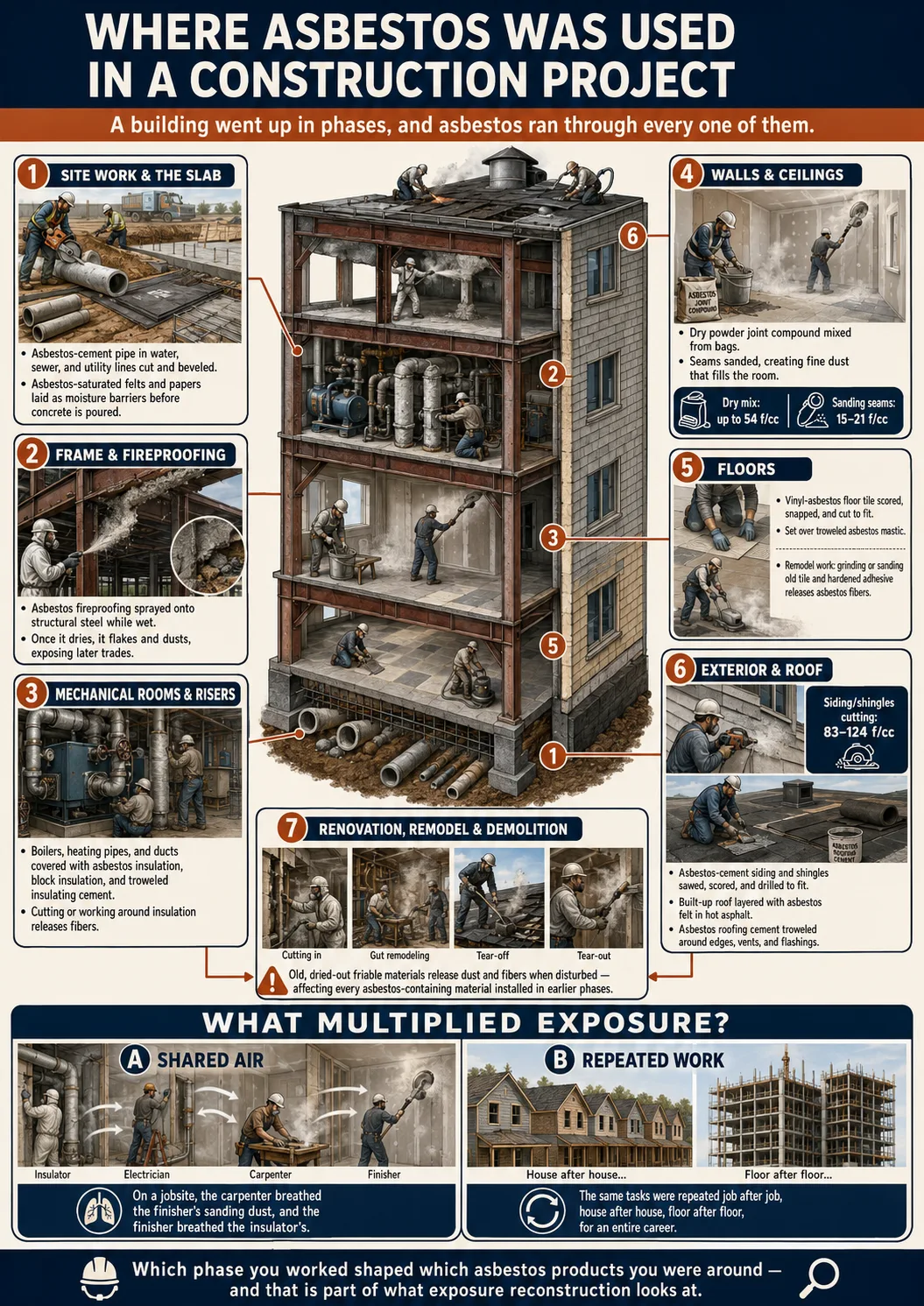
A building went up in phases, and asbestos ran through every one of them. Which phases you worked shapes which products you were around, and that's part of what we reconstruct. Here's the job, start to finish.
- The site work and the slab. Asbestos cement pipe went into the water, sewer, and utility runs, cut and beveled on site, and asbestos-saturated felts and papers went down as moisture barriers before the concrete was poured. See how asbestos cement pipe and board caused exposure.
- The frame and the fireproofing. On commercial and high-rise work, asbestos fireproofing was sprayed onto the structural steel, coating whole floors in wet fiber that dried, flaked, and dusted every trade that came after. See how asbestos spray fireproofing and insulation caused exposure.
- The mechanical rooms and risers. The boilers, heating pipes, and ducts got asbestos insulation, block, and troweled insulating cement, installed by the insulators and cut into by every trade that worked near the lines afterward. See how asbestos insulating cement caused exposure.
- The walls and ceilings. Drywall crews hung the board, then mixed the joint compound and texture from bags of dry powder, a task measured as high as 54 f/cc, and sanded the cured seams smooth at 15 to 21 f/cc, filling closed-up rooms with fine dust that settled on every surface and got swept back into the air. Plaster systems ran the same way in the decades before drywall took over. See how asbestos joint compound caused exposure.
- The floors. Vinyl-asbestos tile was scored, snapped, and cut to fit over troweled asbestos mastic, and remodel work meant grinding and sanding the old floor and its hardened adhesive out first. See how asbestos floor tile caused exposure, and how asbestos mastic and adhesives caused exposure.
- The exterior and the roof. Asbestos cement siding and shingles were sawed, scored, and drilled to fit, the task behind the 83 to 124 f/cc measurements, and built-up roofs were layered from asbestos felt set in hot asphalt, sealed with asbestos roofing cement troweled around every edge and vent. See how asbestos roofing felt caused exposure.
- Renovation, remodel, and demolition. This is the phase that never ends. Every cut into an older building, every gut remodel, every tear-off and tear-out disturbed the asbestos an earlier crew had installed, and old, dried-out, friable (crumbly and dusty) material releases more fiber coming out than it did going in. Remodelers and demolition crews were exposed decades after the products stopped being sold, and careful handling of these materials still matters in older buildings today.
Two things multiplied all of it. A jobsite put every trade in the same air, so the carpenter breathed the finisher's sanding dust and the finisher breathed the insulator's, whoever held the tool. And the work repeated, job after job, for an entire career: a tract-housing crew ran the same tasks house after house down the block, and a commercial hand did them floor after floor up the tower.
Who can be held responsible for a construction site
A construction site wasn't one company; it was a crowd of them. An owner or developer hired a general contractor, the general hired the subs, and a dozen separate employers put their crews into the same rooms and the same air. For a construction worker's case, that structure matters, because the law bars a claim against exactly one of those companies: your own employer. A worker generally can't sue the company that paid him over workplace conditions, because workers' compensation law typically stands in the way. Everyone else on and behind that jobsite is a different story.
So the case is built from the rest of the crowd:
- The product makers, first. Construction is the industry where workers handled the asbestos with their own hands, bag by bag and board by board, so the companies that made the joint compound, cement board, flooring, mastic, roofing felt, insulation, and fireproofing are the core of the case. Most of the biggest names now pay through bankruptcy trusts, and the makers behind each product, trust by trust, are laid out on our asbestos product pages.
- The general contractor who ran the site. The company that controlled the schedule, the trades, and the conditions can be answerable for the dust it allowed, including the dust one sub's crew put into another crew's air.
- The owners of the buildings and plants. When construction and renovation work happened inside an operating plant, refinery, mill, or commercial building, the owner that controlled the premises can be a defendant too, the same way it is for the other industries on this site.
- The other subcontractors. The company whose insulators, sprayers, or finishers filled the air your loved one breathed can be reachable even though his own employer isn't. On a multi-employer site, one man's employer is another man's defendant.
That's why a construction case is rarely small on defendants. A forty-year construction career, run through our exposure database, typically touches products from a dozen or more manufacturers and jobsites controlled by many different companies, which means several trusts and several potential lawsuit defendants, and the workers' comp bar removes only one name from the list.
Where you did that work matters less than it does in other industries, because the materials were national: the same compound, board, tile, felt, and insulation went into office towers and tract houses, schools and hospitals, factories and military bases, from the postwar housing booms through the high-rise decades. What matters is the phases you worked, the trades around you, and the years, and that's the reconstruction we do.
What the asbestos industry's own magazine said about construction
For sixty years the trade journal Asbestos wrote for the companies that mined, made and sold asbestos, and building was one of their biggest customers. Its pages show where the products went, which codes called for them, and when the dust on jobsites became a public issue.
Building was a main market
As early as 1920, the magazine said "great quantities" of asbestos paper and millboard went into "the new buildings going up on every hand." It added that cities and towns were requiring fireproofing behind ranges, above heaters and in switch boxes (Asbestos, July 1920). A federal report the magazine reprinted in 1944 said building activity had "a decided influence on asbestos sales," because asbestos insulation, fireproofing, shingles, siding and wallboard "are used extensively" (Asbestos, Apr. 1944). In 1965 the head of a fireproofing maker wrote: "Without knowing it most of us have asbestos overhead and underfoot" (Asbestos, Jan. 1965).
Codes that called for asbestos
Building codes sometimes wrote asbestos in by name. Chicago's ordinances, as printed in 1920, said magnesia blocks for lining chimneys and stacks must contain "50 per cent asbestos fibre" (Asbestos, Dec. 1920). A 1924 survey of codes from thirteen cities found many required hot air pipes in wooden partitions to be "securely covered with asbestos" (Asbestos, Apr. 1924). Ohio's code called for theatre curtains of "pure asbestos fibre" (Asbestos, Apr. 1923).
Named buildings
| Building | Year reported | What the magazine says was used | Contractor | Source |
|---|---|---|---|---|
| Missouri Pacific Building, St. Louis | 1928 | Asbestos ebony switchboard panels (J-M) | Humes-Deal Construction Co. (general contractor) | J-M Circle, May 1928 |
| Bell Telephone Laboratories, New York City | 1932 | Vibration mats "made of lead and asbestos" | — | Asbestos, Mar. 1932 |
| British Pavilion, New York World's Fair | 1939 | About 25,000 sq. ft. of corrugated asbestos-cement sheets as the ceiling | Asbestos Erectors, Inc., Ambler, Pa. | Asbestos, May 1939 |
| League of Nations building, Swiss Pavilion, Petroleum Industries Building, World's Fair | 1939 | Linabestos (K&M), 33,760 sq. ft. in the League of Nations building alone | — | Asbestos, May 1939 |
| Ford, DuPont, Eastman Kodak, Firestone and other World's Fair buildings | 1939 | 85% Magnesia and low-pressure insulation | Ehret Magnesia Mfg. Co. | Asbestos, May 1939 |
| Three Navy hospitals and twelve other Navy projects, California | 1945 | Cemesto Board, "the asbestos-cement" sandwich board (Celotex) | Modulok, Inc. | Asbestos, July 1945 |
| Bell Telephone building, New York World's Fair | 1964 | Sprayed asbestos on the underside of the molded sections | — | Asbestos, July 1964 |
| Prudential Centre tower (52 stories), Boston; GM Futurama buildings, World's Fair | 1966 | Sprayed Limpet Asbestos | — | Asbestos, Sept. 1966 |
| Harborplace Mall, Baltimore | 1981 | Asbestos wallboard, until the state threatened to halt the job | Unnamed contractor and subcontractor | Asbestos, June 1981 |
For the 1939 World's Fair alone, the magazine counted over 60,000 feet of asbestos-cement pipe and at least 3,000,000 square feet of asbestos roofing felt (Asbestos, May 1939). It said at least 38 Fair buildings held "large quantities of asbestos products" (Asbestos, May 1939).
Sprayed fireproofing on steel
By the 1960s asbestos was sprayed straight onto steel. Baldwin-Ehret-Hill's Pyrospray, "a fireproofing, spray-on asbestos and mineral fiber material," went on steel beams and columns. It came "directly from the spray gun nozzle" while other trades kept working floor by floor (Asbestos, Nov. 1963).
The companies behind the spraying measured and wrote about the dust. In August 1960 J. W. Roberts, the Turner & Newall company that licensed the Limpet spray machine, sampled the air while Limpet was sprayed in a new research laboratory building for Pilkington Brothers in England, and counted 140 to 520 dust particles per cubic centimeter around the sprayer (J. W. Roberts report, 1960, p. 1). In the United States, Limpet's applicator, Armstrong Contracting and Supply, told its spray crews to wear a dust respirator "at all times during the application process" and to clean "all excess damp fibers" from surrounding surfaces at the end of each day (Armstrong operating instructions, pp. 2, 7).
In 1969 the sprayers' trade group, the New York plasterers and Mount Sinai agreed on rules for New York City jobs (Asbestos, Oct. 1969). They required "complete containment" of the spray on construction sites (Asbestos, Oct. 1969). In 1970 the city issued interim orders on spraying any insulation containing asbestos (Asbestos, July 1970). The makers said the rules reduced the risk to the men spraying "and to other workers at construction jobs" (Asbestos, Aug. 1970). By December 1972, spraying was "pretty much at a standstill," having been "banned in several major cities" (Asbestos, Dec. 1972). A 1979 report said sprayed asbestos had been used "until 1973 in many buildings" (Asbestos, Feb. 1979).
Dust on the jobsite
The magazine also recorded the human cost. In 1975, state doctors were to examine some 80 Buffalo plasterers who had done "fireproofing work utilizing sprayed asbestos" (Asbestos, July 1975). In 1976 a wrecking company was convicted over its demolition of a New Orleans hospital; its workers testified "they were never warned" (Asbestos, May 1976).
If a building you worked on isn't listed here, that doesn't mean it was free of asbestos. These are only the jobs the trade press happened to write about.
The trades that worked the sites
Construction is a collection of crafts, and many of them have their own pages, because each trade's products and tasks tell their own story. If your loved one's work fits one of these, start there:
- Carpenters
- Drywall finishers
- Flooring installers
- Roofers
- Insulators and insulation workers
- Pipefitters and plumbers
- All asbestos occupations
And if the work didn't fit one craft, that's construction too. The laborers, helpers, and cleanup crews who moved between the trades, carried the materials, and swept the floors at the end of the day worked in every phase's dust, and their claims are built the same way: from the phases, the products, and the years.
Sources of compensation for construction workers
A construction worker's recovery usually comes from more than one place, and the different channels run in parallel without canceling one another out. We file across all of them that apply.
- Asbestos bankruptcy trusts. The companies that made the joint compound, cement board, flooring, roofing, and insulation and later went bankrupt set aside money in trusts to pay the people they harmed. These are paper claims that don't require a lawsuit or a courtroom, and a construction career often supports filings against several trusts at once. Because construction workers handled so many different products, this channel is usually the backbone of the case. How asbestos trust claims work.
- Lawsuits against solvent manufacturers. Some makers of construction products are still in business and can be sued directly for making and selling products they knew were dangerous. How product liability lawsuits work.
- Claims against the companies that ran the jobsites. The general contractors that controlled the sites, the owners of the buildings and plants where the work was done, and the other subcontractors whose crews filled the air can all be answerable, and the workers' comp bar removes only your own employer from that list. How premises liability claims work.
- Federal and disability benefits. These depend on where and how the work was done, and they're paid in addition to the trust and lawsuit recovery. Construction at military bases or federal facilities can support FECA (the Federal Employees' Compensation Act) benefits for federal employees, military service before or after the construction years can support VA disability benefits, and Social Security disability is available to anyone whose illness stops them from working. How asbestos disability and benefit claims work.
Mentioned on this site
- ABB Lummus Asbestos Trust Claims
- ACandS Asbestos Trust Claims
- American Industrial Hygiene Association Journal
- American Journal of Epidemiology
- American Journal of Industrial Medicine
- Annals of the New York Academy of Sciences
- Armstrong World Industries Asbestos Trust Claims
- Asbestos Cement Pipe, Transite, and Marinite
- Asbestos Exposure by Industry
- Asbestos Exposure in Bystander and Proximity Workers
- Asbestos Exposure in Carpenters and Construction Workers
- Asbestos Exposure in Drywall Finishers, Plasterers, and Painters
- Asbestos Exposure in Electricians and Electrical Workers
- Asbestos Exposure in Flooring Installers
- Asbestos Exposure in Glass, Aluminum, and Cement Plant Workers
- Asbestos Exposure in HVAC, Refrigeration, and Appliance Workers
- Asbestos Exposure in Insulators and Insulation Workers
- Asbestos Exposure in Pipefitters and Plumbers
- Asbestos Exposure in Refractory Bricklayers
- Asbestos Exposure in Roofers
- Asbestos Exposure in Welders
- Asbestos Floor Tile, Sheet Flooring, and Black Mastic
- Asbestos Information Association Annual Meeting Minutes on the State of the Medical Art Memorandum (1978)
- Asbestos Information Association Board of Directors Minutes on a Captive Insurance Company (1976)
- Asbestos Information Association Executive Committee Minutes on the Legal-Medical Research Program (1976)
- Asbestos Information Association Technical Committee Papers and Draft Letter Selling the Enterline Study (1978)
- Asbestos Joint Compound, Drywall Mud, and Texture Coatings
- Asbestos News
- Bell's United Asbestos Company
- BMC Public Health
- BMJ Open
- BMJ Open Respiratory Research
- British Journal of Cancer
- CA
- Environmental Science and Pollution Research International
- Frank H. Zimmerman of National Gypsum to C. L. Sheckler Opposing the Asbestos-Cement Health Safety Booklet (1968)
- Gardner Asphalt Corporation
- Industrial Health
- International Archives of Occupational and Environmental Health
- International Journal of Cancer
- International Journal of Occupational and Environmental Health
- JAMA
- Johns-Manville
- Johns-Manville
- Johns-Manville
- Journal of Hazardous Materials
- Lung Cancer
- Occupational and Environmental Medicine
- Pediatric Blood & Cancer
- Reading Castleman, Chapter 5
- Reading Castleman, Chapter 7
- Reading Castleman, Chapter 10
- Research on Construction
- Respiration; International Review of Thoracic Diseases
- Respiratory Medicine Case Reports
- Scandinavian Journal of Work, Environment & Health
- Scottish Medical Journal
- Sprayed Insulation, Inc.
- Texaco
- The Annals of Occupational Hygiene
- Transite
- Tumori
- United States Gypsum Asbestos Trust Claims
- United States Plywood Corporation
- United States Plywood Corporation
- United States Plywood Corporation
In the research library
The National Library of Medicine indexes 35 studies in our medical research library under the construction industry. Among the most cited:
- Occupation and work-related ill-health in UK construction workersS.J. Stocks, S. Turner, R. McNamee, et al, 2011 · Occupational Medicine · cited 43 times
- Smoking, occupational exposures, and idiopathic pulmonary fibrosis among Swedish construction workersM. Andersson, P.D. Blanc, K. Torén, et al, 2021 · American Journal of Industrial Medicine · cited 25 times
- Asbestos Exposure and Malignant Mesothelioma in Construction Workers-Epidemiological Remarks by the Italian National Mesothelioma Registry (ReNaM)A. Binazzi, D. Di Marzio, M. Verardo, et al, 2021 · International Journal of Environmental Research and Public Health · cited 23 times
- Construction and demolition waste management: China's lessonsH. Duan, J. Li, 2016 · Waste Management & Research · cited 21 times
- The impact of asbestos exposure in Swedish construction workersB. Järvholm, A. Englund, 2014 · American Journal of Industrial Medicine · cited 20 times
In our case-law library
503 court decisions in our case-law library involve construction. Among them:
- Galier v. Murco Wall Products, Inc.Oklahoma Supreme Court, 2022 · Child visiting and helping clean up father's construction sites at his father's building sites around Moore, Oklahoma, 1971-1975
- Irwin Industrial Tool Company v. PiferMaryland Court of Appeals, 2022 · Carpet installer (mechanic) at Clyde W. Dent Carpet Installation, College Park, 1960s-1980s
- Nemeth v. Brenntag N. Am.New York Court of Appeals, 2022 · Home renovations
- Smith v. Schlage Lock Company, LLCU.S. Court of Appeals, Fourth Circuit, 2021 · Pipefitter at Schlage Lock plant, Rocky Mount, 1972
- Dougan v. Sikorsky Aircraft CorporationConnecticut Supreme Court, 2020 · Subcontractor employee removing pipe from boiler house at Sikorsky cogeneration project, boiler house, Stratford, March-July 2010
- Hart v. Keenan Properties, Inc.California Supreme Court, 2020 · Installed pipes at McKinleyville project, September 1976 to March 1977
Videos

The defenses companies raise, and how we answer them
When a construction worker's case goes to court, the companies raise the same handful of defenses they raise in most asbestos cases, plus a few tuned to the jobsite, and none of them is new to us. The short version is that the arguments describe a cleaner, smaller version of the work than the one your loved one actually did, and the evidence answers them. The detail is below for anyone who wants it.
All of this applies only to the lawsuit side of a case. The trust claims are a paper process: no opposing lawyer raises defenses, no one is deposed, and no one goes to court.
How we answer the defenses raised in construction cases
"It was just construction dust, the same as any jobsite has." That's exactly what the workers were left to believe, and it's why no one protected himself. The dust from sanding asbestos joint compound, sawing asbestos cement board, and sweeping up after both wasn't ordinary dust, and the published industrial hygiene testing that measured it, task by task, is how we show what was actually in the air.
"You can't prove whose product was on those jobs." Product identification is real work in a construction case, and it's work we know how to do. We reconstruct it from our exposure database, the trust documentation, supplier and lumberyard records, the brands that dominated a region and an era, and the recollections of the worker and his coworkers. The trusts are built for exactly this reconstruction, and in court the identification burden is one we've carried many times.
"The joint compound was mostly not asbestos, so the exposure was minor." The percentage of asbestos in the bag isn't the exposure; the fiber in the air is. Mixing the dry compound and sanding the cured seams put measured, elevated fiber levels into closed rooms regardless of what fraction of the product's weight the asbestos made up, and the testing measured the air the finisher actually breathed.
"The exposure to any one company's product was too small to have made a difference." These cases are built on documented exposure: the specific high-dust tasks the trades performed and the dose built up across a full career of jobs. The bankruptcy trusts pay on brief exposure, and in court we prove a meaningful contribution with that task and career evidence.
Frequently asked questions
I worked for dozens of different contractors over the years and have no records. Can I still file?
Yes, and that's the normal shape of a construction career. You don't need pay stubs, contractor names, or job addresses in hand to start. We reconstruct the history from our exposure database, the trust documentation for each product's maker, union records where they exist, the brands that dominated your region and era, and the recollections of the worker, family, and coworkers. The claim is built on the phases you worked, the products those phases used, and the years, not on a perfect employment file.
I was self-employed for part of my career, or did side jobs. Does that hurt the case?
No. The workers' comp bar only removes an employer from the defendant list, and a self-employed worker doesn't have one to remove. The claims against the product makers and their trusts, and against the owners and contractors who controlled the sites, are built the same way regardless of who signed the checks.
My loved one has already passed away. Can we still bring a claim?
Yes. Families regularly file after a death, both trust claims and, depending on the state, a wrongful death lawsuit. These deadlines vary by state and some are short, and the family's claim can depend on whether a claim was preserved during the worker's life, so it's best to call promptly. We handle wrongful death and estate claims as a matter of routine.
He smoked. Does that ruin the case?
No. Mesothelioma isn't caused by smoking, so a smoking history doesn't touch a mesothelioma claim at all. For lung cancer, asbestos and smoking multiply each other's damage rather than canceling out, and construction workers who smoked and breathed asbestos may still have strong claims. Don't let a smoking history stop you from asking.
Could my family have been exposed through the work clothes?
Yes, and it's common. The dust that settled on a construction worker's clothes, hair, and boots came home with him, and spouses who shook out and laundered work clothes and children who hugged a parent after a shift were exposed too. That's why our representation includes free asbestos health screening for family members, and if a family member is later diagnosed, they may have a claim of their own. The screening is a chest X-ray read by a B-reader, with a CT scan if needed; it looks for asbestos-related changes in the lungs and isn't a diagnosis or a reliable way to find mesothelioma early.
What happens when I call?
A member of our litigation team, not a screener, takes the call, and the first conversation usually runs twenty to thirty minutes. We listen to the work history, explain which claims and channels may apply, and lay out the timeline for your situation. No one is pressured to sign anything on that call.
What does it cost to work with you?
Nothing up front, and nothing at all unless we recover for you. We work on a contingency fee, which means our fee comes only out of money we recover, and the case review and consultation are free.
Do we have to travel to your office?
No. We handle these cases by phone, video, and mail, and we come to you when an in-person visit helps. Families work with us from every state without traveling to us.
Talk with an asbestos lawyer about construction exposure
Whether you're a construction worker who was just diagnosed, or a spouse or adult child trying to find help for someone who is sick or who has passed, we're ready to talk. You don't need the brand names, you don't need the old records, and you don't need to travel to us. Start with the trades you worked, the kinds of jobs, and the years, and we'll take it from there.
Related resources
Sources and references
The exposure measurements on this page come from published industrial hygiene testing, cited in full on the product pages where each figure lives:
- The 83 to 124 f/cc cement-board sawing measurement is documented on our asbestos cement board and siding page.
- The 15 to 21 f/cc joint-compound sanding measurement and the 8 to 54 f/cc dry-mixing measurement are documented on our asbestos joint compound page.
Other authorities relied on:
- Occupational exposure limits. OSHA's asbestos standard sets the current permissible exposure limit at 0.1 f/cc averaged over eight hours, with a short-term excursion limit of 1.0 f/cc over thirty minutes. 29 C.F.R. § 1910.1001.
- Carcinogenicity. The International Agency for Research on Cancer classifies all forms of asbestos as carcinogenic to humans (Group 1) and recognizes no safe threshold of exposure for mesothelioma. IARC Monographs, Vol. 100C.
- Historical product placement. L. O. Montpetit, "Asbestos in the Construction Industry," The Canadian Mining and Metallurgical Bulletin (September 1963), the asbestos industry's own survey of its construction product markets, in our document archive.
This page is provided for general informational purposes and does not constitute legal advice. Every asbestos case turns on its own facts, exposure history, diagnosis, deadlines, available evidence, and applicable law. Reviewing this page does not create an attorney-client relationship. For advice about your specific situation, call 833-4-ASBESTOS for a free case review.