
If you laid floors for a living — or if someone in your family did — and a mesothelioma, lung cancer, asbestosis, or other asbestos diagnosis has now come in, this page is the place to start. The same dust reached the spouses and children who washed the work clothes, and the carpenters and other tradesmen who shared the rooms while the old floors came up and the new ones went down.
A flooring installer breathed asbestos both going in and coming out. Putting a floor down meant scoring and snapping vinyl-asbestos tile (VAT) to fit and troweling out asbestos mastic, and ripping an old floor out was dustier still. Industrial hygiene testing of sanding old tile to prepare a subfloor for new flooring measured 1.2 to 1.3 fibers per cubic centimeter, more than a dozen times today's federal limit, and that work was done on hands and knees, right in the installer's breathing zone. See how asbestos floor tile caused exposure.
You don't need to remember whose tile or adhesive you used, and you don't need old job records or union cards in hand. The bankruptcy trusts that pay many of these claims are built to compensate exactly this kind of work: for mesothelioma, even brief asbestos exposure on a worksite that used it is typically enough to qualify, so you don't have to prove a heavy dose. If you can say "I laid floors for twenty-five years" or "my dad was in the Floorlayers," we have a starting point.
Fibers per cubic centimeter (f/cc), measured during the task
OSHA’s asbestos standard lists 0.1 f/cc as the 8-hour time-weighted average limit and 1.0 f/cc over 30 minutes as the excursion limit. Both flooring tasks ran well above the 8-hour limit, roughly 4.4 and 13 times higher, and sanding old tile topped even the short-term ceiling. There is no level of asbestos exposure known to be safe. Sources: published industrial hygiene testing, cited on our asbestos floor tile page.

You don't need the product names or old records. No fee unless we recover compensation for your family.
Quick answers
| Did laying floors really expose me to asbestos? | Almost certainly, if your career ran through the decades when floor tile, sheet flooring, and mastic were made with asbestos. The dust came from your own work: scoring and snapping tile to fit, troweling adhesive, and above all grinding and sanding out old tile and dried mastic on removals. You did that work on your knees, right in your own breathing zone. |
|---|---|
| I mostly installed new tile, not removals. Was I still exposed? | New installation was generally lighter than tear-outs, but it wasn't zero. Cutting and snapping vinyl-asbestos tile and troweling asbestos mastic both released fiber. Because even lower-intensity exposure can support a mesothelioma claim, it's worth checking your specific work history. |
| How much exposure do I need for a claim? | For mesothelioma, less than you'd expect. The asbestos bankruptcy trusts that pay many of these claims are built to compensate brief exposure on a worksite that used asbestos, so you don't have to prove years of heavy dust. Courts ask for more than the trusts do, and we handle that distinction for you. |
| How long do I have to file? | It depends on your state and on whether this is a personal-injury or a wrongful-death situation, and some of those deadlines are short. The safest step is to call as soon as possible after diagnosis so the clock doesn't run out. |
| Do I have to file a lawsuit? | No. Many flooring installers and their families recover through trust claims and benefits without ever filing a lawsuit. Trust claims are paper claims, not courtroom cases. We explain both paths and respect your decision. |
| What can a flooring installer's case recover from? | Usually several sources at once: the bankruptcy trusts of asbestos makers like Armstrong, Congoleum, and Flintkote; lawsuits against still-solvent manufacturers and the building owners or contractors who controlled the worksites; and disability benefits. One doesn't cancel out another. |
| Can a spouse or adult child call for the worker? | Yes. Most of our first calls come from a wife or an adult child researching for someone who is sick or who has passed. You don't need a power of attorney to ask questions. |
“I started this firm after learning that the cancers that killed my father and grandparents were caused by asbestos, something we did not realize until it was too late to hold anyone accountable. That experience is why we built this site: so that no other family misses their chance to ask the questions, hear the options, and decide for themselves what to do.”
Why flooring installers were exposed to asbestos
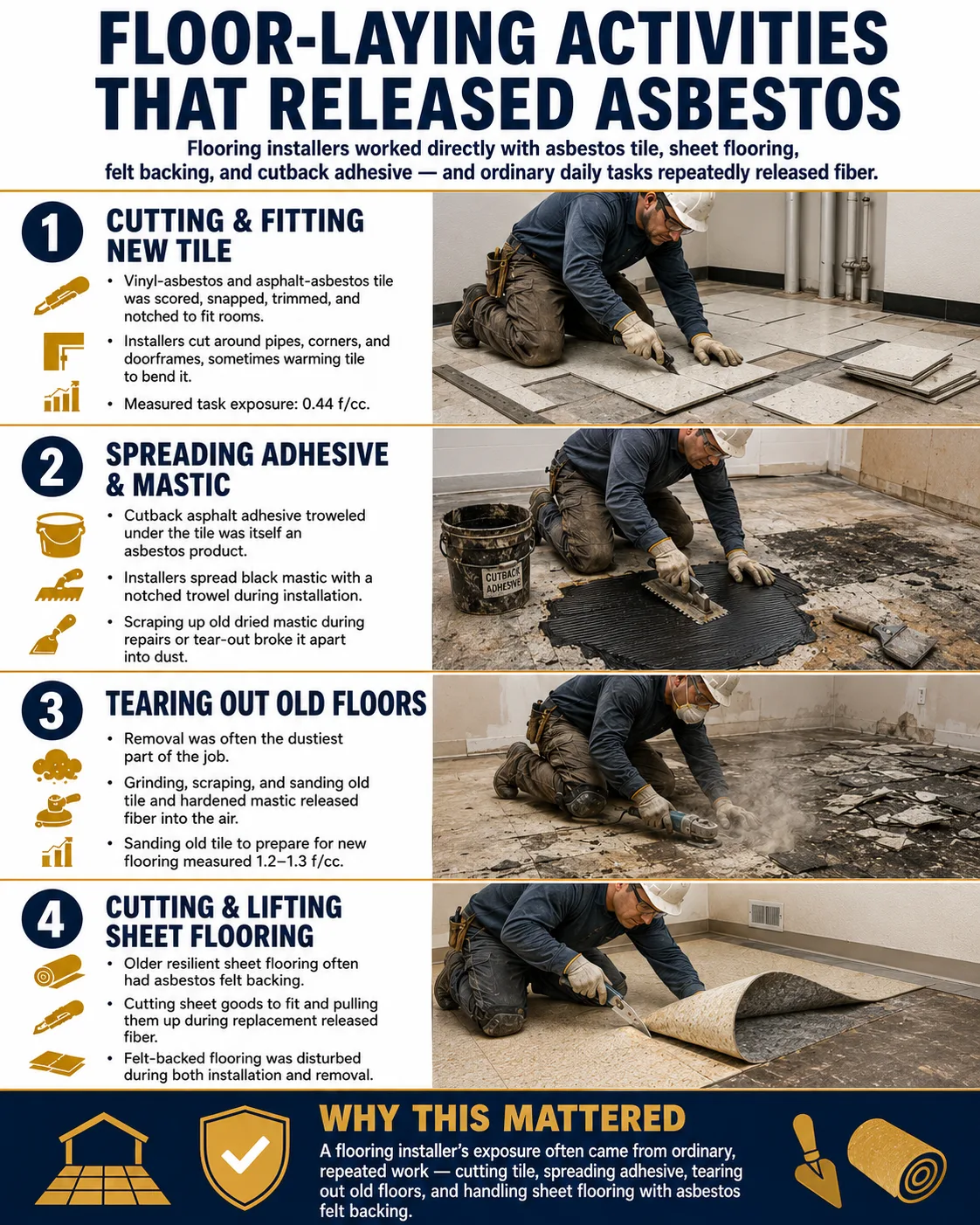
Laying floors put workers in steady contact with asbestos for a simple reason: for most of the twentieth century, asbestos was added to the floor itself. Vinyl-asbestos and asphalt-asbestos tile, the cutback adhesive troweled underneath, and the felt backing on resilient sheet flooring were all made with asbestos by design. A flooring installer encountered it because the product he handled all day was built out of it.
The exposure came from the ordinary, repeated motions of the trade, not from anything unusual:
- Cutting and fitting new tile. Fitting a room meant scoring and snapping tile to size, cutting borders and notching around pipes and doorframes, and sometimes warming and bending it. Snapping and cutting vinyl-asbestos tile has been measured at 0.44 f/cc.
- Spreading adhesive and mastic. The cutback asphalt adhesive troweled under the tile was itself an asbestos product, and scraping up the old, dried mastic on a tear-out broke it apart into dust.
- Tearing out old floors. The dustiest work was removal. Grinding, scraping, and sanding old tile and the hardened mastic beneath it to get a clean subfloor threw fiber into the air. Sanding old tile to prepare for new flooring has been measured at 1.2 to 1.3 f/cc.
- Cutting and lifting sheet flooring. Older resilient sheet goods were backed with asbestos felt, and cutting them to fit or pulling them up released fiber the same way.
Two things multiplied all of this. The work happened low to the floor, with the installer kneeling or bent right over the dust, so the fiber rose straight into his breathing zone, often in small, closed-up rooms with little ventilation, and the dry debris was frequently just swept up at the end of the day. And it happened over and over for an entire working life. A career floorlayer cut, snapped, troweled, and tore out floors thousands of times across decades, and removing old, friable (crumbly and dusty), degraded material released far more fiber than laying it new.
Through all of it, the men doing the work were given no warning and no protection. They worked bare-handed, dry-swept the cutoffs, and went home in dusty clothes to their families, while the companies that made the products knew what the dust was doing.
The asbestos products a flooring installer handled, and why they add up to more than one claim
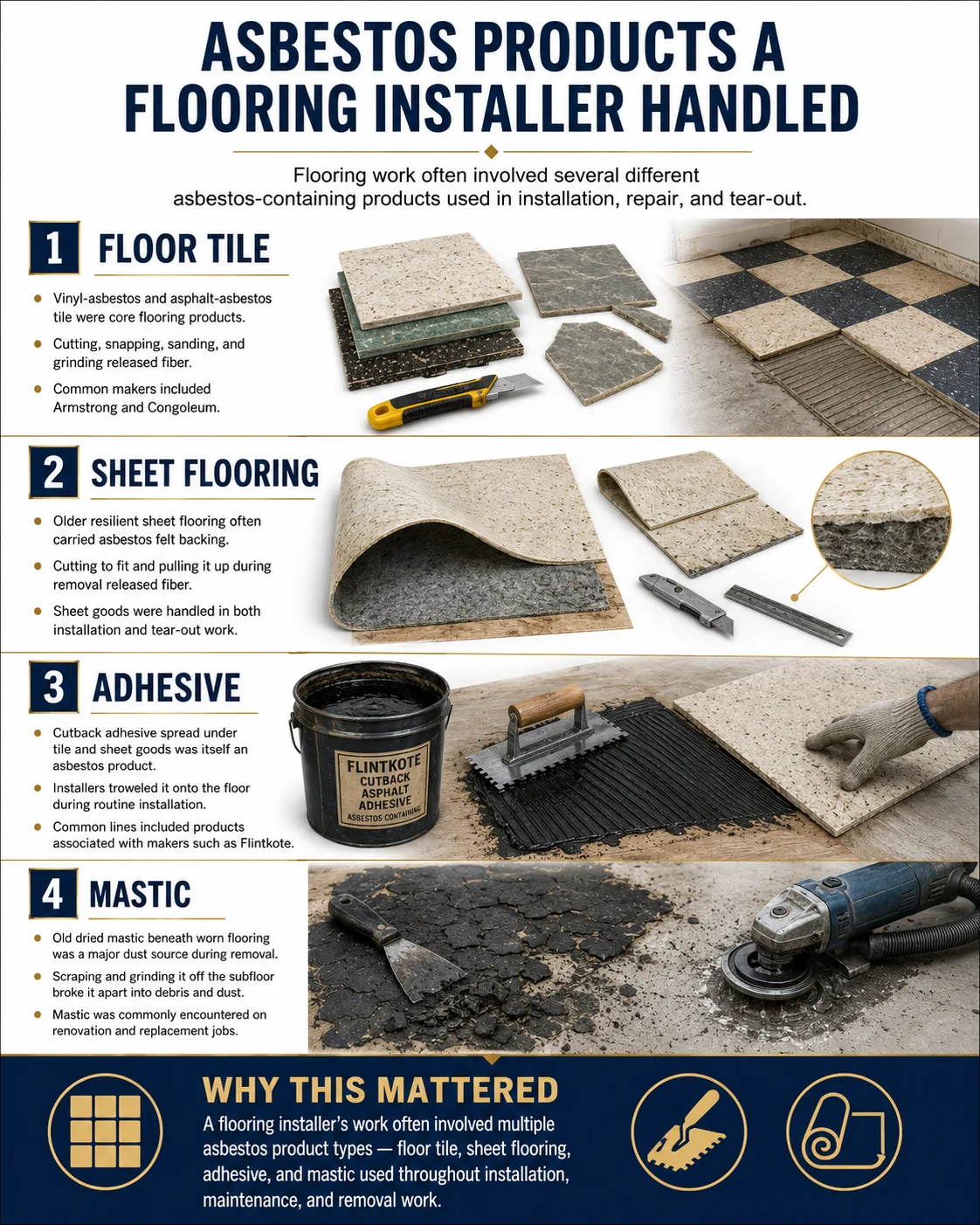
Over a career, a flooring installer handled several different asbestos products, each made by a different set of companies, and that combination is what shapes the claim. Understanding the products is how we identify who's responsible and which claims you can bring.
Floor tile and sheet flooring. Vinyl-asbestos and asphalt-asbestos tile were the core of the trade, and older resilient sheet flooring carried an asbestos felt backing. Cutting, snapping, and especially sanding and grinding this material out is where the fiber came loose. The makers behind these products include companies now covered by bankruptcy trusts, such as Armstrong and Congoleum, alongside still-solvent manufacturers you can sue directly. See how asbestos floor tile caused exposure.
Adhesive and mastic. The cutback asphalt adhesive spread under tile and sheet goods was an asbestos product in its own right, and the dried mastic an installer ground and scraped off during removals was a major source of dust. These trace back to makers including Flintkote, much of which now pays through a trust. See how asbestos adhesives and mastic caused exposure.
This is why a flooring installer's case is rarely a single claim. Because the work touched tile, sheet flooring, and adhesive from many different manufacturers, the typical recovery runs against several bankruptcy trusts at once, plus lawsuits against the manufacturers still in business and the building owners or general contractors who controlled the worksite. You don't need to remember whose tile you set in 1979 or whose mastic you scraped up in 1986. Give us the work history, and we trace each product back to its maker, and each maker to its trust or its place in a lawsuit.
Where you worked, and why the setting still matters
A flooring installer carried the exposure with him, so the trade put him at risk in almost any building. Where he worked still matters to the case, though, because it decides which property owners and contractors can be held responsible as premises defendants, and whether a federal benefit program comes into play on top of the trust and lawsuit claims.
Most flooring work falls under the broad umbrella of construction, across a few familiar settings: new homes and apartment buildings; commercial space such as offices, stores, and restaurants; and institutional buildings like schools, hospitals, and government offices, much of it remodel and renovation work where old floors came up and new ones went down. In each of those settings, the building owner and the general contractor who controlled the site can be reachable, separate from the companies that made the tile and the mastic. Construction industry asbestos exposure.
If your loved one laid floors at a federal facility, tell us. Work at a federal building can add a benefit channel that runs in parallel with everything else.
What the asbestos industry's own magazines said about floor tile
The trade journal Asbestos and Johns-Manville's employee magazines wrote about floor tile for fifty years. In their pages the tile is described in the industry's own words, along with the buildings it went into and the people who laid it.
What the tile was made of
In 1929 Johns-Manville bought a Chicago maker of "Rubber-Tex-Tile" and described it as asphalt compounds, "asbestos fibre and mineral fillers," laid in "J-M special waterproof paste cement" (J-M Circle, May 1929). In 1939 Asbestos wrote plainly that "J-M Asphalt Tile Flooring contains asbestos" (Asbestos, Feb. 1939). In 1949 the magazine's own editors put Kentile on their office floor and only afterwards learned it contained asbestos. They then reported that asbestos was "about 50% of its volume" (Asbestos, June 1949; Sept. 1949).
How floors went down
The 1949 article traced the work back to the First World War. Factory floors and ship decks were then covered with "Mastic," made of asbestos fibre and asphalt thinned with solvent and laid in "six or seven layers." Later the material was rolled into sheets and cut into squares "to make installation easier and quicker" (Asbestos, Sept. 1949). Tile was set in cement or adhesive. J-M said in 1930 that a job's success "depends largely upon the merits and permanence of the cementing agent" (J-M Circle, July–Aug. 1930). In 1955 it offered a brush-on adhesive so that troweling was "eliminated." That adhesive bonded Terraflex vinyl-asbestos tile to concrete, plywood and "asphalt saturated asbestos felt" (Asbestos, Apr. 1955). In 1965 Nicolet planned vinyl flooring "applied to Nicolet's asbestos floor covering base" for its own new offices (Asbestos, Apr. 1965).
Not all of the tile was laid by tradesmen. By 1949, homeowners were buying "just 100, or 150, square feet" to lay their own basements and kitchens (Asbestos, Sept. 1949). In 1962 a J-M maintenance mechanic was laying tile part-time in a shopping center, a supermarket and a New Orleans office (J-M News Pictorial, Feb. 1962). Around 1969–70, residents of drug-rehabilitation programs laid donated J-M vinyl-asbestos tile themselves (J-M News Pictorial, Jan.–Feb. 1969; Jan.–Feb. 1970).
Named buildings
Each floor is named as the page names it. Some of these pages give the product name without saying what it contained.
| Year | Building | Place | Flooring as named | Source |
|---|---|---|---|---|
| by 1929 | State and Logan Square Savings Bank (basement) | Chicago | Rubber-Tex-Tile | J-M Circle, May 1929 |
| 1930 | St. Francis Hotel billiard hall, 10,000 sq ft, laid by The G. Seestedt Company | St. Paul, Minn. | Tile Flooring Type "A" | J-M Circle, Dec. 1930 |
| 1930 | Broad-Grace Arcade building | Richmond | asphalt tile | J-M Circle, Apr. 1930 |
| 1930 | 75 Federal Street Building, 9th floor | Boston | J-M Type "A" Asphalt Tile | Asbestos, Nov. 1930 |
| by 1942 | New England Mutual Life Insurance Building | Boston | J-M asphalt tile, "a combination of asbestos and asphalt" | Asbestos, Nov. 1942 |
| by 1947 | Boro Hall | Manville, N.J. | asphalt tile | Asbestos, Sept. 1947 |
| by 1949 | The Pentagon, 4,000,000 sq ft | Washington, D.C. | Kentile | Asbestos, Sept. 1949 |
| by 1949 | General Electric Electronic building, about 1,000,000 sq ft | Syracuse | Kentile | Asbestos, Sept. 1949 |
| by 1949 | 9,000 homes, "Kentile in every room" | Levittown, N.Y. | Kentile | Asbestos, Sept. 1949 |
| 1959 | Arthur Vining Davis library, American School of Classical Studies | Athens, Greece | Flexachrome vinyl-asbestos | Asbestos, Oct. 1959 |
| 1968 | 39 St. John's Place brownstone | Brooklyn, N.Y. | vinyl-asbestos floor tile | J-M News Pictorial, June 1968 |
| 1968–69 | Phoenix House, 116th St. | Manhattan | Vinyl Asbestos Flooring | J-M News Pictorial, Jan.–Feb. 1969 |
How big it got
Asphalt tile sales rose "about 900% in the past ten years," Asbestos reported in 1949 (Sept. 1949). Industry executives put 1956 sales at about 1.12 billion square feet. They said the tile went into "institutional industrial and commercial construction" as well as "modernization and repair" (Asbestos, June 1957). By 1961 J-M called resilient flooring "a billion dollar industry" (Asbestos, Dec. 1961).
What the industry said about health
In 1979 Asbestos reprinted Johns-Manville's annual report. It listed resilient flooring among products where the fiber is "locked in place," and said that "asbestos fiber poses no hazard to users or the public" (Asbestos, May 1979). These magazines never described the dust a floor layer breathed while cutting tile or tearing out an old floor.
How a flooring installer's case can come together
The following is a composite example, not a real client, but it reflects how these cases typically come together in our experience.
Gus spent twenty-eight years as a floorlayer, out of his local, working both houses and commercial jobs. The work was the same wherever he went: score and snap vinyl-asbestos tile to fit, cut the borders and notch around the pipes, trowel out the cutback mastic, and on the remodels grind and sand the old tile and dried adhesive off the subfloor so the new floor would lay flat. He did most of it on his knees in closed-up rooms, with the dust rising right past his face, and swept up the cutoffs dry at the end of the day. In early 2026, after a stretch of breathlessness and chest pain he'd put down to age, a biopsy confirmed pleural mesothelioma of the epithelioid type.
For Gus's family, the case moves on several tracks at once, which is typical for the trade. Trust claims go in against the makers of the tile, sheet flooring, and adhesive he handled across his career, several different companies and several different trusts. Lawsuits go against the manufacturers still in business and against the building owners and contractors who controlled the sites where he worked. Because the most effective mesothelioma treatment is often available only at a handful of specialized centers, getting Gus to the right one may mean travel, and the firm advances the cost of travel and lodging when the best center isn't close to home. How legal recovery funds mesothelioma treatment access. Gus's wife, who shook out and washed his dusty work clothes for years, is eligible for free asbestos health screening as part of the representation. The screening is a chest X-ray read by a B-reader, with a CT scan if needed; it looks for asbestos-related changes in the lungs and isn't a diagnosis or a reliable way to find mesothelioma early.
This example is general. Every case depends on the diagnosis, the exposure history, the dates, the defendants, the applicable law, and the available evidence.
Sources of compensation for flooring installers
A flooring installer's recovery usually comes from more than one place, and the different channels run in parallel without canceling one another out. We file across all of them that apply.
- Asbestos bankruptcy trusts. The companies that made the tile, sheet flooring, and adhesive he handled and later went bankrupt set aside money in trusts to pay the people they harmed. These are paper claims that don't require a lawsuit or a courtroom, and a single career often supports filings against several trusts at once. How asbestos trust claims work.
- Lawsuits against solvent manufacturers. Many flooring and adhesive makers are still in business and can be sued directly for making and selling a product they knew was dangerous. How product liability lawsuits work.
- Premises liability against the site owners. The building owners and general contractors who controlled the homes, stores, offices, and institutions where the work was done can be held responsible for the conditions they allowed, separate from the companies that made the products. How premises liability claims work.
- Federal and disability benefits. Flooring work rarely opens the military and maritime benefit programs, but civilian work at a federal facility can support benefits under the Federal Employees' Compensation Act (FECA), and Social Security disability is available to anyone whose illness stops them from working. These are paid in addition to the trust and lawsuit recovery. How asbestos disability and benefit claims work.
Mentioned on this site
- Armstrong
- Armstrong World Industries Asbestos PI Settlement Trust
- Armstrong World Industries Asbestos Trust Claims
- Asbestos Exposure by Occupation
- Asbestos Exposure in the Construction Industry
- Asbestos Floor Tile, Sheet Flooring, and Black Mastic
- Asbestos in Schools
- Asbestos Paper Products
- Azrock Floor Products
- Azrock Floor Products
- Azrock Floor Products
- Best HEPA Vacuum for Asbestos
- Bird & Son
- CDC
- Composition Flooring
- Cutback Adhesive
- Does Old Linoleum Contain Asbestos?
- Kentile Floors (Metex) Asbestos Trust Claims
- Kentile Floors
- Sorel Cement Flooring
- Speckled Floor Tile
- Vinyl-Asbestos Tile
In our case-law library
21 court decisions in our case-law library involve flooring installers. Among them:
- Accident Fund Insurance Company v. CaseyMissouri Supreme Court, 2018 · Floor tile installer at E.J. Cody Company, Inc., 1984-1990
- Olivotto v. DeMarco Bros. Co.Nebraska Supreme Court, 2007 · Terrazzo installer at post office, 1970s
- Pifer v. Irwin Industrial Tool Co.Maryland Court of Special Appeals, 2021 · Carpet installer (mechanic) at Clyde W. Dent Carpet Installation, College Park, 1960-1980s
- Accident Fund Insurance Company v. CaseyMissouri Court of Appeals, 2017 · Tile installer at E.J. Cody Company, Inc., Kansas City, 1984-1990
- Bier v. Am. BiltriteOhio Court of Appeals, 2012 · Owner of D&F Tile, a flooring company at D&F Tile, 1962 into the 1970s
- Union Bank OF California, NA v. Copeland Lumber Yards, Inc.Oregon Court of Appeals, 2007 · Floor installer at 1953 to 1991
Videos

The defenses companies raise, and how we answer them
When a flooring installer's case goes to court, the manufacturers raise the same handful of defenses they raise in most asbestos cases, and none of them is new to us. The short version is that the arguments describe a cleaner, smaller version of the job than the one your loved one actually did, and the evidence answers them. The detail is below for anyone who wants it.
All of this applies only to the lawsuit side of a case. The trust claims are a paper process: no opposing lawyer raises defenses, no one is deposed, and no one goes to court.
How we answer the defenses raised in flooring installer cases
"The asbestos was locked inside the tile, which is non-friable, so it stayed sealed during normal use." A finished, undisturbed floor isn't where the exposure came from. It came from working the material: scoring and snapping it, and above all grinding, scraping, and sanding old tile and the dried mastic underneath to clear a subfloor. That breaks the so-called non-friable product apart and sends respirable fiber into the air. The industrial hygiene testing that recorded the high fiber levels recorded them during exactly that cutting and removal work, the work flooring installers did every day.
"The exposure to any one company's product was too small to have made a difference." These cases are built on documented exposure: the specific high-dust tasks the trade performed and the dose built up across a full career, which is what separates a flooring installer's claim from a trivial one. The bankruptcy trusts pay on brief exposure, and in court we prove a meaningful contribution with that task and career evidence. We never rely on a single stray fiber.
"You can't prove our product was the one on those floors." Product identification is something we reconstruct rather than expect you to recall. From the work history, our exposure database, the trust documentation for each manufacturer, the brands sold in your region during your working years, and the recollections of coworkers and suppliers, we connect the floors you worked on to the companies that made the tile and the mastic.
Frequently asked questions
I don't remember the tile brands or have my old records. Can I still file?
Yes, and most people are in exactly that position. You don't need brand names, pay stubs, or union cards in hand to start. We reconstruct the work history and the products from our exposure database, the trust documentation for each manufacturer, the brands sold in your area during your working years, and the recollections of coworkers, and union and pension records often fill in the dates and worksites. The conversation starts with what you remember.
My loved one has already passed away. Can we still bring a claim?
Yes. Families regularly file after a death, both trust claims and, depending on the state, a wrongful death lawsuit. These deadlines vary by state and some are short, and the family's claim can depend on whether a claim was preserved during the worker's life, so it's best to call promptly. We handle wrongful death and estate claims as a matter of routine.
My dad did both residential and commercial flooring. Does that complicate the case?
It usually strengthens it. A flooring installer who moved among houses, stores, offices, and institutional buildings was exposed to more products, made by more companies, at more premises, which means more trusts and more potential defendants. We reconstruct the full career and file across every documented worksite.
Could my family have been exposed through the work clothes?
Yes, and it's common. The dust that settled on a flooring installer's clothes, hair, and tools came home with him, and spouses who shook out and laundered work clothes and children who hugged a parent at the end of a shift were exposed too. That's why our representation includes free asbestos health screening for family members, and if a family member is later diagnosed, they may have a claim of their own.
What happens when I call?
A member of our litigation team, not a screener, takes the call, and the first conversation usually runs twenty to thirty minutes. We listen to the work history, explain which claims and channels may apply, and lay out the timeline for your situation. No one is pressured to sign anything on that call.
What does it cost to work with you?
Nothing up front, and nothing at all unless we recover for you. We work on a contingency fee, which means our fee comes only out of money we recover, and the case review and consultation are free.
Do we have to travel to your office?
No. We handle these cases by phone, video, and mail, and we come to you when an in-person visit helps. Families work with us from every state without traveling to us.
Talk with an asbestos lawyer about flooring installer exposure
Whether you're a worker who was just diagnosed, or a spouse or adult child trying to find help for someone who is sick or who has passed, we're ready to talk. You don't need the product names, you don't need the old records, and you don't need to travel to us. Start with what you remember, and we'll take it from there.
Related resources
Sources and references
The exposure measurements on this page come from published industrial hygiene testing, cited in full on the product pages where each figure lives:
- The 1.2–1.3 f/cc tile-sanding measurement and the 0.44 f/cc cutting-and-snapping measurement are documented on our asbestos floor tile page.
Other authorities relied on:
- Occupational exposure limits. OSHA's asbestos standard sets the current permissible exposure limit at 0.1 f/cc averaged over eight hours, with a short-term excursion limit of 1.0 f/cc over thirty minutes. 29 C.F.R. § 1910.1001.
- Carcinogenicity. The International Agency for Research on Cancer classifies all forms of asbestos, including chrysotile, as carcinogenic to humans (Group 1) and recognizes no safe threshold of exposure for mesothelioma. IARC Monographs, Vol. 100C.
This page is provided for general informational purposes and does not constitute legal advice. Every asbestos case turns on its own facts, exposure history, diagnosis, deadlines, available evidence, and applicable law. Reviewing this page does not create an attorney-client relationship. For advice about your specific situation, call 833-4-ASBESTOS for a free case review.