
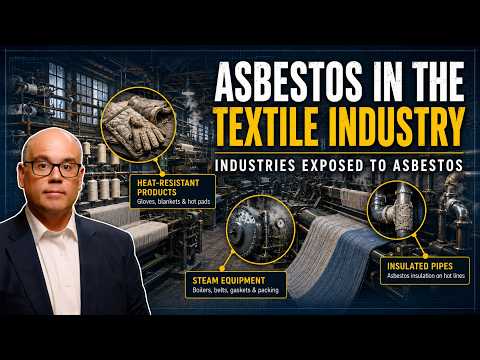
Asbestos textiles were the gear that stood between a worker and the heat: the gloves for handling hot metal, the blankets thrown over a weld, the coats and hoods worn at the furnace, and the cloth, tape, and rope wrapped around anything that ran hot. The danger was that the protection itself shed fiber every time it was handled. Clapping the dust out of a pair of worn asbestos gloves has been measured at 47.6 fibers per cubic centimeter, which in fifteen minutes puts roughly fourteen years' worth of ordinary city background air through a worker's lungs1, and that was a gesture workers made without a thought, dozens of times a week, for years. You don't need to remember which brand of gloves hung by the furnace or dig up any old records to find out whether you have a claim; if you wore or handled this gear at work, that's where we start.
Even ordinary city air carries a faint trace of asbestos everywhere, from natural mineral erosion and decades of industrial use, and that trace is the baseline both sides of the panel are measured against.
What these numbers mean. Asbestos in air is measured in fibers per cubic centimeter (f/cc), a unit that hides how dangerous a task was. Across this site we translate each measurement into fibers breathed, feet of fiber end to end, and years of ordinary city air, using conservative, government-sourced assumptions. See how we measure asbestos in air for the method and its limits.
You don't need the product names or old records. No fee unless we recover compensation for your family.
Quick answers
| Did asbestos gloves and blankets really expose me? | Very likely, if you wore or handled them regularly. The heaviest exposure came from handling the gear: clapping dust out of gloves, shaking out blankets, and cutting or tearing cloth, which drove fiber straight into the breathing zone. |
|---|---|
| The gear was supposed to protect me. How was it dangerous? | It protected against heat, and it did that job well. The problem was the material itself: woven asbestos wore, frayed, and shed, so the routine handling of protective gear became its own source of asbestos in the air. |
| How much exposure do I need for a claim? | For mesothelioma, less than you'd expect. The bankruptcy trusts that pay many of these claims are built to compensate brief exposure on a worksite that used asbestos. Courts ask for a meaningful contribution, and we handle that distinction for you. |
| Which companies made asbestos textiles? | Names like Johns-Manville, Raybestos, Amatex, Eagle-Picher, Porter, and AstenJohnson. Most of the major makers went bankrupt and now pay through trusts. |
| Do I need to remember the brand of the gloves or cloth? | No. Almost no one does; the gear hung by the furnace and got used by everyone. We reconstruct the products from your work history, our exposure database, and the trust documentation. The brand names are our job, not yours. |
| Do I have to file a lawsuit? | Not necessarily. Many textile claims run mostly through trust claims, which are paper claims with no courtroom. Where a lawsuit is available, we explain both paths and you decide. |
| Can a spouse or adult child call for the worker? | Yes. Most of our first calls come from a wife or an adult child. You don't need a power of attorney to ask questions. |
“I started this firm after learning that the cancers that killed my father and grandparents were caused by asbestos, something we did not realize until it was too late to hold anyone accountable. That experience is why we built this site: so that no other family misses their chance to ask the questions, hear the options, and decide for themselves what to do.”
What asbestos textiles were
Asbestos is a mineral, but its fibers are long and flexible enough to be spun and woven like wool, and that single property built an entire product category. Mills carded raw fiber into roving (loosely twisted strands ready for spinning), spun the roving into yarn, and wove the yarn into cloth, and from that cloth the industry cut and sewed nearly everything that had to survive heat: gloves and mitts for handling hot metal, aprons and leggings for pouring and casting, coats and hoods for furnace work, blankets and curtains for welding, and pads for stress-relieving welds on pipe.
Alongside the sewn goods came the woven and twisted forms sold by the roll and the coil. Asbestos cloth wrapped pipes, boilers, and wiring runs. Woven asbestos tape, sold in narrow rolls, wrapped joints, hoses, and electrical work. Asbestos rope and wick packed the doors of ovens, kilns, and boilers, and sealed the seams that gaskets couldn't reach. Much of it ran to very high asbestos content, because the mineral was the point; the cotton or other carrier fiber was there only to help the weave hold together.
Representative products and their asbestos content. These are examples, not a full list:
| Product | Maker | Fiber | Asbestos content |
|---|---|---|---|
| Asbestos cloth | Johns-Manville | Chrysotile | 95% |
| Asbestos rope | Amatex | Chrysotile | 95% |
| Woven asbestos tape | Amatex | Chrysotile | 95% |
| Cleangard (impregnated cloth) | Safety First Industries | Chrysotile | 83% |
| Asbestos roving | Amatex | Chrysotile | 95% |
Notice what those percentages mean. A product that is 95% asbestos isn't a material with some asbestos in it; it's asbestos, held together by a thread of something else. Textiles were overwhelmingly a chrysotile (white asbestos) category, because chrysotile is the form whose fibers spin and weave well, and we present that point honestly rather than blurring it: chrysotile is classified by IARC as a Group 1 human carcinogen and is a recognized cause of mesothelioma5. The case for these products doesn't need any overstatement about fiber type; it rests on what the woven mineral did in the air when people handled it.
How asbestos textiles put asbestos in the air
A new asbestos glove or blanket looks like a solid piece of fabric, and the industry leaned on that impression for decades. But a weave isn't a seal. Every flex of the fabric works fibers loose, heat dries and embrittles the material, and wear frays the surface into a nap of exposed fiber. The dust that built up on and in the gear then came out the way dust always comes out of fabric: by handling it. Clapping gloves together to knock the grit off, shaking out a blanket after a weld, folding and unfolding a curtain, and cutting or tearing cloth and tape to length all released fiber directly at face height, in the breathing zone, which is the air right where a worker actually inhales.
Here is what that handling measured. Each figure is a phase-contrast (PCM) measurement, which counts only the longer fibers and so reads as a floor, not a ceiling:
| Task | Measured (f/cc) | ≈ years of background per 15 min | Source |
|---|---|---|---|
| Clapping the dust out of worn gloves | 47.6 | ~14 years | Millette / MVA 19921 |
| Clapping the dust out of good-condition gloves | 23.4 | ~7 years | Millette / MVA 19921 |
| Shaking out a welding blanket | (confirm) | (confirm) | Hatfield & Longo, MAS 19992 |
| Wearing asbestos coats, hoods, and gloves at blast furnaces | (confirm) | (confirm) | Gibbs 19753 |
The pattern in that table is the whole story of this product. The worn gloves read twice as high as the good ones, because wear is exactly what turns a woven product into a fiber source, and no glove on a working shop floor stayed in good condition for long. The gear got used until it fell apart, and it shed the entire time.
By the illustrative math on our how we measure asbestos in air page, 15 minutes of clapping the dust out of worn gloves put roughly 14 years of ordinary city air through the lungs. This estimates fibers in the air breathed, not a retained dose.
The full task-by-task story of who wore this gear and where, from the welding bay to the furnace floor, lives on the occupation and industry pages linked below. What belongs here is the product itself and the fact that its danger was built into how it had to be used: worn on the body, handled by hand, and cleaned by shaking.
What the makers knew
The documented record on asbestos textiles has a bitter through-line: the very gear sold to keep workers safe from heat was itself putting fiber into their air, and that fact was measured and published, not guessed at.
The work-practice literature recorded it directly. A 1992 Millette/MVA study of glove handling recorded peak short-duration exposures reaching 47.6 f/cc from nothing more than clapping the dust out of a worn pair1. Hatfield and Longo at Materials Analytical Services documented in 1999 that just six minutes of routinely shaking out a single welding blanket generated substantial breathing-zone fiber2. And the measurements reach back further still: Gibbs measured workers in 1975 simply for wearing asbestos coats, hoods, and gloves around blast furnaces, treating the protective clothing itself as the exposure source under study3. Wearing the gear was an exposure; handling and cleaning it was a heavy one; and the literature said so for decades.
That record matters legally as well as historically. These weren't exotic laboratory conditions; the studies measured the ordinary, intended use of the products, the exact handling every manufacturer knew its gloves and blankets would receive on a shop floor. A hazard documented in the published literature of the industry is a hazard the makers are charged with knowing, and the workers wearing the gear were told the opposite: that this was the safety equipment.
Who was exposed
Asbestos textiles weren't tied to one trade; they were issued wherever work ran hot. Rather than retell each worker's story here, this page hands that off to the pages that own it:
- welders, who worked under and beside asbestos blankets, gloves, and heat garments every day
- steelworkers and foundry workers, whose furnace and pouring work meant asbestos coats, hoods, mitts, and leggings
- electricians, who cut and wrapped asbestos cloth and woven tape around wiring, connections, and heat-prone equipment
If you or your family member wore heat gear or handled asbestos cloth in any of these settings, the exposure history is usually easy to reconstruct.
The manufacturers and the trusts
Recovery in a textile case runs mostly through the asbestos bankruptcy trusts, because the major makers of asbestos cloth, garments, and blankets went bankrupt under the weight of these claims, and the trusts they funded pay claims today through a paper process with no lawsuit. Depending on where the gear was worn, the site owner can also be reached as a premises defendant, and one pathway doesn't reduce another.
| Manufacturer / brand | Status | How claims are handled |
|---|---|---|
| Johns-Manville (cloth, tape, lagging, garments, gloves) | Manville trust, active since 1988 | Trust claim, no lawsuit |
| Eagle-Picher (Hyldreth Asbestos Yarn Mill, Joplin, MO) | Eagle-Picher trust, active since 1996 | Trust claim, no lawsuit |
| Porter (asbestos textiles) | §524(g) trust | Trust claim, no lawsuit |
| AstenJohnson (asbestos textiles) | §524(g) trust | Trust claim, no lawsuit |
| Raymark / Raybestos (asbestos textiles) | Raymark Chapter 7 liquidation, 2001 | Recovery limited |
| Facility owners (mills, foundries, shipyards, plants) | Solvent, premises liability | Lawsuit (state-law dependent) |
A §524(g) trust, named for the bankruptcy-code section that creates it, is a fund a bankrupt asbestos company sets aside to pay present and future claimants; filing against one is a documentation process, not a courtroom fight. If the idea of any lawsuit is uncomfortable, you're in good company; Clarence Borel, the refinery insulator whose 1973 case built the modern asbestos-litigation system, didn't want to sue either, and we can pursue trust claims alone if that's your preference.
Sources of compensation
A textile case usually draws from several sources at once, and they run in parallel:
- Asbestos bankruptcy trusts. The makers who went bankrupt set aside money to pay the people they harmed. These are paper claims, with no lawsuit and no courtroom, and one career in heat gear often supports filings against several trusts. How asbestos trust claims work.
- Lawsuits against solvent companies. Where a responsible company never went bankrupt, it can be sued directly, and those tort recoveries often exceed what a trust pays per claim. How product liability lawsuits work.
- Premises liability against site owners. The mills, foundries, shipyards, and plants that issued the gear and controlled the worksite can be held responsible for the conditions they allowed. How premises liability claims work.
- Federal and disability benefits. Navy service can support VA disability benefits, and civilian shipyard work can support Longshore (Longshore and Harbor Workers' Compensation Act) benefits, both paid in addition to the rest. How asbestos disability and benefit claims work.
In the research library
The National Library of Medicine indexes 54 studies in our medical research library under asbestos textiles. Among the most cited:
- Relationship of mortality to measures of environmental asbestos pollution in an asbestos textile factoryJ. Peto, R. Doll, C. Hermon, et al, 1985 · The Annals of Occupational Hygiene · cited 162 times
- Follow-up study of chrysotile textile workers: cohort mortality and exposure-responseM.J. Hein, L.T. Stayner, E. Lehman, et al, 2007 · Occupational and Environmental Medicine · cited 145 times
- Dust exposure and mortality in an American chrysotile textile plantA.D. McDonald, J.S. Fry, A.J. Woolley, et al, 1983 · British Journal of Industrial Medicine · cited 121 times
- Follow-up study of chrysotile asbestos textile workers: cohort mortality and case-control analysesJ.M. Dement, D.P. Brown, A. Okun, 1994 · American Journal of Industrial Medicine · cited 102 times
- Respiratory cancer in chrysotile textile and mining industries: exposure inferences from lung analysisP. Sebastien, J.C. McDonald, A.D. McDonald, et al, 1989 · British Journal of Industrial Medicine · cited 92 times
In our case-law library
169 court decisions in our case-law library involve asbestos textiles. Among them:
- Kinseth v. Weil-McLainIowa Supreme Court, 2018 · Boiler and furnace installer at Kinseth Plumbing and Heating, 1953-1987
- Scapa Dryer Fabrics, Inc. v. KnightGeorgia Supreme Court, 2016 · Sheet-metal worker; independent contractor at Scapa Dryer Fabrics facility, Waycross, 1967-1973
- Sequira v. 3M CompanyU.S. Court of Appeals, Ninth Circuit, 2015 · F-80 aircraft with J-33 engine
- Bostic v. Georgia-Pacific Corp.Texas Supreme Court, 2014 · Relief hot end worker at Knox Glass plant, summers of 1980, 1981 and 1982
- Exxon Mobil Corporation v. MintonVirginia Supreme Court, 2013 · Ship repair staff supervisor at Exxon vessels repaired at the Shipyard, Newport News, 1966-1977
- Gallagher v. National Grid Usa/narragansett Electric.Rhode Island Supreme Court, 2012 · Welder at Electric Boat, Groton, 1965-1971
In our products database
The cloth, tape and other textiles our document library describes, by the company that made or sold it. Each product's page says when it was made and how much asbestos it held, from the documents.
A. W. Chesterton: 64 Diagonal High Pressure Packing · Russo · Tanpac
A.P.G. Hewitt Hose: Variflex
Advance Glove: Advance 1211 · Advance 1253 · Advance Barbecue Chef
Allied Polymer Group: Apg Hewitt
Amatex: Litelag · Quietline · Safecote · Style A11P16G · Thermalon · Thermolan 26 · Titegrip
American Optical: AO Thermogarb
Ametek: Thermolan
Anchor Packing: S-1565,9S-4680L
Applied Plastics: Applon A Tfe · Applon T Tfe
Asahi Kasei Kogyo Kabushiki Kaisha: Sofilia
Asberit S.A.: Metalbest
Asbestos Textile Co.: Aztec
Atlas Asbestos: Beswik
Atlas Asbestos Company, North Wales: Atlas (Atlas Asbestos) · Beswick (Atlas Asbestos)
Atlas Textile: Flamemaster · Thrift-T
Beldam Packing & Rubber Company: Beldam'S Pilot
British Belting & Asbestos: BB
C. W. Hanslip: Standco
Cape Asbestos: Noramite
Cape Asbestos Co. of London: Caposite
Car-Mon Products: Nu-Flex
Car-mon Products: Weldproff
Cement Asbestos Products Co. (Capco): Granostruct
CertainTeed: Flexible Trainline Pipe
Charles Laurence Willis: Stella
Chester M. Roe: Sea-Ro The Universal Packing
Claremont Industries: Clarex-lageeze
Coast Manufacturing & Supply: Trevarno
Consolidated Asbestos: No Dust
Continental Diamond Fibre: Celoron · Dilecto
Devcon: Form Pack
Duplan: Etnatex
E. I. Du Pont De Nemours And: Quilon
Elliot Glove: JB 1000A
Elliott Glove: John Bull · Red Ram · Rra 1000
Eureka Packing: Brapaco
Excelsior: X-l
Facile: Laminglas
GAF: Air Cell
Garland: Supercote
Garlock: Ring packing
General Asbestos & Rubber: Garco
General Plastics: Dura Sleeve
Grant Wilson: Gum-Bestos Asbestos Paper Tape
Greene Tweed & Co.: Palmetto Cabcock · Runwel
H. K. Porter: Aluminum Coated Asbestos Cloth · Cleangard · Covergard · Flamegard · Guardian · Heatgard · Hi-Luster · Inslgard · Porterlag · Portersite · Rwl-100 · Soundgard · Splashgard · Style 1030 · Style 2844 · Style 5621 Asbestos Wick · Tadpole · Therm-a-gard · Thermoid Custom Lag · Type 2 Porter Tape · Type 4 Porter Tape · Type 6 Porter Tape · Weldgard
Harco Chemical: Azkem
Henrite Products: Squeegee
Herbert A. Greene: S
Industrial Glove: Industrial No. 200-14 · Industrial No. 225-14
Industrial Gloves Company: Old Hickory · Steel-Grip (Industrial Gloves)
International Plumbing Products: Tru Flame
Irvington: Novabestos
J. P. Stevens: Asbestos
Jackson, Gordon C.: Jaxcolite
James Walker & Co.: Lion Trade Mark
Janos Industrial Insulation: Thermolan
John Herman: Herco
Johns-Manville: 101 Cloth (Coated) · 135 Tadpole Gasketing Tape · 135-S Tadpole Gasketing Tape · 55 Cable Fireproofing Tape · 88 Cloth (Coated) · 89 Cloth (Coated) · 91 Cloth (Coated) · 95 Cloth (Coated) · 96 Cloth (Coated) · A Grade Asbestos Cloth · A Grade Asbestos Tubing · A-275 · AA Grade Asbestos Cloth · AA Grade Asbestos Tubing · Aaa Grade Asbestos Cloth · Aaa Grade Asbestos Tape · Aaa Grade Asbestos Tubing · Aaaa Grade Asbestos Cloth · Aaaa Grade Asbestos Tape · American Colonial · Armaturo Asbestos Tape · Asbestica · Asbestica Tape · Asbestos Cloth · Asbestos Listing · Asbestos Paper Tape · Asbestos Rope · Asbestos Tape · Asbestos Yarn · Besto-Tak · Blastape · Blastube · Ceilinite · Chempac · Chemtite · Colorbestos · Colorbestos Drapery · Commercial Grade Asbestos Cloth · Commercial Grade Asbestos Tape · Commercial Grade Asbestos Tubing · Duplex Rod and Plunger Packing · Jewett · Johns-Manville Jm · Kearsarge · Min-k · Model X-250 Expansion Joint · MX 4851 (Aluminized) Cloth (Coated) · MX 5184 Cloth (Coated) · MX 5215 Cloth (Coated) · MX 5243 Cloth (Coated) · MX 5385 Cloth (Coated) · Niagarite · No. 118 Kearsarge Gaskets · No. 55 Cable Fireproofing Tape · Quinorgo R-4 · Quinterra 71 · Quinterra Type 3 · Super Temp-Tite · Superheat · Tadpole · Thermo-Chem · Thermo-Pac · Thermo-Pac 2700 · Thermobestos pipe covering · Thermoflex · Thermomat · Thermotape · Thermowrap · Underwriter's Grade Asbestos Cloth · Underwriter's Grade Asbestos Tape · Underwriter's Grade Asbestos Tubing · Wearbestos · X-250 Expansion A · X-275
Joneric Products: Brown Bag
Keasbey & Mattison: Asbestos Cloth · Asbestos Paper Tape · Asbestos Rope · Asbestos Tape · Asbestos Tubing or Sleeving · Asbestos Yarn · Battleship · K&M Best in Asbestos · Kamklad · Kay NM Tape
Keller Glove: Kelnit
Lehon: "Not A Kick In A Million Feet" · Mule-Hide · So Good That Only The Dealers Sell It
Lewis Asphalt Engineering: Karnak
M. H. Detrick: Asbestos Rope
Maker not given: Tex-Knit (maker not given)
Nicolet: Nicofil · Nicolon · Sal-mo
North American Asbestos: Noramite
O.K.I. Supply: Coronado Line
Pacor: Philbestos
Pars Manufacturing: Pars
Philip Carey: Asbestos Paper Tape · Carey (generic name)
Protector Safety Industries: Protector Gold Cross
Quigley: Insulag
Quin-T: Cablegard
Raybestos-Manhattan: Ablatape · Ablatube · Allbestos · Asbestos Cloth · Asbestos Rope · Asbestos Tape · Asbestos Tubing or Sleeving · Asbestos Yarn · Eleven-thirty-three · Flourobestos · Gatortape · Glasbestos · Glassbestos · Goldbestos · Green Shield · Greenshield · Novabestos · Novatex · Polybestos · Pyrotex · Quik Flame Oil Stove Wicking · R/M Glassbestos · R/M Green Shield · R/M Style 25 Thermal Insulating Tape · R/M Style 41-Rpd Pyrotex Yarns · Raybestex · Rhinobestos · RM 24 H120 · RM 7504 · RM or R/M · RM Style 25 · Sealsafe · Silvabestos · Speed-Lag-Cloth · Speedlag · Tadpole · Terrybestos · Tribestos
Raybestos—Manhattan: Shipshape
Record Industrial: Rico
Rex Asbestwerke: Tilon
Ruberoid: Asbestos Paper Tape
Safety Clothing & Equipment: Gardwell #164 · Gardwell #174 · Gardwell #1744 · Gardwell
Sall Mountain: Sal-Mo
Scandura: Coldfinger
Singer Glove: Emalfon
Singer Safety Products: Flamesafe
Small & Parkes: Railko
Societa Italiana Pirelli: Supersport
Southern Asbestos Co.: Covergard · Flamegard (Southern Asbestos) · Gardian Line · Soundgard · Splashgard · Thermagard · Weldgard
Spaulding Fibre: Filawound · Spauldite
Standard Oil of California: Chevron Asbestos Roof Coating
Standard Safety Equipment: Sta Safe Long Life
Sterling Packing & Gasket Company: Graybestos
Sun Chemical: Glas-Bes · Polybes
Sun Chemical Co. (Electro-Technical Div.): Bes-Var
TBA Industrial Products: Fortex
The Manhattan Rubber Manufacturing Company: Hycoe brake lining (Manhattan Rubber)
Turner Brothers Asbestos: Tba "T" Range
U.S. Asbestos: Grey Rock Eagle · Hyco
U.S. Gypsum: Perf-a-tape
U.S. Plywood-Champion Papers: Weldwood
U.S. Rubber: Asbestall · Asbeston · Asbeston Style S/6555 · Asbeston Style S/799A · Carosel
Unarco: 810 · 848 · Amosite Cloth · Insutape · Superinsutape · Unarco (generic name) · Unarco Asbestos Tape · Unarco Asbestos Tubing or Sleeving · Unarco Asbestos Yarn · Unarco Brand Asbestos Cloth · Unarco Brand Asbestos Rope · Unarco Type SF
Union Asbestos & Rubber Co.: Unarco
Uniroyal: Asbestall · Asbeston
United States Rubber: Uniroyal
Wahlert Products: Safety Wahlert Products
Wheeler Protective Apparel: Wheeler
Wm. E. Hooper & Sons: Hooperwood
York Industries: Stik-On
The defenses companies raise, and how we answer them
The defendants in textile cases lean on the fabric itself, arguing that a woven product is a contained product. None of it is new to us. All of this applies only to the lawsuit side. Trust claims are a paper process: no opposing lawyer raises defenses, no one is deposed, and no one goes to court.
How we answer the defenses raised in asbestos textile cases
"The asbestos was woven and bonded into the fabric, so it didn't release fiber." A weave holds a shape; it doesn't hold fiber. The published work-practice studies measured the ordinary handling of this gear, and the numbers speak for themselves: clapping the dust out of worn gloves measured 47.6 f/cc in the breathing zone1, and shaking out a welding blanket generated substantial fiber within minutes2. Cutting cloth and tape to length released fiber the same way. The release wasn't a misuse of the product; it was the use.
"It was only chrysotile, the least dangerous type." Chrysotile is classified by IARC as carcinogenic to humans (Group 1) and is a recognized cause of mesothelioma5. We put the point exactly that way, without conflating chrysotile with the amphibole fibers: the textile category was overwhelmingly chrysotile, and chrysotile causes the disease these cases are about.
Frequently asked questions
I only wore the gloves now and then. Could that still matter?
It can. Mesothelioma doesn't require decades of heavy exposure, and the measurements on this page show how much fiber a few minutes of ordinary handling put into the air. Tell us what you remember about the gear and the work, and we'll tell you honestly whether it supports a claim.
My loved one has already passed away. Can we still bring a claim?
Yes. Families regularly file after a death, both trust claims and, depending on the state, a wrongful death lawsuit. Some of these deadlines are short, so it's best to call promptly. We handle wrongful death and estate claims as a matter of routine.
The gear belonged to the company, not to me. Does that change anything?
No, and it's the normal situation. Gloves, blankets, and coats were shop equipment, issued and shared, and nobody kept receipts. Claims run against the companies that made the gear and, in some cases, the site that issued it, not against anything you were supposed to keep track of.
Could my family have been exposed through my work clothes?
Yes, and it's common. Fiber that settled on work clothes, or that came off the heat gear itself, came home with the worker, and spouses who laundered the clothes were exposed too. Our representation includes free asbestos health screening for family members, and if one is later diagnosed, they may have a claim of their own. The screening is a chest X-ray read by a B-reader, with a CT scan if needed; it looks for asbestos-related changes in the lungs and isn't a diagnosis or a reliable way to find mesothelioma early.
What if the gear I used was already old and falling apart?
Then your exposure was likely on the high end. The measurements on this page show worn gloves releasing twice the fiber of gloves in good condition, and gear on a real shop floor was used long past the point of wear. Frayed, dried-out textiles were the heaviest shedders.
What does it cost to work with you?
Nothing up front, and nothing at all unless we recover for you. We work on a contingency fee, which means our fee comes only out of money we recover, and the case review is free.
What happens when I call?
A member of our litigation team, not a screener, takes the call, and the first conversation usually runs twenty to thirty minutes. We listen to the work history, explain which claims may apply, and lay out the timeline. No one is pressured to sign anything.
Talk with an asbestos lawyer about textile exposure
Whether you're a worker who was just diagnosed or a spouse or adult child trying to find help for someone who is sick, we're ready to talk. You don't need the brand of the gloves, you don't need the old records, and you don't need to travel to us. Start with what you remember, and we'll take it from there.
Related resources
Sources and references
- MVA, Inc. / Millette JR. Asbestos Fiber Release During Use of Asbestos Clothing (MVA0365); 1992.
- Hatfield RL, Longo WE. Welding-blanket handling work-practice study. Materials Analytical Services; 1999.
- Gibbs GW. Asbestos exposure during use of protective clothing. 1975.
- OSHA asbestos standard, permissible exposure limit 0.1 f/cc over eight hours with a short-term excursion limit of 1.0 f/cc over thirty minutes. 29 C.F.R. § 1910.1001.
- International Agency for Research on Cancer. Arsenic, Metals, Fibres, and Dusts. IARC Monographs, Vol. 100C (all forms of asbestos, including chrysotile, classified as carcinogenic to humans, Group 1).
- Borel v. Fibreboard Paper Products Corp., 493 F.2d 1076 (5th Cir. 1973).
This page is provided for general informational purposes and does not constitute legal advice. Every asbestos case turns on its own facts, exposure history, diagnosis, deadlines, available evidence, and applicable law. Reviewing this page does not create an attorney-client relationship. For advice about your specific situation, call 833-4-ASBESTOS for a free case review.