
Thermobestos was a Johns-Manville molded insulation for hot pipes and equipment, made as pipe covering and blocks.1 In sworn answers in a 1958 lawsuit, J-M described it as "hydrous calcium silicate combined with asbestos fiber."1,2
You don't need the product names or old records. No fee unless we recover compensation for your family.
When and where it was made
By May 1954, a trade article reprinted in Asbestos magazine called Thermobestos "a fairly recent J-M insulation development" for temperatures up to 1200°F.3 Through the 1960s, J-M's employee magazine and Asbestos magazine place it at Manville, New Jersey: a Thermobestos department and its superintendent at the Manville plant, and a 1964 visit to "Johns-Manville's Thermobestos Plant in Manville, New Jersey."4,5,6 In November 1959, Canadian Johns-Manville announced it would expand its Toronto plant to make Thermobestos for the Canadian market, with commercial production expected by the middle of 1960.7 J-M reported that greater use of Thermobestos pipe insulation helped raise its foreign sales in 1970.8
An insurance company's 1981 list of asbestos products, compiled from other companies' answers in lawsuits, gives Thermobestos pipe and block as made from 1939 to 1973, and a Thermobestos cement as made from 1959 to 1969.1 J-M's 1958 answers say it sold Thermobestos to one insulation contractor, H. W. Porter & Co., from 1952 to 1956.2
Where it was used
In 1954 it insulated the power plants of the "Mariner" ships, and in 1959 Canadian J-M said it was widely accepted in the petroleum, chemical, power generation and marine industries.3,7 J-M called it "a vital insulating material" in the Nuclear Ship Savannah in 1960.9 In 1964, J-M trucked Thermobestos from Manville for a Navy salt-water conversion plant moved from San Diego to Guantanamo Bay, Cuba.10 In 1969 it was the insulation inside the aluminum-jacketed "Metal-On" piping system on the tanker Manhattan.11
What it was made of
The documents describe it differently: J-M's 1958 answers, covering 1952 to 1956, list 10 to 15 percent asbestos and 40 to 50 percent diatomite.2 In 1959, J-M's medical director wrote that it was "primarily" calcium silicate with asbestos at "approximately 10%" of the mix, and Canadian J-M said it was made of asbestos, diatomaceous silica and lime.7,12 Owens-Corning's notes of a 1968 meeting at J-M record that Thermobestos then used only chrysotile asbestos, 4T grade, at 7% by weight, and no amosite, and that Owens-Corning had noticed the product change in the summer of 1966.13 Canadian J-M's 1966 and 1967 notices call it a hydrous calcium silicate, or calcium silicate, insulation and don't mention asbestos.14,15
In late 1969, J-M announced Thermobestos LD, molded pipe-fitting insulation that it said "reduces dust and damage resulting from cutting and handling."16
See also Thermobestos pipe covering.
Pictures
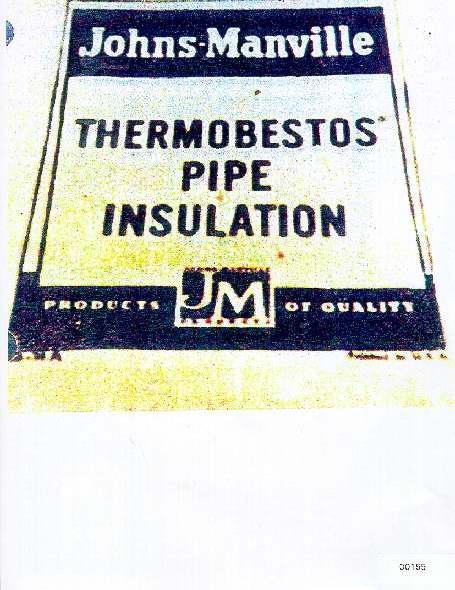
How Thermobestos looked: a label, photograph or catalog page from our library. Each picture has its own page and library number, so it can be cited on its own.
Asbestos claims
If you or a family member worked with or around Thermobestos and later developed mesothelioma or another asbestos disease, a claim may be paid by the Manville Personal Injury Settlement Trust. Free case review.
What each document says
Every statement about Thermobestos in the documents, in each document's own words.
The Travelers Insurance Company's Product Information Booklet for Its Asbestos Seminar (1980–1981)
Johns-Manville Products Corporation's Answers to Interrogatories in Le Grande v. Johns-Manville (1958), Answers to interrogatories
- Sold from: “sold to H. W. Porter & Co. by Johns-Manville Sales Corporation during the years 1952 to 1956, inclusive” (sales to H. W. Porter & Co.), p. 12
- Asbestos content: “Asbestos 10- 15” (as of 1952-1956), p. 22
- Description: “Moulded pipe covering and blocks hydrous calcium silicate combined with asbestos fiber.” (as of 1952-1956), p. 12
- Ingredient: “Diatomite 40-50” (as of 1952-1956), p. 22
Asbestos Magazine, 1954, May 1954
J-M News Pictorial, 1963, January 1963
- Made at: “Industrial Insulations Div. at Manville ... Finishing Foreman, Thermobestos Dept.” (as of 1963) (the plant: Manville, New Jersey), p. 104
J-M News Pictorial, 1967, April 1967
- Made at: “Manville Plant ... Superintendent, Thermobestos” (as of 1967) (the plant: Manville, New Jersey), p. 145
Asbestos Magazine, 1965, February 1965
- Made at: “Johns-Manville's Thermobestos Plant in Manville, New Jersey” (as of April 1964) (the plant: Manville, New Jersey), p. 116
Asbestos Magazine, 1959, November 1959
- Made from: “Commercial production of Thermobestos is expected to start mid year of 1960.”, p. 127
- Description: “a new molded high temperature industrial insulation”, p. 127
- Sold until: “for the Canadian market”, p. 127
- Ingredient: “diatomaceous silica”, p. 127
- Ingredient: “lime”, p. 127
- Use: “petroleum, chemical, power generation, marine and other industries; severe outdoor operating conditions”, p. 127
- Made at: “Canadian Johns-Manville's Toronto plant will be expanded to manufacture” (the plant: Toronto, Ontario), p. 127
- Ingredient: “asbestos”, p. 127
Asbestos Magazine, 1971, April 1971
- Sold until: “Greater use of ... Thermobestos pipe insulation helped boost foreign sales above the 1969 volume.” (as of 1970), p. 528
J-M News Pictorial, 1960, October 1960
- Use: “a vital insulating material in the Nuclear Ship Savannah” (sales to N.S. Savannah (Nuclear Ship Savannah)), p. 169
J-M News Pictorial, 1964, October–November 1964
- Description: “J-M Thermobestos®”, p. 810
- Use: “salt water conversion plant transferred from San Diego to Guantanamo Bay, Cuba” (as of 1964; sales to Burns and Roe Construction Corp. (Navy Bureau of Yards and Docks project, Guantanamo Bay, Cuba)), p. 810
- Made at: “J-M Thermobestos® from Manville, N. J.” (as of 1964) (the plant: Manville, New Jersey), p. 810
Asbestos Magazine, 1970, January 1970
- Use: “"Metal-On" factory assembled system ... Thermobestos insulation ... on the Manhattan” (as of 1969; sales to tanker Manhattan (Northwest Passage voyage); applied by Philadelphia Asbestos Corporation), p. 2011
Dr. Kenneth Smith to Detroit Edison Company on Thermobestos, Mineral Wool and Asbestos (1959)
Owens-Corning Fiberglas Notes of a Meeting with Johns-Manville on the Filter Press Process for Calcium Silicate (1968)
- Change: “We noted this change in summer 1966. Their product became extremely laminar, heavier and lower in strength.”, p. 113
- Fiber grade: “4T grade” (as of 1968), said by Johns-Manville (Burleson, Kelley, Truax, Blair), as recorded by Owens-Corning Fiberglas, p. 113
- Asbestos content: “They use only one grade of chrysotile - 4T grade in the amount of 7%/wt.” (as of 1968), said by Johns-Manville (Burleson, Kelley, Truax, Blair), as recorded by Owens-Corning Fiberglas, p. 113
- Asbestos fiber: “Thermobestos contains only chrysotile asbestos. No amosite asbestos is used” (as of 1968), said by Johns-Manville (Burleson, Kelley, Truax, Blair), as recorded by Owens-Corning Fiberglas, p. 113
Asbestos Magazine, 1966, May 1966
Asbestos Magazine, 1967, May 1967
Asbestos Magazine, 1969, December 1969
Asbestos; Publication of Identifying Information (1990)
- Made from: “produced 1939 to 1973”, said by Manville Corporation, as recorded by U.S. EPA, Federal Register 55 FR (Feb. 13, 1990), p. 1417
- Made until: “produced 1939 to 1973”, said by Manville Corporation, as recorded by U.S. EPA, Federal Register 55 FR (Feb. 13, 1990), p. 1417
- Ingredient: “diatomaceous earth, 45 to 50%; quicklime, 40 to 46%”, said by Manville Corporation, as recorded by U.S. EPA, Federal Register 55 FR (Feb. 13, 1990), p. 1417
- Description: “white pipe covering and block forms”, said by Manville Corporation, as recorded by U.S. EPA, Federal Register 55 FR (Feb. 13, 1990), p. 1417
- Asbestos content: “asbestos fibers, 5 to 10%”, said by Manville Corporation, as recorded by U.S. EPA, Federal Register 55 FR (Feb. 13, 1990), p. 1417
The Potter v. Fibreboard Case File (1969-1972), Answers to plaintiff's interrogatories with exhibits
- Made from: “some THERMOBESTOS block produced by Defendant during the period 1940 - 1967”, p. 1218
- Made from: “"THERMOBESTOS" has been manufactured by Defendant since 1955”, p. 318
- Warning label: “precautionary label from on or about December 15, 1964 (THERMOBESTOS)”, p. 318
- Form: “SEGMENTAL PIPE INSULATION ... when large pipe sizes are involved”, p. 2818
- Description: “some THERMOBESTOS block ... had the initials "JM" or some Johns-Manville trade-mark imprinted thereon”, p. 1218
- Ingredient: “lime, diatomaceous silica and asbestos fiber”, p. 2918
- Form: “(H. T. Pipe & Block Insulation)”, p. 2918
The Potter v. Fibreboard Case File (1969-1972), Additional answer to third set of interrogatories
- Description: “some THERMOBESTOS block produced 1940-1967 had the initials "JM" or a Johns-Manville trade-mark imprinted on it”, p. 919
- Form: “block”, p. 919
- Warning label: “CAUTION THIS PRODUCT CONTAINS ASBESTOS FIBER. INHALATION OF ASBESTOS IN EXCESSIVE QUANTITIES OVER LONG PERIODS OF TIME MAY BE HARMFUL. IF DUST IS CREATED WHEN THIS PRODUCT IS HANDLED, AVOID BREATHING THE DUST. IF ADEQUATE VENTILATION CONTROL IS NOT POSSIBLE, WEAR RESPIRATORS APPROVED BY THE U. S. BUREAU OF MINES FOR PNEUMOCONIOSIS PRODUCING DUSTS.” (as of 1970), p. 219
The Borel v. Fibreboard Case File (1969-1972), Answers to interrogatories with exhibits
- Description: “some THERMOBESTOS block produced by Defendant during the period 1940 - 1967 had the initials "JM" or some Johns-Manville trade-mark imprinted thereon”, p. 1220
- Made from: “has been manufactured by Defendant since 1955”, p. 320
- Warning label: “CAUTION THIS PRODUCT CONTAINS ASBESTOS FIBER. INHALATION OF ASBESTOS IN EXCESSIVE QUANTITIES OVER LONG PERIODS OF TIME MAY BE HARMFUL”, p. 320
- Description: “THERMOBESTOS. (H. T. Pipe & Block Insulation) Made from lime, diatomaceous silica and asbestos fiber.”, p. 2920
- Asbestos content: “Made from lime, diatomaceous silica and asbestos fiber”, p. 2920
The Borel v. Fibreboard Case File (1969-1972), Supplemental answers to interrogatories
- Description: “some THERMOBESTOS block produced 1940-1967 had the initials "JM" or a Johns-Manville trade-mark imprinted on it”, p. 1221
Manville Fund's Answers to Interrogatories in Gunn v. Celotex (1989)
- Made from: “Date Manufactured: 1950”, p. 12222
- Made from: “Date Manufactured: 1959”, p. 12222
- Warning label: “Date Labeled: 1964”, p. 12222
- Made from: “Date Manufactured: 1966”, p. 12022
- Warning label: “Date Labeled: 1966”, p. 12022
- Made until: “Date Discontinued: 1974”, p. 12022
- Form: “Sheet/Block, Pipe Covering”, p. 12022
- Warning label: “Date Labeled: None”, p. 12222
- Form: “Block, Pipe Covering”, p. 12222
- Asbestos content: “asbestos containing”, p. 6322
- Asbestos content: “7.0 - 14.3 % fiber by weight”, p. 12022
- Description: “Silicated THERMOBESTOS - Dry granular sodium silicate added to THERMOBESTOS”, p. 7122
- Temperature limit: “for service up to 1200 degrees F”, p. 7122
- Asbestos fiber: “Chrysotile and/or Amosite”, p. 12222
- Asbestos content: “7.0 - 14.3 % fiber by weight”, p. 12222
- Description: “A high temperature insulation, made from lime, diatomaceous silica, and asbestos fiber”, p. 7122
- Asbestos fiber: “Chrysotile and/or Amosite”, p. 12022
- Description: “THERMOBESTOS Cement - The same material used in THERMOBESTOS sectional and block insulation”, p. 8222
- Made at: “Manville Plant, Manville, New Jersey (1913 through 1985): Silicated Thermobestos Block; Silicated Thermobestos Pipe Covering” (at Manville) (the plant: Manville, New Jersey), p. 6322
- Asbestos fiber: “Chrysotile and/or Amosite”, p. 12222
- Form: “Cement”, p. 12222
- Made until: “Date Discontinued: 1974”, p. 12222
- Made until: “Date Discontinued: 1969”, p. 12222
- Asbestos fiber: “Chrysotile and/or Amosite”, p. 12022
Manville Fund's Responses to Plaintiffs' Interrogatories in Moore v. H.K. Porter (1990)
- Change: “THERMOBESTOS replaced by non-asbestos THERMO-12, 1972/74”, p. 1723
- Asbestos content: “asbestos containing (thermal insulation product)”, p. 1723
- Made at: “Manville Plant (1913 to 1985): Silicated Thermobestos Block; Silicated Thermobestos Pipe Covering” (at Manville) (the plant: Manville, New Jersey), p. 2323
- Made at: “Long Beach Plant (1938 to 1982): Thermobestos Insulating Cement” (at Long Beach) (the plant: Long Beach, California), p. 2123
- Made at: “Waukegan Plant (1922 to 1985): Thermobestos Cement” (at Waukegan) (the plant: Waukegan, Illinois), p. 2823
Military Qualified Products List (1951–1995)
- Made at: “Manville, N. J.” (as of 1956-08-29) (the plant: Manville, New Jersey), p. 2624
- Description: “qualified under QPL-2781 as Thermobestos, Grade I, Class b (QPL-2781-9)” (as of 1956-08-29), p. 2624
- Made at: “Plant: Long Beach, Calif.” (as of 1961-08-11) (the plant: Long Beach, California), p. 6924
- Description: “qualified under QPL-2781 as Thermobestos, Grade III, Class e, Types I and II (QPL-2781-36)” (as of 1969-05-27), p. 10724
- Made at: “Plant: Manville, NJ” (as of 1 August 1972) (the plant: Manville, New Jersey), p. 10824
- Made at: “Plant: Long Beach, CA” (as of 1 August 1972) (the plant: Long Beach, California), p. 10824
- Description: “qualified under QPL-2781 as Thermobestos (Grade I Class b; Grade II Class d; Grade III Class e Types I and II)” (as of 1 August 1972), p. 10824
J-M News Pictorial, 1962, July–August 1962
- Made at: “THERMOBESTOS WEEKLY COST OF YOUR REJECTS ... posted prominently at the Manville (N. J.) Industrial Insulations Plant” (as of 1962) (the plant: Manville, New Jersey), p. 525
Union Carbide Chemicals Company: Thermal Insulation and Accessories Manual (1962)
- Asbestos content: “Hydrous calcium silicate reinforced with a small amount of asbestos fibers”, p. 7826
- Description: “Hydrous calcium silicate reinforced with a small amount of asbestos fibers. Good compressive strength. Rigid.”, p. 7826
- Temperature limit: “Atmos to 1200”, p. 7826
- Form: “Block and Pipe Covering”, p. 7826
Sourcebook on Asbestos Diseases: Medical, Legal, and Engineering Aspects, Volume Two
- Description: “calcium silicate & asbestos fiber, block, pipe” (as of 1939-1973), p. 11727
Related products
Kind of product
We list Thermobestos with pipe covering and block insulation, insulating cement and coatings and asbestos-cement pipe, board and sheet, from how the documents describe its form. Those pages explain how such products exposed workers.
Trades that worked with products like it: Insulators and Insulation Workers, Pipefitters and Plumbers, Boilermakers, Carpenters and Construction Workers.
Other pipe covering and block insulation by Johns-Manville (59)
Superex · Asbestocel · 85 Magnesia · Firetard · Vitribestos · Super Fire Felt · Superex 2000 · Superex-1900 · Superex-m · Superex-sg · Therm-o-bestos · Thermo Fire Felt · Thermowrap · Train Pipe Covering · Vitro Fire Felt · White Surface Asbestos Jacket · Zerogloss · Air-Cell · Anti-sweat · Asbesto-metallic · and 39 more on the company's page
Pipe covering and block insulation by other makers (216)
Careytemp (Philip Carey) · Kaylo (Owens-Corning) · Unibestos (Union Asbestos & Rubber Co.) · Kaylo (Owens-Illinois) · Unibestos (Pittsburg Corning) · Therm-O-Flake (Illinois Clay Products) · Thermalite (Keene) · Thermalite 85% Magnesia (Baldwin-Ehret-Hill) · Thermalite 85% Magnesia (Ehret Magnesia Manufacturing Co.) · Thermasil (Baldwin-Ehret-Hill) · Thermasil (Ehret Magnesia Manufacturing Co.) · Thermasil (Keene) · Tri-calite (Crown Cork & Seal) · Trica-mag (Crown Cork & Seal) · Tricalite (Mundet Cork) · Type 19 (Crown Cork & Seal) · Type 19 Block (Mundet Cork) · Type M (Crown Cork & Seal) · Unarco (Union Asbestos & Rubber Co.) · Unibestos (Pittsburgh Corning) · and 196 more: all pipe covering and block insulation
Other insulating cement and coatings by Johns-Manville (51)
Superex · Asbestile · 85 Magnesia · 302 · 352 · Mx-3808 Asb Filler · Mx-3808 Asbestos Filler · Navy 450 Cement · No. 302 Insulation Cement · Superex Cement · Superex Cement for Navy · Superex-m · Thermobestos Cement · Thermomix 700 · Thermomix 720 · Thermomix 770 · Thermomix 810 · 0352 Cement · 300 Cement · 301 · and 31 more on the company's page
Insulating cement and coatings by other makers (273)
Prasco (Fibreboard) · Calsilite (GAF) · Caltemp (Fibreboard) · Sal-mo (Nicolet) · Super 66 (Eagle-Picher) · Temp-Sure I-c 250 (Insul-Coustic) · Tempcheck (Philip Carey) · Thermalcoat (M. H. Detrick) · Thermalite (Keene) · Thermalite 85% Magnesia (Baldwin-Ehret-Hill) · Thermalkote (Flintkote) · Thermasil (Keene) · Thermokote (Ryden Industries) · Trica-mag (Crown Cork & Seal) · Trowel and Spray Grade (Baldwin-Ehret-Hill) · Turnall (Atlas Asbestos) · Type 19 (Crown Cork & Seal) · Type 7 (Flintkote) · Type M (Crown Cork & Seal) · Unicote (North American Refractories) · and 253 more: all insulating cement and coatings
See also
- Johns-Manville: the company's history, documents, people, products and plants
- Johns-Manville on our products page: what the documents say about the company's asbestos products, with sources
References
- The Travelers Insurance Company's Product Information Booklet for Its Asbestos Seminar (1980–1981) (April 30, 1981), p. 9.
- Johns-Manville Products Corporation's Answers to Interrogatories in Le Grande v. Johns-Manville (1958), Answers to interrogatories (1958), pp. 1–2.
- Asbestos Magazine, 1954, May 1954 (May 1, 1954), p. 22.
- J-M News Pictorial, 1963, January 1963 (January 1, 1963), p. 10.
- J-M News Pictorial, 1967, April 1967 (April 1, 1967), p. 14.
- Asbestos Magazine, 1965, February 1965 (February 1, 1965), p. 11.
- Asbestos Magazine, 1959, November 1959 (November 1, 1959), p. 12.
- Asbestos Magazine, 1971, April 1971 (April 1, 1971), p. 52.
- J-M News Pictorial, 1960, October 1960 (October 1, 1960), p. 16.
- J-M News Pictorial, 1964, October–November 1964 (October 1, 1964), p. 8.
- Asbestos Magazine, 1970, January 1970 (January 1, 1970), p. 20.
- Dr. Kenneth Smith to Detroit Edison Company on Thermobestos, Mineral Wool and Asbestos (February 19, 1959), p. 1.
- Owens-Corning Fiberglas Notes of a Meeting with Johns-Manville on the Filter Press Process for Calcium Silicate (February 23, 1968), p. 1.
- Asbestos Magazine, 1966, May 1966 (May 1, 1966), p. 12.
- Asbestos Magazine, 1967, May 1967 (May 1, 1967), p. 18.
- Asbestos Magazine, 1969, December 1969 (December 1, 1969), p. 30.
- Asbestos; Publication of Identifying Information (February 13, 1990), p. 14.
- The Potter v. Fibreboard Case File (1969-1972), Answers to plaintiff's interrogatories with exhibits (December 29, 1969), p. 12.
- The Potter v. Fibreboard Case File (1969-1972), Additional answer to third set of interrogatories (March 13, 1970), p. 9.
- The Borel v. Fibreboard Case File (1969-1972), Answers to interrogatories with exhibits (March 27, 1970), p. 12.
- The Borel v. Fibreboard Case File (1969-1972), Supplemental answers to interrogatories (July 30, 1970), p. 12.
- Manville Fund's Answers to Interrogatories in Gunn v. Celotex (December 7, 1989), p. 122.
- Manville Fund's Responses to Plaintiffs' Interrogatories in Moore v. H.K. Porter (February 15, 1990), p. 17.
- Military Qualified Products List (1951–1995) (August 29, 1956), p. 26.
- J-M News Pictorial, 1962, July–August 1962 (July 1, 1962), p. 5.
- Union Carbide Chemicals Company: Thermal Insulation and Accessories Manual (October 1, 1962), p. 78.
- Sourcebook on Asbestos Diseases: Medical, Legal, and Engineering Aspects, Volume Two (1986), p. 117. Not yet published in our library.
- Johns-Manville Material Safety Data Sheet for THERMOBESTOS, p. 1.
Mentioned on this site
- A. Mayer-Pareyn to R. B. Von Wald and J. A. Brown on the Health and Safety History of J-M do Brazil (1980)
- Arthur J. Vorwald to Owens-Illinois on Kaylo Causing Asbestosis in Animals (1948)
- C. J. Dandrow's Draft Bulletin to District Managers on a High Temperature Insulation Fabrication Shop (1955)
- C. L. Sheckler, Summary of Atmospheric Hygiene Studies at the Manville Plant (1957–1959)
- D. R. Christensen to D. H. Markusson on Simulated 1960s Thermobestos Sawing and Cement Mixing (1976)
- Dr. Kenneth Smith to Detroit Edison Company on Thermobestos, Mineral Wool and Asbestos (1959)
- Dr. Kenneth W. Smith to A. J. Maahs on a Warning for Ring-Tite Lubricant (1954)
- E. C. Lindstrom to J-M Plant Managers on Caution Labels for High Temperature Insulations (1964)
- E. M. Fenner to D. B. Wingerter on Which Insulation Products to Label (1969)
- E. M. Fenner to E. R. Bettinardi on Warning Labels for Superex and Thermobestos (1969)
- G. A. Wall to J. G. Moore and Others on Dryer Standards at Manville (1964)
- G. W. H. Schepers, T. M. Durkan and A. B. Delahant, "Effect of Inhaled Commercial Hydrous Calcium Silicate Dust on Animal Tissues" (1955)
- H. M. Jackson to Dr. R. E. Joyner of Carbide and Carbon Chemicals on Superex and Thermobestos Insulation (1956)
- H. M. Jackson to T. R. Turnbull on Perlite Dust in Asbestos Pipe Covering (1949)
- J-M Production Engineering Report on Equipment for Thermobestos Pipe Covering and Thermoflex Felts (1949)
- J. B. Jobe to D. L. Hinmon on Labeling Asbestos Products to Lessen Claims (1964)
- Johns-Manville Correspondence on Thermobestos Skin Irritation at Reid-Hayden (1953)
- Johns-Manville Material Safety Data Sheet for THERMOBESTOS
- Johns-Manville Products Corporation's Answers to Interrogatories in Le Grande v. Johns-Manville (1958)
- Kenneth W. Smith to E. C. Lindstrom on the Gummed Caution Label at Manville (1964)
- M. W. Burleson's Notice to the Industrial Insulations Division on Health Hazard Caution Labels (1970)
- Owens-Corning Fiberglas Notes of a Meeting with Johns-Manville on the Filter Press Process for Calcium Silicate (1968)
- R. J. Sexton to G. J. Ratcliffe Enclosing Union Carbide's Survey of New Thermobestos Blocks (1962)
- R. J. Sexton to L. N. Dickinson Enclosing Union Carbide's Thermobestos and Kaylo Dust Survey (1962)
- R. J. Sexton to S. C. Giambruno Enclosing Union Carbide's Third Insulation Block Dust Survey (1963)
- R. J. Sexton to S. C. Giambruno on Johns-Manville's Thermobestos Proposal (1962)
- Robert E. Peele's Diary Pages (1963)
- The Motley 1000
- Union Carbide Institute Plant Dust Surveys of J-M Thermobestos Insulation Blocks (1962)
- W. B. Reitze and J. T. Vanderveen on Replacing Thermobestos with Thermo-12 in Brazil (1975)
- W. B. Reitze to H. B. Moreno, Trip Report on Asberit and Magnebras in Brazil (1977)
- W. E. Hodgson to A. Pocius on Removing Caution Labels from Cartons for Canada (1965)
- W. W. Acher to E. C. Lindstrom on Caution Wording for High-Temperature Insulations (1964)
Cite this page
“Thermobestos.” AsbestosClaims.Law Library. https://asbestosclaims.law/library/products/thermobestos.
ACL Doc numbers and their short links never change. See how to cite the Library.
Talk with an asbestos lawyer
Start with what you remember, and we'll take it from there.
This page is provided for general informational purposes and does not constitute legal advice. Every asbestos case turns on its own facts, exposure history, diagnosis, deadlines, available evidence, and applicable law. Reviewing this page does not create an attorney-client relationship. For advice about your specific situation, call 833-4-ASBESTOS for a free case review.