
Kaylo was a pipe covering and block insulation from the Kaylo Division of Owens-Illinois Glass Co.1,2 A 1952 draft of the company's pamphlet "Handling Kaylo Products" describes it as a solid formed by a chemical reaction of lime, white sand and water, "with fibers added to give toughness," and says the name came from the engineers' "K" factor for heat loss.3 The light grade, about 10 lb per cubic foot, was used for pipe, vessel and flat block insulation; the heavy grade, about 20 lb, for roof tile, doors, core material and wall panels.3
You don't need the product names or old records. No fee unless we recover compensation for your family.
How it began
The same draft says Owens-Illinois first turned to the material in 1938 and started a pilot operation in 1942.3 In February 1943 the company's director of research, U. E. Bowes, wrote to the Saranac Laboratory about a new hydrous calcium silicate "in the pilot plant stage," meant for interior structural uses and as industrial insulation for pipe; the letter does not name it, but it is the material that became Kaylo.4 Saranac's director, Leroy U. Gardner, answered in March that what they had taken for synthetic asbestos in it "proved to be chrysotile which had been added as a reenforcing agent."5
When and where it was made
An insurance company's 1981 list of asbestos products, compiled from other companies' answers in lawsuits, gives Owens-Illinois's Kaylo as made from 1948 to 1958.1 In December 1948, an Owens-Illinois letter said a subsidiary, the American Structural Products Company, made Kaylo, "a light-weight, white insulating tile or slab."6 The U.S. military's list of approved pipe insulation named the Kaylo Division's plants at Berlin and Sayreville, New Jersey, in December 1951; by the November 1958 edition it named only Berlin, under Owens-Corning.2 An Aetna insurance survey of the Berlin plant in April and May 1958 still called it the Owens-Illinois Kaylo Division.7
A December 1953 equipment dealer's ad in Asbestos magazine offered machinery "purchased and installed new in 1948" by the Owens-Illinois Kaylo Division, to be inspected at its premises in Sayreville.8 In 1955 and 1956, the magazine named E. C. Shuman of the Kaylo Division of Owens-Illinois as a speaker on calcium silicate insulation and as an officer of an ASTM insulation committee.9,10 In May 1959, Philip Carey announced a hire who had been a regional sales manager of "The Kaylo Division of Owens Illinois Glass."11
What it was made of
Owens-Illinois's December 1948 letter lists Kaylo's raw materials as silica flour, diatomaceous earth, hydrated lime and asbestos.6 A 1952 company research report says Kaylo dust consists of a hydrous calcium silicate and asbestos.12
The sources disagree about the fiber. A September 1948 letter from W. G. Hazard of Owens-Illinois put Kaylo at 15 to 20 percent asbestos "of the amosite and chrysotile varieties," and said more recent Kaylo dust may have held a greater ratio of amosite to chrysotile.13 The Saranac Laboratory's 1951 survey of the Kaylo plant listed both amosite and chrysotile among the raw materials, along with tripoli, and describes the opening of a 200 lb. bag of "amosite long-fiber asbestos" there.14 In 1954, W. C. Taylor of Owens-Illinois's research division computed from chemical and x-ray analyses that Kaylo held 19.8 percent asbestos, all of it chrysotile, and wrote that all the competing products except Kaylo contained amosite.15 His October 1954 comparison of pipe coverings gave Kaylo's fiber length as short, 3/8" at most, and his June report noted that "the chrysotile fraction in all cases except Kaylo is of a grade finer than #4."15 The insurer's 1981 list gives 15-25 percent asbestos.1
Later years: Kaylo under Owens-Corning.
Pictures
How Kaylo (Owens-Illinois) looked: labels, photographs and catalog pages from our library. Each picture has its own page and library number, so it can be cited on its own.
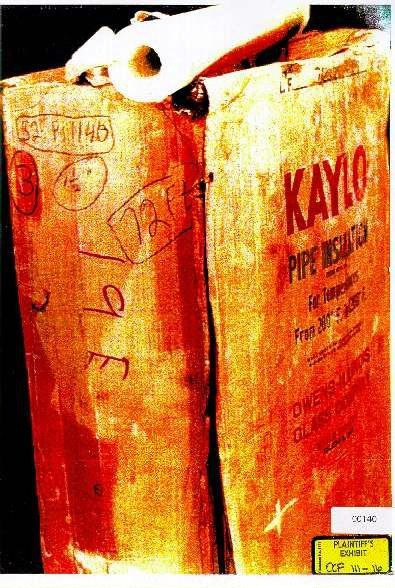 Product photograph: KAYLO PIPE INSULATION (OWENS-ILLINOIS GLASS COMPANY)Product photograph · ACL Doc 15162
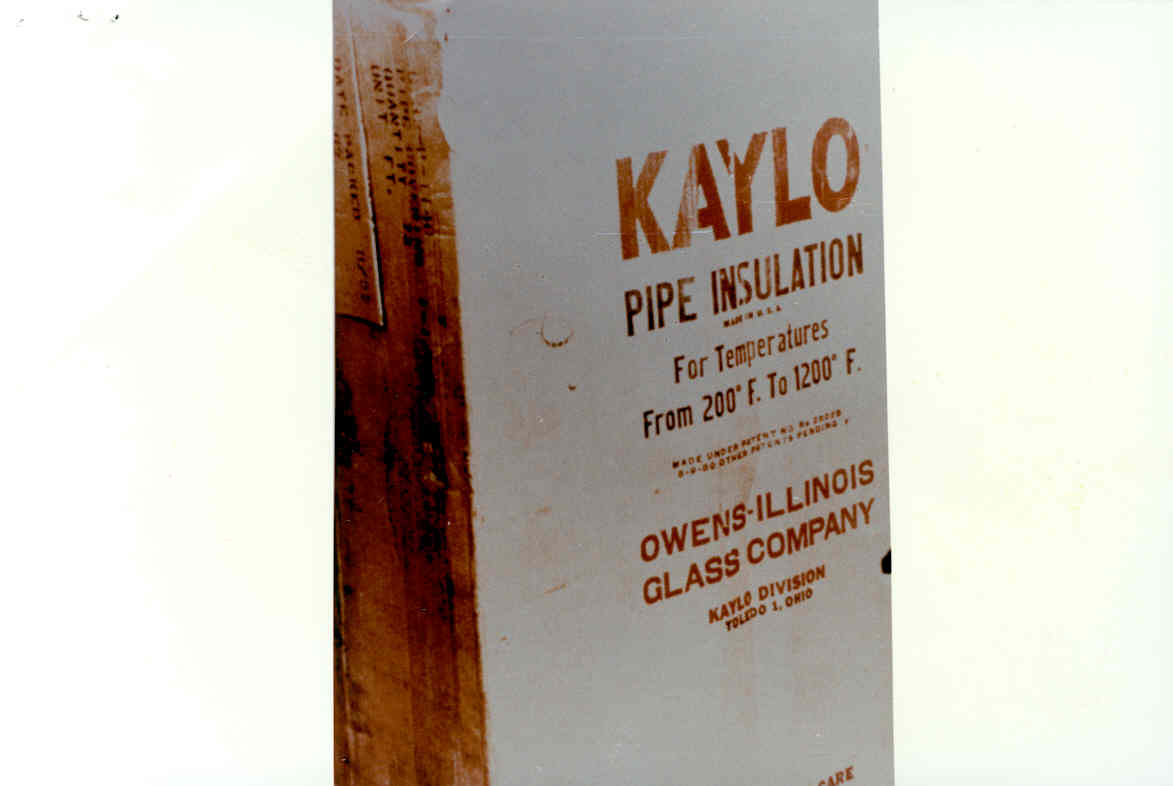 Package: Kaylo pipe insulation carton (Owens-Illinois Glass Company)Label or package · ACL Doc 20682
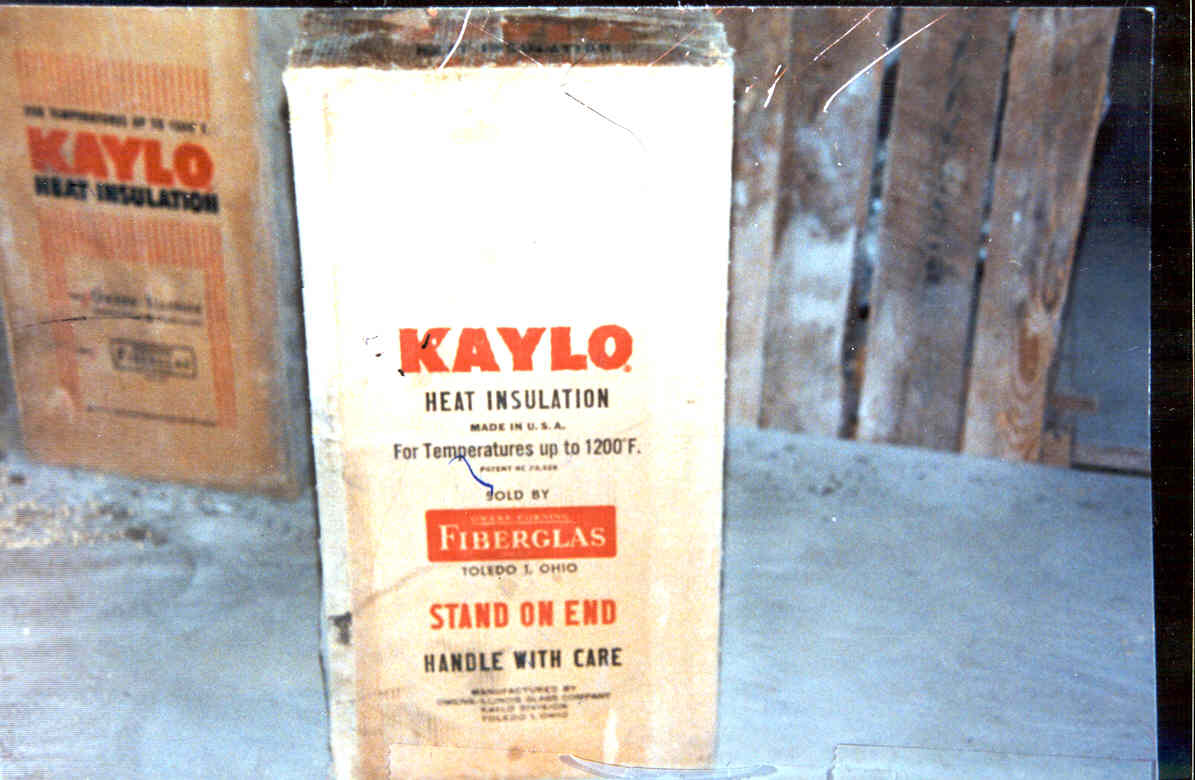 Package: Kaylo Heat Insulation carton (Owens-Corning Fiberglas / Owens-Illinois)Label or package · ACL Doc 20680
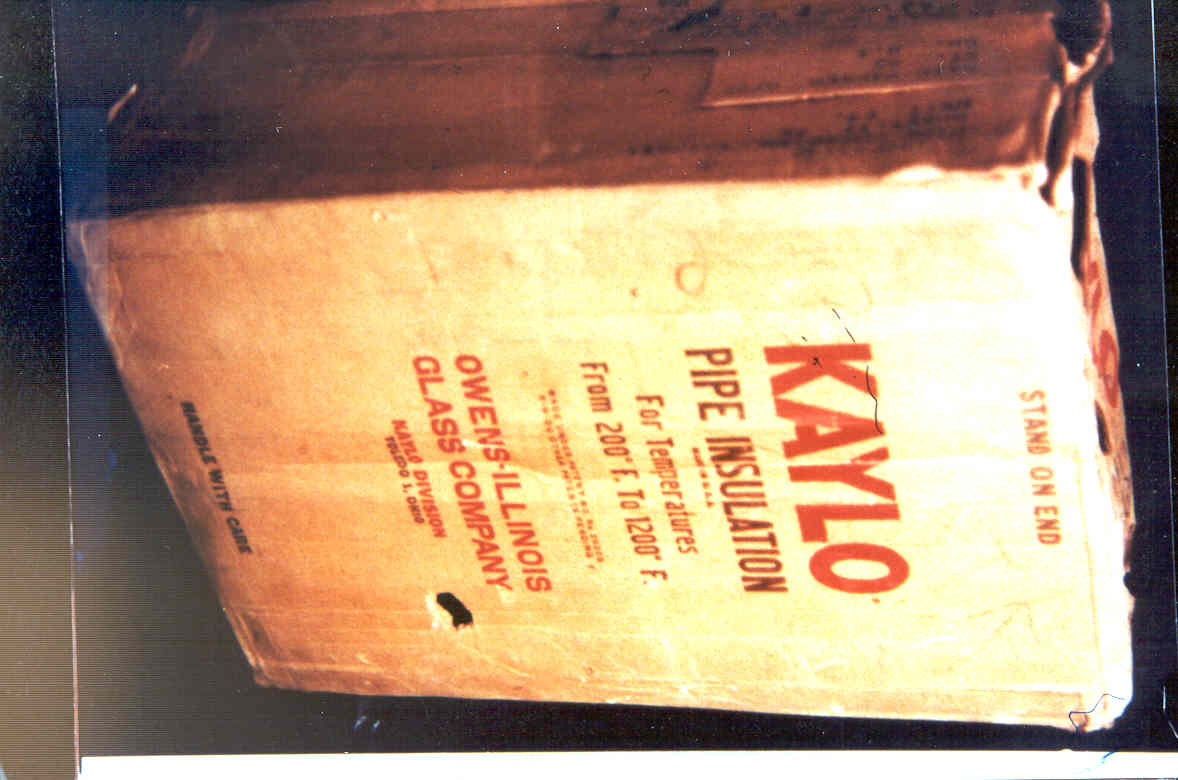 Package: Kaylo pipe insulation carton (Owens-Illinois Glass Company) (2)Label or package · ACL Doc 20681
Asbestos claims
If you or a family member worked with or around Kaylo (Owens-Illinois) and later developed mesothelioma or another asbestos disease, a claim may be paid by the Owens-Illinois Asbestos Personal Injury Trust. Free case review.
What each document says
Every statement about Kaylo (Owens-Illinois) in the documents, in each document's own words.
The Travelers Insurance Company's Product Information Booklet for Its Asbestos Seminar (1980–1981)
Military Qualified Products List (1951–1995)
- Made at: “Plants: Berlin, N. J.” (the plant: Berlin, New Jersey), p. 12
- Made at: “Plants: ... Sayreville, N. J.” (the plant: Sayreville, New Jersey), p. 12
- Description: “qualified under QPL-2781 as KAYLO, Grade I, Classes a, b (QPL-2781-1)” (as of 1951-12-03), p. 12
- Description: “qualified under QPL-2781 as Kaylo, Grade I, Class b, Owens-Illinois as manufacturer and Owens-Corning as distributor (QPL-2781-15)” (as of 1958-08-20), p. 442
Curtis W. Howard to George R. White Proposing the "Handling Kaylo Products" Pamphlet (1952)
- Made from: “a pilot operation started in 1942”, p. 23
- Use: “heavy (about 20 lb/cu ft): Roof Tile, Doors, Core Material, Wall Panels”, p. 23
- Description: “a solid formed by a chemical reaction of lime, white sand, and water, with fibers added to give toughness”, p. 23
- Use: “light (about 10 lb/cu ft): Pipe Insulation, Vessel Insulation, Flat Block Insulation”, p. 23
U. E. Bowes to Leroy U. Gardner Asking Saranac to Test a Hydrous Calcium Silicate (1943)
Leroy U. Gardner to U. E. Bowes on Asbestos in the Synthetic Insulation (1943)
- Asbestos fiber: “chrysotile which had been added as a reenforcing agent”, p. 15
W. G. Hazard of Owens-Illinois to the Industrial Hygiene Foundation on Studying Kaylo Dust (1948)
Aetna Life Affiliated Companies, Dust Survey of Owens-Illinois's Kaylo Plant at Berlin, New Jersey (1958)
- Made at: “Owens-Illinois Kaylo Division Berlin, N. J.” (the plant: Berlin, New Jersey), p. 27
Asbestos Magazine, 1953, December 1953
- Description: “OWENS-ILLINOIS GLASS CO., Kaylo Div.” (as of 1948), p. 358
- Made at: “the premises of the OWENS-ILLINOIS GLASS CO., Kaylo Div., Sayreville, N. J.” (as of 1948-1953) (the plant: Sayreville, New Jersey), p. 358
Asbestos Magazine, 1955, February 1955
- Description: “the Kaylo Division of Owens-Illinois” (as of January 1955), p. 169
Asbestos Magazine, 1956, August 1956
- Description: “Kaylo Div. Owens-Illinois” (as of 1956), p. 5410
Asbestos Magazine, 1959, May 1959
- Description: “The Kaylo Division of Owens Illinois Glass” (as of before May 1959 (prior employment)), p. 4811
Owens-Illinois, Hydrous Calcium Silicates Part V, Physical and Chemical Properties of Kaylo Products, Excerpt (1952)
- Ingredient: “The dust of kaylo consists of a hydrous calcium silicate and asbestos”, p. 212
W. G. Hazard to Arthur J. Vorwald on the Composition of Kaylo (1948)
Saranac Laboratory, Report of Industrial Hygiene Survey of the Owens-Illinois Kaylo Division Plant (1951), Report, May 29, 1951 (clearer partial copy, from page 4)
W. C. Taylor of Owens-Illinois on Asbestos in Kaylo and Competing Calcium Silicate Insulations (1954)
- Asbestos fiber: “Kaylo: 0 % Amosite, 100 % Chrysotile”, p. 215
- Asbestos content: “Kaylo 19.8 (% Asbestos)”, p. 115
- Fiber grade: “The chrysotile fraction in all cases except Kaylo is of a grade finer than #4.”, p. 215
- Fiber grade: “Fiber length: Short 3/8" Max.; fiberization: Intermediate”, p. 315
- Form: “Owens-Illinois "Kaylo" Calcium Silicate, 2 x 1 (pipe covering)”, p. 415
Kind of product
We list Kaylo (Owens-Illinois) with pipe covering and block insulation, from how the documents describe its form. That page explains how such products exposed workers.
Trades that worked with products like it: Insulators and Insulation Workers, Pipefitters and Plumbers.
Pipe covering and block insulation by other makers (276)
Thermobestos · Superex (Johns-Manville) · Careytemp (Philip Carey) · Kaylo (Owens-Corning) · Unibestos (Union Asbestos & Rubber Co.) · K-20 (Combustion Engineering) · K-fac (U.S. Gypsum) · K-fac 19 (U.S. Gypsum) · Kaiser M. (Combustion Engineering) · Kalfelt (Atlas Asbestos) · Kalsil (Atlas Asbestos) · Kay-Therm (Keasbey & Mattison) · Kaylo 10 (Owens-Corning) · Kaylo 20 (Owens-Corning) · Kaylo-klad (Owens-Corning) · Kaytherm (Nicolet) · Lasco (Lynch Asbestos) · Lennolite (Philip Carey) · LK (AC&S) · LK (Armstrong Cork) · and 256 more: all pipe covering and block insulation
See also
- Kaylo in the Lexicon
- Kaylo exposure and claims
- Owens-Illinois: the company's history, documents, people, products and plants
- Owens-Illinois on our products page: what the documents say about the company's asbestos products, with sources
References
- The Travelers Insurance Company's Product Information Booklet for Its Asbestos Seminar (1980–1981) (April 30, 1981), p. 6.
- Military Qualified Products List (1951–1995) (December 3, 1951), p. 1.
- Curtis W. Howard to George R. White Proposing the "Handling Kaylo Products" Pamphlet (December 9, 1952), p. 2.
- U. E. Bowes to Leroy U. Gardner Asking Saranac to Test a Hydrous Calcium Silicate (February 12, 1943), p. 1.
- Leroy U. Gardner to U. E. Bowes on Asbestos in the Synthetic Insulation (March 12, 1943), p. 1.
- W. G. Hazard of Owens-Illinois to the Industrial Hygiene Foundation on Studying Kaylo Dust (December 14, 1948), p. 1.
- Aetna Life Affiliated Companies, Dust Survey of Owens-Illinois's Kaylo Plant at Berlin, New Jersey (April 28, 1958), p. 2.
- Asbestos Magazine, 1953, December 1953 (December 1, 1953), p. 35.
- Asbestos Magazine, 1955, February 1955 (February 1, 1955), p. 16.
- Asbestos Magazine, 1956, August 1956 (August 1, 1956), p. 54.
- Asbestos Magazine, 1959, May 1959 (May 1, 1959), p. 48.
- Owens-Illinois, Hydrous Calcium Silicates Part V, Physical and Chemical Properties of Kaylo Products, Excerpt (October 15, 1952), p. 2.
- W. G. Hazard to Arthur J. Vorwald on the Composition of Kaylo (September 21, 1948), pp. 1–2.
- Saranac Laboratory, Report of Industrial Hygiene Survey of the Owens-Illinois Kaylo Division Plant (1951), Report, May 29, 1951 (clearer partial copy, from page 4) (May 29, 1951), pp. 8, 13.
- W. C. Taylor of Owens-Illinois on Asbestos in Kaylo and Competing Calcium Silicate Insulations (June 8, 1954), pp. 1–4.
- Sourcebook on Asbestos Diseases: Medical, Legal, and Engineering Aspects, Volume Two (1986), p. 88. Not yet published in our library.
Mentioned on this site
- Aetna Life Affiliated Companies, Dust Survey of Owens-Illinois's Kaylo Plant at Berlin, New Jersey (1958)
- Arthur J. Vorwald to Owens-Illinois on Kaylo Causing Asbestosis in Animals (1948)
- Arthur J. Vorwald to U. E. Bowes on Kaylo Producing Asbestosis in Animals (1948)
- Arthur J. Vorwald to W. G. Hazard on Waiting for the Final Kaylo Report (1950)
- Arthur J. Vorwald to W. G. Hazard on X-Ray Readings and Kaylo Findings (1950)
- Arthur J. Vorwald to W. G. Hazard Sending the Final Kaylo Report (1952)
- Curtis W. Howard to George R. White Proposing the "Handling Kaylo Products" Pamphlet (1952)
- G. W. H. Schepers, T. M. Durkan and A. B. Delahant, "Effect of Inhaled Commercial Hydrous Calcium Silicate Dust on Animal Tissues" (1955)
- James F. Morgan to W. G. Hazard on X-Ray Analysis of Kaylo Dust (1950)
- Leroy U. Gardner to U. E. Bowes on Animal Tests of Hydrous Calcium Silicate (1944)
- Leroy U. Gardner to U. E. Bowes on Asbestos in the Synthetic Insulation (1943)
- Leroy U. Gardner to U. E. Bowes Proposing an Inhalation Study of K-Lo Dust (1944)
- Owens-Illinois, Hydrous Calcium Silicates Part V, Physical and Chemical Properties of Kaylo Products, Excerpt (1952)
- Saranac Laboratory, Final Report on the Capacity of Inhaled Kaylo Dust to Injure the Lung (1952)
- Saranac Laboratory, Interim Report on the Biological Activity of Kaylo Dust (1948)
- Saranac Laboratory, Report of Industrial Hygiene Survey of the Owens-Illinois Kaylo Division Plant (1951)
- The Motley 1000
- Theodore F. Hatch to W. G. Hazard Returning the Saranac Report on Kaylo (1949)
- U. E. Bowes to Leroy U. Gardner Asking Saranac to Test a Hydrous Calcium Silicate (1943)
- W. C. Taylor of Owens-Illinois on Asbestos in Kaylo and Competing Calcium Silicate Insulations (1954)
- W. G. Hazard of Owens-Illinois to Ira I. Brought on Kaylo and the Saranac Experiments (1956)
- W. G. Hazard of Owens-Illinois to the Industrial Hygiene Foundation on Studying Kaylo Dust (1948)
- W. G. Hazard to Arthur J. Vorwald on a Kaylo Health Brochure (1950)
- W. G. Hazard to Arthur J. Vorwald on the Composition of Kaylo (1948)
- W. G. Hazard to Ira I. Brought Sending the Saranac Kaylo Article (1956)
- W. G. Hazard to J. F. McMahon Sending Kaylo Boxcar Dust for Analysis (1949)
- W. G. Hazard to W. J. Stewart on Ira Brought's Request for a Kaylo Health Brochure (1956)
Cite this page
“Kaylo (Owens-Illinois).” AsbestosClaims.Law Library. https://asbestosclaims.law/library/products/owens-illinois-kaylo.
ACL Doc numbers and their short links never change. See how to cite the Library.
Talk with an asbestos lawyer
Start with what you remember, and we'll take it from there.
This page is provided for general informational purposes and does not constitute legal advice. Every asbestos case turns on its own facts, exposure history, diagnosis, deadlines, available evidence, and applicable law. Reviewing this page does not create an attorney-client relationship. For advice about your specific situation, call 833-4-ASBESTOS for a free case review.