
Careytemp was a pipe covering and block insulation made by The Philip Carey Manufacturing Company.1,2 In August 1959, Carey announced that Careytemp had been introduced after three years' research by its Insulation Division at Plymouth Meeting, Pennsylvania, for temperatures up to 1600°F.1
Carey described it as expanded silica with a specially developed binder, "reinforced with an inorganic fibre"; by 1964 it was saying "expanded perlite, a silica."1,3 Carey's notices in Asbestos magazine never name that fiber.1,4,5 An insurance company's 1981 list of asbestos products, compiled from other companies' answers in lawsuits, gives Careytemp pipe covering and block as made from 1958 to 1969, with 6 in the column read as percent asbestos.6
The line grew through the 1960s. Carey added premolded Careytemp elbows in 1963, also furnished for steam tracing, and announced Dual Careytemp and Careytemp 2000 in 1965.5,7 It was still showing "the entire Careytemp line" at trade shows in 1968.8
You don't need the product names or old records. No fee unless we recover compensation for your family.
Pictures
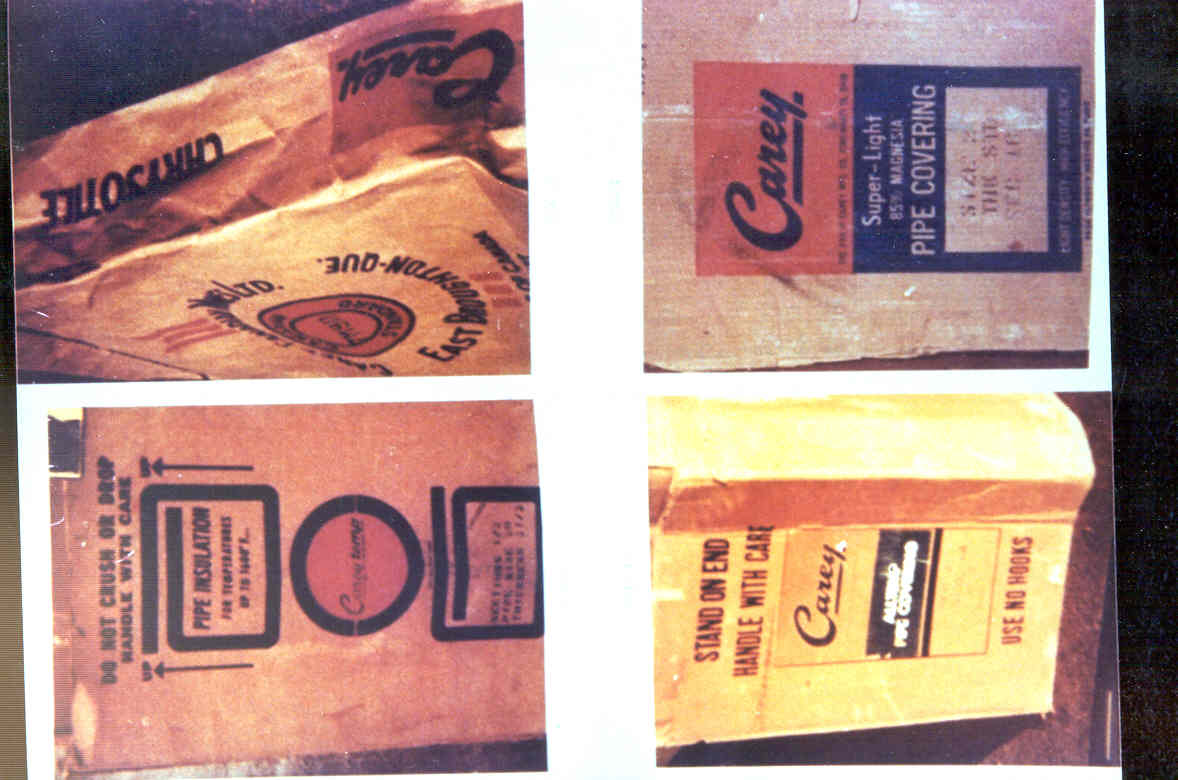
How Careytemp (Philip Carey) looked: a label, photograph or catalog page from our library. Each picture has its own page and library number, so it can be cited on its own.
Asbestos claims
If you or a family member worked with or around Careytemp (Philip Carey) and later developed mesothelioma or another asbestos disease, a claim may be paid by the Celotex Asbestos Settlement Trust. Free case review.
What each document says
Every statement about Careytemp (Philip Carey) in the documents, in each document's own words.
Asbestos Magazine, 1959, August 1959
- Made from: “has been introduced by The Philip Carey Manufacturing Company, Cincinnati, Ohio”, p. 561
- Description: “the result of three years' research by the Insulation Division”, p. 561
- Binder: “a specially developed binder”, p. 561
- Ingredient: “reinforced with an inorganic fibre”, p. 561
- Form: “pipe and block insulation”, p. 561
- Temperature limit: “for all temperatures up to 1600°F.”, p. 561
- Made at: “manufactured by the company's Insulation Division, Plymouth Meeting, Pennsylvania” (as of 1959) (the plant: Plymouth Meeting, Pennsylvania), p. 561
- Ingredient: “Composed of expanded silica”, p. 561
Asbestos Magazine, 1966, February 1966
- Description: “Careytemp insulations developed and manufactured by The Philip Carey Manufacturing Company. The entire Careytemp line” (as of 1966), p. 132
Asbestos Magazine, 1964, July 1964
- Description: “a strong, efficient insulation designed to meet the most demanding physical, chemical and moisture resistant requirements ... incombustible”, p. 133
- Binder: “especially developed binders”, p. 133
- Ingredient: “composed of expanded perlite, a silica with especially developed binders and is reinforced with inorganic fibers”, p. 133
Asbestos Magazine, 1961, August 1961
- Temperature limit: “for temperatures up to 1600°F.”, p. 204
- Ingredient: “Composed of expanded silica with a specially developed binder and reinforced with an inorganic fibre”, p. 204
- Description: “manufactured by Carey's Insulation Division” (as of 1961), p. 204
- Form: “block and pipe insulation”, p. 204
Asbestos Magazine, 1963, September 1963
- Made from: “Premolded Elbow Insulation, now available for industrial application”, p. 135
- Ingredient: “composed of expanded silica with a specially developed binder and reinforced with an inorganic fibre”, p. 135
- Temperature limit: “piping systems operating from ambient temperature to 1600°F.”, p. 135
- Form: “Premolded Elbow Insulation ... Both 45° and 90° long and short radius ells ... Iron pipe sizes range from 1/2" to 14", 1" to 4" thick”, p. 135
- Use: “piping systems ... Careytemp ells are also furnished for steam tracing purposes”, p. 135
The Travelers Insurance Company's Product Information Booklet for Its Asbestos Seminar (1980–1981)
Asbestos Magazine, 1965, March 1965
Asbestos Magazine, 1968, February 1968
- Description: “CAREYTEMP insulations, developed and manufactured by The Philip Carey Manufacturing Company ... The entire Careytemp line” (as of 1968), p. 158
The Potter v. Fibreboard Case File (1969-1972), Answers to plaintiff's interrogatories
- Made at: “Lockland, Ohio (1958-Sept. 1969)” (the plant: Lockland, Ohio), p. 19
- Made at: “Plymouth Meeting, Pennsylvania (1958-1962)” (the plant: Plymouth Meeting, Pennsylvania), p. 19
- Made from: “1958”, p. 19
- Made at: “licensee B & B Engineering & Supply Company, Inc., Houston, Texas (fitting elements, from 1959)” (the plant: Houston, Texas), p. 169
- Change: “asbestos fiber eliminated, fiberglass substituted, September 1969”, p. 29
- Change: “New Careytemp 1500 Pipe Covering and Block, Sept. 23, 1969 to present”, p. 29
- Description: “formulation protected by patents in the United States and certain other countries”, p. 159
- Ingredient: “Expanded Perlite, Bentonite clay, chopped glass roving and asbestos fiber”, p. 19
The Borel v. Fibreboard Case File (1969-1972), Answers to interrogatories
- Made at: “Lockland, Ohio” (the plant: Lockland, Ohio), p. 210
- Made at: “Plymouth Meeting, Pennsylvania” (the plant: Plymouth Meeting, Pennsylvania), p. 110
- Made from: “Careytemp Pipe 1958-1962” (at Plymouth Meeting, Pennsylvania), p. 110
- Use: “In 1959, we licensed B & B Engineering & Supply Company, Inc., Houston, Texas, to manufacture and use, transfer or sell "Careytemp" insulation elements molded to fit valves, tube turns, tees, ells, unions, flanges and other fittings”, p. 1510
- Made until: “Careytemp Pipe 1958-1962” (at Plymouth Meeting, Pennsylvania), p. 110
- Made until: “1958- Sept. 1969” (at Lockland, Ohio), p. 210
- Change: “Since September of 1969, asbestos fiber has been eliminated from regular Careytemp and fiberglass has been substituted therefor.”, p. 210
- Description: “New Careytemp 1500 Pipe Covering and Block ... Expanded Perlite, Bentonite clay and chopped glass roving”, p. 210
- Asbestos content: “Expanded Perlite, Bentonite clay, chopped glass roving and asbestos fiber” (at Plymouth Meeting, Pennsylvania), p. 110
R. J. Sexton to S. C. Giambruno Enclosing Union Carbide's Third Insulation Block Dust Survey (1963)
- Use: “"Carey-Temp" insulation blocks which have been processed in the Construction Department's Insulation Shop ... cannot be fabricated safely with existing equipment” (sales to Union Carbide Chemicals Company, Institute Plant, Charleston, W. Va.), p. 111
The Borel v. Fibreboard Case File (1969-1972), Answers to plaintiffs' joint interrogatories with exhibits
- Use: “fabricated at Union Carbide's Charleston, West Virginia plant (prefabrication shop), first attempted in 1967” (sales to Union Carbide), p. 512
- Asbestos content: “asbestos is known to be an ingredient of the parent material”, p. 1012
- Use: “cut on saws during fabrication at the Union Carbide Plant in Charleston, West Virginia” (sales to Union Carbide), p. 912
- Form: “Carey Temp insulation board”, p. 1112
- Made at: “Lockland plant (dust counts made there in 1967)” (the plant: Lockland, Ohio), p. 512
- Asbestos content: “our product containing asbestos (the Carey Temp board tested by Kettering Laboratory)”, p. 612
The Potter v. Fibreboard Case File (1969-1972), Letter to Arthur Mueller, Philip Carey, on dust samples from cutting Carey Temp insulation
- Use: “fabrication of Carey Temp insulation at the Union Carbide Plant in Charleston, West Virginia” (sales to Union Carbide, Charleston, West Virginia), p. 113
The Borel v. Fibreboard Case File (1969-1972), Answers to plaintiffs' joint interrogatories
- Change: “since September 23, 1969 it no longer contains asbestos fiber”, p. 214
- Asbestos content: “approximately 6% of asbestos fiber (product produced until September 23, 1969)”, p. 214
- Use: “customers using the product in significant amounts include Union Carbide and Dow Chemical” (sales to Union Carbide; Dow Chemical), p. 214
The Potter v. Fibreboard Case File (1969-1972), Answers to plaintiff's interrogatories
- Asbestos content: “a high temperature heat insulation which does not contain asbestos: Careytemp 1500”, p. 215
- Ingredient: “Expanded Perlite 77.0%”, p. 215
- Ingredient: “Bentonite Clay 10.0%”, p. 215
- Change: “Careytemp 1500, a high temperature heat insulation which does not contain asbestos, manufactured since October 19, 1969”, p. 215
- Ingredient: “Starch (Acetylated) 6.0%”, p. 215
- Ingredient: “Phenolic Resin 2.5%”, p. 215
- Ingredient: “Glass Fiber (Borosilicate Glass) 4.0%”, p. 215
- Ingredient: “Silicone (Methyltrimethoxysilane) 0.5%”, p. 215
Asbestos Magazine, 1960, August 1960
Military Qualified Products List (1951–1995)
- Made at: “Lockland Station Cincinnati 15, Ohio Plant: Same address” (as of 1964-06-16) (the plant: Lockland, Ohio), p. 8417
- Description: “qualified under QPL-2781 as Careytemp Cylindrical & Segmental Pipe Insulation, Grade I Class b (QPL-2781-29)” (as of 1964-06-16), p. 8417
- Description: “qualified under QPL-2781 as New Careytemp 1500 Cylindrical & Segmental Pipe Insulation, Grade I Class b (QPL-2781-36)” (as of 1969-05-27), p. 10517
- Made at: “Philip Carey Corp. 320 S. Wayne Ave. Cincinnati, Ohio 45215 Plant: Same address” (as of 1969-05-27) (the plant: Cincinnati, Ohio), p. 10517
- Description: “qualified under QPL-2781 as New Careytemp 1500 Cylindrical & Segmental Pipe Insulation (Grade I Class b; Grade II Class d; Grade III Class e Types I and II)” (as of 1 August 1972), p. 10817
- Made at: “320 S. Wayne Ave. Cincinnati, OH 45215 Plant: Same address” (as of 1 August 1972) (the plant: Cincinnati, Ohio), p. 10817
Asbestos Magazine, 1966, July 1966
- Use: “an insulation for many industrial and commercial applications”, p. 1318
Asbestos Magazine, 1967, September 1967
- Description: “Careytemp insulation developed and manufactured by The Philip Carey Manufacturing Company” (as of 1967), p. 1119
The Borel v. Fibreboard Case File (1969-1972), Supplemental answers to interrogatories
- Description: “distinguished from others' insulation through its formulation protected by patents; only one licensee”, p. 920
Travelers Asbestos Products Printout, July 1981
- Form: “ADHESIVE”, p. 1821
Sourcebook on Asbestos Diseases: Medical, Legal, and Engineering Aspects, Volume Two
- Description: “pipe insulation” (as of 1961), p. 6522
Kind of product
We list Careytemp (Philip Carey) with pipe covering and block insulation and asbestos-cement pipe, board and sheet, from how the documents describe its form. Those pages explain how such products exposed workers.
Trades that worked with products like it: Insulators and Insulation Workers, Pipefitters and Plumbers, Carpenters and Construction Workers.
Other pipe covering and block insulation by Philip Carey (26)
Careycel · 19 Hitemp · Aircel · 85 Magnesia · Excel · Super-Light 85% Magnesia · Temp-check · Tempcheck · Alltemp · Asbestos Paper · Asbestos Sponge · Carey Cal-silicate · Careytemp 2000 · Carocel · Defendex · Dual Careytemp · Fireguard Jacketing · Grosscell · Hightemp #12 · Hightemp #15 · and 6 more on the company's page
Pipe covering and block insulation by other makers (250)
Thermobestos · Superex (Johns-Manville) · Kaylo (Owens-Corning) · Unibestos (Union Asbestos & Rubber Co.) · Asbestocel (Johns-Manville) · Caltemp (Fibreboard) · Caltemp Cement (Fibreboard) · Caltherm (Fibreboard) · Caposil 1400 (Cape Asbestos) · Caposite (Holmes Foundry) · Caposite Plus (Cape Insulation) · Carey-temp (Celotex) · Castablock (Combustion Engineering) · Celite (Johns-Manville) · Cell-O-Tone (Norristown Magnesia & Asbestos Company) · Celo-temp (Celotex) · Champion Sectional Covering (Johns-Manville) · Cobra (Johns-Manville) · Colorthin (Johns-Manville) · CS (Riva & Mariani) · and 230 more: all pipe covering and block insulation
Other asbestos-cement pipe, board and sheet by Philip Carey (26)
Careycel · Aircel · Careystone · Thermo-board · AC Board · Asbestos millboard · Asbestos Rollboard · Carey · Careybesto-Board · Careyflex · Careysote · Careystone Colonial Clapboard Siding · Coverall Board · Fire-chex 325 · Firefoil · Formboard · Industrial A-c Board · Marine Panel · No. 1 Hard · Roll Board · and 6 more on the company's page
Asbestos-cement pipe, board and sheet by other makers (357)
Flexboard (Johns-Manville) · Thermobestos · Min-k (Johns-Manville) · Unibestos (Union Asbestos & Rubber Co.) · Asbestocel (Johns-Manville) · Aslac (UBE Ceycon) · Atco (American Tar) · Best-Side (DeWitt Products) · Birdsboard (Mirawal, Kaiser Aluminum & Chemical) · Bromley's Honor Pledge (George W. Bromley) · C Asbestos Millboard (Johns-Manville) · C Millboard (Johns-Manville) · Carinsul (Johns-Manville) · Cedargrain (Johns-Manville) · Cemesto (Celotex) · Cemesto Board (Celotex) · Cemesto Structural Insulating Panels (Celotex) · Century (Keasbey & Mattison) · Certa-Seal (CertainTeed) · Chemstone (Johns-Manville) · and 337 more: all asbestos-cement pipe, board and sheet
See also
- Philip Carey: the company's history, documents, people, products and plants
- Philip Carey on our products page: what the documents say about the company's asbestos products, with sources
References
- Asbestos Magazine, 1959, August 1959 (August 1, 1959), p. 56.
- Asbestos Magazine, 1966, February 1966 (February 1, 1966), p. 13.
- Asbestos Magazine, 1964, July 1964 (July 1, 1964), p. 13.
- Asbestos Magazine, 1961, August 1961 (August 1, 1961), p. 20.
- Asbestos Magazine, 1963, September 1963 (September 1, 1963), p. 13.
- The Travelers Insurance Company's Product Information Booklet for Its Asbestos Seminar (1980–1981) (April 30, 1981), p. 4.
- Asbestos Magazine, 1965, March 1965 (March 1, 1965), p. 13.
- Asbestos Magazine, 1968, February 1968 (February 1, 1968), p. 15.
- The Potter v. Fibreboard Case File (1969-1972), Answers to plaintiff's interrogatories (December 23, 1969), p. 1.
- The Borel v. Fibreboard Case File (1969-1972), Answers to interrogatories (April 2, 1970), p. 2.
- R. J. Sexton to S. C. Giambruno Enclosing Union Carbide's Third Insulation Block Dust Survey (October 23, 1963), p. 1.
- The Borel v. Fibreboard Case File (1969-1972), Answers to plaintiffs' joint interrogatories with exhibits (November 4, 1970), p. 5.
- The Potter v. Fibreboard Case File (1969-1972), Letter to Arthur Mueller, Philip Carey, on dust samples from cutting Carey Temp insulation (January 2, 1968), p. 1.
- The Borel v. Fibreboard Case File (1969-1972), Answers to plaintiffs' joint interrogatories (September 21, 1970), p. 2.
- The Potter v. Fibreboard Case File (1969-1972), Answers to plaintiff's interrogatories (November 22, 1971), p. 2.
- Asbestos Magazine, 1960, August 1960 (August 1, 1960), p. 14.
- Military Qualified Products List (1951–1995) (June 16, 1964), p. 84.
- Asbestos Magazine, 1966, July 1966 (July 1, 1966), p. 13.
- Asbestos Magazine, 1967, September 1967 (September 1, 1967), p. 11.
- The Borel v. Fibreboard Case File (1969-1972), Supplemental answers to interrogatories (July 7, 1970), p. 9.
- Travelers Asbestos Products Printout, July 1981 (July 1, 1981), p. 18.
- Sourcebook on Asbestos Diseases: Medical, Legal, and Engineering Aspects, Volume Two (1986), p. 65. Not yet published in our library.
Mentioned on this site
Cite this page
“Careytemp (Philip Carey).” AsbestosClaims.Law Library. https://asbestosclaims.law/library/products/philip-carey-careytemp.
ACL Doc numbers and their short links never change. See how to cite the Library.
Talk with an asbestos lawyer
Start with what you remember, and we'll take it from there.
This page is provided for general informational purposes and does not constitute legal advice. Every asbestos case turns on its own facts, exposure history, diagnosis, deadlines, available evidence, and applicable law. Reviewing this page does not create an attorney-client relationship. For advice about your specific situation, call 833-4-ASBESTOS for a free case review.