
Kaylo was a calcium silicate pipe covering and block insulation that Owens-Corning Fiberglas Corp. took over from the Kaylo Division of Owens-Illinois.1,2 The U.S. military's list of approved pipe insulation named Owens-Corning as Kaylo's distributor from July 1953, while Owens-Illinois was still its manufacturer, and from November 1958 named Owens-Corning as the maker, at a plant in Berlin, New Jersey.2 An insurance company's 1981 list of asbestos products, compiled from other companies' answers in lawsuits, gives Owens-Corning's Kaylo as made from 1958 to 1972, with 15 percent asbestos.1
In a 1990 EPA notice that published what companies reported under the Asbestos Information Act, Fibreboard Corporation said it made Kaylo block and pipe covering from 1960 to 1971, under a rebrand agreement and to Owens-Corning Fiberglas's specifications.3 The military list carried a version called Kaylo 10AF, made at Berlin, from 1973, and still listed it in 1989.2
You don't need the product names or old records. No fee unless we recover compensation for your family.
The asbestos in it
In November 1961, a telegram from J. W. Moore of Owens-Corning ordered an end to all grades of J-M chrysotile once the current inventory, about 34 tons of 7D grade, was consumed, because of its high chloride content.4 A memo by G. C. Stefango, probably dated December 4, 1961, ties the decision to Kaylo: it explains that the chloride content of all Kaylo insulation had to come down to meet the demands of DuPont and Union Carbide, which had good reason to insist on low-chloride material; it names Lake Asbestos and Philip Carey as sources lower in chloride.5 Owens-Corning's notes of a February 1968 meeting with Johns-Manville record that J-M's new way of opening asbestos "permits them to use less asbestos than we do."6
Where it was used
A 1962 Union Carbide industrial hygiene survey describes band-saw operators in a construction insulation shop ripping "head segments" from standard 18" x 36" x 4" insulation blocks, among them "Kaylo" blocks, "an Owens Corning product."7 The same shop also cut Thermobestos.7
In a 1968 lawsuit, the insulator Claude J. Tomplait swore that he had worked around Kaylo made by Owens-Corning, and that it was like Kaytherm, 85% magnesia and Thermobestos, "and contains asbestos."8 That March, his lawyers' questions to Owens-Corning quoted the warning it had placed on "Kaylo and Kaylo 20": "This Product Contains Asbestos Fiber - If dust is created when this product is handled, avoid breathing the dust."9
Earlier years: Kaylo under Owens-Illinois.
Pictures
How Kaylo (Owens-Corning) looked: labels, photographs and catalog pages from our library. Each picture has its own page and library number, so it can be cited on its own.
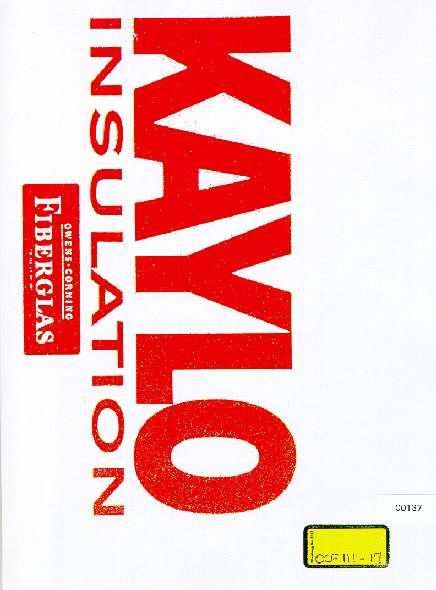 Product image: Kaylo (Owens-Corning Fiberglas)Other · ACL Doc 15101
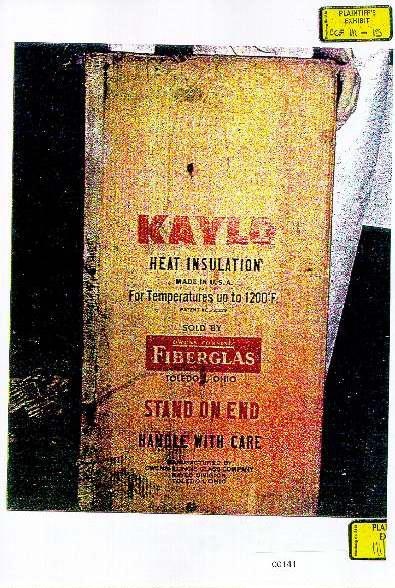 Label: KAYLO (Owens-Corning Fiberglas)Label or package · ACL Doc 15034
Asbestos claims
If you or a family member worked with or around Kaylo (Owens-Corning) and later developed mesothelioma or another asbestos disease, a claim may be paid by the Owens Corning/Fibreboard asbestos trust (Owens Corning subfund). Free case review.
What each document says
Every statement about Kaylo (Owens-Corning) in the documents, in each document's own words.
The Travelers Insurance Company's Product Information Booklet for Its Asbestos Seminar (1980–1981)
Military Qualified Products List (1951–1995)
- Sold from: “Owens-Corning Fiberglas Corp., Toledo 1, Ohio (Distributor)”, p. 82
- Made at: “Owens-Corning Fiberglas Corp. Toledo 1, Ohio Plant: Berlin, N.J.” (the plant: Berlin, New Jersey), p. 482
- Description: “Kaylo 10AF”, p. 1112
- Made at: “Kaylo 10AF ... Plant: Berlin, NJ 08009” (as of 1989-04-13) (the plant: Berlin, New Jersey), p. 1482
- Description: “qualified under QPL-2781 as Kaylo, Grade I, Class b, listed under Owens-Corning Fiberglas Corp. (QPL-2781-17)” (as of 1958-11-20), p. 482
- Description: “qualified under QPL-2781 as Kaylo, Grade III, Class e, Types I and II (QPL-2781-36)” (as of 1969-05-27), p. 1072
- Description: “qualified under QPL-2781 as Kaylo (Grade I Class b; Grade II Class d; Grade III Class e Types I and II)” (as of 1 August 1972), p. 1082
- Made at: “Plant: Berlin, NJ” (as of 1 August 1972) (the plant: Berlin, New Jersey), p. 1082
- Description: “qualified under QPL-2781 as Kaylo 10AF” (as of 17 February 1990), p. 1502
Asbestos; Publication of Identifying Information (1990)
- Made from: “produced 1958 to 1972”, said by Owens-Corning Fiberglas Corporation, as recorded by U.S. EPA, Federal Register 55 FR (Feb. 13, 1990), p. 163
- Made from: “Kaylo ... block and pipe-covering thermal insulation, under rebrand agreements and specifications for Owens-Corning Fiberglas ... manufactured 1960 to 1971”, said by Fibreboard Corporation, as recorded by U.S. EPA, Federal Register 55 FR 5147 (Asbestos Information Act submissions), p. 73
- Made until: “produced 1958 to 1972”, said by Owens-Corning Fiberglas Corporation, as recorded by U.S. EPA, Federal Register 55 FR (Feb. 13, 1990), p. 163
- Description: “high temperature insulation”, said by Owens-Corning Fiberglas Corporation, as recorded by U.S. EPA, Federal Register 55 FR (Feb. 13, 1990), p. 163
- Ingredient: “quicklime, silica, diatomaceous earth, clay, chromite, limestone, and sodium silicate”, said by Owens-Corning Fiberglas Corporation, as recorded by U.S. EPA, Federal Register 55 FR (Feb. 13, 1990), p. 163
- Asbestos content: “15% asbestos”, said by Owens-Corning Fiberglas Corporation, as recorded by U.S. EPA, Federal Register 55 FR (Feb. 13, 1990), p. 163
- Made until: “manufactured 1960 to 1971 (by Fibreboard for Owens-Corning Fiberglas)”, said by Fibreboard Corporation, as recorded by U.S. EPA, Federal Register 55 FR 5147, p. 73
J. W. Moore of Owens-Corning Fiberglas Telegram on Ending Use of J-M Chrysotile for Its Chloride Content (1961)
- Fiber grade: “JM chrysotile ... approximately 34 ton 7D grade”, p. 14
G. C. Stefango to Don S. Wright on Discontinuing J-M Chrysotile in Kaylo (1961)
- Change: “reduce the chloride content of all Kaylo insulation; discontinue JM chrysotile; Lake Asbestos and Philip Carey material lower in chloride”, p. 15
- Use: “Kaylo insulation for DuPont and Union Carbide (low-chloride demand)” (sales to DuPont; Union Carbide), p. 15
- Asbestos fiber: “JM chrysotile asbestos (use discontinued)”, p. 15
Owens-Corning Fiberglas Notes of a Meeting with Johns-Manville on the Filter Press Process for Calcium Silicate (1968)
- Ingredient: “asbestos (J-M's new opening method 'permits them to use less asbestos than we do')”, p. 16
R. J. Sexton to L. N. Dickinson Enclosing Union Carbide's Thermobestos and Kaylo Dust Survey (1962)
The Tomplait v. Combustion Engineering Case File (1962-1969), Response to Owens-Corning Fiberglas interrogatories
- Asbestos content: “contains asbestos”, p. 18
The Tomplait v. Combustion Engineering Case File (1962-1969), Interrogatories to Owens-Corning Fiberglas
- Description: “Kaylo and Kaylo 20”, p. 29
- Warning label: “This Product Contains Asbestos Fiber - If dust is created when this product is handled, avoid breathing the dust. ... If adequate ventilation control is not possible, wear respirator approved by U.S. Bureau of Mines.”, said by Owens-Corning Fiberglas (warning as quoted by plaintiff's counsel), as recorded by Stephenson, Thompson & Morris (attorneys for plaintiff), Tomplait v. Combustion Engineering, p. 29
The Tomplait v. Combustion Engineering Case File (1962-1969), Response to plaintiff's interrogatories with exhibits
- Made from: “since 1958 Owens-Corning has manufactured an industrial insulating material comprised of calcium silicate, asbestos fibers and various types of binders. This product is known as Kaylo or Kaylo 20 Insulation.”, p. 110
- Warning label: “"This Product Contains Asbestos Fiber - If dust is created when this product is handled, avoid breathing the dust. If adequate ventilation control is not possible, wear respirator approved by U. S. Bureau of Mines" are set forth on the packaging container for Kaylo and Kaylo 20.”, p. 210
- Ingredient: “comprised of calcium silicate, asbestos fibers and various types of binders”, p. 110
The Potter v. Fibreboard Case File (1969-1972), Answers to plaintiff's interrogatories
The Borel v. Fibreboard Case File (1969-1972), Answers to interrogatories
- Made from: “since 1958”, p. 112
- Made from: “Since May, 1958”, p. 412
- Warning label: “This Product Contains Asbestos Fiber If dust is created when this product is handled, avoid breathing the dust.”, p. 312
- Asbestos content: “comprised of calcium silicate, asbestos fibers and various types of binders”, p. 112
Owens Corning's Responses to Plaintiffs' Master Interrogatories in Greco v. A-Best Products (1997)
- Use: “Bath Iron Works decided to use Kaylo pipecovering on future projects” (sales to Bath Iron Works), p. 3613
The Tomplait v. Combustion Engineering Case File (1962-1969), Answers to second interrogatories
- Warning label: “The statement ... was first printed on the packaging materials for Kaylo products in 1967 ... adopted in following a practice previously established by another insulation products manufacturer.”, p. 114
- Asbestos content: “Kaylo products contain approximately 13 - 22% asbestos fibers.”, p. 114
Union Carbide Chemicals Company: Thermal Insulation and Accessories Manual (1962)
- Form: “Block and Pipe Covering”, p. 7815
- Description: “Hydrous calcium silicate reinforced with a small amount of asbestos fibers. Good compressive strength. Rigid.”, p. 7815
- Temperature limit: “Atmos to 1200”, p. 7815
- Asbestos content: “Hydrous calcium silicate reinforced with a small amount of asbestos fibers”, p. 7815
Celanese Memo Forwarding NIOSH's List of Trade-Name Products Containing Regulated Carcinogens (1977)
- Asbestos content: “KAYLO | Asbestos | 15 | 0000024” (as of 1972-74), said by National Institute for Occupational Safety and Health, as recorded by Celanese Chemical Company (C. D. Barrett memo CDB-70-77), p. 716
Kind of product
We list Kaylo (Owens-Corning) with pipe covering and block insulation, from how the documents describe its form. That page explains how such products exposed workers.
Trades that worked with products like it: Insulators and Insulation Workers, Pipefitters and Plumbers.
Other pipe covering and block insulation by Owens-Corning (3)
Pipe covering and block insulation by other makers (273)
Thermobestos · Superex (Johns-Manville) · Careytemp (Philip Carey) · Unibestos (Union Asbestos & Rubber Co.) · Asbestocel (Johns-Manville) · K-20 (Combustion Engineering) · K-fac (U.S. Gypsum) · K-fac 19 (U.S. Gypsum) · Kaiser M. (Combustion Engineering) · Kalfelt (Atlas Asbestos) · Kalsil (Atlas Asbestos) · Kay-Therm (Keasbey & Mattison) · Kaylo (Owens-Illinois) · Kaytherm (Nicolet) · Lasco (Lynch Asbestos) · Lennolite (Philip Carey) · LK (AC&S) · LK (Armstrong Cork) · Lk-20 (Armstrong Cork) · LT (Armstrong Cork) · and 253 more: all pipe covering and block insulation
See also
- Kaylo in the Lexicon
- Kaylo exposure and claims
- Owens-Corning: the company's history, documents, people, products and plants
- Owens-Corning on our products page: what the documents say about the company's asbestos products, with sources
References
- The Travelers Insurance Company's Product Information Booklet for Its Asbestos Seminar (1980–1981) (April 30, 1981), p. 6.
- Military Qualified Products List (1951–1995) (November 20, 1958), pp. 8, 48, 111, 148.
- Asbestos; Publication of Identifying Information (February 13, 1990), pp. 7, 16.
- J. W. Moore of Owens-Corning Fiberglas Telegram on Ending Use of J-M Chrysotile for Its Chloride Content (November 30, 1961), p. 1.
- G. C. Stefango to Don S. Wright on Discontinuing J-M Chrysotile in Kaylo (December 4, 1961), p. 1.
- Owens-Corning Fiberglas Notes of a Meeting with Johns-Manville on the Filter Press Process for Calcium Silicate (February 23, 1968), p. 1.
- R. J. Sexton to L. N. Dickinson Enclosing Union Carbide's Thermobestos and Kaylo Dust Survey (January 1, 1962), p. 2.
- The Tomplait v. Combustion Engineering Case File (1962-1969), Response to Owens-Corning Fiberglas interrogatories (January 17, 1968), p. 1.
- The Tomplait v. Combustion Engineering Case File (1962-1969), Interrogatories to Owens-Corning Fiberglas (March 4, 1968), p. 2.
- The Tomplait v. Combustion Engineering Case File (1962-1969), Response to plaintiff's interrogatories with exhibits (February 14, 1968), p. 1.
- The Potter v. Fibreboard Case File (1969-1972), Answers to plaintiff's interrogatories (December 23, 1969), p. 1.
- The Borel v. Fibreboard Case File (1969-1972), Answers to interrogatories (March 24, 1970), p. 1.
- Owens Corning's Responses to Plaintiffs' Master Interrogatories in Greco v. A-Best Products (January 1, 1997), p. 36.
- The Tomplait v. Combustion Engineering Case File (1962-1969), Answers to second interrogatories (April 16, 1968), p. 1.
- Union Carbide Chemicals Company: Thermal Insulation and Accessories Manual (October 1, 1962), p. 78.
- Celanese Memo Forwarding NIOSH's List of Trade-Name Products Containing Regulated Carcinogens (August 26, 1977), p. 7.
Mentioned on this site
- F. H. Edwards to J. M. Briley on Asbestosis and Lung Cancer in Insulation Workers (1966)
- G. C. Stefango to Don S. Wright on Discontinuing J-M Chrysotile in Kaylo (1961)
- Owens-Corning Fiberglas Notes of a Meeting with Johns-Manville on the Filter Press Process for Calcium Silicate (1968)
- R. J. Sexton to L. N. Dickinson Enclosing Union Carbide's Thermobestos and Kaylo Dust Survey (1962)
- R. J. Sexton to S. C. Giambruno Enclosing Union Carbide's Third Insulation Block Dust Survey (1963)
- Robert E. Peele's Diary Pages (1963)
- Union Carbide Institute Plant Dust Surveys of J-M Thermobestos Insulation Blocks (1962)
Cite this page
“Kaylo (Owens-Corning).” AsbestosClaims.Law Library. https://asbestosclaims.law/library/products/owens-corning-kaylo.
ACL Doc numbers and their short links never change. See how to cite the Library.
Talk with an asbestos lawyer
Start with what you remember, and we'll take it from there.
This page is provided for general informational purposes and does not constitute legal advice. Every asbestos case turns on its own facts, exposure history, diagnosis, deadlines, available evidence, and applicable law. Reviewing this page does not create an attorney-client relationship. For advice about your specific situation, call 833-4-ASBESTOS for a free case review.