
Superex was a Johns-Manville insulation for high temperatures, sold as molded pipe covering, blocks and a cement.1,2 In sworn answers in a 1958 lawsuit, J-M described it as "calcined diatomaceous silicate combined with asbestos fiber," and named Superex Block, Superex M Block and Superex Combination Pipe Insulation.1
You don't need the product names or old records. No fee unless we recover compensation for your family.
When and where it was made
The documents give different dates: a 1990 EPA notice that published what Manville reported says Superex M and Superex 1900 pipe covering and block were produced from 1922 to 1972, and dates a group of insulating cements that includes Superex from 1930 to 1973.3 An insurance company's 1981 list of asbestos products, compiled from other companies' answers in lawsuits, gives Superex cement as made from 1931 to 1973.2 J-M's 1970 answers in another lawsuit say only that Superex was made "long before 1959."4
J-M memos of 1964 and 1970 list Superex cement, pipe insulation and block under its Waukegan plant, and in 1965 Canadian Johns-Manville wrote that it imported Superex pipe covering from Waukegan.5,6,7 J-M's employee magazine reported in 1961 and 1962 that its newly acquired Niguarda plant near Milan, Italy, was making Superex blocks.8,9
Where it was used
In 1929 J-M's employee magazine said Superex blocks were used in great quantities on high-temperature furnaces, kilns, retorts and other manufacturing equipment, at temperatures from 600° to more than 1600° Fahrenheit.10 In 1930 it reported an order from the Illinois Steel Company for some 16 cars of Superex blocks, and blocks for two rotary lime kilns of the Union Carbide Company in Michigan.11 A 1954 J-M article reprinted in Asbestos magazine said Superex, with 85% Magnesia, gave double-layer insulation to 1900 F in the power plants of the Mariner cargo ships.12 J-M's 1958 answers say it sold Superex to the insulation contractor H. W. Porter & Co. from 1952 to 1956.1
What it was made of
J-M's employee magazine said in 1929 that Superex "combines an excellent refractory material with asbestos fibre."10 J-M's 1958 answers give 5 to 10 percent asbestos and 60 to 70 percent diatomite.1 Manville's 1990 report gives Superex M and Superex 1900 pipe covering and block 8 to 14 percent asbestos fibers, with 55 to 60 percent celite and 25 to 35 percent magnesia.3 For the cements it gives only one range for the whole group, Superex among them: 10 to 100 percent asbestos.3
Caution labels
J-M swore that on or about December 15, 1964, it began putting a caution label on Superex cement, pipe insulation and block; the label read, in part, "THIS PRODUCT CONTAINS ASBESTOS FIBER."4,5 Weeks later, Canadian Johns-Manville wrote that the label was not needed in Canada and asked Waukegan to sand the marking off cartons shipped there.7,13 A 1969 J-M memo said warning labels had been used on Superex "for a number of years."14
See also Thermobestos.
Pictures
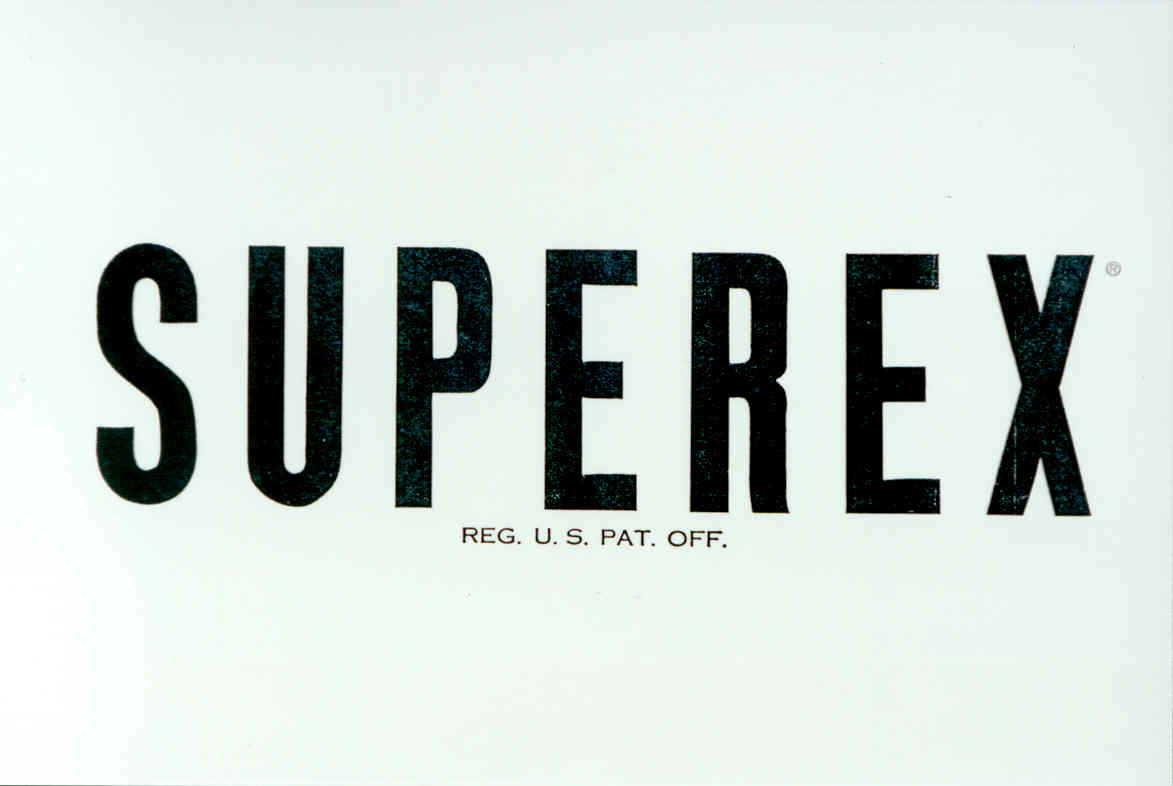
How Superex (Johns-Manville) looked: a label, photograph or catalog page from our library. Each picture has its own page and library number, so it can be cited on its own.
Asbestos claims
If you or a family member worked with or around Superex (Johns-Manville) and later developed mesothelioma or another asbestos disease, a claim may be paid by the Manville Personal Injury Settlement Trust. Free case review.
What each document says
Every statement about Superex (Johns-Manville) in the documents, in each document's own words.
LeGrande v. Johns-Manville Products, Plaintiff's Interrogatories and J-M's Answers (1957)
- Use: “sold to H. W. Porter & Co by Johns-Manville Sales Corporation during the years 1952 to 1956” (sales to H. W. Porter & Co.), p. 111
- Asbestos content: “Asbestos 5- 10”, p. 121
- Description: “Moulded pipe covering and blocks and cement calcined diatomaceous silicate combined with asbestos fiber”, p. 111
- Form: “Superex Block Insulation, Superex M Block Insulation and Superex Combination Pipe Insulation”, p. 141
- Ingredient: “Diatomite 60-70”, p. 121
The Travelers Insurance Company's Product Information Booklet for Its Asbestos Seminar (1980–1981)
Asbestos; Publication of Identifying Information (1990)
- Made from: “produced 1922”, said by Manville Corporation, as recorded by U.S. EPA, Federal Register 55 FR (Feb. 13, 1990), p. 143
- Ingredient: “magnesia, 25 to 35%”, said by Manville Corporation, as recorded by U.S. EPA, Federal Register 55 FR (Feb. 13, 1990), p. 143
- Asbestos content: “Superex M & Superex 1900 ... contained asbestos fibers, 8 to 14%”, said by Manville Corporation, as recorded by U.S. EPA, Federal Register 55 FR (Feb. 13, 1990), p. 143
- Ingredient: “celite, 55 to 60%”, said by Manville Corporation, as recorded by U.S. EPA, Federal Register 55 FR (Feb. 13, 1990), p. 143
- Asbestos content: “Asbestos-Binder cements: ... Superex, 85% Magnesia (produced 1930 to 1973) ... contained asbestos, 10 to 100%”, said by Manville Corporation, as recorded by U.S. EPA, Federal Register 55 FR (Feb. 13, 1990), p. 143
- Made from: “produced 1930”, said by Manville Corporation, as recorded by U.S. EPA, Federal Register 55 FR (Feb. 13, 1990), p. 143
- Made until: “to 1973”, said by Manville Corporation, as recorded by U.S. EPA, Federal Register 55 FR (Feb. 13, 1990), p. 143
- Description: “grey-white pipe covering and block forms, used for high temperature insulation”, said by Manville Corporation, as recorded by U.S. EPA, Federal Register 55 FR (Feb. 13, 1990), p. 143
- Made until: “to 1972”, said by Manville Corporation, as recorded by U.S. EPA, Federal Register 55 FR (Feb. 13, 1990), p. 143
The Borel v. Fibreboard Case File (1969-1972), Answers to interrogatories with exhibits
- Made from: “manufactured by Defendant long before 1959”, p. 24
- Warning label: “On or about December 15, 1964, Defendant began ... to place a precautionary label”, p. 34
- Form: “Segmental Pipe Insulation”, p. 284
- Description: “SUPEREX. (H. T. Pipe & Block Insulation - H. T. Cement) Made from asbestos fiber, diatomaceous silica and other insulating materials.”, p. 294
- Asbestos content: “Made from asbestos fiber, diatomaceous silica and other insulating materials”, p. 294
E. C. Lindstrom to J-M Plant Managers on Caution Labels for High Temperature Insulations (1964)
- Warning label: “CAUTION THIS PRODUCT CONTAINS ASBESTOS FIBER. ...”, p. 15
- Made at: “Waukegan” (the plant: Waukegan, Illinois), p. 25
M. W. Burleson's Notice to the Industrial Insulations Division on Health Hazard Caution Labels (1970)
- Warning label: “*Superex P/I, Block & Cement ... label L-4956”, p. 26
- Made at: “Waukegan Plant” (the plant: Waukegan, Illinois), p. 26
W. E. Hodgson to A. Pocius on Removing Caution Labels from Cartons for Canada (1965)
- Warning label: “remove the marking by sanding ... on cartons being shipped into Canada”, p. 17
- Made at: “Superex Pipe Covering imported from Waukegan” (the plant: Waukegan, Illinois), p. 17
J-M News Pictorial, 1961, April 1961
- Made at: “Niguarda, Italy” (the plant: Niguarda (Milan), Italy), p. 168
J-M News Pictorial, 1962, February 1962
- Made at: “J-M's Niguarda Plant near Milan, Italy, produces ... Superex blocks” (the plant: Niguarda (Milan), Italy), p. 99
The J-M Circle, 1929, April 1929
The J-M Circle, 1930, March 1930
Asbestos Magazine, 1954, May 1954
- Temperature limit: “in combination with 85% Magnesia, provides double layer insulation for temperatures to 1900 F”, said by Johns-Manville (Power Specialist), as recorded by Asbestos (magazine), p. 2212
W. E. Hodgson to S. Lane and C. H. Jensen to E. C. Lindstrom on Leaving Caution Labels Off Shipments to Canada (1965), Letter, W. E. Hodgson to S. Lane, January 14, 1965
- Warning label: “not necessary to use the Caution label on products containing asbestos in Canada”, p. 113
E. M. Fenner to E. R. Bettinardi on Warning Labels for Superex and Thermobestos (1969)
- Warning label: “Warning labels have been used on Superex and Thermobestos products for a number of years.”, p. 114
The Potter v. Fibreboard Case File (1969-1972), Answers to plaintiff's interrogatories with exhibits
- Made from: “have been manufactured by it since the early 1900's”, p. 215
- Warning label: “precautionary label from on or about December 15, 1964 (SUPEREX CEMENT; MAGNESIA & SUPEREX P/I; MAGNESIA & SUPEREX BLOCK)”, p. 315
- Form: “(H. T. Pipe & Block Insulation - H. T. Cement)”, p. 2915
- Ingredient: “asbestos fiber, diatomaceous silica and other insulating materials”, p. 2915
Manville Fund's Answers to Interrogatories in Gunn v. Celotex (1989)
- Made from: “Date Manufactured: 1922”, p. 12116
- Warning label: “Date Labeled: 1965”, p. 12116
- Made until: “Date Discontinued: 1973”, p. 12116
- Form: “Cement”, p. 12116
- Asbestos fiber: “Chrysotile and/or Amosite”, p. 12116
- Asbestos content: “asbestos containing”, p. 6316
- Asbestos fiber: “Chrysotile and/or Amosite”, p. 12116
- Use: “used with SUPEREX or THERMO-12 pipe and block insulation for patching, pointing up joints, and covering irregular shapes”, p. 8216
- Asbestos content: “8.4 - 15.0 % fiber by weight”, p. 12116
- Made at: “Manville Plant, Manville, New Jersey (1913 through 1985): Superex Cement” (at Manville) (the plant: Manville, New Jersey), p. 6316
- Description: “The same material as used in SUPEREX sectional and block insulation”, p. 8216
Label: Superex trademark (Johns-Manville, Inc.), Image
- Sold from: “Date of First Use in Commerce: November 22, 1926”, said by Johns-Manville, Inc., as recorded by U.S. Patent Office trademark file17
J-M Production Engineering Report on Equipment for Thermobestos Pipe Covering and Thermoflex Felts (1949)
- Description: “insulating material (Magnesia, Superex, and other insulations)”, p. 218
The Potter v. Fibreboard Case File (1969-1972), Additional answer to third set of interrogatories
- Warning label: “CAUTION THIS PRODUCT CONTAINS ASBESTOS FIBER. INHALATION OF ASBESTOS IN EXCESSIVE QUANTITIES OVER LONG PERIODS OF TIME MAY BE HARMFUL. IF DUST IS CREATED WHEN THIS PRODUCT IS HANDLED, AVOID BREATHING THE DUST. IF ADEQUATE VENTILATION CONTROL IS NOT POSSIBLE, WEAR RESPIRATORS APPROVED BY THE U. S. BUREAU OF MINES FOR PNEUMOCONIOSIS PRODUCING DUSTS.” (as of 1970), p. 219
- Form: “cement; pipe insulation (P/I) and block (with magnesia)”, p. 219
C. H. Jensen to E. C. Lindstrom on a Customer's Alarm at the Superex Caution Label (1965)
- Warning label: “caution labels on Superex cartons” (sales to Lindberg Engineering Company, Chicago (via Asbestos & Magnesia Materials Co.)), p. 120
C. H. Jensen Wire to E. C. Lindstrom on Shipping Superex to Canada (1965)
- Warning label: “SHIP SUPEREX TO CANADA WITH CAUTION LABELS OR ARE TO REMOVE TH[EM]”, p. 121
Military Qualified Products List (1951–1995)
- Made at: “Plants: Redwood City, Calif.” (as of 1951-12-03) (the plant: Redwood City, California), p. 222
- Made at: “Plants: Manville, N. J.” (as of 1951-12-03) (the plant: Manville, New Jersey), p. 222
- Made at: “Plants: Waukegan, Ill.” (as of 1951-12-03) (the plant: Waukegan, Illinois), p. 222
- Description: “qualified under QPL-2781 as JM SUPEREX and SUPEREX, Grade III, Class e (QPL-2781-1)” (as of 1951-12-03), p. 222
- Description: “qualified under QPL-2781 as JM Superex and Superex, Grade III, Class e, Type II (QPL-2781-14)” (as of 1958-06-06), p. 4222
H. M. Jackson to Dr. R. E. Joyner of Carbide and Carbon Chemicals on Superex and Thermobestos Insulation (1956)
- Ingredient: “flux-calcined diatomaceous earth”, p. 123
Union Carbide Chemicals Company: Thermal Insulation and Accessories Manual (1962)
Sourcebook on Asbestos Diseases: Medical, Legal, and Engineering Aspects, Volume Two
- Description: “diatomaceous earth & asbestos block” (as of 1954, 1955), p. 11425
Manville Fund's Responses to Plaintiffs' Interrogatories in Moore v. H.K. Porter (1990)
- Made at: “Manville Plant (1913 to 1985): Superex Cement” (at Manville) (the plant: Manville, New Jersey), p. 2326
- Made at: “Waukegan Plant (1922 to 1985): Superex Cement” (at Waukegan) (the plant: Waukegan, Illinois), p. 2826
- Asbestos content: “asbestos containing”, p. 2326
- Made at: “Redwood City Plant (1932 to 1955): Rough Superex Sectional Pipe Covering, Pipe Blocks and Blocks; Superex Block; Superex Cement; Superex Pipe Covering; Superex Plastic” (at Redwood City) (the plant: Redwood City, California), p. 2626
Kind of product
We list Superex (Johns-Manville) with pipe covering and block insulation and insulating cement and coatings, from how the documents describe its form. Those pages explain how such products exposed workers.
Trades that worked with products like it: Insulators and Insulation Workers, Pipefitters and Plumbers, Boilermakers.
Other pipe covering and block insulation by Johns-Manville (60)
Thermobestos · Asbestocel · 85 Magnesia · Thermobestos pipe covering · Firetard · Perfection Pipe Covering · Ring-Tite · Safety Blow-Off Covering · Silicated Thermobestos · Sonite · Standard Sectional Covering · Super Fire Felt · Superex 2000 · Superex-1900 · Superex-m · Superex-sg · Therm-o-bestos · Thermo Fire Felt · Thermowrap · Train Pipe Covering · and 40 more on the company's page
Pipe covering and block insulation by other makers (216)
Careytemp (Philip Carey) · Kaylo (Owens-Corning) · Unibestos (Union Asbestos & Rubber Co.) · Kaylo (Owens-Illinois) · Unibestos (Pittsburg Corning) · Super Caltemp (Fibreboard) · Super Cell (Ruberoid) · Super Insutape (Unarco) · Super Insutape (Union Asbestos & Rubber Co.) · Super Unibestos (Unarco) · Super-light (Philip Carey) · Super-Light 85% Magnesia (Philip Carey) · Temp-check (Philip Carey) · Tempcheck (Philip Carey) · Therm-O-Flake (Illinois Clay Products) · Thermalite (Keene) · Thermalite 85% Magnesia (Baldwin-Ehret-Hill) · Thermalite 85% Magnesia (Ehret Magnesia Manufacturing Co.) · Thermasil (Baldwin-Ehret-Hill) · Thermasil (Ehret Magnesia Manufacturing Co.) · and 196 more: all pipe covering and block insulation
Other insulating cement and coatings by Johns-Manville (51)
Thermobestos · Asbestile · 85 Magnesia · 302 · 352 · Johns-Manville Jm · Laptite · Laptite Cement · Mx-3808 Asb Filler · Mx-3808 Asbestos Filler · Navy 450 Cement · No. 302 Insulation Cement · Superex Cement · Superex Cement for Navy · Superex-m · Thermobestos Cement · Thermomix 700 · Thermomix 720 · Thermomix 770 · Thermomix 810 · and 31 more on the company's page
Insulating cement and coatings by other makers (273)
Prasco (Fibreboard) · Calsilite (GAF) · Caltemp (Fibreboard) · Sal-mo (Nicolet) · Super 66 (Eagle-Picher) · Super 711 (Combustion Engineering) · Super Caltemp (Fibreboard) · Super Finish (Combustion Engineering) · Super Powerhouse (Keene) · Super Stic-tite (Combustion Engineering) · Super-light (Philip Carey) · Super-Light Cement (Philip Carey) · Swetcheck (Eagle-Picher) · T-60 (Combustion Engineering) · Temp-Sure I-c 250 (Insul-Coustic) · Tempcheck (Philip Carey) · Thermalcoat (M. H. Detrick) · Thermalite (Keene) · Thermalite 85% Magnesia (Baldwin-Ehret-Hill) · Thermalkote (Flintkote) · and 253 more: all insulating cement and coatings
See also
- Johns-Manville: the company's history, documents, people, products and plants
- Johns-Manville on our products page: what the documents say about the company's asbestos products, with sources
References
- LeGrande v. Johns-Manville Products, Plaintiff's Interrogatories and J-M's Answers (January 17, 1958), pp. 11–12, 14.
- The Travelers Insurance Company's Product Information Booklet for Its Asbestos Seminar (1980–1981) (April 30, 1981), p. 8.
- Asbestos; Publication of Identifying Information (February 13, 1990), p. 14.
- The Borel v. Fibreboard Case File (1969-1972), Answers to interrogatories with exhibits (March 27, 1970), pp. 2–3.
- E. C. Lindstrom to J-M Plant Managers on Caution Labels for High Temperature Insulations (October 15, 1964), pp. 1–2.
- M. W. Burleson's Notice to the Industrial Insulations Division on Health Hazard Caution Labels (July 1, 1970), p. 2.
- W. E. Hodgson to A. Pocius on Removing Caution Labels from Cartons for Canada (February 1, 1965), p. 1.
- J-M News Pictorial, 1961, April 1961 (April 1, 1961), p. 16.
- J-M News Pictorial, 1962, February 1962 (February 1, 1962), p. 9.
- The J-M Circle, 1929, April 1929 (April 1, 1929), p. 33.
- The J-M Circle, 1930, March 1930 (March 1, 1930), p. 19.
- Asbestos Magazine, 1954, May 1954 (May 1, 1954), p. 22.
- W. E. Hodgson to S. Lane and C. H. Jensen to E. C. Lindstrom on Leaving Caution Labels Off Shipments to Canada (1965), Letter, W. E. Hodgson to S. Lane, January 14, 1965 (January 14, 1965), p. 1.
- E. M. Fenner to E. R. Bettinardi on Warning Labels for Superex and Thermobestos (October 3, 1969), p. 1.
- The Potter v. Fibreboard Case File (1969-1972), Answers to plaintiff's interrogatories with exhibits (December 29, 1969), p. 2.
- Manville Fund's Answers to Interrogatories in Gunn v. Celotex (December 7, 1989), p. 121.
- Label: Superex trademark (Johns-Manville, Inc.), Image.
- J-M Production Engineering Report on Equipment for Thermobestos Pipe Covering and Thermoflex Felts (August 1, 1949), p. 2.
- The Potter v. Fibreboard Case File (1969-1972), Additional answer to third set of interrogatories (March 13, 1970), p. 2.
- C. H. Jensen to E. C. Lindstrom on a Customer's Alarm at the Superex Caution Label (February 9, 1965), p. 1.
- C. H. Jensen Wire to E. C. Lindstrom on Shipping Superex to Canada (February 16, 1965), p. 1.
- Military Qualified Products List (1951–1995) (December 3, 1951), p. 2.
- H. M. Jackson to Dr. R. E. Joyner of Carbide and Carbon Chemicals on Superex and Thermobestos Insulation (August 22, 1956), p. 1.
- Union Carbide Chemicals Company: Thermal Insulation and Accessories Manual (October 1, 1962), p. 79.
- Sourcebook on Asbestos Diseases: Medical, Legal, and Engineering Aspects, Volume Two (1986), p. 114. Not yet published in our library.
- Manville Fund's Responses to Plaintiffs' Interrogatories in Moore v. H.K. Porter (February 15, 1990), p. 23.
Mentioned on this site
- C. H. Jensen to E. C. Lindstrom on a Customer's Alarm at the Superex Caution Label (1965)
- C. H. Jensen Wire to E. C. Lindstrom on Shipping Superex to Canada (1965)
- C. J. Dandrow's Draft Bulletin to District Managers on a High Temperature Insulation Fabrication Shop (1955)
- E. C. Lindstrom on Caution Labels for High Temperature Insulations (1964)
- E. C. Lindstrom to J-M Plant Managers on Caution Labels for High Temperature Insulations (1964)
- E. M. Fenner to E. R. Bettinardi on Warning Labels for Superex and Thermobestos (1969)
- H. M. Jackson to Dr. R. E. Joyner of Carbide and Carbon Chemicals on Superex and Thermobestos Insulation (1956)
- Johns-Manville Products Corporation's Answers to Interrogatories in Le Grande v. Johns-Manville (1958)
- LeGrande v. Johns-Manville Products, Plaintiff's Interrogatories and J-M's Answers (1957)
- M. W. Burleson's Notice to the Industrial Insulations Division on Health Hazard Caution Labels (1970)
- W. E. Hodgson to A. Pocius on Removing Caution Labels from Cartons for Canada (1965)
- W. E. Hodgson to S. Lane and C. H. Jensen to E. C. Lindstrom on Leaving Caution Labels Off Shipments to Canada (1965)
- W. W. Acher to E. C. Lindstrom on Caution Wording for High-Temperature Insulations (1964)
Cite this page
“Superex (Johns-Manville).” AsbestosClaims.Law Library. https://asbestosclaims.law/library/products/johns-manville-superex.
ACL Doc numbers and their short links never change. See how to cite the Library.
Talk with an asbestos lawyer
Start with what you remember, and we'll take it from there.
This page is provided for general informational purposes and does not constitute legal advice. Every asbestos case turns on its own facts, exposure history, diagnosis, deadlines, available evidence, and applicable law. Reviewing this page does not create an attorney-client relationship. For advice about your specific situation, call 833-4-ASBESTOS for a free case review.