
Prasco was a high-temperature insulation of diatomaceous earth and asbestos, made as blocks, pipe covering and cement.1,2 Its makers changed names over the years before it appeared under Fibreboard.3,4,5 A 1924 ad in Asbestos, the industry's trade journal, says Prasco blocks were made by Plant Rubber and Asbestos Works of San Francisco, which had its mill in Redwood City, California.3 In 1948 the company, by then a division of The Paraffine Companies, announced that it had become The Paraffine Companies' Insulation Division as of July 1, and that Prasco High Temperature Insulation would go on being made under that name.4 A 1951 Navy list of approved products names Pabco Products, Inc. of San Francisco as its maker, at a plant in Redwood City.6 From 1957 to 1961 it appears in ads of the Pabco Industrial Insulations Division of Fibreboard Paper Products Corporation.5,7
You don't need the product names or old records. No fee unless we recover compensation for your family.
When it was made
The sources give different dates.1,2,8 A June 1925 article in Asbestos on Prasco's history says the Prasco High Temperature Block was developed about two years earlier, but was not put on the general market straight away; at first it was used only where it could be carefully watched.1 An insurance company's 1981 list of asbestos products, compiled from other companies' answers in lawsuits, gives Prasco as made from 1928 to 1957, and Fibreboard's report published by the EPA in 1990 gives about 1928 to 1957.2,9 In sworn answers in a 1969 lawsuit, which asked only about products from 1940 on, Fibreboard said Prasco pipe covering, block and cement were made until January 1957.8 Yet Pabco's ads still listed Prasco 15 C pipe covering, block and cement, for temperatures to 1500° F, and Prasco 19 C block, to 1900° F, from May 1957 through January 1961.5,7
What it contained
Fibreboard's 1969 answers say Prasco contained 85% diatomaceous earth and 15% asbestos.8 The 1981 list gives 15 in the column read as percent asbestos.2 Fibreboard's 1990 report gives 85% diatomaceous earth and binders, about 15% asbestos, and says the product was yellow or red.9
Where it was used
The 1924 ad offered Prasco blocks for temperatures of 1000° Fahrenheit and over, for boiler casings, brick walls and breeching.3 The 1925 article recommended the blocks between fire brick and the outer brick or steel casing of boilers, on any part of a marine boiler, and on uptakes and breechings, and said they had stood up where pyrometer readings showed 1700 degrees.1 It also described a steam pipe covering then being made with an inner layer of Prasco and outer layers of 85% Magnesia.1 In 1930 the magazine reported that Plant Rubber had finished a large contract for the Great Western Company, with 85% magnesia applied over Prasco, in some places six inches thick.10
Pictures
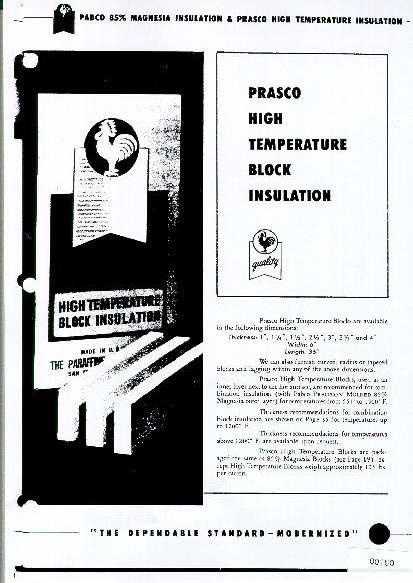
How Prasco (Fibreboard) looked: a label, photograph or catalog page from our library. Each picture has its own page and library number, so it can be cited on its own.
Asbestos claims
If you or a family member worked with or around Prasco (Fibreboard) and later developed mesothelioma or another asbestos disease, a claim may be paid by the Owens Corning/Fibreboard asbestos trust (Fibreboard subfund). Free case review.
What each document says
Every statement about Prasco (Fibreboard) in the documents, in each document's own words.
Asbestos Magazine, 1925, June 1925
- Ingredient: “composed of diatomaceous earth and asbestos fibres as basic materials”, p. 181
- Made from: “developed about two years ago (c. 1923); not immediately put on the general market”, p. 181
- Form: “pipe covering with inner layer of Prasco and outer layer(s) of 85% Magnesia”, p. 191
- Temperature limit: “stood up under working conditions where pyrometer readings show 1700 degrees”, p. 191
- Use: “between fire brick and boiler brick or steel casing; marine boilers; uptakes and breechings over 1000 degrees”, p. 191
The Travelers Insurance Company's Product Information Booklet for Its Asbestos Seminar (1980–1981)
Asbestos Magazine, 1924, October 1924
- Description: “PRASCO High Temperature Insulating Blocks”, p. 413
- Use: “boiler casings, brick walls, breeching”, p. 413
- Made at: “MILL: REDWOOD CITY, CALIFORNIA” (at Redwood City, California) (the plant: Redwood City, California), p. 413
Asbestos Magazine, 1948, August 1948
- Description: “Prasco High Temperature Insulation continues under The Paraffine Companies, Inc., Insulation Division”, p. 314
Asbestos Magazine, 1957, May 1957
Military Qualified Products List (1951–1995)
- Made at: “Plant: Redwood City, Calif.” (at Redwood City, Calif.) (the plant: Redwood City, California), p. 26
- Description: “qualified under QPL-2781 as PRASCO, Grade III, Class e (QPL-2781-1)” (as of 1951-12-03), p. 26
- Made at: “Plant: Emeryville, Calif.” (as of 1960-02-25) (the plant: Emeryville, California), p. 686
- Description: “qualified under QPL-2781 as Prasco, Grade III, Class e, Type II (QPL-2781-36)” (as of 1969-05-27), p. 1076
Asbestos Magazine, 1961, January 1961
- Description: “Prasco 15 C and Prasco 19 C still in Pabco's insulation guide, May 1957 – January 1961”, p. 557
The Potter v. Fibreboard Case File (1969-1972), Answers to interrogatories
Asbestos; Publication of Identifying Information (1990)
- Description: “color: yellow or red”, said by Fibreboard Corporation, as recorded by U.S. EPA, Federal Register 55 FR (Feb. 13, 1990), p. 79
- Made from: “manufactured from about 1928 to 1957”, said by Fibreboard Corporation, as recorded by U.S. EPA, Federal Register 55 FR (Feb. 13, 1990), p. 79
- Ingredient: “85% diatomaceous earth and binders”, said by Fibreboard Corporation, as recorded by U.S. EPA, Federal Register 55 FR (Feb. 13, 1990), p. 79
- Made until: “manufactured from about 1928 to 1957”, said by Fibreboard Corporation, as recorded by U.S. EPA, Federal Register 55 FR (Feb. 13, 1990), p. 79
- Asbestos content: “about 15% asbestos”, said by Fibreboard Corporation, as recorded by U.S. EPA, Federal Register 55 FR (Feb. 13, 1990), p. 79
- Form: “a block, pipe-covering, and cement thermal insulation”, said by Fibreboard Corporation, as recorded by U.S. EPA, Federal Register 55 FR (Feb. 13, 1990), p. 79
Asbestos Magazine, 1930, March 1930
- Use: “under 85% magnesia, up to six inches thick, Great Western Company contract” (sales to Great Western Company), p. 5310
The Borel v. Fibreboard Case File (1969-1972), Answers to interrogatories
- Made from: “manufactured from 1940”, p. 111
- Made until: “to January, 1957”, p. 111
- Use: “sold primarily in the west and mid-west for use in new construction of refineries, petrochemical plants and power plants”, p. 511
- Form: “Prasco Pipe Covering, Block, Cement”, p. 111
- Asbestos content: “contained 85% diatamaceous earth and 15% asbestos”, p. 111
Sourcebook on Asbestos Diseases: Medical, Legal, and Engineering Aspects, Volume Two
- Description: “15% asbestos” (as of 1928-1957), p. 10112
Kind of product
We list Prasco (Fibreboard) with pipe covering and block insulation and insulating cement and coatings, from how the documents describe its form. Those pages explain how such products exposed workers.
Trades that worked with products like it: Insulators and Insulation Workers, Pipefitters and Plumbers, Boilermakers.
Other pipe covering and block insulation by Fibreboard (13)
Pipe covering and block insulation by other makers (263)
Thermobestos · Superex (Johns-Manville) · Careytemp (Philip Carey) · Kaylo (Owens-Corning) · Unibestos (Union Asbestos & Rubber Co.) · No. 6 High Temperature Cement (Baldwin-Hill) · Non-sweat (Keasbey & Mattison) · Non-sweat (Nicolet) · Norwal (Nicolet) · Perfection Pipe Covering (Johns-Manville) · Pipecoverings (U.S. Gypsum) · Plisulate (Plibrico Jointless Firebrick) · Precision-molded (Ehret/Keene) · Precision-molded (Mundet Cork) · Precision-molded (Philip Carey) · PV Supertemp Block (Eagle-Picher) · Pyro-bestos (U.S. Gypsum) · Pyrocal (PPG Industries) · Rigid Block Insulation (U.S. Gypsum) · Ring-Tite (Johns-Manville) · and 243 more: all pipe covering and block insulation
Other insulating cement and coatings by Fibreboard (8)
Insulating cement and coatings by other makers (316)
Thermobestos · Superex (Johns-Manville) · Asbestile (Johns-Manville) · 85 Magnesia (Johns-Manville) · Calsilite (GAF) · P-k (Keene/Ehret) · Perforated Saffit Panels (Gold Bond Bldg. Products (National Gypsum)) · Permiseal (Combustion Engineering) · Pittcote 600 B (Pittsburgh Corning) · Plastic Emulsion (Armstrong Cork) · Plisulate (Plibrico Jointless Firebrick) · Powerhouse (Keene) · Protektite (Bitucote) · Pyroscat (Combustion Engineering) · Quik Set (Forty-Eight Insulations) · Red Top (U.S. Gypsum) · S-90 Tile (Armstrong Cork) · S.I.S. (Celotex) · Sal-mo (Nicolet) · Sanded Premix (Flintkote) · and 296 more: all insulating cement and coatings
See also
- Fibreboard: the company's history, documents, people, products and plants
- Fibreboard on our products page: what the documents say about the company's asbestos products, with sources
References
- Asbestos Magazine, 1925, June 1925 (June 1, 1925), pp. 18–19.
- The Travelers Insurance Company's Product Information Booklet for Its Asbestos Seminar (1980–1981) (April 30, 1981), p. 7.
- Asbestos Magazine, 1924, October 1924 (October 1, 1924), p. 41.
- Asbestos Magazine, 1948, August 1948 (August 1, 1948), p. 31.
- Asbestos Magazine, 1957, May 1957 (May 1, 1957), p. 63.
- Military Qualified Products List (1951–1995) (December 3, 1951), p. 2.
- Asbestos Magazine, 1961, January 1961 (January 1, 1961), p. 55.
- The Potter v. Fibreboard Case File (1969-1972), Answers to interrogatories (December 22, 1969), p. 1.
- Asbestos; Publication of Identifying Information (February 13, 1990), p. 7.
- Asbestos Magazine, 1930, March 1930 (March 1, 1930), p. 53.
- The Borel v. Fibreboard Case File (1969-1972), Answers to interrogatories (April 3, 1970), p. 1.
- Sourcebook on Asbestos Diseases: Medical, Legal, and Engineering Aspects, Volume Two (1986), p. 101. Not yet published in our library.
Mentioned on this site
Cite this page
“Prasco (Fibreboard).” AsbestosClaims.Law Library. https://asbestosclaims.law/library/products/fibreboard-prasco.
ACL Doc numbers and their short links never change. See how to cite the Library.
Talk with an asbestos lawyer
Start with what you remember, and we'll take it from there.
This page is provided for general informational purposes and does not constitute legal advice. Every asbestos case turns on its own facts, exposure history, diagnosis, deadlines, available evidence, and applicable law. Reviewing this page does not create an attorney-client relationship. For advice about your specific situation, call 833-4-ASBESTOS for a free case review.