
The Redwood City plant first appears as a magnesia factory of the Plant Rubber & Asbestos Works of San Francisco: a 1970 look back in Asbestos, the industry's trade journal, recalled that Plant Rubber "completed negotiations for the purchase of the factory and business of" Merle Magnesia of Redwood City, which was producing carbonate of magnesia, and that Plant "intended to enlarge the facility for increased production of 85% Magnesia pipe covering."2 A Plant Rubber advertisement in Asbestos in June 1921 lists a "Magnesia Factory, Redwood City, Cal.," and calls the company "Manufacturers of 85% Magnesia Pipe and Boiler Coverings," air cell and Minocel coverings, and plastic cements.6
You don't need the product names or old records. No fee unless we recover compensation for your family.
Owners
In October 1928 Asbestos reported that Paraffine Companies, Inc., of San Francisco "has purchased the Plant Rubber & Asbestos Works of that city," and a January 1929 item dated the purchase to "October 1928."3,5 A 1978 look back in the same journal described Paraffine as "a maker of linoleum" and Plant as "a producer of asbestos and magnesia insulating materials and asbestos-based packings."4 In May 1945 the trade journal reported that "E. Fred Karklin has been made Superintendent of the Redwood City plant and salt works operations."7
What the plant made
A 1924 Plant Rubber and Asbestos Works advertisement for PRASCO "High Temperature Insulating Blocks" gives the mill as "REDWOOD CITY, CALIFORNIA," and a Navy list of qualified products in 1951 gives Redwood City as the plant for PRASCO.10,11 Fibreboard described PRASCO in general, not Redwood City's output in particular: in its sworn answers in a 1969 lawsuit it said PRASCO pipe covering, block and cement "were manufactured from 1940 to January 1957 and contained 85% diatamaceous earth and 15% asbestos," and in a 1990 EPA notice that published what the company reported, it said PRASCO was made "from about 1928 to 1957" with "about 15% asbestos."12,13 A June 1925 article in Asbestos says the Prasco block was developed "about two years ago."14
In August 1946 Asbestos reported that The Paraffine Companies planned a new asbestos-cement plant at Redwood City to "make Asbestos-Cement Siding Shingles, Roof Shingles, Corrugated Asbestos Siding and Asbestos Lumber or Flat Board," adjoining "Plant Rubber's existing Redwood City manufacturing department where magnesia insulation products are made."1 In September 1947 the plant was "now under construction" and expected to be in operation "during the latter part of 1947"; the same item said high temperature insulation at Redwood City "will be discontinued" once new "Precision Molded" facilities were completed at the Emeryville plant.8 In December 1947 the journal reported that Plant "started production in its new asbestos-cement factory at Redwood City, Calif."9
Location
Pictures of products made here
Labels, packages, photographs and catalog pages from our library of products documents say were made at this plant. Each picture has its own page and library number.
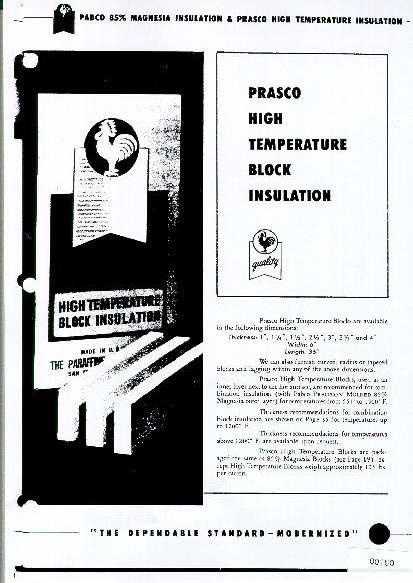
Asbestos products made here
The products documents say were made at this plant, with the years a document gives for the product here. Each product's page has what the documents say about it, including its asbestos content.
- Prasco (Fibreboard) · from 192410,11
Asbestos claims
If you or a family member worked at this plant, lived with someone who did, or worked with its products, and later developed mesothelioma or another asbestos disease, a claim may be paid by the Owens Corning/Fibreboard asbestos trust (Fibreboard subfund). Free case review.
What each document says
Every statement about this plant in the documents, in each document's own words.
Asbestos Magazine, 1946, August 1946
- Description: “planned: new million dollar asbestos-cement products plant (siding shingles, roof shingles, corrugated asbestos siding, asbestos lumber or flat board)” (The Paraffine Companies, Inc.), p. 401
- Products made: “existing Redwood City manufacturing department where magnesia insulation products are made” (The Paraffine Companies, Inc.), p. 401
Asbestos Magazine, 1970, October 1970
- Owned or run by: “Plant Rubber & Asbestos Works, San Francisco, completed negotiations for the purchase of the factory and business of Merle Magnesia Mfg. Co., Redwood City, California” (Plant Rubber & Asbestos Works), said by Asbestos (magazine), as recorded by Asbestos (magazine), p. 622
Asbestos Magazine, 1928, October 1928
- Owned or run by: “Paraffine Companies, Inc. ... has purchased the Plant Rubber & Asbestos Works” (Paraffine Companies, Inc.), said by Asbestos (magazine), as recorded by Asbestos (magazine), p. 463
Asbestos Magazine, 1978, November 1978
- Owned or run by: “Paraffine Companies, Inc., of San Francisco, California, announced its purchase of the Plant Rubber & Asbestos Works” (Paraffine Companies, Inc.), said by Asbestos (magazine), as recorded by Asbestos (magazine), p. 624
Asbestos Magazine, 1929, January 1929
- Owned or run by: “during October 1928, Paraffine Companies, Inc., in turn, purchased the Plant Rubber & Asbestos Works” (Paraffine Companies, Inc.), said by Asbestos (magazine), as recorded by Asbestos (magazine), p. 45
Asbestos Magazine, 1921, June 1921
- Operated: “Magnesia Factory, Redwood City, Cal.” (Plant Rubber and Asbestos Works), said by Plant Rubber and Asbestos Works, as recorded by Asbestos (magazine), p. 226
Asbestos Magazine, 1945, May 1945
- Operated: “Superintendent of the Redwood City plant and salt works operations” (Plant Rubber & Asbestos Works), p. 327
Asbestos Magazine, 1947, September 1947
- Opened: “asbestos-cement products plant now under construction; should be in operation during the latter part of 1947” (Plant Rubber & Asbestos Works), p. 448
- Description: “manufacture of high temperature insulation at Redwood City to be discontinued when Emeryville "Precision Molded" facilities are completed (planned)” (Plant Rubber & Asbestos Works), p. 448
Asbestos Magazine, 1947, December 1947
- Opened: “Plant started production in its new asbestos-cement factory at Redwood City, Calif. [1947]” (Plant Rubber & Asbestos Works), p. 69
Other names
Documents call this plant “Redwood City, Calif.”, “MILL: REDWOOD CITY, CALIFORNIA”, “Redwood City, California”.
See also
References
- Asbestos Magazine, 1946, August 1946 (August 1, 1946), p. 40.
- Asbestos Magazine, 1970, October 1970 (October 1, 1970), p. 62.
- Asbestos Magazine, 1928, October 1928 (October 1, 1928), p. 46.
- Asbestos Magazine, 1978, November 1978 (November 1, 1978), p. 62.
- Asbestos Magazine, 1929, January 1929 (January 1, 1929), p. 4.
- Asbestos Magazine, 1921, June 1921 (June 1, 1921), p. 22.
- Asbestos Magazine, 1945, May 1945 (May 1, 1945), p. 32.
- Asbestos Magazine, 1947, September 1947 (September 1, 1947), p. 44.
- Asbestos Magazine, 1947, December 1947 (December 1, 1947), p. 6.
- Military Qualified Products List (1951–1995) (December 3, 1951), p. 2.
- Asbestos Magazine, 1924, October 1924 (October 1, 1924), p. 41.
- The Potter v. Fibreboard Case File (1969-1972), Answers to interrogatories (December 22, 1969), p. 1.
- Asbestos; Publication of Identifying Information (February 13, 1990), p. 7.
- Asbestos Magazine, 1925, June 1925 (June 1, 1925), p. 18.
Cite this page
“Plant Rubber and Asbestos Works / Pabco Products, Inc. plant at Redwood City, California.” AsbestosClaims.Law Library. https://asbestosclaims.law/library/plants/redwood-city-ca-fibreboard.
ACL Doc numbers and their short links never change. See how to cite the Library.
Talk with an asbestos lawyer
Start with what you remember, and we'll take it from there.
This page is provided for general informational purposes and does not constitute legal advice. Every asbestos case turns on its own facts, exposure history, diagnosis, deadlines, available evidence, and applicable law. Reviewing this page does not create an attorney-client relationship. For advice about your specific situation, call 833-4-ASBESTOS for a free case review.