
Super 66 was an insulating cement made by Eagle-Picher from mineral wool and asbestos.1,2,3 In sworn answers given in a lawsuit in 1970, Eagle-Picher described it as "a dry, bulk cement composed of Eagle-Picher granulated mineral wool thoroughly blended with suitable binding, rust inhibitive, and plasticizing ingredients," and listed asbestos among its ingredients, with bentonite clay, tri-sodium phosphate, sodium nitrate and a sudsing agent.3 Its 1968 answers in another lawsuit give the same list, but with sodium nitrite.4 A 1990 EPA notice that published what the company reported says it dried to a grayish-white color, with dark mineral wool nodules of generally uniform size.2
Eagle-Picher packaged Super 66 under its own name and sold it to contractors, to its distributors and to certain large users, and also packaged such cements for other companies to sell under their own names.3,4 As early as September 1936, an article in Asbestos, the industry's trade journal, described an insulation "composed of mineral wool, asbestos fibre and a binding agent," and named Eagle Super "66" Plastic Insulation, a product of Eagle Picher Lead Co., in a footnote.5 The article said the mineral wool pellets were "thoroly mixed with long asbestos fibre."5
You don't need the product names or old records. No fee unless we recover compensation for your family.
When it was made
The documents give different start dates: Eagle-Picher's 1968 answers say Super 66 was first made before 1950, and its 1970 answers say before 1940.3,4 The 1990 notice says Super "66," formerly called Eagle "66," was made from 1930 to August 1971.2 An insurance company's 1981 list of asbestos products, compiled from other companies' answers in lawsuits, gives it as made from 1931 to 1971.1
How much asbestos it contained
The 1990 notice says Super 66 contained 8 to 10% chrysotile asbestos by weight from 1931 to 1963, and 3 to 4% from 1964 to 1971, as the formula came to use more bentonite clay.2 The insurer's 1981 list gives 2-9 in the column read as percent asbestos.1
See also One-Cote.
Pictures
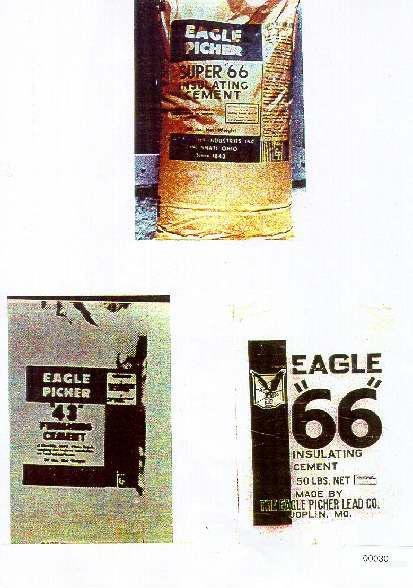
How Super 66 (Eagle-Picher) looked: a label, photograph or catalog page from our library. Each picture has its own page and library number, so it can be cited on its own.
Asbestos claims
If you or a family member worked with or around Super 66 (Eagle-Picher) and later developed mesothelioma or another asbestos disease, a claim may be paid by the Eagle-Picher Industries asbestos trust. Free case review.
What each document says
Every statement about Super 66 (Eagle-Picher) in the documents, in each document's own words.
The Travelers Insurance Company's Product Information Booklet for Its Asbestos Seminar (1980–1981)
Asbestos; Publication of Identifying Information (1990)
- Made from: “Super "66" asbestos-containing insulating cement, formerly called Eagle "66," was manufactured from 1930 to August 1971.”, said by Eagle-Picher Industries, Inc., as recorded by U.S. EPA, Federal Register 55 FR (Feb. 13, 1990), p. 62
- Asbestos content: “8 to 10% (1931 to 1963) ... chrysotile asbestos fibers by weight”, said by Eagle-Picher Industries, Inc., as recorded by U.S. EPA, Federal Register 55 FR (Feb. 13, 1990), p. 62
- Asbestos fiber: “chrysotile asbestos fibers”, said by Eagle-Picher Industries, Inc., as recorded by U.S. EPA, Federal Register 55 FR (Feb. 13, 1990), p. 62
- Change: “22 to 33% (1931 to 1963) and 44 to 52% (1963 to 1971) bentonite clay by weight; 8 to 10% (1931 to 1963) and 3 to 4% (1964 to 1971) chrysotile asbestos fibers by weight”, said by Eagle-Picher Industries, Inc., as recorded by U.S. EPA, Federal Register 55 FR (Feb. 13, 1990), p. 62
- Asbestos content: “3 to 4% (1964 to 1971) chrysotile asbestos fibers by weight”, said by Eagle-Picher Industries, Inc., as recorded by U.S. EPA, Federal Register 55 FR (Feb. 13, 1990), p. 62
- Made until: “manufactured from 1930 to August 1971”, said by Eagle-Picher Industries, Inc., as recorded by U.S. EPA, Federal Register 55 FR (Feb. 13, 1990), p. 62
- Ingredient: “42 to 67% granulated mineral wool (dark) fiber nodules by weight; less than 5% other ingredients by weight”, said by Eagle-Picher Industries, Inc., as recorded by U.S. EPA, Federal Register 55 FR (Feb. 13, 1990), p. 62
- Description: “an insulating cement which dried to a grayish-white color with dark mineral wool fiber nodules of generally uniform size (1/4" to 1/2")”, said by Eagle-Picher Industries, Inc., as recorded by U.S. EPA, Federal Register 55 FR (Feb. 13, 1990), p. 62
The Borel v. Fibreboard Case File (1969-1972), Answers to interrogatories
- Made from: “Super 66 Insulating Cement / Date First Manufactured: Pre-1940”, p. 23
- Warning label: “Caution: This product contains asbestos fiber. Inhalation of asbestos in excessive quantities over long periods of time may be harmful.”, p. 73
- Sold until: “packages its mineral wool insulating cements, Eagle Super 66 Insulating Cement and One-Coat Cement ... and sells them”, p. 53
- Ingredient: “Composition: Granulated Wool Screen Test, Asbestos, Bentonite Clay, Tri-Sodium Phosphate, Sodium Nitrate, Sudsing Agent”, p. 23
- Description: “A dry, bulk cement composed of Eagle-Picher granulated mineral wool thoroughly blended with suitable binding, rust inhibitive, and plasticizing ingredients.”, p. 23
- Use: “packages its mineral wool insulating cements, Eagle Super 66 Insulating Cement and One-Coat Cement ... sells them to contractors, its distributors and to certain large ultimate users, and also packages such products for private accounts” (as of 1970), p. 53
- Asbestos content: “Composition: Granulated Wool Screen Test, Asbestos, Bentonite Clay, Tri-Sodium Phosphate, Sodium Nitrate, Sudsing Agent”, p. 23
The Tomplait v. Combustion Engineering Case File (1962-1969), Response to plaintiff's interrogatories
- Made from: “Super 66 Insulating Cement / Date First Manufactured: Pre-1950”, p. 34
- Use: “packages the following mineral wool insulating cements under its own trade name and sells them to contractors, to distributors and to certain large ultimate users, and also packages such cements for private accounts under their respective trade names - Eagle Super 66 Insulating Cement and One-Cote Cement” (as of 1968), p. 44
- Description: “A dry, bulk cement composed of Eagle-Picher granulated mineral wool thoroughly blended with suitable binding, rust inhibitive, and plasticizing ingredients.”, p. 34
- Ingredient: “Composition: Granulated Wool Screen Test, Asbestos, Bentonite Clay, Tri-Sodium Phosphate, Sodium Nitrite, Sudsing Agent”, p. 34
Asbestos Magazine, 1936, September 1936
The Potter v. Fibreboard Case File (1969-1972), Answers to Pittsburgh Corning interrogatories (W-2 exhibits withheld)
- Use: “Eagle-Picher #66 (power house cement), Todd Galveston Drydocks, 1940-1942”, p. 16
The Potter v. Fibreboard Case File (1969-1972), Answers to plaintiff's interrogatories
- Made from: “Pre-1940 (date first manufactured)”, p. 27
- Warning label: “"Caution: This product contains asbestos fibre." first begun in May or June of 1964”, p. 77
- Use: “sold to contractors, distributors and certain large ultimate users; also packaged for private accounts”, p. 57
- Ingredient: “Granulated Wool Screen Test Asbestos Bentonite Clay Tri-Sodium Phosphate Sodium Nitrite Sudsing Agent”, p. 27
- Description: “A dry, bulk cement composed of Eagle-Picher granulated mineral wool thoroughly blended with suitable binding, rust inhibitive, and plasticizing ingredients.”, p. 27
North American Refractories Company's Responses to Interrogatories and Requests for Production in Bexar County (1994)
Union Carbide Chemicals Company: Thermal Insulation and Accessories Manual (1962)
- Description: “mineral wool insulating cement (UCC generic class 104)”, p. 419
Kind of product
We list Super 66 (Eagle-Picher) with insulating cement and coatings, from how the documents describe its form. That page explains how such products exposed workers.
Trades that worked with products like it: Insulators and Insulation Workers, Boilermakers.
Other insulating cement and coatings by Eagle-Picher (21)
43 · Hylo · Insulseal · 20 · Fireproofing · Hi-stick · Insulstic · One Cote Cement · One-cote · Spray-mastic · Stalastic · Stamastic · Swetcheck · 106 · 33 · 66 · 7M · 99 · 99 Finishing Cement · Armor Temp · and 1 more on the company's page
Insulating cement and coatings by other makers (303)
Thermobestos · Superex (Johns-Manville) · Asbestile (Johns-Manville) · 85 Magnesia (Johns-Manville) · Prasco (Fibreboard) · Ss-11 (A. P. Green Firebrick Co.) · Stazon (North American Refractories) · Stic-tite (Combustion Engineering) · Stirup (Combustion Engineering) · Super 48 (48 Insulations) · Super 48 (Forty-Eight Insulations) · Super 606 (Philip Carey) · Super 711 (Combustion Engineering) · Super Caltemp (Fibreboard) · Super Finish (Combustion Engineering) · Super Powerhouse (Keene) · Super Stic-tite (Combustion Engineering) · Super-light (Philip Carey) · Super-Light Cement (Philip Carey) · Superex Cement (Johns-Manville) · and 283 more: all insulating cement and coatings
See also
- Eagle-Picher: the company's history, documents, people, products and plants
- Eagle-Picher on our products page: what the documents say about the company's asbestos products, with sources
References
- The Travelers Insurance Company's Product Information Booklet for Its Asbestos Seminar (1980–1981) (April 30, 1981), p. 8.
- Asbestos; Publication of Identifying Information (February 13, 1990), p. 6.
- The Borel v. Fibreboard Case File (1969-1972), Answers to interrogatories (April 1, 1970), pp. 2, 5.
- The Tomplait v. Combustion Engineering Case File (1962-1969), Response to plaintiff's interrogatories (February 15, 1968), pp. 3–4.
- Asbestos Magazine, 1936, September 1936 (September 1, 1936), pp. 5–6.
- The Potter v. Fibreboard Case File (1969-1972), Answers to Pittsburgh Corning interrogatories (W-2 exhibits withheld) (July 18, 1969), p. 1.
- The Potter v. Fibreboard Case File (1969-1972), Answers to plaintiff's interrogatories (December 26, 1969), p. 2.
- North American Refractories Company's Responses to Interrogatories and Requests for Production in Bexar County (January 1, 1994), p. 36.
- Union Carbide Chemicals Company: Thermal Insulation and Accessories Manual (January 1, 1962), p. 41.
Mentioned on this site
Cite this page
“Super 66 (Eagle-Picher).” AsbestosClaims.Law Library. https://asbestosclaims.law/library/products/eagle-picher-super-66.
ACL Doc numbers and their short links never change. See how to cite the Library.
Talk with an asbestos lawyer
Start with what you remember, and we'll take it from there.
This page is provided for general informational purposes and does not constitute legal advice. Every asbestos case turns on its own facts, exposure history, diagnosis, deadlines, available evidence, and applicable law. Reviewing this page does not create an attorney-client relationship. For advice about your specific situation, call 833-4-ASBESTOS for a free case review.