
In October 1947, Asbestos, the industry's trade journal, reported that the new asbestos-cement plant of The Philip Carey Manufacturing Company "is nearing completion" at Cincinnati, Ohio, with "some units already in production."1 In April 1965 the journal printed the company's announcement that Duane S. Bosma "has been appointed Plant Manager of the Cincinnati, Ohio, plant of The Philip Carey Manufacturing Company."2
You don't need the product names or old records. No fee unless we recover compensation for your family.
Careytemp and the Navy's lists
The Navy's lists of qualified products give a Cincinnati plant at 320 S. Wayne Ave. for Careytemp pipe insulation: the May 1969 list names Philip Carey Corporation at that address with "Plant: Same address," the 1972 list gives the same address, and in 1973 the product appears as Carey-Temp under Celotex, its plant at the same Wayne Avenue address.3 On the 1969 and 1972 pages the qualified product is "New Careytemp 1500 Cylindrical & Segmental Pipe Insulation."3 Philip Carey dated New Careytemp 1500 "Sept. 23, 1969 to present," made of "Expanded Perlite, Bentonite clay and chopped glass roving," and called Careytemp 1500 "a high temperature heat insulation which does not contain asbestos."4,5,6
Careytemp itself was older: in 1959 Asbestos reported that the "pipe and block insulation" had been introduced by The Philip Carey Manufacturing Company, Cincinnati, Ohio, "the result of three years' research by the Insulation Division."7 The company later dated the asbestos-containing Careytemp "1958- Sept. 1969," and said that since September 1969 "asbestos fiber has been eliminated from regular Careytemp and fiberglass has been substituted therefor."5 Panacon Corporation, formerly Philip Carey, said the product made until September 23, 1969 had "approximately 6% of asbestos fiber," and Celotex's report, published by the EPA in 1990, described Careytemp, "produced 1958 to 1969, asbestos removed 1969," as "90% perlite, 6 to 7% asbestos and binders."8,9 These figures describe Careytemp in general, not what was made at Cincinnati in particular.8,9
Location
Pictures of products made here
Labels, packages, photographs and catalog pages from our library of products documents say were made at this plant. Each picture has its own page and library number.
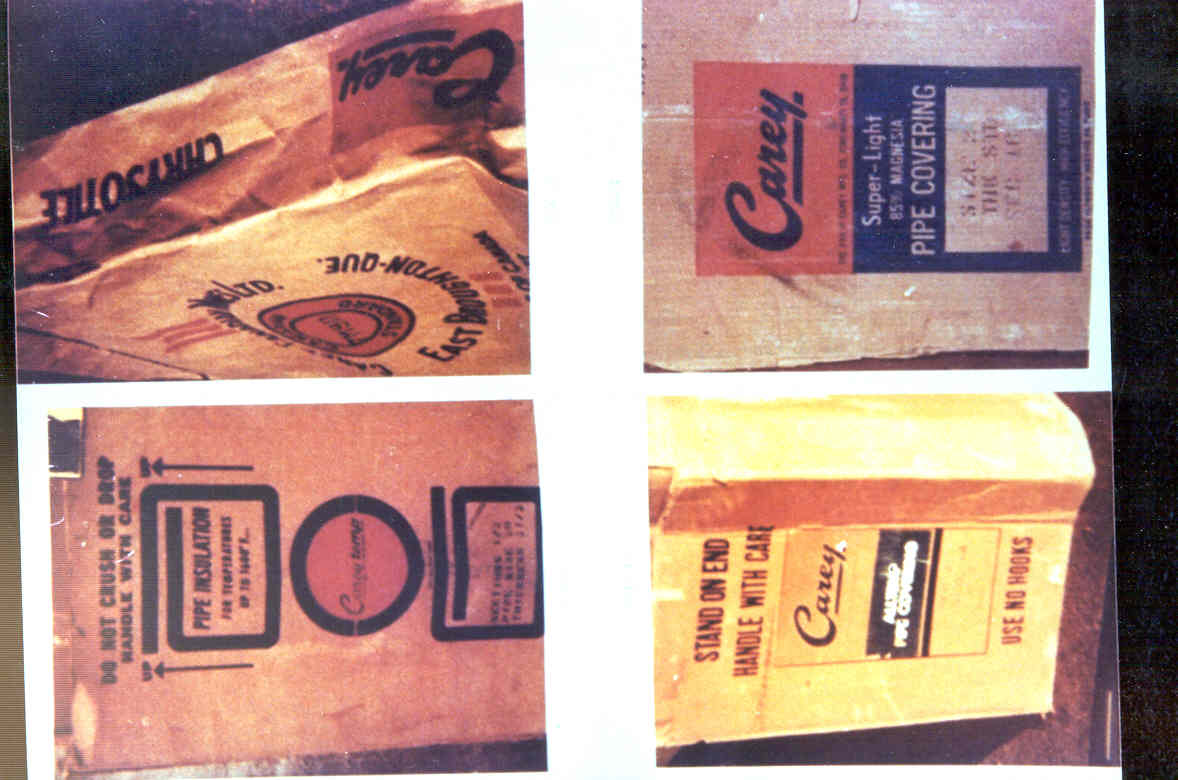
Asbestos products made here
The products documents say were made at this plant, with the years a document gives for the product here. Each product's page has what the documents say about it, including its asbestos content.
Asbestos claims
If you or a family member worked at this plant, lived with someone who did, or worked with its products, and later developed mesothelioma or another asbestos disease, a claim may be paid by the Celotex Asbestos Settlement Trust. Free case review.
What each document says
Every statement about this plant in the documents, in each document's own words.
Asbestos Magazine, 1947, October 1947
- Opened: “new asbestos-cement plant nearing completion, some units already in production” (The Philip Carey Mfg. Company), p. 421
Asbestos Magazine, 1965, April 1965
- Operated: “Plant Manager of the Cincinnati, Ohio, plant of The Philip Carey Manufacturing Company” (The Philip Carey Manufacturing Company), said by The Philip Carey Manufacturing Company, as recorded by Asbestos (magazine), p. 222
Other names
Documents call this plant “320 S. Wayne Ave., Cincinnati, Ohio 45215”, “320 S. Wayne Ave. Cincinnati, OH”, “320 S. Wayne Ave., Cincinnati, Ohio”, “320 S. Wayne Ave., Cincinnati, OH 45215”, “320 S. Wayne Ave., Cincinnati, OH”.
See also
- Philip Carey Corp.: the company's history, documents, people, products and plants
- Celotex: the company's history, documents, people, products and plants
- Asbestos exposure sites in Ohio
References
- Asbestos Magazine, 1947, October 1947 (October 1, 1947), p. 42.
- Asbestos Magazine, 1965, April 1965 (April 1, 1965), p. 22.
- Military Qualified Products List (1951–1995) (May 27, 1969), pp. 105, 108, 112.
- The Potter v. Fibreboard Case File (1969-1972), Answers to plaintiff's interrogatories (December 23, 1969), p. 2.
- The Borel v. Fibreboard Case File (1969-1972), Answers to interrogatories (April 2, 1970), p. 2.
- The Potter v. Fibreboard Case File (1969-1972), Answers to plaintiff's interrogatories (November 22, 1971), p. 2.
- Asbestos Magazine, 1959, August 1959 (August 1, 1959), p. 56.
- The Borel v. Fibreboard Case File (1969-1972), Answers to plaintiffs' joint interrogatories (September 21, 1970), p. 2.
- Asbestos; Publication of Identifying Information (February 13, 1990), p. 5.
Mentioned on this site
Cite this page
“Philip Carey Corp. / Celotex plant at Cincinnati, Ohio.” AsbestosClaims.Law Library. https://asbestosclaims.law/library/plants/cincinnati-oh-philip-carey.
ACL Doc numbers and their short links never change. See how to cite the Library.
Talk with an asbestos lawyer
Start with what you remember, and we'll take it from there.
This page is provided for general informational purposes and does not constitute legal advice. Every asbestos case turns on its own facts, exposure history, diagnosis, deadlines, available evidence, and applicable law. Reviewing this page does not create an attorney-client relationship. For advice about your specific situation, call 833-4-ASBESTOS for a free case review.