
Flat Transite was a Johns-Manville asbestos-cement board, which J-M's employee magazine called "flat Transite asbestos wood" in 1928.1,2,3 A 1990 EPA notice that published what Manville reported says corrugated and flat Transite and Transite acoustical panel were produced from 1930 to 1982.2 An insurance company's 1981 list of asbestos products, compiled from other companies' answers in lawsuits, gives Flat Transite, listed as board, as made from 1930 to 1981, the list's own year.1 J-M's employee magazine shows a Cleveland salesman already taking orders for it from laundries in September 1928.3
For the asbestos content, Manville's 1990 report gives one range for corrugated and flat Transite and the acoustical panel together: 25 to 35 percent asbestos fiber, with 40 to 45 percent portland cement and 25 to 30 percent silica.2
J-M's employee magazines report a wide range of uses: table tops and flat iron stands in laundries in 1928, a trampled-and-broken "flagstone walk" of one-eighth inch sheets for the stage production "Miracle" in Milwaukee in 1929, and the fume hoods and ventilating ducts of a new chemistry annex at the University of Illinois in 1930.3,4,5 In 1938 J-M offered it, like Flexboard, as the outer veneer of insulated curtain walls for factory buildings.6 In 1945 J-M listed Flat Transite among the products it had supplied to the Manhattan Project.7 In 1966 J-M's Nashua plant was making flat Transite sheets for customers who made defense and space products, and a 1969 J-M survey names a "Flat Transite Saw Operator" station at its Pittsburg plant.8,9
See also Flexboard.
You don't need the product names or old records. No fee unless we recover compensation for your family.
Pictures
How Flat Transite (Johns-Manville) looked: a label, photograph or catalog page from our library. Each picture has its own page and library number, so it can be cited on its own.
Asbestos claims
If you or a family member worked with or around Flat Transite (Johns-Manville) and later developed mesothelioma or another asbestos disease, a claim may be paid by the Manville Personal Injury Settlement Trust. Free case review.
What each document says
Every statement about Flat Transite (Johns-Manville) in the documents, in each document's own words.
The Travelers Insurance Company's Product Information Booklet for Its Asbestos Seminar (1980–1981)
Asbestos; Publication of Identifying Information (1990)
- Ingredient: “silica, 25 to 30%”, said by Manville Corporation, as recorded by U.S. EPA, Federal Register 55 FR (Feb. 13, 1990), p. 5155, p. 152
- Ingredient: “portland cement, 40 to 45%”, said by Manville Corporation, as recorded by U.S. EPA, Federal Register 55 FR (Feb. 13, 1990), p. 5155, p. 152
- Asbestos content: “asbestos fiber, 25 to 35%”, said by Manville Corporation, as recorded by U.S. EPA, Federal Register 55 FR (Feb. 13, 1990), p. 5155, p. 152
- Made from: “produced 1930”, said by Manville Corporation, as recorded by U.S. EPA, Federal Register 55 FR (Feb. 13, 1990), p. 5155, p. 152
- Made until: “produced ... to 1982”, said by Manville Corporation, as recorded by U.S. EPA, Federal Register 55 FR (Feb. 13, 1990), p. 5155, p. 152
The J-M Circle, 1928, September 1928
- Description: “flat Transite asbestos wood”, said by Johns-Manville, as recorded by The J-M Circle (J-M employee magazine), p. 63
- Use: “table tops and flat iron stands in laundries” (sales to laundries in the Cleveland territory), said by Johns-Manville, as recorded by The J-M Circle (J-M employee magazine), p. 63
The J-M Circle, 1929, December 1929
- Use: “stage scenery (flagstone walk) for the theatrical production "Miracle", Milwaukee” (sales to producers of the "Miracle" (theatrical production), Milwaukee), said by Johns-Manville, as recorded by The J-M Circle (J-M employee magazine), p. 124
The J-M Circle, 1930, February 1930
- Use: “fume hoods and ventilating ducts, University of Illinois chemistry annex” (sales to University of Illinois (new chemistry annex)), said by Johns-Manville, as recorded by The J-M Circle (J-M employee magazine), p. 175
Asbestos Magazine, 1938, May 1938
- Use: “veneer on Encased Insulating Board in J-M's patented industrial curtain wall”, said by Johns-Manville, as recorded by Asbestos (magazine), p. 366
- Use: “exterior surface sheet cemented to Encased Insulating Board between windows”, said by Johns-Manville, as recorded by Asbestos (magazine), p. 386
Asbestos Magazine, 1945, September 1945
- Use: “supplied to the Manhattan Project” (sales to Manhattan Project (atomic bomb development and production)), said by Johns-Manville, as recorded by Asbestos (magazine), reporting the J-M News Pictorial of August 15 [1945], p. 367
J-M News Pictorial, 1966, November 1966
- Made at: “Nashua (J-M plant)” (at Nashua, N.H.) (the plant: Nashua, New Hampshire), said by Johns-Manville, as recorded by J-M News Pictorial (employee magazine), p. 88
- Use: “sheets supplied to makers of defense and space products” (sales to makers of defense and space products), said by Johns-Manville, as recorded by J-M News Pictorial (employee magazine), p. 88
E. M. Fenner's Report of the Environmental Control Subcommittee Meeting on Electron Microscope Counts and a New Fiber Limit (1970)
- Made at: “Pittsburg Plant (Flat Transite saw station)” (at Pittsburg Plant) (the plant: Pittsburg, California), p. 99
Manville Fund's Answers to Interrogatories in Gunn v. Celotex (1989)
- Made from: “Date Manufactured: 1907”, p. 11110
- Warning label: “Date Labeled: 1970”, p. 11110
- Asbestos fiber: “Chrysotile and/or Amosite”, p. 11110
- Asbestos content: “22.0 - 69.2 % fiber by weight”, p. 11110
- Asbestos content: “asbestos-cement sheets”, p. 7510
- Asbestos fiber: “Chrysotile and/or Amosite”, p. 11110
- Description: “Incombustible asbestos-cement sheets, resistant to corrosion and weather”, p. 7510
- Form: “Board”, p. 11110
- Made until: “Date Discontinued: 1985”, p. 11110
USPTO trademark case files (Trademark Full Text XML Data, Annual Applications, 2025 edition)
R. W. Dobson to C. P. Weber on Health Hazard Labels for Marinite and Other Sheet Products (1969)
- Warning label: “no labelling policy; suggests no action on labelling sheet products”, p. 112
Sourcebook on Asbestos Diseases: Medical, Legal, and Engineering Aspects, Volume Two
- Description: “board” (as of 1930), p. 7813
Manville Fund's Responses to Plaintiffs' Interrogatories in Moore v. H.K. Porter (1990)
- Asbestos content: “asbestos containing”, p. 2414
- Made at: “Nashua Plant (1907 to 1985): Flat Transite” (at Nashua) (the plant: Nashua, New Hampshire), p. 2414
- Made at: “Waukegan Plant (1922 to 1985): Flat Transite” (at Waukegan) (the plant: Waukegan, Illinois), p. 2714
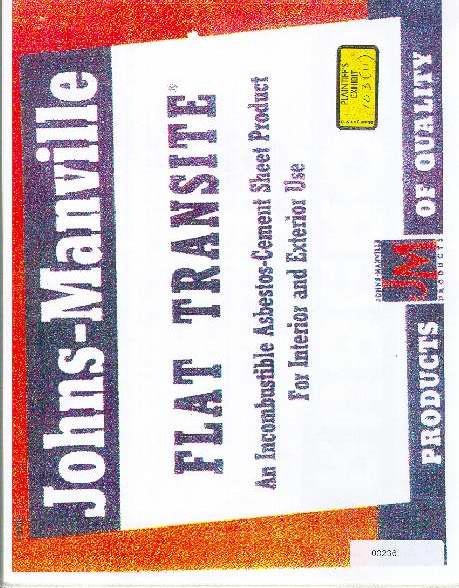
Catalog page: FLAT TRANSITE (Johns-Manville)
- Asbestos content: “An Incombustible Asbestos-Cement Sheet Product For Interior and Exterior Use”, p. 115
Kind of product
We list Flat Transite (Johns-Manville) with asbestos-cement pipe, board and sheet, from how the documents describe its form. That page explains how such products exposed workers.
Trades that worked with products like it: Carpenters and Construction Workers.
Other asbestos-cement pipe, board and sheet by Johns-Manville (119)
Flexboard · Thermobestos · Min-k · Asbestocel · Metal-on · Corspan · Dekeran · Equality · Face Span · Facespan · Fine Corrugated Asbestocel · Fire Felt · Flexite · Heat Treated Molted Metal Marinite · Homestead · Imperial Marinite · Korduct · Magno · Marimet 45 · Marine Acoustical Unit · and 99 more on the company's page
Asbestos-cement pipe, board and sheet by other makers (264)
Careytemp (Philip Carey) · Unibestos (Union Asbestos & Rubber Co.) · Unibestos (Pittsburg Corning) · Sal-mo (Nicolet) · Careycel (Philip Carey) · Facad (United States Plywood) · Facade (Cape Universal Bldg. Products of Cape Asbestos Group) · Ferobestos (J. W. Roberts Ltd (Turner & Newall)) · Fiber-Shake (Supradur) · Fiber-Shake Sidewall Shingle (Supradur) · Fire-chex 325 (Philip Carey) · Firefoil (Philip Carey) · Flintite (Flintkote) · Flintite (Orangeburg) · Fluid-Tite (CertainTeed) · Fluid-Tite (Keasbey & Mattison) · Follansbee Terne (Follansbee Steel) · Formboard (Philip Carey) · Frycor (Owens-Corning) · Fyrbestos (Keene/Beh) · and 244 more: all asbestos-cement pipe, board and sheet
See also
- Johns-Manville: the company's history, documents, people, products and plants
- Johns-Manville on our products page: what the documents say about the company's asbestos products, with sources
References
- The Travelers Insurance Company's Product Information Booklet for Its Asbestos Seminar (1980–1981) (April 30, 1981), p. 5.
- Asbestos; Publication of Identifying Information (February 13, 1990), p. 15.
- The J-M Circle, 1928, September 1928 (September 1, 1928), p. 6.
- The J-M Circle, 1929, December 1929 (December 1, 1929), p. 12.
- The J-M Circle, 1930, February 1930 (February 1, 1930), p. 17.
- Asbestos Magazine, 1938, May 1938 (May 1, 1938), pp. 36, 38.
- Asbestos Magazine, 1945, September 1945 (September 1, 1945), p. 36.
- J-M News Pictorial, 1966, November 1966 (November 1, 1966), p. 8.
- E. M. Fenner's Report of the Environmental Control Subcommittee Meeting on Electron Microscope Counts and a New Fiber Limit (January 1, 1970), p. 9.
- Manville Fund's Answers to Interrogatories in Gunn v. Celotex (December 7, 1989), p. 111.
- USPTO trademark case files (Trademark Full Text XML Data, Annual Applications, 2025 edition) (November 5, 1970). Not yet published in our library.
- R. W. Dobson to C. P. Weber on Health Hazard Labels for Marinite and Other Sheet Products (February 20, 1969), p. 1.
- Sourcebook on Asbestos Diseases: Medical, Legal, and Engineering Aspects, Volume Two (1986), p. 78. Not yet published in our library.
- Manville Fund's Responses to Plaintiffs' Interrogatories in Moore v. H.K. Porter (February 15, 1990), p. 24.
- Catalog page: FLAT TRANSITE (Johns-Manville), p. 1.
Cite this page
“Flat Transite (Johns-Manville).” AsbestosClaims.Law Library. https://asbestosclaims.law/library/products/johns-manville-flat-transite.
ACL Doc numbers and their short links never change. See how to cite the Library.
Talk with an asbestos lawyer
Start with what you remember, and we'll take it from there.
This page is provided for general informational purposes and does not constitute legal advice. Every asbestos case turns on its own facts, exposure history, diagnosis, deadlines, available evidence, and applicable law. Reviewing this page does not create an attorney-client relationship. For advice about your specific situation, call 833-4-ASBESTOS for a free case review.