
Millboard was an asbestos board from The Ruberoid Co. and GAF.1,2 In its 1989 filing with the U.S. Environmental Protection Agency under the Asbestos Information Act, made for itself and The Ruberoid Co., GAF said its asbestos paper, millboard and laminated products were manufactured by Ruberoid from 1928 to 1967, then by General Aniline & Film Corporation in 1967, and then by GAF Corporation from 1968 to 1981.2 A 1990 EPA notice that published what GAF reported gives the same years, for its asbestos paper and millboard products as a group.3
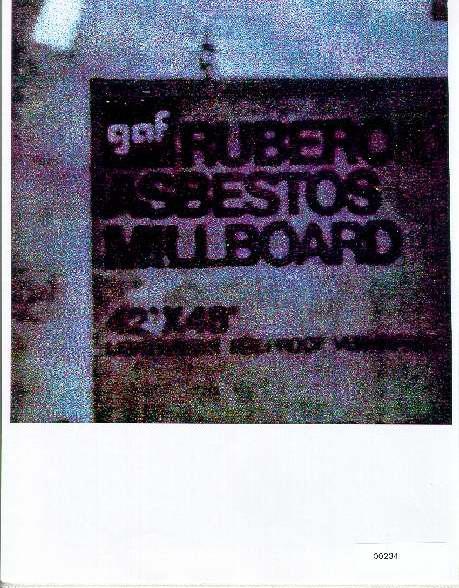
The notice describes millboard as "a stiffer product than asbestos paper or rollboard," manufactured in sheets of varying thicknesses to customers' specifications.3 Both documents say it consisted generally of chrysotile asbestos, usually grades 5D, 5R and 6D, with sulphite pulp and often other constituents, bonded with portland cement and/or starch; at least as early as 1974, latex was added as a binder.2,3 A GAF product picture shows the words "ASBESTOS MILLBOARD."1
The 1989 filing also lists millboard formulas over the years: soft, medium hard and hard boards and a Foundriboard from about December 1938, and commercial, latex, starch, Hi-Temp and Foundriboard millboards in formulas dated from 1960 to 1981.2
See also Rollboard and Asbestos Paper.
You don't need the product names or old records. No fee unless we recover compensation for your family.
Pictures
How Millboard (GAF) looked: a label, photograph or catalog page from our library. Each picture has its own page and library number, so it can be cited on its own.
Asbestos claims
If you or a family member worked with or around Millboard (GAF) and later developed mesothelioma or another asbestos disease, a claim may be paid by the G-I Holdings (GAF) asbestos trust. Free case review.
The formulas
The 23 formulas documents give for Millboard (GAF), each with its ingredients and amounts exactly as printed. Amounts are by weight unless the document says otherwise; a total that doesn't come to 100 is the document's own.
Soft Board - Code 100 · Circa 12/15/38
| Constituent | Amount |
|---|---|
| chrysotile | 84.3% |
| Portland cement | 11.9% |
| lime | 3.8% |
Derived from documents dated during the period 1938-40; GAF does not have a complete set of formulas for that period nor complete information about production dates (p. 25).
Source: GAF Asbestos Information Act Submission (1989), p. 252
Medium Hard Board - Code 101 · Circa 12/15/38
For 3/16" and over.
| Constituent | Amount |
|---|---|
| chrysotile | 81.1% |
| Portland cement | 15.3% |
| pebble lime | 3.6% |
Derived from documents dated during the period 1938-40; GAF does not have a complete set of formulas for that period nor complete information about production dates (p. 25).
Source: GAF Asbestos Information Act Submission (1989), p. 252
Medium Hard Board - Code 101 · Circa 12/15/38
For 1/16" through 1/8".
| Constituent | Amount |
|---|---|
| chrysotile | 78.1% |
| Portland cement | 18.4% |
| pebble lime | 3.5% |
Derived from documents dated during the period 1938-40; GAF does not have a complete set of formulas for that period nor complete information about production dates (p. 25).
Source: GAF Asbestos Information Act Submission (1989), p. 252
Hard Mill Board - Code 102 · Circa 12/15/38
| Constituent | Amount |
|---|---|
| chrysotile | 72.8% |
| Portland cement | 23.9% |
| pebble lime | 3.3% |
Derived from documents dated during the period 1938-40; GAF does not have a complete set of formulas for that period nor complete information about production dates (p. 25).
Source: GAF Asbestos Information Act Submission (1989), p. 262
Hard Mill Board, Special 1/16" - Code 202 · Circa 12/15/38
| Constituent | Amount |
|---|---|
| chrysotile | 73.7% |
| Portland cement | 20.8% |
| pebble lime | 5.5% |
Derived from documents dated during the period 1938-40; GAF does not have a complete set of formulas for that period nor complete information about production dates (p. 25).
Source: GAF Asbestos Information Act Submission (1989), p. 262
1/4" Glass House Board for Montgomery Discs - Code 106 · Circa 12/19/38
| Constituent | Amount |
|---|---|
| scrap (millboard broke) | 80.4% |
| unbleached sulphite | 4.5% |
| Portland cement | 8.4% |
| pebbled lime | 4.5% |
| starch | 2.2% |
Derived from documents dated during the period 1938-40; GAF does not have a complete set of formulas for that period nor complete information about production dates (p. 25).
Source: GAF Asbestos Information Act Submission (1989), p. 262
9/16" Mill Board - Code 107 · Circa 12/19/38
| Constituent | Amount |
|---|---|
| chrysotile | 85.0% |
| Portland cement | 10.0% |
| pebble lime | 3.8% |
| silicate of soda | 1.2% |
Derived from documents dated during the period 1938-40; GAF does not have a complete set of formulas for that period nor complete information about production dates (p. 25).
Source: GAF Asbestos Information Act Submission (1989), p. 262
Foundriboard · Circa 12/19/38
| Constituent | Amount |
|---|---|
| chrysotile | 65.8% |
| Portland cement | 30.9% |
| lime | 3.3% |
Derived from documents dated during the period 1938-40; GAF does not have a complete set of formulas for that period nor complete information about production dates (p. 25).
Source: GAF Asbestos Information Act Submission (1989), p. 262
E-100 CommercialMillboard · 1968-81
Also known as Standard Insulation Board and Soft Millboard.
| Constituent | Amount |
|---|---|
| chrysotile | 92.0 ± 8.0% |
| Portland cement | 8.0 ± 8.0% |
| burtonite in years 1974-1978 | Traces not exceeding .5% |
Derived in the same manner as the asbestos paper formulas for those years: averages of Beater Furnish Reports and Commodity Specification and Cost Sheets, with a plus or minus range (p. 23).
Source: GAF Asbestos Information Act Submission (1989), p. 232
E-101 Commercial Millboard · 1960; 1972-81
| Constituent | Amount |
|---|---|
| chrysotile | 84.0 ± 8.0% |
| Portland cement | 16.0 ± 8.0% |
| burtonite in years 1972-78 | Traces not exceeding .5% |
Derived in the same manner as the asbestos paper formulas for those years: averages of Beater Furnish Reports and Commodity Specification and Cost Sheets, with a plus or minus range (p. 23).
Source: GAF Asbestos Information Act Submission (1989), p. 232
E-101 Millboard (Regular or Mineralboard) · 1978-79
| Constituent | Amount |
|---|---|
| chrysotile | 70.5% |
| Portland cement | 29.5% |
| burtonite (occasionally used) | Traces not exceeding .5% |
Derived in the same manner as the asbestos paper formulas for those years: averages of Beater Furnish Reports and Commodity Specification and Cost Sheets, with a plus or minus range (p. 23).
Source: GAF Asbestos Information Act Submission (1989), p. 232
E-102 Commercial Millboard · 1960; 1969-71
Also known as Extrahard Millboard.
| Constituent | Amount |
|---|---|
| chrysotile | 70.0 ± 10.0% |
| Portland cement | 30.0 ± 10.0% |
Derived in the same manner as the asbestos paper formulas for those years: averages of Beater Furnish Reports and Commodity Specification and Cost Sheets, with a plus or minus range (p. 23).
Source: GAF Asbestos Information Act Submission (1989), p. 242
E-104 Foundriboard · 1969-79
| Constituent | Amount |
|---|---|
| chrysotile | 65.0 ± 4.0% |
| Portland cement | 35.0 ± 4.0% |
| burtonite in years 1975-78 | Traces not exceeding .5% |
Derived in the same manner as the asbestos paper formulas for those years: averages of Beater Furnish Reports and Commodity Specification and Cost Sheets, with a plus or minus range (p. 23).
Source: GAF Asbestos Information Act Submission (1989), p. 242
E-101- L (Latex) Regular Millboard · 1974-81
| Constituent | Amount |
|---|---|
| chrysotile | 79.0 ± 4.0% |
| Portland cement | 17.0 ± 5.0% |
| latex (GAF, Goodrich or Goodyear) | 3.0 ± 2.0% |
| burtonite | Traces not exceeding .5% |
Derived in the same manner as the asbestos paper formulas for those years: averages of Beater Furnish Reports and Commodity Specification and Cost Sheets, with a plus or minus range (p. 23).
Source: GAF Asbestos Information Act Submission (1989), p. 242
E-109 Hi-Temp (low organic) Millboard · 1975-81
| Constituent | Amount |
|---|---|
| chrysotile | 98.0 ± 1.0% |
| Portland cement | 2.0 ± 1.0% |
Derived in the same manner as the asbestos paper formulas for those years: averages of Beater Furnish Reports and Commodity Specification and Cost Sheets, with a plus or minus range (p. 23).
Source: GAF Asbestos Information Act Submission (1989), p. 242
E-109 Hi-Temp Millboard · 1979-81
| Constituent | Amount |
|---|---|
| chrysotile | 89.0 ± 1.0% |
| Portland cement | 11.0 ± 1.0% |
Derived in the same manner as the asbestos paper formulas for those years: averages of Beater Furnish Reports and Commodity Specification and Cost Sheets, with a plus or minus range (p. 23).
Source: GAF Asbestos Information Act Submission (1989), p. 242
Starch Board · 1979-80
| Constituent | Amount |
|---|---|
| chrysotile | 88.0% |
| bleached sulphite | 2.0% |
| starch | 10.0% |
Derived in the same manner as the asbestos paper formulas for those years: averages of Beater Furnish Reports and Commodity Specification and Cost Sheets, with a plus or minus range (p. 23).
Source: GAF Asbestos Information Act Submission (1989), p. 242
Commercial Millboard · 1969; 1973
| Constituent | Amount |
|---|---|
| chrysotile | 89.0 ± 2.0% |
| bleached sulphite | 5.0 ± 1.0% |
| Celite | 4.0% |
| Starch (two types) Type 1 | .1 ± .30% |
| Starch (two types) Type 2 | 1.0 or 3.0% |
| burtonite (two types) Type 1 used if Borax was included in formula | .6% |
| burtonite (two types) Type 2 used if Borax was not included in formula | .3 ± .05% |
| borax (used in some batches) | .3% |
Derived in the same manner as the asbestos paper formulas for those years: averages of Beater Furnish Reports and Commodity Specification and Cost Sheets, with a plus or minus range (p. 23).
Source: GAF Asbestos Information Act Submission (1989), p. 252
Commercial Millboard 10-209 · 1979
| Constituent | Amount |
|---|---|
| chrysotile | 70.0% |
| Portland cement | 30.0% |
Derived in the same manner as the asbestos paper formulas for those years: averages of Beater Furnish Reports and Commodity Specification and Cost Sheets, with a plus or minus range (p. 23).
Source: GAF Asbestos Information Act Submission (1989), p. 252
Regular Millboard 101 with whiting · 1971-75
| Constituent | Amount |
|---|---|
| chrysotile | 63.0 or 69.0% |
| Portland cement | 25.0 or 21.0% |
| whiting | 12.0 or 10.0% |
Derived in the same manner as the asbestos paper formulas for those years: averages of Beater Furnish Reports and Commodity Specification and Cost Sheets, with a plus or minus range (p. 23).
Source: GAF Asbestos Information Act Submission (1989), p. 252
footnote 12 alternate formula for 5. E-104 Foundriboard · 1978 and 1979
“A different formula consisting of 51.5% chrysotile and 48.5% Portland cement may have been used on occasion in 1978 and 1979.”
| Constituent | Amount |
|---|---|
| chrysotile | 51.5% |
| Portland cement | 48.5% |
Derived in the same manner as the asbestos paper formulas for those years: averages of Beater Furnish Reports and Commodity Specification and Cost Sheets, with a plus or minus range (p. 23).
Source: GAF Asbestos Information Act Submission (1989), p. 242
footnote 13 alternate formula for 6. E-101- L (Latex) Regular Millboard · circa December 1978
“A different formula consisting of 68% chrysotile, 28% Portland cement, and 3% latex may have been used circa December 1978.”
| Constituent | Amount |
|---|---|
| chrysotile | 68% |
| Portland cement | 28% |
| latex | 3% |
Derived in the same manner as the asbestos paper formulas for those years: averages of Beater Furnish Reports and Commodity Specification and Cost Sheets, with a plus or minus range (p. 23).
Source: GAF Asbestos Information Act Submission (1989), p. 242
footnote 14 alternate formula for 8. E-109 Hi-Temp Millboard
“A different formula consisting of 85% chrysotile and 15% Portland cement may have been used on occasion.”
| Constituent | Amount |
|---|---|
| chrysotile | 85% |
| Portland cement | 15% |
Derived in the same manner as the asbestos paper formulas for those years: averages of Beater Furnish Reports and Commodity Specification and Cost Sheets, with a plus or minus range (p. 23).
Source: GAF Asbestos Information Act Submission (1989), p. 242
What each document says
Every statement about Millboard (GAF) in the documents, in each document's own words.
Product photograph: RUBEROID ASBESTOS MILLBOARD (gaf)
- Asbestos content: “ASBESTOS MILLBOARD”, p. 11
GAF Asbestos Information Act Submission (1989)
- Made from: “manufactured by Ruberoid from 1928” (as of asbestos paper, millboard and laminated products), p. 162
- Change: “In later years, at least as early as 1974, latex was added as a binder.”, p. 232
- Fiber grade: “usually grades 5D, 5R and 6D”, p. 232
- Description: “chrysotile asbestos (usually grades 5D, 5R and 6D), sulphite pulp and often other constituents, bonded with Portland cement and/or starch”, p. 232
- Made until: “by GAF Corporation from 1968 to 1981” (as of asbestos paper, millboard and laminated products), p. 162
Asbestos; Publication of Identifying Information (1990)
- Made from: “produced by Ruberoid from 1928 to 1967 ... and by GAF Corporation from 1968 to 1981”, said by GAF Building Materials Corporation, as recorded by U.S. EPA, Federal Register 55 FR (Feb. 13, 1990), p. 83
- Change: “at least as early as 1974, latex was added as a binder”, said by GAF Building Materials Corporation, as recorded by U.S. EPA, Federal Register 55 FR (Feb. 13, 1990), p. 83
- Made until: “produced by Ruberoid from 1928 to 1967 ... and by GAF Corporation from 1968 to 1981”, said by GAF Building Materials Corporation, as recorded by U.S. EPA, Federal Register 55 FR (Feb. 13, 1990), p. 83
- Description: “a stiffer product than asbestos paper or rollboard ... manufactured in sheets of varying thicknesses according to customer specifications”, said by GAF Building Materials Corporation, as recorded by U.S. EPA, Federal Register 55 FR (Feb. 13, 1990), p. 83
- Fiber grade: “usually grades 5D, 5R, and 6D”, said by GAF Building Materials Corporation, as recorded by U.S. EPA, Federal Register 55 FR (Feb. 13, 1990), p. 83
- Binder: “bonded with portland cement and/or starch”, said by GAF Building Materials Corporation, as recorded by U.S. EPA, Federal Register 55 FR (Feb. 13, 1990), p. 83
- Asbestos fiber: “consisted generally of chrysotile asbestos”, said by GAF Building Materials Corporation, as recorded by U.S. EPA, Federal Register 55 FR (Feb. 13, 1990), p. 83
Kind of product
We list Millboard (GAF) with paper, felt and millboard, from how the documents describe it. That page explains how such products exposed workers.
Other paper, felt and millboard by GAF (12)
Paper, felt and millboard by other makers (287)
Min-k (Johns-Manville) · Pyrotex (Raybestos-Manhattan) · Insubestos (Unarco) · Limpet (Keasbey & Mattison) · Novabestos (Raybestos-Manhattan) · Kreuznacher Filter-Undasbestwerke Germany.Theo & Geoseitz (Seitz-Asbest Werke, Theo & Geo Seitz) · Lasco (Lynch Asbestos) · Lily (Jujo Paper) · Long Fiber Asbestos Paper (Johns-Manville) · Micabestos (Raybestos-Manhattan) · Micarta 8564 (Westinghouse) · Microbestos (Johns-Manville) · Min-klad (Johns-Manville) · Muffler (Celotex) · Mule-Hide (Lehon) · Neon (Nicolet) · Niagarite (Johns-Manville) · Niagrite (Johns-Manville) · Nicel (Nicolet) · No. 15 Fiberock (Philip Carey) · and 267 more: all paper, felt and millboard
See also
- Asbestos Millboard in the Lexicon
- GAF: the company's history, documents, people, products and plants
- GAF on our products page: what the documents say about the company's asbestos products, with sources
References
- Product photograph: RUBEROID ASBESTOS MILLBOARD (gaf), p. 1.
- GAF Asbestos Information Act Submission (October 6, 1989), pp. 16, 23–26.
- Asbestos; Publication of Identifying Information (February 13, 1990), p. 8.
Cite this page
“Millboard (GAF).” AsbestosClaims.Law Library. https://asbestosclaims.law/library/products/gaf-millboard.
ACL Doc numbers and their short links never change. See how to cite the Library.
Talk with an asbestos lawyer
Start with what you remember, and we'll take it from there.
This page is provided for general informational purposes and does not constitute legal advice. Every asbestos case turns on its own facts, exposure history, diagnosis, deadlines, available evidence, and applicable law. Reviewing this page does not create an attorney-client relationship. For advice about your specific situation, call 833-4-ASBESTOS for a free case review.