
Duxseal was one of Johns-Manville's plastic sealing compounds.1,2 It was already part of that line in April 1944, when Asbestos, the industry's trade journal, reported J-M's announcement of a new compound, Uniseal, and said that like J-M's other sealing compounds, Duxseal among them, Uniseal "contains a high percentage of asbestos."1 The magazine gave no figure for Duxseal itself.1
The sources give different years. An insurance company's 1981 list of asbestos products, compiled from other companies' answers in lawsuits, gives Duxseal as made from 1957 to 1981; 1981 was the list's own year, so the end date may mean it was still being made.2 A 1990 EPA notice that published what Manville reported gives 1957 to 1977, but as one date range for a group of nine putty-like sealing compounds that includes Duxseal.3
The 1990 notice gives only figures for the whole group of nine compounds: asbestos, 25 to 65%, with butane polymer, castor oil, chlorinated paraffin, calcium carbonate and other ingredients, packaged as pugs in fiberboard cartons.3
In September 1945, Asbestos reported that J-M's employee magazine had listed the products J-M supplied to the Manhattan Project, Duxseal among them.4 J-M's 1955 instructions for running the dust collectors in its own plants said imperfect seals in the washers "should be corrected by use of J-M Duxseal."5 A 1969 memo from J-M's Environmental Control Department proposed that Duxseal be among the products that would not carry a caution label.6
See also Albaseal.
You don't need the product names or old records. No fee unless we recover compensation for your family.
Pictures
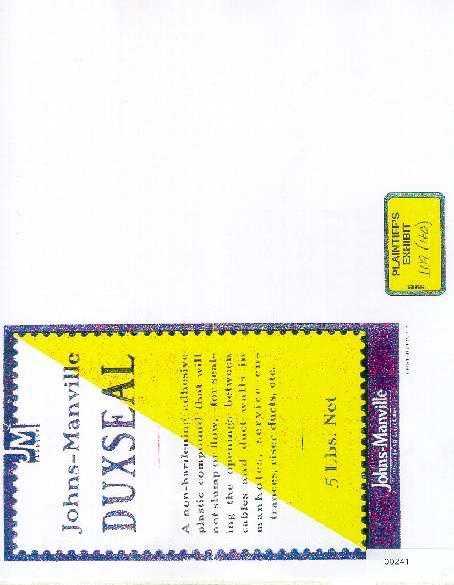
How Duxseal (Johns-Manville) looked: a label, photograph or catalog page from our library. Each picture has its own page and library number, so it can be cited on its own.
Asbestos claims
If you or a family member worked with or around Duxseal (Johns-Manville) and later developed mesothelioma or another asbestos disease, a claim may be paid by the Manville Personal Injury Settlement Trust. Free case review.
What each document says
Every statement about Duxseal (Johns-Manville) in the documents, in each document's own words.
Asbestos Magazine, 1944, April 1944
- Description: “one of J-M's plastic sealing compounds”, said by Johns-Manville, as recorded by Asbestos (magazine), p. 391
- Asbestos content: “Like their other sealing compounds—Duxseal, Pakseal, Tranoseal and Nodrseal—Uniseal contains a high percentage of asbestos.”, said by Johns-Manville, as recorded by Asbestos (magazine), p. 391
The Travelers Insurance Company's Product Information Booklet for Its Asbestos Seminar (1980–1981)
Asbestos; Publication of Identifying Information (1990)
- Made from: “produced 1957 to 1977”, said by Manville Corporation, as recorded by U.S. EPA, Federal Register 55 FR (Feb. 13, 1990), p. 143
- Made until: “produced 1957 to 1977”, said by Manville Corporation, as recorded by U.S. EPA, Federal Register 55 FR (Feb. 13, 1990), p. 143
- Form: “Putty-like Sealing Compound ... Pugs-packaged in fiberboard cartons”, said by Manville Corporation, as recorded by U.S. EPA, Federal Register 55 FR (Feb. 13, 1990), p. 143
- Asbestos content: “asbestos, 25 to 65%”, said by Manville Corporation, as recorded by U.S. EPA, Federal Register 55 FR (Feb. 13, 1990), p. 143
- Ingredient: “butane polymer, 0 to 40%; calcium carbonate, 0 to 20%; ... castor oil, 0 to 40%; ... chlorinated paraffin, 0 to 55%”, said by Manville Corporation, as recorded by U.S. EPA, Federal Register 55 FR (Feb. 13, 1990), p. 143
Asbestos Magazine, 1945, September 1945
- Use: “supplied to the Manhattan Project” (sales to Manhattan Project (atomic bomb development and production)), said by Johns-Manville, as recorded by Asbestos (magazine), citing J-M News Pictorial of Aug. 15, 1945, p. 364
Johns-Manville General Plant Engineering Department, Instructions for the Operation of Dust Collectors (1955)
- Use: “Imperfect seals should be corrected by use of J-M Duxseal.”, p. 425
E. M. Fenner to D. B. Wingerter on Which Insulation Products to Label (1969)
- Warning label: “proposed: would not be labelled” (as of 1969), p. 16
Manville Fund's Answers to Interrogatories in Gunn v. Celotex (1989)
- Made from: “Date Manufactured: 1934”, p. 1097
- Asbestos content: “asbestos containing”, p. 627
- Asbestos content: “52.5 - 69.0 % fiber by weight”, p. 1097
- Use: “Wires and cables at duct entrances; general purpose”, p. 807
- Asbestos fiber: “Chrysotile”, p. 1097
- Warning label: “Date Labeled: None”, p. 1097
- Form: “Sealing Compound”, p. 1097
- Made at: “Manville Plant, Manville, New Jersey (1913 through 1985): Duxseal” (at Manville) (the plant: Manville, New Jersey), p. 627
- Made until: “Date Discontinued: 1982 - Asbestos Content”, p. 1097
Celanese Memo Forwarding NIOSH's List of Trade-Name Products Containing Regulated Carcinogens (1977)
- Asbestos content: “Duxseal Sealing Compound | Asbestos | 50 | 0462685” (as of 1972-74), said by National Institute for Occupational Safety and Health, as recorded by Celanese Chemical Company (C. D. Barrett memo CDB-70-77), p. 58
Johns-Manville Material Safety Data Sheet for DUXSEAL (1982)
Sourcebook on Asbestos Diseases: Medical, Legal, and Engineering Aspects, Volume Two
- Description: “sealing compounds” (as of 1957), p. 7410
Manville Fund's Responses to Plaintiffs' Interrogatories in Moore v. H.K. Porter (1990)
- Made at: “Manville Plant (1913 to 1985): Duxseal” (at Manville) (the plant: Manville, New Jersey), p. 2211
- Asbestos content: “asbestos containing”, p. 2211
See also
- Johns-Manville: the company's history, documents, people, products and plants
- Johns-Manville on our products page: what the documents say about the company's asbestos products, with sources
References
- Asbestos Magazine, 1944, April 1944 (April 1, 1944), p. 39.
- The Travelers Insurance Company's Product Information Booklet for Its Asbestos Seminar (1980–1981) (April 30, 1981), p. 4.
- Asbestos; Publication of Identifying Information (February 13, 1990), p. 14.
- Asbestos Magazine, 1945, September 1945 (September 1, 1945), p. 36.
- Johns-Manville General Plant Engineering Department, Instructions for the Operation of Dust Collectors (January 1, 1955), p. 42.
- E. M. Fenner to D. B. Wingerter on Which Insulation Products to Label (August 7, 1969), p. 1.
- Manville Fund's Answers to Interrogatories in Gunn v. Celotex (December 7, 1989), p. 109.
- Celanese Memo Forwarding NIOSH's List of Trade-Name Products Containing Regulated Carcinogens (August 26, 1977), p. 5.
- Johns-Manville Material Safety Data Sheet for DUXSEAL (March 18, 1982), p. 1.
- Sourcebook on Asbestos Diseases: Medical, Legal, and Engineering Aspects, Volume Two (1986), p. 74. Not yet published in our library.
- Manville Fund's Responses to Plaintiffs' Interrogatories in Moore v. H.K. Porter (February 15, 1990), p. 22.
Mentioned on this site
Cite this page
“Duxseal (Johns-Manville).” AsbestosClaims.Law Library. https://asbestosclaims.law/library/products/johns-manville-duxseal.
ACL Doc numbers and their short links never change. See how to cite the Library.
Talk with an asbestos lawyer
Start with what you remember, and we'll take it from there.
This page is provided for general informational purposes and does not constitute legal advice. Every asbestos case turns on its own facts, exposure history, diagnosis, deadlines, available evidence, and applicable law. Reviewing this page does not create an attorney-client relationship. For advice about your specific situation, call 833-4-ASBESTOS for a free case review.