

Actinolite is one of the six minerals regulated as asbestos under US law. It's the green, iron-rich twin of tremolite, and it's the least commercial of all six asbestos minerals. It was essentially never mined or made into products. Its danger comes entirely from being a contaminant in other minerals and from turning up in naturally occurring rock. Like every form of asbestos, it causes mesothelioma (a cancer of the lining of the lungs or abdomen), lung cancer, and asbestosis (permanent scarring of the lungs).1 Because actinolite is encountered the same ways tremolite is, our tremolite page covers the exposure sources, the diseases, and what to do in detail. This page focuses on what's specific to actinolite.
If you've been diagnosed with an asbestos disease and think actinolite or tremolite may have been involved, call 833-4-ASBESTOS.
You don't need the product names or old records. No fee unless we recover compensation for your family.
The green twin of tremolite
Actinolite and tremolite are really the same mineral at two different iron levels. Tremolite is iron-poor and white. As iron replaces the magnesium in the crystal, the mineral turns green and becomes actinolite. The line between the two names is set by convention at about 10 percent iron, but that's a label, not a difference the body recognizes.2 Scientists and regulators often just write "tremolite-actinolite" and treat the two as one.
Actinolite got its name in 1801 from the French mineralogist René Just Haüy, often called the father of modern crystallography. He named it from the Greek word for "ray," because its green crystals grow in radiating, sunburst-like clusters. The green color told him iron was present, which is what set it apart from white tremolite.3
What actinolite never had was a real commercial life. Its fibers are short and brittle, so they couldn't be spun, woven, or used for much of anything. The US Geological Survey record reflects the fact that commercial mining of actinolite asbestos is practically unknown.4 The lone exception proves the point. In the small Ontario village named Actinolite, which took its name from a local deposit, the Actinolite Mining Company worked a cluster of properties on and off between 1901 and 1934, and the whole district's output came to just 187 tons of fiber, worth $27,309.5 Against the millions of tons of chrysotile mined in the same years, that's a rounding error, and it's the main thing that separates actinolite from tremolite, which at least had one genuine commercial use in acid-resistant filters.
Being commercially worthless never made actinolite safe. It's a rigid, long-lasting amphibole fiber, and it causes the same diseases as any other asbestos.
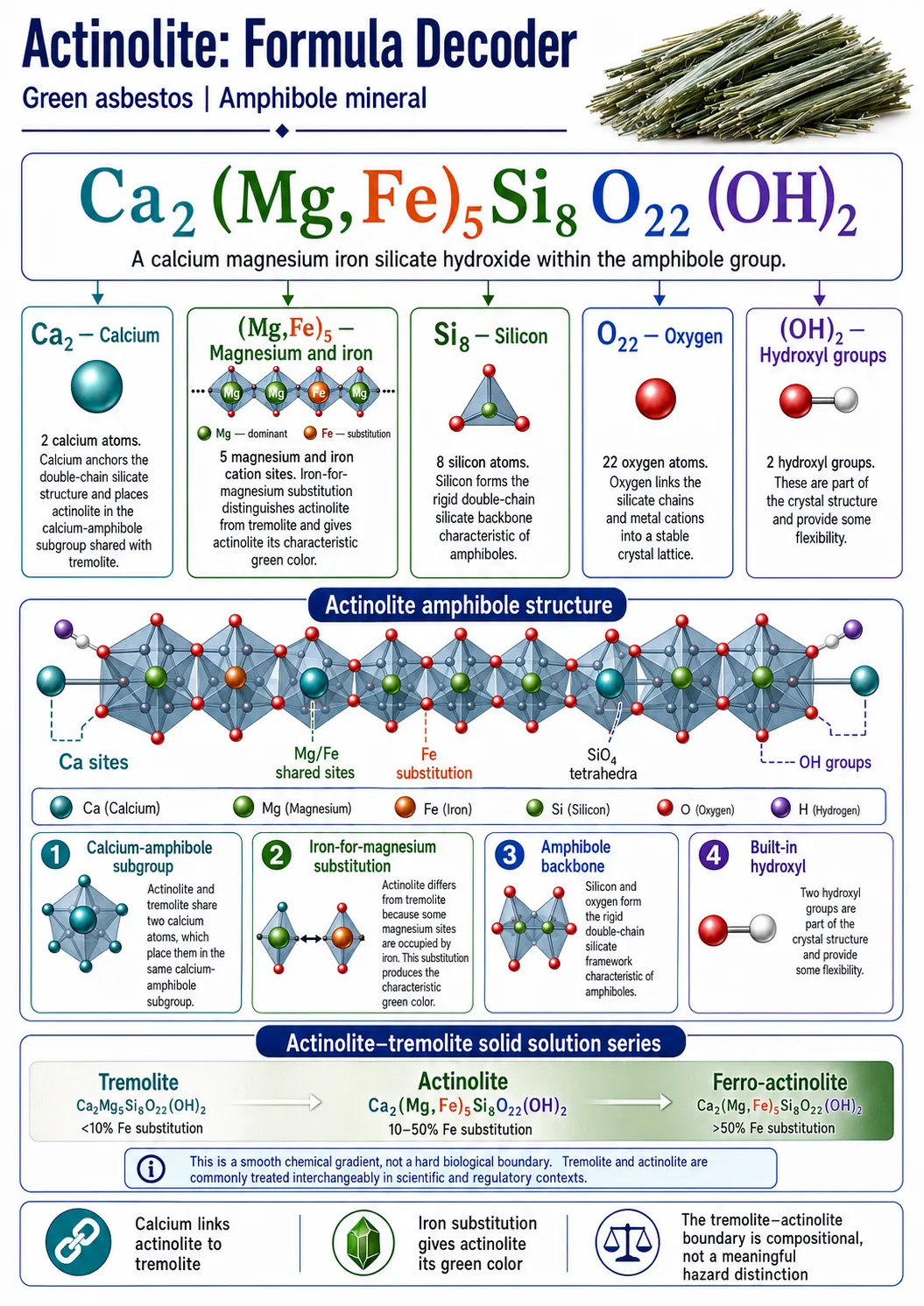
The mineralogy in brief: actinolite's chemistry and how it compares to the other five asbestos minerals
Actinolite's chemical formula is Ca₂(Mg,Fe)₅Si₈O₂₂(OH)₂, which makes it a calcium magnesium iron silicate in the amphibole group. It's identical to tremolite except for the iron: where tremolite has magnesium, actinolite has magnesium with iron mixed in. That iron is what produces the green color, brighter when there's less iron, darker when there's more. As iron increases, the mineral grades from tremolite into actinolite and eventually into a rare iron-rich form called ferro-actinolite. Like all amphiboles, actinolite is built from double chains of silicon and oxygen and crystallizes in the monoclinic form, producing straight, rigid, needle-like fibers in its asbestos form.2
| Mineral | Chemical formula | Main metals | Crystal system | Mineral group |
|---|---|---|---|---|
| Actinolite | Ca₂(Mg,Fe)₅Si₈O₂₂(OH)₂ | Calcium, magnesium, iron | Monoclinic | Amphibole |
| Tremolite | Ca₂Mg₅Si₈O₂₂(OH)₂ | Calcium, magnesium | Monoclinic | Amphibole |
| Anthophyllite | (Mg,Fe)₇Si₈O₂₂(OH)₂ | Magnesium, iron | Orthorhombic | Amphibole |
| Amosite | (Fe,Mg)₇Si₈O₂₂(OH)₂ | Iron, magnesium | Monoclinic | Amphibole |
| Crocidolite | Na₂Fe₃²⁺Fe₂³⁺Si₈O₂₂(OH)₂ | Sodium, iron | Monoclinic | Amphibole |
| Chrysotile | Mg₃Si₂O₅(OH)₄ | Magnesium | Monoclinic | Serpentine |
How people are exposed, and why it's dangerous
Because actinolite was never a product, almost all exposure comes from the same routes that expose people to tremolite: contamination of talc and vermiculite, contamination of chrysotile products, and naturally occurring asbestos in rock and soil that gets disturbed by construction, quarrying, or road work. Our tremolite page walks through those pathways, the Libby vermiculite disaster, and the talcum-powder story in full.
Of those routes, contamination of chrysotile reached the most people, and it's worth understanding why. Canadian chrysotile, which supplied much of the asbestos used in North American products, was never pure. When one researcher dissolved the chrysotile away from commercial samples and examined what remained, every Canadian source still held tremolite and actinolite, a share of it in the thin, durable, asbestiform shape that lodges in the lungs. The amounts varied widely from one mine to the next, but no Canadian chrysotile was free of it.6 That fiber rode along into a vast range of everyday "chrysotile" materials. So while almost no one was ever exposed to a product built to contain actinolite, many people who handled ordinary chrysotile goods were exposed to some actinolite and tremolite without ever knowing it.
The proof that actinolite causes disease on its own comes from places where people breathed it straight from the environment, with no industry in between. In southern Turkey, villagers with no asbestos jobs developed mesothelioma from tremolite and actinolite in their local soil and rock. When researchers examined the lung tissue of one of these patients, they found 286,000 actinolite fibers per gram, more than a hundred times the normal range.7 The same pattern has surfaced in the United States: in southern Nevada, geologists identified actinolite and several other fibrous minerals occurring naturally in the desert rock, and the mesothelioma cases in those counties carried the signature of environmental rather than workplace exposure, striking men and women in roughly equal numbers and at younger ages, instead of the older, mostly male pattern that follows job exposure.8 In the body, actinolite behaves like any other amphibole asbestos: straight and rigid enough to lodge deep in the lungs, durable enough to stay there for decades, and capable of causing mesothelioma, lung cancer, and asbestosis.9 For how those diseases develop and what symptoms to watch for, see our page on asbestos-related diseases.
Were you or a family member exposed to asbestos?
If you've been diagnosed with mesothelioma, lung cancer, or asbestosis, and you think actinolite or tremolite may have been involved, we can help you find out whether you have a claim. Because the two minerals are found together and are encountered the same ways, exposure usually traces back to talc, vermiculite insulation, chrysotile products, or naturally occurring asbestos. Our tremolite page explains those sources in detail.
When you call, you reach our litigation team, not a screener. There's no fee unless we recover compensation for your family.
Call 833-4-ASBESTOS to speak with us about your case.
Actinolite in the industry's own words
Because actinolite was never really a product, the asbestos industry wrote little about it. These are the places it does come up in our library: the industry's trade journal, Asbestos, and the patents it filed.
In the trade journal
The journal never ran an article about actinolite. The word turns up on about 50 pages across nearly 50 issues, most often in articles on the geology of asbestos, where actinolite is described alongside tremolite and the commercial fibers. These are the articles that discuss it most. Each link opens the page where it's discussed.
- Anthophyllite, Amphibole and Serpentine, September 1927
- Geology of Asbestos Deposits: Vermont, by Kay Badollet, March 1948
- Ontario, July 1950
- Varieties and Uses of Asbestos, by Dr. Oliver Bowles, September 1950
In patents
35 US patents in our library mention actinolite in their text, from 1938 to 1980, usually in a list of asbestos fibers an invention could use. A fiber named in a patent wasn't necessarily ever used in a product that was sold.
Every patent that mentions actinolite (35), oldest first
- Method of Coagulating Rubber upon Fibres (US Patent 2,133,693, 1938), Philip Carey Manufacturing Co
- Method of Making Fibrous Material (US Patent 2,133,694, 1938), Philip Carey Manufacturing Co
- Composition of Matter (US Patent 2,254,301, 1941), Pacific Clay Products Co
- Compressed and Densified Product (US Patent 2,326,516, 1943), Johns Manville
- Method of Manufacturing Fibrous Insulation (US Patent 2,326,517, 1943), Johns Manville
- Roofing (US Patent 2,326,723, 1943), George Arthur Fasold, Harold W. Greider
- Roofing (US Patent 2,326,724, 1943), George Arthur Fasold, Harold W. Greider
- Asbestos Sheet Material (US Patent 2,407,581, 1946), Philip Carey Manufacturing Co
- Compositions for Built-Up Roofing (US Patent 2,424,234, 1947), Harold W. Greider, George Arthur Fasold
- Asbestos Sheet Material (US Patent 2,467,540, 1949), Philip Carey Manufacturing Co
- Composition Roofing (US Patent 2,490,430, 1949), Harold W. Greider, George Arthur Fasold
- Oil base drilling fluids (US Patent 2,995,514, 1961), Nat Lead Co
- Elastomeric composition for use as rocket insulation (US Patent 3,347,047, 1967), General Tire and Rubber Co
- Heat-resistant fibrous amphibole asbestos board containing an inorganic binder (US Patent 3,334,010, 1967), Philip Carey Manufacturing Co
- Method of rendering asbestos ore particles differentially fluorescent (US Patent 3,346,111, 1967), Colonial Sugar Refining Co Ltd
- Traction rolls and material handling apparatus employing such rolls (US Patent 3,317,303, 1967), Norman Shorr
- Method of ore sorting based on differential infrared emission (US Patent 3,395,793, 1968), Colonial Sugar Refining Co Ltd
- Phosphoric acid bonded asbestos fiber sheets and method of manufacture (US Patent 3,383,230, 1968), Johns Manville
- Asbestos-foam laminates (US Patent 3,522,140, 1970), PPG Industries Inc
- High temperature traction rolls (US Patent 3,515,531, 1970), PPG Industries Inc
- Method of coating wood (US Patent 3,531,353, 1970), PPG Industries Inc
- Method of orienting fibres by means of ac and dc voltages (US Patent 3,497,419, 1970), Albert A. Winer, Henry M. Woodrooffe
- Method for drilling in permafrost (US Patent 3,618,680, 1971), Joe D. Ellard, Lee Bone
- Nonsettling thixotropic cold bottom filler composition (US Patent 3,567,471, 1971), George F. Kahle
- Method for preparing an asbestos fiber product of improved filtration characteristics (US Patent 3,644,138, 1972), Charles E. Stiefken
- Heat vulcanizable polysiloxane compositions containing asbestos (US Patent 3,715,329, 1973), General Electric Co
- Thickened organic liquids (US Patent 3,714,041, 1973), Cabot Corp
- Composition and method for inhibiting asbestos fiber dust (US Patent 3,928,060, 1975), NL Industries Inc
- Chemically opening chrysotile asbestos and encapsulating (US Patent 3,965,284, 1976), Canadian Patents and Development Ltd
- Heat vulcanizable polysiloxane compositions containing asbestos (US Patent 3,933,726, 1976), General Electric Co
- Method of producing a non-combustible molding material (US Patent 3,978,180, 1976), Sekisui Chemical Co Ltd
- Non-combustible molding material (US Patent 3,945,840, 1976), Sekisui Chemical Co Ltd
- Non-combustible molding material (US Patent 3,988,402, 1976), Sekisui Chemical Co Ltd
- Non-combustible molding material (US Patent 4,013,476, 1977), Harutoshi Ueda, Naoyuki Suzuki, Masami Nagao
- Cementitious composition containing asbestos fibres and prepared using a surfactant (US Patent 4,190,456, 1980), Victor J. Absolon, George T. Hurst, John C. Worboys, George H. Barnett, Ross P. Dickson
Actinolite mines in our records
The documents in our library report 1 mine producing actinolite that was sold or shipped: the U.S. Bureau of Mines' and Geological Survey's yearbooks and the asbestos industry's trade journal, Asbestos. Each mine's page says who worked it and when, what it produced and which document says so.
- Actinolite Mining Co.Kaladar Township, Ontario · Actinolite Mining Company Limited · 1901–1934
Our records also name 1 other actinolite deposit or mine with no reported sales.
References
- IARC. Arsenic, Metals, Fibres, and Dusts. IARC Monographs on the Evaluation of Carcinogenic Risks to Humans, Vol 100C. International Agency for Research on Cancer; 2012.
- Dana ES, Dana JD. Dana's New Mineralogy. 8th ed. Wiley; 1997:1245.
- Haüy RJ. Traité de Minéralogie. Vol 4. Chez Louis; 1801:246-248.
- Virta, R.L., 2002, Asbestos: Geology, Mineralogy, Mining, and Uses: U.S. Geological Survey Open‑File Report 02‑149.
- Asbestos in Ontario. Asbestos. July 1950.
- Chatfield EJ. Associated minerals in chrysotile deposits and their potential health risks. Front Public Health. 2025;13:1583469. doi:10.3389/fpubh.2025.1583469
- Zeren EH, Gümürdülü D, Roggli VL, Tuncer I, Zorludemir S, Erkişi M. Environmental malignant mesothelioma in southern Anatolia: a study of fifty cases. Environ Health Perspect. 2000;108(11):1047-1050.
- Baumann F, Buck BJ, Metcalf RV, McLaurin BT, Merkler DJ, Carbone M. The presence of asbestos in the natural environment is likely related to mesothelioma in young individuals and women from Southern Nevada. J Thorac Oncol. 2015;10(5):731-737. doi:10.1097/JTO.0000000000000506
- Ross M. The geological occurrences and health hazards of amphibole and serpentine asbestos. In: Veblen DR, ed. Amphiboles and Other Hydrous Pyriboles — Mineralogy. Reviews in Mineralogy. Vol 9A. Mineralogical Society of America; 1981:279-323.
Key Sources
Badollet MS. Asbestos, a mineral of unparalleled properties. Transactions of the Canadian Institute of Mining and Metallurgy. 1951;54:151-160.
Berger H. Asbestos Fundamentals: Origin, Properties, Mining, Processing, Utilization. Plenum Press; 1963.
Speil S, Leineweber JP. Asbestos minerals in modern technology. Environ Res. 1969;2(3):166-208.
In the research library
The National Library of Medicine indexes 26 studies in our medical research library under actinolite. Among the most cited:
- The morbidity and mortality of vermiculite miners and millers exposed to tremolite-actinolite: Part II. MortalityH.E. Amandus, R. Wheeler, 1987 · American Journal of Industrial Medicine · cited 89 times
- The morbidity and mortality of vermiculite miners and millers exposed to tremolite-actinolite: Part I. Exposure estimatesH.E. Amandus, R. Wheeler, J. Jankovic, et al, 1987 · American Journal of Industrial Medicine · cited 57 times
- The morbidity and mortality of vermiculite miners and millers exposed to tremolite-actinolite: Part III. Radiographic findingsH.E. Amandus, R. Althouse, W.K. Morgan, et al, 1987 · American Journal of Industrial Medicine · cited 34 times
- EPR, optical, infrared and Raman spectral studies of Actinolite mineralN.O. Gopal, K.V. Narasimhulu, J.L. Rao, 2004 · Spectrochimica Acta. Part A, Molecular and Biomolecular Spectroscopy · cited 20 times
- Tremolite-actinolite fiber coatings of sub-nanometer silica-rich particles in lungs from deceased Quebec minersM. Germine, J.H. Puffer, 2020 · Toxicology and Industrial Health · cited 4 times
In our case-law library
2 court decisions in our case-law library involve actinolite. Among them:
- Pifer v. Irwin Industrial Tool Co.Maryland Court of Special Appeals, 2021 · Carpet installer (mechanic) at Clyde W. Dent Carpet Installation, College Park, 1960-1980s
- Leavitt v. Johnson & JohnsonCalifornia Court of Appeal, 2021 · Consumer user of baby powder at 1966-1998
Frequently asked questions
Is actinolite asbestos?
Yes. Actinolite is one of the six minerals regulated as asbestos under US law. It's part of the amphibole group, along with tremolite, amosite, anthophyllite, and crocidolite.
What's the difference between actinolite and tremolite?
They're the same basic mineral at different iron levels. Tremolite is iron-poor and white; actinolite has more iron and is green. The two form a continuous series, the dividing line is just a naming convention, and the body treats them the same.
Was actinolite ever used in products?
No. Of all six regulated asbestos minerals, actinolite is the one that was essentially never mined or used commercially, because its short, brittle fibers had no real industrial value. It matters as a contaminant of other minerals and as naturally occurring asbestos, not as a product.
Can actinolite cause mesothelioma?
Yes. Lung tissue from mesothelioma patients in southern Turkey, who had no asbestos jobs, contained hundreds of thousands of actinolite fibers per gram. Like all amphibole asbestos, actinolite causes mesothelioma, lung cancer, and asbestosis.
What should I do if I think I was exposed?
If you've been diagnosed with an asbestos-related disease and think actinolite or tremolite may have been involved, call 833-4-ASBESTOS. You'll reach our litigation team, and there's no fee unless we recover compensation for your family.
Talk with an asbestos lawyer
Start with what you remember, and we'll take it from there.
This page is provided for general informational purposes and does not constitute legal advice. Every asbestos case turns on its own facts, exposure history, diagnosis, deadlines, available evidence, and applicable law. Reviewing this page does not create an attorney-client relationship. For advice about your specific situation, call 833-4-ASBESTOS for a free case review.