

Tremolite is one of the six minerals regulated as asbestos under US law. It's a calcium-magnesium amphibole fiber, white to gray in color, and it sits at the iron-poor end of a mineral series it shares with actinolite. Unlike the asbestos types that were mined and sold by the millions of tons, tremolite was barely a commercial product. Most people exposed to it never knew, because tremolite's danger comes mainly from contaminating other things: talcum powder, vermiculite attic insulation, and the chrysotile in countless building products. It causes the same diseases as every other form of asbestos, including mesothelioma (a cancer of the lining of the lungs or abdomen).1 It's the fiber at the center of the talcum-powder lawsuits and the Libby, Montana disaster.
If you used talcum powder for years, had vermiculite insulation in your home, or worked around either one, and you've been diagnosed with an asbestos disease, call 833-4-ASBESTOS to find out whether you have a claim.
You don't need the product names or old records. No fee unless we recover compensation for your family.
The asbestos that was never supposed to be there
Most asbestos disease comes from products that were made with asbestos on purpose: insulation, pipe, brake linings, fireproofing. Tremolite is different. It was more often a contaminant in products that weren't intended to contain asbestos, such as talc and vermiculite.
Tremolite forms in the same kinds of rock as talc and vermiculite, so when companies mined those minerals, they often brought tremolite up with them. That's how asbestos ended up in talcum powder sold for babies, in the insulation poured into millions of American attics, and in the soil of entire towns. People breathed it without ever working around what they thought of as "asbestos."
The clearest example is Libby, Montana, where a vermiculite mine contaminated with tremolite sickened not just the miners but their wives, their children, and neighbors who never went near the mine. Thousands of miles away, in the villages of southern Turkey, people developed mesothelioma at epidemic rates from tremolite in the local rock and in the whitewash on their walls. Tremolite may never have been much of a product, but it has killed a great many people.
For an overview of all six asbestos minerals and the diseases they cause, see our main asbestos minerals page.
What is tremolite?
Tremolite is a naturally occurring mineral in the amphibole branch of the asbestos family, which means its fibers are straight, stiff, and needle-like, the kind the lungs can't easily clear.2 It's a calcium-magnesium silicate, and in its pure form it contains almost no iron, which is why it's white or pale gray rather than brown or blue like some other asbestos types.
Tremolite is one half of a pair. It shares a continuous chemical series with actinolite, its greener, iron-richer twin. The only real difference between them is how much iron has replaced the magnesium in the crystal, and the boundary between the two names is set by convention at about 10 percent iron.3 Below that line, a fiber is called tremolite; above it, actinolite. The two are so alike that scientists and regulators often just write "tremolite-actinolite" and treat them as one mineral. The human body certainly doesn't tell them apart. For the actinolite side of the pair, see our page on actinolite.
The name comes from Val Tremola, a valley in the Swiss Alps near where the mineral was first described in 1789, making it one of the few minerals named after a place.
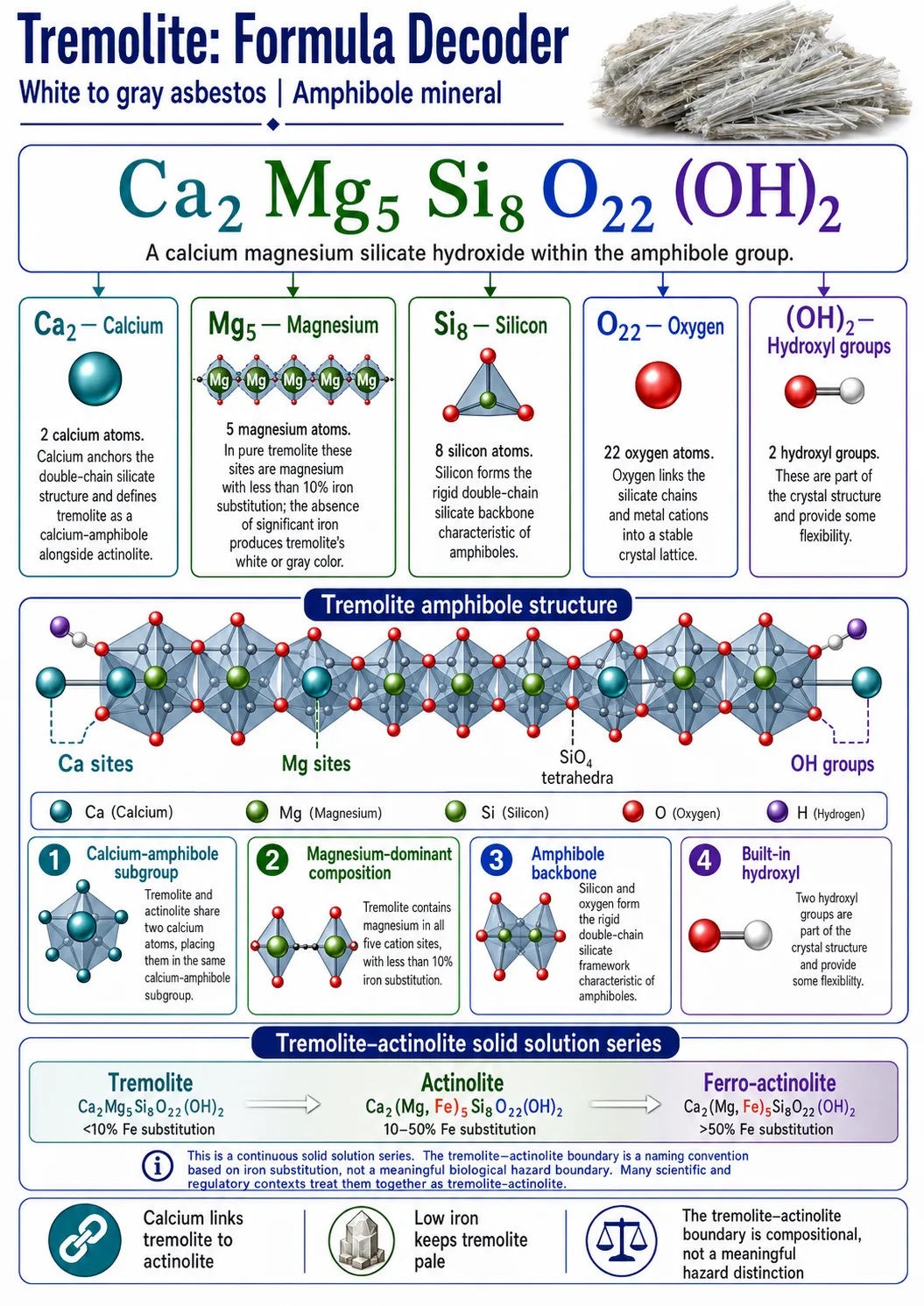
The mineralogy in depth: chemistry, crystal structure, and how tremolite compares to the other five asbestos minerals
Chemical composition
Tremolite's chemical formula is Ca₂Mg₅Si₈O₂₂(OH)₂, which makes it a calcium magnesium silicate hydroxide in the amphibole group. The formula tells us it's built mostly from calcium and magnesium, bonded to silicon, oxygen, and a small amount of water (the OH part).
The thing to notice is what's missing: iron. In pure tremolite, the metal slots in the crystal are filled by magnesium, with almost no iron. That's what makes tremolite white or pale gray. As iron starts to replace that magnesium, the mineral turns green and becomes actinolite. So tremolite and actinolite are really the same mineral at two different iron levels, and the 10 percent boundary between their names is a label, not a meaningful difference in how dangerous they are.3
Crystal structure
Like all amphiboles, tremolite is built from double chains of silicon and oxygen, held together by strips of calcium and magnesium. It crystallizes in the "monoclinic" form, and in its asbestos form it produces fine, straight, rigid fibers. (The same mineral can also grow as ordinary blocky crystals that aren't asbestos. Only the long, thin, fibrous form carries the asbestos health risk.) Those straight, rigid fibers are what let tremolite lodge deep in the lungs and stay there.
How tremolite compares to the other asbestos minerals
| Mineral | Chemical formula | Main metals | Crystal system | Mineral group |
|---|---|---|---|---|
| Tremolite | Ca₂Mg₅Si₈O₂₂(OH)₂ | Calcium, magnesium | Monoclinic | Amphibole |
| Actinolite | Ca₂(Mg,Fe)₅Si₈O₂₂(OH)₂ | Calcium, magnesium, iron | Monoclinic | Amphibole |
| Anthophyllite | (Mg,Fe)₇Si₈O₂₂(OH)₂ | Magnesium, iron | Orthorhombic | Amphibole |
| Amosite | (Fe,Mg)₇Si₈O₂₂(OH)₂ | Iron, magnesium | Monoclinic | Amphibole |
| Crocidolite | Na₂Fe₃²⁺Fe₂³⁺Si₈O₂₂(OH)₂ | Sodium, iron | Monoclinic | Amphibole |
| Chrysotile | Mg₃Si₂O₅(OH)₄ | Magnesium | Monoclinic | Serpentine |
Tremolite's low-iron chemistry made it white and gave it good resistance to acid, which is why its one real commercial use was in acid-resistant filters. But chemistry doesn't change the basic hazard. All amphibole fibers, tremolite included, are rigid, long-lasting, and capable of causing mesothelioma, lung cancer, and asbestosis.
Physical properties
| Property | Value | What it meant |
|---|---|---|
| Color | White to pale gray | Tremolite is iron-poor, so it lacks the brown or blue of other amphiboles |
| Luster | Silky to glassy | Fibrous forms have a silky sheen |
| Hardness | About 5 to 6 (Mohs scale) | Comparable to the other amphiboles |
| Specific gravity | 2.9 to 3.1 | Typical for the calcium amphiboles |
| Cleavage | Perfect prismatic | Splits lengthwise into fibers and splinters |
| Acid resistance | Good | Better than chrysotile, which is why it was used for acid filters |
| Thermal stability | Very high | Withstands extreme heat |
Tremolite fibers tend to be shorter and more brittle than the long, spinnable fibers of chrysotile or amosite, which is a big reason it never became a major commercial product. It couldn't be woven or spun the way the commercial fibers could. That brittleness offered no protection to anyone who breathed it.
Where tremolite came from and what it contaminated
Two things are often said about tremolite that aren't quite right. The first is that it was never mined commercially. The second is that it couldn't have caused many illnesses because it wasn't mined commercially. Both are wrong.
Tremolite was mined commercially, just not on a large scale. It had one real industrial use: acid-resistant filters. Because tremolite holds up against acid far better than ordinary chrysotile asbestos, it was the preferred fiber for filtering corrosive chemicals. One American company, Powhatan Mining, built its business around tremolite and even moved its entire operation about 2,500 miles, from Maryland to California, to keep mining it when the eastern deposits ran out. Italy mined tremolite for generations, and as recently as 2003, India produced roughly 19,000 metric tons of it in a single year, more than all US tremolite mining combined across history.4
But tremolite's real importance, and the reason most people were exposed to it, is as a contaminant of three other things:
- Talc and talcum powder. Talc and tremolite form in the same rock, so talc mines often pull up tremolite along with the talc. That's how asbestos got into baby powder, body powder, and cosmetics, as well as into industrial talc used in ceramics, paint, roofing, and rubber. Testing of cosmetic talc has repeatedly found asbestos fibers, and this is the basis for the talcum-powder lawsuits.5 For more on that, see talc and ovarian cancer lawsuits.
- Vermiculite insulation. Vermiculite is a lightweight mineral that was poured into attics as loose-fill insulation, sold for decades under the brand name Zonolite by W.R. Grace. The vermiculite mined at Libby, Montana was heavily contaminated with tremolite, and Libby supplied most of the vermiculite used in the country. Millions of homes may still have it in their attics today.
- Chrysotile products. Chrysotile, the most common type of asbestos, frequently carried a little tremolite as a natural companion in the ore.6 So workers who handled chrysotile products such as joint compound, floor tile, cement sheet, insulation, and brake linings often breathed some tremolite too, whether anyone intended it or not.
For more on the kinds of products that contained asbestos, see our guide to asbestos-containing products.
The full record: the US and international tremolite mines, and the geology behind the contamination
The mineral content on this site draws on a systematic review of 88 consecutive USGS Minerals Yearbook chapters on asbestos, spanning 1932 through 2024, the complete run of the federal government's annual reporting on the asbestos industry. That record corrects a common myth. Tremolite was not "never mined." The government documented at least eleven separate US tremolite operations, plus production in Italy, Turkey, and India.7
Powhatan Mining: a tremolite business that crossed the country
The clearest proof that tremolite was a deliberate product, not just an accident of geology, is the Powhatan Mining Company of Baltimore. Powhatan mined tremolite near Pylesville, Maryland from the early 1930s, selling it mainly as filter material for handling chemicals. When the Maryland deposits ran low in the 1940s, the company didn't quit. It relocated its tremolite mining roughly 2,500 miles west to Shasta County, California, near Castella, and kept producing into the late 1940s. A company doesn't move across the continent to chase a mineral that has no value.
Powhatan's history also carries a warning about old records. In 1938, the government reclassified Powhatan's Maryland product from anthophyllite to tremolite. Workers who handled that fiber in the early 1930s were told they were working with one mineral when they were actually working with another. Historical exposure records from before modern lab testing should be read with that in mind.
Other US and international production
Several smaller US tremolite operations ran through the 1940s and 1950s, concentrated in Shasta County, California (the Loma Blanca and Sylvester mines) and Placer County, California (the Noon Day mine), with additional producers in Oregon, Alaska, and Georgia. Almost all of them served the same narrow market: acid-resistant chemical filters.
Internationally, Italy has the longest tremolite mining history of any country, producing it for filters from deposits in the north until the country shifted to chrysotile in the mid-twentieth century. Turkey ran a commercial tremolite mine near Eskişehir. And India became the largest modern producer, mining about 19,000 metric tons in 2003 from the Rajasthan region to feed its asbestos-cement building industry.4 Because that production is recent, Indian tremolite is still present in buildings and supply chains today.
The geology behind the contamination
Tremolite's importance as a contaminant comes down to where it forms. The same metamorphic conditions that create talc and vermiculite from magnesium-rich rock also create tremolite in the same or neighboring rock. So talc deposits and vermiculite deposits frequently contain tremolite mixed in. When the talc or vermiculite is mined, the tremolite comes up with it. A company claiming its talc was "asbestos-free" is really making a claim about the geology of its mine, and that claim can be tested. Older testing methods often missed tremolite that more sensitive methods would have found, which is why some products once called "asbestos-free" were later shown to contain it.
Who was exposed to tremolite
You may have been exposed to tremolite if you, or someone whose dusty work clothes you were around, fits one of these descriptions:
- Used talcum powder, baby powder, or body powder regularly over many years
- Worked with industrial talc, in ceramics, paint, rubber, roofing, paper, or pharmaceuticals
- Had vermiculite (Zonolite) attic insulation in your home, or installed, removed, or did renovation work around it
- Worked at, or lived near, the vermiculite mine at Libby, Montana, or near a talc operation such as the one in Gouverneur, New York8
- Worked with chrysotile asbestos products, which usually carried some tremolite
- Worked at one of the tremolite mines or at a chemical-filter manufacturer that processed the fiber
- Lived or worked in an area with naturally occurring asbestos in the rock and soil, such as parts of California or northern Virginia, where construction, quarrying, or road work disturbs the ground
Family members were exposed too. Tremolite fibers traveled home on work clothes, hair, and skin. Wives who washed laundry and children who lived in the house have developed mesothelioma from that secondhand, or "take-home," exposure. At Libby, people were also exposed simply by living in town, because contaminated vermiculite waste had been spread across gardens, driveways, ball fields, and a school running track.
Health risks
All forms of asbestos cause the same group of diseases: asbestosis (permanent scarring of the lungs), mesothelioma, lung cancer, and cancers of the larynx and ovary.1 For how these diseases develop and what symptoms to watch for, see our page on asbestos-related diseases.
Tremolite causes every one of these diseases. Its straight, rigid fibers lodge deep in the lungs, resist the body's efforts to clear them, and stay there for decades, driving the slow process of inflammation, scarring, and DNA damage that leads to disease, often 20 to 50 years after exposure. Because tremolite was never a big commercial product, there was never a large workforce exposed to it alone, so the kind of huge worker studies that exist for other fibers don't exist for tremolite. But the evidence that it causes mesothelioma is still beyond dispute, and it comes from two unusually clear sources.
The Mediterranean villages: mesothelioma from the ground itself
In several rural areas around the Mediterranean, ordinary villagers with no industrial jobs have developed mesothelioma at epidemic rates, simply from living where tremolite is in the local rock.9 The most carefully studied is southern Turkey. A study of 50 mesothelioma patients there, none of whom had ever worked with asbestos, traced their disease to tremolite and actinolite in the soil and in the traditional white stucco whitewash on their homes. When researchers examined lung tissue, they found enormous fiber concentrations of tremolite fibers per gram, far above anything normal and comparable to heavily exposed workers.10 The same pattern has been documented in villages in Cyprus,11 in Metsovo in northern Greece (where the local whitewash carried tremolite),12 and in Corsica.13
These cases matter because they remove every other explanation. There was no factory, no shipyard, and no asbestos product the villagers were exposed to. There was only tremolite in the environment, and it produced the same fatal cancer that commercial asbestos produces in workers.
Libby, Montana: a town poisoned by contaminated insulation
The vermiculite mine just outside Libby, Montana operated from 1919 to 1990, owned for much of that time by W.R. Grace and Company. The vermiculite was contaminated with tremolite, and the mining and processing released those fibers into the air, the soil, and people's homes. The vermiculite was sold across the country as Zonolite attic insulation.
The contamination spread through the whole community. Waste was used as fill in gardens, driveways, the school running track, and ball fields. Workers carried fibers home on their clothes. People who never worked at the mine developed asbestosis, mesothelioma, and lung cancer at rates far above the national average.14,15,16 The EPA made Libby a Superfund cleanup site in 2002 and declared a public health emergency there in 2009, the first such declaration in the agency's history.17
One technical note for accuracy: the Libby fiber was called "tremolite" for most of the mine's history, but a 2003 analysis showed it's actually a mix of related amphibole minerals, mostly winchite and richterite, with tremolite making up a smaller share.18 This doesn't change anything for the people harmed. The fiber causes the same diseases, and claims tied to Libby vermiculite and Zonolite are handled the same way.
Were you or a family member exposed to tremolite?
If you've been diagnosed with mesothelioma, lung cancer, or asbestosis, and you think tremolite may have been involved, we can help you find out whether you have a claim. That includes exposure from talcum powder, from Zonolite or other vermiculite attic insulation, from chrysotile products on the job, from a family member's clothes, or from living in a contaminated community.
If your exposure was tied to Zonolite insulation or other W.R. Grace products, including Monokote spray-on fireproofing used in many commercial buildings, you may be able to file a claim with the W.R. Grace asbestos trust. You can learn more about filing an asbestos trust claim.
When you call, you reach our litigation team, not a screener. We'll talk through where and when you may have been exposed and explain your options. There's no fee unless we recover compensation for your family.
Call 833-4-ASBESTOS to speak with us about your case.
Is tremolite still a danger today?
Tremolite is one of the six minerals formally regulated as asbestos by the Environmental Protection Agency, the Occupational Safety and Health Administration, and the International Agency for Research on Cancer.1,19 The EPA's 2024 rule under the Toxic Substances Control Act banned the ongoing uses of chrysotile, the only asbestos type still imported and used in the country.20 In a separate 2024 evaluation, the agency assessed the other five fiber types, tremolite among them, along with Libby amphibole and asbestos-containing talc, and found that asbestos poses an unreasonable risk to human health, with further regulation to follow.21 For where asbestos regulation stands now, see our main asbestos page.
Even though tremolite was never a major product, exposure still happens, mostly through the things it contaminated. Vermiculite attic insulation installed before about 1990 should be treated as if it contains asbestos unless testing proves otherwise, and it should not be disturbed without professional help. Talc remains a concern, which is why testing and litigation continue. Tremolite is also released during the demolition and renovation of older buildings, and during construction, quarrying, and road work in areas where it occurs naturally in the rock. Because the disease can take decades to appear, new cases from past exposure will keep emerging for years.
Tremolite in the industry's own words
The asbestos industry rarely wrote about tremolite as a fiber of its own, but it comes up in its trade journal, Asbestos, and in the patents it filed. These are the places in our library where it does.
In the trade journal
The journal never ran an article about tremolite itself. The word appears on about 200 pages across some 150 issues, most often in articles on the geology of asbestos deposits, where tremolite is described as a minor fiber found with chrysotile and the other amphiboles. These are the articles that discuss it most, with the journal's 1925 story of the vermiculite deposit at Libby, Montana. Each link opens the page where it's discussed.
- Asbestos in the Union of South Africa, September 1923
- The Story of Zonolite, February 1925
- Anthophyllite, Amphibole and Serpentine, September 1927
- Amosite and Other Varieties, August 1941
- Geology of Italian Deposits, January 1948
- Geology of Asbestos Deposits: Arizona, by Kay Badollet, September 1948
- Varieties and Uses of Asbestos, by Dr. Oliver Bowles, September 1950
- The Anomaly of Slip-Fibre, September 1954
- A New Chrysotile Discovery in Montana, November 1957
In patents
52 US patents in our library mention tremolite in their text, from 1937 to 1980, usually in a list of asbestos fibers an invention could use. At least 11 were assigned to Johns-Manville. A fiber named in a patent wasn't necessarily ever used in a product that was sold.
Every patent that mentions tremolite (52), oldest first
- Water Repellent Product (US Patent 2,068,219, 1937), Johns Manville
- Colored Asbestos Product (US Patent 2,198,800, 1940), Johns Manville
- Sheet Asbestos Product (US Patent 2,220,386, 1940), Johns Manville
- Compressed and Densified Product (US Patent 2,326,516, 1943), Johns Manville
- Method of Manufacturing Fibrous Insulation (US Patent 2,326,517, 1943), Johns Manville
- Roofing (US Patent 2,326,723, 1943), George Arthur Fasold, Harold W. Greider
- Roofing (US Patent 2,326,724, 1943), George Arthur Fasold, Harold W. Greider
- Asbestos Sheet Material (US Patent 2,407,581, 1946), Philip Carey Manufacturing Co
- Compositions for Built-Up Roofing (US Patent 2,424,234, 1947), Harold W. Greider, George Arthur Fasold
- Asbestos Sheet Material (US Patent 2,467,540, 1949), Philip Carey Manufacturing Co
- Dielectric Sheet and Method of Manufacture (US Patent 2,485,458, 1949), Johns Manville
- Filter media and method of making (US Patent 2,971,907, 1961), Walter J. Smith
- Oil base drilling fluids (US Patent 2,995,514, 1961), Nat Lead Co
- Film forming composition (US Patent 3,057,744, 1962), Glen D. Barbaras
- Methods for making asbestos fiber products (US Patent 3,271,186, 1966), Johns Manville
- Castable gunning mix (US Patent 3,360,594, 1967), Harbison Walker Refractories Co
- Conductive cellulosic paper containing asbestos and acid salt of a polyvalent metal (US Patent 3,337,392, 1967), ST Regis Paper Co
- Elastomeric composition for use as rocket insulation (US Patent 3,347,047, 1967), General Tire and Rubber Co
- Heat-resistant fibrous amphibole asbestos board containing an inorganic binder (US Patent 3,334,010, 1967), Philip Carey Manufacturing Co
- Method of rendering asbestos ore particles differentially fluorescent (US Patent 3,346,111, 1967), Colonial Sugar Refining Co Ltd
- Traction rolls and material handling apparatus employing such rolls (US Patent 3,317,303, 1967), Norman Shorr
- Material for Hot-Top (US Patent 3,373,047, 1968), Herbert D. Sheets, John W. Lennon
- Method of ore sorting based on differential infrared emission (US Patent 3,395,793, 1968), Colonial Sugar Refining Co Ltd
- Phosphoric acid bonded asbestos fiber sheets and method of manufacture (US Patent 3,383,230, 1968), Johns Manville
- Silica gel-asbestos compositions (US Patent 3,375,201, 1968), Milton E. Winyall
- Slag cement compositions (US Patent 3,449,140, 1969), Johns Manville
- High temperature traction rolls (US Patent 3,515,531, 1970), PPG Industries Inc
- Method of orienting fibres by means of ac and dc voltages (US Patent 3,497,419, 1970), Albert A. Winer, Henry M. Woodrooffe
- Dispersion of asbestos (US Patent 3,586,639, 1971), Nat Lead Co
- Method for drilling in permafrost (US Patent 3,618,680, 1971), Joe D. Ellard, Lee Bone
- Nonsettling thixotropic cold bottom filler composition (US Patent 3,567,471, 1971), George F. Kahle
- Hot top liner and refractory ring combination for use with metal casing that is hot (US Patent 3,660,122, 1972), Susquehanna Corp
- Hot top liner and refractory ring combination for use with metal hot top casing (US Patent 3,660,121, 1972), Susquehanna Corp
- Method for preparing an asbestos fiber product of improved filtration characteristics (US Patent 3,644,138, 1972), Charles E. Stiefken
- Heat vulcanizable polysiloxane compositions containing asbestos (US Patent 3,715,329, 1973), General Electric Co
- Method for dispersing asbestos fibers (US Patent 3,721,637, 1973), F. Schultz, H. Fogel
- Thickened organic liquids (US Patent 3,714,041, 1973), Cabot Corp
- Composition and method for inhibiting asbestos fiber dust (US Patent 3,928,060, 1975), NL Industries Inc
- Molecular sieves as fade inhibitors in friction materials (US Patent 3,916,062, 1975), Thiokol Corp
- Asbestos fiber and organic polymeric binder heat reaction products and method of forming same (US Patent 3,968,072, 1976), James Julius Barna
- Chemically opening chrysotile asbestos and encapsulating (US Patent 3,965,284, 1976), Canadian Patents and Development Ltd
- Filled polyolefin compositions (US Patent 3,951,680, 1976), EI Du Pont de Nemours and Co
- Heat vulcanizable polysiloxane compositions containing asbestos (US Patent 3,933,726, 1976), General Electric Co
- Inorganic composition for high temperature use and method of forming a millboard therefrom (US Patent 3,954,556, 1976), Johns Manville Corp
- Method of producing a non-combustible molding material (US Patent 3,978,180, 1976), Sekisui Chemical Co Ltd
- Non-combustible molding material (US Patent 3,945,840, 1976), Sekisui Chemical Co Ltd
- Non-combustible molding material (US Patent 3,988,402, 1976), Sekisui Chemical Co Ltd
- Thermal shock resistant asbestos-cement compositions and their preparation (US Patent 3,933,515, 1976), Johns Manville Corp
- Non-combustible molding material (US Patent 4,013,476, 1977), Harutoshi Ueda, Naoyuki Suzuki, Masami Nagao
- Sulfur composition (US Patent 4,129,453, 1978), Chevron Research Co
- Reinforced conglomerates for the construction or building industry and process for preparing the same (US Patent 4,132,556, 1979), Montefibre SpA
- Cementitious composition containing asbestos fibres and prepared using a surfactant (US Patent 4,190,456, 1980), Victor J. Absolon, George T. Hurst, John C. Worboys, George H. Barnett, Ross P. Dickson
Tremolite mines in our records
The documents in our library report 14 mines in 4 countries producing tremolite that was sold or shipped: the U.S. Bureau of Mines' and Geological Survey's yearbooks and the asbestos industry's trade journal, Asbestos. Each mine's page says who worked it and when, what it produced and which document says so.
- L. M. Carswell depositBlithfield Township, Ontario · L. M. Carswell · 1945–1946
- Aosta Valley tremoliteAosta Valley, Torino · 1865–1933
- Mavita minesouth of Vila Manica near the Rhodesian border, Mozambique · Sociedade Mineira de Mavita, Lda. · 1962–1979
- Dahl Creek depositDahl Creek, Kobuk River district, Alaska · Arctic Circle Exploration Co. · 1944–1945
- Flora Winsenberg propertyRogue River, Oregon · Mrs. Flora Winsenberg, Flora Winsenberg · 1941–1944
- H. Zimdars and J. DelumeForesthill, California · H. Zimdars, J. Delume · 1946–1954
- Homer E. Fenn depositHazel Creek, California · Homer E. Fenn · 1945
- Loma Blanca mineShasta, California · Homer Fenn, Loma Blanca Mines, Inc. · 1946–1950
- Noon Day mineIowa Hill district, California · W. Zimdars and J. Delmue, Zimdars & Delmue · 1955–1956
- Philip S. Hoyt propertyGrants Pass, Oregon · Philip S. Hoyt · 1943–1951
- Powhatan Mining CorporationPylesville, Maryland · Powhatan Mining Corporation · 1923–1948
- Powhatan tremolite depositsCastella and Hazel Creek (Sims), California · Powhatan Mining Co. · 1944–1948
- Ray J. Sylvester tremolitenear Dunsmuir, California · Ray J. Sylvester, Powhatan Mining Co., Ray Sylvester · 1947–1959
- Todd minePylesville, Maryland
Our records also name 7 other tremolite deposits and mines with no reported sales.
References
- IARC. Arsenic, Metals, Fibres, and Dusts. IARC Monographs on the Evaluation of Carcinogenic Risks to Humans, Vol 100C. International Agency for Research on Cancer; 2012.
- Ross M. The geological occurrences and health hazards of amphibole and serpentine asbestos. In: Veblen DR, ed. Amphiboles and Other Hydrous Pyriboles — Mineralogy. Reviews in Mineralogy. Vol 9A. Mineralogical Society of America; 1981:279-323.
- Dana ES, Dana JD. Dana's New Mineralogy. 8th ed. Wiley; 1997:1245.
- Virta RL. Worldwide Asbestos Supply and Consumption Trends From 1900 to 2003. US Geological Survey Circular 1298. US Department of the Interior; 2006.
- Cralley LJ, Lainhart WS, Key MM, Ligo RN. Fibrous and mineral content of cosmetic talcum products. Am Ind Hyg Assoc J. 1968;29(4):350-354.
- Chatfield EJ. Associated minerals in chrysotile deposits and their potential health risks. Front Public Health. 2025;13:1583469. doi:10.3389/fpubh.2025.1583469
- US Geological Survey. Minerals Yearbook: Asbestos annual chapters. US Department of the Interior; 1932-2024.
- Kleinfeld M, Messite J, Kooyman O, Zaki MH. Mortality among talc miners and millers in New York State. Arch Environ Health. 1967;14(5):663-667.
- Yazicioglu S, Ilcayto R, Balci K, Sayli BS, Yorulmaz B. Pleural calcification, pleural mesotheliomas, and bronchial cancers caused by tremolite dust. Thorax. 1980;35(8):564-569.
- Zeren EH, Gümürdülü D, Roggli VL, Tuncer I, Zorludemir S, Erkişi M. Environmental malignant mesothelioma in southern Anatolia: a study of fifty cases. Environ Health Perspect. 2000;108(11):1047-1050.
- McConnochie K, Simonato L, Mavrides P, Christofides P, Pooley FD, Wagner JC. Mesothelioma in Cyprus: the role of tremolite. Thorax. 1987;42(5):342-347.
- Constantopoulos SH, Goudevenos JA, Saratzis N, Langer AM, Selikoff IJ, Moutsopoulos HM. Metsovo lung: pleural calcification and restrictive lung function in northwestern Greece. Environ Res. 1985;38(2):319-331.
- Rey F, Boutin C, Steinbauer J, Viallat JR, Alessandroni P, Pallardy G, et al. Environmental pleural plaques in an asbestos exposed population of northeast Corsica. Eur Respir J. 1993;6(7):978-982.
- Amandus HE, Wheeler R. The morbidity and mortality of vermiculite miners and millers exposed to tremolite-actinolite: Part II. Mortality. Am J Ind Med. 1987;11(1):15-26.
- McDonald JC, Harris J, Armstrong B. Mortality in a cohort of vermiculite miners exposed to fibrous amphibole in Libby, Montana. Occup Environ Med. 2004;61(4):363-366.
- Peipins LA, Lewin M, Campolucci S, Lybarger JA, Miller A, Middleton D, et al. Radiographic abnormalities and exposure to asbestos-contaminated vermiculite in the community of Libby, Montana, USA. Environ Health Perspect. 2003;111(14):1753-1759.
- US Environmental Protection Agency. Public Health Emergency Declared in Libby, Montana press release. US Environmental Protection Agency; 2009.
- Meeker GP, Bern AM, Brownfield IK, Lowers HA, Sutley SJ, Hoefen TM, Vance JS. The composition and morphology of amphiboles from the Rainy Creek complex, near Libby, Montana. Am Mineral. 2003;88:1955-1969.
- Occupational Safety and Health Administration. Asbestos. 29 C.F.R. § 1910.1001.
- US Environmental Protection Agency. Asbestos Part 1; chrysotile asbestos; regulation of certain conditions of use under the Toxic Substances Control Act (TSCA). Fed Regist. 2024;89(61):21970-22010.
- US Environmental Protection Agency. Risk Evaluation for Asbestos, Part 2: Supplemental Evaluation Including Legacy Uses and Associated Disposals of Asbestos. US Environmental Protection Agency; 2024.
Key Sources
Badollet MS. Asbestos, a mineral of unparalleled properties. Transactions of the Canadian Institute of Mining and Metallurgy. 1951;54:151-160.
Berger H. Asbestos Fundamentals: Origin, Properties, Mining, Processing, Utilization. Plenum Press; 1963.
Speil S, Leineweber JP. Asbestos minerals in modern technology. Environ Res. 1969;2(3):166-208.
Selikoff IJ, Lee DHK. Asbestos and Disease. Academic Press; 1978.
In the research library
The National Library of Medicine indexes 184 studies in our medical research library under tremolite. Among the most cited:
- Cohort study of mortality of vermiculite miners exposed to tremoliteJ.C. McDonald, A.D. McDonald, B. Armstrong, et al, 1986 · British Journal of Industrial Medicine · cited 118 times
- Vermiculite, respiratory disease, and asbestos exposure in Libby, Montana: update of a cohort mortality studyP.A. Sullivan, 2007 · Environmental Health Perspectives · cited 109 times
- Chrysotile, tremolite, and malignant mesothelioma in manA. Churg, 1988 · Chest · cited 101 times
- The morbidity and mortality of vermiculite miners and millers exposed to tremolite-actinolite: Part II. MortalityH.E. Amandus, R. Wheeler, 1987 · American Journal of Industrial Medicine · cited 89 times
- Mesothelioma in Cyprus: the role of tremoliteK. McConnochie, L. Simonato, P. Mavrides, et al, 1987 · Thorax · cited 77 times
In our case-law library
31 court decisions in our case-law library involve tremolite. Among them:
- Johnson v. Edward Orton, JR. Ceramic FoundationU.S. Court of Appeals, Seventh Circuit, 2023 · Ceramics artist and teacher at 1971 to 1984
- Nemeth v. Brenntag N. Am.New York Court of Appeals, 2022 · Daily user of commercial cosmetic talcum powder at 1960-1971
- Kruse v. Vanderbilt Minerals, LLCAlabama Supreme Court, 2015 · Paint filling department worker (first three months on the bull gang unloading materials) at Mobile Paint Company, Conception Street plant, 1965-1975
- Orr v. StateMontana Supreme Court, 2004 · Miner at Libby vermiculite mine and mill, 1965-1967
- Fisher v. American International IndustriesPennsylvania Superior Court, 2024 · Hairdresser and beauty salon owner at Sandy's Beauty Shop, 1960-1985
- Ann Strobel v. Johnson & JohnsonCalifornia Court of Appeal, 2021 · Consumer who used Johnson's Baby Powder on himself at 1951-2014
Frequently asked questions
Is tremolite asbestos?
Yes. Tremolite is one of the six minerals regulated as asbestos under US law, and it's part of the amphibole group along with actinolite, amosite, anthophyllite, and crocidolite.
Was tremolite ever actually used or mined?
Yes, but on a small scale. Its one real commercial use was in acid-resistant chemical filters, and it was mined for that in the United States, Italy, Turkey, and India. Its bigger impact, though, comes from contaminating other products rather than from being used on its own.
Is tremolite in talcum powder and baby powder?
It can be. Talc and tremolite form in the same rock, so talc from certain mines carries tremolite contamination. Asbestos has been found in cosmetic talc products through testing, which is the basis for the talcum-powder lawsuits.
Is tremolite in vermiculite or Zonolite insulation?
Yes, in vermiculite from Libby, Montana, which supplied most of the country's vermiculite and was sold as Zonolite. If your home has older vermiculite attic insulation, treat it as asbestos-containing and don't disturb it without professional testing and help.
What's the difference between tremolite and actinolite?
They're the same basic mineral at different iron levels. Tremolite is iron-poor and white; actinolite has more iron and is green. The two form a continuous series, and the body treats them the same. See our page on actinolite for more.
Can you get mesothelioma from tremolite if you never worked with asbestos?
Yes. Villagers in Turkey, Greece, Cyprus, and Corsica developed mesothelioma from tremolite in their local environment, and Libby residents developed it from living in a contaminated town. You do not have to have worked with asbestos.
Is "Libby tremolite" really tremolite?
It was called tremolite for decades, but a 2003 analysis showed the Libby fiber is mostly winchite and richterite, two closely related amphiboles, with some tremolite. It causes the same diseases, and claims tied to Libby vermiculite and Zonolite are unaffected.
What should I do if I think I was exposed?
If you've been diagnosed with an asbestos-related disease and think tremolite may have been involved, call 833-4-ASBESTOS. You'll reach our litigation team, and there's no fee unless we recover compensation for your family.
Talk with an asbestos lawyer
Start with what you remember, and we'll take it from there.
This page is provided for general informational purposes and does not constitute legal advice. Every asbestos case turns on its own facts, exposure history, diagnosis, deadlines, available evidence, and applicable law. Reviewing this page does not create an attorney-client relationship. For advice about your specific situation, call 833-4-ASBESTOS for a free case review.