

Crocidolite, also called blue asbestos, is one of the six minerals regulated as asbestos under US law, and it's widely considered the most dangerous of them for causing mesothelioma (a cancer of the lining of the lungs or abdomen).1 It was mined mainly in South Africa and Australia, with a small amount in Bolivia, and was never mined in the United States. Most American exposure came through asbestos-cement water and sewer pipe, and on a smaller scale through specialty gaskets, World War II gas mask filters and, for about four years, the filters in Kent cigarettes. People are still exposed today when old blue-asbestos pipe and building materials are cut, repaired, or torn out.
If you or a family member worked around crocidolite, or worked with asbestos-cement pipe, and you've been diagnosed with an asbestos disease, call 833-4-ASBESTOS to find out whether you have a claim.

You don't need the product names or old records. No fee unless we recover compensation for your family.
The discovery that proved asbestos kills more than just workers
In February 1956, a young pathologist named J.C. Wagner opened the chest of a man who had died at a South African hospital. The death had been blamed on tuberculosis, a common diagnosis in that rural mining region. What Wagner found instead was something he had never seen: a massive tumor filling the entire right side of the chest, with asbestos fibers scattered through the lung.2
Over the following months, a surgeon named Paul Marchand kept sending Wagner more tissue samples from patients in the same region who were dying of what local doctors had been calling tuberculosis. A pattern emerged. These weren't infections. They were mesothelioma, a cancer so rare that most doctors had never seen a single case. And they were turning up in people who lived near the blue asbestos mines of the Northern Cape: housewives, domestic workers, farmers, cattle breeders. Many had never set foot in a mine.
In 1960, Wagner and two colleagues published their findings. They documented 33 cases of mesothelioma, all from a region where crocidolite had been mined for decades.3 The paper became one of the most cited in the history of industrial medicine, and it changed the world's understanding of the disease. Before it, mesothelioma was a rare cancer with no known cause. After it, mesothelioma had a cause: asbestos, and crocidolite above all.
What Wagner's work proved was even bigger than that. His cases included people who had never worked with asbestos a day in their lives. They had simply lived in the area and breathed the dust, or lived with a family member who carried fibers home on his clothes. Blue asbestos hadn't only sickened miners. It had killed their wives, their children, and their neighbors. Asbestos was not just a workplace hazard. It was a community-wide catastrophe.
For an overview of all six asbestos minerals and the diseases they cause, see our main asbestos minerals page.
What is crocidolite?
Crocidolite is the fibrous form of a mineral called riebeckite. It belongs to the amphibole branch of the asbestos family, which means its fibers are straight, stiff, and needle-like, the kind of shape the lungs can't clear.4 Of all the asbestos types, crocidolite has the finest fibers, and it's generally regarded as the most potent at causing mesothelioma.
Its most recognizable feature is its color. Crocidolite is blue, ranging from a soft lavender-blue to a deep dark blue, which is why it's known in the trade as "blue asbestos" or "Cape blue." That color comes from iron in its crystal structure. Crocidolite is also the only asbestos mineral that contains sodium. Together, the iron and sodium make the fiber chemically tough: it resists acid, and once it's in the body it resists being broken down, so it stays lodged in the lungs essentially for life.
The name comes from a Greek word for the nap or tuft on woven cloth, because when the fibers are pulled apart they separate into soft, woolly blue tufts. Two German scientists, Hausmann and Stromeyer, gave it that name in 1831.5

The mineralogy in depth: chemistry, crystal structure, and how crocidolite compares to the other five asbestos minerals
Chemical composition
Crocidolite's chemical formula is Na₂Fe₃²⁺Fe₂³⁺Si₈O₂₂(OH)₂, which makes it a sodium iron silicate hydroxide in the amphibole group.6 Two things about that formula set crocidolite apart from every other asbestos mineral:
- It's the only asbestos mineral that contains sodium, which helps it resist being dissolved by the body's fluids. That resistance is part of why crocidolite fibers stay in lung tissue almost indefinitely.
- It contains iron in two different forms at once (chemists call these ferrous and ferric iron). This mixed iron gives crocidolite its blue color and also creates a reactive fiber surface that can damage DNA in nearby cells.
The combination of sodium and mixed iron is what makes crocidolite chemically unusual. The same chemistry that made it durable and useful in industry is what makes it so persistent and so harmful once it's breathed in.
Crystal structure
Like all amphiboles, crocidolite is built from double chains of silicon and oxygen, held together by metal atoms. What's distinctive is how fine its fibers are. Crocidolite fibers can be as thin as 0.05 micrometers across, the finest of any of the straight-fiber asbestos types. (Chrysotile fibrils are technically thinner, but chrysotile is curly and flexible, while crocidolite fibers are rigid needles.)
That combination, very fine and very stiff, is thought to be a big part of why crocidolite is so dangerous. The fibers are small enough to travel deep into the lungs, sharp and rigid enough to pierce the lining around the lungs where mesothelioma starts, and durable enough to stay there for decades.
How crocidolite compares to the other asbestos minerals
| Mineral | Chemical formula | Main metals | Crystal system | Mineral group |
|---|---|---|---|---|
| Crocidolite | Na₂Fe₃²⁺Fe₂³⁺Si₈O₂₂(OH)₂ | Sodium, iron | Monoclinic | Amphibole |
| Amosite | (Fe,Mg)₇Si₈O₂₂(OH)₂ | Iron, magnesium | Monoclinic | Amphibole |
| Anthophyllite | (Mg,Fe)₇Si₈O₂₂(OH)₂ | Magnesium, iron | Orthorhombic | Amphibole |
| Tremolite | Ca₂Mg₅Si₈O₂₂(OH)₂ | Calcium, magnesium | Monoclinic | Amphibole |
| Actinolite | Ca₂(Mg,Fe)₅Si₈O₂₂(OH)₂ | Calcium, magnesium, iron | Monoclinic | Amphibole |
| Chrysotile | Mg₃Si₂O₅(OH)₄ | Magnesium | Monoclinic | Serpentine |
The chemistry that made crocidolite commercially valuable is the same chemistry that made it deadly. Its fine, strong, chemically tough fibers were perfect for filters and pressure pipe. Those same fibers, once inhaled, resist the body's defenses and keep damaging tissue for the rest of a person's life.
Physical properties
| Property | Value | What it meant |
|---|---|---|
| Color | Lavender-blue to dark blue | The only asbestos type that's blue |
| Luster | Silky to dull | Fibrous masses have a silky sheen |
| Hardness | About 4 (Mohs scale) | Softer than the other amphibole asbestos types |
| Specific gravity | 3.2 to 3.4 | Higher than chrysotile |
| Fiber diameter | 0.05 to 0.1 micrometers | The finest of the straight-fiber asbestos types |
| Tensile strength | High | Strong despite very fine fibers |
| Acid resistance | Good | Better than chrysotile |
| Heat resistance | Good | Stable to about 400°C |
Crocidolite's mix of fine fibers, strength, and chemical durability made it exceptionally long-lasting in the body. Once inhaled, the fibers resist the lungs' cleaning mechanisms and can stay embedded for decades, irritating tissue the whole time.
Where crocidolite came from and what it was used for
Crocidolite was never mined in the United States. It came from just a few places in the world. South Africa's Northern Cape was the main source for most of the twentieth century. Australia ran a single large mine at Wittenoom, in Western Australia, from 1943 to 1966. Bolivia had a small but strategically important deposit.7 South African mines were largely owned and controlled by European companies, including Cape Asbestos in Britain and the Eternit group in Belgium, a connection that has mattered a great deal in later lawsuits.
Even though it was never more than a few percent of all asbestos used, crocidolite went into a handful of very specific products because of its fine fibers, strength, filtration abilities, and chemical resistance:
- Asbestos-cement pressure pipe. This was the biggest use of crocidolite in the United States by far. Blue asbestos made water mains, sewer mains, and other pressurized pipe that ordinary asbestos couldn't match, because its stiff fibers let the wet cement drain and set much faster during manufacturing. One company, Johns-Manville, used about 62 percent of all the crocidolite in the country, by its own 1988 account, mostly for pipe, at plants in Stockton, California and Denison, Texas.8 CertainTeed and smaller companies made it too. The pipe plants our records name are listed below, and what the companies themselves said about the fiber is further down. A great deal of this pipe is still buried in municipal water systems, and exposure continues today as aging pipe is dug up and cut.
- Gas mask filters. During World War II, the US military used pure crocidolite to make the filters in gas masks, manufactured mainly by the Hollingsworth and Vose Company. The fiber's filtering ability was unmatched. So was its effect on the workers who handled it, as the studies below show.
- Kent cigarette filters. From 1952 to about 1956, the Lorillard Tobacco Company sold Kent cigarettes with a "Micronite" filter made from crocidolite, advertised as a health feature. For about four years, smokers breathed blue asbestos with every puff.
- Nuclear plant air filters. The same wartime filter technology, called CC-6 paper, was used to trap radioactive dust at US nuclear facilities from the early 1950s into at least 1969.
- Textiles, gaskets, packings, and spray-on fireproofing. Crocidolite's strength made it useful for woven fabrics and yarns, and its acid resistance made it useful for seals in chemical equipment and for sprayed insulation, especially in Britain and Europe.
For more on the kinds of products that contained asbestos, see our guide to asbestos-containing products.
The full record: the South African and Australian mines, the European corporate owners, wartime stockpiling, and fiber grading
The mineral content on this site draws on a systematic review of 88 consecutive USGS Minerals Yearbook chapters on asbestos, spanning 1932 through 2024, the complete run of the federal government's annual reporting on the asbestos industry. Crocidolite drew an unusual amount of attention in that record: it generated hundreds of separate mentions even though it never made up more than a few percent of world asbestos production, because of its strategic military value, its premium price, and its use in products where nothing else worked.8
The Northern Cape, South Africa
South African crocidolite mining began in the 1890s in the Prieska and Kuruman districts of the Northern Cape, along a 400-mile belt of asbestos-bearing ironstone. The industry grew slowly, then expanded sharply from the 1930s on, peaking at well over 100,000 tons a year in the mid-1960s. The blue fiber forms in ancient banded iron rock roughly 2.5 billion years old, which is why commercial deposits are so rare. The same kind of rock produced commercial crocidolite in only two places: the Northern Cape and Western Australia.
The European corporate owners
The South African mines were not independent local operations. They were largely owned and controlled by European corporations. The British company Cape Asbestos controlled its own mines there for decades. The Belgian Eternit group, one of the world's largest asbestos-cement manufacturers, owned the Whitebank and Klipfontein mines through a subsidiary. The British-South African conglomerate Lonrho owned two more mines through a company called Duiker. The fiber that killed workers in Prieska and Kuruman generated profits that flowed to boardrooms in London, Brussels, and Zurich.
This ownership structure has had real legal consequences. Courts in Britain, Belgium, Italy, and other countries have traced responsibility for South African mining conditions back through these corporate chains. In Italy, executives of Eternit were criminally prosecuted over the asbestos disaster centered on the town of Casale Monferrato. By the early 1980s a single South African group, Gencor, had bought up nearly every asbestos mine in the country, and commercial crocidolite mining in South Africa ended in 1996.
Wittenoom, Australia
Australia's crocidolite came from a single mine at Wittenoom, in the remote Hamersley Range of Western Australia, operated from 1943 to 1966 by a subsidiary of the Colonial Sugar Refining Company. More than 20,000 people lived in the company town over its lifetime. It is now essentially erased. The government relocated residents, demolished buildings, and removed the town's name from official maps, because the entire area was contaminated. The mine's blue-asbestos tailings had been spread through the town as road surfacing, footpaths, schoolyard cover, and fill in people's yards. The health record from Wittenoom, described in the health section below, is one of the worst from any industrial site anywhere.
Bolivia
The third source was a small deposit in the Cochabamba region of Bolivia. Its fiber was unusually long (up to five inches) and made exceptional filter material. When wartime shipping disruptions threatened the supply of South African blue asbestos, Bolivian crocidolite filled the gap for US Navy gas mask filters. It was the only asbestos the US government classified as "strategic" rather than merely "critical" during the war.
Wartime control and stockpiling
During World War II the US government bought up the entire supply of critical asbestos grades and rationed it to manufacturers making military goods, with crocidolite reserved for asbestos-cement pipe, gas mask filters, and acid-resistant seals. After the war the government kept stockpiling blue asbestos, holding more than 40,000 tons by the mid-1960s, and later sold it back into industry. The last of the national stockpile was finally disposed of in 2001.
Fiber grades: the Cape Blue system
Crocidolite was graded unusually, because buyers cared about two separate things: how long the fibers were and how much surface area they had. Long fiber went into woven textiles, medium fiber into asbestos-cement pressure pipe, and the finest, highest-surface-area grades into filters. The main producer, Cape Blue Mines, published a grading table that, alone among the asbestos grading systems, listed surface area as a specification. (The Quebec system used for chrysotile, which the chrysotile page covers in full, graded on length alone.) The Cape Blue grades, as recorded in the industrial-minerals literature of the mid-1970s, ran as follows:9
| Cape Blue grade | Avg. fiber length | Surface area (Rigden, cm²/g) | Principal commercial use |
|---|---|---|---|
| C | 1¼–1¾ in | 1,500 | Textile spinning; long-fiber crude |
| S | ¼–¾ in | 5,500 | Asbestos-cement pressure pipe; textile |
| S 80 | ¼–¾ in | 9,500 | Asbestos-cement pipe; feedstock for higher-surface-area processing |
| P 25 | ¼–¾ in | 8,300 | Asbestos-cement pipe; general reinforcement |
| H | ⅛–½ in | 7,500 | Short-fiber reinforcement; asbestos-cement products |
| H 80 | ⅛–½ in | 10,000 | Gas mask filter paper; high-efficiency filtration |
| 713 | ⅛–½ in | 13,000 | Gas mask filter paper; maximum-surface-area filtration |
| WDS | ⅛–⅜ in | 9,000 | Shortest milled grade; specialty high-surface-area uses |
The surface-area figures were measured by the Rigden air-permeability method then standard in the trade, and aren't directly comparable to modern nitrogen-adsorption (BET) measurements, but they show what mattered commercially: the spread runs from 1,500 cm²/g for the longest crude up to 13,000 cm²/g for the 713 grade, nearly ninefold, and within a single length range the grades are distinguished by surface area rather than length.

Three fiber properties explain why each grade went where it did. Length gave tensile strength and spinnability, so the long C grade went into woven textiles and the top of the S range into the bridging fiber for pressure pipe. Fiber shape gave drainage: crocidolite's straight, rigid needles form a porous mat that sheds water far faster than chrysotile's curly fibers during cement-pipe forming, the property the Bureau of Mines called "free filterability," and the reason crocidolite was blended with chrysotile in high-grade asbestos-cement pressure pipe.10 And surface area gave filtration: the finest grades (H 80 and especially 713, at up to 13,000 cm²/g) carried the most trapping surface per gram, which is why they, not the longer grades, went into gas mask filter paper, the CC-6 nuclear filter, and the Kent Micronite cigarette filter. The exceptionally long Bolivian crocidolite was prized for gas masks for the same reason: beating long fiber mechanically produced more high-surface-area fibril per gram than beating short fiber.
The wider trade used a simpler vocabulary. The crocidolite producers' association sorted Cape Blue output into four categories (long, medium-long, medium, and medium-short), and smaller producers used only "long" and "short." Three grading vocabularies thus coexisted: Cape Blue's detailed letter grades, the association's four categories, and the small producers' two.
Who was exposed to crocidolite
You may have been exposed to crocidolite if you, or someone whose dusty work clothes you were around, fits one of these descriptions:
- Worked at an asbestos-cement pipe plant, including the Johns-Manville plants in Stockton, California or Denison, Texas, or a CertainTeed plant (the plants our records name are listed below)
- Installed, cut, drilled, repaired, or removed asbestos-cement water or sewer pipe, as a water utility worker, plumber, pipefitter, or construction or demolition worker (this is the most common US crocidolite pathway, and it's still active today)
- Worked with certain acid-resistant gaskets made by companies like Garlock and Flexitallic, among others
- Made gas mask filters during World War II, especially at Hollingsworth and Vose
- Smoked Kent cigarettes between 1952 and 1956, when the filter contained crocidolite
- Worked at a nuclear facility that used CC-6 asbestos air filters
- Worked with crocidolite textiles, packings, or sprayed insulation
- Worked at, or lived near, the crocidolite mines in South Africa's Northern Cape or at Wittenoom in Australia
Family members were exposed too. Crocidolite fibers traveled home on work clothes, hair, and skin. Wives who shook out and washed laundry, and children who lived in the house, have developed mesothelioma from that secondhand exposure, often called "take-home" exposure. At Wittenoom, children were exposed simply by playing in the blue asbestos waste spread around their town.
One of the hardest things to accept about crocidolite is that it doesn't take long exposure to cause disease. As the records below show, a few months of work, or even just living nearby, has been enough.
Health risks
All forms of asbestos cause the same group of diseases: asbestosis (permanent scarring of the lungs), mesothelioma, lung cancer, and cancers of the larynx and ovary.1 For how these diseases develop and what symptoms to watch for, see our page on asbestos-related diseases.
Crocidolite stands apart because of how potent it is and how little of it it takes.11 Its fibers are the finest of the straight-fiber asbestos types, fine enough to reach the deepest parts of the lung and sharp enough to pierce the lining around it, where mesothelioma begins. And because the fiber resists being broken down, it stays there for decades, causing damage the whole time. The gap between exposure and diagnosis is long, usually 13 to 58 years,12 which is why cases are still appearing today from exposures in the 1960s and 1970s.13
Wittenoom: a whole town poisoned
The mine at Wittenoom, Australia produced one of the worst health disasters ever recorded. Researchers have followed nearly 7,000 people who worked there. By 2008, 329 of them had developed mesothelioma. Put another way, 4.7 percent of workers at the mine died of mesothelioma, a cancer that strikes only about one person in 100,000 in the general population each year.14
What makes Wittenoom especially alarming is that most workers were only there briefly. Nearly three-quarters worked at the mine for less than a year before moving on. It wasn't enough to keep them safe. And the disease wasn't limited to workers, because blue asbestos tailings had been spread through the town. Residents who never worked at the mine, including children who played in the waste, developed the same diseases.15
One more pattern in the Wittenoom record is worth noting, because it shows up wherever crocidolite exposure was heaviest. Among the most heavily exposed workers, more than a third of the mesotheliomas arose in the lining of the abdomen (the peritoneum) rather than the chest; among the lighter-exposed, the share was closer to one in fifteen. The gas-mask workers described below showed the same abdominal-heavy pattern. A high proportion of peritoneal mesothelioma in an exposed group is a marker of how intense the exposure was.14,16
The gas mask workers: months of work, decades later
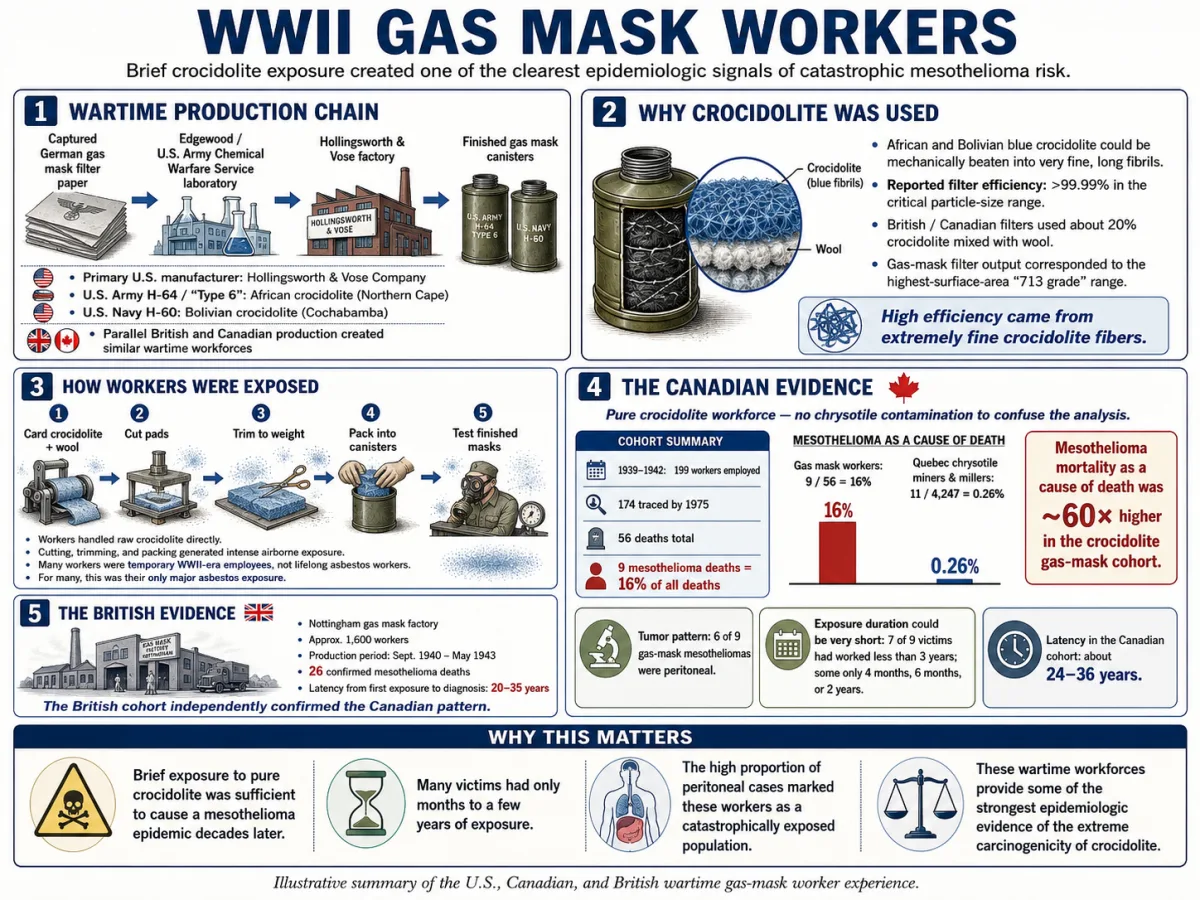
During World War II, factories in Canada and Britain made gas mask filters out of pure crocidolite. Decades later, researchers went back and traced what happened to those workers. In one Canadian group of 199 workers employed between 1939 and 1942, researchers found that by 1975, 56 had died, and 9 of those deaths, about 16 percent, were from mesothelioma. Seven of the nine had worked with the fiber for less than three years. Some had worked only a few months. Workers described the factory as not even looking especially dusty.16 In that same study, mesothelioma was roughly sixty times more frequent as a cause of death among these pure-crocidolite workers than among a large Quebec chrysotile mining cohort followed over the same years, a gap that reflects those particular workforces and their very different exposures rather than a fixed potency ratio between the two fibers.16 A British factory in Nottingham showed the same pattern, with 26 mesothelioma deaths among about 1,600 workers.17,18
These were not lifelong asbestos workers. They were ordinary people who took a wartime job for a few months, moved on with their lives, and developed a fatal cancer 20 to 35 years later.
How the crocidolite gas-mask filter was made, and why it was eventually dropped
The wartime filter traced back to a captured enemy mask. Early in World War II, the British passed the US Army Chemical Corps laboratories at Edgewood, Maryland a piece of filter paper taken from a German gas-mask canister. It was exactly what the Chemical Corps had been looking for, and together with the Naval Research Laboratory they copied the design and had it mass-produced on ordinary paper-making machinery by the Hollingsworth and Vose Company.19
Two papers came out of that work. The Navy's, made with the long Bolivian crocidolite, was designated H-60; the Army's, made with African crocidolite from the Northern Cape, was H-64, later called Type 6. Melvin First, the Harvard industrial hygienist who worked on the program, recorded that the greatest filtering efficiency came from African or Bolivian blue crocidolite beaten mechanically into very fine fibers, which is the high-surface-area output the Cape Blue table calls the 713 range. That is why the exceptionally long Bolivian fiber was prized: beating long fiber yielded more fine, high-surface-area fibril per gram than beating short fiber.19
Making the filters meant working the crocidolite into pads and trimming and packing them into canisters, the operations that put fiber into the air the workers breathed. The asbestos paper was finally retired not on health grounds but on supply grounds: in 1951 the Naval Research Laboratory developed an all-glass-fiber paper drawn from spun-glass fibers well under a micron across, and once domestic industry could make glass that fine in quantity, crocidolite was no longer needed.19
Kent cigarettes: asbestos sold as a health feature
For about four years in the early 1950s, the crocidolite that killed gas mask workers was being put into cigarette filters. Kent's "Micronite" filter, sold from 1952 to about 1956, was made from blue asbestos and marketed as a healthier way to smoke. Smokers who chose Kent during that window inhaled crocidolite fibers directly. Mesothelioma cases have been documented in former Kent smokers whose only known asbestos exposure was the cigarettes themselves.20
Disease in neighbors and families
Wagner's original South African cases were housewives, domestic workers, and farmers who had never worked with asbestos. They got sick from living in a mining region. The same pattern showed up at Wittenoom and everywhere else crocidolite was mined or processed. And family members of workers, especially wives who washed work clothes, developed mesothelioma from fibers carried home. Crocidolite has proven, again and again, that you didn't have to work with it to be killed by it.
Were you or a family member exposed to crocidolite?
If you've been diagnosed with mesothelioma, lung cancer, or asbestosis, and you think blue asbestos may have been involved, we can help you find out whether you have a claim. That includes exposure from asbestos-cement pipe work, from making or handling gas mask filters, from Kent cigarettes during the 1952 to 1956 window, from a family member's clothes, or from living near a plant that made products with crocidolite. Even brief exposure can matter, because crocidolite is so potent.
When you call, you reach our litigation team, not a screener. We'll talk through where and when you may have been exposed and explain your options. There's no fee unless we recover compensation for your family.
Call 833-4-ASBESTOS to speak with us about your case.
Is crocidolite still a danger today?
Crocidolite was the first asbestos type that governments moved to ban, a reflection of how clearly dangerous it was. The European Economic Community restricted it in 1983, years before banning the other asbestos types. Australia's Wittenoom mine closed in 1966, and Australia eventually banned all forms of asbestos by the end of 2003. In the United States, crocidolite is regulated as asbestos by the Environmental Protection Agency, the Occupational Safety and Health Administration, and others.1,21 The EPA's 2024 rule under the Toxic Substances Control Act banned the ongoing uses of chrysotile, the only asbestos type still imported and used in the country; in a separate 2024 evaluation, the agency assessed the other five fiber types, crocidolite among them, and found that asbestos poses an unreasonable risk to health.22,23 For where asbestos regulation stands now, see our main asbestos page.
Even so, exposure continues. The biggest ongoing source in the United States is the vast network of asbestos-cement pressure pipe still buried in municipal water and sewer systems. As that aging pipe is dug up, cut, and replaced, it releases crocidolite fibers. Exposure also happens during the demolition and renovation of older buildings and during the cleanup of contaminated sites. Because crocidolite disease can take half a century to appear, new cases from past exposure will keep emerging for years to come.
Crocidolite in the industry's own words
The asbestos industry wrote about crocidolite for decades: in its trade journal, Asbestos, in the patents it filed, and in its own letters and sworn answers. These are the documents in our library that discuss it.
In the pipe plants
The companies that made asbestos-cement pipe said in their own papers that they put blue asbestos in it:
- The government's count. By the Bureau of Mines' figures, American use of crocidolite more than tripled in five years, from 8,000 tons in 1953 to 26,000 in 1958, and "most of the crocidolite was used in making asbestos cement pipe" (Minerals Yearbook, 1958). A 1977 article in the trade journal said that in 1974 "more than 90% of the Crocidolite used in the United States went into piping applications" (Asbestos, May 1977).
- Manville's own count. A 1988 Manville internal memo said the company had used, in its own plants, "approximately 25% of the chrysotile, 23% of the amosite, and 62% of the crocidolite consumed in the United States." "The vast majority of all crocidolite used in the U.S., both by Manville and other manufacturers, was for making asbestos cement pipe," it said, and Manville was the largest maker of that pipe. Efforts to replace crocidolite with chrysotile "resulted in a poorer quality product and increased production costs."
- Johns-Manville's pipe patent. J-M's 1943 patent on asbestos-cement pipe, filed in 1941, says the inventor used "a relatively harsh, freely filtering fibre, such, for example, as crocidolite."
- Long Beach, California. A 1970 J-M memo on its workers' chest X-rays said the principal fiber at the Long Beach Pipe Plant, open since 1938, had been chrysotile, with "a small percentage of Crocidolite."
- Stockton, California. In a personal and confidential letter in 1977, J-M's president, J. A. McKinney, told the chairman of Nicolet: "Both chrysotile and crocidolite are used in the Stockton Plant." He added that exposures there had once been above the standard of the day.
- Manville, New Jersey. At an industry conference in 1980, McKinney said of the company's pipe plant there, which had "the highest incidence of disease in any plant we have had": "In making asbestos-cement pipe over a period of years we use chyrsotile mainly, but also crocidolite and amosite."
- Toronto, Canada. In 1975 Canadian Johns-Manville told the Canadian government that all the crocidolite it imported went into asbestos-cement pipe, about 8 percent of the pipe's asbestos. Without it, the company said, it couldn't make sewer pipe wider than 16 inches or pressure pipe wider than 12 to 14 inches (meeting summary). The company wrote to Ontario the same year that a ban on blue asbestos "would eliminate approximately 12,000 tons of coupling production, 25,000 tons of pressure pipe production" at its Toronto plant.
- CertainTeed. In a sworn answer in 2000, CertainTeed said that from 0 to 24 percent of the asbestos in its asbestos-cement pipe was crocidolite, by weight. It named five plants that made the pipe: Ambler, Pennsylvania; St. Louis, Missouri; Hillsboro, Texas; Santa Clara, California; and Riverside, California. CertainTeed began making pipe in 1962.
In the trade journal
The journal followed crocidolite from the South African mining fields of the early 1920s, through Australia's Wittenoom mine, wartime Bolivia and the pipe boom of the 1950s and 1960s, to the South African mills of the late 1970s. Each link opens the article's page in that issue.
- Early History of Blue Asbestos, July 1922
- Blue Asbestos Mattress Coverings, January 1923
- Asbestos in South Africa, August 1923
- Bolivia, November 1923
- Blue Asbestos in the Chemical Industry, May 1924
- Density of Blue Asbestos Deposits, November 1924
- The Mining of Blue Asbestos, September 1925
- Francis Oats, a Pioneer in the South African Asbestos Field, October 1925
- Ups and Downs of Blue Asbestos, April 1926
- Difficulties of Blue Asbestos, February 1927
- Sidelights on the Blue Asbestos Fields, January 1928
- Mining Blue Asbestos, March 1928
- White Crocidolite, October 1928
- Jottings on Blue Asbestos, May 1930
- Uses for Blue Crocidolite Asbestos, May 1935
- Mining of Blue Asbestos, April 1937
- Australian Blue Asbestos Mines, January 1939
- Bolivia, March 1941
- Union of South Africa: Its Asbestos Fields, April 1941
- Crocidolite in South Africa, July 1941
- Blue Asbestos in Australia, October 1941
- Bolivia, April 1942
- Blue Asbestos of the Hamersley Ranges, April 1942
- Asbestos Mill at Wittenoom, September 1946
- Milling Amosite and Blue, June 1950
- Present Status of Crocidolite, May 1951
- Production of Crocidolite or Blue in South Africa (I), July 1951
- Production of Crocidolite or Blue in South Africa (II), August 1951
- Spotlight on Blue Asbestos, March 1956
- Distribution of Crocidolite Asbestos, by W. E. Sinclair, September 1956
- Tiger-Eye and Its Relation to Crocidolite Asbestos, by W. E. Sinclair, November 1956
- The Economic Future of Crocidolite and Amosite Asbestos, by W. E. Sinclair, October 1957
- Crocidolite Development, November 1958
- Grading Crocidolite Asbestos, February 1959
- The Outlook for Crocidolite Asbestos, July 1960
- Crocidolite Production in South Africa and Australia, September 1963
- Amosite/Crocidolite Fact Sheet, January 1967
- Crocidolite and Amosite in Asbestos-Cement Pipe, June 1967
- Amphibole Mineral Fibers: What Purpose?, October 1967
- United Nations Assisting in Bolivia, July 1968
- Cape Asbestos Modernizes Fiber Packaging, August 1970
- Bolivian Blue Asbestos, by Dr. H. G. Klos, February 1976
- Griqualand Annual Report, 1976, September 1977
- Gefco, Blue Asbestos Producer, October 1977
- The New Pomfret Mill Complex, November 1978
In patents
111 US patents in our library mention crocidolite or blue asbestos in their text, from 1929 to 1980. At least 25 were assigned to Johns-Manville, among them the 1943 asbestos-cement pipe patent above.
Every patent that mentions crocidolite (111), oldest first
- Heat Insulating and Fireproofing Material (US Patent 1,721,096, 1929), Walter L. Steffens
- Material and Article Containing Fibre (US Patent 2,006,392, 1935), Philip Carey Manufacturing Co
- Electrical Insulation (US Patent 2,068,208, 1937), Johns Manville
- Water Repellent Product (US Patent 2,068,219, 1937), Johns Manville
- Acid Resisting Laminated Product (US Patent 2,128,097, 1938), Gerald H. Mains
- Method of Coagulating Rubber upon Fibres (US Patent 2,133,693, 1938), Philip Carey Manufacturing Co
- Method of Making Fibrous Material (US Patent 2,133,694, 1938), Philip Carey Manufacturing Co
- Article of Manufacture (Electrical Switchboard Panel) (US Patent 2,170,434, 1939), Johns Manville
- Asbestos-Cement Product (US Patent 2,182,353, 1939), Johns Manville
- Colored Asbestos Product (US Patent 2,198,800, 1940), Johns Manville
- Sheet Asbestos Product (US Patent 2,220,386, 1940), Johns Manville
- Building Construction (US Patent 2,258,955, 1941), Stuart G. Meek
- Method of Making Asbestos Cement Pipe (US Patent 2,246,537, 1941), Ernest Wayne Rembert
- Composite Sheet (US Patent 2,281,591, 1942), Johns Manville
- Stonelike Units (US Patent 2,280,488, 1942), Edward M. Jenkins, Rembert Ernest Wayne
- Asbestos-Cement Pipe (US Patent 2,322,592, 1943), Johns Manville
- Method of Manufacturing Fibrous Insulation (US Patent 2,326,517, 1943), Johns Manville
- Roofing (US Patent 2,326,723, 1943), George Arthur Fasold, Harold W. Greider
- Roofing (US Patent 2,326,724, 1943), George Arthur Fasold, Harold W. Greider
- Method of Fiberizing Asbestos (US Patent 2,386,401, 1945), Raybestos Manhattan Inc
- Asbestos Sheet Material (US Patent 2,407,581, 1946), Philip Carey Manufacturing Co
- Manufacture of Dielectric Shapes (US Patent 2,407,520, 1946), Johns Manville
- Asbestos Sheet Material (US Patent 2,467,540, 1949), Philip Carey Manufacturing Co
- Composition Roofing (US Patent 2,490,430, 1949), Harold W. Greider, George Arthur Fasold
- Manufacturing Gaskets (US Patent 2,459,721, 1949), Johns Manville
- Sheet packing and method of manufacture (US Patent 2,530,906, 1950), Johns Manville
- Process of manufacturing asbestoscontaining material (US Patent 2,546,474, 1951), Societe des Usines Chimiques Rhone Poulenc SA
- Method of making filter media (US Patent 2,797,163, 1957), Walter J. Smith, Raymond W. James
- Thermal insulating structures and methods for the production thereof (US Patent 2,788,053, 1957), Norman Louis Dolbey, Frank C. Hooper
- Controlled precipitation of rubber onto asbestos fibers (US Patent 2,940,893, 1960), Armstrong Cork Co
- Filter media and method of making (US Patent 2,971,907, 1961), Walter J. Smith
- Oil base drilling fluids (US Patent 2,995,514, 1961), Nat Lead Co
- Electrolytic cell diaphragm (US Patent 3,057,794, 1962), Pittsburgh Plate Glass Co
- Film forming composition (US Patent 3,057,744, 1962), Glen D. Barbaras
- Flexible asbestos-cement products (US Patent 3,058,872, 1962), Armstrong Cork Co
- Asbestos paper containing vinyl alkyl ether-maleic anhydride copolymer and method of forming same (US Patent 3,113,064, 1963), Samuel T. Cukier
- Asbestos fiber reinforced molding material, molded articles and methods of making same (US Patent 3,235,530, 1966), Johns Manville
- Asbestos paper containing carbon and method of making it (US Patent 3,269,889, 1966), Johns Manville
- Fluid-permeable materials and process of making the same (US Patent 3,246,767, 1966), David B. Pall, Cyril A. Keedwell
- Friction member with friction material (US Patent 3,270,846, 1966), Hanns F. Arledter, Jr Carl R. Canfield, Daniel C. Gillespie
- Method of thermally insulating articles with a filled polyurethane composition (US Patent 3,259,516, 1966), Thiokol Corp
- Methods for making asbestos fiber products (US Patent 3,271,186, 1966), Johns Manville
- Molded mineral fiber acoustical tile (US Patent 3,250,633, 1966), Ronald F. Cotts
- Castable gunning mix (US Patent 3,360,594, 1967), Harbison Walker Refractories Co
- Conductive cellulosic paper containing asbestos and acid salt of a polyvalent metal (US Patent 3,337,392, 1967), ST Regis Paper Co
- Elastomeric composition for use as rocket insulation (US Patent 3,347,047, 1967), General Tire and Rubber Co
- Fluid-permeable fibrous multilayer materials and process of making the same (US Patent 3,353,682, 1967), David B. Pall, Cyril A. Keedwell
- Heat-resistant fibrous amphibole asbestos board containing an inorganic binder (US Patent 3,334,010, 1967), Philip Carey Manufacturing Co
- Method of making a non-weeping reinforced plastic pipe of asbestos fiber paper (US Patent 3,356,554, 1967), Johns Manville
- Method of rendering asbestos ore particles differentially fluorescent (US Patent 3,346,111, 1967), Colonial Sugar Refining Co Ltd
- Method of transfer molding (US Patent 3,356,781, 1967), Johns Manville
- Molding composition for making thermal barriers and method of making same (US Patent 3,314,915, 1967), Taylor Corp
- Traction rolls and material handling apparatus employing such rolls (US Patent 3,317,303, 1967), Norman Shorr
- Transparent, stress-crack resistant polyhydroxy-ether compositions (US Patent 3,324,073, 1967), Union Carbide Corp
- Material for Hot-Top (US Patent 3,373,047, 1968), Herbert D. Sheets, John W. Lennon
- Method of ore sorting based on differential infrared emission (US Patent 3,395,793, 1968), Colonial Sugar Refining Co Ltd
- Phosphoric acid bonded asbestos fiber sheets and method of manufacture (US Patent 3,383,230, 1968), Johns Manville
- Silica gel-asbestos compositions (US Patent 3,375,201, 1968), Milton E. Winyall
- Tobacco composition (US Patent 3,410,276, 1968), Reynolds Metals Co
- Alumina trihydrate-fibrous matrix composition and method of forming same (US Patent 3,477,865, 1969), Reynolds Metals Co
- Asbestos millboard conveyor rolls for high temperature use (US Patent 3,456,931, 1969), Philip Carey Corp
- Elastic insulating bodies of inorganic fiber material and method of producing such bodies (US Patent 3,461,191, 1969), Protex Corp Ltd
- Manufacture of asbestos (US Patent 3,449,227, 1969), Gordon F. Heron, John O. Halstead, Robert B. Gettins
- Manufacture of asbestos products (US Patent 3,449,230, 1969), Gordon F. Heron, John Outram Halstead
- Non-porous asbestos-reinforced plastic pipe (US Patent 3,460,581, 1969), Johns Manville
- Anthophyllite asbestos diaphragm for chlor-alkali electrolytic cells (US Patent 3,505,200, 1970), Hooker Chemical Corp
- Asbestos-foam laminates (US Patent 3,522,140, 1970), PPG Industries Inc
- Method of coating wood (US Patent 3,531,353, 1970), PPG Industries Inc
- Method of orienting fibres by means of ac and dc voltages (US Patent 3,497,419, 1970), Albert A. Winer, Henry M. Woodrooffe
- Asbestos sheet material and process for manufacture (US Patent 3,558,427, 1971), Armstrong Cork Co
- Low density cork-asbestos felt and process of producing the same (US Patent 3,591,447, 1971), Raybestos Manhattan Inc
- Method for drilling in permafrost (US Patent 3,618,680, 1971), Joe D. Ellard, Lee Bone
- Nonsettling thixotropic cold bottom filler composition (US Patent 3,567,471, 1971), George F. Kahle
- Stopping lost circulation in well drilling (US Patent 3,574,099, 1971), Pan American Petroleum Corp
- Compressed asbestos sheet packing products and method (US Patent 3,694,304, 1972), Johns Manville
- Hot top liner and refractory ring combination for use with metal casing that is hot (US Patent 3,660,122, 1972), Susquehanna Corp
- Hot top liner and refractory ring combination for use with metal hot top casing (US Patent 3,660,121, 1972), Susquehanna Corp
- Method for preparing an asbestos fiber product of improved filtration characteristics (US Patent 3,644,138, 1972), Charles E. Stiefken
- Heat vulcanizable polysiloxane compositions containing asbestos (US Patent 3,715,329, 1973), General Electric Co
- High speed sorting (US Patent 3,712,469, 1973), Colonial Sugar Refining Co Ltd
- Method for dispersing asbestos fibers (US Patent 3,721,637, 1973), F. Schultz, H. Fogel
- Thickened organic liquids (US Patent 3,714,041, 1973), Cabot Corp
- Composition and method for inhibiting asbestos fiber dust (US Patent 3,928,060, 1975), NL Industries Inc
- Coupling agents for chrysotile asbestos and thermoplastic polymers (US Patent 3,928,278, 1975), Union Carbide Corp
- Method of increasing the production rate of asbestos fiber containing articles and product thereof (US Patent 3,891,498, 1975), Johns Manville
- Molecular sieves as fade inhibitors in friction materials (US Patent 3,916,062, 1975), Thiokol Corp
- Compositions for rigid asbestos - reinforced polyvinyl chloride (US Patent 3,948,833, 1976), Centre for Industrial Research CIR Ltd
- Fibrous blanket containing solder flux and solder flux with increased melted viscosity (US Patent 3,936,325, 1976), Dunbar L. Shanklin
- Heat vulcanizable polysiloxane compositions containing asbestos (US Patent 3,933,726, 1976), General Electric Co
- Inorganic composition for high temperature use and method of forming a millboard therefrom (US Patent 3,954,556, 1976), Johns Manville Corp
- Method of producing a non-combustible molding material (US Patent 3,978,180, 1976), Sekisui Chemical Co Ltd
- Method of producing fiber strand (US Patent 3,943,220, 1976), Johns Manville Corp
- Non-combustible molding material (US Patent 3,945,840, 1976), Sekisui Chemical Co Ltd
- Non-combustible molding material (US Patent 3,988,402, 1976), Sekisui Chemical Co Ltd
- Precision-moldable abrasion-resistant molding composition and moldings (US Patent 3,988,291, 1976), Rostone Corp
- Surface treatment of asbestos fibers (US Patent 3,957,571, 1976), Johns Manville Corp
- Thermal shock resistant asbestos-cement compositions and their preparation (US Patent 3,933,515, 1976), Johns Manville Corp
- Cloth comprising asbestos fibers and method of producing said cloth (US Patent 4,031,041, 1977), Rhone Poulenc Industries SA
- Non-combustible molding material (US Patent 4,013,476, 1977), Harutoshi Ueda, Naoyuki Suzuki, Masami Nagao
- Bonded asbestos diaphragms (US Patent 4,093,533, 1978), Dow Chemical Co
- Friction material (US Patent 4,125,496, 1978), Raybestos Manhattan Inc
- Sulfur composition (US Patent 4,129,453, 1978), Chevron Research Co
- Asbestos treatment with metal molybdates (US Patent 4,171,405, 1979), Dow Chemical Co
- Asbestos treatment with metal tungstates (US Patent 4,168,346, 1979), Dow Chemical Co
- Bonded asbestos diaphragms and mats (US Patent 4,180,449, 1979), Henrik R. Heikel
- Brine electrolysis using bonded asbestos diaphragms (US Patent 4,142,951, 1979), Dow Chemical Co
- Production of improved chrysotile asbestos fibres (US Patent 4,180,433, 1979), Roger W. Glass, Richard A. Kuntze
- Cementitious composition containing asbestos fibres and prepared using a surfactant (US Patent 4,190,456, 1980), Victor J. Absolon, George T. Hurst, John C. Worboys, George H. Barnett, Ross P. Dickson
- Latex blend binder compositions for asbestos sheets (US Patent 4,209,562, 1980), David W. Suwala, Eugene S. Barabas
- Process for the manufacture of a permeable diaphragm for an electrolysis cell (US Patent 4,204,941, 1980), Solvay SA
- Removal of asbestos fibers from water (US Patent 4,181,607, 1980), United States Department of the Interior
Crocidolite mines in our records
The documents in our library report 29 mines in 3 countries producing crocidolite that was sold or shipped: the U.S. Bureau of Mines' and Geological Survey's yearbooks and the asbestos industry's trade journal, Asbestos. Each mine's page says who worked it and when, what it produced and which document says so.
- Blue asbestos depositWestern Australia
- HawkerHawker, about 250 miles north of Adelaide, South Australia · 1933
- West Australian Blue Asbestos Fibres Co.Hamersley Ranges, Western Australia · West Australian Blue Asbestos Fibres Co., Ltd. · 1946
- WittenoomWittenoom, Western Australia · Australian Blue Asbestos, Ltd., Blue Asbestos, Ltd., Colonial Sugar Refinery Co. and others · 1937–1968
- Blue asbestos depositBolivia · 1942
- Chapare crocidolite depositProvince of Chapare, Bolivia · 1965–1970
- Bretby mineKuruman area, Cape Province · Griqualand Exploration & Finance Company, Griqualand Exploration and Finance Co. Ltd. (Gefco), General Mining and Finance Corporation Ltd. · 1953–1979
- Bute mineVryburg District, Cape Province · Griqualand Exploration and Finance Co. Ltd., Dublin Consolidated Asbestos Mines (Pty.) Ltd.
- Cape Asbestos Co. blue asbestos minesPrieska; Hay district, Cape Province · Cape Asbestos Co., Ltd. · 1933–1944
- Dominion Blue Asbestos MinesKuruman, Cape Province · Dominion Blue Asbestos Mines (Prop'y) Limited, Gillanders & Campbell, Cape Asbestos Company · 1930–1933
- Elcor minesKuruman area, Cape Province · Elcor Investments (Pty.) Limited, Hans Merensky Trust Company, Griqualand Exploration & Finance Co. Ltd. and others · 1965–1979
- Emmarentia mineSouth Africa · Duiker Exploration (Lonrho Group)
- Gefco Kuruman mineKuruman, Cape Province · Griqualand Exploration and Finance Co. (Gefco) · 1975–1979
- Griqualand Exploration and Finance Co. minesnear Kuruman, South Africa · Griqualand Exploration and Finance Co. Ltd. · 1962–1976
- Groenwater minePostmasburg, Cape Province · Postmasburg Cape Blue Asbestos, Groenwater Asbestos Mining, Groenwater Asbestos Mining Co. (Pty.) Ltd. and others · 1927–1975
- KeikamspoortPrieska District, Griqualand, Cape Province · Mr. Meeuwsen, Carn Brea Asbestos Syndicate, The Cape Asbestos Company, Limited · 1923
- Klipfontein mine and millKlipfontein, Postmasburg District, Cape Province · Kuruman Cape Blue Asbestos (Pty.) Ltd., Eternit (Asbestos Investments (Pty.) Ltd.) · 1975–1979
- Kliphuis minePrieska District, Cape Province · G. Heller Co., Limited, The Cape Asbestos Company · 1924
- KoegasKoegas, Cape Province · Cape Blue Mines (Pty.), Ltd., Cape Industries, Ltd., Transvaal Consolidated Land and Exploration, Ltd. (TCL) · 1893–1978
- Kuruman Cape Blue Asbestos plantKuruman, South Africa · Kuruman Cape Blue Asbestos, Kuruman Cape Blue Asbestos (Pty.), Ltd. · 1962–1975
- Malips Drift (McBean's) minenear Malips River, Transvaal · Malips Drift Asbestos Mines Limited, Cape Asbestos Company Limited, Cape Blue Mines (Pty) Ltd. and others · 1913–1959
- Ouplaas minesfarm Ouplaas, Danielskuil District, Cape Province · Danielskuil Cape Blue Asbestos (Pty.) Ltd. · 1978–1979
- Pietersburg districtPietersburg district, Transvaal · 1933–1942
- Pomfret minePomfret, South Africa · Cape Blue Mines (Pty.), Ltd., Cape Industries, Ltd., Transvaal Consolidated Land and Exploration, Ltd. (TCL) and others · 1953–1983
- Postmasburg Cape Blue AsbestosPostmasburg District, Cape Province · Postmasburg Cape Blue Asbestos (Pty.) Ltd. · 1975
- Prieska and Kuruman districtsPrieska and Kuruman districts, Cape Province · 1924–1942
- Rooipoort Blue AsbestosPostmasburg District, Cape Province · Rooipoort Blue Asbestos (Pty.) Ltd. · 1975
- Wandrag mineKuruman District, Cape Province · Wandrag Asbestos (Pty.) Ltd., Duiker Exploration (Lonrho Group) · 1975–1978
- Westerberg mine45 miles from Prieska, Cape Province · Cape Blue Mines, Cape Blue Mines (Pty) Ltd. · 1952–1958
Our records also name 14 other crocidolite deposits and mines with no reported sales.
Plants that made crocidolite products
Companies' sworn answers in asbestos lawsuits, the asbestos industry's trade journal and company records in our library name 9 asbestos products as containing crocidolite, made at 12 plants, and name crocidolite in use at 1 more plant. Many of these products contained other fibers too; each product's page gives what each document says it contained. People who worked in these plants, their families, and people who lived nearby may have been exposed.
- Ambler, PennsylvaniaCertainTeed Corporation · 1938–1982 · 1 crocidolite product
- Denison, TexasJohns-Manville · 1957–1982 · 1 crocidolite product
- Green Cove Springs, FloridaJohns-Manville · 1964–1982 · 1 crocidolite product
- Hillsboro, TexasCertainTeed Corporation · 1960–1987 · 1 crocidolite product
- Long Beach, CaliforniaJohns-Manville · 1938–1982 · 1 crocidolite product · a document names crocidolite at this plant
- Manville, New JerseyJohns-Manville · 1912–1985 · 1 crocidolite product · a document names crocidolite at this plant
- Marrero, LouisianaJohns-Manville · 1936–1980 · 1 crocidolite product
- Riverside, CaliforniaCertainTeed Corporation · 1962–1992 · 1 crocidolite product
- Santa Clara, CaliforniaCertainTeed Corporation · 1950–1982 · 1 crocidolite product
- St. Louis, MissouriCertainTeed Corporation · 1938–1979 · 1 crocidolite product
- Stockton, CaliforniaJohns-Manville · 1956–1982 · 1 crocidolite product · a document names crocidolite at this plant
- Waukegan, IllinoisJohns-Manville · 1919–1985 · 1 crocidolite product
- Toronto, CanadaCanadian Johns-Manville · from 1948 · a document names crocidolite at this plant
References
- IARC. Arsenic, Metals, Fibres, and Dusts. IARC Monographs on the Evaluation of Carcinogenic Risks to Humans, Vol 100C. International Agency for Research on Cancer; 2012.
- Wagner JC. The discovery of the association between blue asbestos and mesotheliomas and the aftermath. Br J Ind Med. 1991;48(6):399-403.
- Wagner JC, Sleggs CA, Marchand P. Diffuse pleural mesothelioma and asbestos exposure in the North Western Cape Province. Br J Ind Med. 1960;17(4):260-271.
- Ross M. The geological occurrences and health hazards of amphibole and serpentine asbestos. In: Veblen DR, ed. Amphiboles and Other Hydrous Pyriboles — Mineralogy. Reviews in Mineralogy. Vol 9A. Mineralogical Society of America; 1981:279-323.
- Hausmann JFL, Stromeyer F. Beschreibung und Zerlegung des asbestartigen Krokydoliths. Ann Phys Chem. 1831;99:153-158.
- Dana ES, Dana JD. Dana's New Mineralogy. 8th ed. Wiley; 1997.
- Virta RL. Worldwide Asbestos Supply and Consumption Trends From 1900 to 2003. US Geological Survey Circular 1298. US Department of the Interior; 2006.
- US Geological Survey. Minerals Yearbook: Asbestos [annual chapters]. US Department of the Interior; 1932-2024.
- Industrial Minerals and Rocks. 4th ed. American Institute of Mining, Metallurgical, and Petroleum Engineers; 1975.
- Bowles O. Asbestos: A Materials Survey. Information Circular 7880. US Bureau of Mines; 1959.
- Hodgson JT, Darnton A. The quantitative risks of mesothelioma and lung cancer in relation to asbestos exposure. Ann Occup Hyg. 2000;44(8):565-601.
- Lanphear BP, Buncher CR. Latent period for malignant mesothelioma of occupational origin. J Occup Med. 1992;34(7):718-721.
- Reid A, de Klerk NH, Magnani C, et al. Mesothelioma risk after 40 years since first exposure to asbestos: a pooled analysis. Thorax. 2014;69(9):843-850.
- Musk AW, de Klerk NH, Reid A, et al. Mortality of former crocidolite (blue asbestos) miners and millers at Wittenoom. Occup Environ Med. 2008;65(8):541-543.
- Berry G, Reid A, Aboagye-Sarfo P, et al. Malignant mesotheliomas in former miners and millers of crocidolite at Wittenoom (Western Australia) after more than 50 years follow-up. Br J Cancer. 2012;106(5):1016-1020.
- McDonald AD, McDonald JC. Mesothelioma after crocidolite exposure during gas mask manufacture. Environ Res. 1978;17(3):340-346.
- Newhouse ML, Berry G. Predictions of mortality from mesothelial tumours in asbestos factory workers. Br J Ind Med. 1976;33(3):147-151.
- Jones JSP, Pooley FD, Smith PG. Factory populations exposed to crocidolite asbestos: a continuing survey. IARC Sci Publ. 1976;(52):117-120.
- First MW. Filters: prefilters, high capacity filters, and high efficiency filters; review and projection. In: Tenth AEC Air Cleaning Conference. US Atomic Energy Commission; 1968:65-78.
- Selikoff IJ, Hammond EC. Multiple risk factors in environmental cancer. In: Persons at High Risk of Cancer: An Approach to Cancer Etiology and Control. Academic Press; 1975.
- Occupational Safety and Health Administration. Asbestos. 29 C.F.R. § 1910.1001.
- US Environmental Protection Agency. Asbestos Part 1; chrysotile asbestos; regulation of certain conditions of use under the Toxic Substances Control Act (TSCA). Fed Regist. 2024;89(61):21970-22010.
- US Environmental Protection Agency. Risk Evaluation for Asbestos, Part 2: Supplemental Evaluation Including Legacy Uses and Associated Disposals of Asbestos. US Environmental Protection Agency; 2024.
Key Sources
Klaproth MH. Beiträge zur chemischen Kenntnis der Mineralkörper. Vol 6. Nicolaische Buchhandlung; 1815.
Lichtenstein MH. Reisen im südlichen Afrika in den Jahren 1803, 1804, 1805 und 1806. Berlin; 1811-1812.
Selikoff IJ, Lee DHK. Asbestos and Disease. Academic Press; 1978.
Badollet MS. Asbestos, a mineral of unparalleled properties. Transactions of the Canadian Institute of Mining and Metallurgy. 1951;54:151-160.
Speil S, Leineweber JP. Asbestos minerals in modern technology. Environ Res. 1969;2(3):166-208.
In the research library
The National Library of Medicine indexes 585 studies in our medical research library under crocidolite. Among the most cited:
- Mortality in miners and millers of crocidolite in Western AustraliaB.K. Armstrong, N.H. de Klerk, A.W. Musk, et al, 1988 · British Journal of Industrial Medicine · cited 145 times
- Environmental exposure to crocidolite and mesothelioma: exposure-response relationshipsJ. Hansen, N.H. de Klerk, A.W. Musk, et al, 1998 · American Journal of Respiratory and Critical Care Medicine · cited 120 times
- Mortality of two groups of women who manufactured gas masks from chrysotile and crocidolite asbestos: a 40-year follow-upE.D. Acheson, M.J. Gardner, E.C. Pippard, et al, 1982 · British Journal of Industrial Medicine · cited 120 times
- Iron mobilization from crocidolite asbestos greatly enhances crocidolite-dependent formation of DNA single-strand breaks in phi X174 RFI DNAL.G. Lund, A.E. Aust, 1992 · Carcinogenesis · cited 97 times
- Crocidolite asbestos and SV40 are cocarcinogens in human mesothelial cells and in causing mesothelioma in hamstersB. Kroczynska, R. Cutrone, M. Bocchetta, et al, 2006 · Proceedings of the National Academy of Sciences of the United States of America · cited 92 times
In our case-law library
47 court decisions in our case-law library involve crocidolite. Among them:
- DeLisle v. Crane Co.Florida Supreme Court, 2018 · Smoker of Kent cigarettes at 1952-1956
- Noll v. American Biltrite Inc.Washington Supreme Court, 2017 · Construction worker cutting asbestos-cement pipe at Port Orchard, 1977-1979
- Webb v. Special Electric Company, Inc.California Supreme Court, 2016 · Warehouseman and truck driver at Pyramid Pipe & Supply Co., 1969-1979
- Certainteed Corporation v. DexterKentucky Supreme Court, 2010 · Pipefitter at 1963-1964
- Csr, Limited v. TaylorMaryland Court of Appeals, 2009 · Stevedore at Port of Baltimore, 1942-1983
- Ruckstuhl v. Owens Corning Fiberglas Corp.Louisiana Supreme Court, 1999 · Cigarette smoker at 1952-1959
Frequently asked questions
Is crocidolite asbestos?
Yes. Crocidolite is one of the six minerals regulated as asbestos under US law, and it's part of the amphibole group along with amosite, anthophyllite, tremolite, and actinolite.
What is blue asbestos?
Blue asbestos is the common name for crocidolite. It comes from the mineral's distinctive blue color, which is caused by iron in its structure. It was also sold commercially as "Cape blue."
Why is crocidolite considered the most dangerous asbestos?
Crocidolite has the finest, stiffest fibers of the straight-fiber asbestos types, so they reach deep into the lungs and pierce the lining where mesothelioma starts. The fiber also resists being broken down, so it stays in the body for decades. In studied groups of crocidolite workers, mesothelioma occurred far more often than in chrysotile workers, and even brief exposure proved deadly.
Was crocidolite used in the United States?
It was never mined here, but it was imported and used widely, above all in asbestos-cement water and sewer pipe. It was also used in World War II gas mask filters, in Kent cigarette filters from 1952 to 1956, in nuclear plant air filters, and in some textiles, gaskets, and sprayed insulation.
Is crocidolite in water pipes?
Yes. Asbestos-cement pressure pipe, which often contained crocidolite, was installed throughout US municipal water and sewer systems and much of it is still in the ground. Cutting and replacing this aging pipe is the most common way people are exposed to crocidolite today.
Did cigarettes really contain asbestos?
Yes. Kent cigarettes used a crocidolite "Micronite" filter from 1952 to about 1956, and it was advertised as a health benefit. Mesothelioma has been documented in former Kent smokers from that period.
Can a short exposure to crocidolite cause mesothelioma?
Yes. This is one of the most important things to understand about blue asbestos. Gas mask workers who handled it for only a few months, and people who simply lived near the mines, developed mesothelioma decades later. You do not need years of exposure.
What should I do if I think I was exposed?
If you've been diagnosed with an asbestos-related disease and think crocidolite may have been involved, call 833-4-ASBESTOS. You'll reach our litigation team, and there's no fee unless we recover compensation for your family.
Talk with an asbestos lawyer
Start with what you remember, and we'll take it from there.
This page is provided for general informational purposes and does not constitute legal advice. Every asbestos case turns on its own facts, exposure history, diagnosis, deadlines, available evidence, and applicable law. Reviewing this page does not create an attorney-client relationship. For advice about your specific situation, call 833-4-ASBESTOS for a free case review.