
Griptex was a mineral fiber block insulation made by R & I Refractory and Insulation Corporation, a subsidiary of Combustion Engineering, Inc.1 In sworn answers given in a lawsuit in February 1968, R & I and Combustion Engineering said R & I "began, on or about April 2, 1964, to manufacture" Griptex and its other insulating materials, and had made them up to that time.2 Combustion Engineering's own answers in two later lawsuits, in December 1969 and March 1970, give the same start.1,3
The answers describe the product differently over time: the 1968, 1969 and 1970 answers call Griptex "a mineral fiber block insulation, consisting of mineral wool," packaged in cardboard cartons, and name no asbestos.1,2,3 Combustion Engineering's answers of December 1971 give a formula for "Griptex Block" of spun wool 73.53%, Granulor bentonite 13.24%, Dexecor 11.03% and asbestos 2.20%.4 The same answers say the block, for use in the 1500-1600 degree Fahrenheit range, has been made without asbestos since November 30, 1971.4
An insurance company's 1981 list of asbestos products, compiled from other companies' answers in lawsuits, lists Griptex block under Combustion Engineering as made from 1964 to 1972, with 2 in the column read as percent asbestos.5 The list also has a second Griptex block entry with no dates or figure.5
You don't need the product names or old records. No fee unless we recover compensation for your family.
Pictures
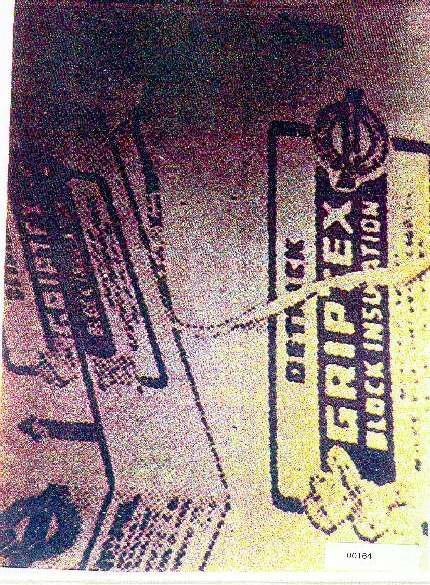
How Griptex (Combustion Engineering) looked: a label, photograph or catalog page from our library. Each picture has its own page and library number, so it can be cited on its own.
Asbestos claims
If you or a family member worked with or around Griptex (Combustion Engineering) and later developed mesothelioma or another asbestos disease, a claim may be paid by the Combustion Engineering 524(g) Asbestos PI Trust. Free case review.
What each document says
Every statement about Griptex (Combustion Engineering) in the documents, in each document's own words.
The Borel v. Fibreboard Case File (1969-1972), Answers to interrogatories
The Tomplait v. Combustion Engineering Case File (1962-1969), Response to plaintiff's interrogatories
The Potter v. Fibreboard Case File (1969-1972), Answers to interrogatories under Rule 33
The Potter v. Fibreboard Case File (1969-1972), Answers to plaintiff's interrogatories
- Change: “manufactured without asbestos since November 30, 1971”, p. 24
- Temperature limit: “for use in the 1500-1600 degree fahrenheit range”, p. 14
- Ingredient: “Granulor bentonite 13.24%”, p. 24
- Asbestos content: “Asbestos 2.20% (Since November 30, 1971 Griptex Block does not contain asbestos)”, p. 24
- Form: “block”, p. 24
- Ingredient: “Dexecor 11.03%”, p. 24
- Ingredient: “Spun wool 73.53%”, p. 24
The Travelers Insurance Company's Product Information Booklet for Its Asbestos Seminar (1980–1981)
Kind of product
We list Griptex (Combustion Engineering) with pipe covering and block insulation, from how the documents describe its form. That page explains how such products exposed workers.
Trades that worked with products like it: Insulators and Insulation Workers, Pipefitters and Plumbers.
Other pipe covering and block insulation by Combustion Engineering (7)
12 · Castablock · 19 · Detrick · K-12 Cal Sil · K-20 · Kaiser M.
Pipe covering and block insulation by other makers (269)
Thermobestos · Superex (Johns-Manville) · Careytemp (Philip Carey) · Kaylo (Owens-Corning) · Unibestos (Union Asbestos & Rubber Co.) · Fireguard Jacketing (Philip Carey) · Firetard (Johns-Manville) · Flexible Trainline (CertainTeed) · Flexible Trainline Pipe (CertainTeed) · Frostproof (Keene/Ehret) · Gaf Hylo (GAF) · Glasweld (United States Plywood) · Grosscell (Philip Carey) · High Temperature Insulation (Johns-Manville) · Hightemp #12 (Philip Carey) · Hightemp #15 (Philip Carey) · HT (Forty-Eight Insulations) · Hy Temp (Keasbey & Mattison) · Hy-temp (Nicolet) · Hylo (Eagle-Picher) · and 249 more: all pipe covering and block insulation
See also
- Combustion Engineering: the company's history, documents, people, products and plants
- Combustion Engineering on our products page: what the documents say about the company's asbestos products, with sources
References
- The Borel v. Fibreboard Case File (1969-1972), Answers to interrogatories (March 30, 1970), p. 1.
- The Tomplait v. Combustion Engineering Case File (1962-1969), Response to plaintiff's interrogatories (February 14, 1968), p. 1.
- The Potter v. Fibreboard Case File (1969-1972), Answers to interrogatories under Rule 33 (December 23, 1969), p. 1.
- The Potter v. Fibreboard Case File (1969-1972), Answers to plaintiff's interrogatories (December 30, 1971), pp. 1–2.
- The Travelers Insurance Company's Product Information Booklet for Its Asbestos Seminar (1980–1981) (April 30, 1981), p. 5.
- Travelers Asbestos Products Printout, July 1981 (July 1, 1981), p. 21.
Mentioned on this site
Cite this page
“Griptex (Combustion Engineering).” AsbestosClaims.Law Library. https://asbestosclaims.law/library/products/combustion-engineering-griptex.
ACL Doc numbers and their short links never change. See how to cite the Library.
Talk with an asbestos lawyer
Start with what you remember, and we'll take it from there.
This page is provided for general informational purposes and does not constitute legal advice. Every asbestos case turns on its own facts, exposure history, diagnosis, deadlines, available evidence, and applicable law. Reviewing this page does not create an attorney-client relationship. For advice about your specific situation, call 833-4-ASBESTOS for a free case review.